DeepSeek released DeepSeek-V4-Pro on April 24, 2026 — the first significant architectural departure from the V3 lineage. Where V3 and V3.2 iterated on the original MoE design, V4 introduced two new components: a hybrid attention mechanism that makes 1M-token context computationally tractable, and Manifold-Constrained Hyper-Connections (mHC) that improve training stability at 1T+ parameter scale.
The result: SWE-bench Verified 80.6% (within 0.2pt of Claude Opus 4.7's 80.8%), 1M context window as standard, MIT license, at $0.435/M input tokens — approximately 7× cheaper than GPT-5.5 for the same quality tier.
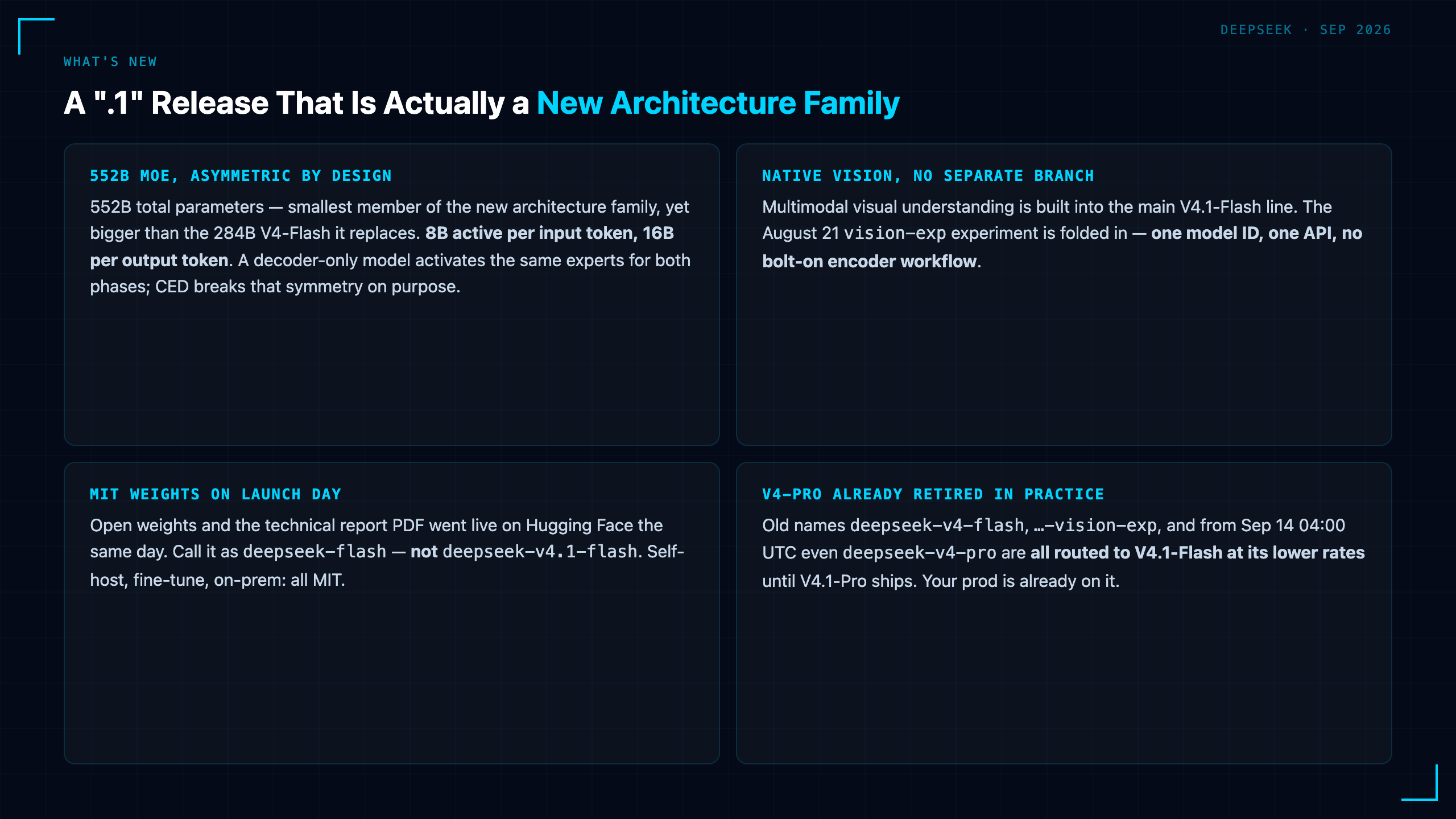
DeepSeek also released V4-Flash simultaneously (284B/13B active, $0.14/M input) — a speed-optimized companion model for high-volume pipelines.
What's New
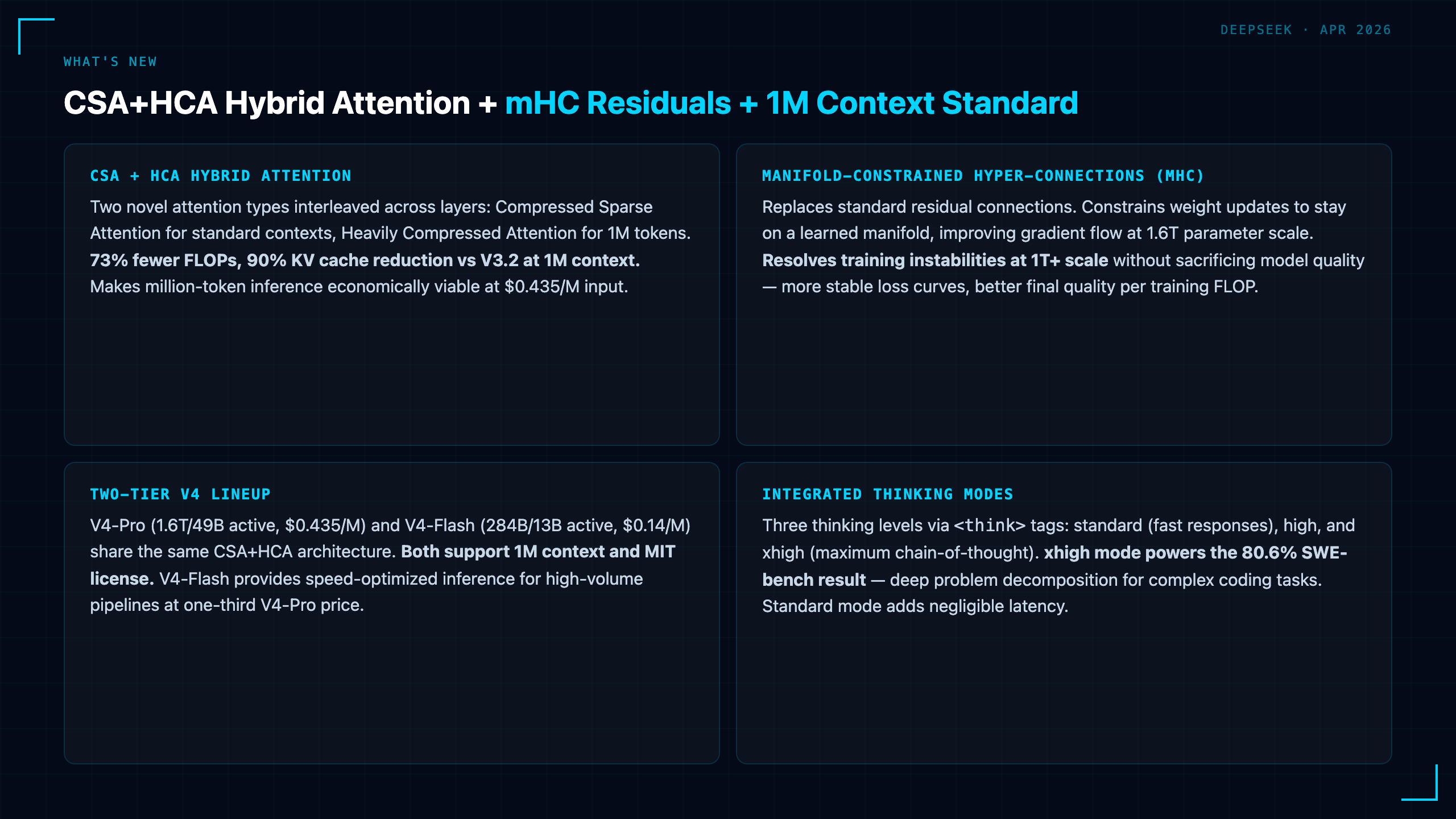
CSA + HCA hybrid attention: DeepSeek-V4-Pro uses two novel attention types interleaved across layers — Compressed Sparse Attention (CSA) for processing standard contexts efficiently, and Heavily Compressed Attention (HCA) for extending to 1M tokens. The combination cuts inference FLOPs by 73% and KV cache by 90% compared to V3.2 at 1M context. This is what makes 1M-token context economically viable at $0.435/M input pricing.
Manifold-Constrained Hyper-Connections (mHC): A replacement for standard residual connections that constrains weight updates to stay on a learned manifold, improving training stability at 1.6T parameter scale. Previous models at this scale encountered training instabilities from poorly conditioned residuals; mHC resolves this without sacrificing model quality.
Two-tier V4 lineup: V4-Pro (1.6T/49B active) and V4-Flash (284B/13B active) share the same hybrid attention architecture. V4-Flash provides faster, cheaper inference for tasks where full V4-Pro reasoning depth isn't required — both support 1M context and MIT license.
Integrated thinking modes: V4-Pro supports three thinking levels (standard, high, xhigh) via <think> tags. The xhigh mode maps to maximum chain-of-thought reasoning and is what powers the 80.6% SWE-bench result. Standard mode provides fast responses; xhigh activates deep problem decomposition for complex tasks.
Architecture
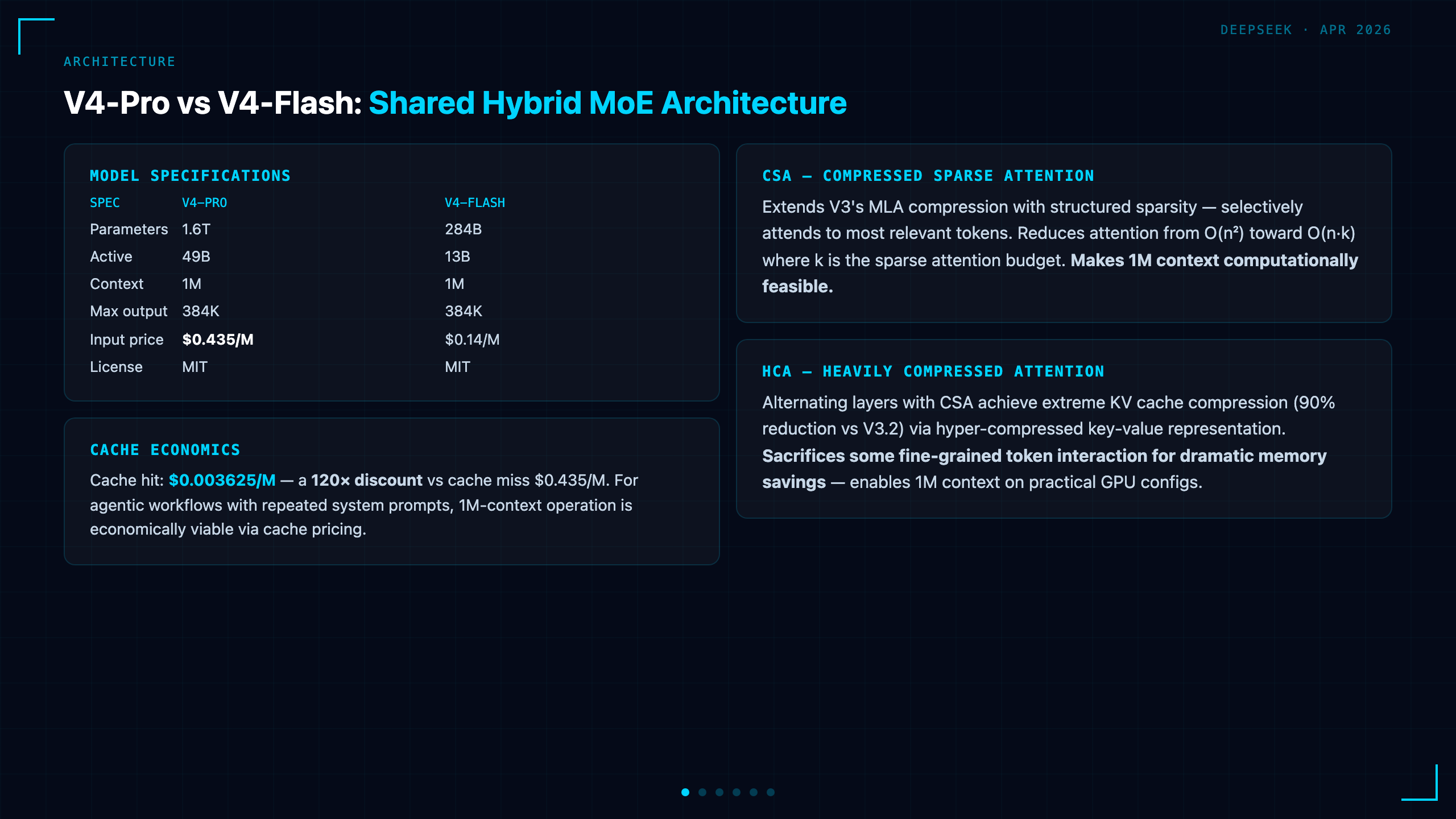
DeepSeek-V4-Pro specifications:
| Component | V4-Pro | V4-Flash |
|---|---|---|
| Total parameters | 1.6T | 284B |
| Active parameters | 49B | 13B |
| Architecture | Hybrid CSA+HCA MoE | Hybrid CSA+HCA MoE |
| Context window | 1M tokens | 1M tokens |
| Max output | 384K tokens | 384K tokens |
| Input price | $0.435/M | $0.14/M |
| Output price | $0.87/M | $0.28/M |
| License | MIT | MIT |
Compressed Sparse Attention (CSA): Extends the KV compression approach from V3's MLA (Multi-head Latent Attention) further. CSA uses structured sparsity to selectively attend to the most relevant tokens at each position, reducing attention computation from O(n²) toward O(n·k) where k is the sparse attention budget. At 1M context, this is the difference between feasible and infeasible inference.
Heavily Compressed Attention (HCA): Applied in alternating layers with CSA, HCA achieves extreme KV cache compression (90% reduction vs V3.2) by using a hyper-compressed key-value representation. Layers using HCA sacrifice some fine-grained token interaction for dramatic memory savings — enabling 1M context on practical GPU configurations.
mHC residual connections: Standard residual connections x + f(x) allow weights to drift far from initialization during training. mHC constrains this by projecting updates to a learned low-dimensional manifold, improving gradient flow at 1T+ scale. The result is more stable loss curves and better final model quality per training FLOP.
Cache economics: V4-Pro's cache hit pricing is $0.003625/M (vs $0.435/M cache miss) — a 120× discount for repeated context. For agentic workflows where system prompts and retrieved context are repeatedly processed, cache hit pricing makes long-context operation economically viable.
Benchmarks
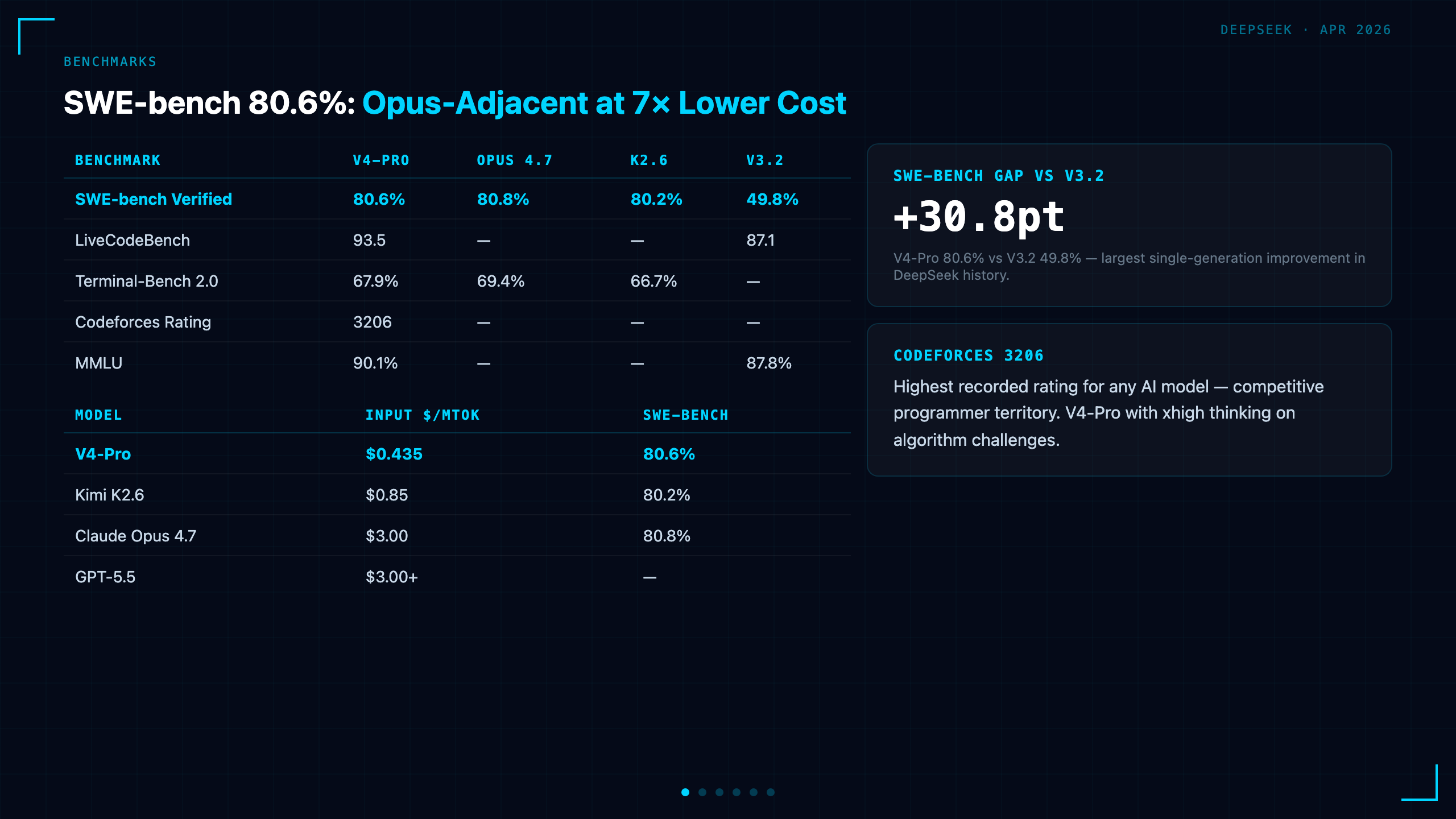
DeepSeek-V4-Pro at April 2026 release:
| Benchmark | V4-Pro | Claude Opus 4.7 | Kimi K2.6 | V3.2 | Notes |
|---|---|---|---|---|---|
| SWE-bench Verified | 80.6% | 87.6% | 80.2% | 49.8% | Code bug fixing |
| SWE-bench Pro | 55.4% | 64.3% | 58.6% | — | Harder coding eval |
| LiveCodeBench | 93.5 | — | — | 87.1 | Competitive coding |
| Terminal-Bench 2.0 | 67.9% | 69.4% | 66.7% | — | CLI task completion |
| MMLU | 90.1% | — | — | 87.8% | General knowledge |
| Codeforces Rating | 3206 | — | — | — | Highest of any model |
SWE-bench Verified 80.6% is the headline — within 0.2pt of Claude Opus 4.7 at 7× lower cost. V4-Pro's Codeforces rating of 3206 is the highest recorded for any AI model, placing it in competitive programmer territory on algorithm challenges.
The jump from V3.2 (49.8%) to V4-Pro (80.6%) on SWE-bench Verified (+30.8pt) is the architectural dividend from CSA+HCA and mHC combined with scale — the largest single-generation SWE-bench improvement in DeepSeek's history.
Pricing in Context
| Model | Input ($/MTok) | Output ($/MTok) | Context | SWE-bench |
|---|---|---|---|---|
| V4-Pro | $0.435 | $0.87 | 1M | 80.6% |
| V4-Flash | $0.14 | $0.28 | 1M | ~68% |
| Claude Opus 4.7 | $3.00 | $15.00 | 1M | 87.6% |
| GPT-5.5 | $3.00+ | $12.00+ | 1M | — |
| Kimi K2.6 | $0.85 | $2.55 | 256K | 80.2% |
V4-Pro delivers SWE-bench 80.6% at $0.435/M input. Claude Opus 4.7 delivers 87.6% at $3.00/M input — a 6.9pt quality gap at 6.9× higher price. For cost-sensitive applications where near-Opus quality is acceptable, V4-Pro is the rational default.
What It Means for Developers
1M context as standard: V4-Pro's 1M context window at $0.435/M makes full-repository code analysis economically viable. A 500K token codebase costs $0.22 to process once (cache miss). Repeated analysis hits cache at $0.0018. For code review, refactoring suggestion, and documentation generation across full repositories, the economics now work.
Agentic coding at Opus-adjacent quality: SWE-bench 80.6% with full tool use support means V4-Pro can handle autonomous coding workflows — issue triage, PR review, code generation, test writing — at quality that was GPT-4-class 18 months ago, at API costs that enable high-volume automation.
V4-Flash for high-throughput pipelines: V4-Flash at $0.14/M input provides a Sonnet-class model for high-volume, latency-sensitive tasks. The same 1M context and MIT license at one-third the V4-Pro price supports document processing pipelines, RAG, and classification at scale.
MIT license for full deployment flexibility: Both V4 models are MIT licensed — commercial use, fine-tuning, redistribution, on-premises deployment. For enterprises requiring data residency or custom deployment, the MIT license enables self-hosting without legal complexity.
Backward compatibility: V4-Pro uses the same OpenAI-compatible API format as V3. model="deepseek-v4-pro" is a configuration change — no code migration required for applications built on V3 or V3.2.
Availability
- API: DeepSeek Platform —
deepseek-v4-proanddeepseek-v4-flash - HuggingFace: deepseek-ai/DeepSeek-V4-Pro
- License: MIT
- Pricing: $0.435/M input (V4-Pro), $0.14/M input (V4-Flash)
Bottom Line
DeepSeek-V4-Pro is the first model to bring 1M context, 1.6T MoE scale, and SWE-bench 80.6% to MIT-licensed open weights at $0.435/M. The CSA+HCA hybrid attention architecture solved the engineering problem that made 1M context impractical at previous scales — 73% fewer FLOPs and 90% KV cache reduction. For developers building autonomous coding agents or long-context document workflows, V4-Pro changed the cost calculus: Opus-adjacent capability at 7× lower price, with full deployment flexibility under MIT.
Resources
- HuggingFace — DeepSeek-V4-Pro
- DeepSeek API Docs — V4 API reference
- DeepSeek Platform — API access
- Technical Report — architecture details
DeepSeek-V4-Pro and V4-Flash are available via the DeepSeek API and on HuggingFace under MIT license.