Inside China's AI
First-hand analysis of DeepSeek, Kimi, MiniMax, ByteDance, and more — written for developers and builders worldwide.
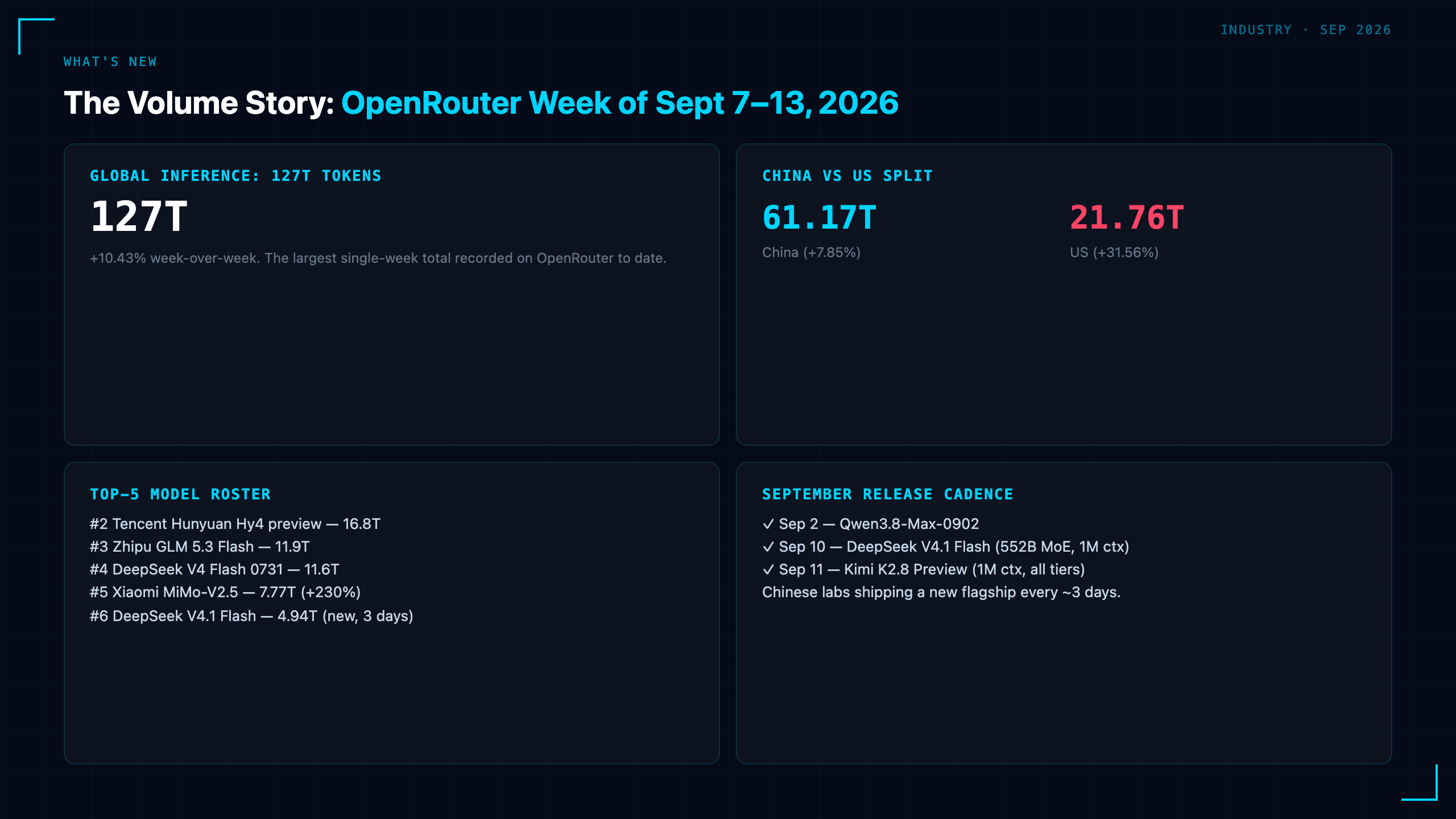
OpenRouter data for the week of Sept 7–13 shows China processing 61.17 trillion tokens against the US's 21.76 trillion — 20 consecutive weeks of Chinese dominance in API call volume. Seven of the top 10 models are Chinese. But on Artificial Analysis Intelligence Index v4.3, the top five are still Western: Claude Fable 5.1 and GPT-6 Astra tied at 53, with GLM-5.3 at 45 in 18th. China wins on volume and price; the hardest reasoning tasks still carry a double-digit gap.
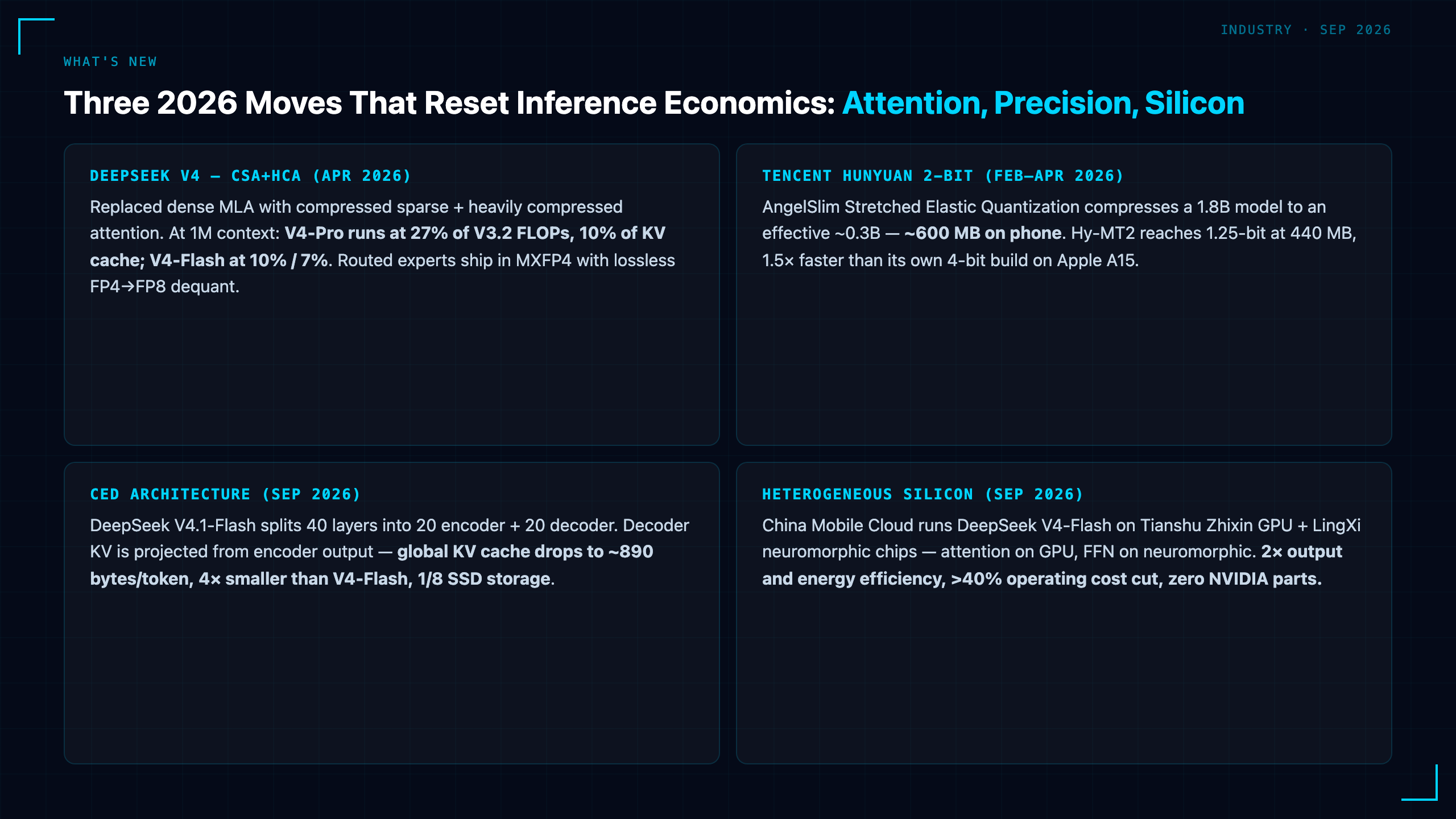
Chinese frontier models are 10–20× cheaper to run than their Western peers. The gap is not one trick but a stack: CSA+HCA hybrid attention collapsing KV cache by 90%, lossless MXFP4 quant, ultra-sparse MoE, and now GPU-plus-neuromorphic heterogenous silicon validated on DeepSeek V4 Flash. Here is the full technical map.
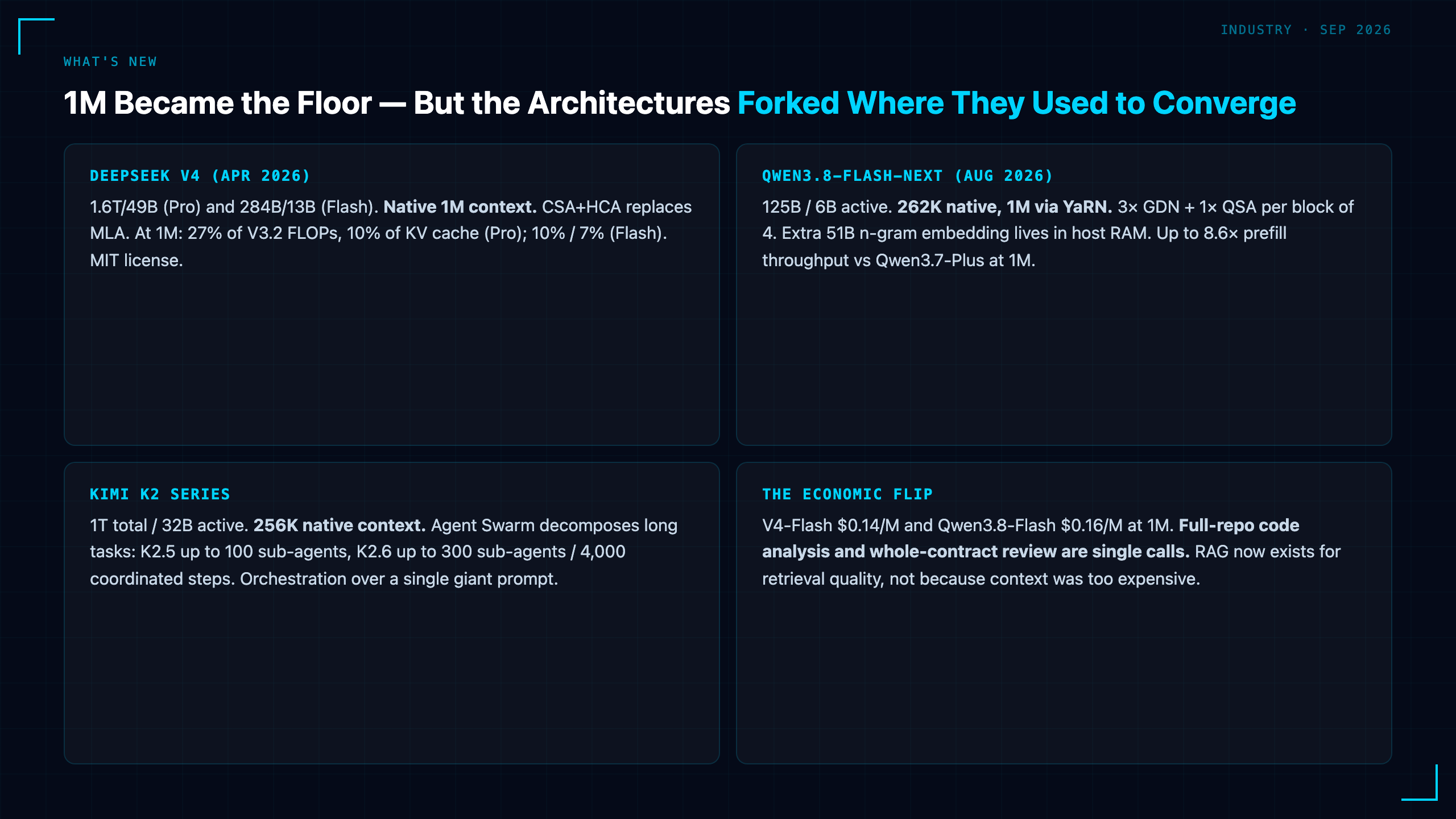
One million-token context stopped being a spec sheet flex in 2026 and became the Chinese baseline. But DeepSeek, Qwen, and Kimi got there three different ways — CSA+HCA compression, YaRN scaling with host-memory n-gram tables, and agent-swarm context orchestration. Here is how the three routes differ in KV cache, throughput, recall, and what each means for your RAG and codebases.
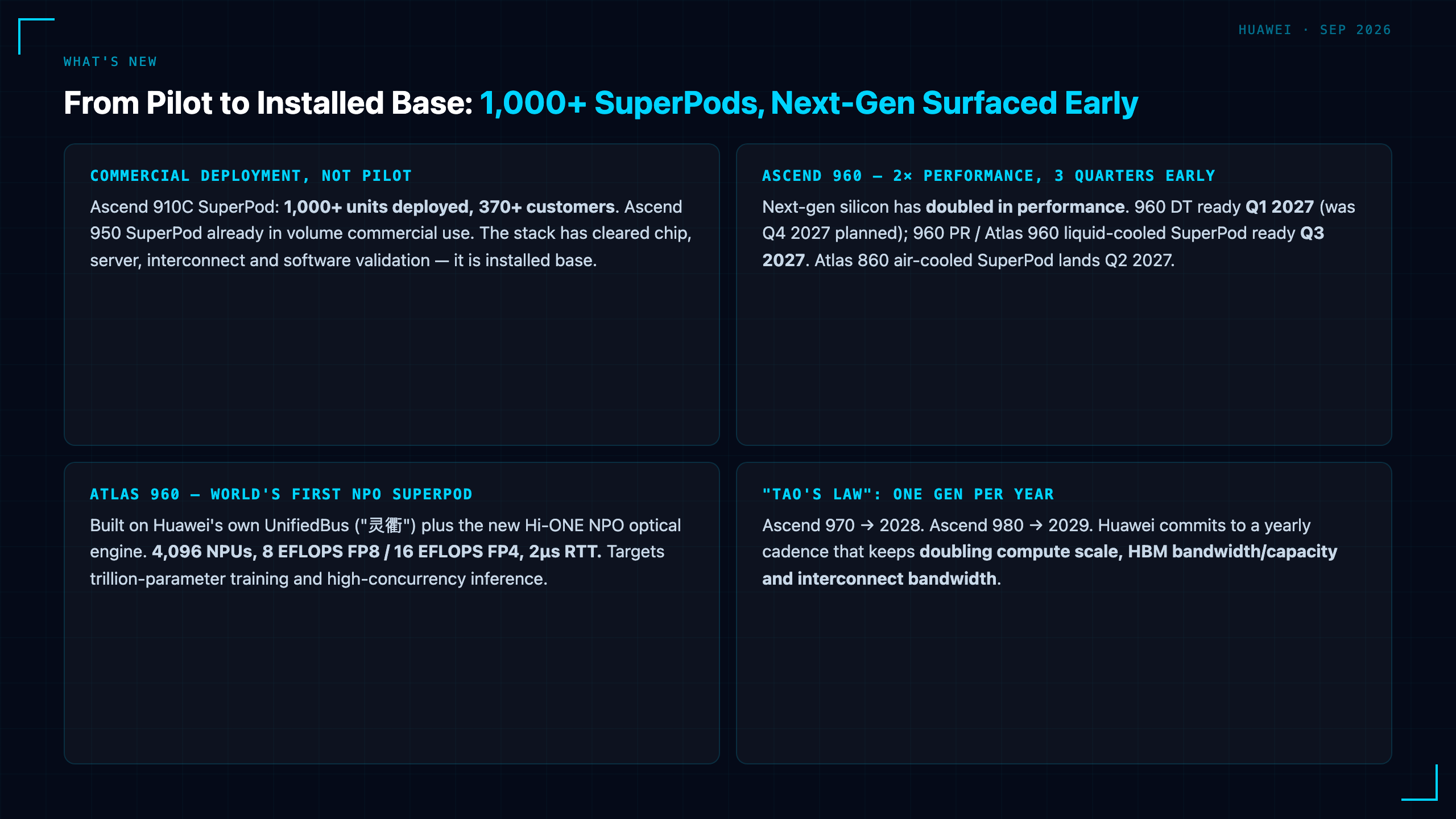
On September 17, 2026, Huawei opened HC2026 in Shanghai announcing 1,000+ Ascend SuperPods deployed across 370+ customers — crossing from engineering validation into commercial deployment. Next-gen Ascend 960 surfaced three quarters early, paired with the industry's first NPO SuperPod (Atlas 960). Target: trillion-parameter model training and high-concurrency inference.
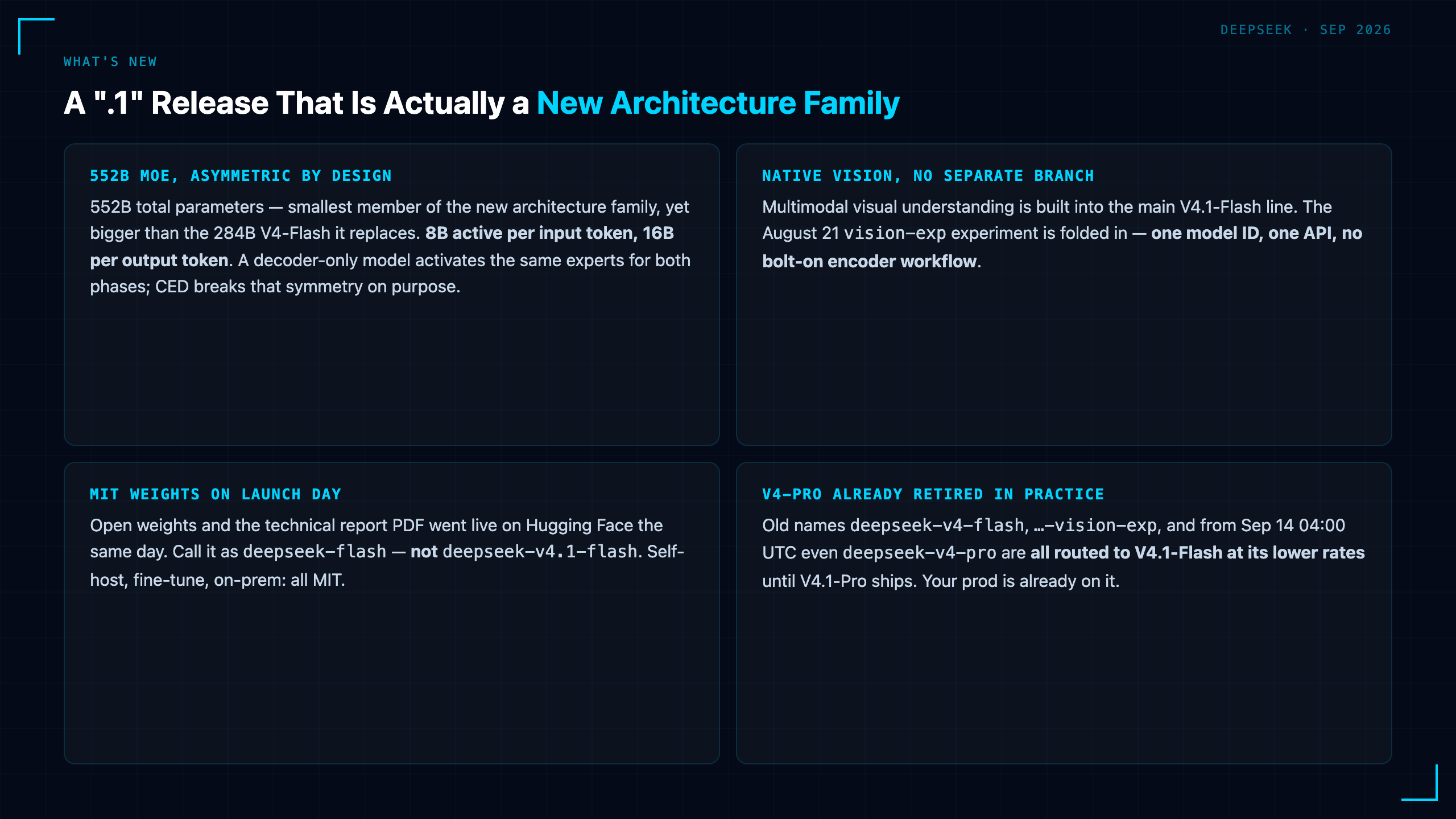
DeepSeek shipped V4.1-Flash on September 10, 2026 — a 552B MoE built on an all-new Causal Encoder-Decoder (CED) architecture that activates only 8B parameters on input and 16B on output. Native vision, MIT-licensed weights, peak/off-peak pricing, and an 8× smaller persistent KV cache. Within four days, DeepSeek routed the old V4-Pro model name to it.
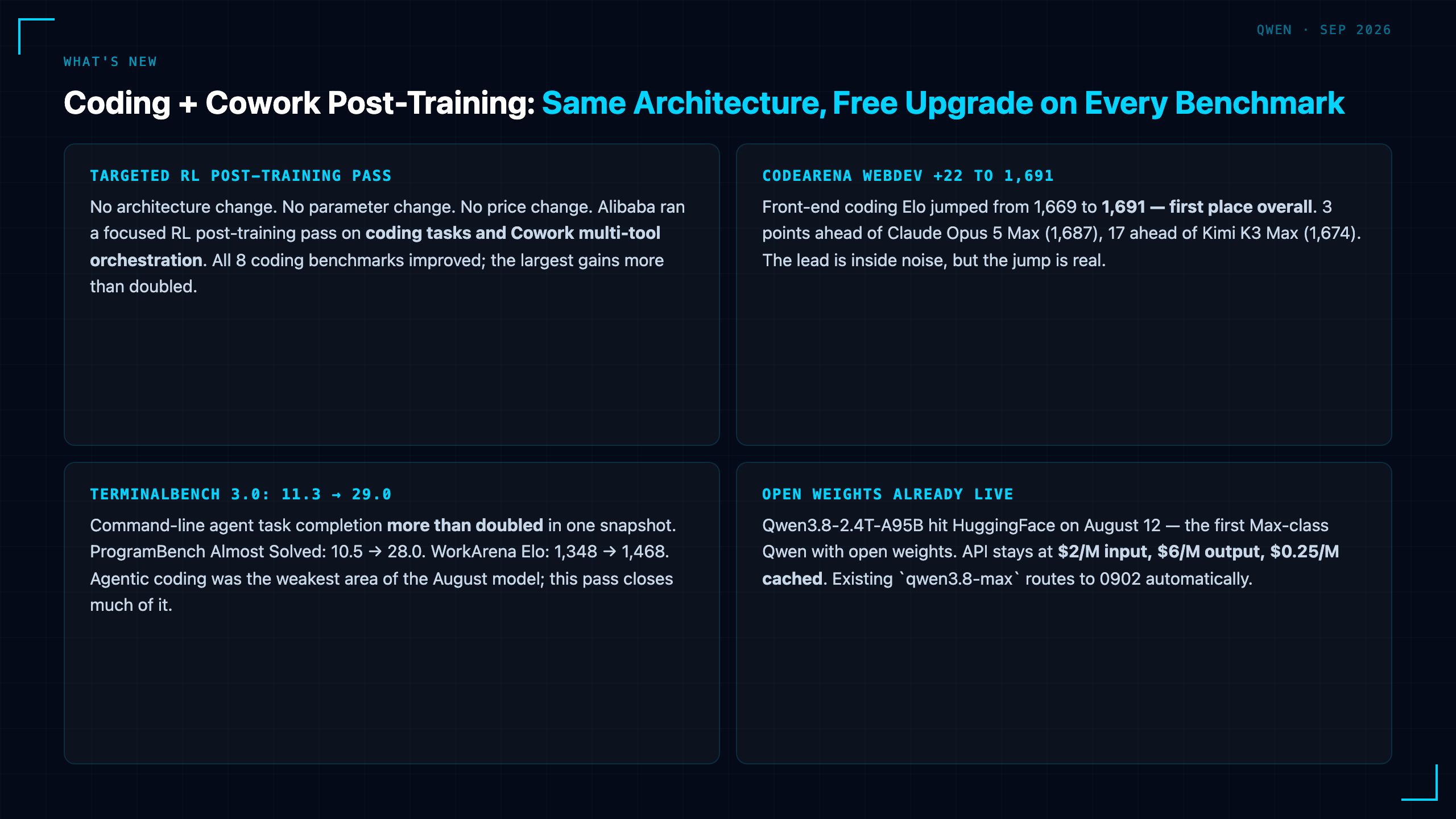
On September 2, Alibaba pushed Qwen3.8-Max to the 0902 snapshot — a post-training pass focused on coding and Cowork agent work. CodeArena WebDev Elo jumped 22 points to 1,691, taking first place ahead of Claude Opus 5 Max (1,687) and Kimi K3 Max (1,674). TerminalBench 3.0 more than doubled from 11.3 to 29.0. Same 2.4T/95B MoE, same 1M context, same $2/$6 pricing. Open text weights already on HuggingFace.
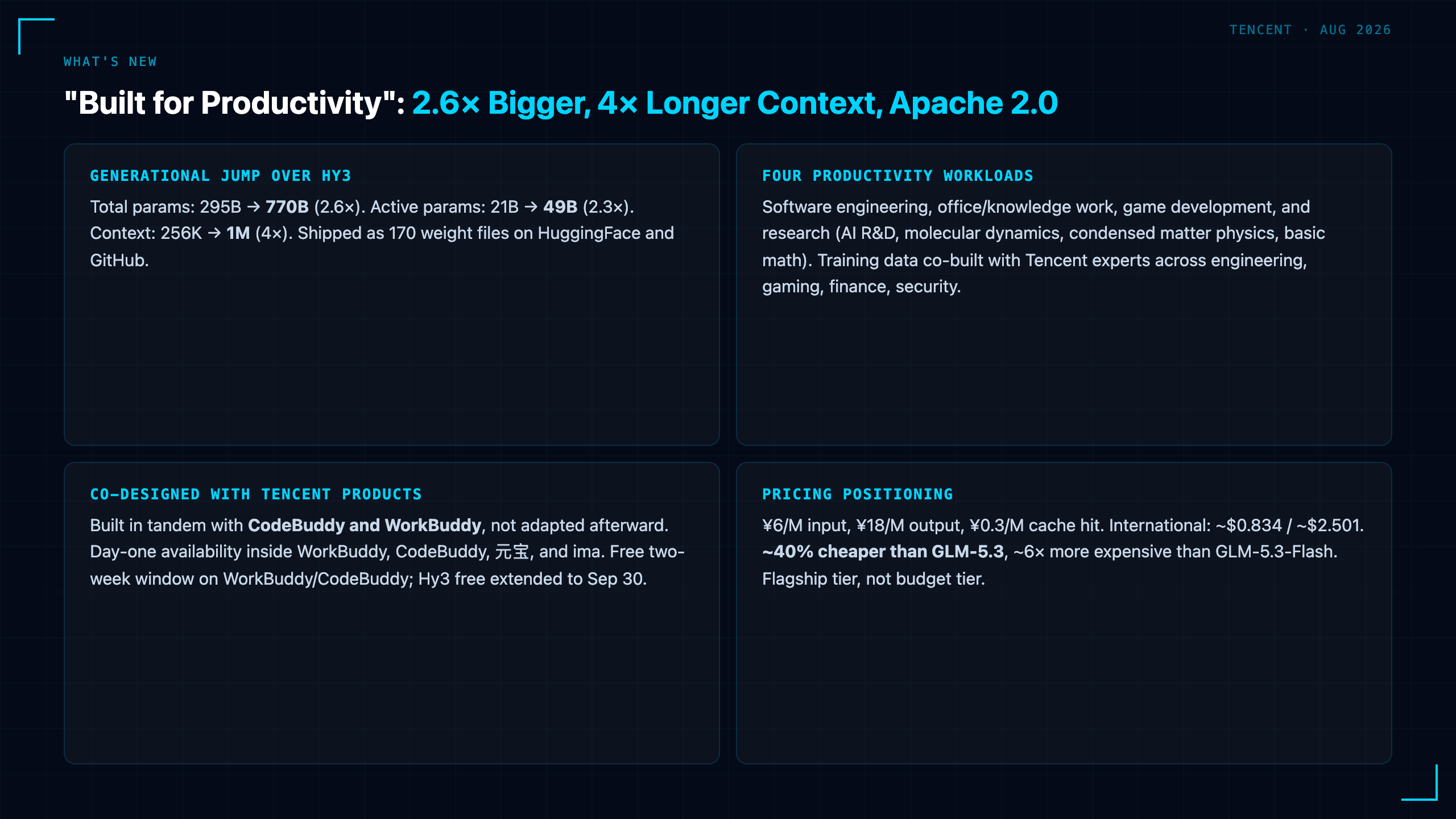
On August 28, Tencent released and open-sourced Hunyuan Hy4 preview: a 770B-total, 49B-active MoE with a 1M-token context window, under a real Apache 2.0 license. No benchmark table in the press release — Tencent led with a 163-expert blind test showing Hy4 preview at 2.99/4, edging GLM-5.3 (2.92) and Kimi K3 (2.94). The only hard third-party number is SWE-bench Pro 65.7%, rank 7 overall and #2 among open weights. Pricing is ¥6/M input and ¥18/M output, roughly 40% cheaper than GLM-5.3. Tencent also stated the model 'participated in its own development,' claiming a 31.8% throughput gain from self-optimized inference tuning.
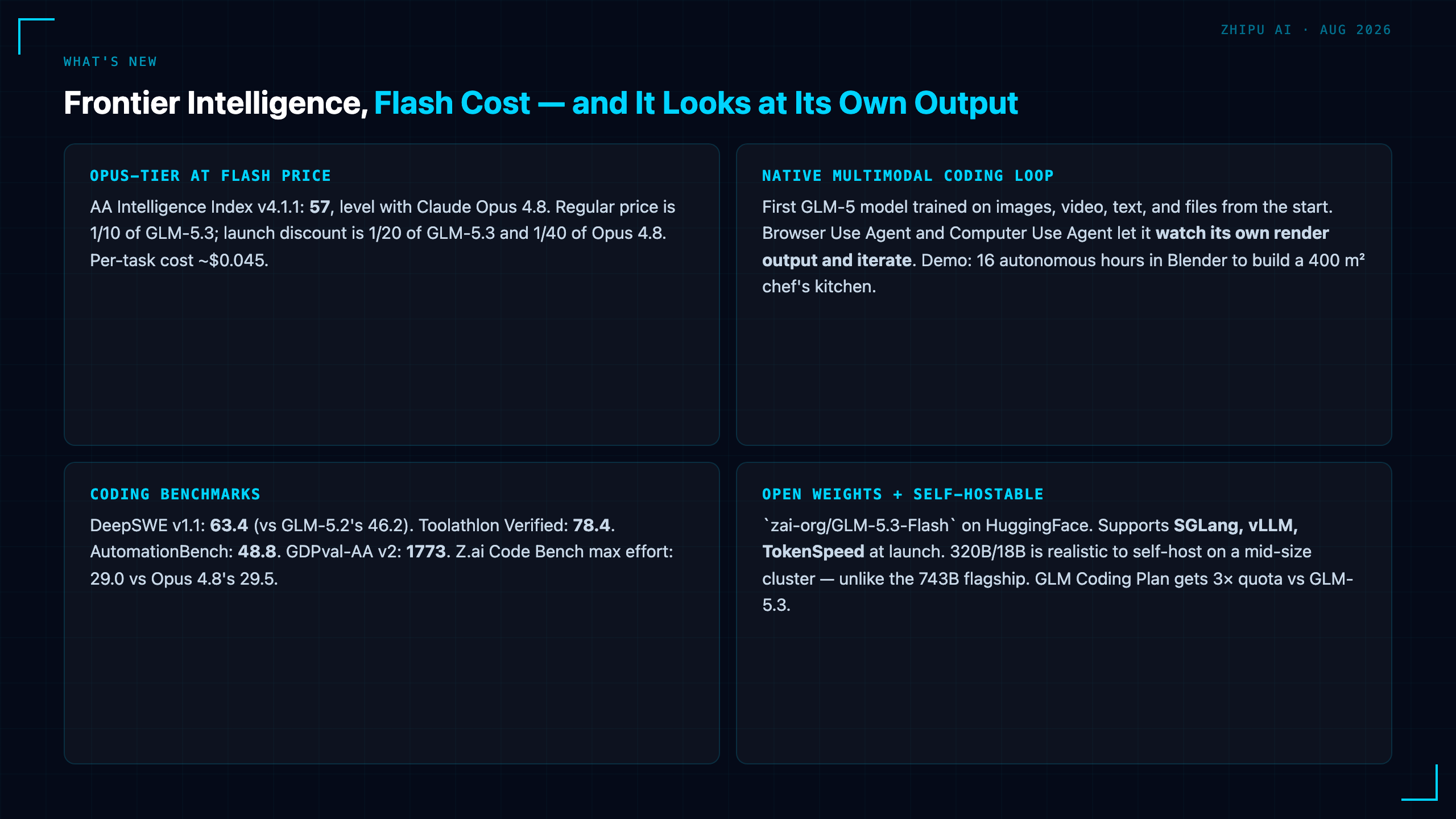
On August 26, Zhipu AI released and open-sourced GLM-5.3-Flash (320B-A18B) — the first native multimodal model in the GLM-5 series. Two weeks earlier, a mystery model called 'ox-alpha' (dubbed '牛来' by the Chinese community) had quietly topped the OpenRouter and OpenCode leaderboards under an anonymous identity. Zhipu confirmed ox-alpha was GLM-5.3-Flash. It scores 57 on the Artificial Analysis Intelligence Index — tied with Claude Opus 4.8 — at roughly $0.045 per task during launch discount, or 1/40 of Opus 4.8's price. First open frontier model to mix sparse + linear attention, with 1M context and weights on HuggingFace.
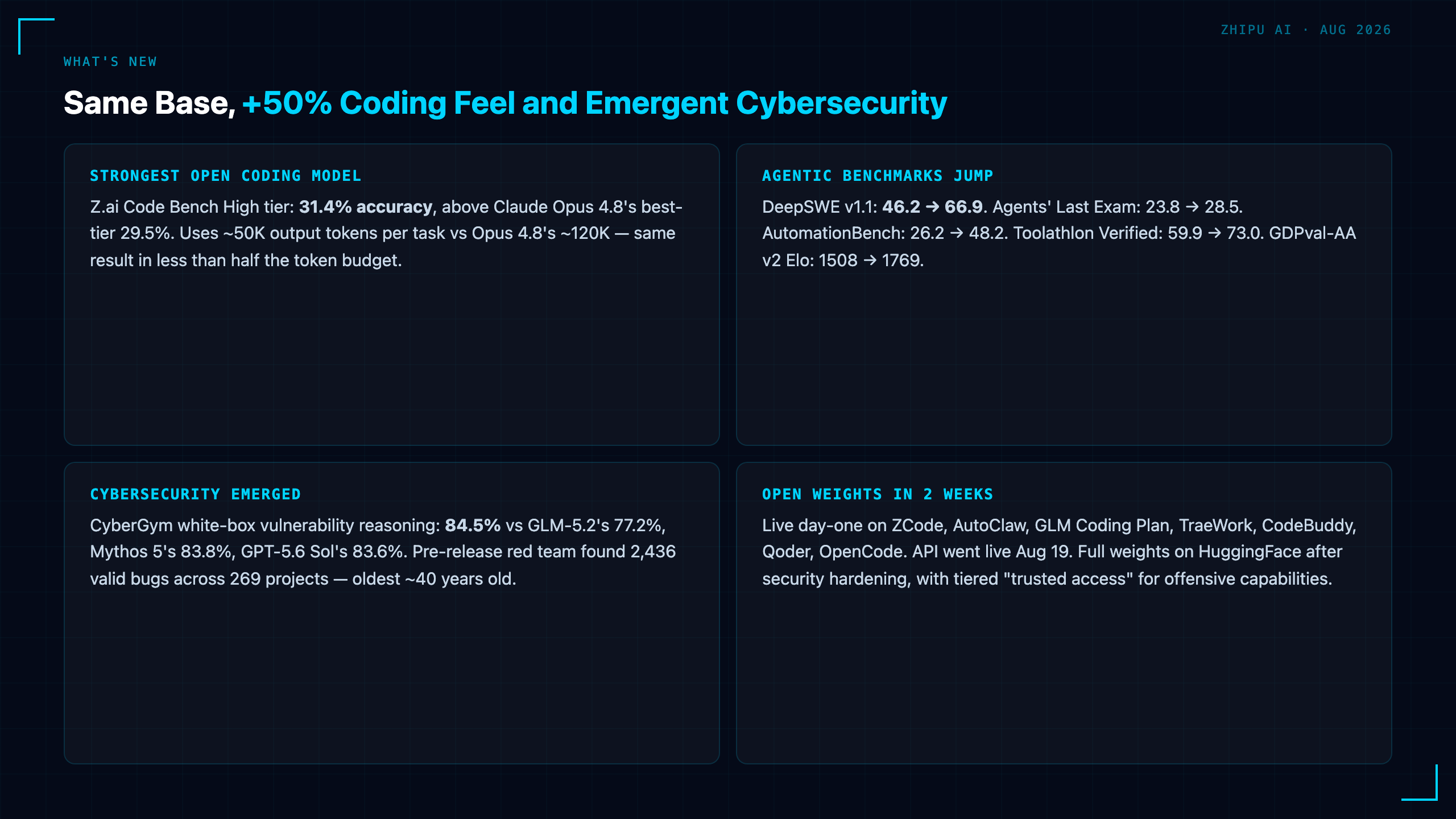
On August 14, Zhipu AI released GLM-5.3 — a 743-billion-parameter flagship that shares an identical pretrained base with GLM-5.2. Every capability gain comes from post-training scaling alone: Terminal-Bench 3.0 jumped from 4.6 to 28.3, DeepSWE v1.1 from 46.2 to 66.9, and CyberGym vulnerability reasoning hit 84.5%, edging out Mythos 5 and GPT-5.6 Sol. Weights open-sourced two weeks later. It is the clearest public test yet of the thesis that you can keep scaling a frozen base model's intelligence ceiling through RL, data quality, and long-horizon environments alone.
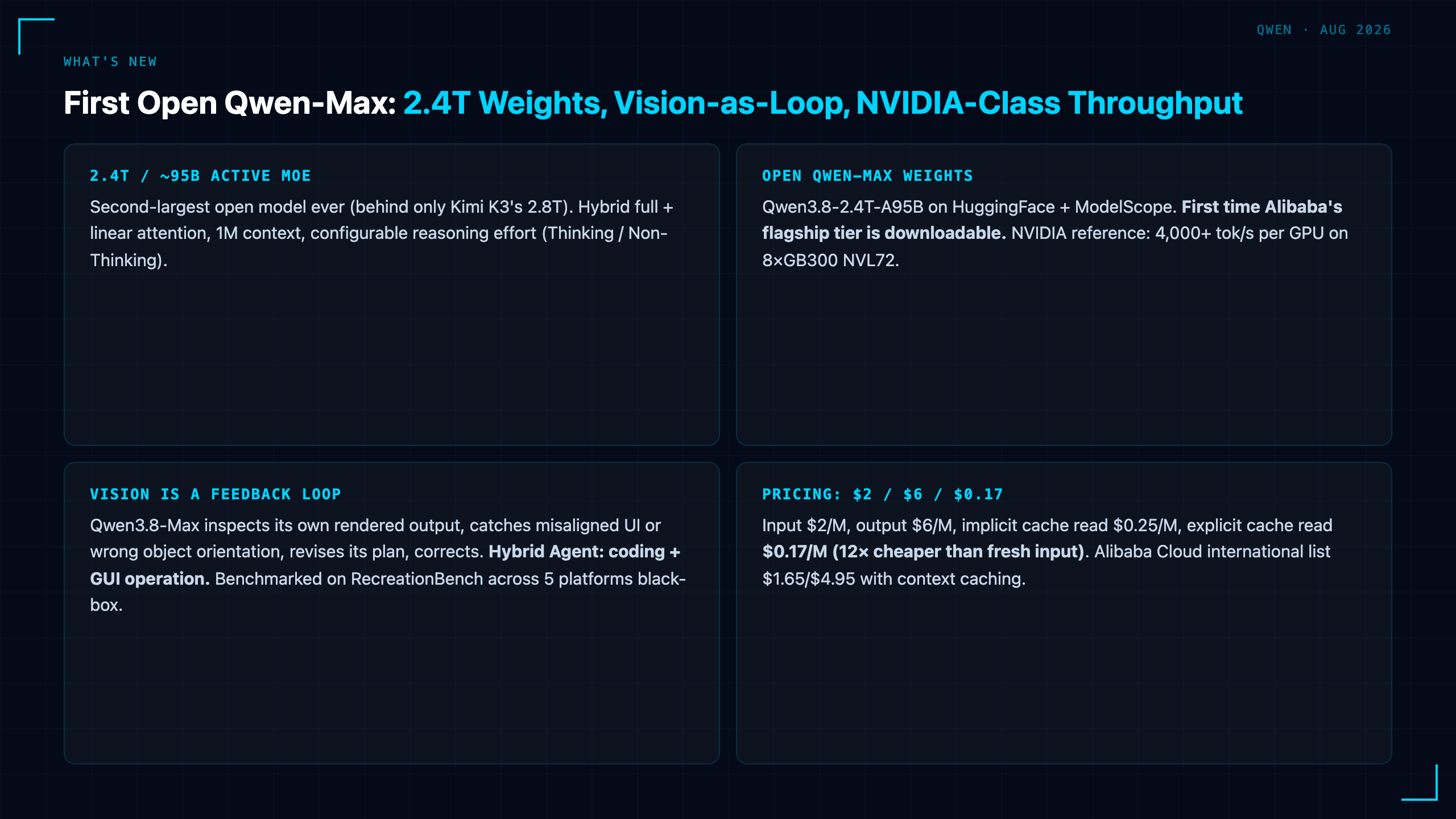
Alibaba released Qwen3.8-Max on August 3, 2026, after a July 19 preview — a 2.4T MoE with ~95B active parameters, 1M context, native text/image/video understanding, and the first open-weight release of a Qwen-Max-class model. It ranks 5th on Text Arena and 2nd on Vision Arena, posts 93.0 on PaperBench (beating Fable 5 and GPT-5.6 Sol), and prices at $2/$6 per million tokens with $0.17 cache read. NVIDIA has it serving at 4,000+ tok/s per GPU on GB300 NVL72.
WAIC 2026 opened in Shanghai on July 17 under the theme Intelligent Partners, Co-Creating the Future — the ninth edition, 100,000+ sqm of exhibition, 1,100+ exhibitors. The message from the floor was consistent: the parameter race is over, and the question is whether agents actually deliver work. Alibaba launched Agent-Native Cloud, Tencent open-sourced three embodied-intelligence foundation models, Baidu's DuMate and StepFun's STEPX Neo took the Hall Treasures spots, and Kimi K3's launch the night before was the story no one could top.
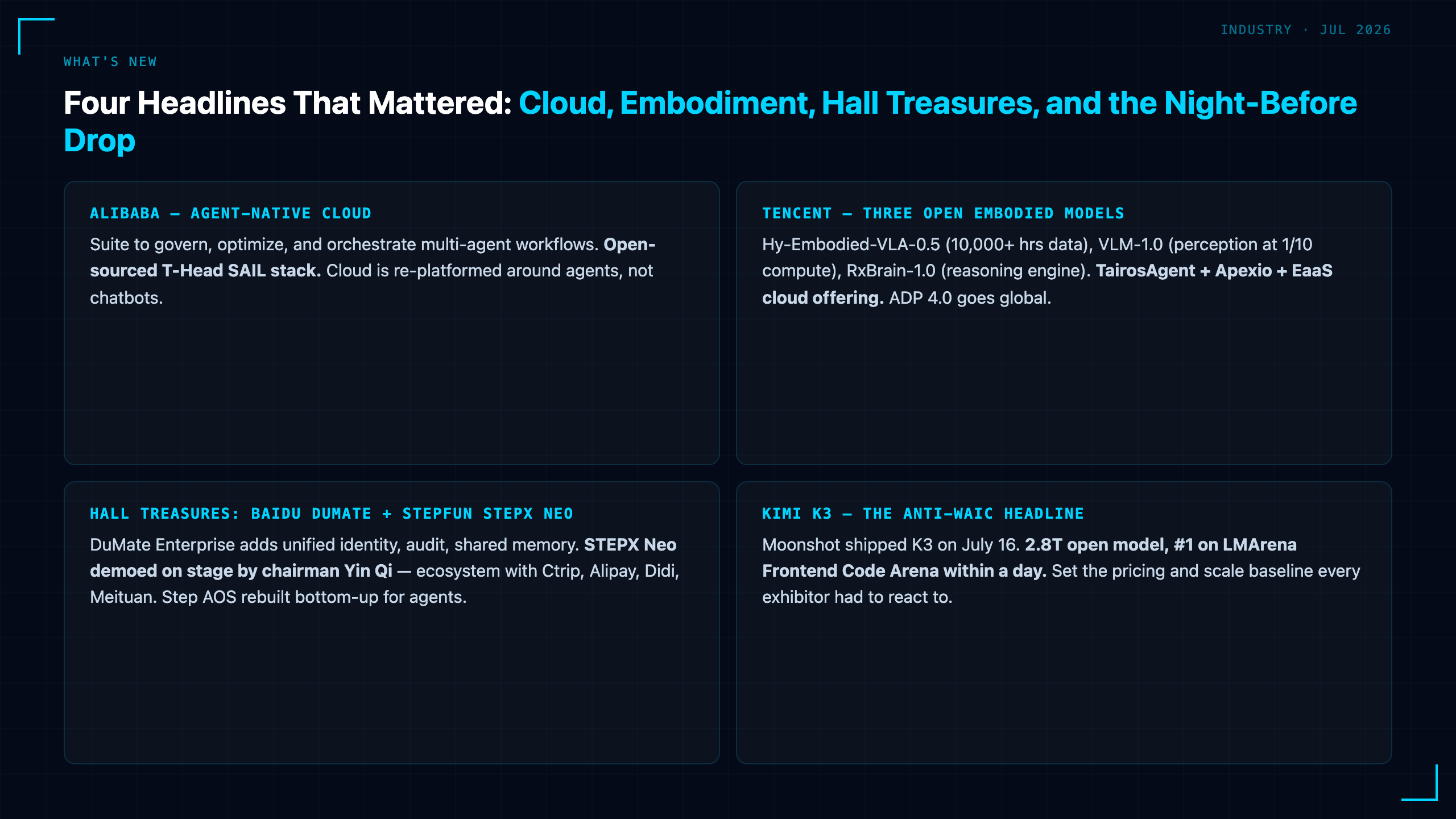
Moonshot AI shipped Kimi K3 on July 16, 2026 and opened the full 2.8T weights on July 27 — the largest open model ever released. 104B active MoE, native vision, 1M context, priced at $0.30/$3/$15 per million tokens. It tops the open-weight field on the Artificial Analysis Index and takes #1 on LMArena's Frontend Code Arena, while sitting a few points behind Claude Fable 5 and GPT-5.6 Sol on broad agentic work.
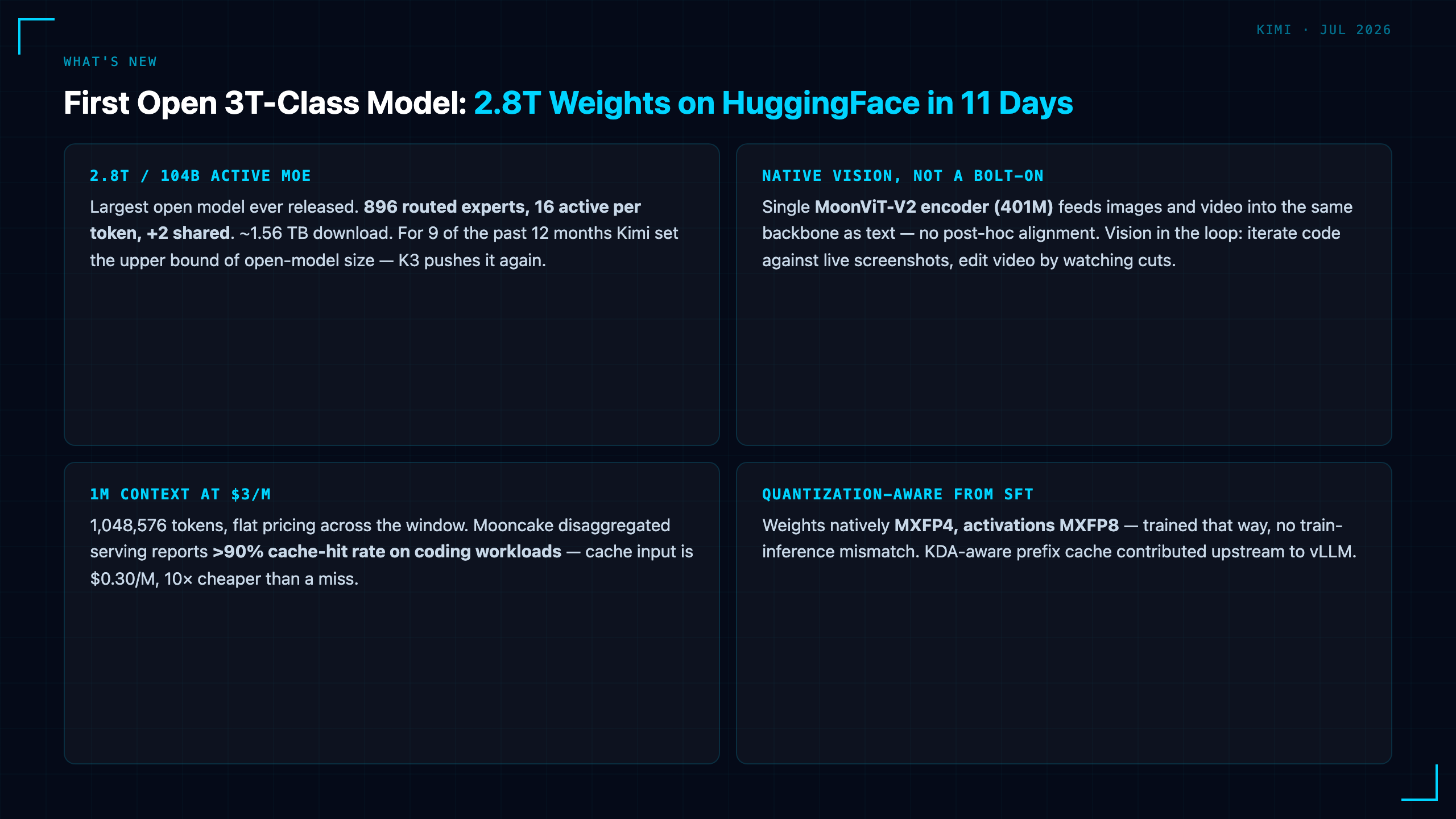
Meituan released LongCat-2.0 on June 30, 2026 — the first trillion-parameter LLM trained and inferred end-to-end on a domestic Chinese compute cluster, with zero NVIDIA hardware. 1.6T MoE, ~48B activated (33B–56B dynamic), 1M native context, ~50,000 domestic cards at peak. It inherited LongCat-Flash's zero-computation-expert design, pushed MoE sparsity to ~97%, and ranked #2 globally on OpenRouter's Claude Code traffic as the anonymous 'Owl Alpha' before reveal.
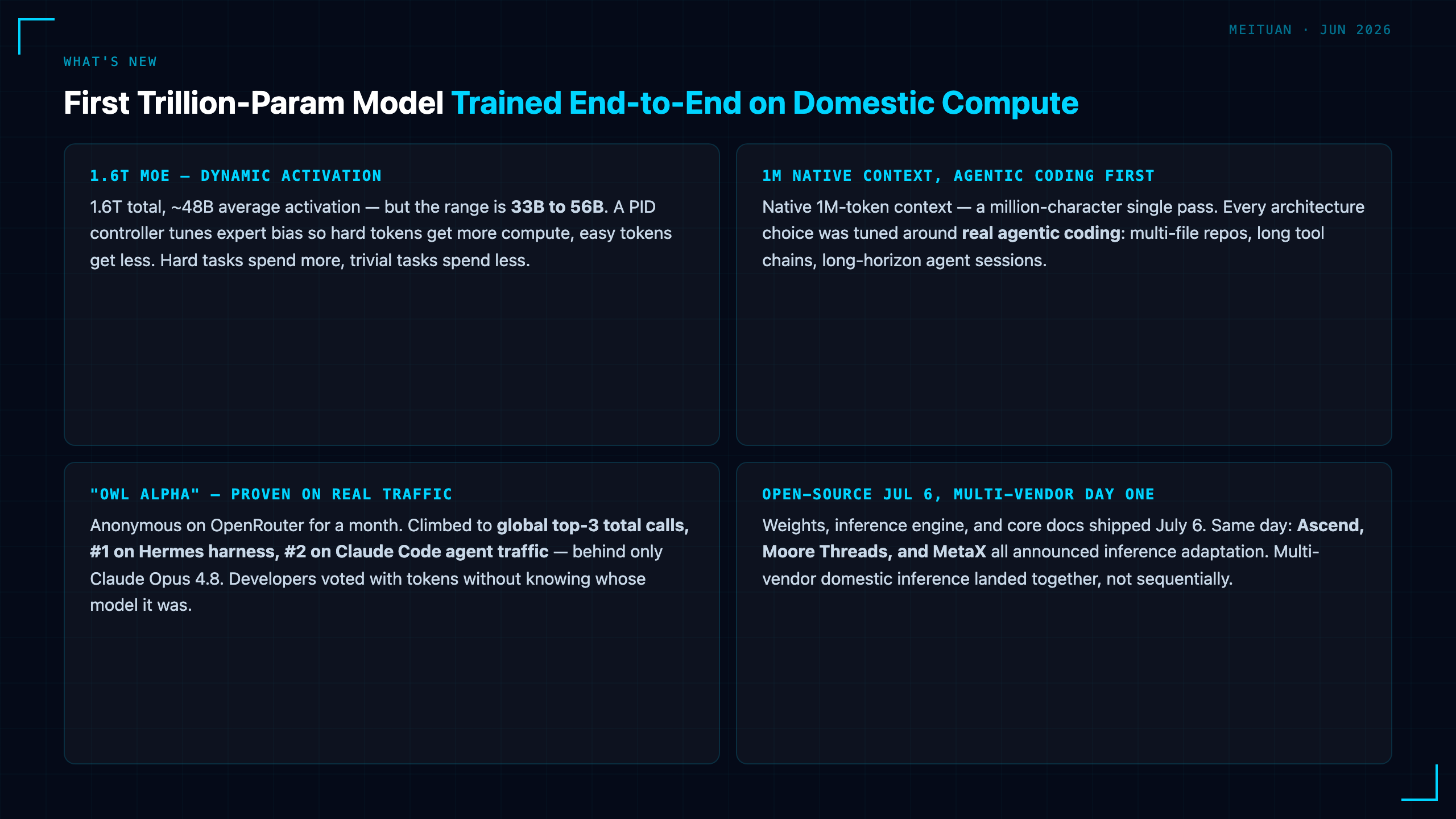
Huawei announced openPangu 2.0 at HDC 2026 on June 12 — Pangu's first-ever open-source release. Two MoE variants: Pro at 505B total / 18B active, Flash at 92B total / 6B active, both with 512K context, both trained and inferred end-to-end on Ascend NPUs. It's the key missing piece for the Ascend software ecosystem and the native AI backbone for HarmonyOS, under a permissive Huawei openPangu license.
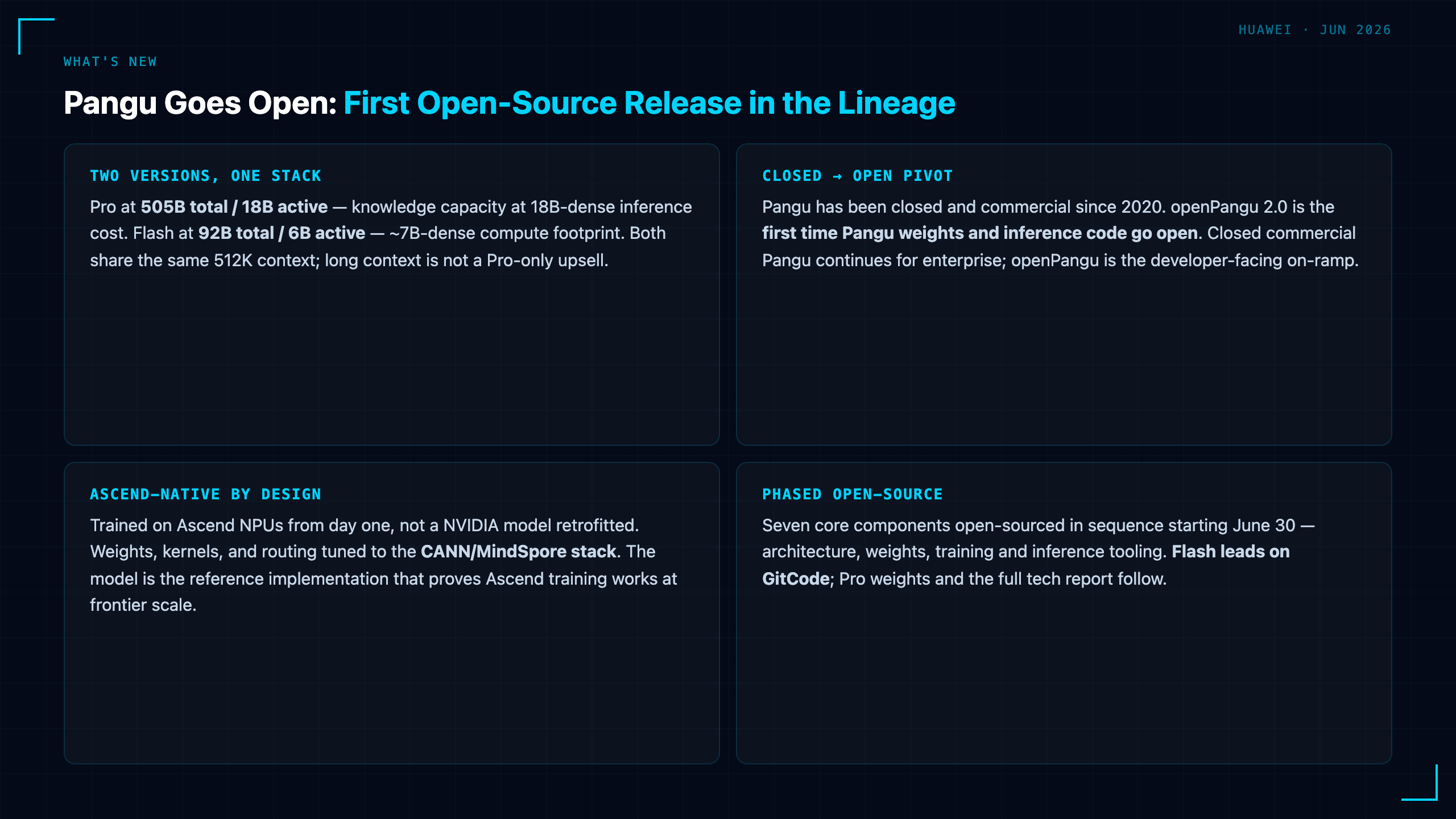
Moonshot AI released Kimi K2.7 Code on June 12, 2026 — an open-source, coding-first agentic model built on the same 1T/32B MoE base as K2.7, but post-trained specifically for long-horizon coding. 262K context, always-on thinking, ~30% fewer reasoning tokens than K2.6. Benchmarks: Kimi Code Bench v2 +21.8% over K2.6, MCP Mark Verified 81.1 beats Claude Opus 4.8. API from ¥6.50/M input, ¥27.00/M output.
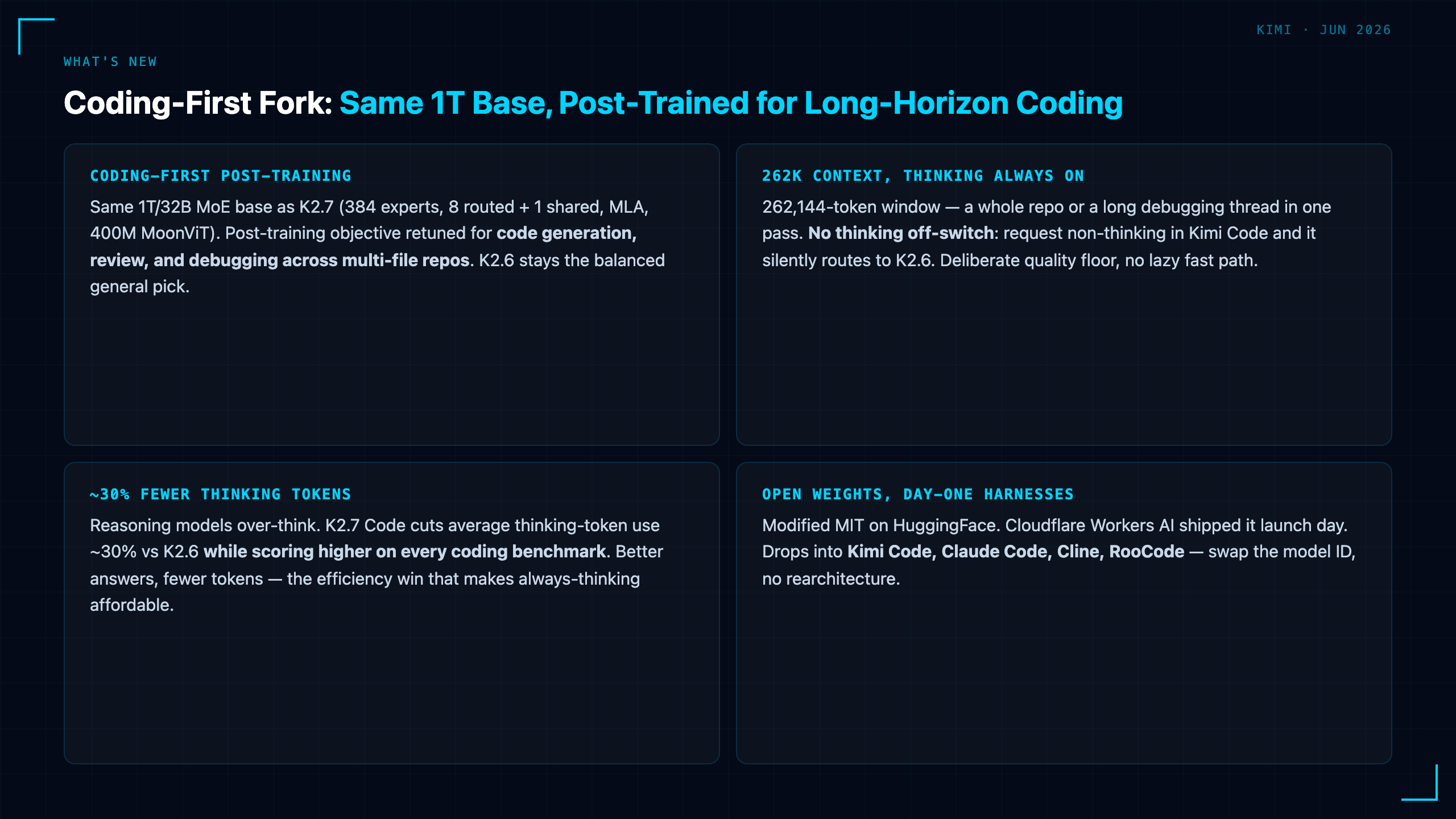
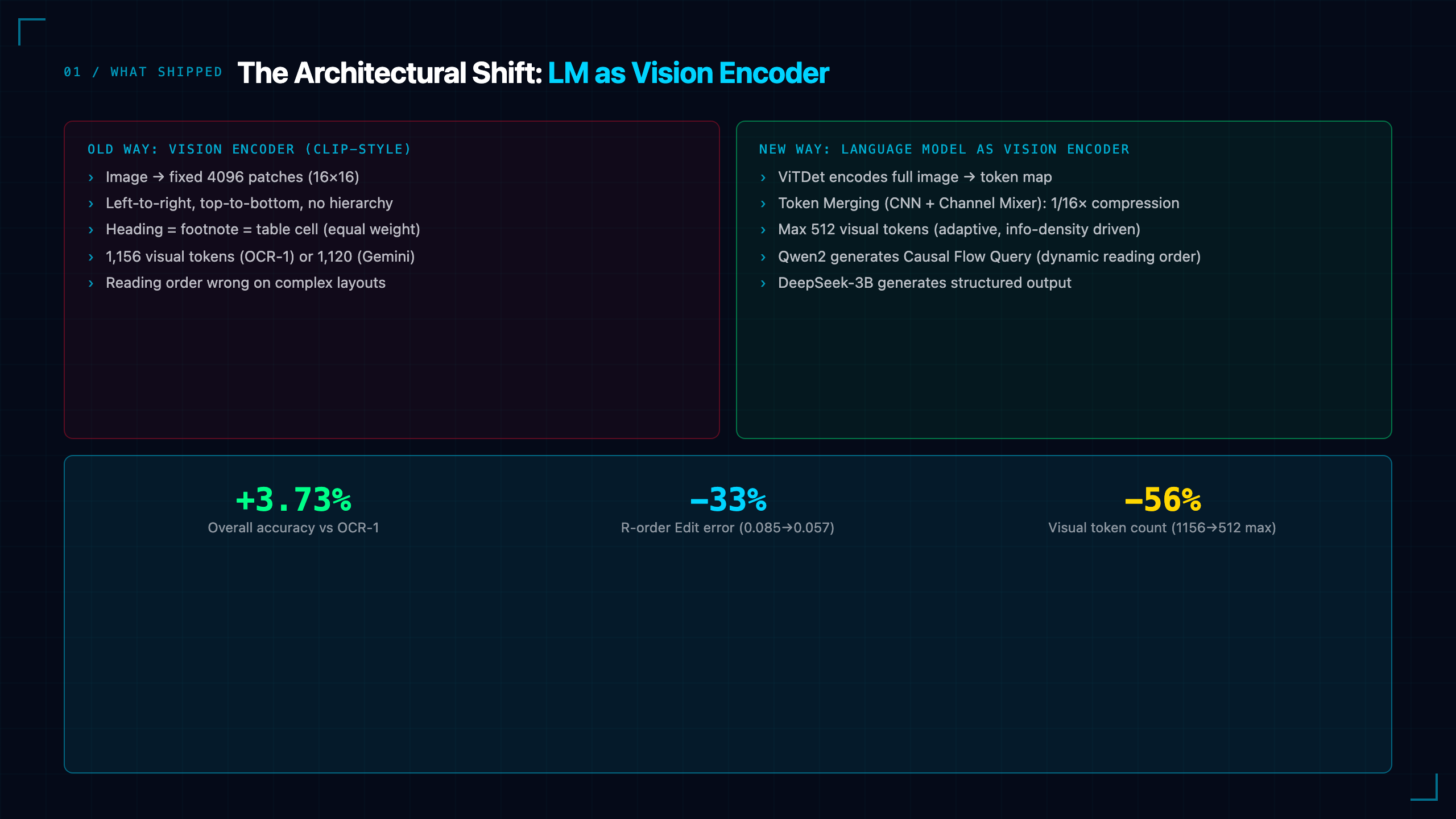
DeepSeek OCR-2 replaces the vision encoder with a language model — the 'LM as Vision Encoder' design — and introduces Causal Flow Query for dynamic reading order. Result: SOTA on OmniDocBench v1.5 using max 512 visual tokens (vs 1120+ for competitors), +3.73% overall accuracy over OCR-1, and 33% reduction in reading-order error. MIT license, models on HuggingFace.
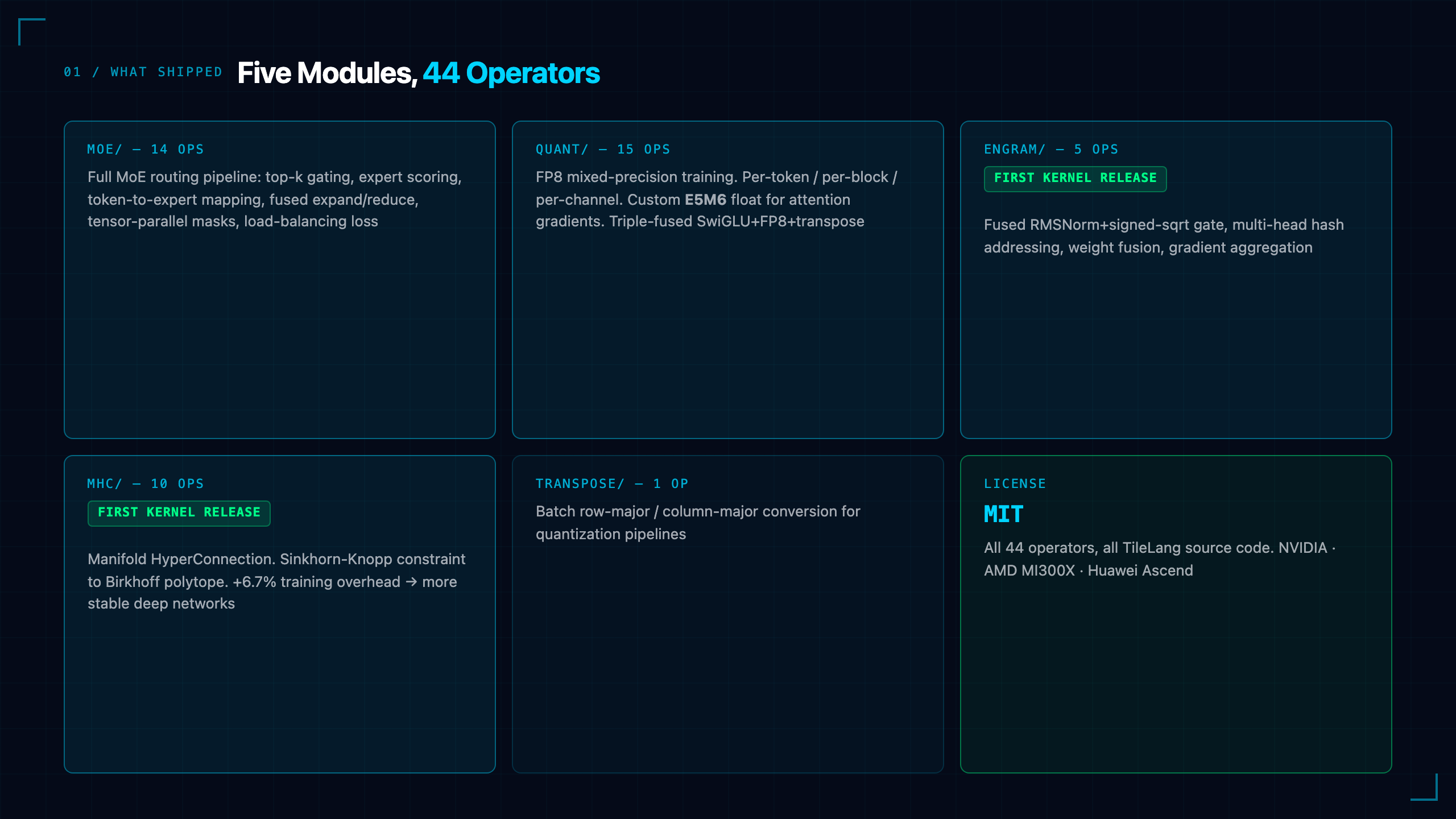
DeepSeek just open-sourced TileKernels — 44 production-grade GPU operators covering MoE routing, FP8 quantization, Engram conditional memory, and Manifold HyperConnection, all written in TileLang with MIT license. This is the first public kernel-level implementation of Engram and mHC. DeepEP v2 also dropped: 1.3x peak perf, 4x SM savings.
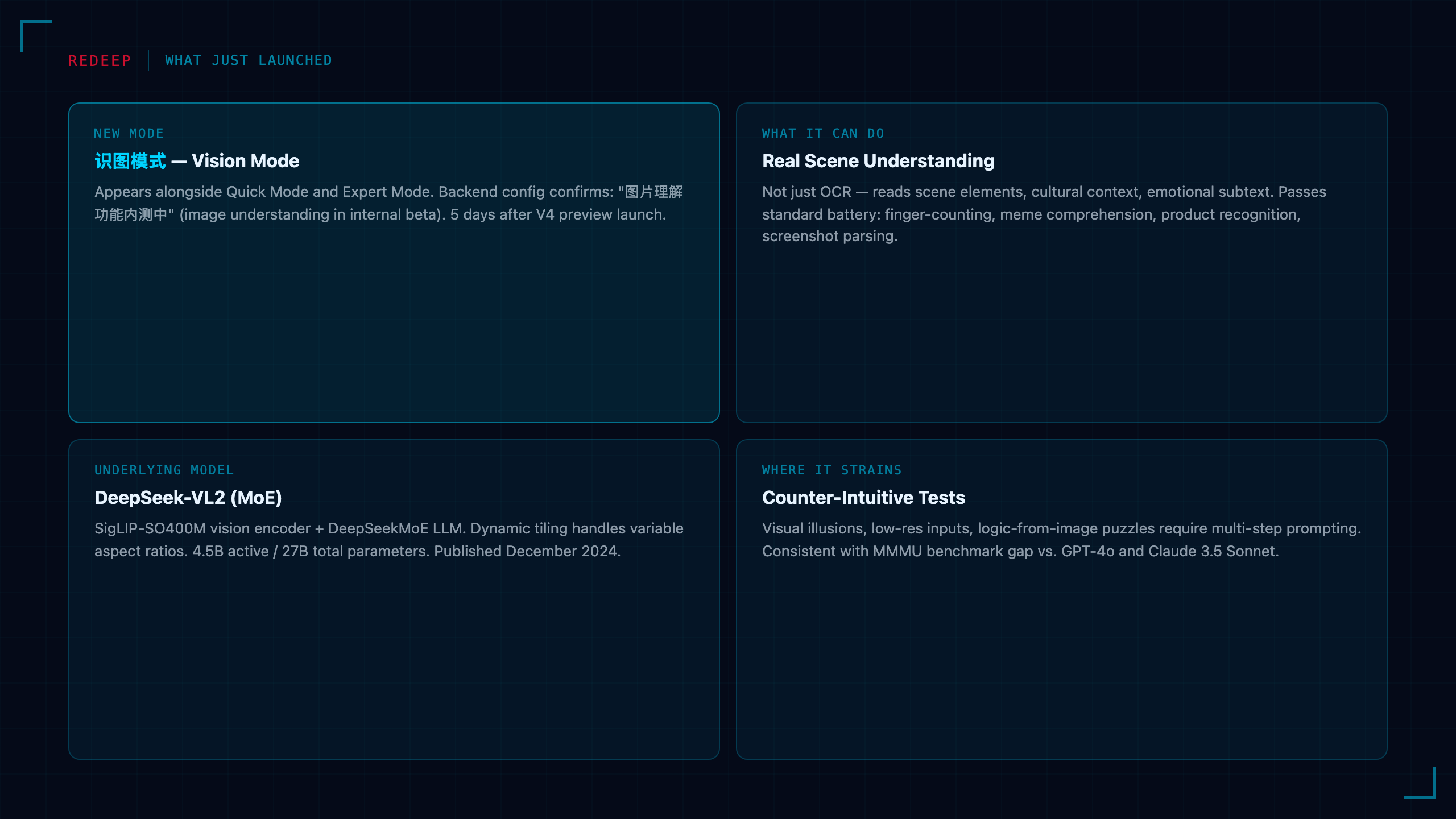
DeepSeek's '识图模式' (vision mode) began grayscale rollout five days after the V4 preview launch, marking the first time image understanding has appeared in the main product. The benchmark story is more nuanced: OCR is best-in-class, but complex visual reasoning still lags GPT-4o by a meaningful margin.
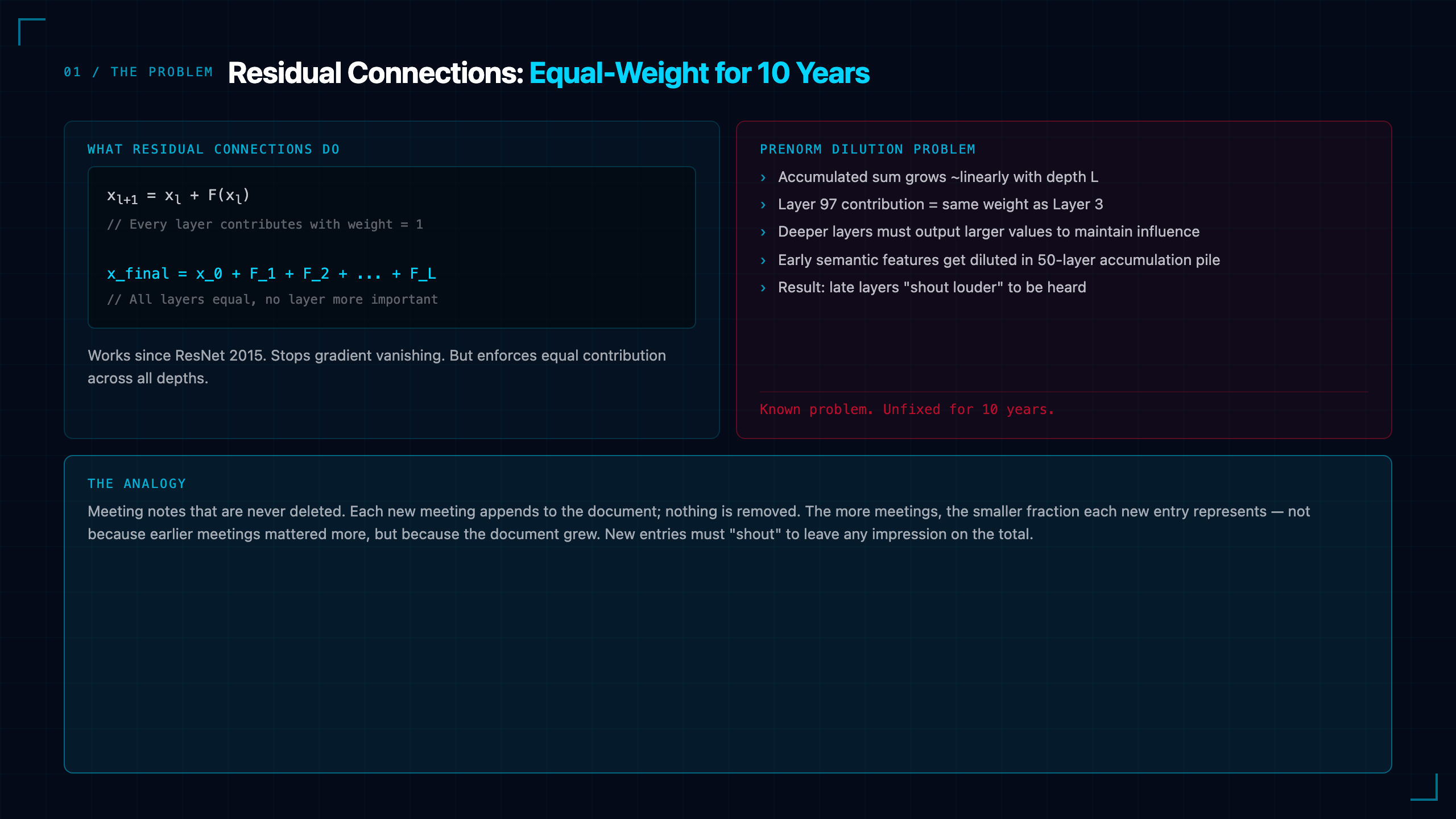
At NVIDIA GTC, Moonshot/Kimi's Yang Zhilin announced three open-sourced architectural primitives: MuonClip, Kimi Linear Attention, and Attention Residuals. The last one — which replaces the standard residual connection used since ResNet 2015 — earned likes from Karpathy and Musk. Block AttnRes achieves 1.25× compute efficiency gains with under 2% inference latency overhead, and is drop-in replaceable.
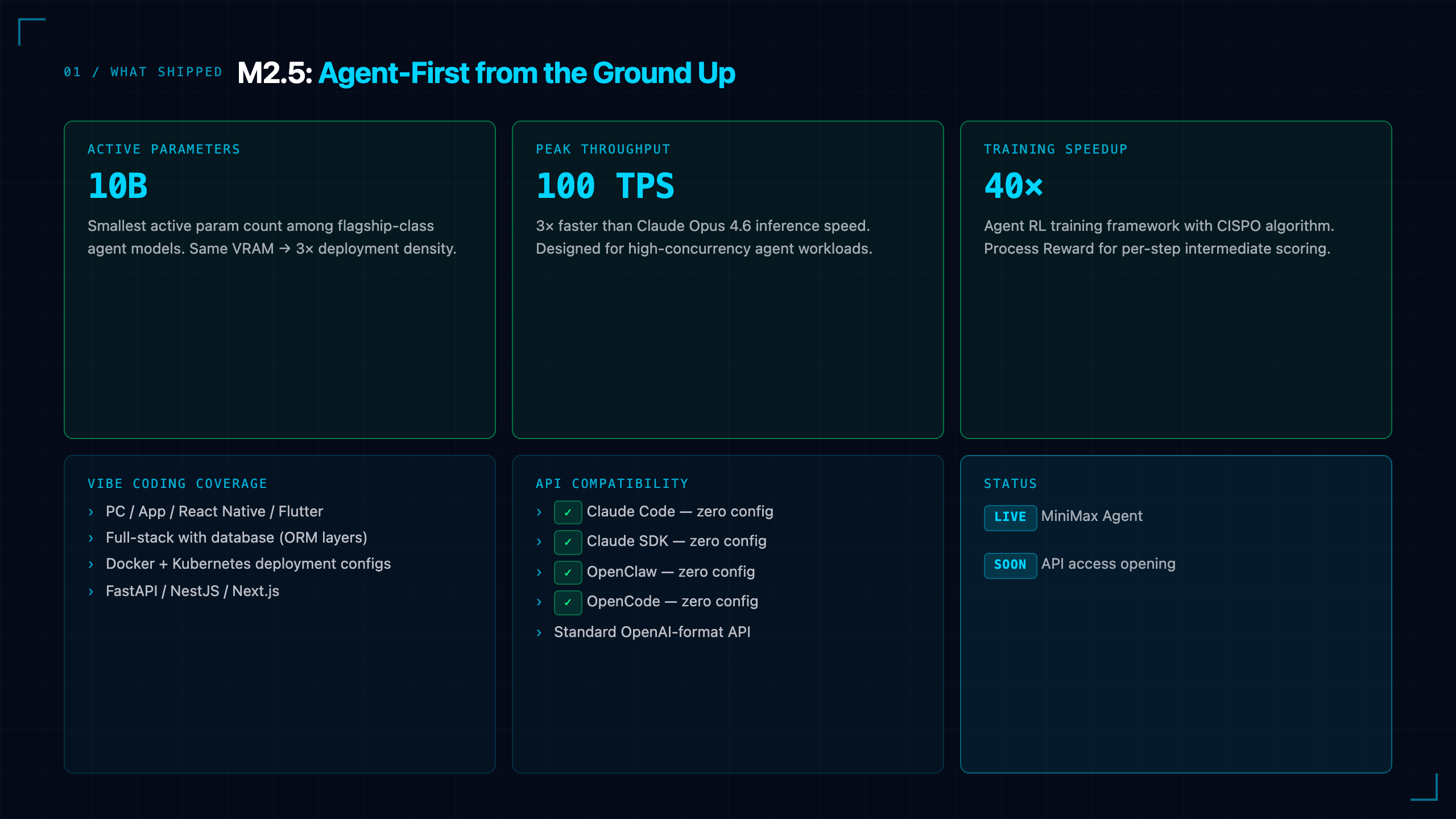
MiniMax Agent 2.0 ships two core features: a Desktop App (local file operations + web automation, no cloud upload required) and Expert Agents (reusable, prebuilt or custom AI specialists with full workflow context). The product directly competes with Claude Code for agentic tasks — with the tradeoff of managed multimodal pipelines vs. raw coding flexibility.
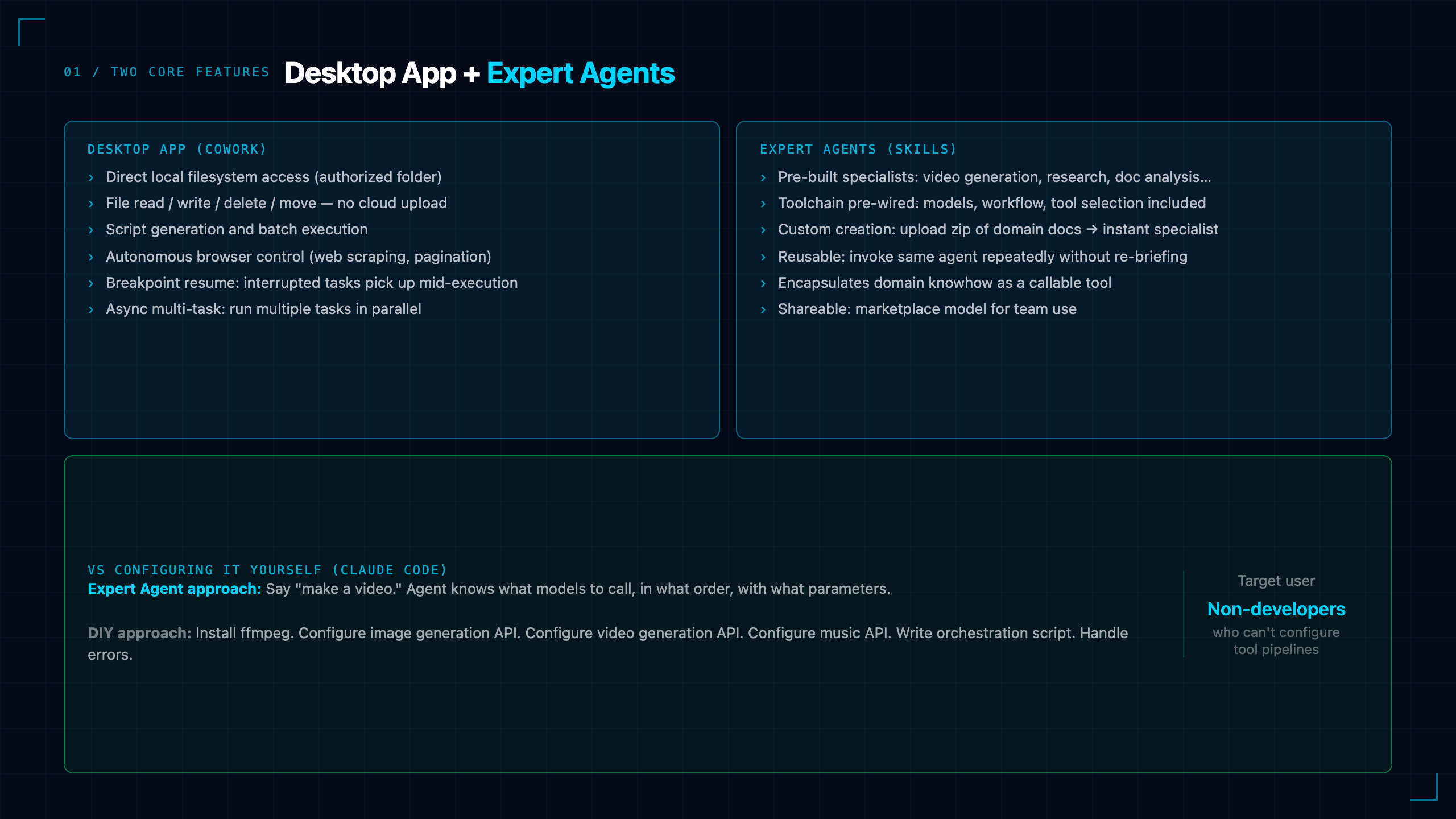
MiniMax M2.1 is a coding-specialized model with first-tier SWE-bench Verified scores and Multi-SWE-bench results that reportedly surpass Claude Sonnet 4.5 across 8 programming languages (Java, TypeScript, JavaScript, Go, Rust, C, C++, Python). First-hand testing confirms: Kepler orbital mechanics in Java from scratch, WebSocket-driven full-stack with correct frontend/backend separation, and one-shot phone OS simulation.
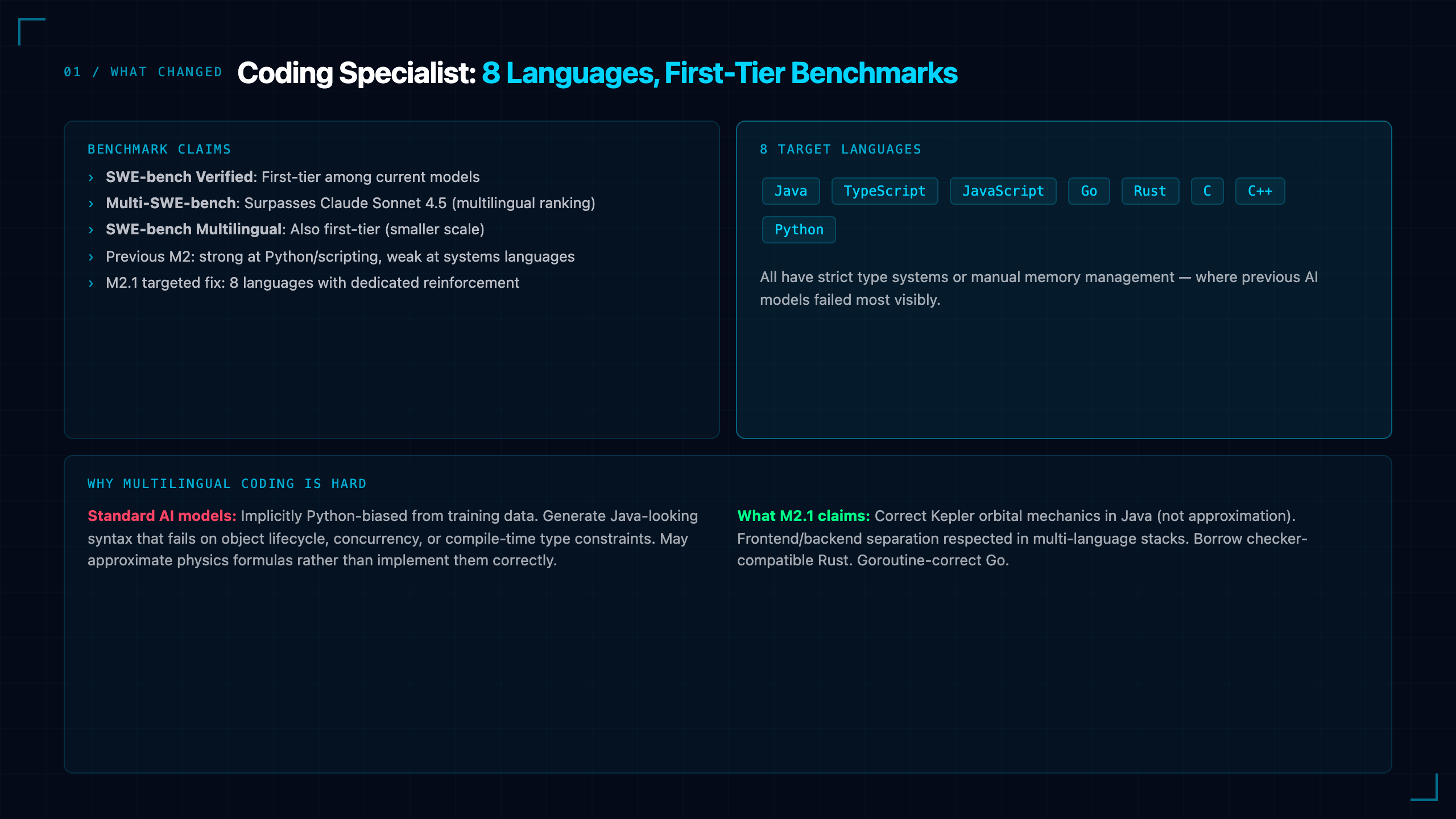
MiniMax M2.5 ships with only 10B active parameters but claims parity with Opus-class models on agentic coding tasks. The case is real: 100 TPS throughput, 3× Opus inference speed, and a native Agent RL training pipeline (CISPO) that allegedly delivered 40× training acceleration. Full compatibility with Claude Code, OpenClaw, and standard OpenAI API tooling. API opening soon.
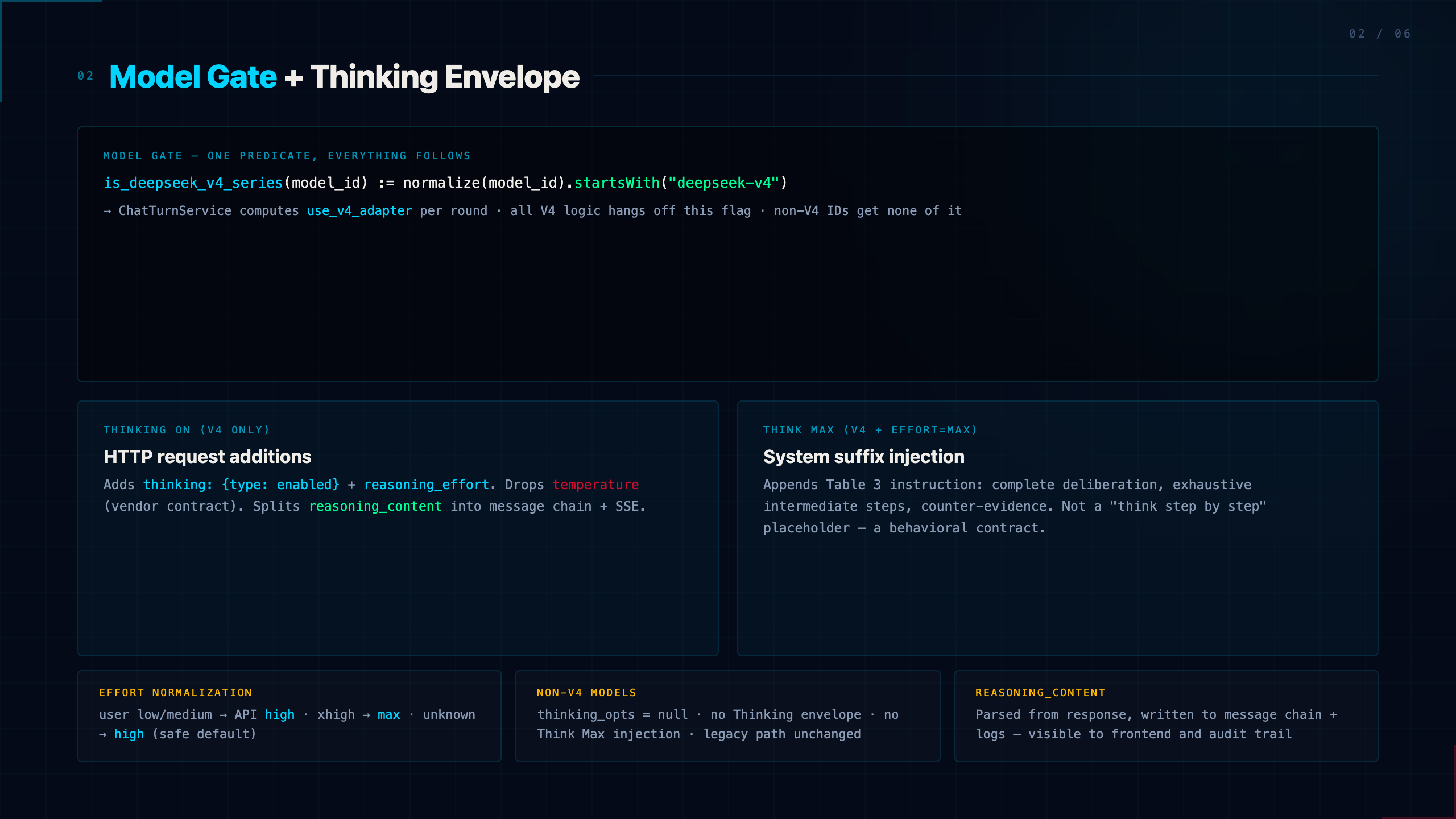
Agentium's open-source AI gateway shows how to adapt DeepSeek V4 without polluting your tool loop: a model gate decides the V4 path, Thinking envelopes and DSML tool blocks stay inside the gateway layer, and six operational switches let you tune cost versus capability per round.
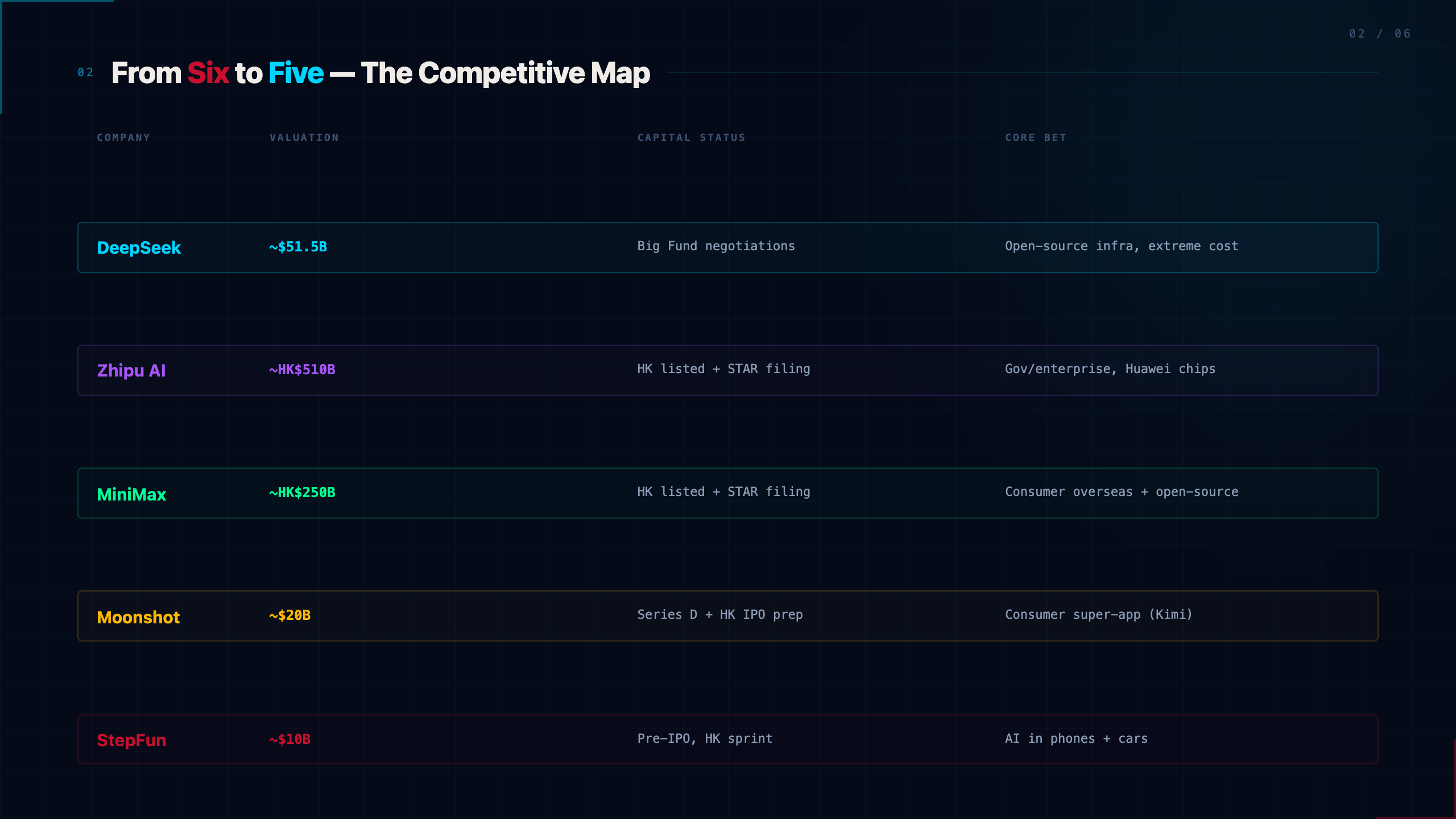
MiniMax M3 beating GPT-5.5 on SWE-Bench Pro is the headline. The real story is what happened to China's AI industry in three years: from six startups chasing GPT-4 to five distinct companies with different business models, different capital structures, and a convergent pressure to turn technology into revenue.
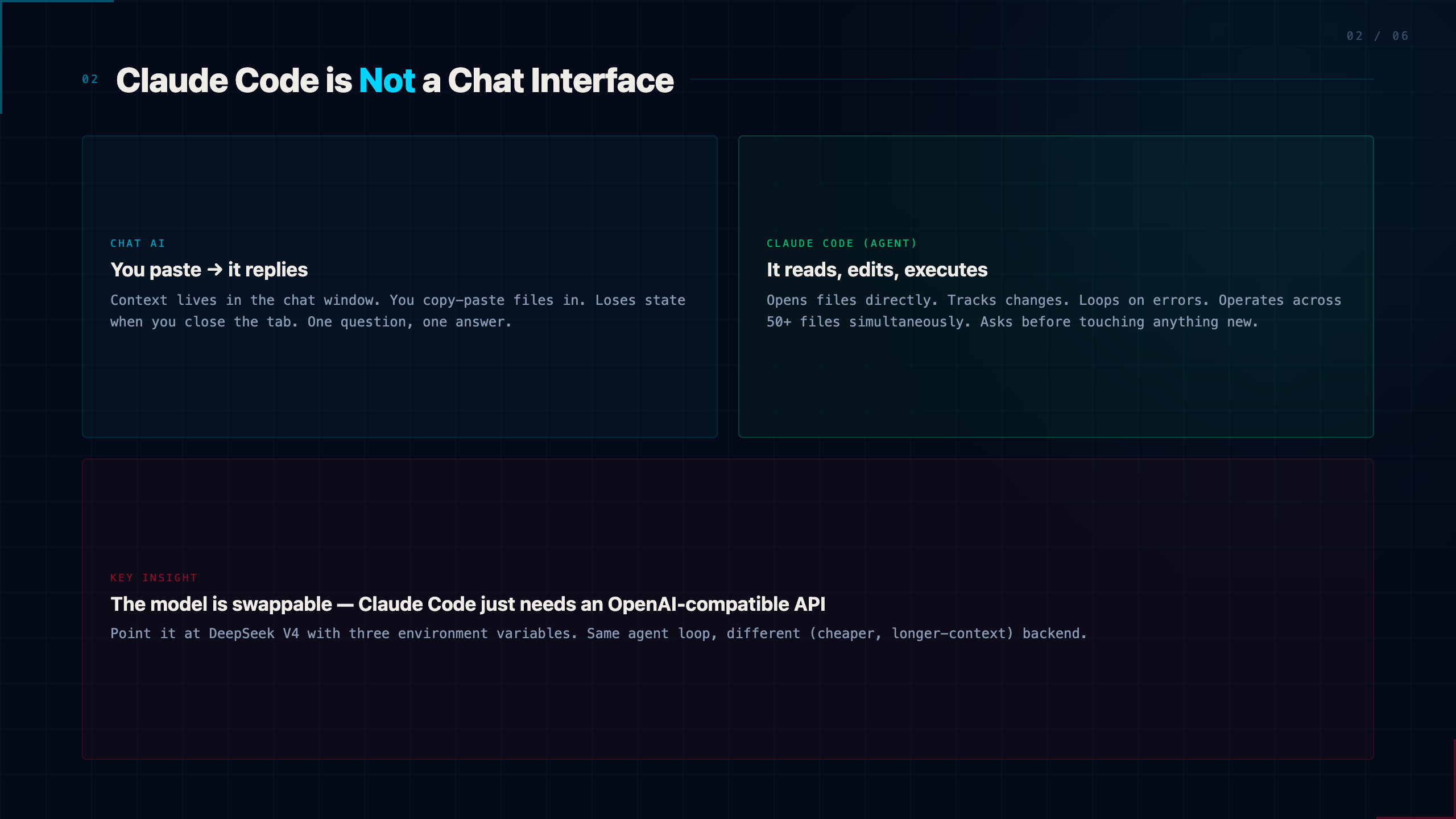
Claude Code is model-agnostic. Swap in DeepSeek V4 as the backend — 1M context, a fraction of the API cost — and you get the same file-editing, task-executing agent without a Claude subscription.
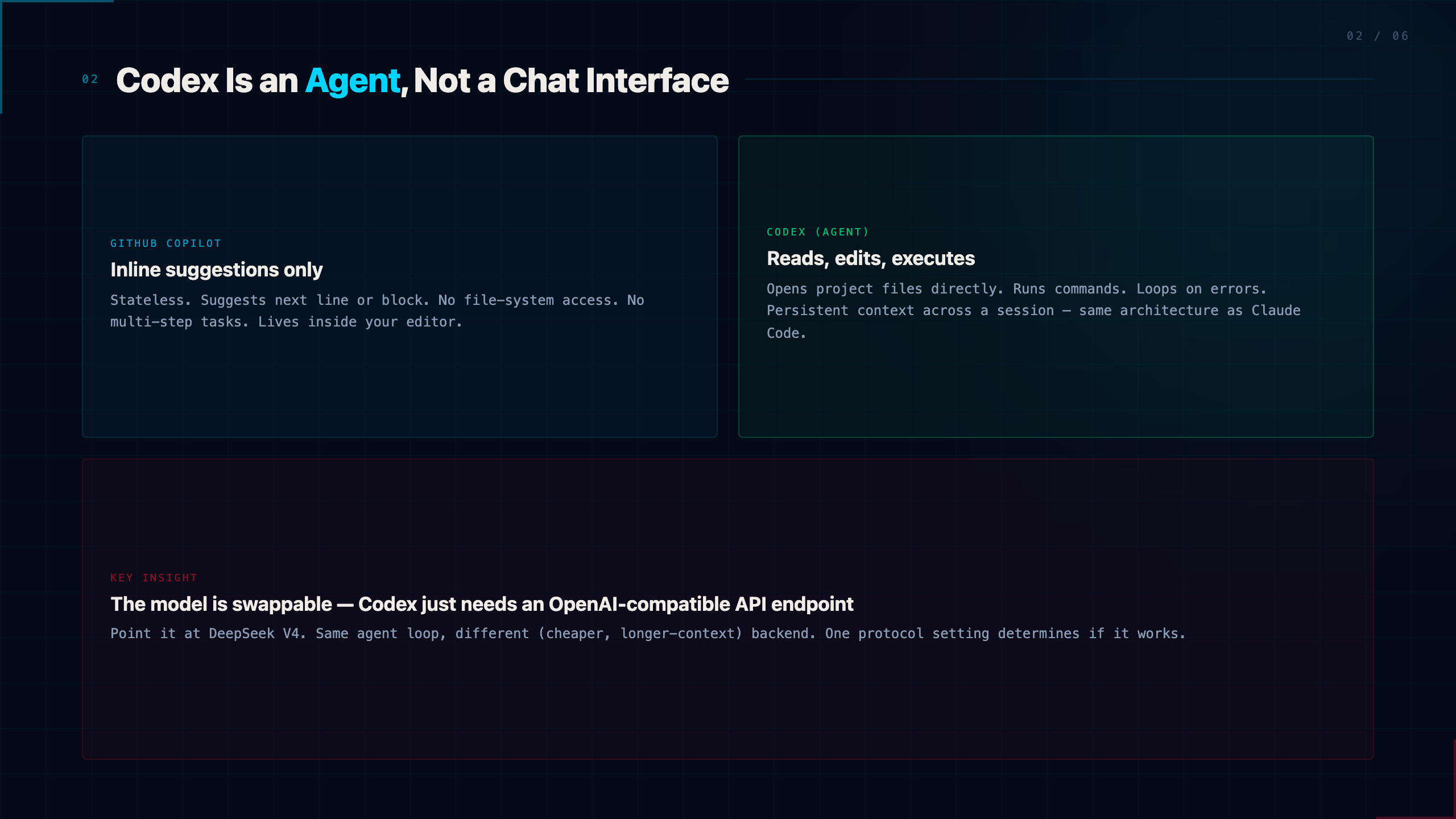
OpenAI Codex, like Claude Code, can run on any OpenAI-compatible backend — including DeepSeek V4. But there's one protocol gotcha that breaks most setups: Codex requires Chat Completions, not the newer Responses API. Here's what that means and why it matters.
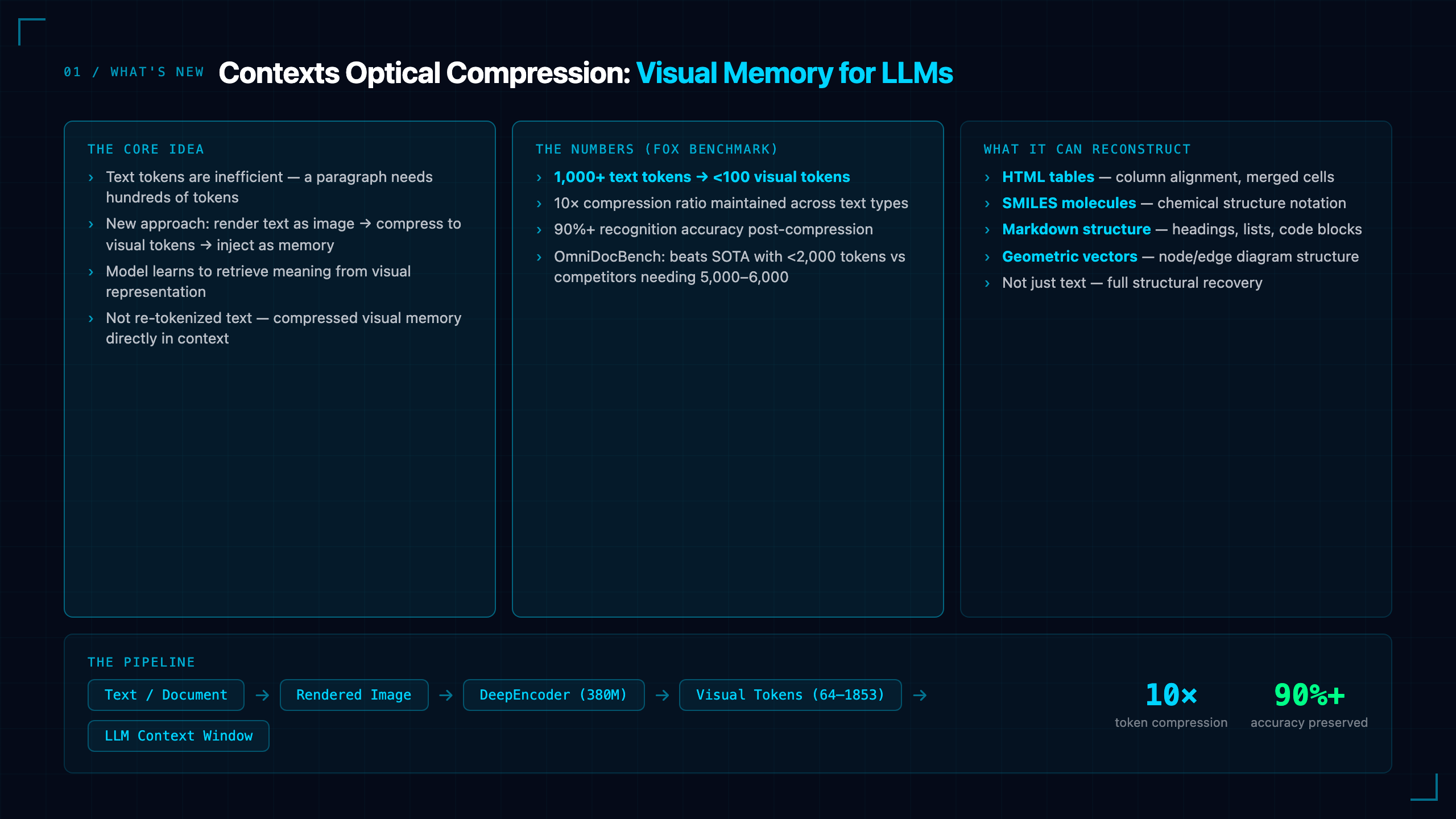
DeepSeek dropped an open-source model that rethinks how LLMs handle long context: render text as an image, compress to visual tokens, feed those tokens as memory. Result: 10× token compression on the Fox benchmark with 90%+ recognition accuracy. The decoder is a 3B MoE with only 570M active params. On OmniDocBench, it outperforms models that use 5,000–6,000 tokens with under 2,000. The forgetting mechanism — reducing resolution for older context — maps directly to how human memory degrades.
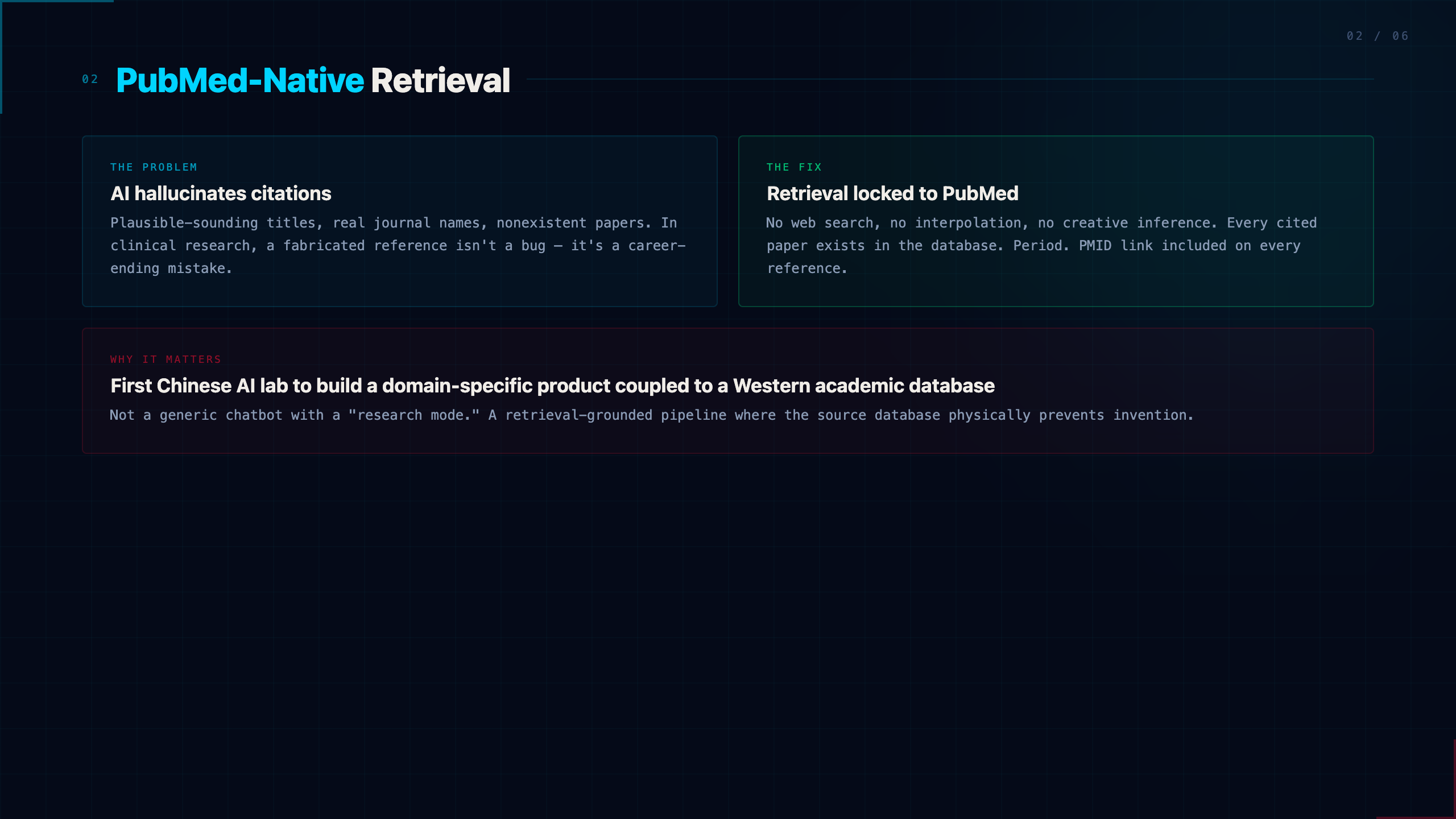
DeepSeek V4 now integrates directly with PubMed — every citation links to a real PMID, every reasoning step is visible, and the full literature workflow from search to formatted references is automated. We examine what this means for researchers and where it still falls short.
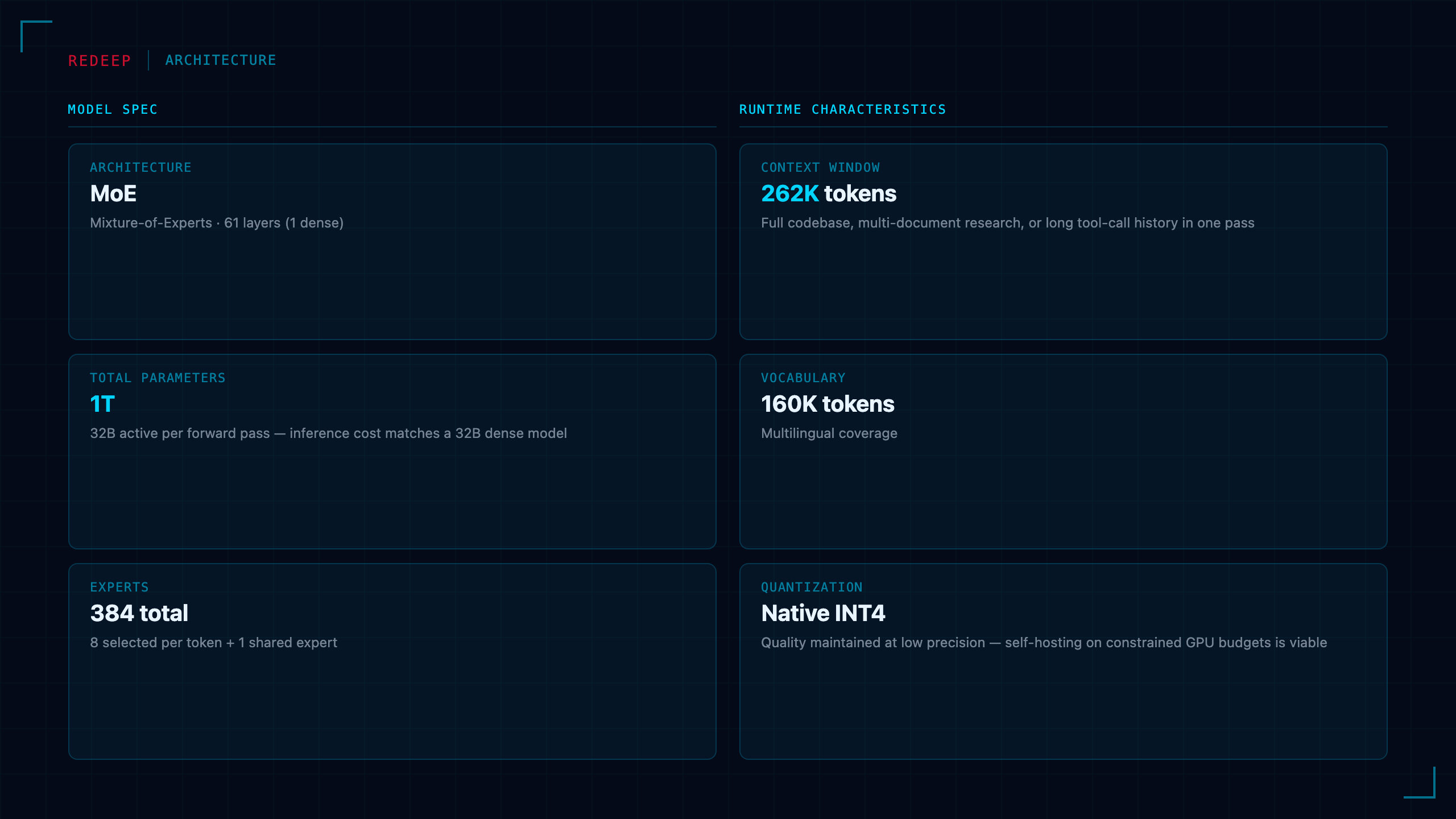
Moonshot AI's Kimi K2 Thinking is a 1-trillion-parameter MoE model that runs 200–300 consecutive tool calls without losing coherence. At $0.60/M input tokens with MIT-licensed weights, it's the clearest open-source challenge to frontier reasoning yet.
Kling 3.0 shipped February 7, 2026 with native 4K/60fps, 6-shot Multi-Shot sequencing, and Elements — a character identity lock that keeps faces, voices, and costumes consistent across every frame. At $0.168/sec via fal.ai, here's why it went viral overnight.

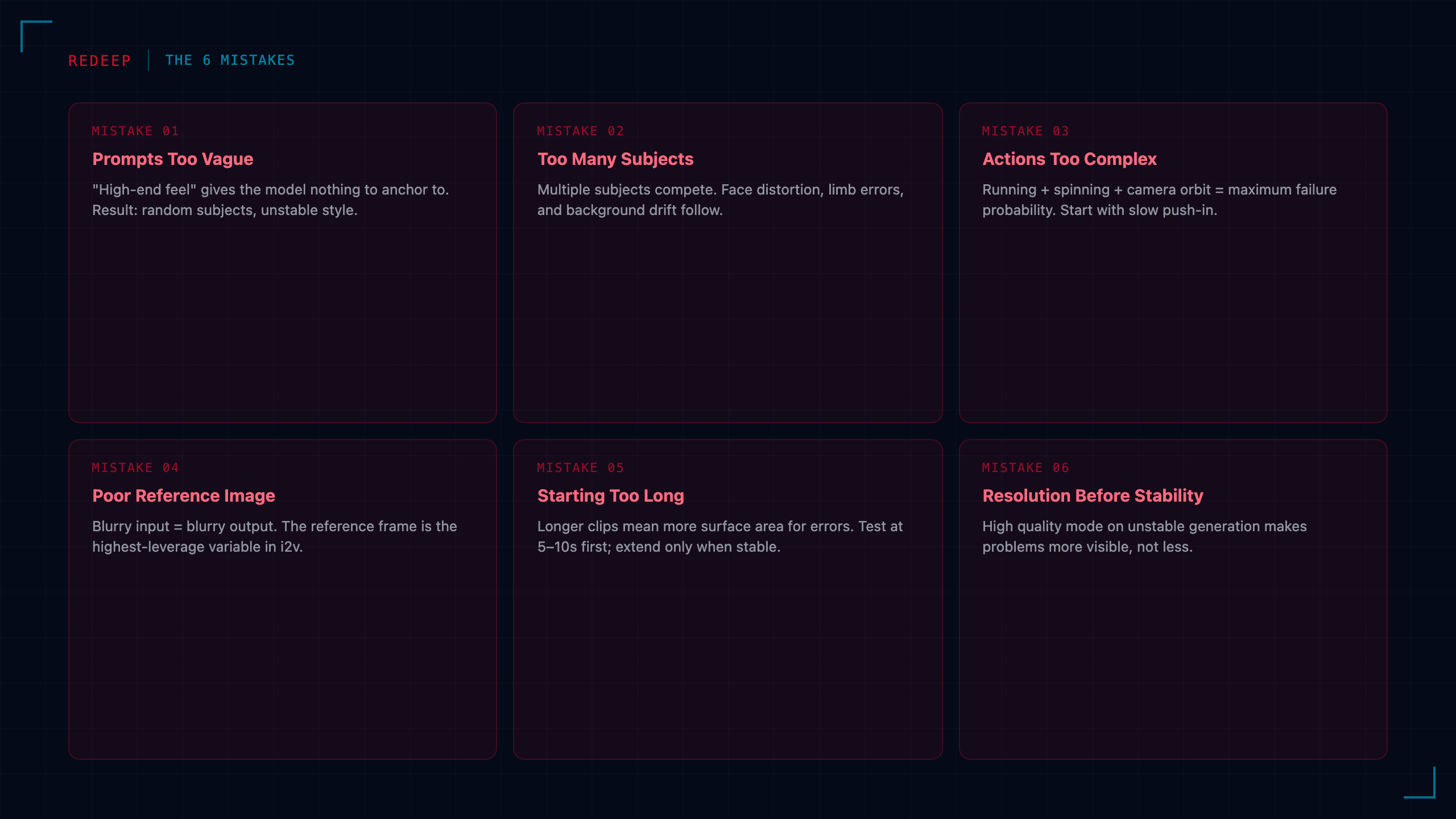
Blurry outputs, unstable subjects, drifting backgrounds — these aren't Kling bugs. They're fixable patterns. Here's the systematic approach that separates one-shot wonders from consistent results.
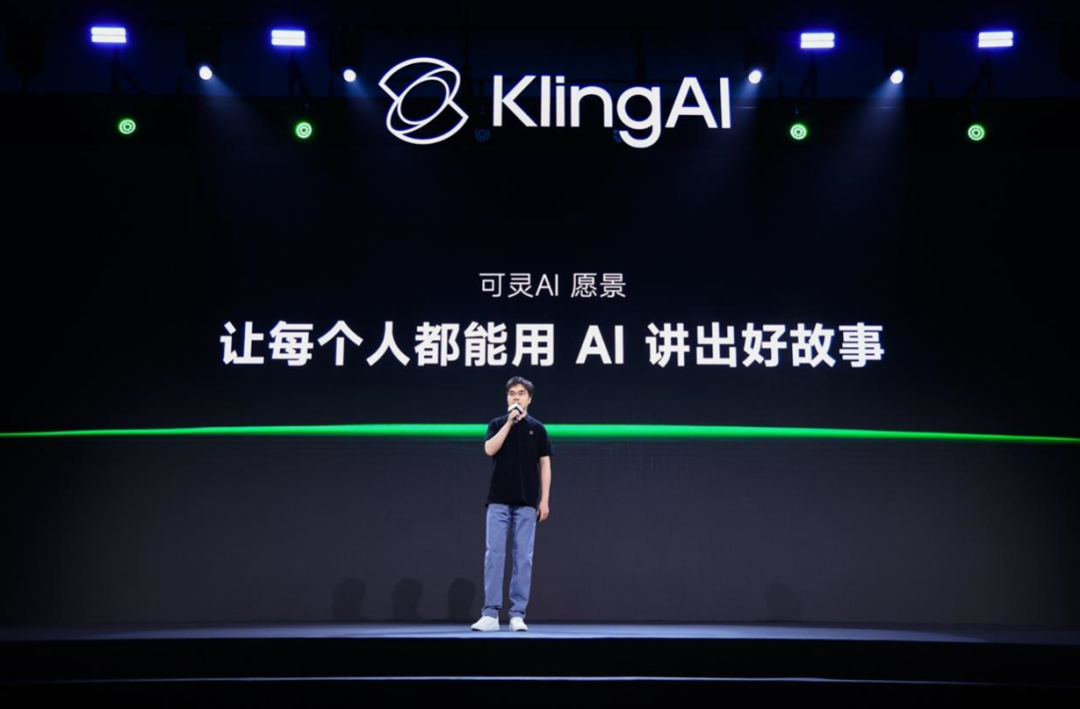
Kling AI hit $500M ARR and 60M global users. Seedance 2.0 shipped 60-second 2K video with native audio in February 2026. Two Chinese labs, two very different bets — here's what it means for developers choosing between them.
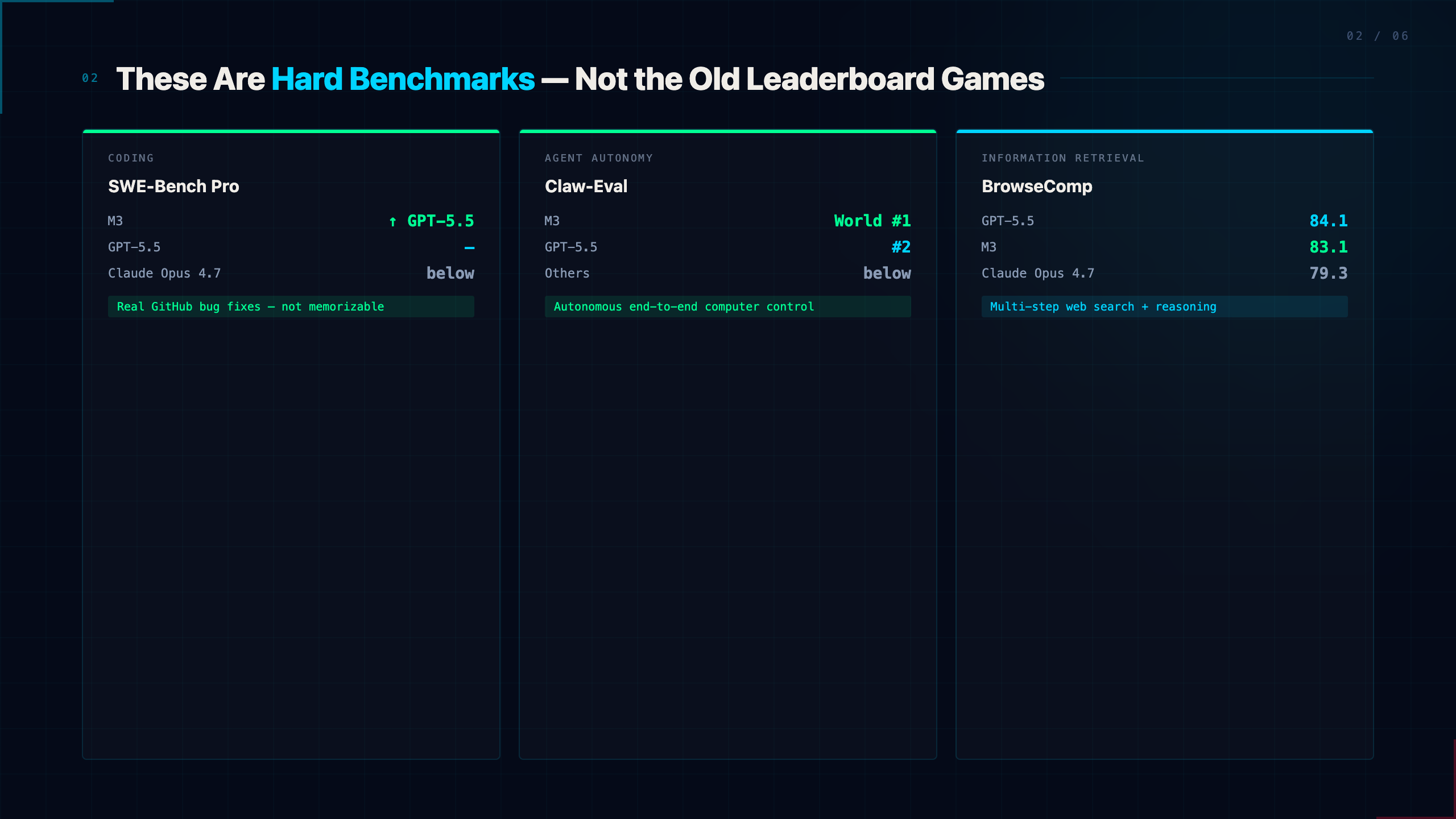
MiniMax M3 posts legitimate top-tier benchmark scores — SWE-Bench Pro above GPT-5.5, Claw-Eval world #1 — powered by a real architectural change. But the launch came with a pricing overhaul that raised costs 257% for heavy users, timed one day after an A-share IPO filing. Here's the full picture.
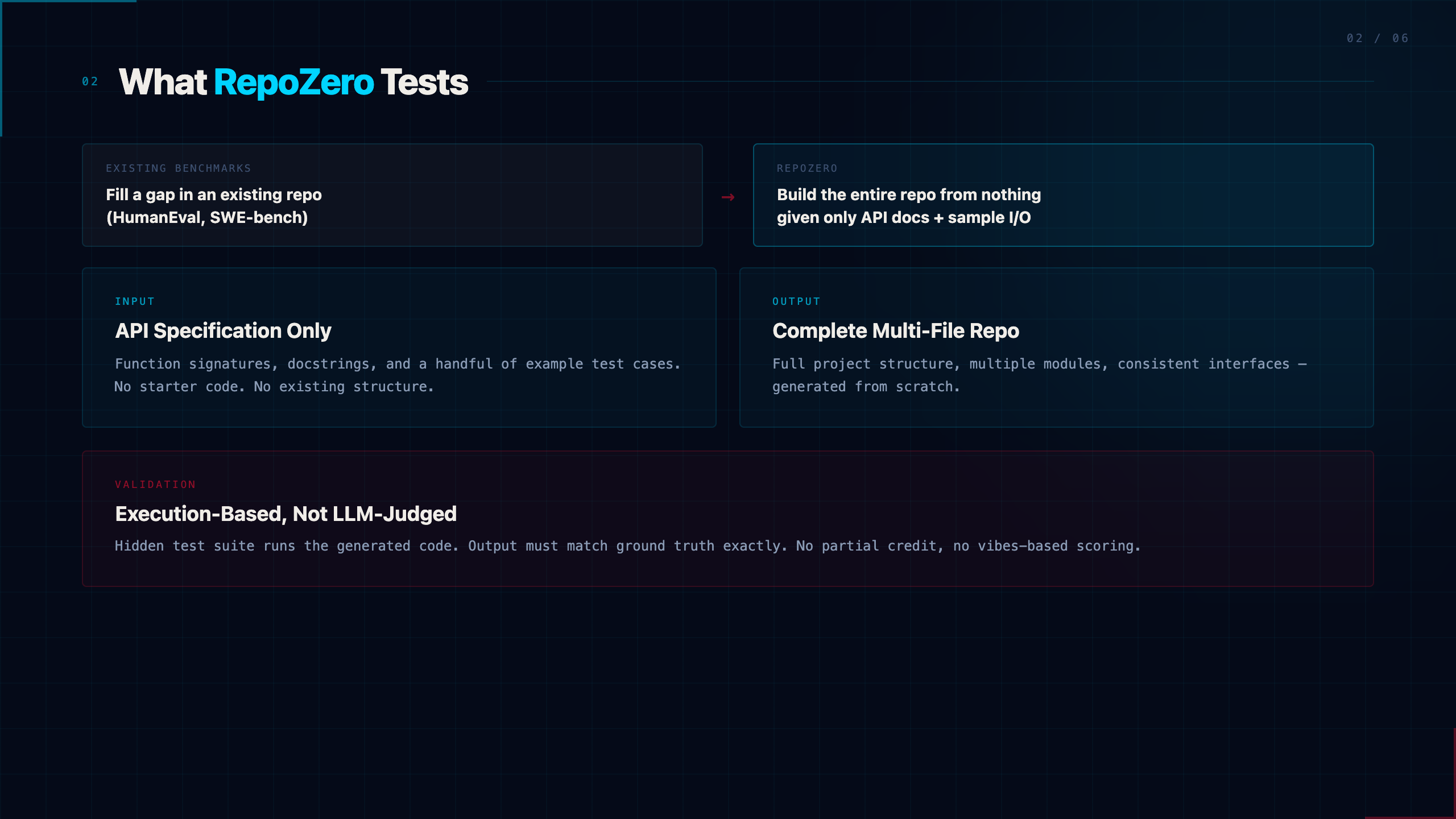
Most benchmarks hand the AI a codebase and ask it to patch something. RepoZero removes the scaffolding entirely — given only API docs, can a model build the whole repo? Today's best models pass 20–40% of the hardest tests.
ByteDance's Seedance 2.0 launched February 2026 with quad-modal inputs, native audio synthesis, and fal.ai API pricing starting at $0.30/sec — roughly 100x cheaper than Sora 2 at equivalent resolution. Here's everything developers need to know.

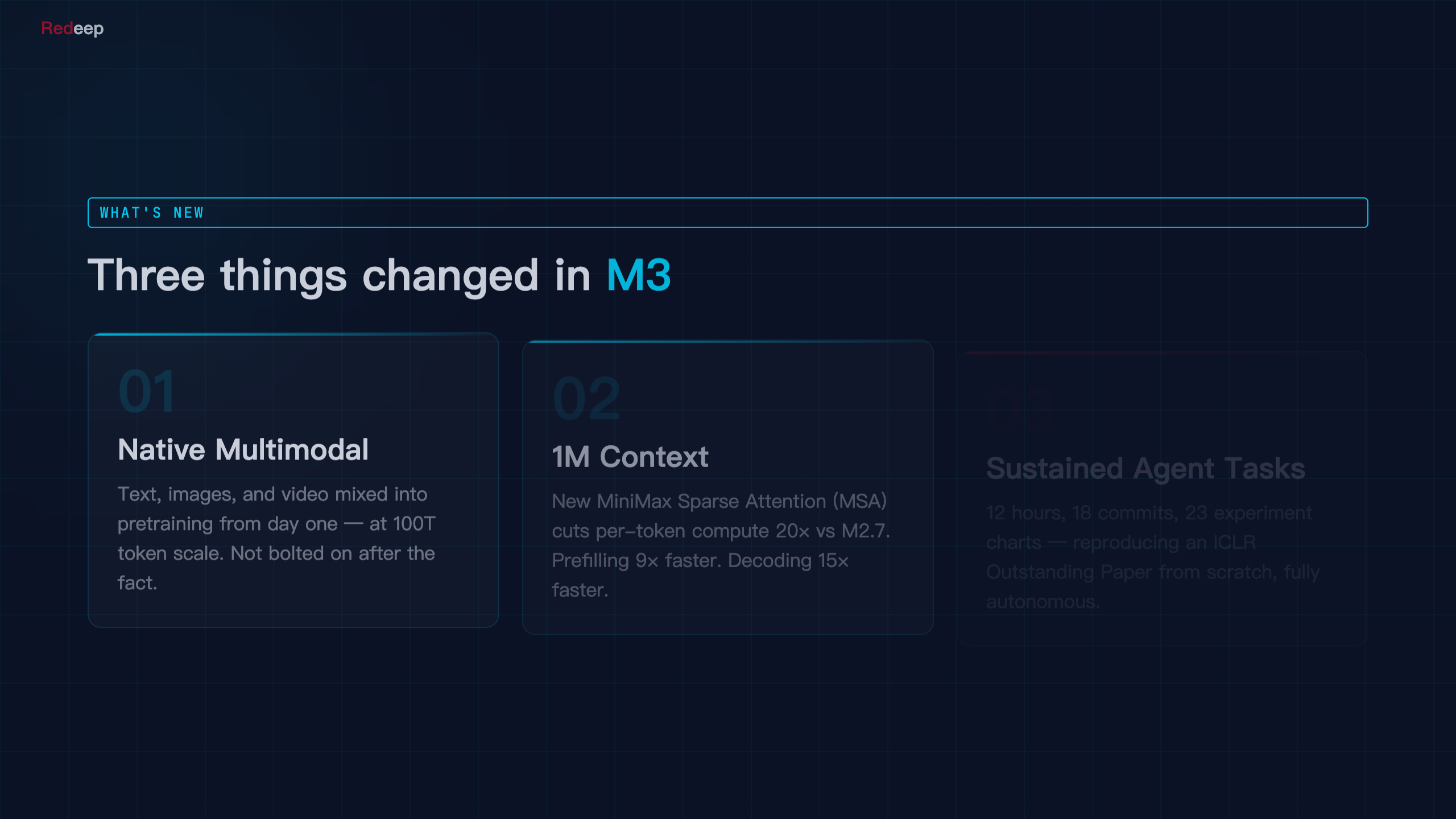
MiniMax just shipped a model that sustains agent tasks for up to 12 hours. It's multimodal, it has a million-token context window, and the flagship tier costs roughly what you'd spend on Netflix. Here's what that actually means.
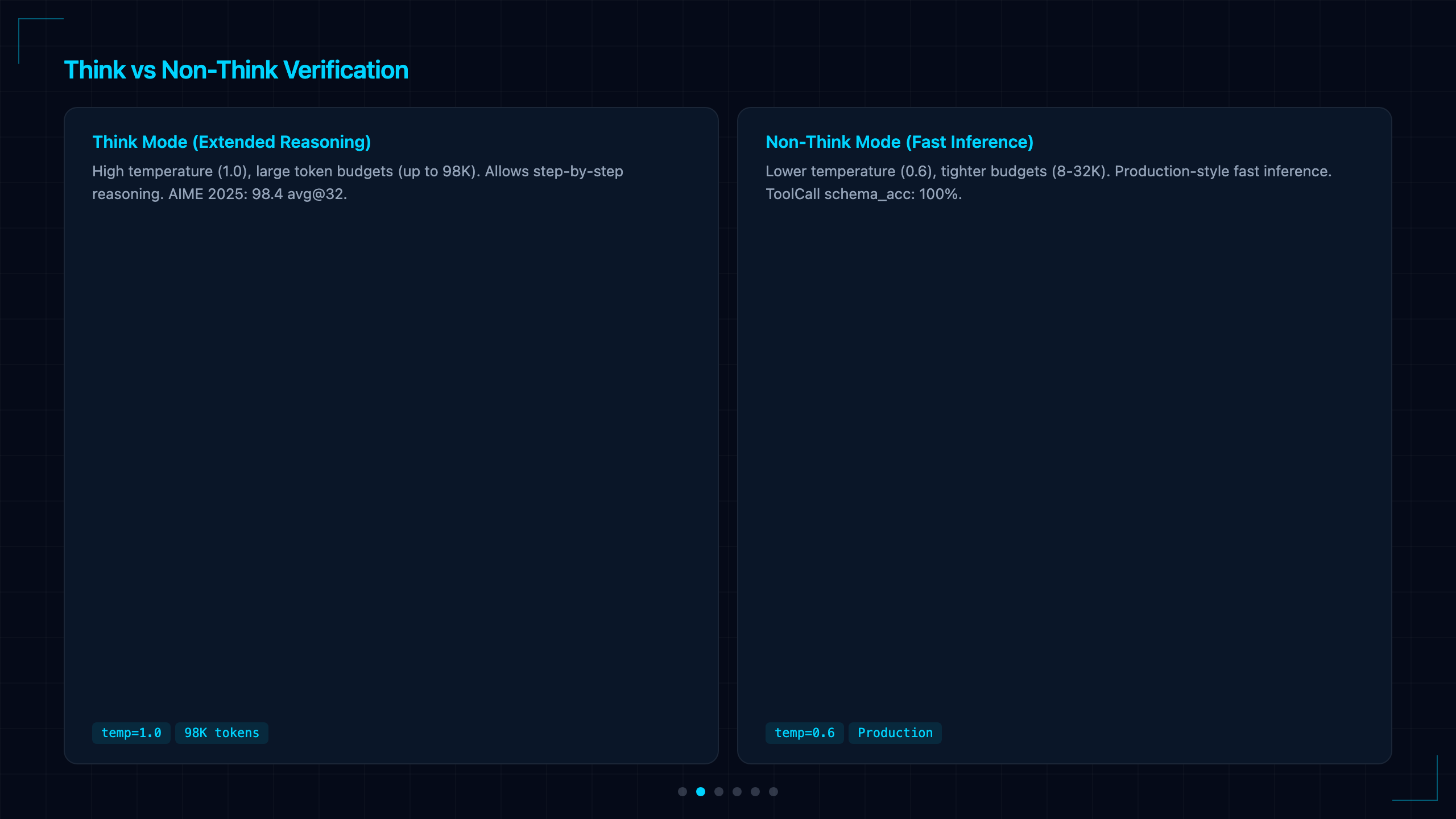
Moonshot AI released Kimi Vendor Verifier (K2VV) — a verification system that proves you're getting the model you're paying for. The system benchmarks API outputs against certified model capabilities across OCRBench (92.0), AIME 2025 (98.4 avg@32 in Think mode), MMMU Pro Vision (78.8), and a new ToolCall benchmark (100% schema accuracy). Two modes: Think (extended reasoning) and Non-Think (fast inference).
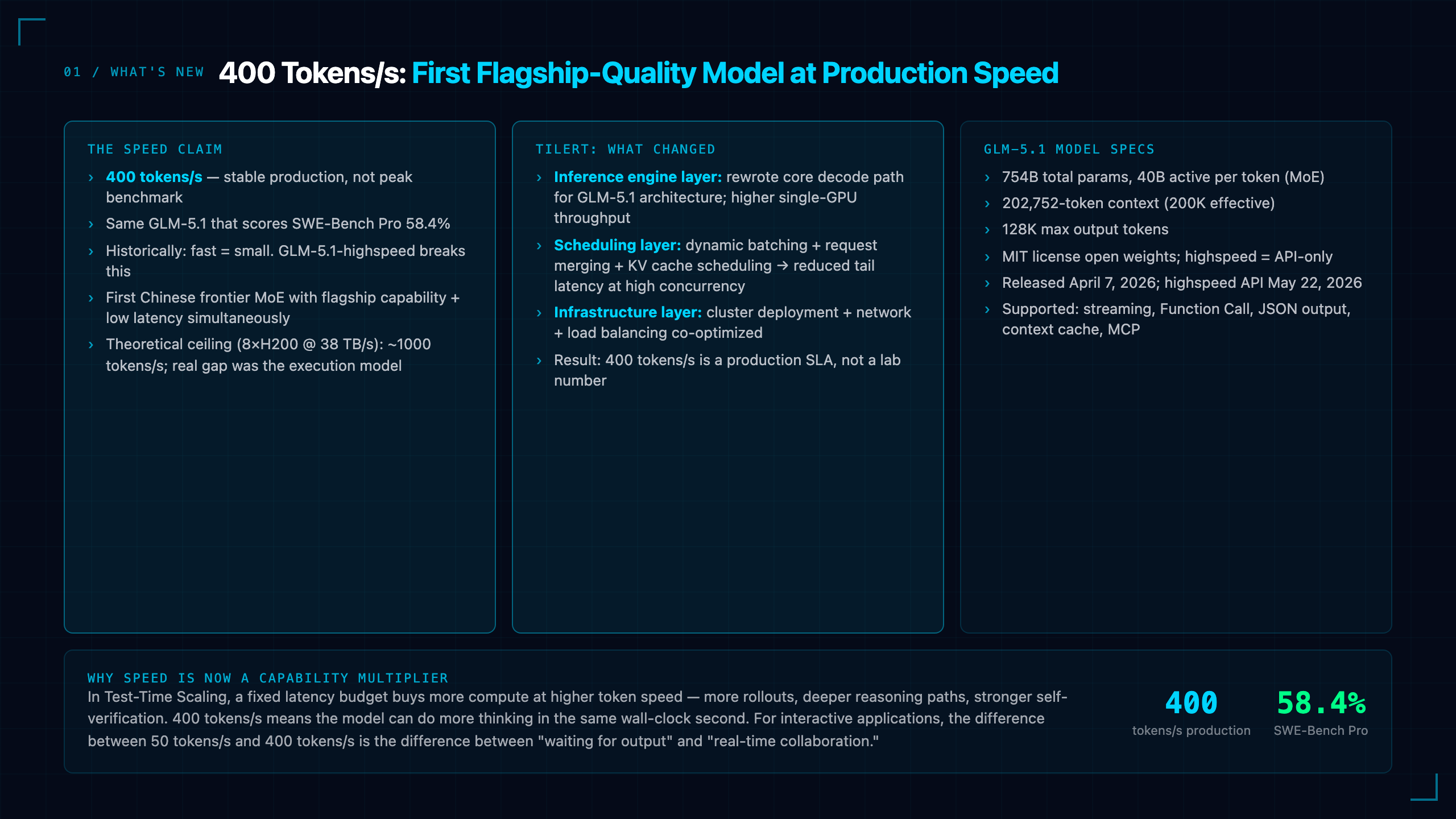
Zhipu AI launched GLM-5.1-highspeed, delivering 400 tokens/s from its 754B-parameter MoE flagship — the first time a Chinese frontier model brings both top-tier capability and sub-second latency to production. The speed comes from TileRT, an inference engine that replaces the conventional operator-by-operator scheduling model with a persistent GPU kernel compiled at AOT time. SWE-Bench Pro: 58.4%; 200K context; available to select enterprise customers via the BigModel platform.
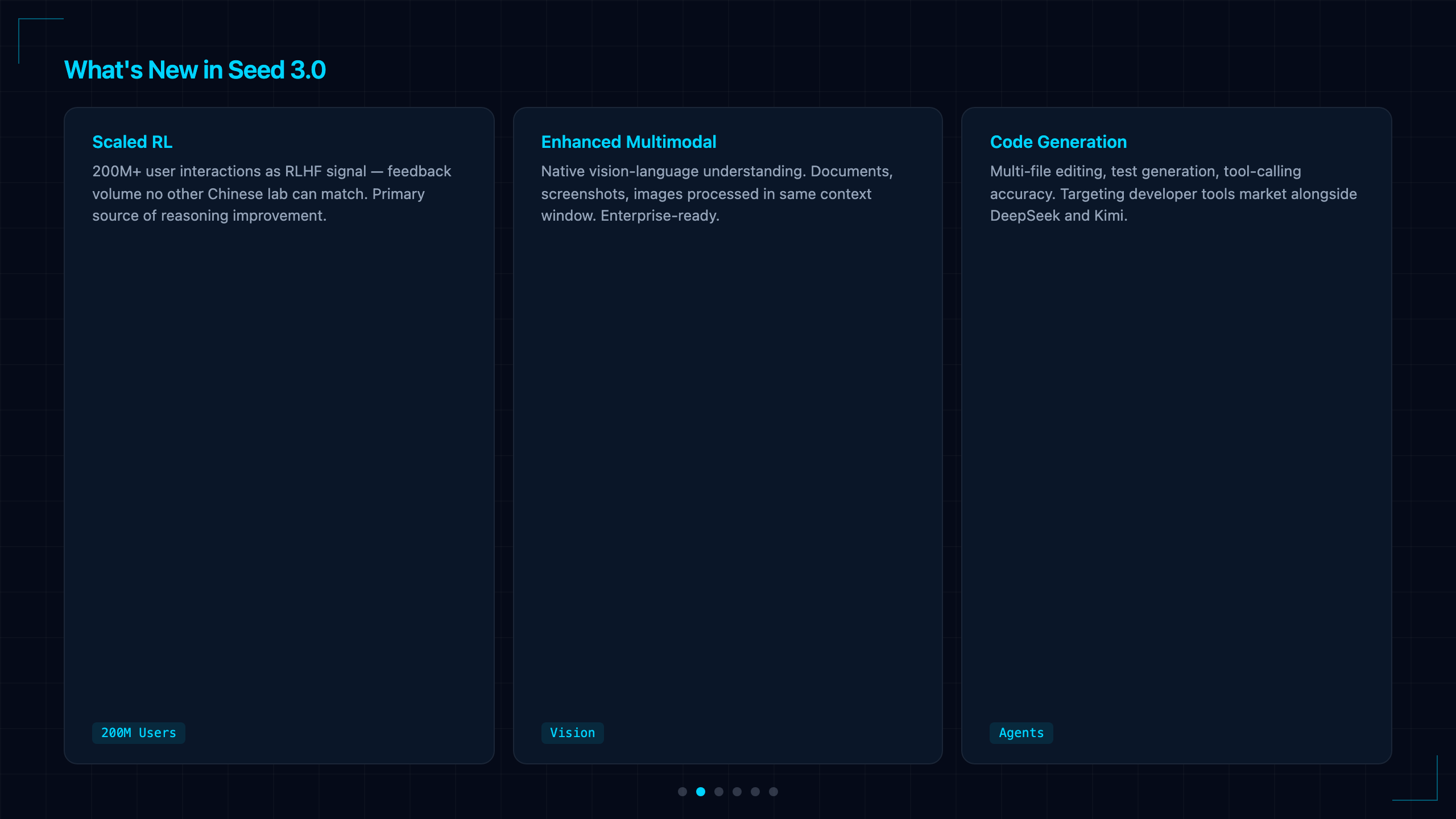
ByteDance's Seed team released Doubao Seed 3.0 — the third-generation foundation model powering China's most-used AI chatbot (200M+ monthly users). Built on scaled RL and new pre-training recipes, Seed 3.0 extends the Seed 2.0 family with improved reasoning, coding, and multimodal capabilities while maintaining the aggressive pricing that made Doubao the volume leader in China's API market.
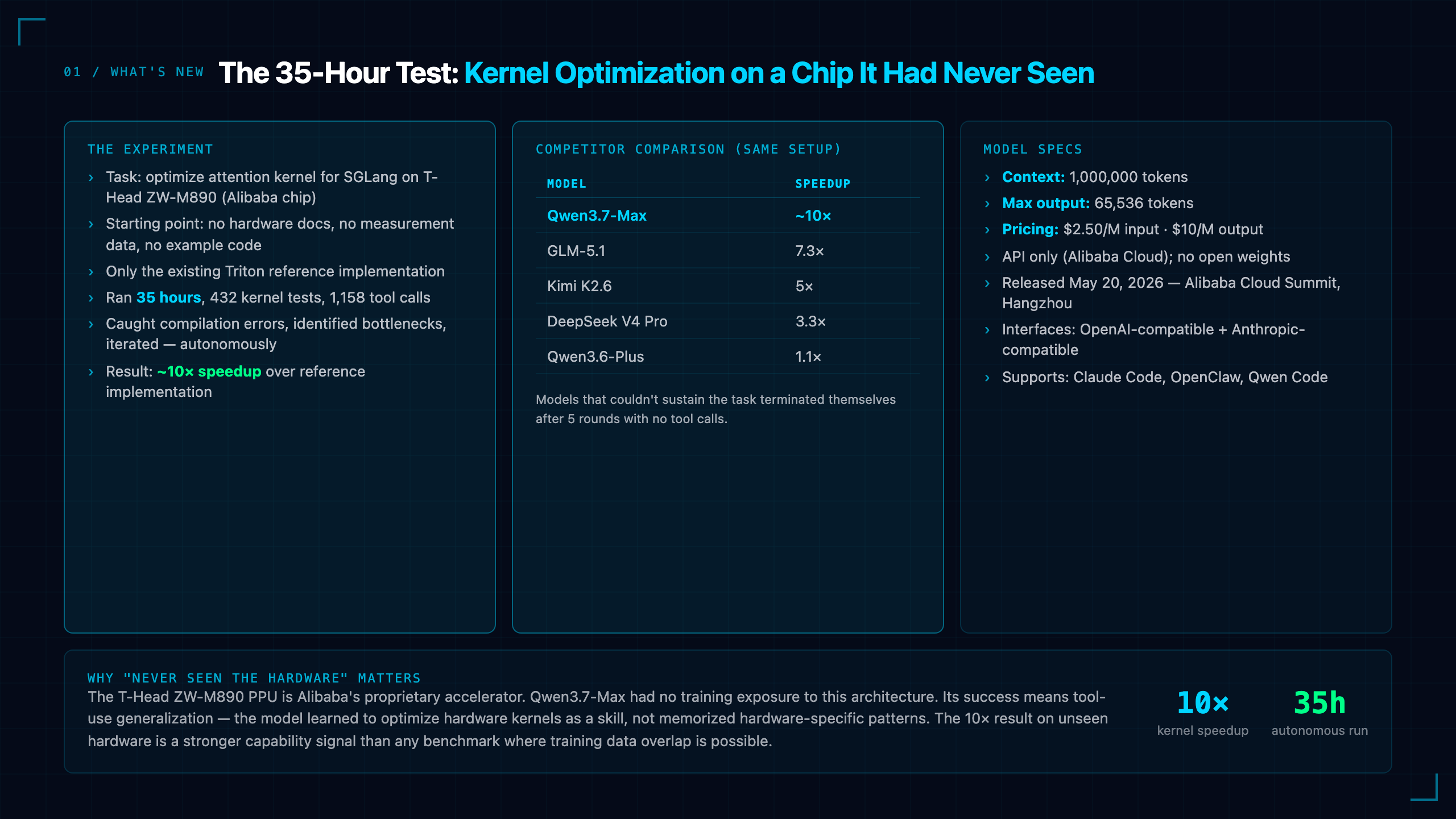
Alibaba's Qwen team released Qwen3.7-Max on May 20, 2026 — a proprietary agent-first model with a 1M token context window. In a live test, the model ran 35 hours continuously, executed 432 kernel tests and 1,158 tool calls, and delivered a 10× speedup on a hardware accelerator architecture it had never encountered in training. SWE-Bench Pro: 60.6% (highest reported). KernelBench L3: 96%. $2.50/M input tokens. API only, no open weights.
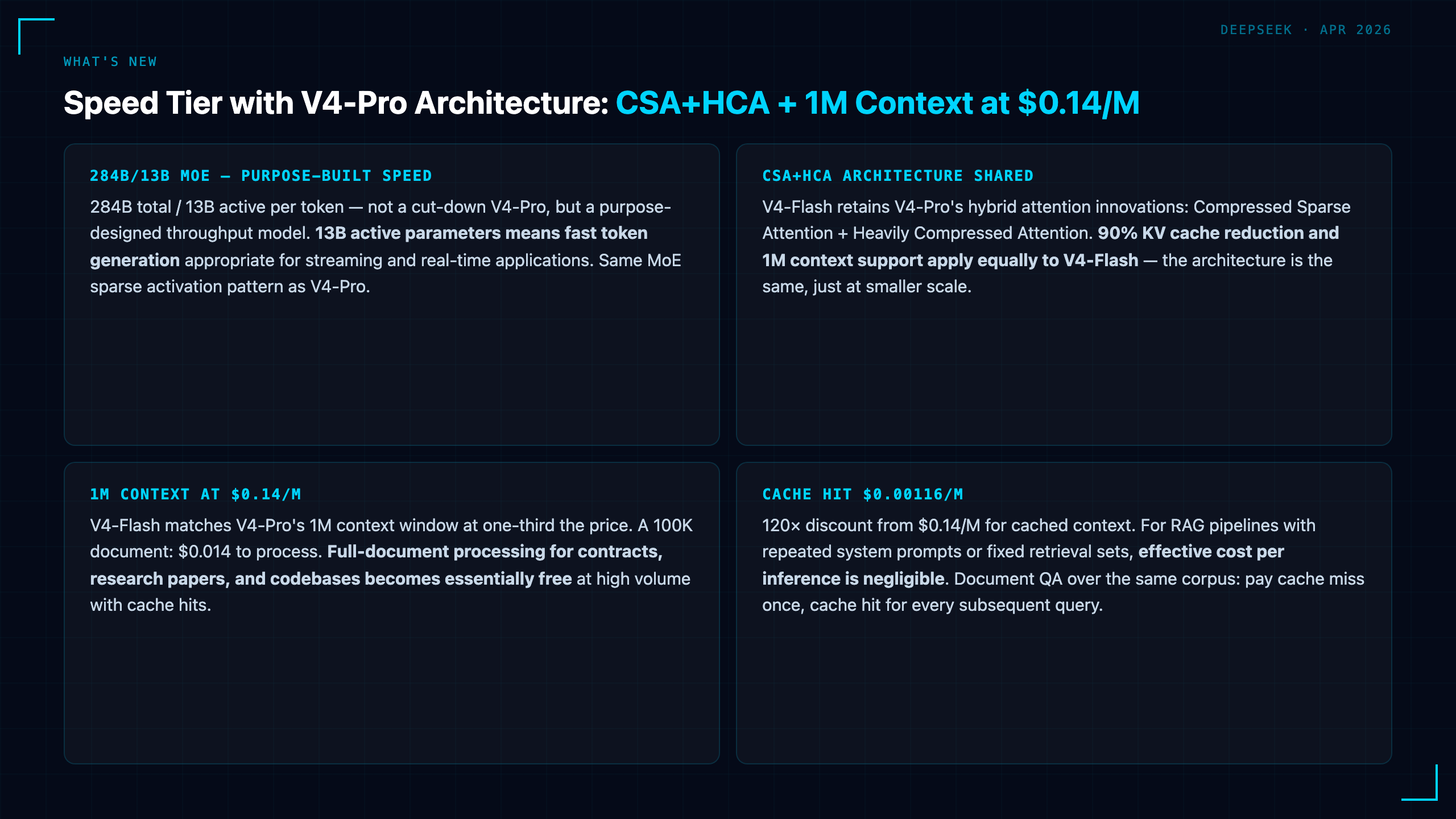
DeepSeek released V4-Flash simultaneously with V4-Pro on April 24, 2026 — a 284B/13B active MoE model sharing V4-Pro's CSA+HCA hybrid attention architecture and 1M context window, at $0.14/M input (one-third of V4-Pro). V4-Flash targets high-volume, latency-sensitive pipelines where Sonnet-class quality is acceptable and throughput economics matter. MIT licensed, same API format, same 1M context as V4-Pro.
DeepSeek released V4-Pro on April 24, 2026 — a 1.6T parameter MoE model with 49B active parameters, 1M token context, and SWE-bench Verified score of 80.6%. A new hybrid attention architecture (CSA + HCA) cut 1M-context inference FLOPs by 73% compared to V3.2, and KV cache by 90%. At $0.435/M input tokens on DeepSeek's own API, V4-Pro costs 7× less than GPT-5.5 for equivalent coding quality.
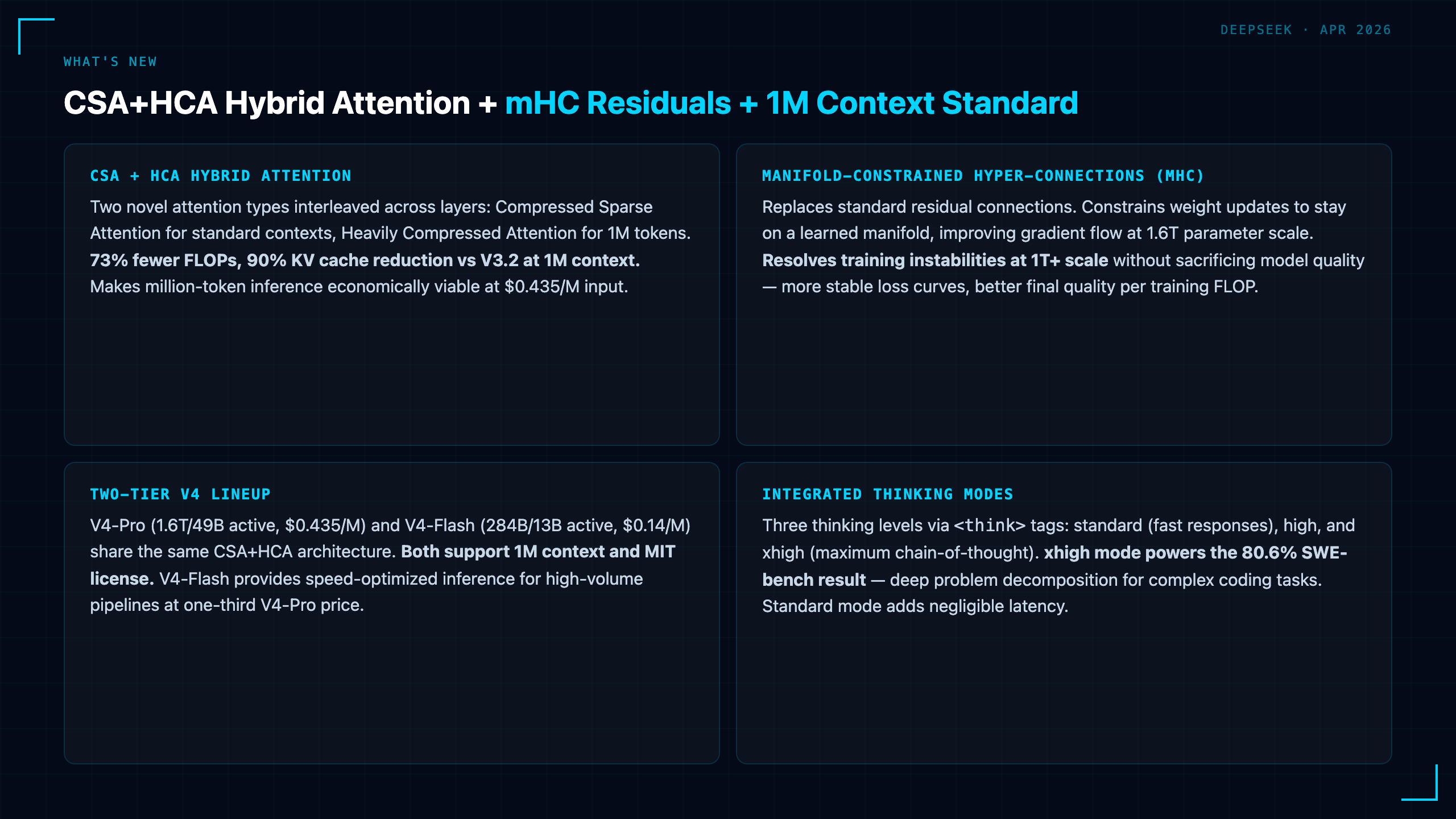
Moonshot AI released Kimi K2.6 on April 20, 2026 — an open-source native multimodal agentic model under Modified MIT license. Agent Swarm scales to 300 parallel sub-agents × 4,000 coordinated steps (3× and 2.7× up from K2.5). Long-horizon execution: 12+ continuous hours, cross-language (Rust, Go, Python). Benchmarks: HLE-Full 54.0%, SWE-Bench Pro 58.6%, SWE-Bench Multilingual 76.7%, GPQA-Diamond 90.5%. Architecture: 1T params, 32B active, MoE with 384 experts, 256K context. INT4 QAT quantization: 594 GB weight file, runs on 4×H100.
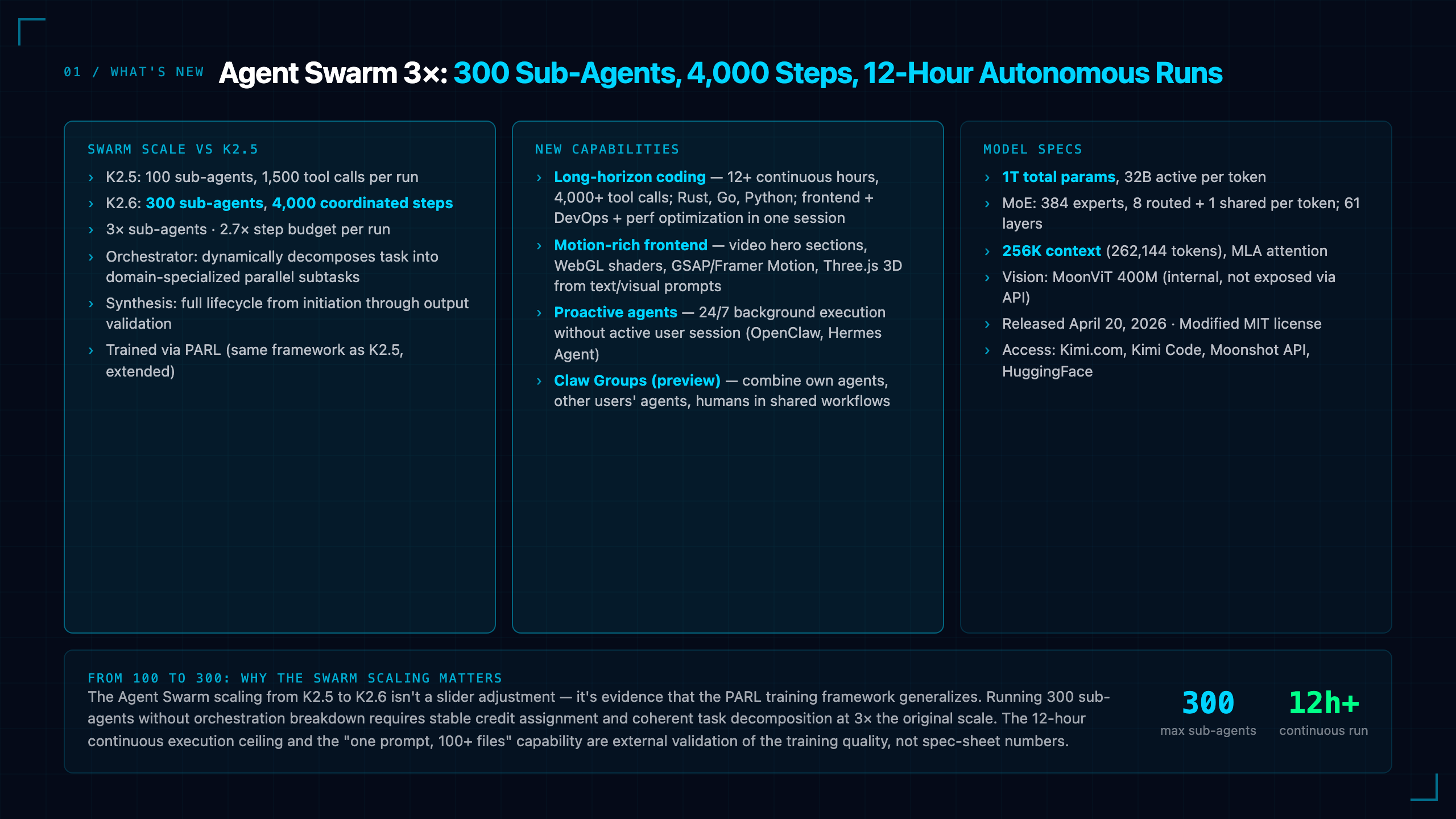
ByteDance's Seed team released Seedream 3.0 — a text-to-image foundation model with enhanced text rendering, multi-subject composition, and style consistency. Part of the Volcengine AI stack alongside Seedance (video) and SeedTTS (speech). Positions ByteDance as a full-stack multimodal platform competing with MidJourney, DALL-E, and domestic players like Tongyi Wanxiang.
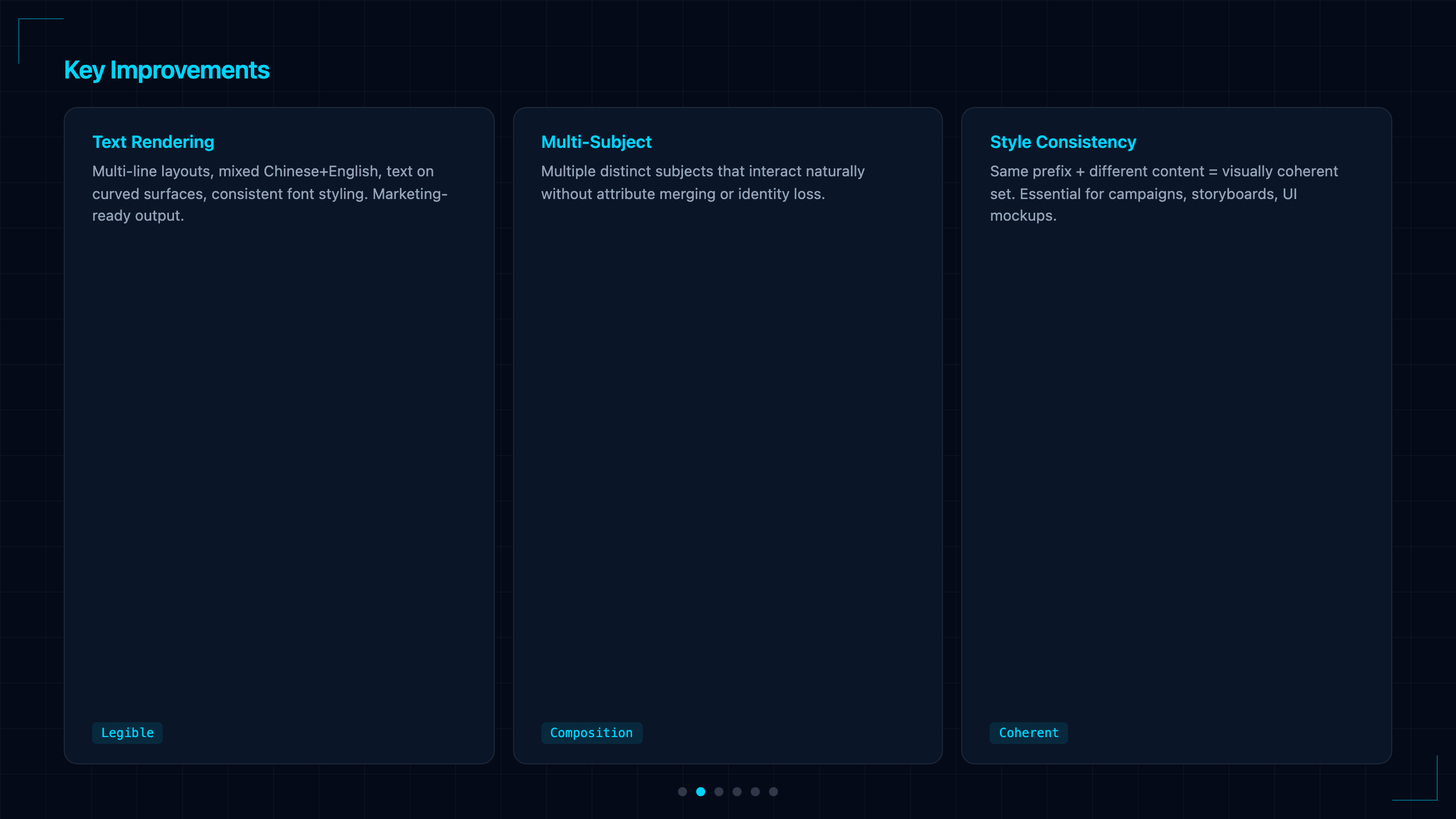
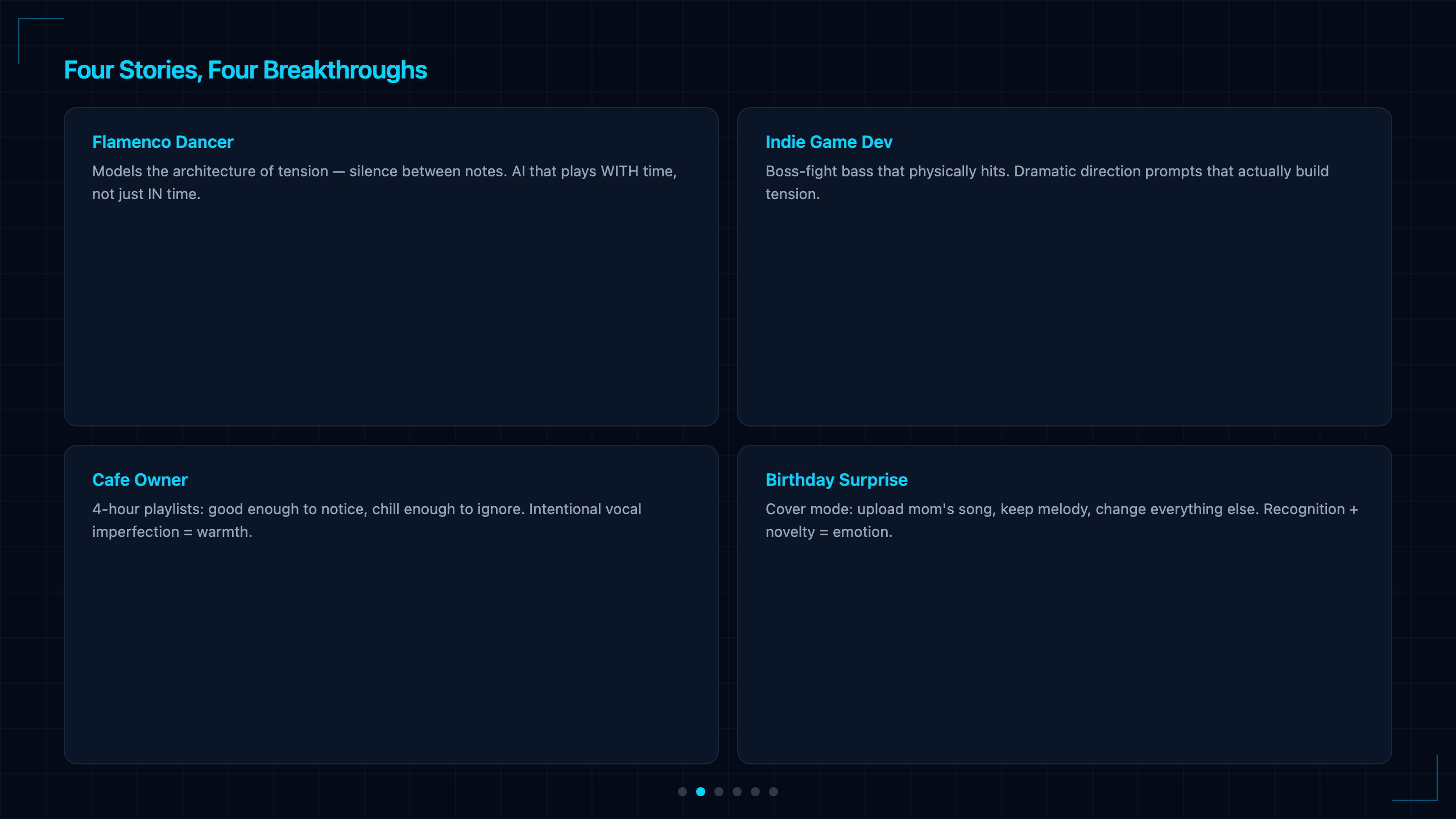
MiniMax released Music 2.6 with three breakthrough capabilities: Cover mode (upload a track, keep the melody, change everything else), redesigned low-end audio (sub-bass that physically hits), and vocal imperfection modeling (lo-fi warmth instead of synthetic polish). Positioned through four real use cases: a flamenco dancer, an indie game dev, a cafe owner, and a daughter making a birthday surprise.
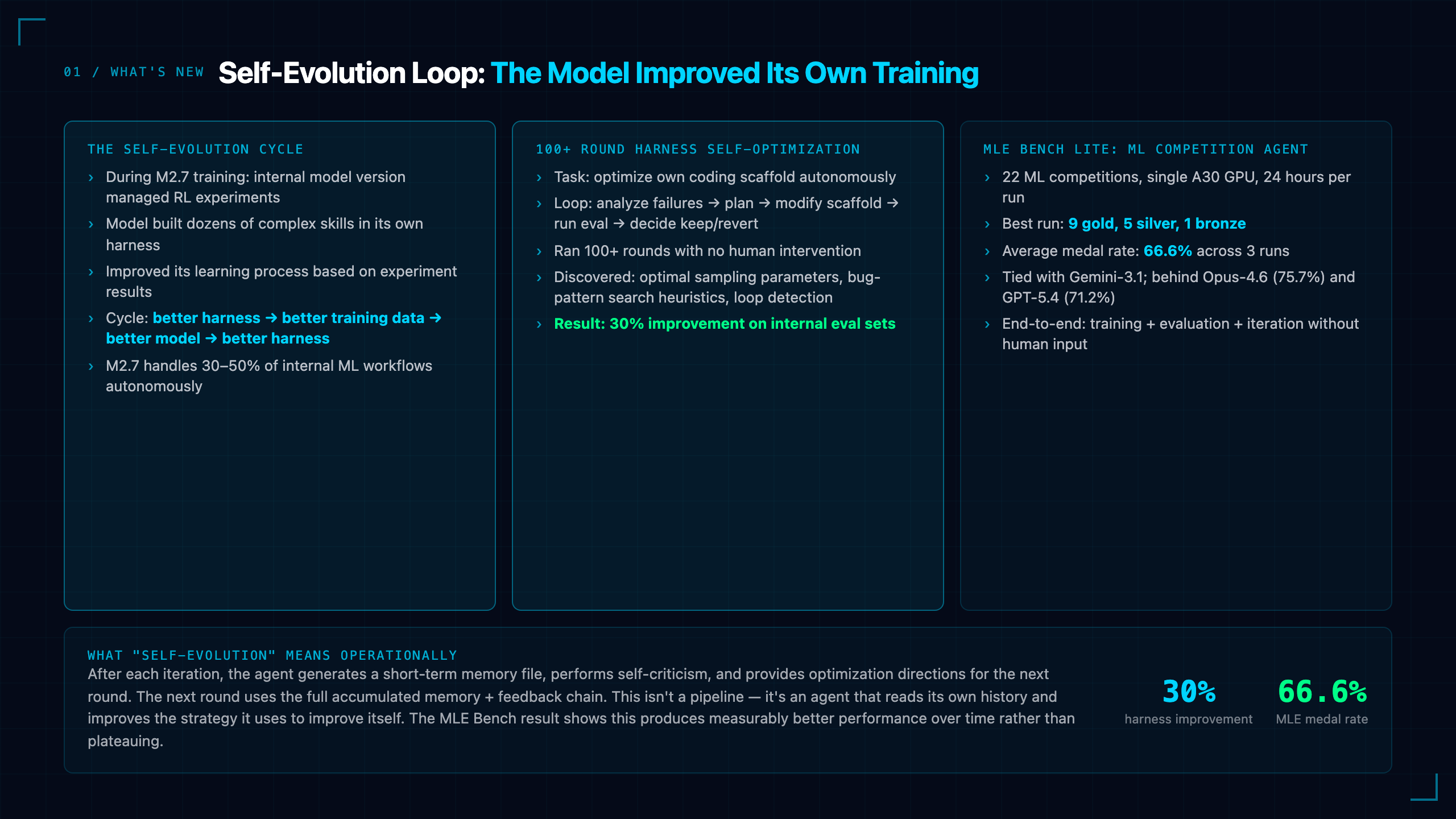
MiniMax M2.7 introduces model self-evolution: during its own training, the model managed reinforcement learning experiments, updated its memory, built complex skills, and improved its own harness based on results. SWE-Pro 56.22% (matches GPT-5.3-Codex), Terminal-Bench 2 57.0%, GDPval-AA ELO 1495 (#1 open-source). MLE Bench Lite: 66.6% medal rate, tied with Gemini-3.1. Production incident debugging reduced to under 3 minutes. Agent Teams, OpenRoom open-sourced.
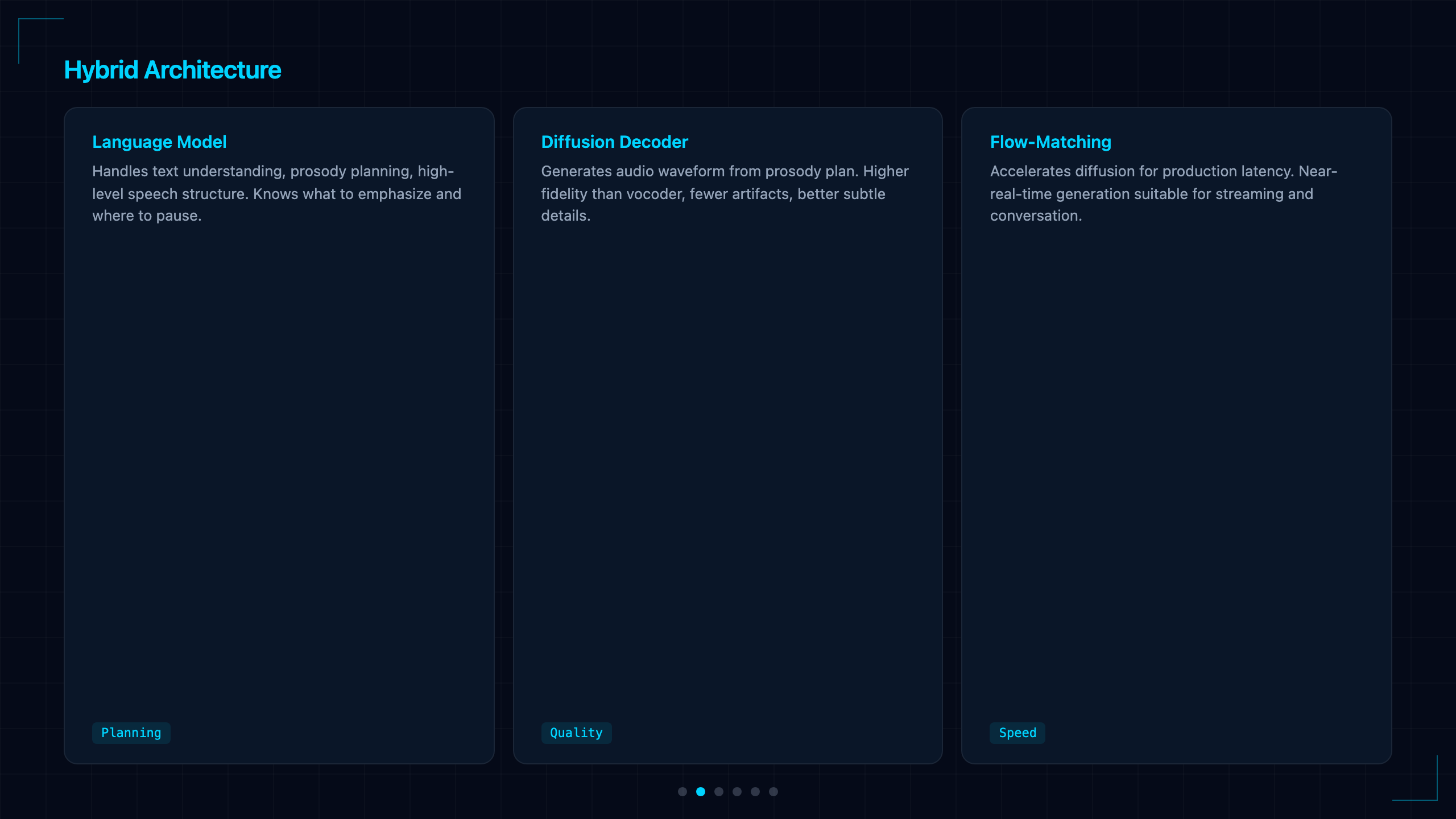
ByteDance's Seed team released SeedTTS 2 — a next-generation text-to-speech model achieving human parity on naturalness scores in both English and Chinese. Features zero-shot voice cloning, emotion control, and multi-speaker dialogue synthesis. Part of the Volcengine stack, competing directly with MiniMax Speech 2.8 and ElevenLabs in the production TTS market.
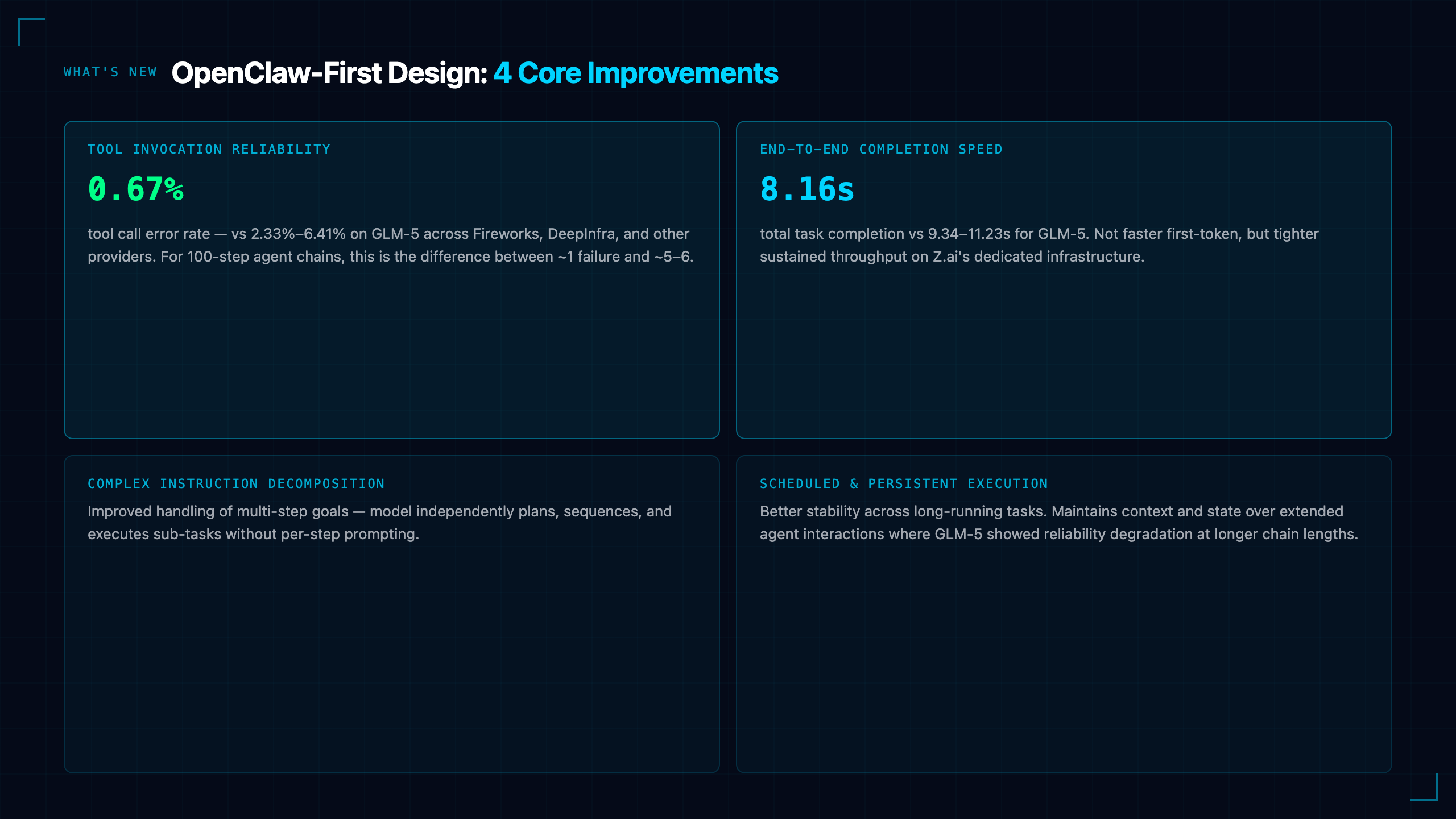
Z.ai released GLM-5-Turbo on March 15, 2026 — the first proprietary (closed-source) model from the lab behind GLM-5. Built on the 744B MoE architecture with 40B active parameters, GLM-5-Turbo is a production-tuned variant optimized for OpenClaw agent scenarios: tool calling, complex instruction decomposition, scheduled execution, and long-chain task stability. Key metric: 0.67% tool call error rate versus 2.33%–6.41% for GLM-5 across third-party inference providers. 200K context window, pricing at $0.96/M input and $3.20/M output.
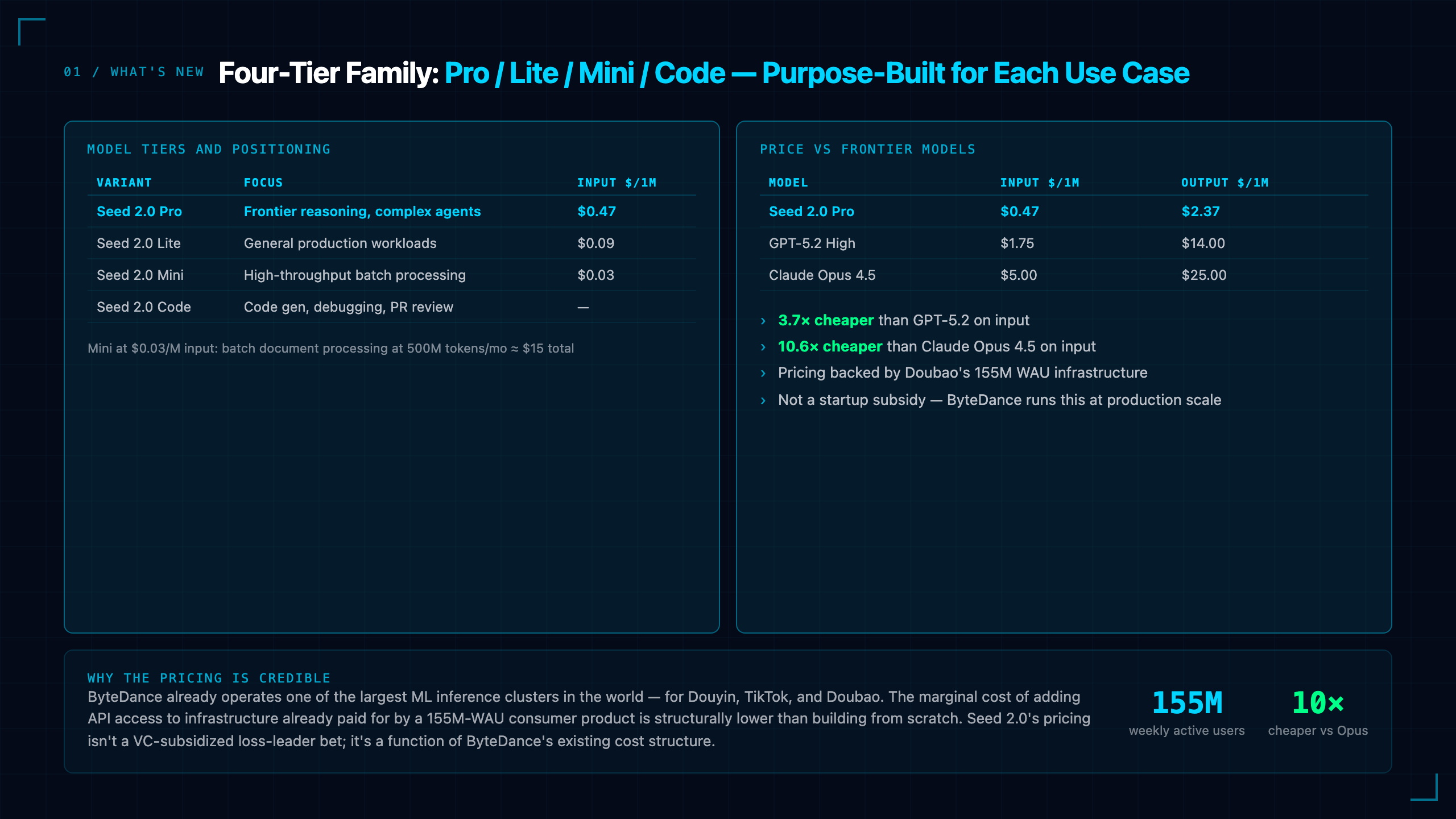
ByteDance released Doubao Seed 2.0 on February 14, 2026 — a four-variant LLM family powering China's most-used AI chatbot (155M weekly active users). Seed 2.0 Pro matches GPT-5.2 and Gemini 3 Pro on most benchmarks at a fraction of the cost: $0.47/M input vs GPT-5.2's $1.75/M (~3.7×), and ~10× cheaper than Claude Opus 4.5. AIME 2025: 98.3%. VideoMME: 89.5%. SWE-Bench Verified: 76.5%. Four tiers: Pro, Lite, Mini, Code. API via Volcano Engine.
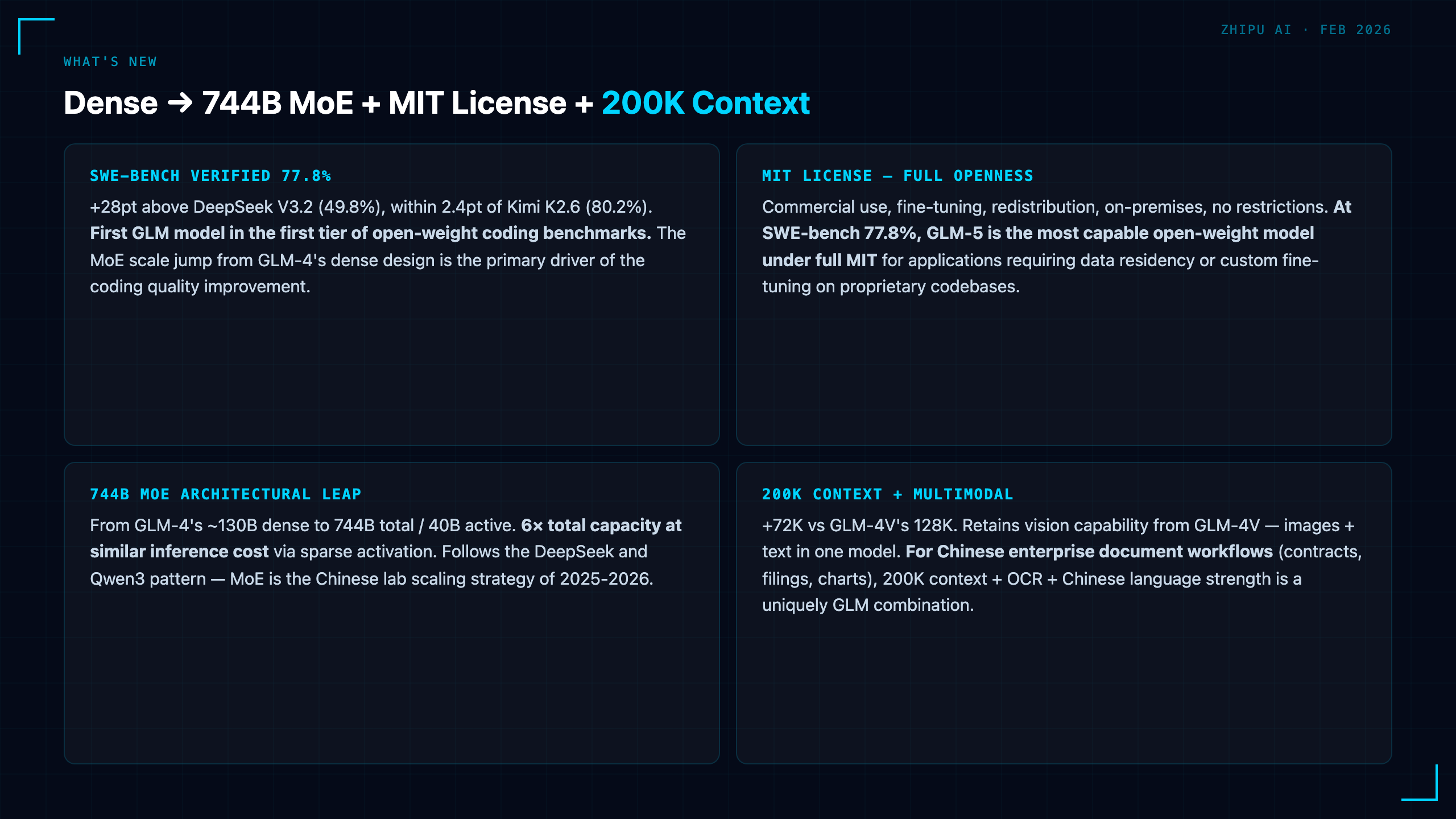
Zhipu AI released GLM-5 on February 14, 2026 — a 744B parameter MoE model with 40B active parameters, 200K token context, and MIT license. SWE-bench Verified 77.8% places GLM-5 firmly in the tier between Claude Sonnet 4 and DeepSeek V3.2. The model represents Zhipu's architectural leap from the GLM-4 generation: larger MoE scale, extended context, and a shift from restricted to fully open licensing.
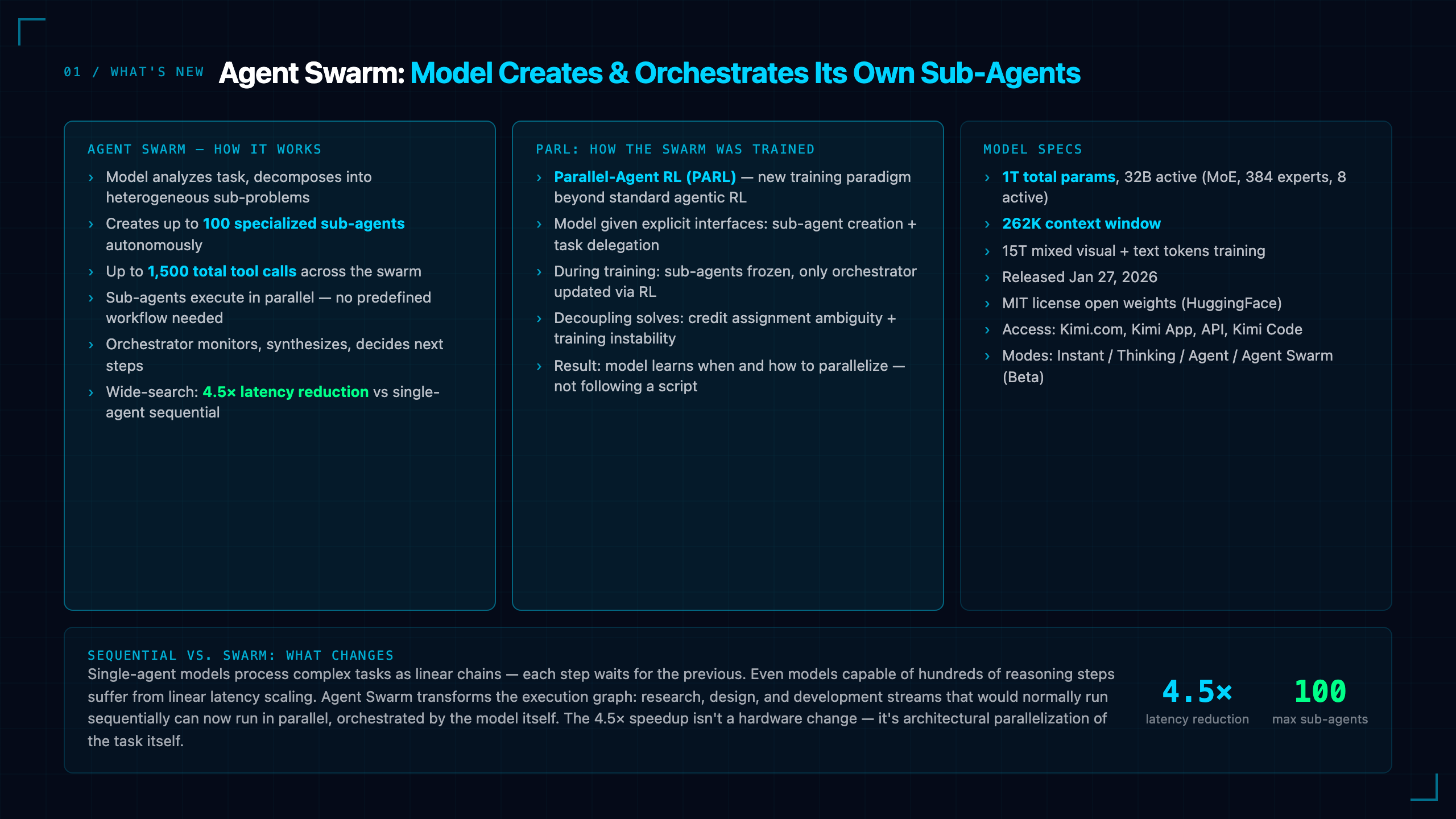
Moonshot AI released Kimi K2.5 on January 27, 2026 — an open-source native multimodal model trained on 15T mixed visual and text tokens. Its central innovation is Agent Swarm: the model autonomously creates and orchestrates up to 100 parallel sub-agents with up to 1,500 tool calls, cutting latency 4.5× over sequential execution. Architecture: 1T parameters, 32B active (MoE), 262K context. HLE: 50.2%. SWE-Bench Multilingual: 76.8%. MIT license. Available on Kimi.com, API, and Kimi Code.
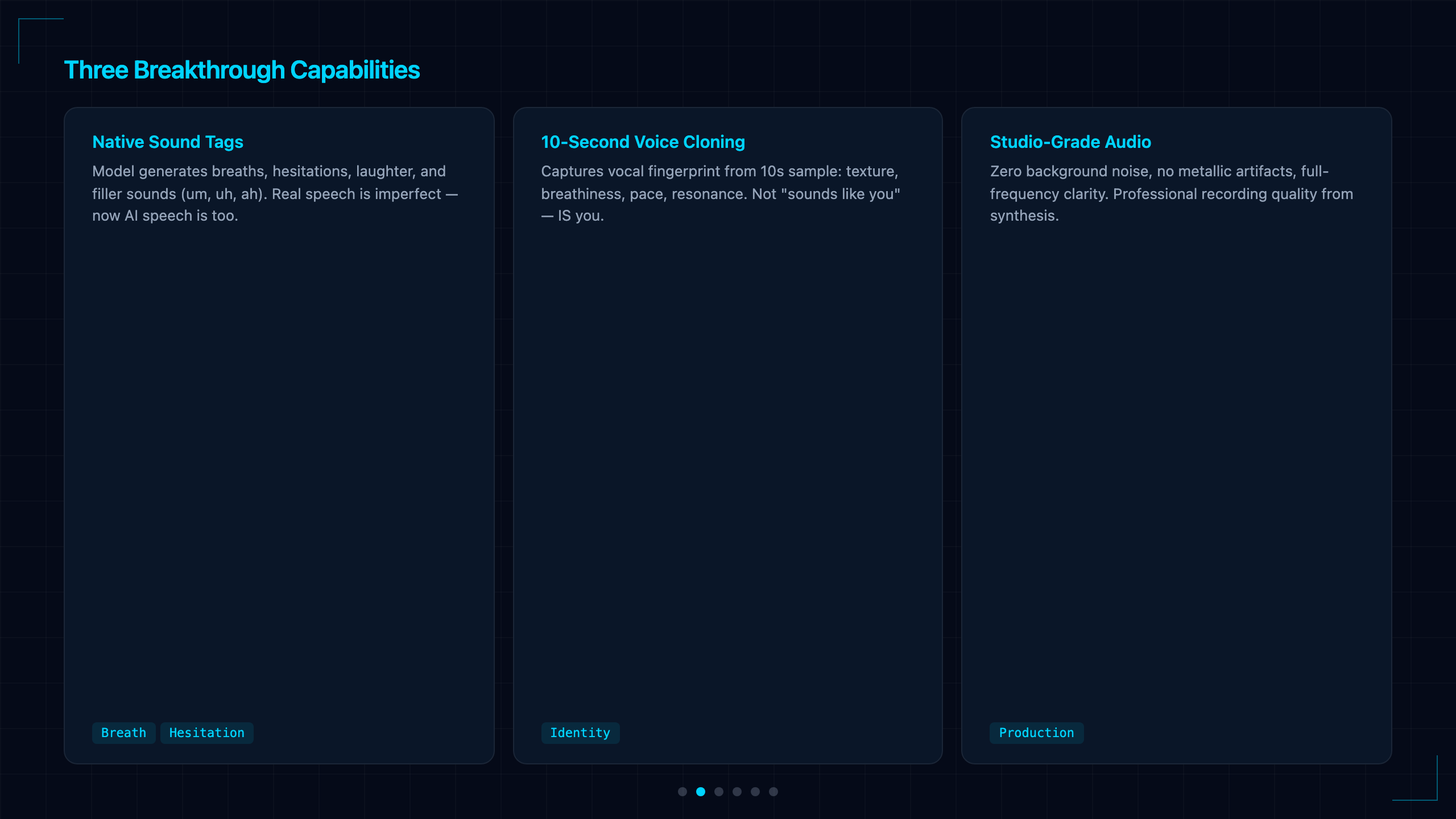
MiniMax released Speech 2.8 — a TTS model that introduces native sound tags (breath, hesitation, laughter), 10-second voice cloning that captures your 'vocal fingerprint,' and studio-grade noise elimination. The key insight: real speech is imperfect, and modeling those imperfections (um, uh, breath pauses) is what separates convincing AI voice from robotic delivery.
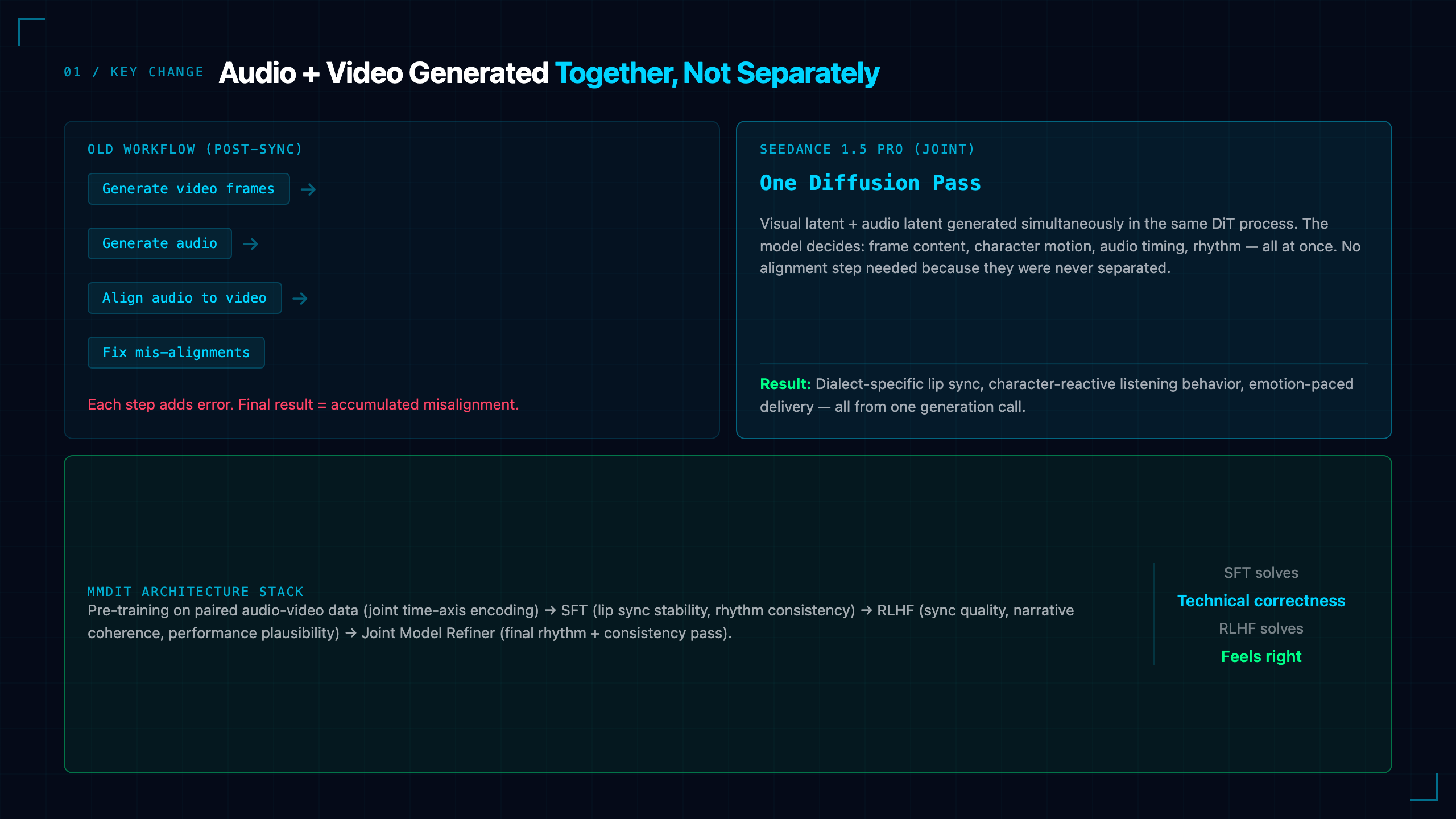
ByteDance's Seedance 1.5 Pro is a native audio-video joint generation model based on MMDiT architecture — audio and video latents generated in the same diffusion pass, not stitched post-hoc. Testing confirms: multi-character multi-language dialogue with synchronized lip movement, dialect support (Cantonese, Sichuan), cinematic emotion micro-performance, and commercial ad generation. API access opens next week on Volcano Engine.
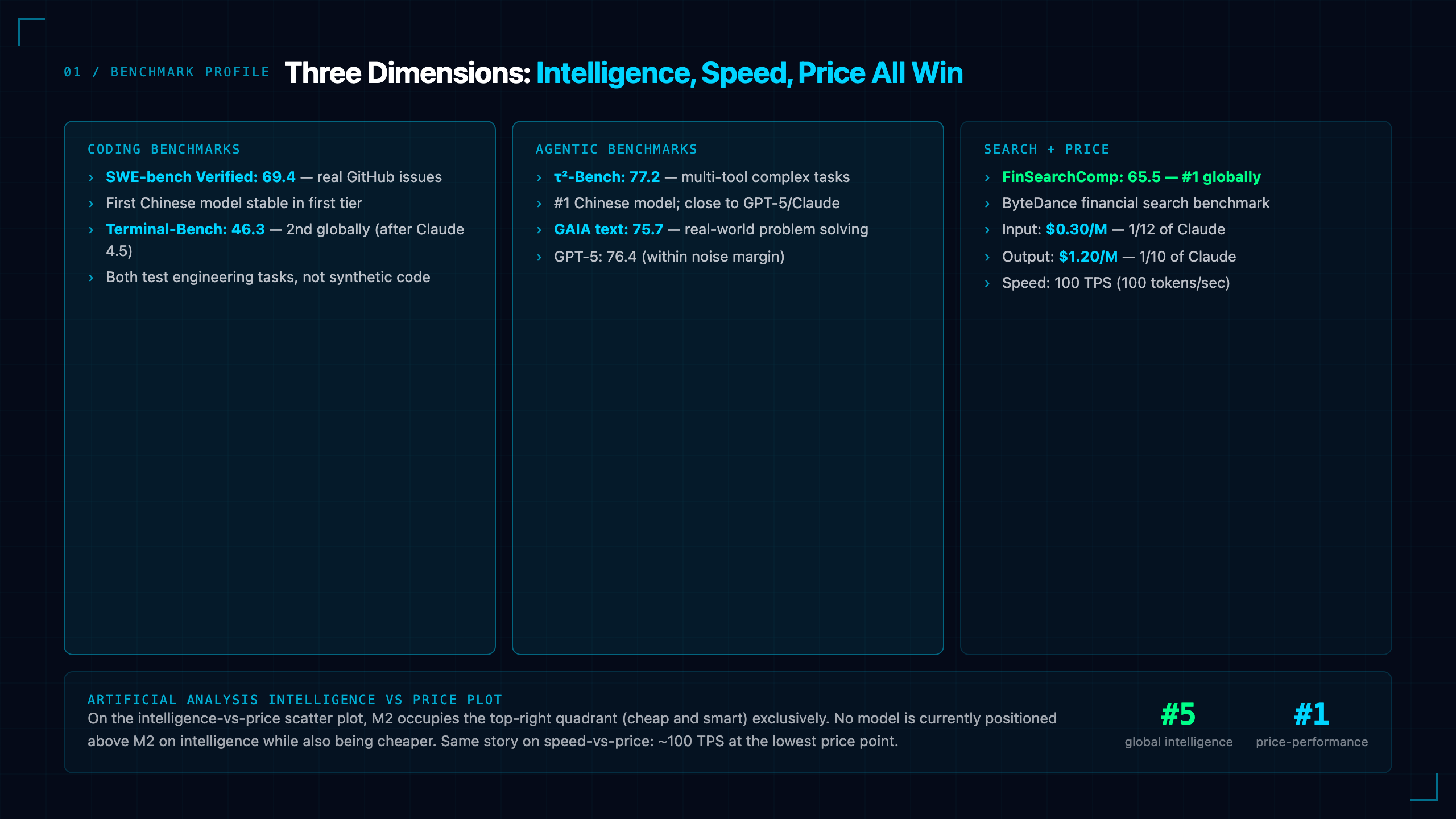
DeepSeek V3.2's launch highlighted a pattern that five major AI labs have independently implemented under different names: Interleaved Thinking (MiniMax M2), Extended Thinking (Anthropic Claude), Thinking in Tool-Use (DeepSeek), thinking-while-using-tools (Kimi). The capability is identical: models think between each tool call, preserving reasoning state across the chain. MiniMax's contribution was making it an engineering standard — with quantified benchmark results (+35.9% on Tau², +40.1% on BrowseComp) and ecosystem adoption across Kilo Code, Cline, OpenRouter.
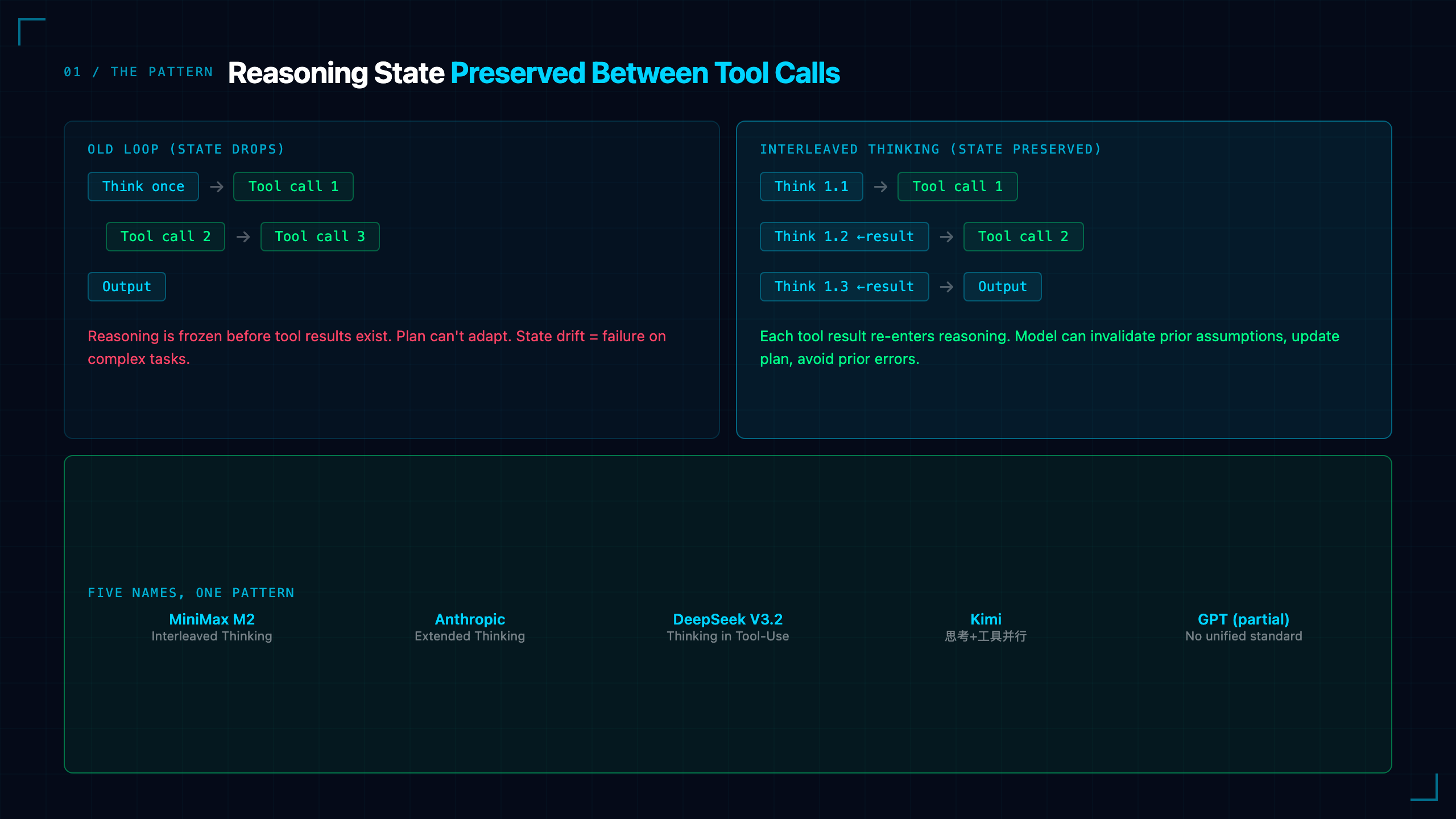
DeepSeek released Math-V2 — a self-verifiable mathematical reasoning model that scores gold-level on IMO 2025, near-perfect 118/120 on Putnam 2024, and solves CMO 2024. Built on V3.2-Exp-Base, it trains a faithful LLM-based verifier as reward model and scales verification compute to maintain the generation-verification gap. Apache 2.0 license.
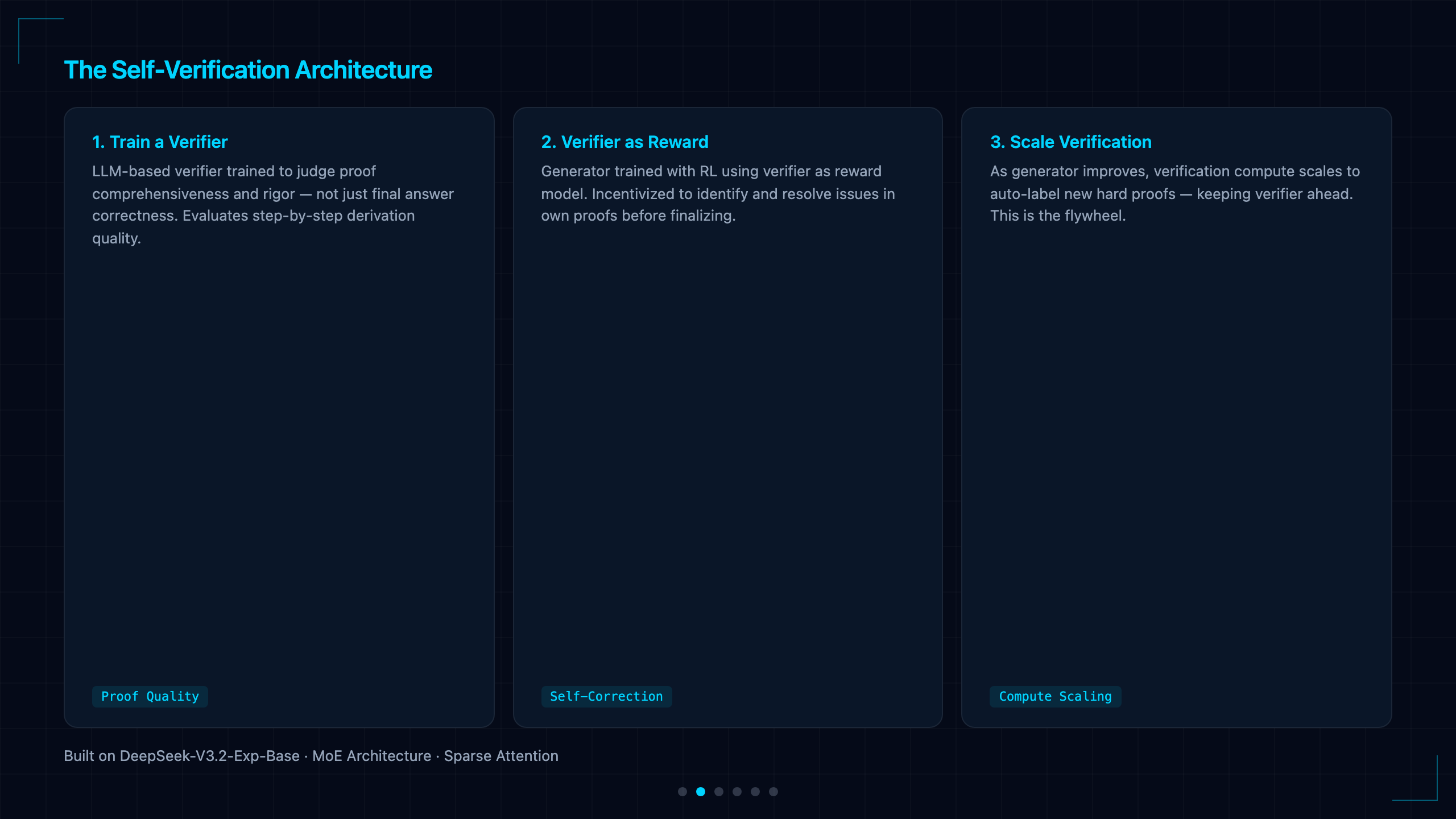
Two weeks after launch, MiniMax M2 hit OpenRouter Top 5 by token volume — fastest-growing Chinese model. Now they've followed with a ¥29/month unlimited coding subscription (first month ¥9.9). Compared to Claude Code Pro ($20/month, 10-20 requests per 5-hour window), MiniMax's plan is 8% of the price with 4× the usage allowance. API config is 4-line JSON in ~/.claude/settings.json. First-hand testing: data analysis to dashboard, MLX/Swift deployment plan, physics-aware mini-game — all first-attempt.
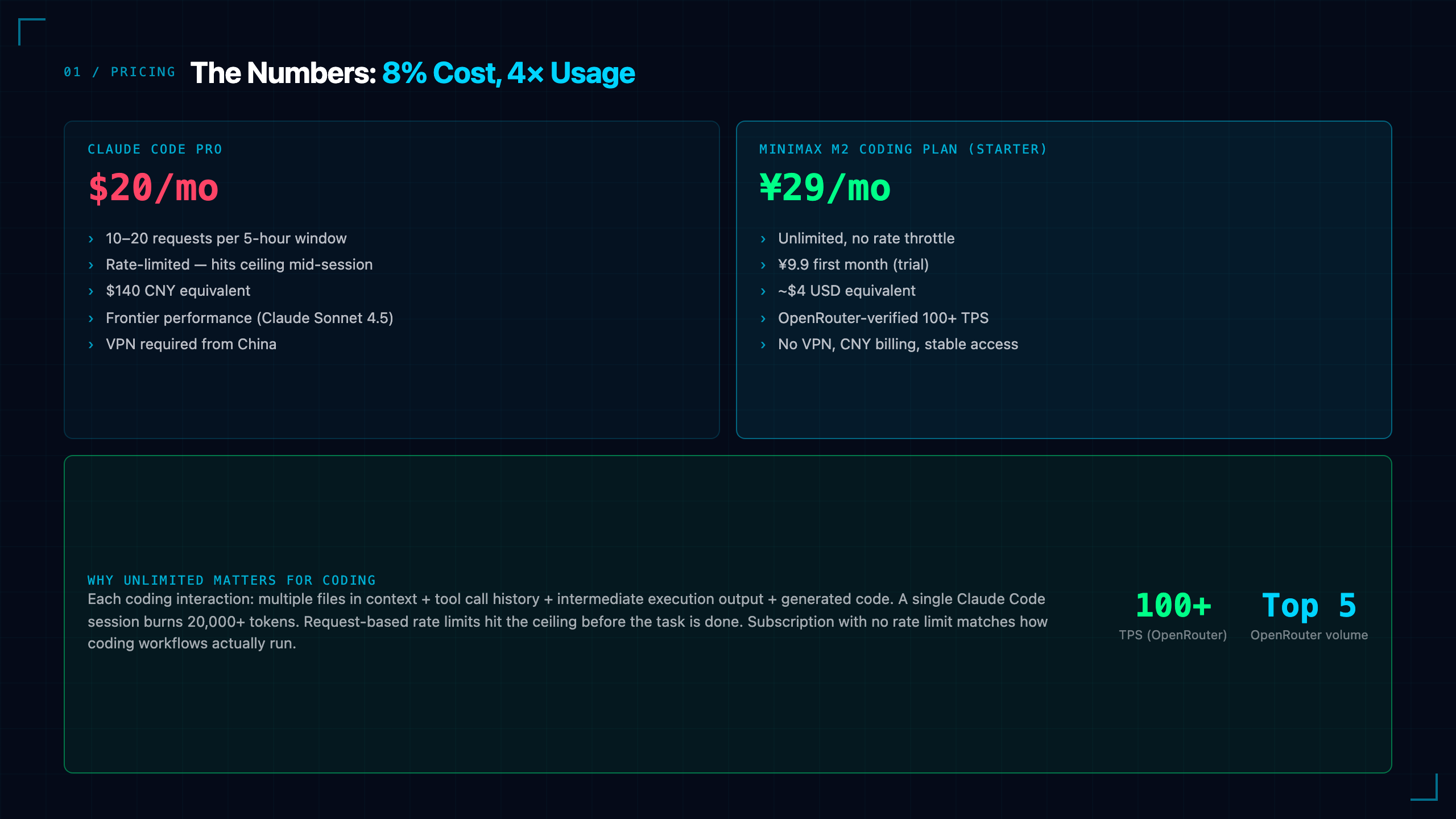
MiniMax M2 launched open-source with a benchmark profile that breaks the usual intelligence/speed/cost tradeoff: Artificial Analysis Intelligence Index #5 globally (behind GPT-5, Grok 4, Claude 4.5), $0.3/M input (1/12 of Claude, 1/7 of GPT-5), 100 TPS, SWE-bench Verified 69.4 (#1 Chinese model), FinSearchComp 65.5 (#1 globally). Six agent use cases tested: iOS app, data-driven web game, wish wall with Supabase backend, financial literature review, renovation budget with 3D layout, multimodal Dunhuang museum tour.
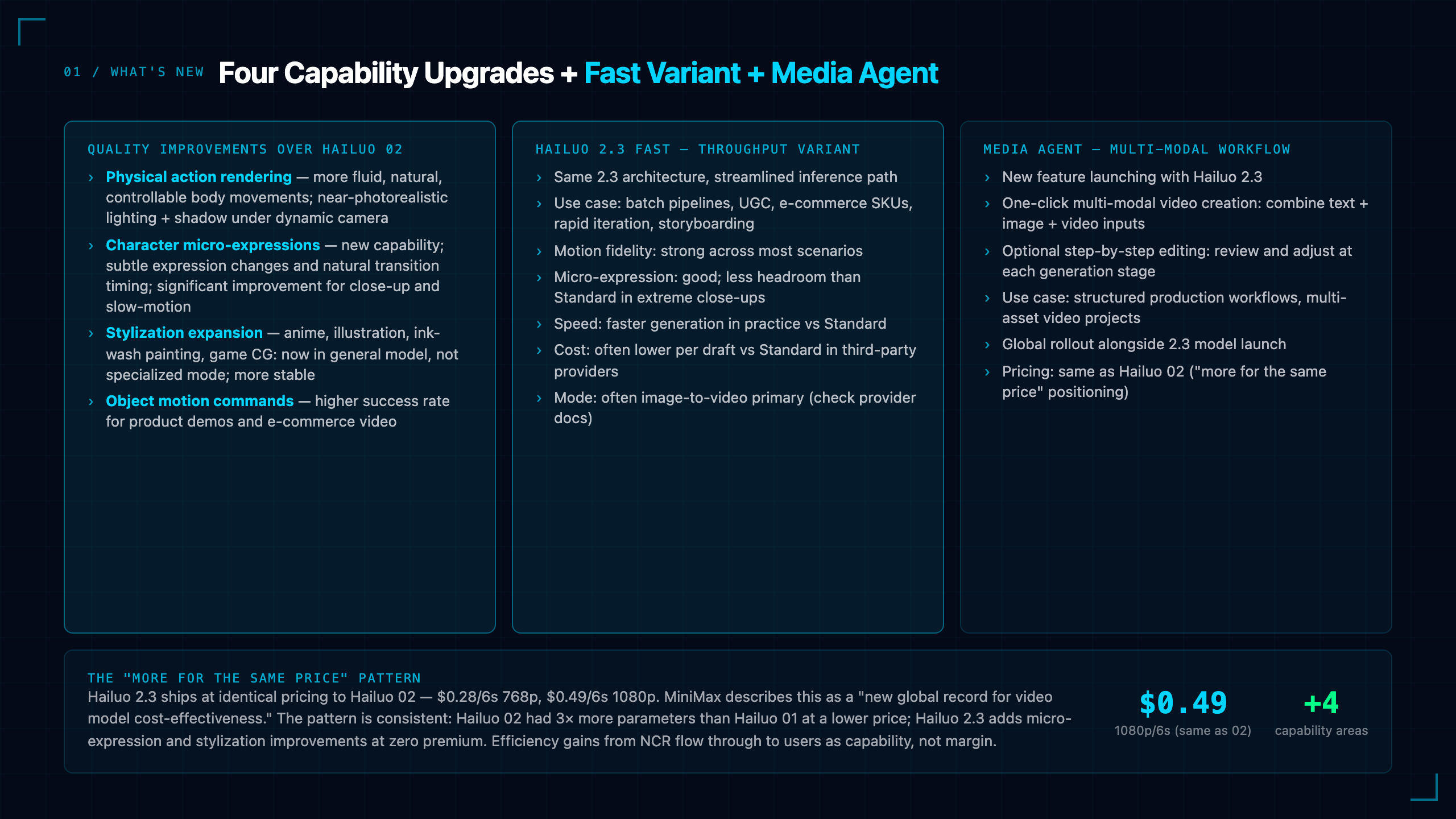
MiniMax released Hailuo 2.3 on October 28, 2025 — the successor to Hailuo 02, with significant improvements in physical action rendering, character micro-expressions, stylization stability (anime, illustration, ink-wash, game CG), and motion command response. A new Fast variant runs at lower cost and latency for batch pipelines. Both variants maintain Hailuo 02 pricing. New Media Agent feature enables one-click multi-modal video creation. Supports 768p/6s, 768p/10s, 1080p/6s.
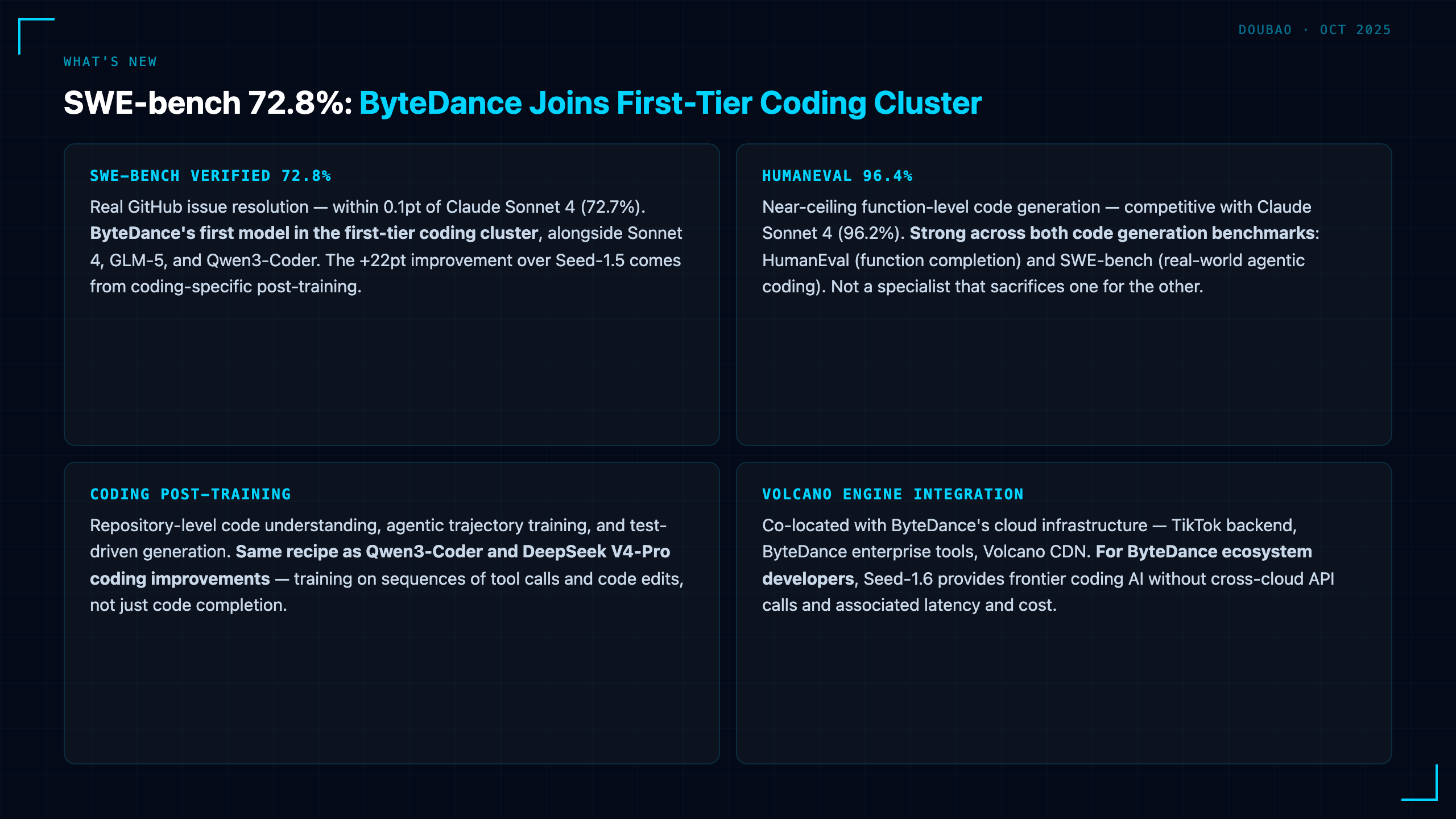
ByteDance released Doubao-Seed-1.6 in October 2025 — a coding-optimized model that reaches SWE-bench Verified 72.8%, LiveCodeBench 71.2, and HumanEval 96.4%. Built on the Doubao Seed series foundation with coding-specific post-training, it positions ByteDance in the first tier of Chinese lab coding models. Available via Volcano Engine API with competitive pricing for high-volume coding applications.
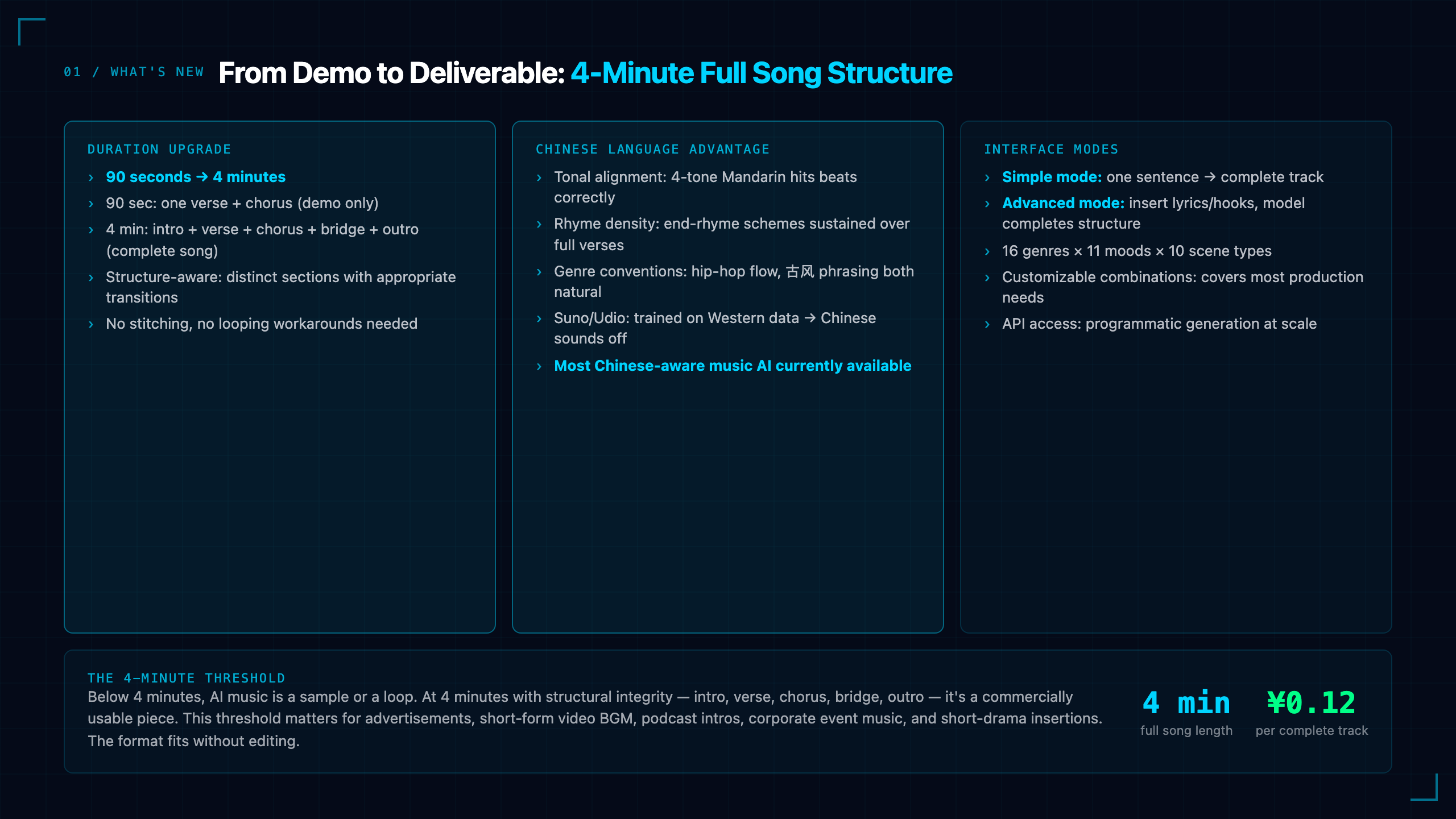
MiniMax upgraded Music to version 1.5, extending single-track generation from 90 seconds to 4 minutes — full pop song length with intro, verse, chorus, bridge, and outro. Price: approximately ¥0.12 per complete track. API access included (Suno doesn't offer API). The model supports 16 genres, 11 moods, 10 scene types, lyric insertion in advanced mode, and demonstrates measurably better Chinese-language musical handling than Western counterparts. Positioned as the production-ready API layer for AI music in China.
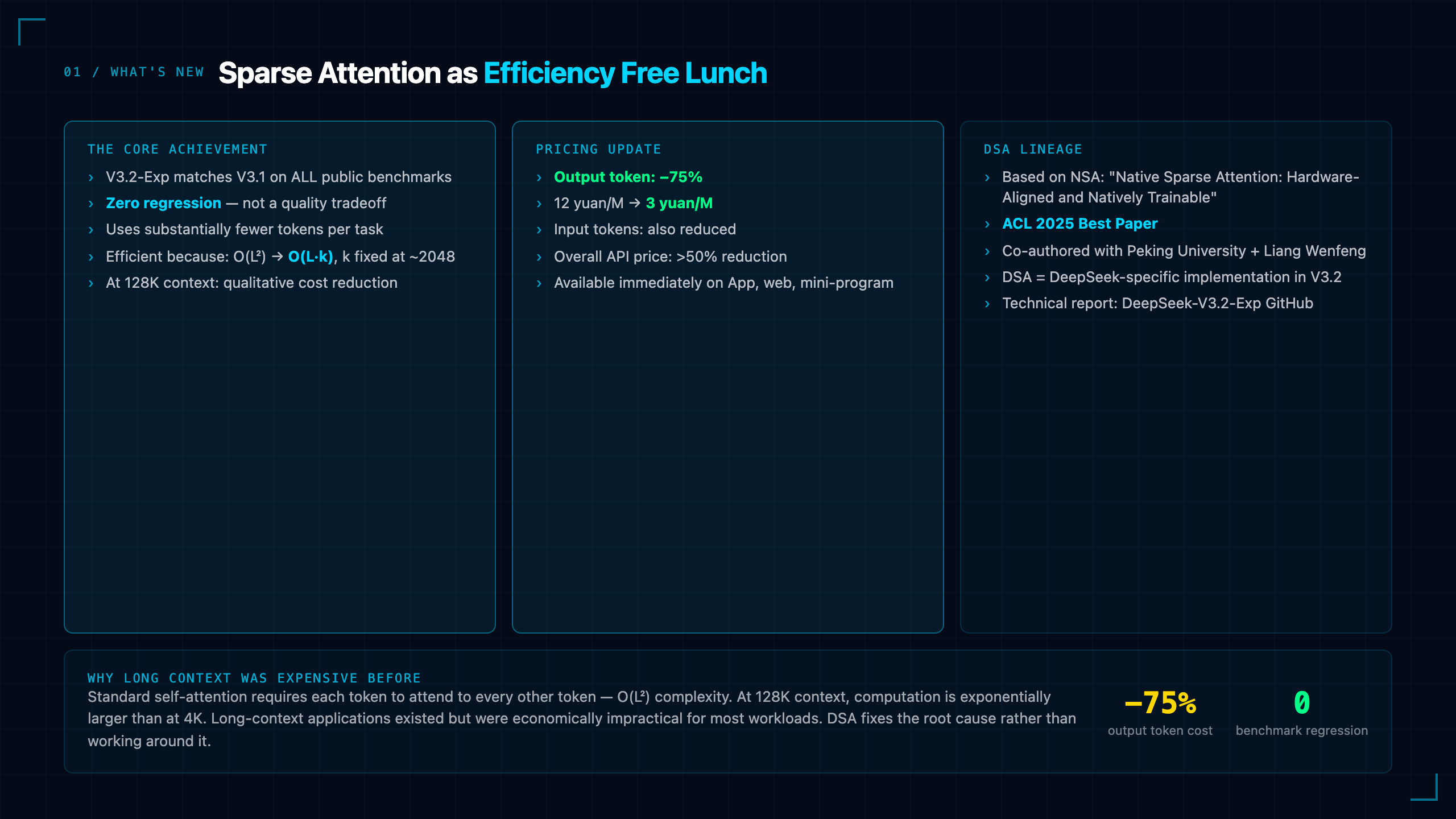
DeepSeek released V3.2-Exp the night before China's National Day holiday — same performance as V3.1 on all public benchmarks, with output token cost slashed 75% (12 yuan/M → 3 yuan/M). The efficiency gain comes from DSA (DeepSeek Sparse Attention), an implementation of Native Sparse Attention that replaces O(L²) full attention with O(L·k) selective attention. Cambricon adapted in 4 minutes post-launch; Huawei Cloud CloudMatrix 384 is hosting inference.
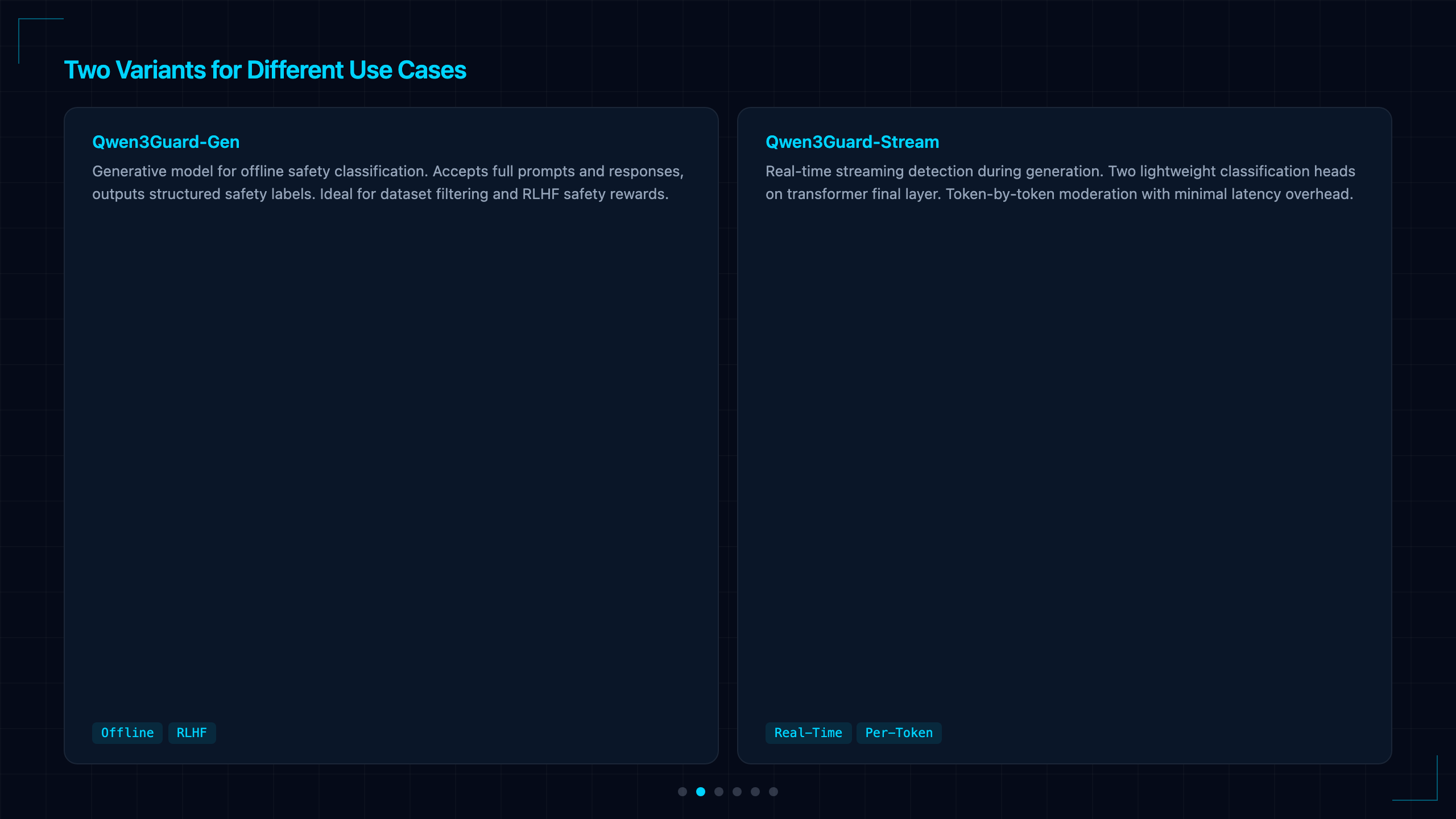
Alibaba released Qwen3Guard — the first open-source guardrail model with real-time streaming safety detection. Two variants: Gen (offline classification) and Stream (token-by-token moderation with lightweight classification heads). Three severity tiers (Safe/Controversial/Unsafe) for flexible policy enforcement. 119 languages. 0.6B to 8B params. Available on HuggingFace and ModelScope.
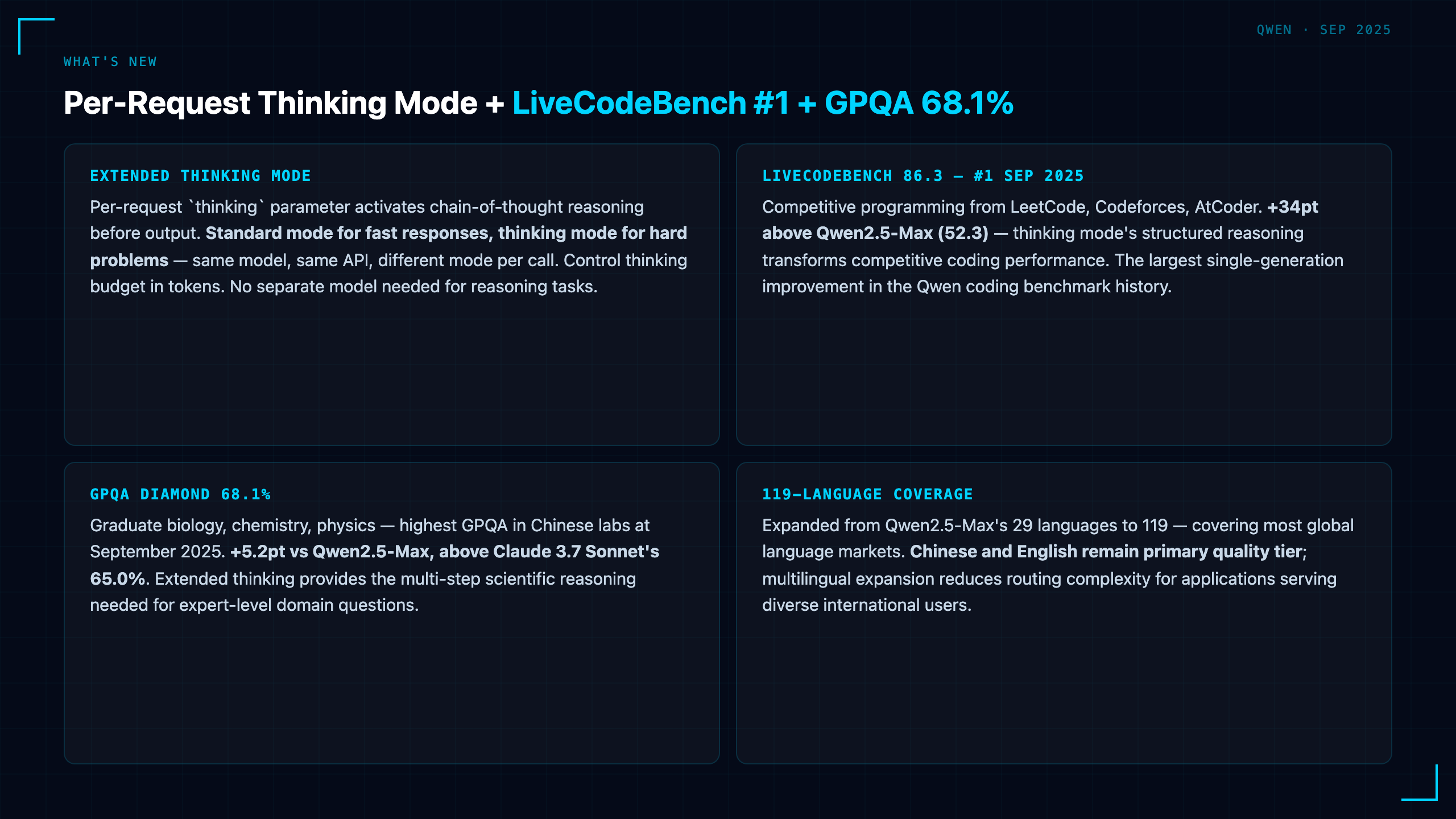
Alibaba released Qwen3-Max in September 2025 — the flagship model in the Qwen3 generation. An upgrade over Qwen2.5-Max, Qwen3-Max introduces extended thinking mode for complex reasoning, tops LiveCodeBench at 86.3, and achieves GPQA Diamond 68.1% — the highest in the Qwen family. At comparable pricing to Qwen2.5-Max, Qwen3-Max delivers materially stronger reasoning, coding, and scientific QA.
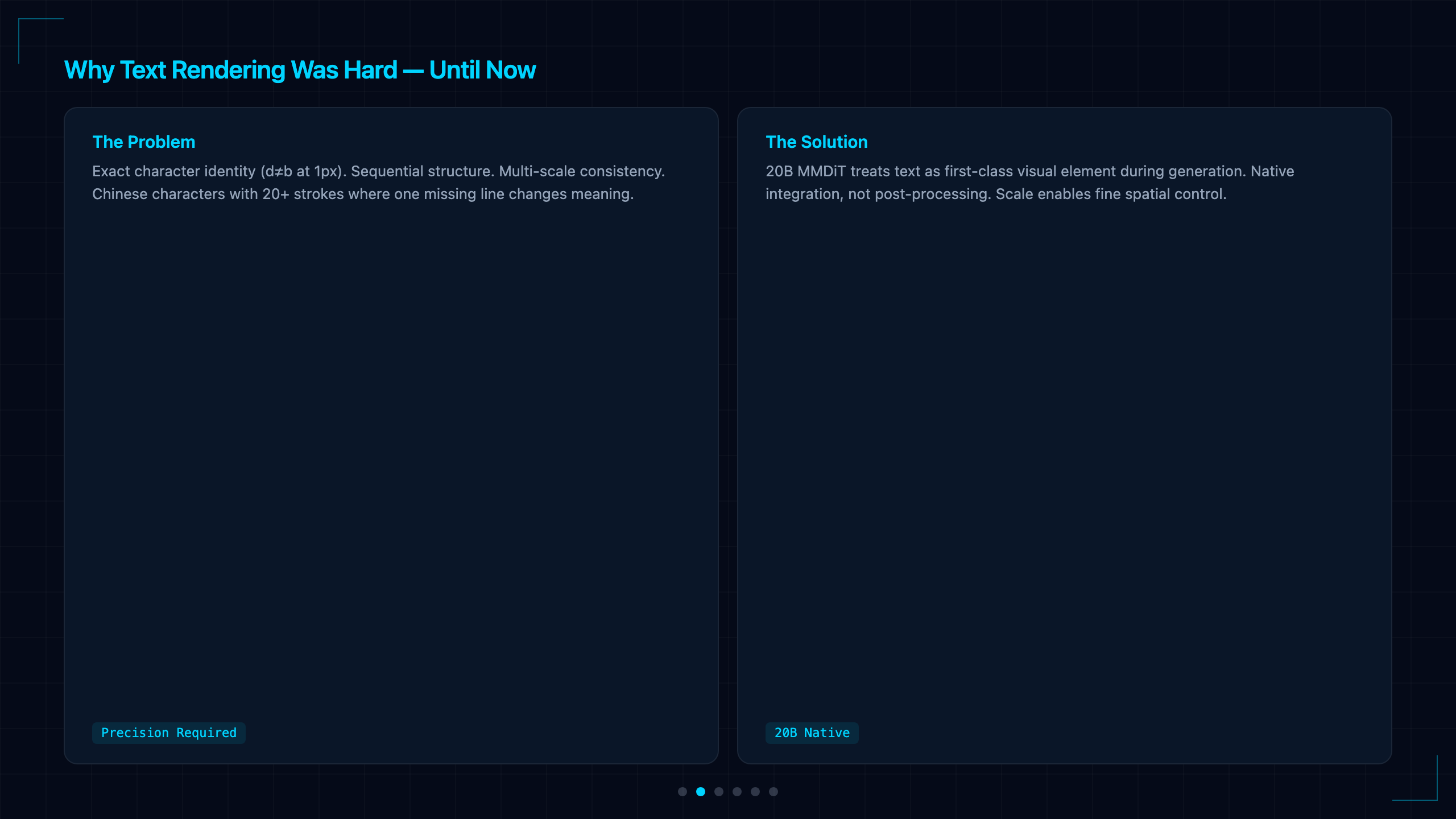
Alibaba released Qwen-Image — a 20B parameter MMDiT image foundation model that achieves state-of-the-art text rendering (especially Chinese) and precise image editing. SOTA on GenEval, DPG, OneIG-Bench (generation), GEdit, ImgEdit, GSO (editing), and LongText-Bench, ChineseWord, TextCraft (text rendering). Open-source on HuggingFace and ModelScope.
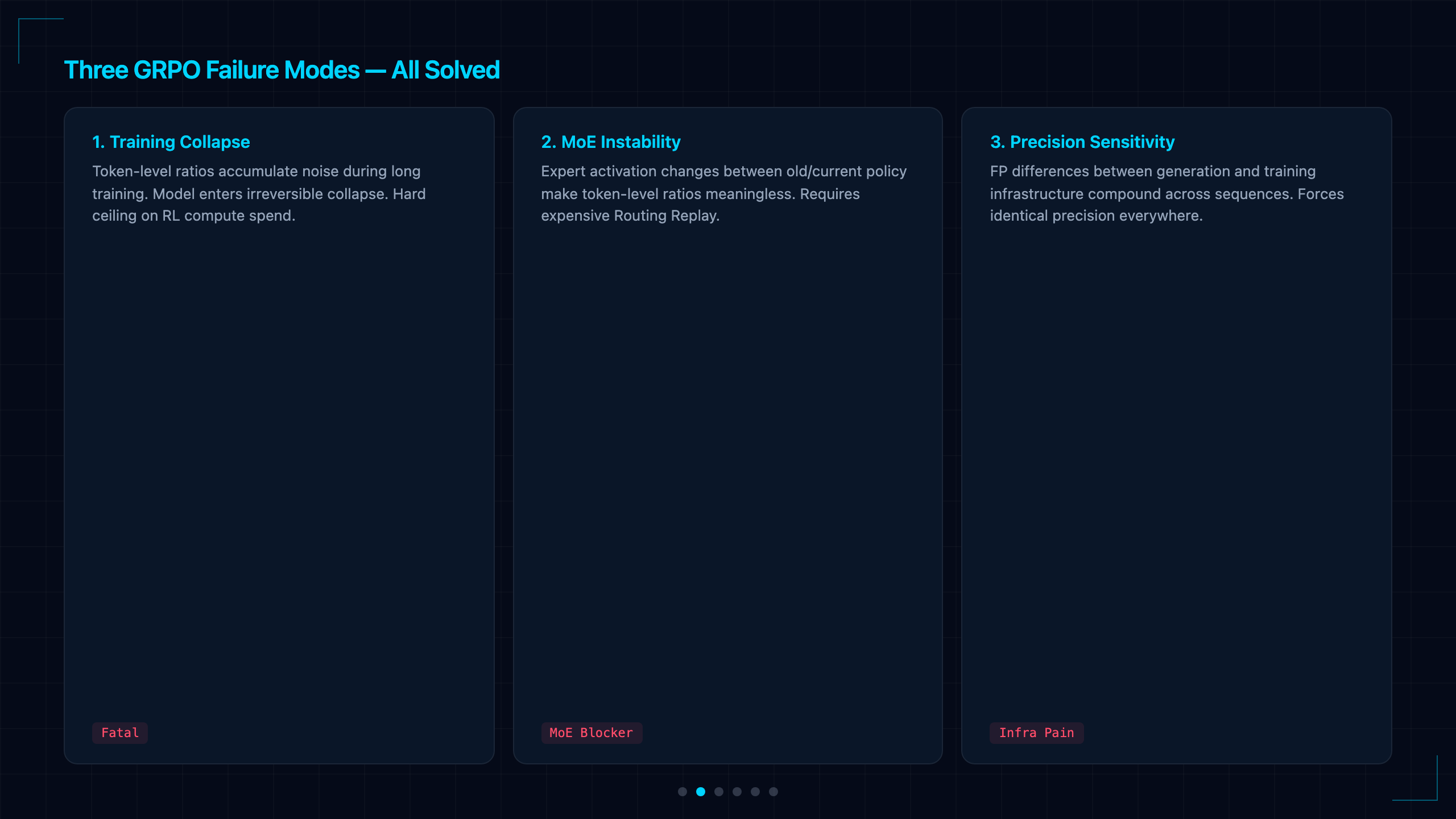
Alibaba's Qwen team published GSPO (Group Sequence Policy Optimization) — a sequence-level RL algorithm that replaces GRPO for scalable LLM training. GSPO fixes three critical GRPO failure modes: training collapse during long runs, MoE expert activation volatility, and infrastructure complexity. It powered the RL training of all Qwen3 models (Instruct, Coder, Thinking). Open paper, no code yet.
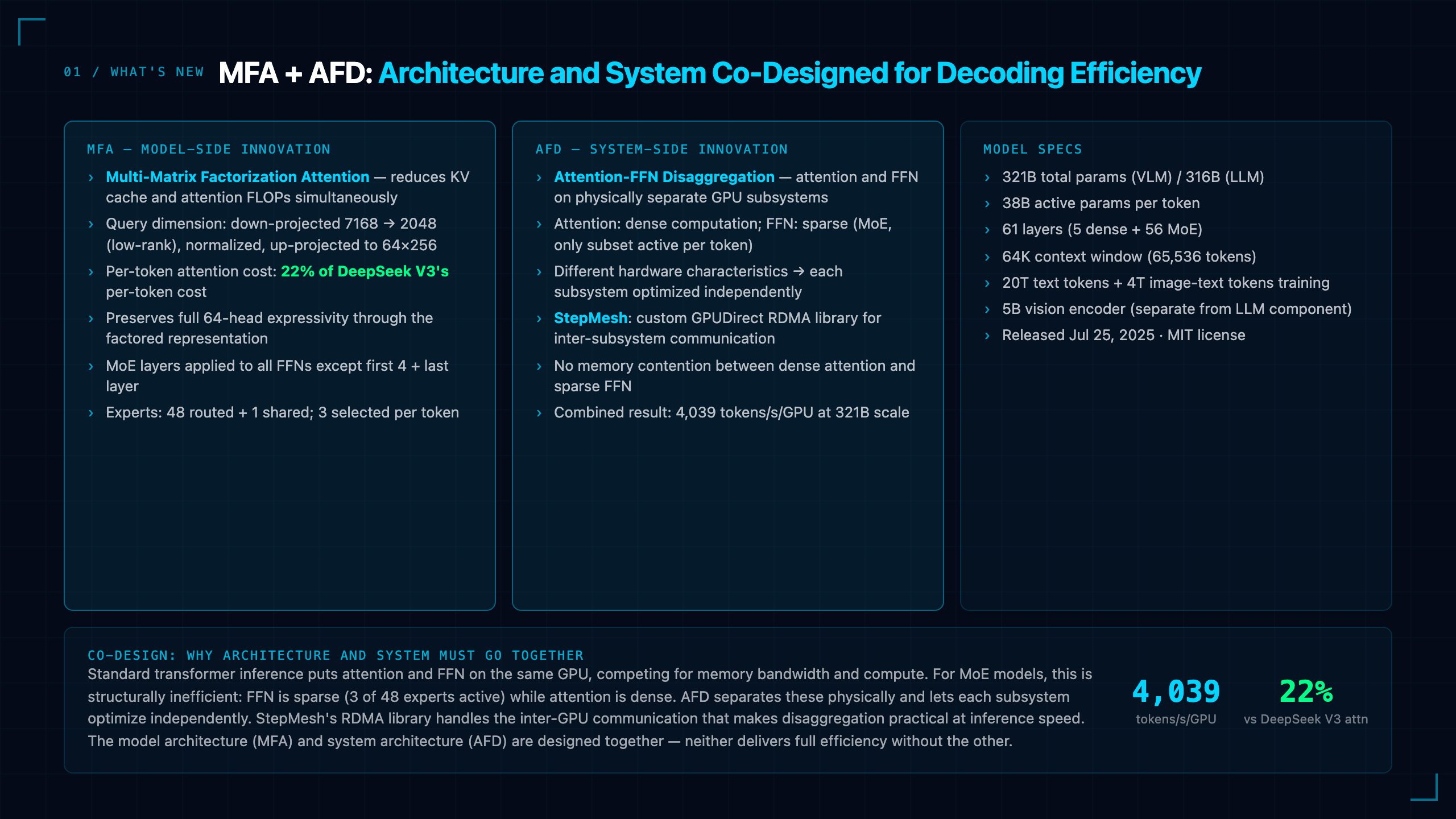
StepFun released Step3 on July 25, 2025 — a 321B-parameter native multimodal MoE model with 38B active parameters per token. Two co-designed innovations: Multi-Matrix Factorization Attention (MFA), using only 22% of DeepSeek V3's per-token attention cost, and Attention-FFN Disaggregation (AFD), physically separating attention and FFN compute to specialized GPU subsystems. Result: 4,039 tokens/s/GPU throughput. Benchmarks: MMMU 74.2%, MATH-Vision 64.8%, AIME 2025 82.9%, GPQA-Diamond 73.0%. #1 open-source VLM on most benchmarks at release. Open weights, MIT license.
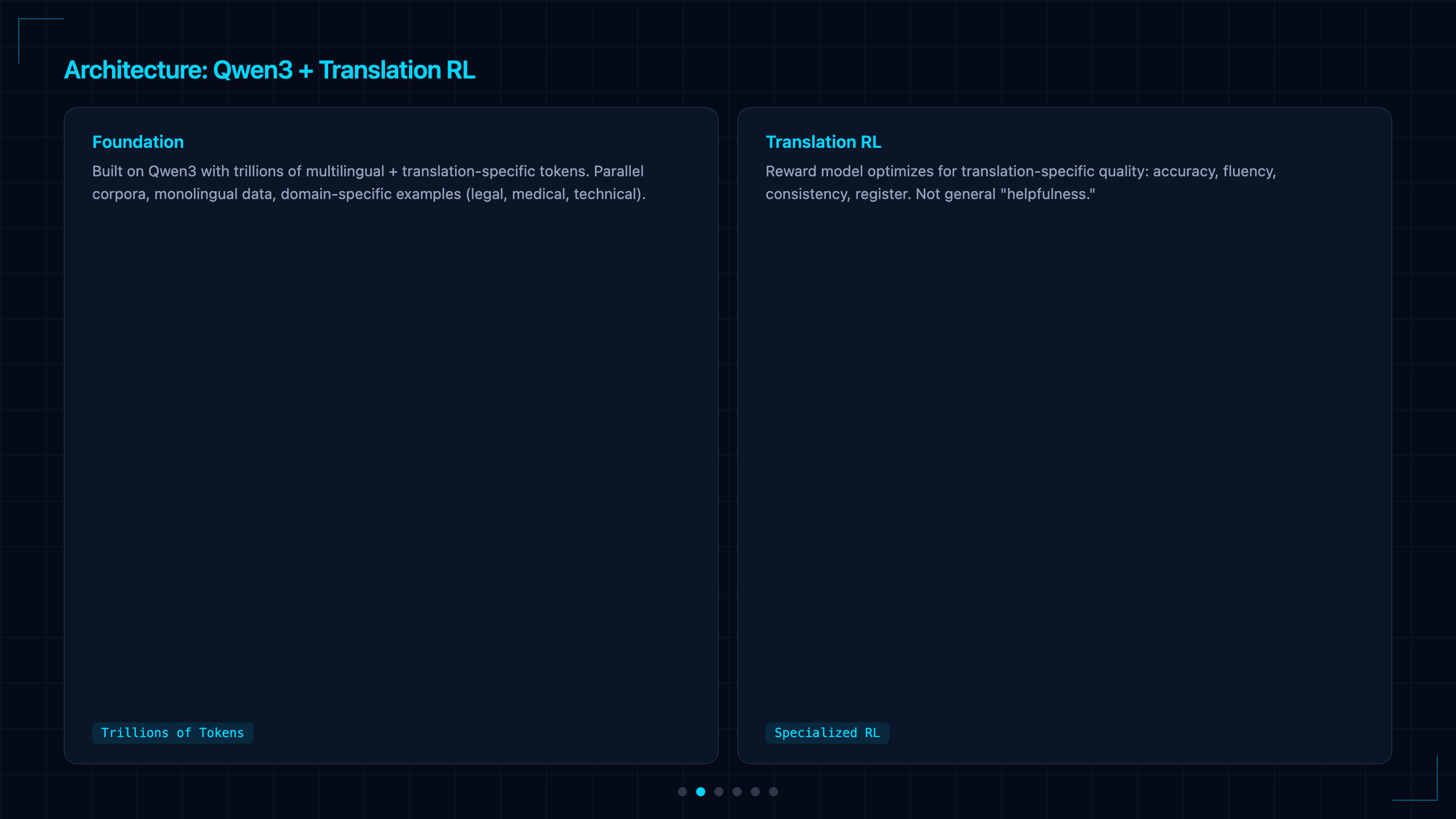
Alibaba released Qwen-MT (qwen-mt-turbo) — a specialized translation model built on Qwen3 with trillions of multilingual tokens and RL-enhanced fluency. Covers 92 languages (95%+ of global population). Trained with reinforcement learning for translation accuracy. Available via Qwen API. Positions Alibaba against DeepL, Google Translate, and general-purpose LLMs used for translation.
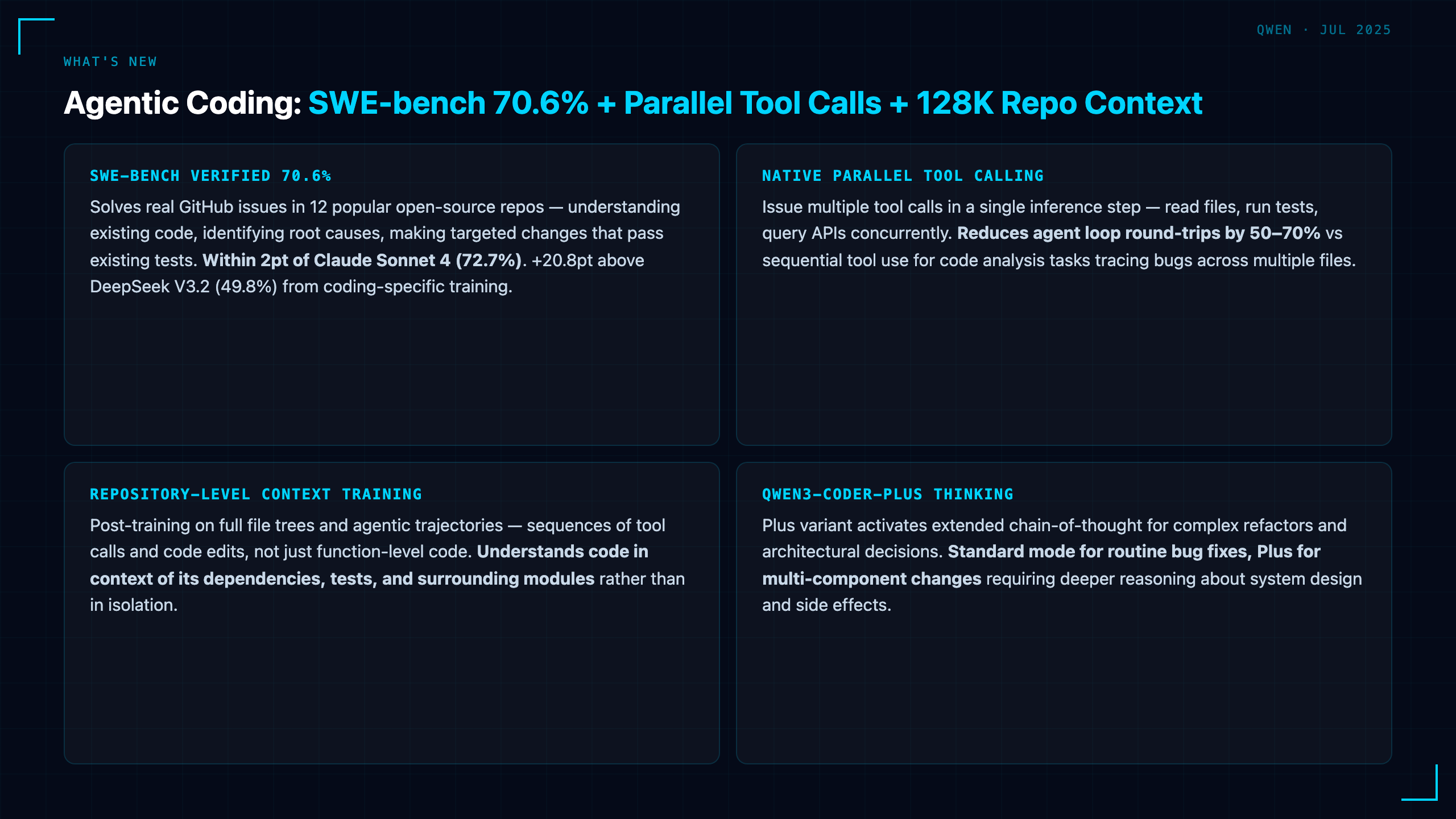
Alibaba released Qwen3-Coder on July 22, 2025 — a 480B parameter MoE model with 35B active parameters, purpose-built for autonomous coding agents. SWE-bench Verified 70.6% places it above DeepSeek V3.2 and competitive with Claude Sonnet 4. Native parallel tool calling, agentic loop support, and a 128K token context window make Qwen3-Coder the first Qwen model optimized specifically for multi-step code execution workflows.
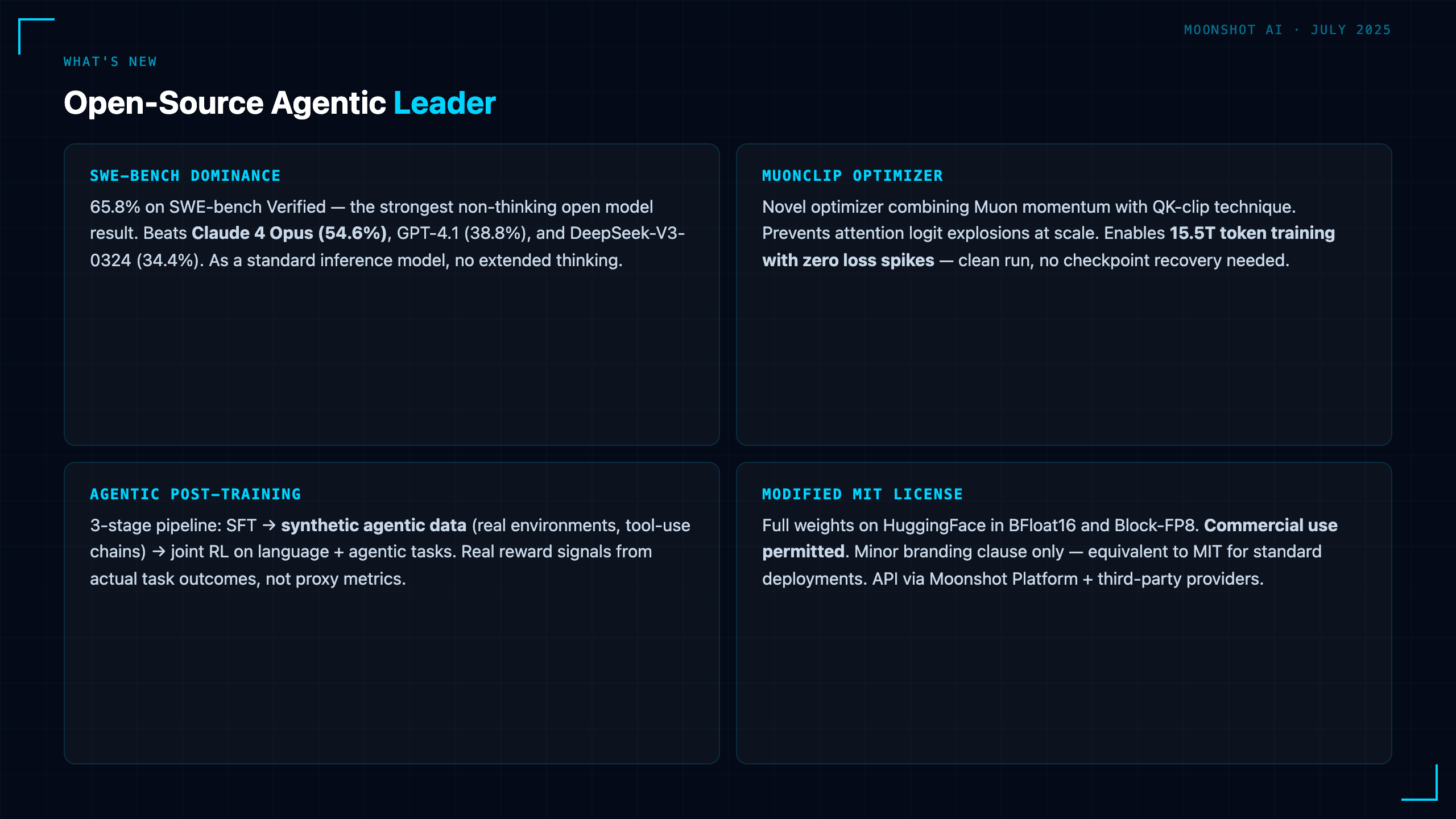
Moonshot AI released Kimi K2 in July 2025 — a 1T-parameter MoE model with 32B active per token, trained on 15.5T tokens using the novel MuonClip optimizer. It scores 65.8% on SWE-bench Verified and 66.1% on Tau2-Bench, surpassing Claude Opus and GPT-4.1 on agentic benchmarks without extended thinking. Released under Modified MIT license with full commercial use.
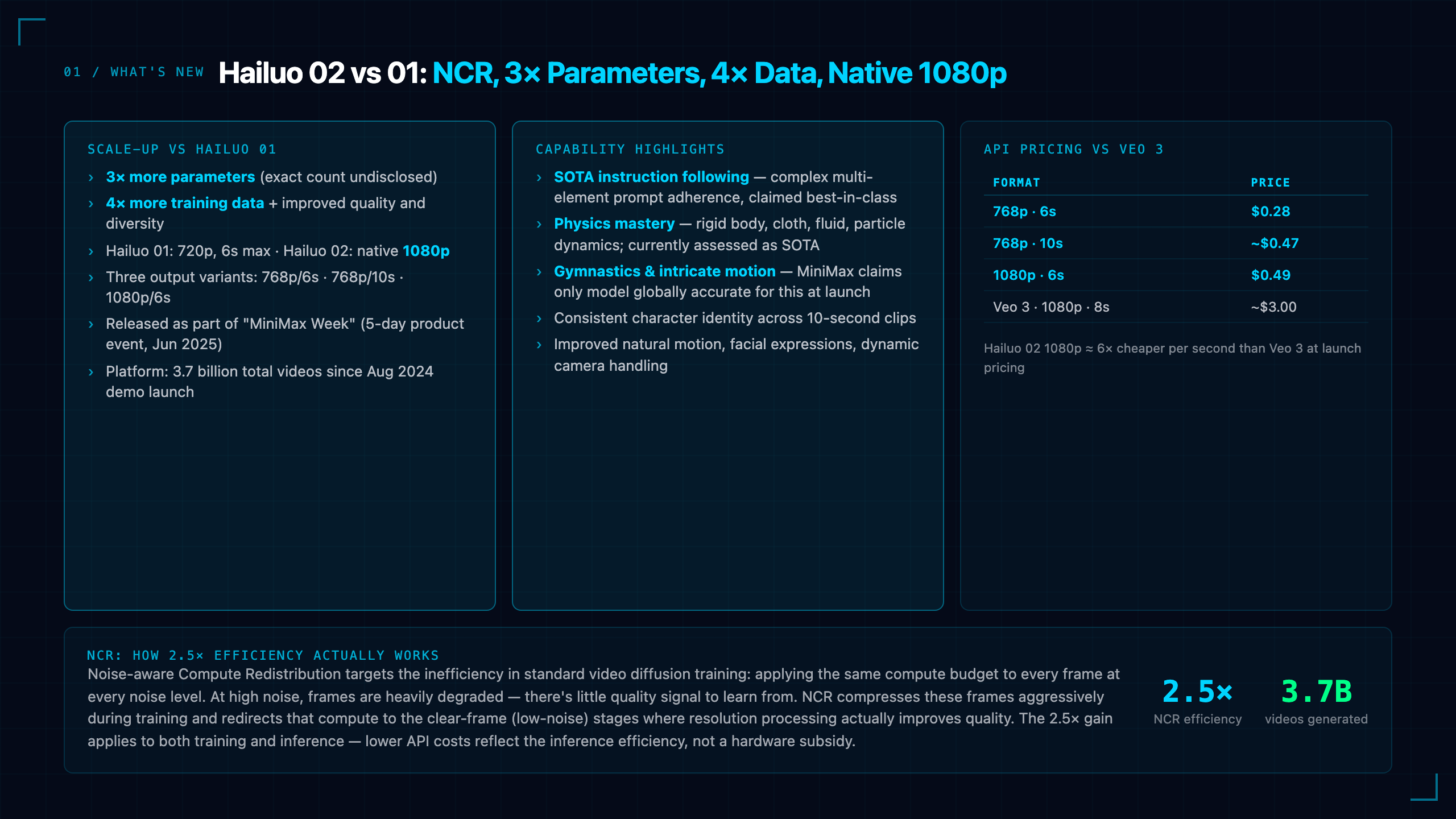
MiniMax released Hailuo 02 on June 18, 2025 — the second generation of its video generation model. Architecture: Noise-aware Compute Redistribution (NCR), 2.5× training and inference efficiency gain. 3× more parameters and 4× more training data than Hailuo 01. Native 1080p output, SOTA instruction following, physics mastery. Artificial Analysis Video Arena: #2 image-to-video (behind Seedance 1.0, ahead of Veo 3 without audio). API: 6-second 768p at $0.28, 1080p at $0.49 vs Veo 3's ~$3 for 8 seconds.
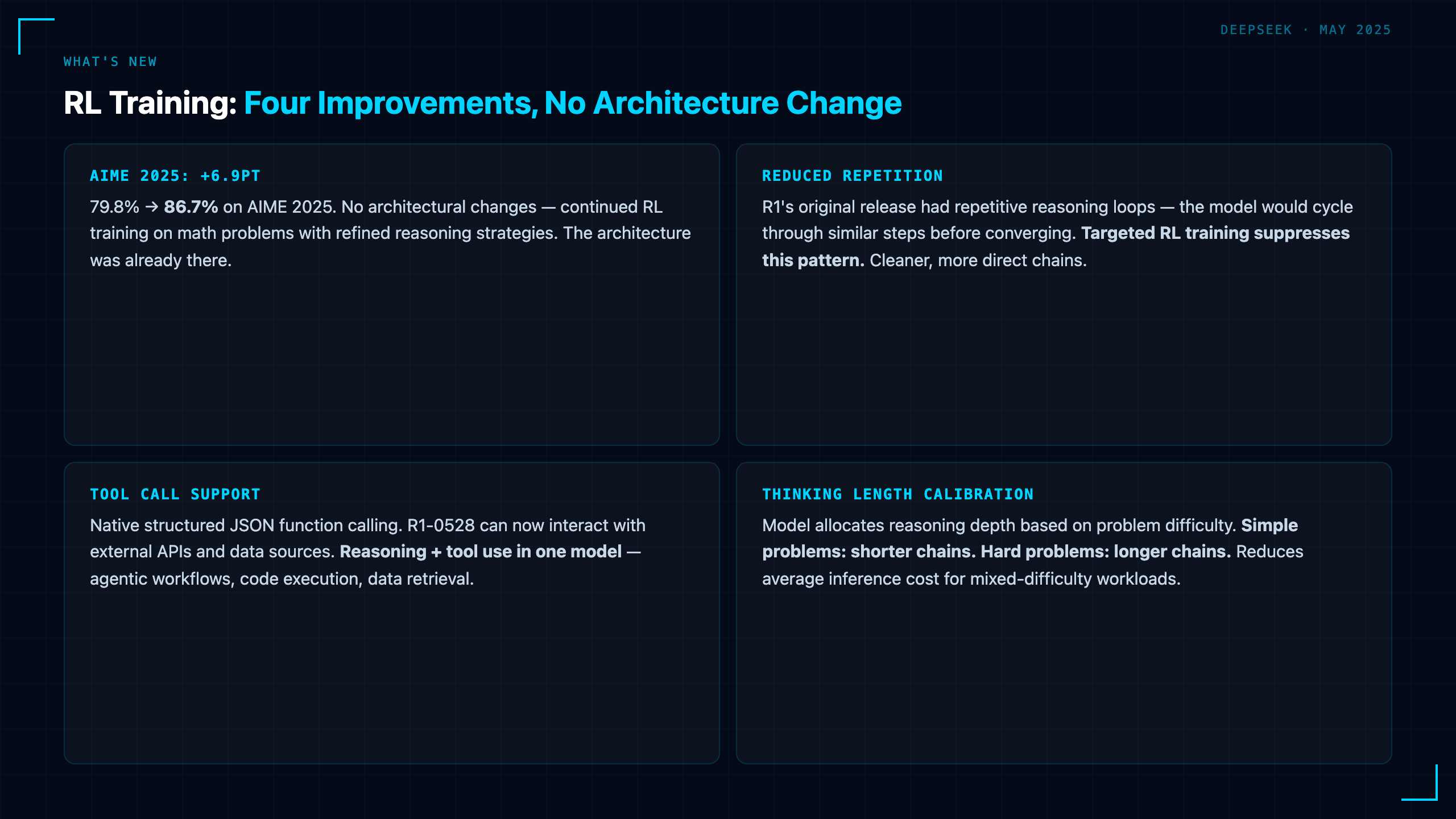
DeepSeek released R1-0528 in May 2025 — a mid-cycle update to R1 that improved AIME performance from 79.8% to 86.7% and added tool call support. The update required no architectural changes, demonstrating that RL training improvements alone could close the remaining gap with o3-tier reasoning. Same MIT license, same API pricing.
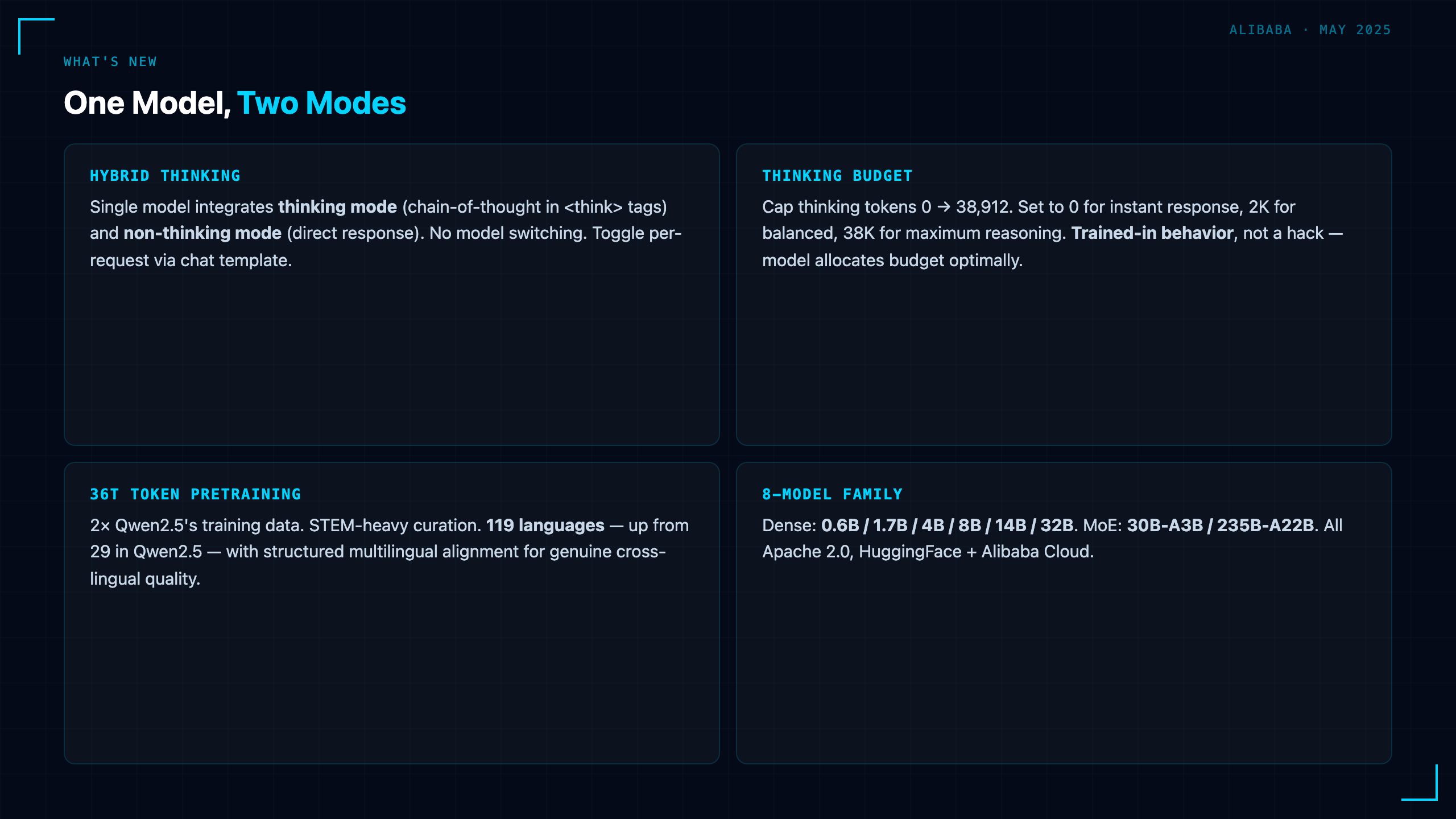
Alibaba released Qwen3 in May 2025 — a family of 8 models (0.6B to 235B) that integrates thinking and non-thinking mode into a single model. The flagship Qwen3-235B-A22B MoE matches o3 on reasoning benchmarks, trained on 36 trillion tokens across 119 languages, with a thinking budget mechanism that lets developers control reasoning depth at inference time. All models are Apache 2.0.
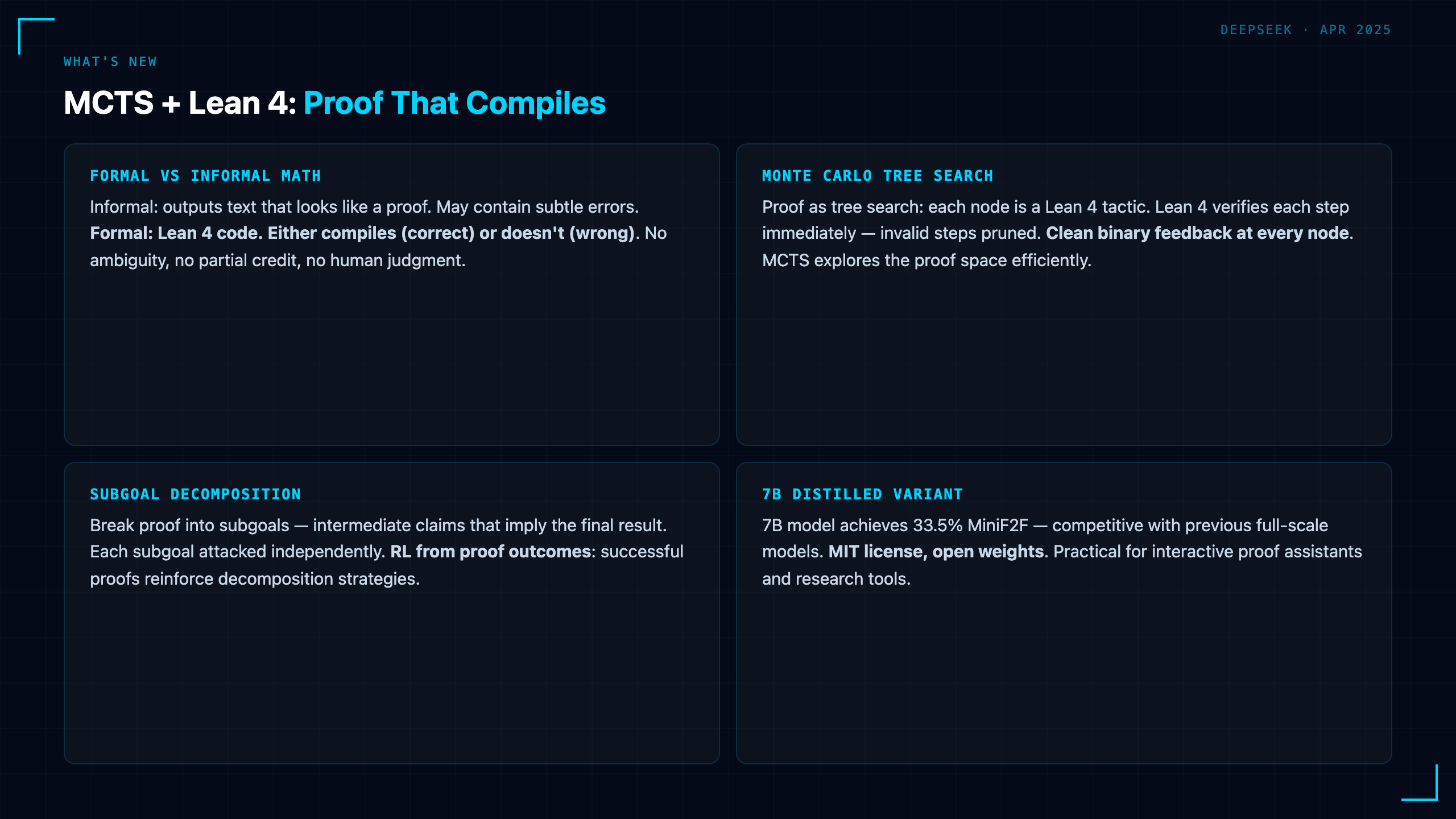
DeepSeek released Prover-V2 in April 2025 — a 671B MoE model specialized for formal mathematical proofs in the Lean 4 theorem prover. It achieves 49.3% on the MiniF2F competition benchmark (hard math problems formalized in Lean), using a novel Monte Carlo Tree Search approach that breaks proofs into subgoals and verifies each step formally. Released as open weights under MIT license.
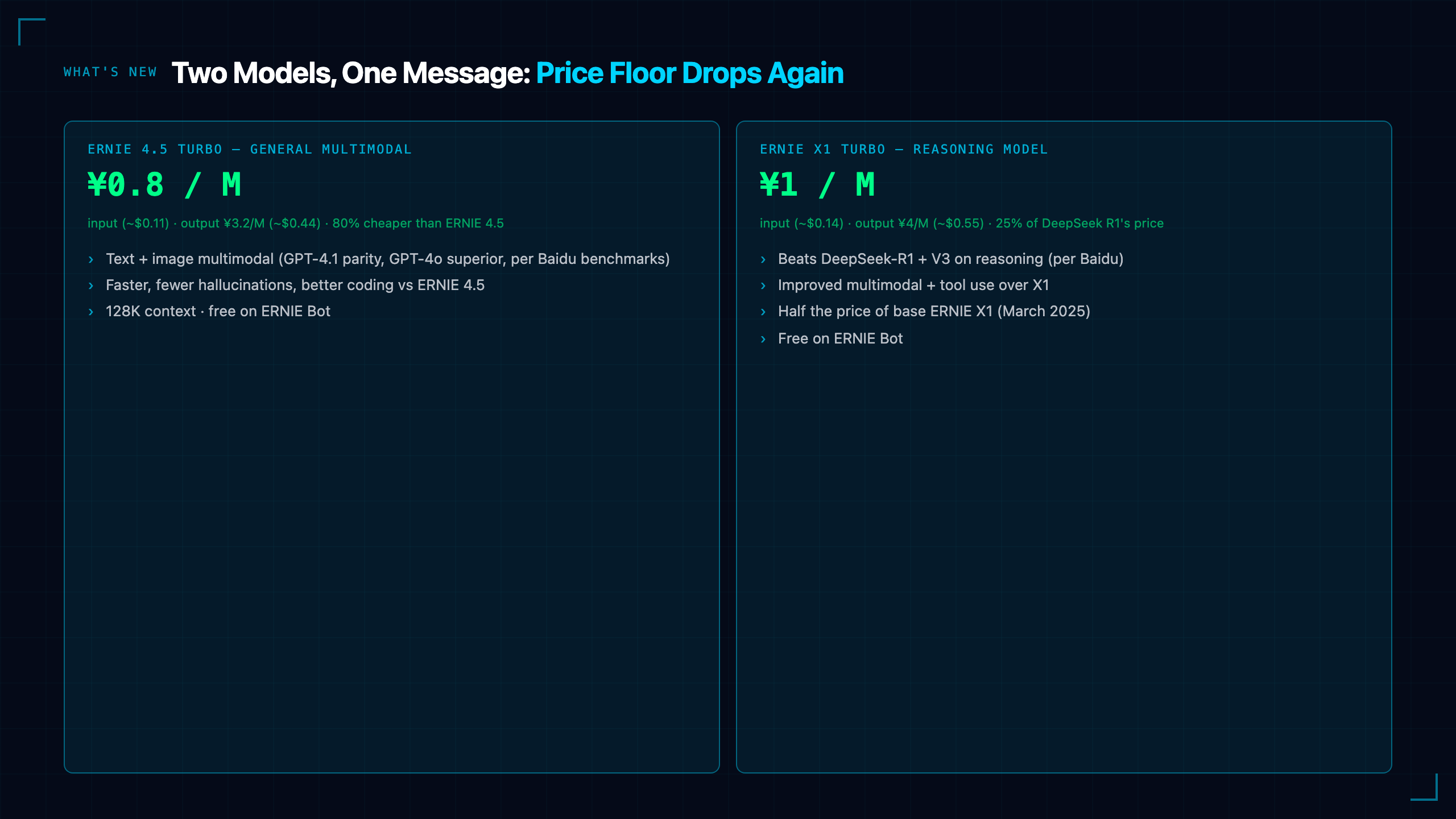
Baidu launched ERNIE 4.5 Turbo and ERNIE X1 Turbo at the Create 2025 developer conference on April 25, 2025. ERNIE 4.5 Turbo cuts ERNIE 4.5's price by 80%, claims GPT-4.1 parity and GPT-4o superiority on multimodal benchmarks, at RMB 0.8/M input (~$0.11). ERNIE X1 Turbo is a reasoning model priced at 25% of DeepSeek R1, with improved performance versus DeepSeek-R1 and V3. Both are free on ERNIE Bot. Architecture: 424B total / 47B active MoE with separate experts for text and image/video.
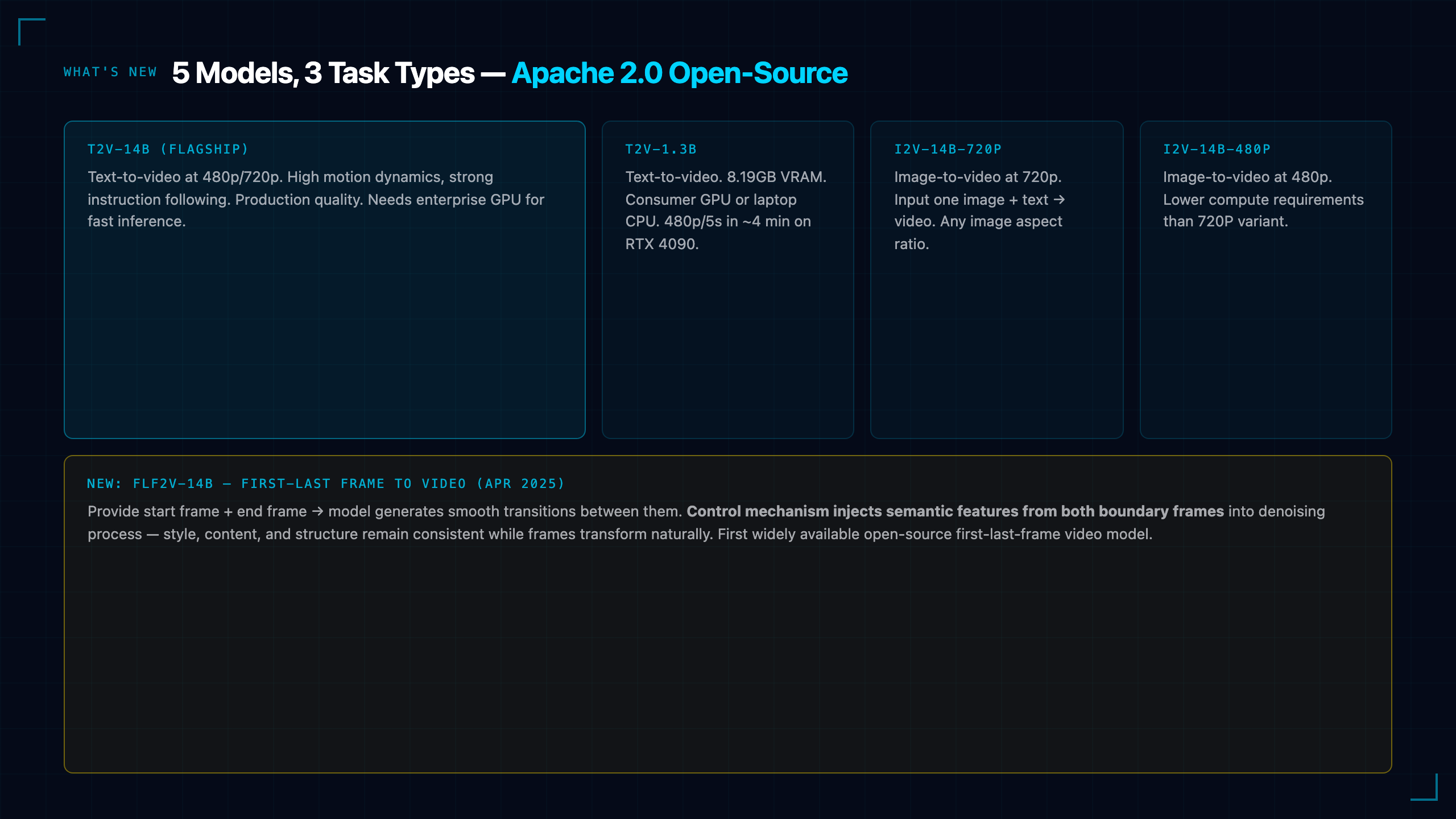
Alibaba Cloud released Wan 2.1 in February 2025 — an open-source video generation model family with 14B and 1.3B variants, supporting text-to-video and image-to-video at 480p and 720p. Wan 2.1 reached #1 on the VBench leaderboard with an 86.22% overall score, the only open-source model in the VBench top five. The 1.3B variant runs on a standard laptop (480p/5s in ~4 minutes). Apache 2.0 license. In April 2025, Alibaba added Wan2.1-FLF2V-14B: a first-and-last-frame-to-video model that generates smooth transitions between user-specified start and end frames.
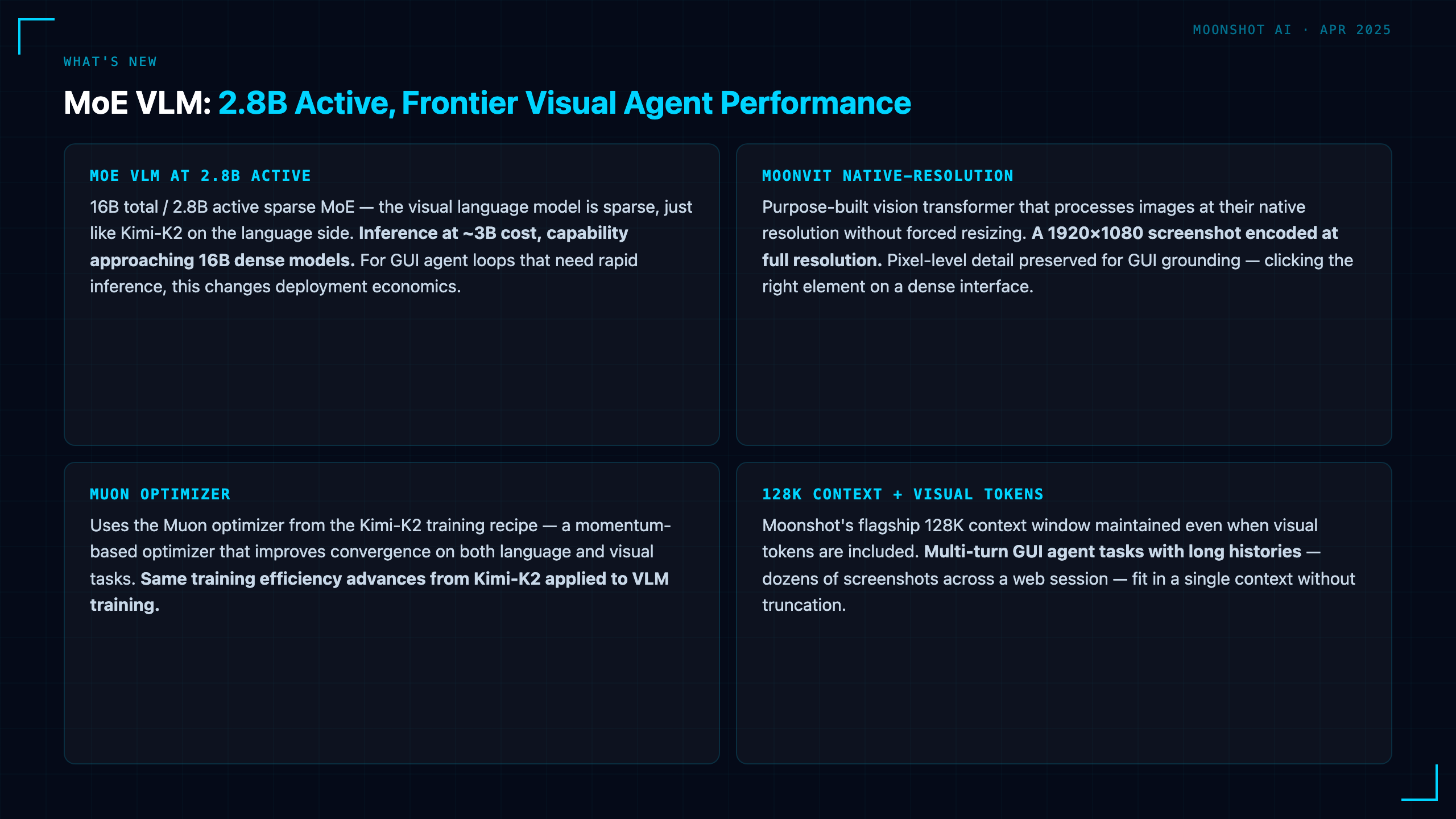
Moonshot AI released Kimi-VL in April 2025 — a 16B MoE vision-language model with only 2.8B active parameters that matched frontier models on agent benchmarks including OSWorld and ScreenSpot. Using MoonViT for native-resolution image encoding and the Muon optimizer from the Kimi-K2 lineage, Kimi-VL demonstrated that visual agent capabilities could be delivered at efficient-model inference cost.
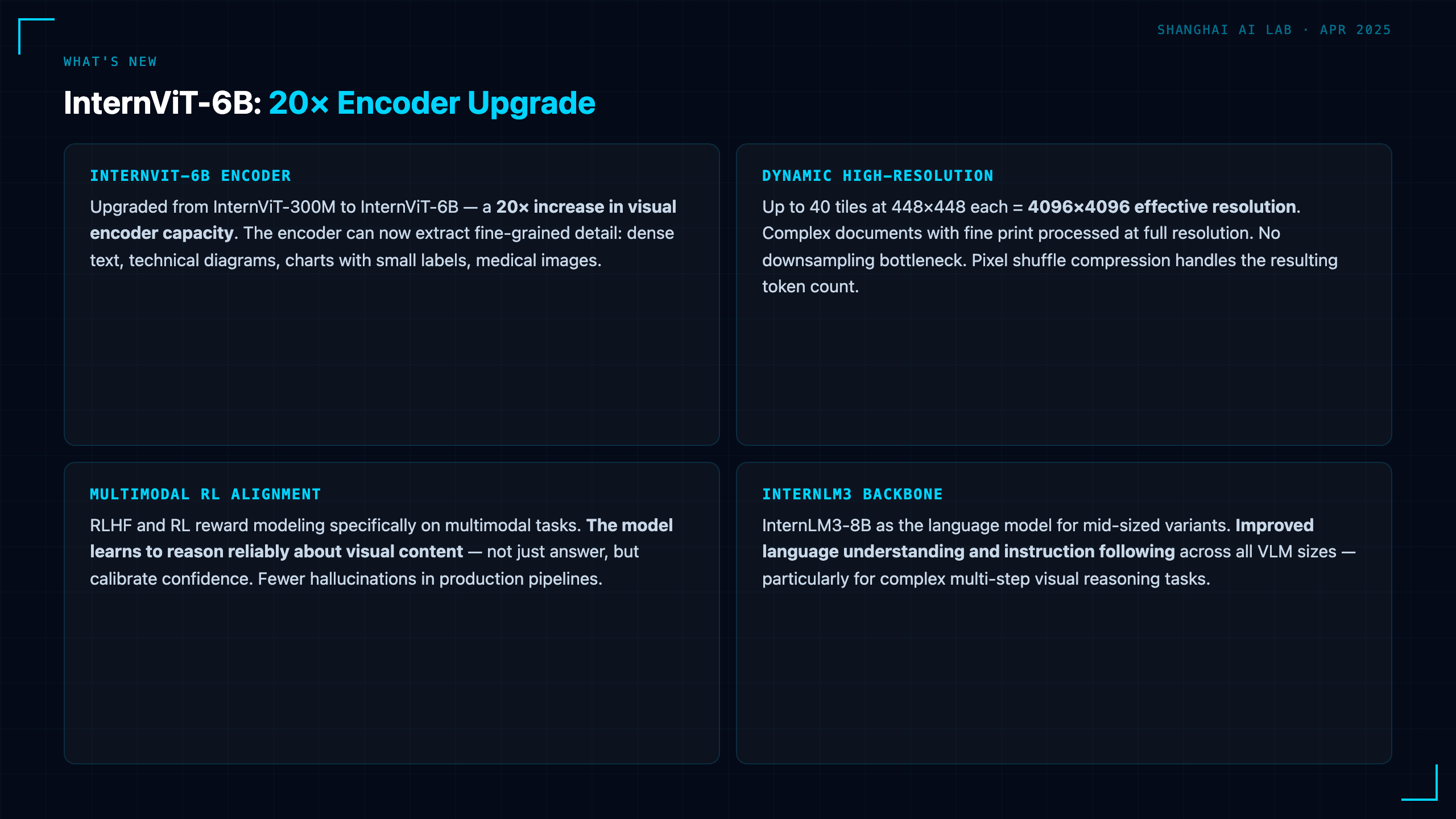
Shanghai AI Lab released InternVL3 in April 2025 — a vision-language model that matched or exceeded GPT-4o and Claude 3.5 Sonnet on most multimodal benchmarks while remaining fully open-source. The 78B flagship scored 72.2% on MathVista and 92.2% on DocVQA, demonstrating that open-source multimodal capability had reached frontier parity.
DeepSeek released V3-0324 (V3.1) on March 24, 2025 — a targeted reasoning upgrade to the V3 MoE architecture. The update pushed Arena-Hard to 91.2%, overtaking GPT-4o and Claude 3.7 Sonnet, and improved Math-500 to 97.2% and LiveCodeBench to 49.2%. Same MIT license, same $0.27/M input pricing, unchanged 128K context — a drop-in upgrade with material quality gains.
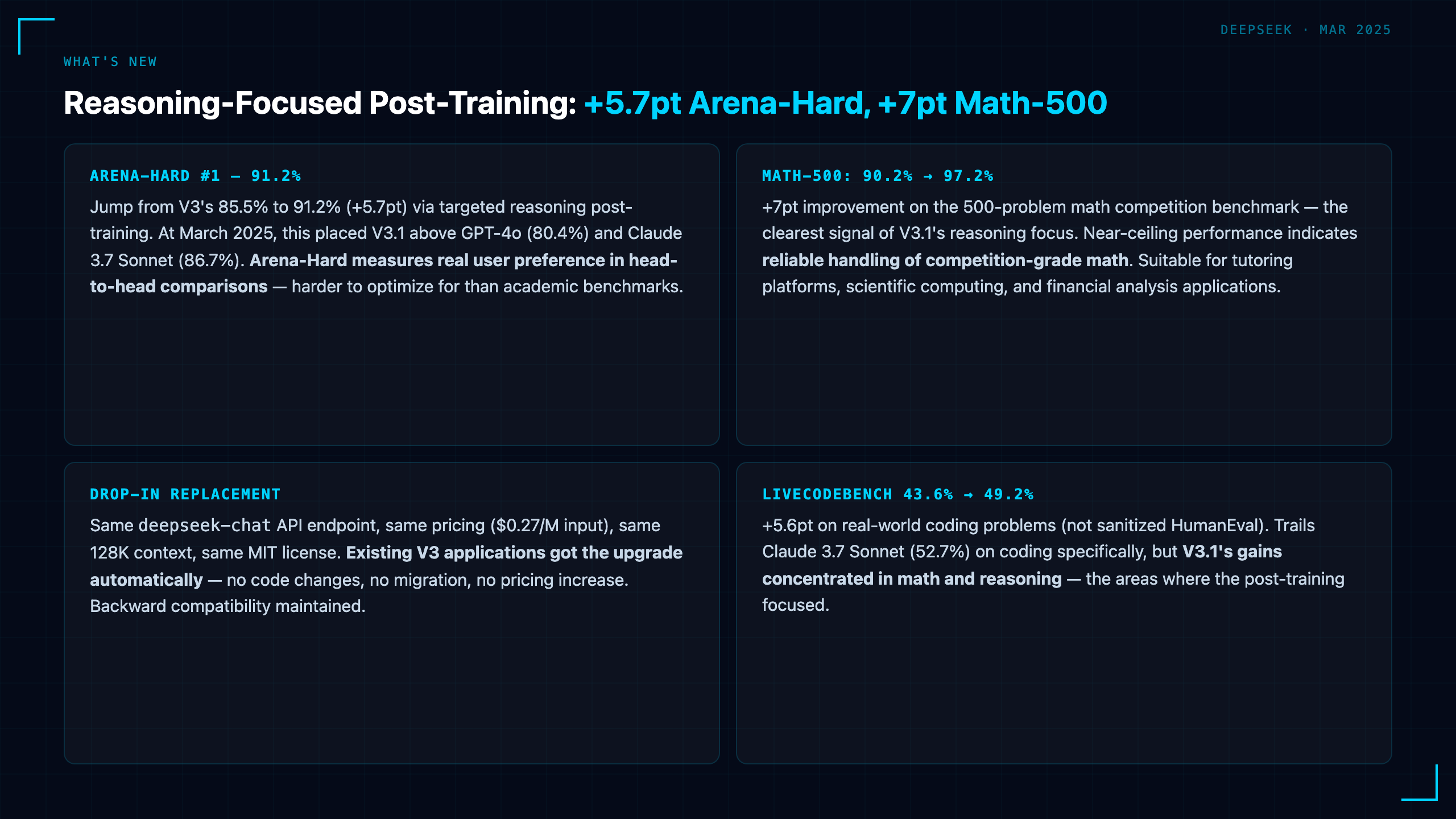
MiniMax released Speech-02 in March 2025 — a text-to-speech model with over 100 built-in voices, emotion and speed control, and voice cloning from a 10-second sample. Scoring 4.28/5 on the MOS naturalness benchmark and supporting 17 languages, Speech-02 positioned itself as the production-grade TTS API for Chinese developers. Latency under 300ms for streaming makes it viable for real-time voice applications.
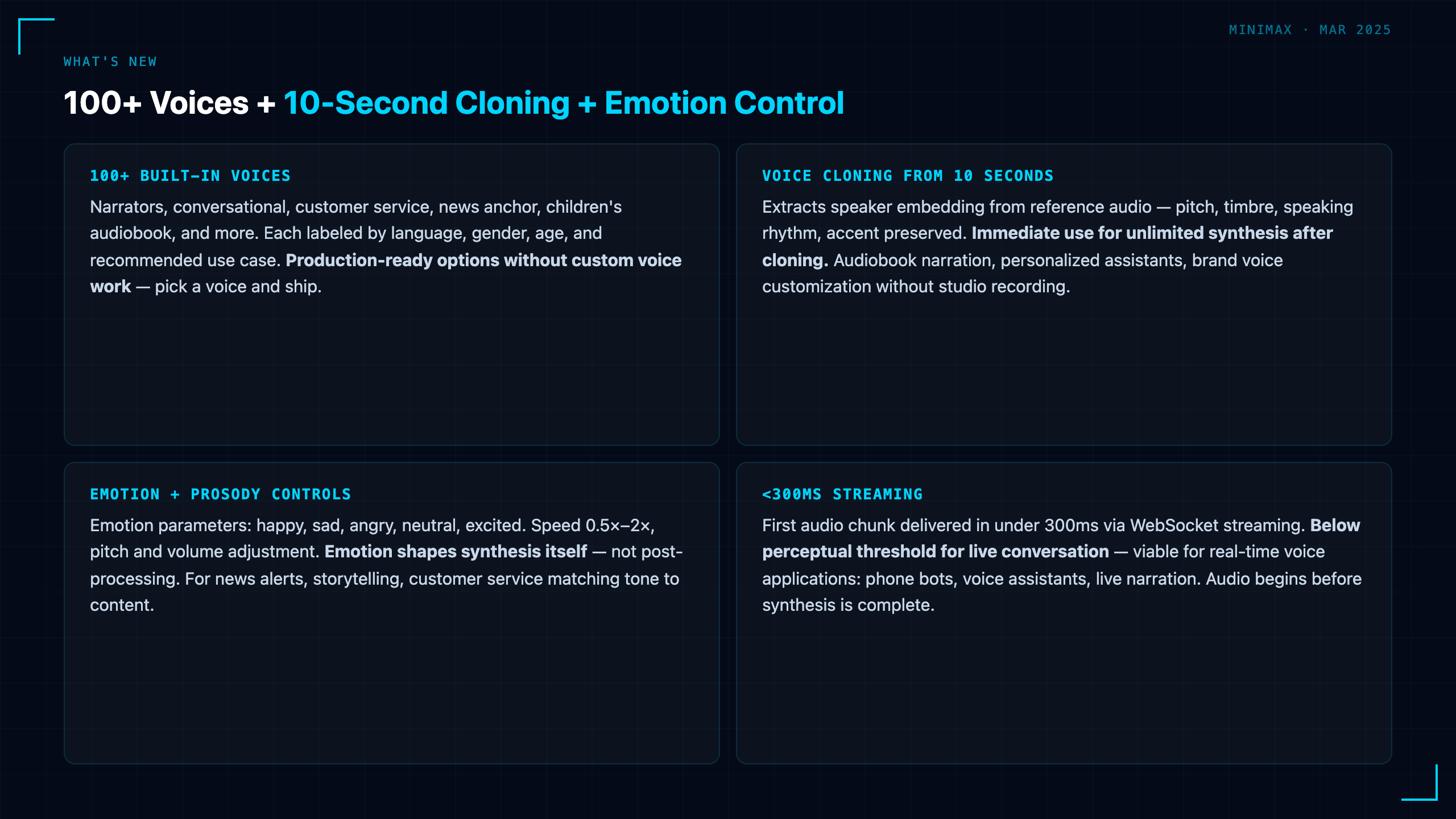
Tencent released Hunyuan-TurboS in February 2025 — the first production frontier model to combine Mamba SSM layers with transformer attention in a hybrid architecture. The design targets two pain points: long-context inference cost and fast decode speed. Hunyuan-TurboS reached top-7 on LMSYS Chatbot Arena and delivers 4× faster token generation than comparable dense transformers on long contexts, at lower inference cost.
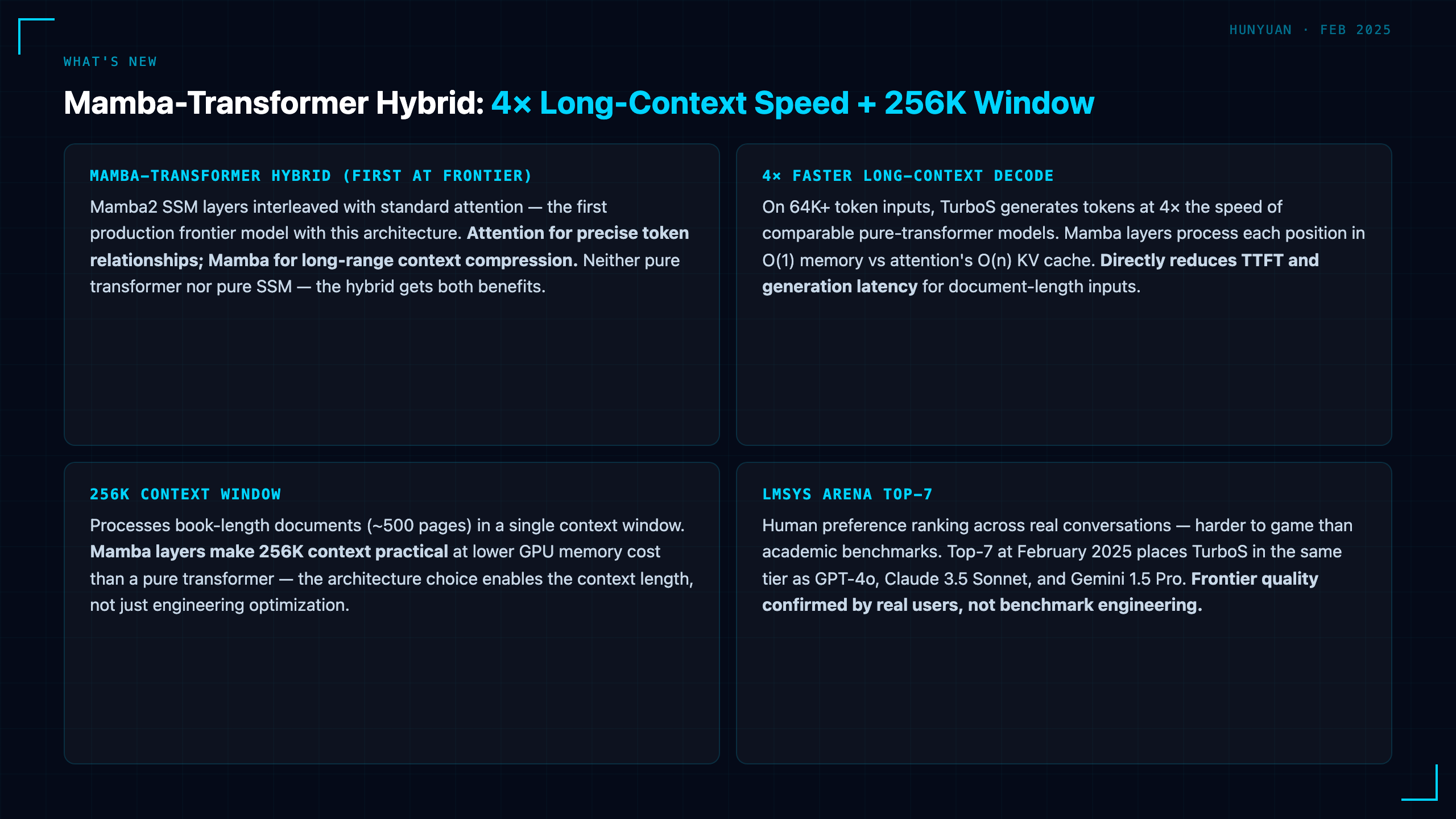
StepFun released Step-Video-T2V in February 2025 — a 30B parameter text-to-video diffusion transformer generating 204-frame videos at 768×448 resolution. Trained on 35 billion video-text pairs, it achieved state-of-the-art results on VBench at release and represented one of the largest open-source text-to-video models available. The model used a 3D VAE for spatial-temporal compression and a bilingual text encoder combining English CLIP with Chinese T5.
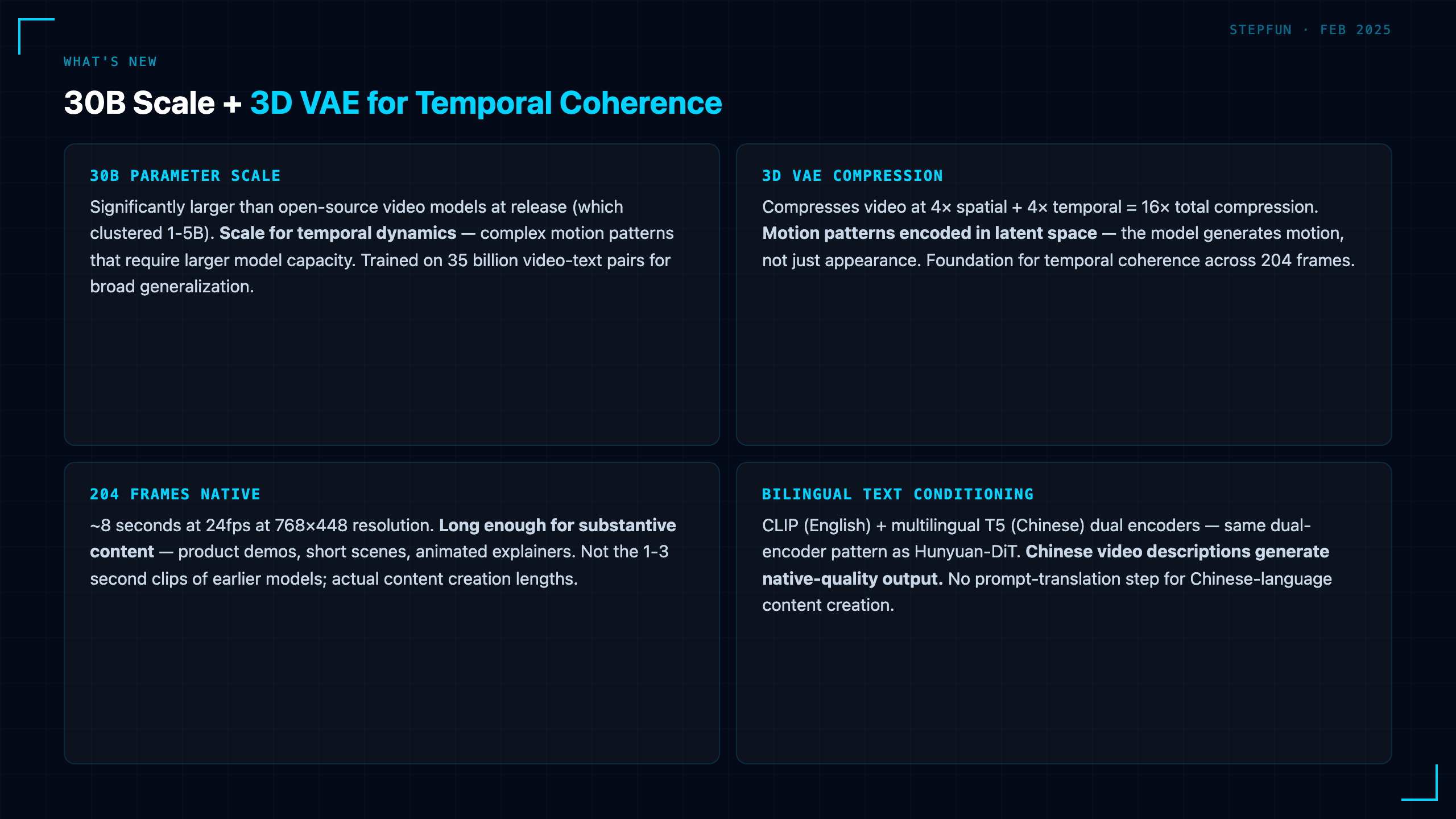
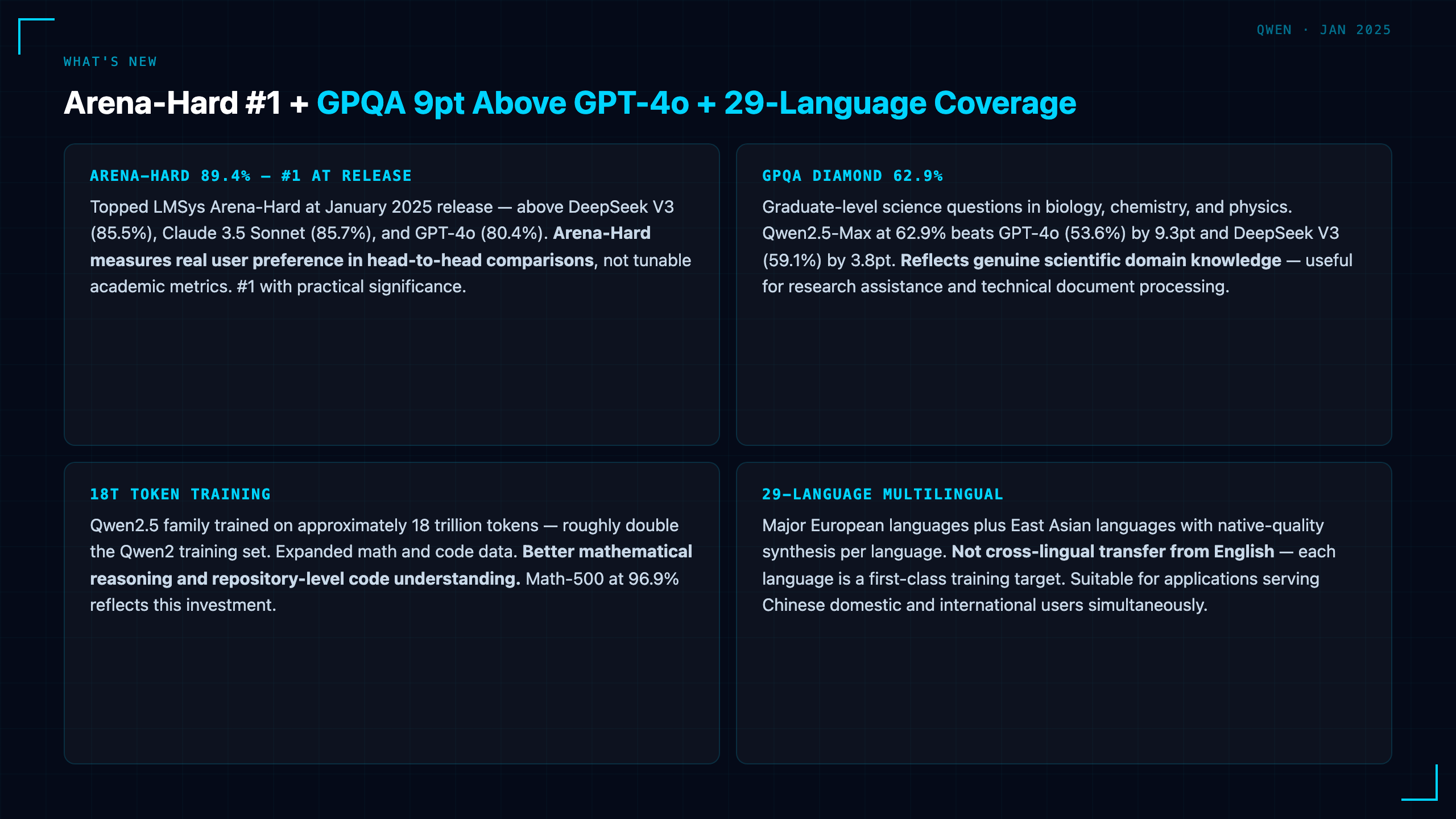
Alibaba released Qwen2.5-Max on January 29, 2025 — a large-scale MoE model that topped the LMSys Arena leaderboard and Chatbot Arena Elo rankings at release, outperforming GPT-4o, Claude 3.5 Sonnet, and DeepSeek V3 on Arena-Hard (89.4%) and GPQA Diamond (62.9%). Available via Alibaba Cloud's Model Studio API and as the engine behind Qwen's web interface.
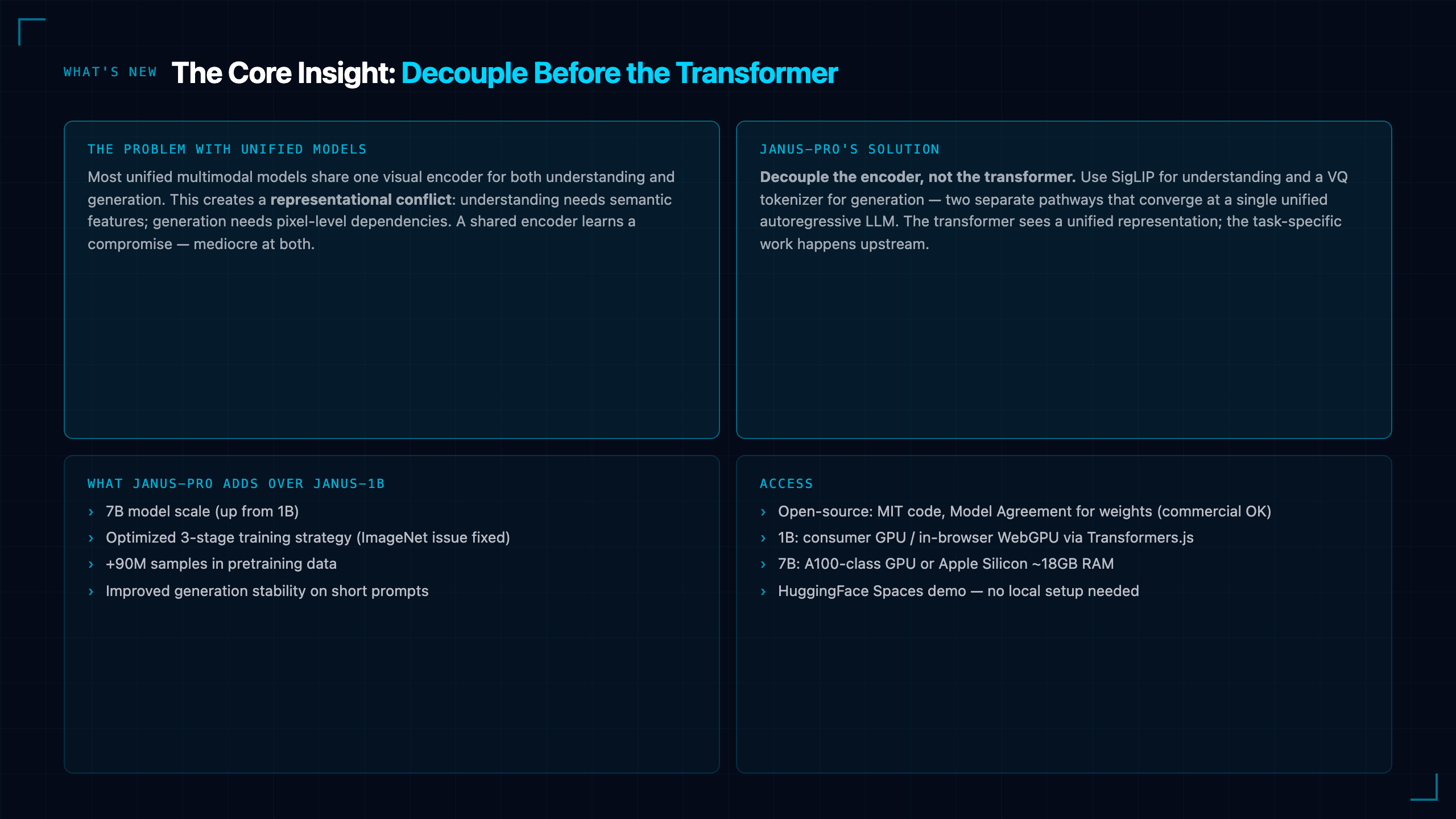
DeepSeek released Janus-Pro on January 27, 2025 — an open-source unified multimodal model that handles both image understanding and text-to-image generation in a single autoregressive transformer. The core architectural insight: decouple the visual encoder into two separate pathways (SigLIP for understanding, VQ tokenizer for generation), eliminating the representational conflict that degrades unified models. Janus-Pro-7B scores 80% on GenEval (vs DALL-E 3's 67%), 79.2 on MMBench, 84.19 on DPG-Bench. Available in 1B and 7B sizes under a commercial-use license.
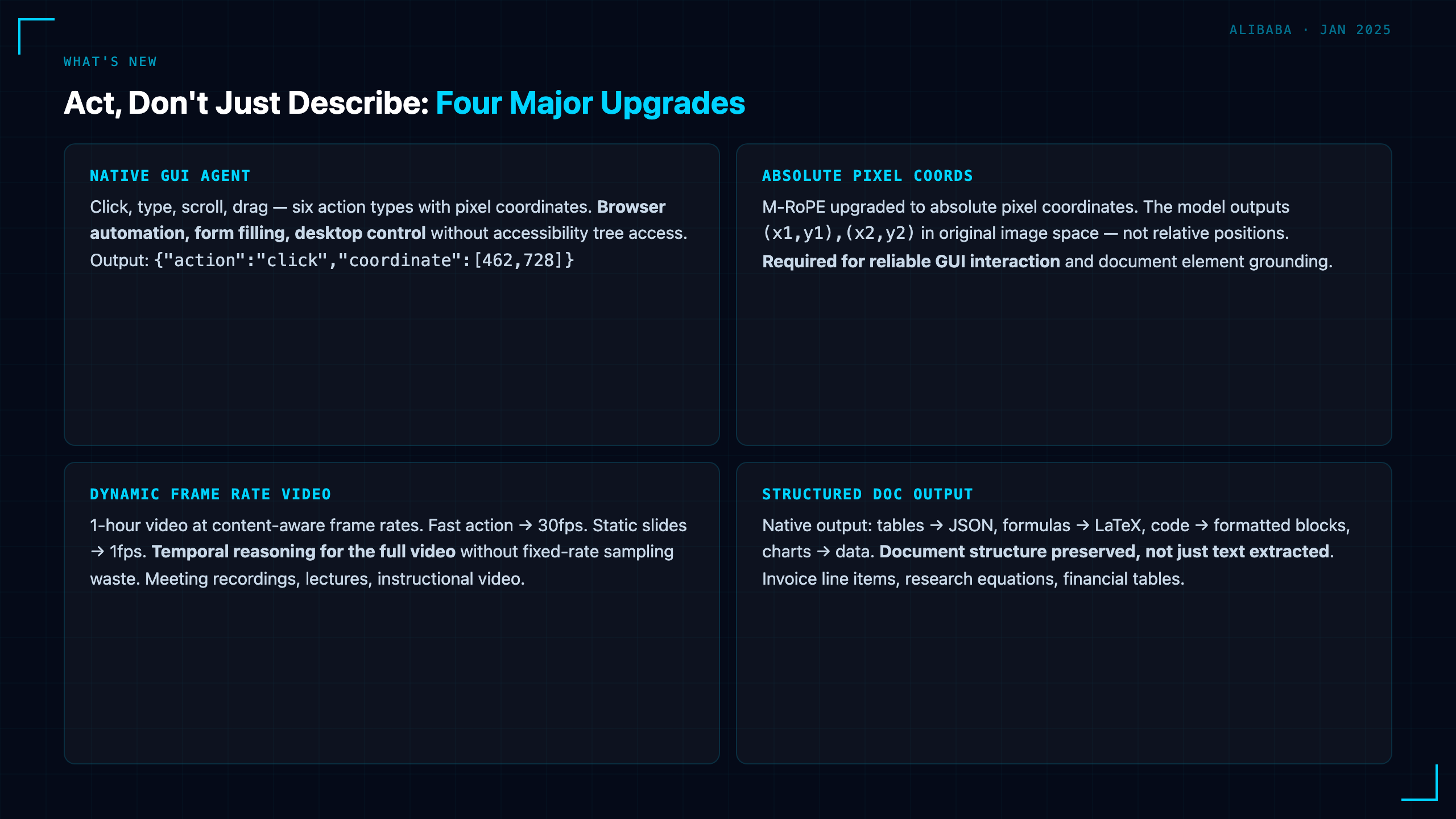
Alibaba's Qwen team released Qwen2.5-VL in January 2025 — a major upgrade to Qwen2-VL that added native GUI agent capabilities, absolute position encoding for pixel-level coordinate output, and video understanding with dynamic frame rates. The 72B variant matched GPT-4o on DocVQA while adding computer use capabilities unavailable in Qwen2-VL.
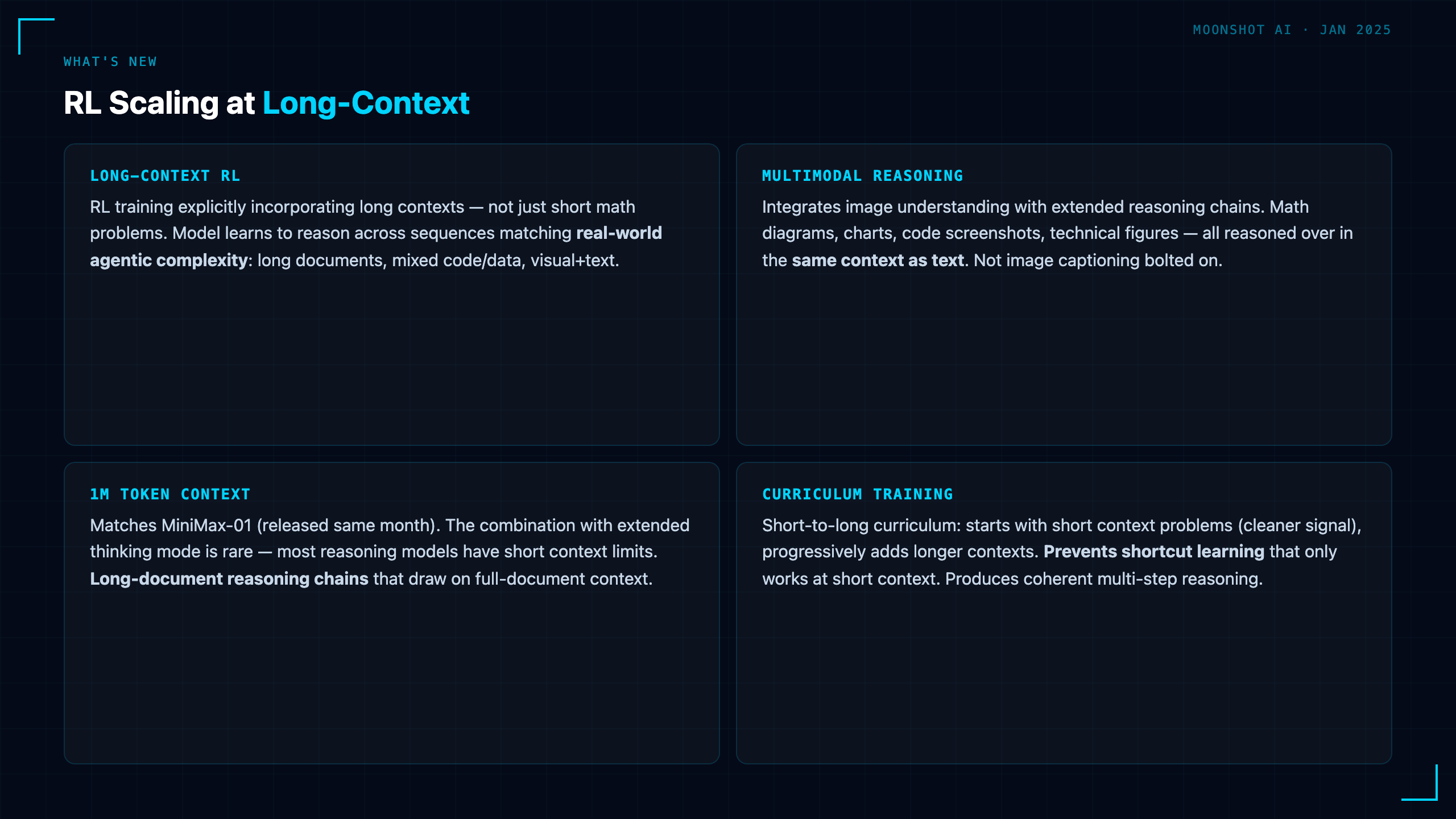
Moonshot AI released Kimi k1.5 in January 2025 — a multimodal reasoning model trained with long-context RL scaling, achieving state-of-the-art performance on math, coding, and vision benchmarks. AIME score of 77.5%, competitive with o1, with a 1M token context window and support for image and text inputs. Released with a technical report detailing the RL training methodology.
On January 20, 2025, DeepSeek released R1 — an open-source reasoning model that matched OpenAI o1-1217 on math and coding benchmarks, trained entirely with reinforcement learning, at an estimated cost 30× lower. It triggered a market selloff, reshaped every AI lab's roadmap, and proved that chain-of-thought reasoning can emerge from RL without supervised fine-tuning. Six distilled variants (1.5B–70B) ship with it under MIT license.
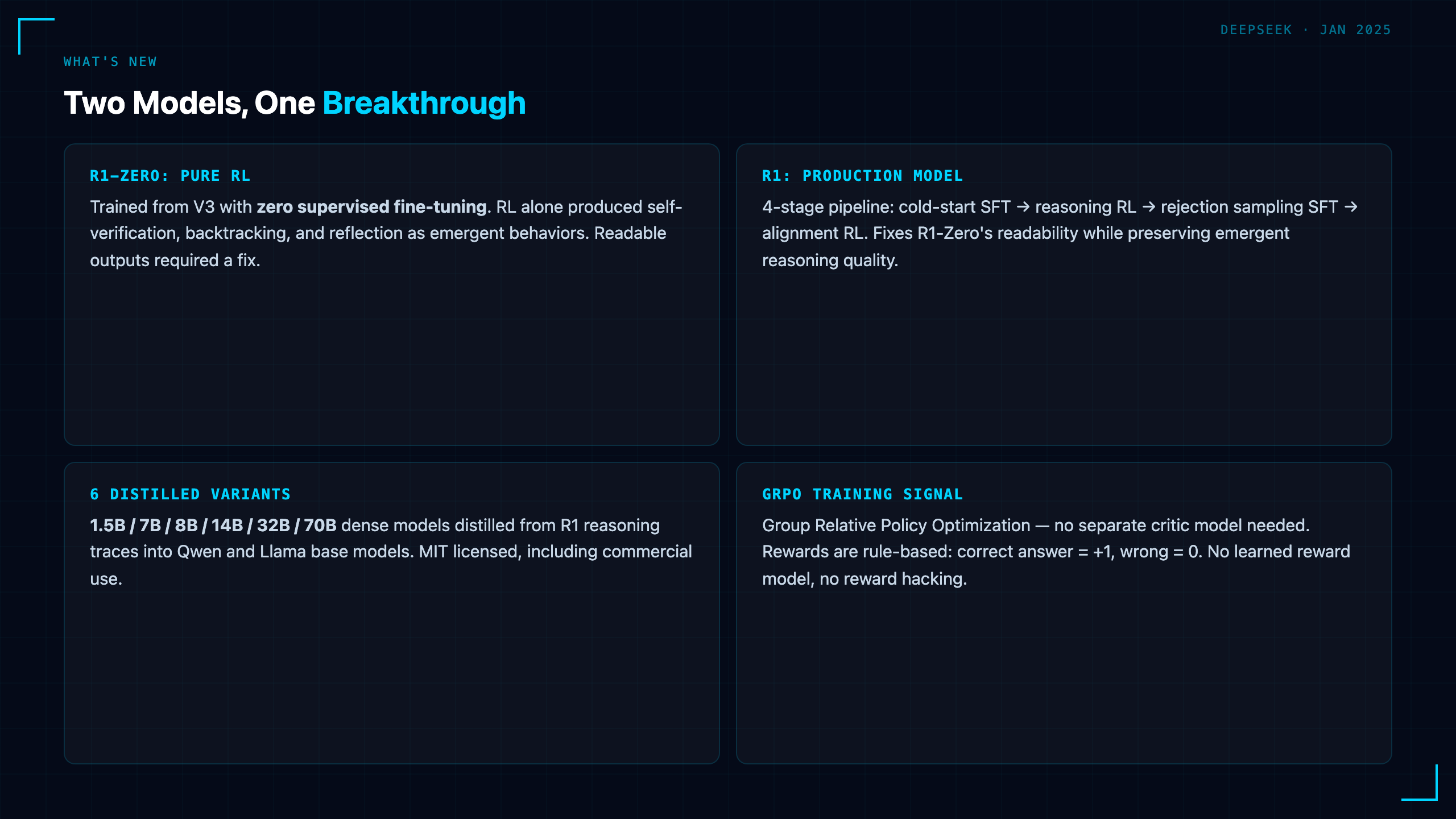
Shanghai AI Lab released InternLM3-8B-Instruct in January 2025 — an 8B reasoning model that achieved 74.0% on MATH and competitive MMLU scores while fitting in the efficient inference tier. The model introduced Thinking Mode, allowing the same model to produce chain-of-thought reasoning or direct answers based on task requirements.
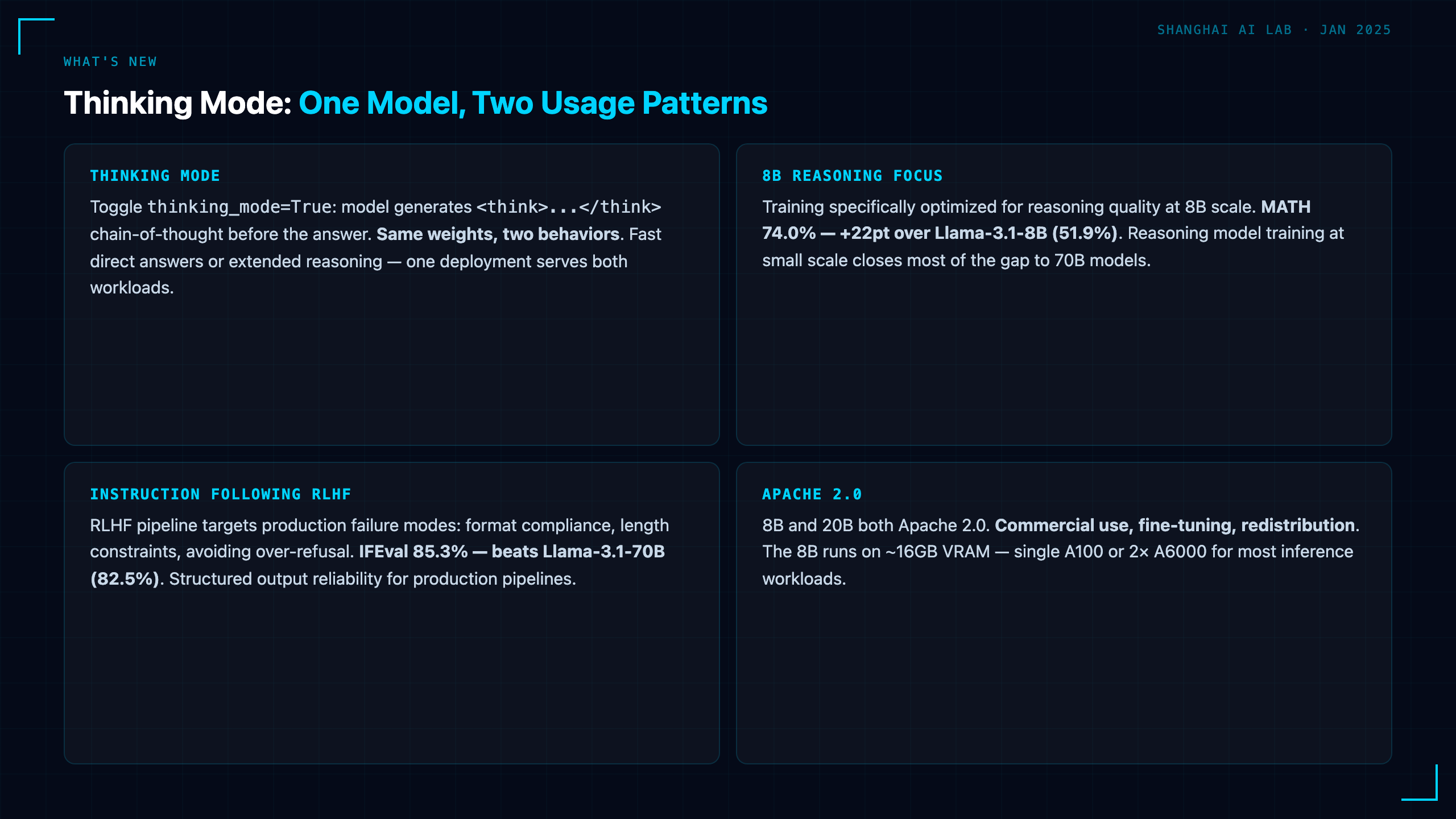
MiniMax open-sourced VTP (Visual Tokenizer Pre-training), the underlying tech of Hailuo Video — their first-ever technical release from that product. The paper documents an industry-wide paradox: training visual tokenizers harder makes generation quality worse (gFID 55.04→58.56). VTP breaks this with joint reconstruction + CLIP + self-supervised training, achieving 65.8% generation quality improvement at 10× compute, and demonstrating Scaling Law across three axes: compute, parameters, and data.
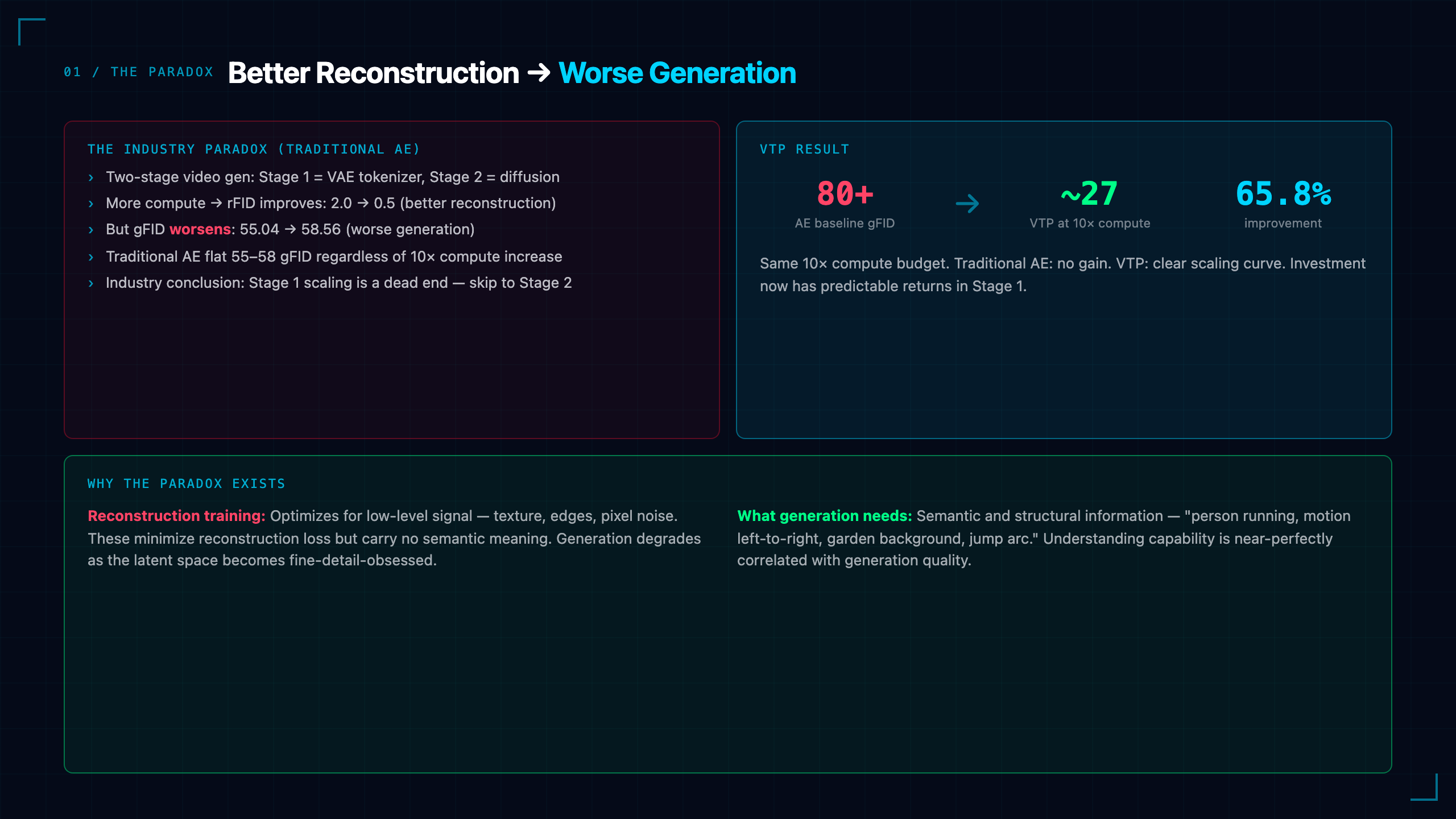
MiniMax released MiniMax-01 in January 2025 — a 456B MoE model with a true 1 million token context window. With 45.9B parameters active per token, it delivers frontier-quality reasoning at a fraction of GPT-4o's cost, while handling context lengths that no other model could reliably sustain. Released under open weights with a permissive license.
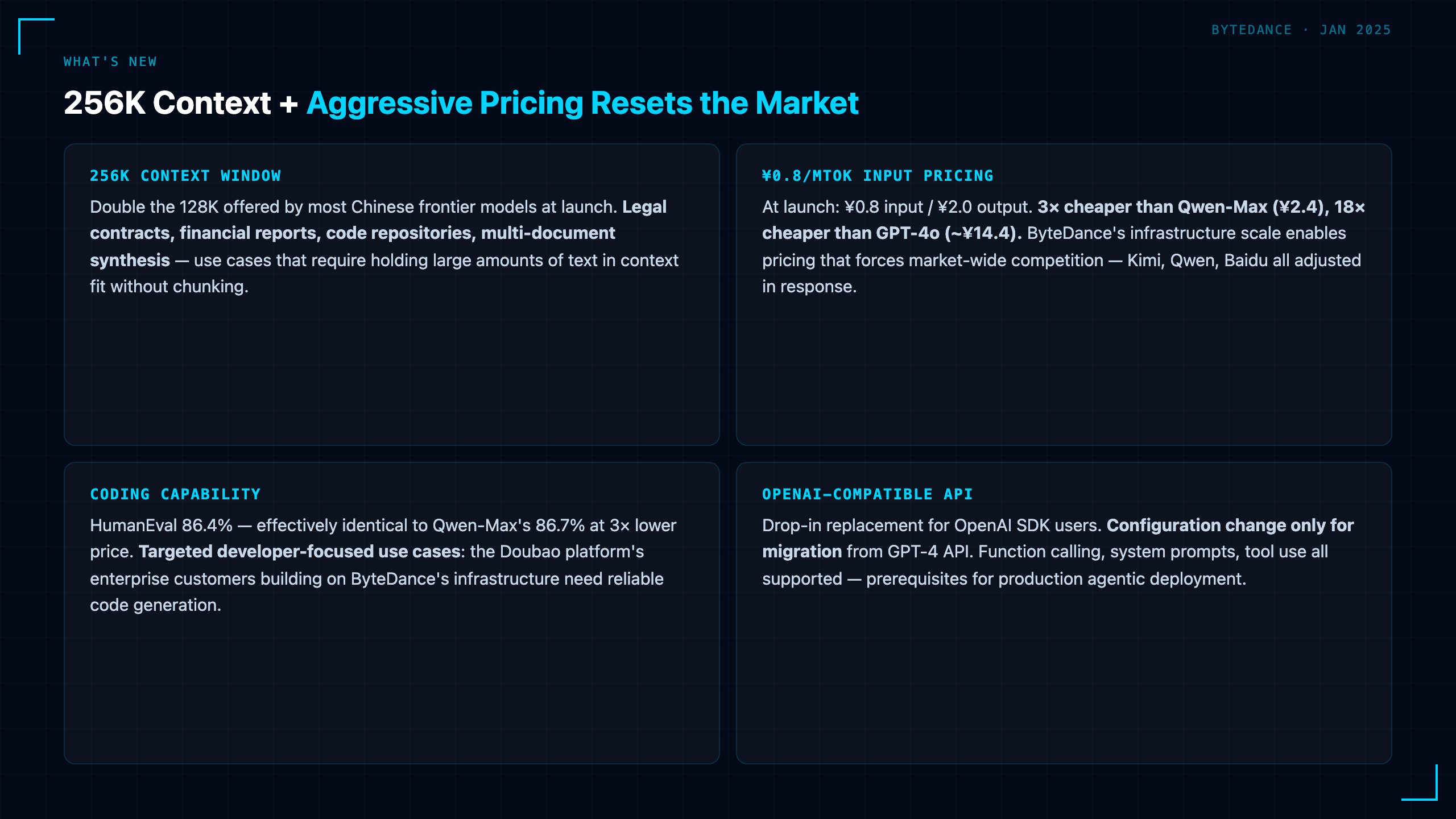
ByteDance released Doubao-1.5-Pro in January 2025 — a model that combined 256K context with aggressive pricing at ¥0.8/MTok input, positioning it as the low-cost frontier option for the Chinese developer market. Scoring 71.5% on MMLU and matching Claude 3.5 Sonnet on several coding benchmarks, Doubao-1.5-Pro demonstrated ByteDance's intent to compete on price-performance rather than raw capability leadership.
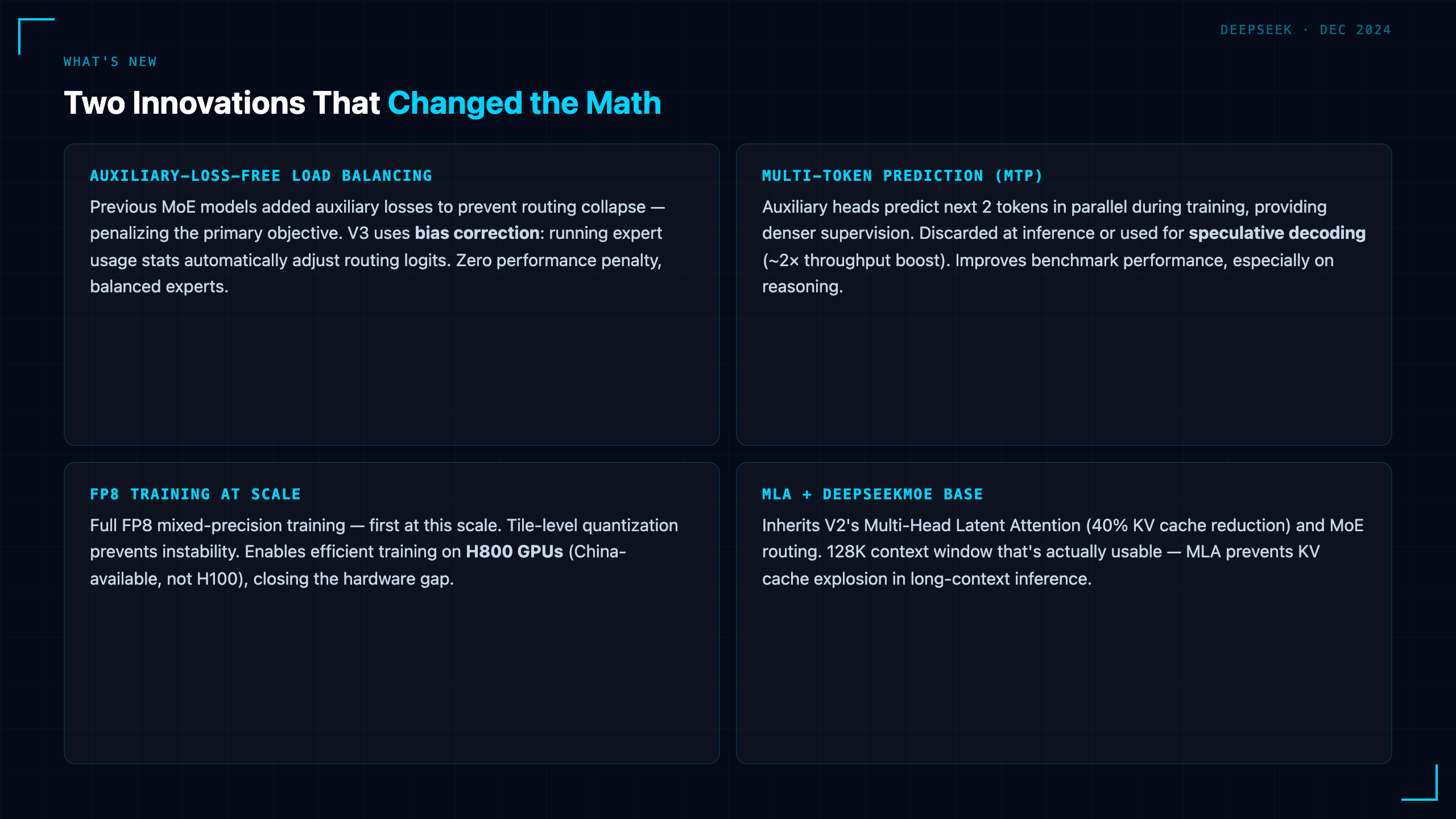
DeepSeek released V3 on December 26, 2024 — a 671B MoE model trained on 14.8T tokens at a reported cost of $5.5M. It matched GPT-4o and Claude Sonnet on most benchmarks, offered API pricing at $0.27/M input tokens, and introduced two architectural innovations: auxiliary-loss-free load balancing and multi-token prediction. It became the base for DeepSeek-R1 three weeks later.
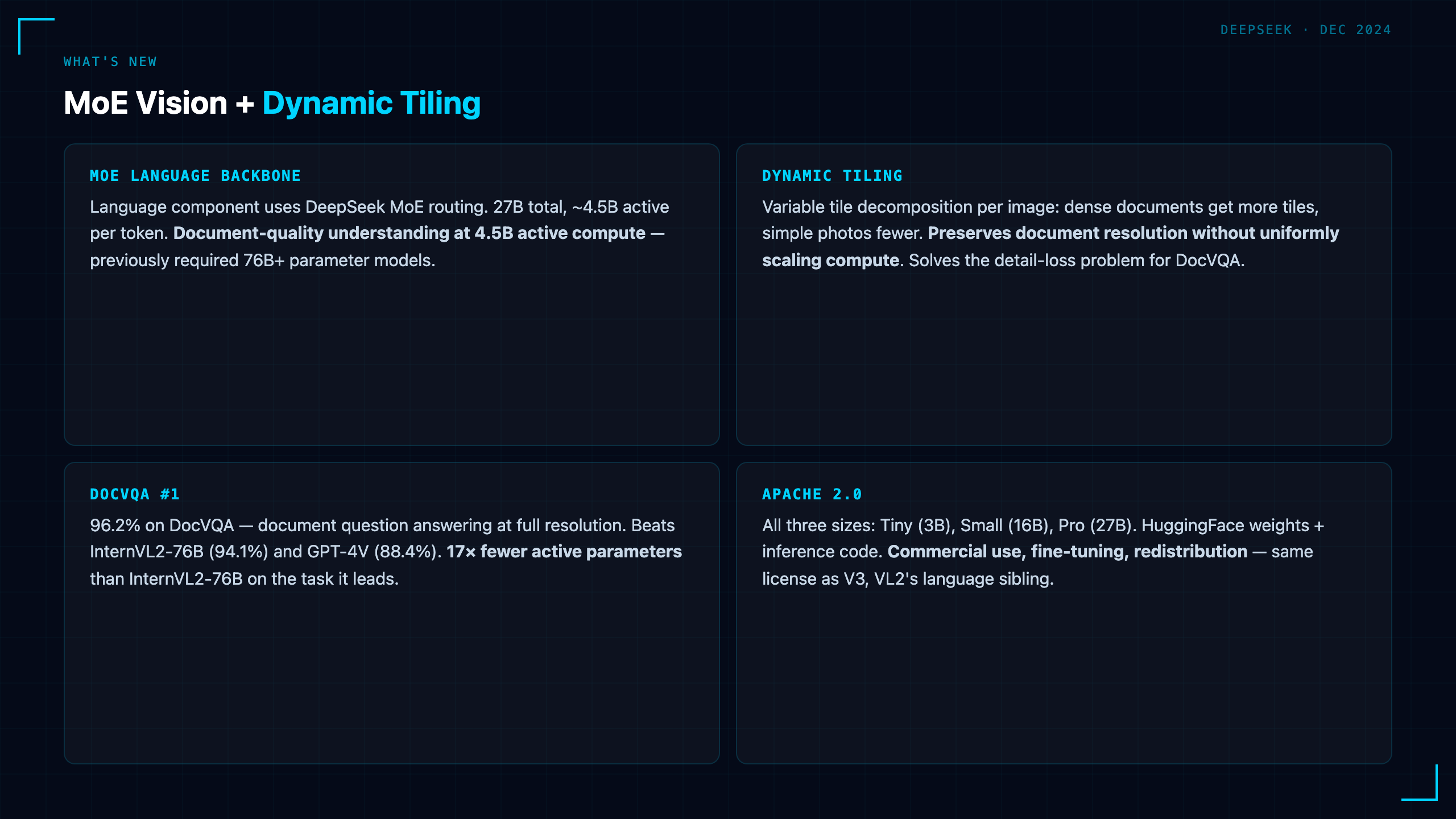
DeepSeek released VL2 in December 2024 — a family of MoE-based vision-language models (3B, 16B, 27B) that set new open-source records on document understanding, chart analysis, and visual reasoning. Dynamic tiling enables high-resolution image processing without fixed-size patches. DeepSeek-VL2-Pro (27B) matches InternVL2-76B on DocVQA and ChartQA while using a fraction of the active parameters. Apache 2.0 license.
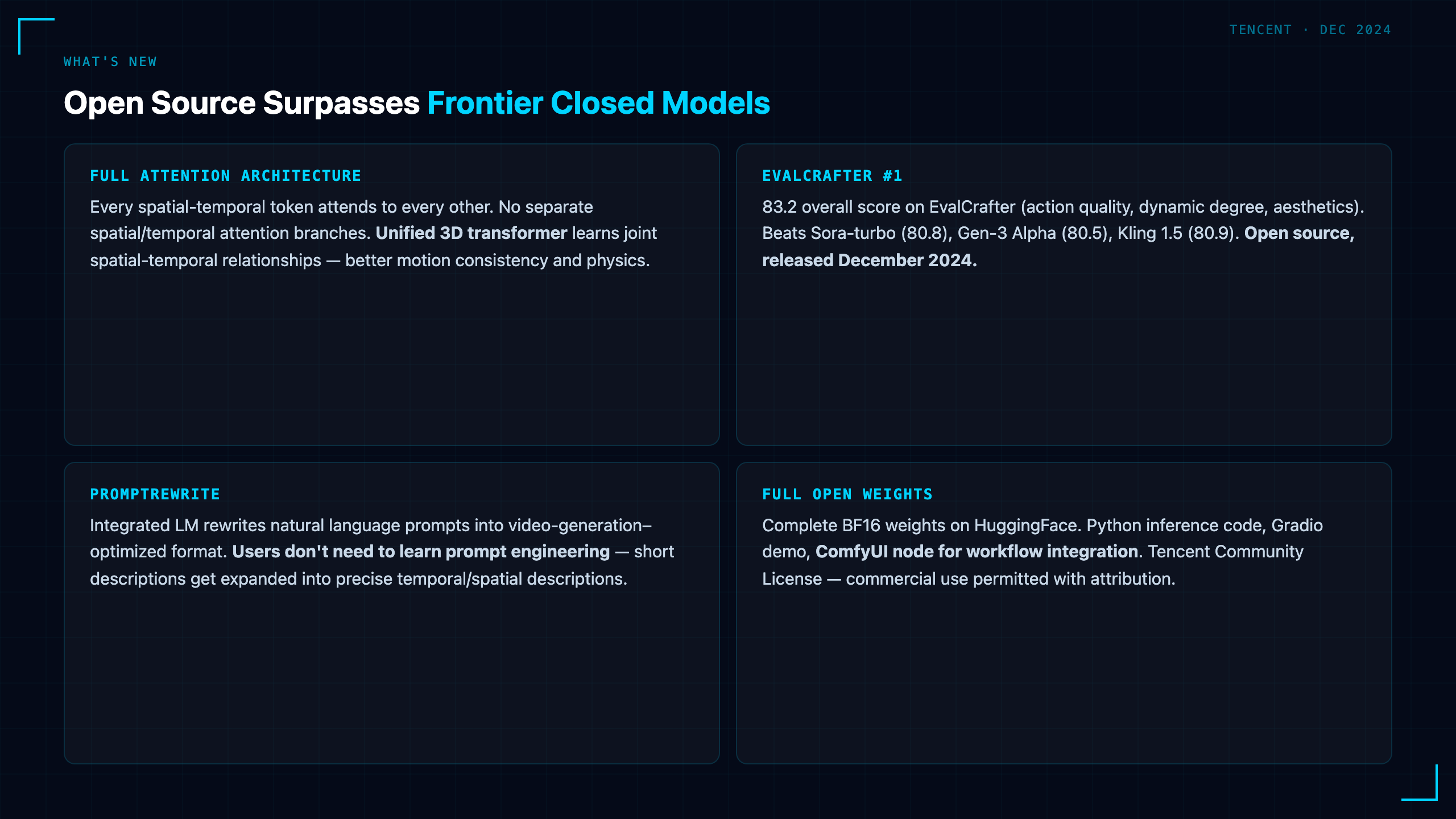
Tencent released HunyuanVideo in December 2024 — a 13B parameter video generation model based on a unified DiT architecture for both image and video. It outperforms Sora, Gen-3, and Kling on the EvalCrafter benchmark while running on 8×A100 80GB. Released as open source under a permissive license, with full weights and inference code on HuggingFace.
Alibaba released Qwen2.5-Coder-32B in November 2024 — the first open-weight model to match GPT-4o on coding benchmarks. HumanEval 92.7%, EvalPlus 90.2%, and CRUXEval 66.6% placed it above GPT-4o (90.2%) and DeepSeek-Coder-V2 on code generation. Apache 2.0 licensed, self-hostable at 32B, and available in variants from 0.5B to 72B, Qwen2.5-Coder-32B made GPT-4o-class coding accessible to any developer with GPU access.
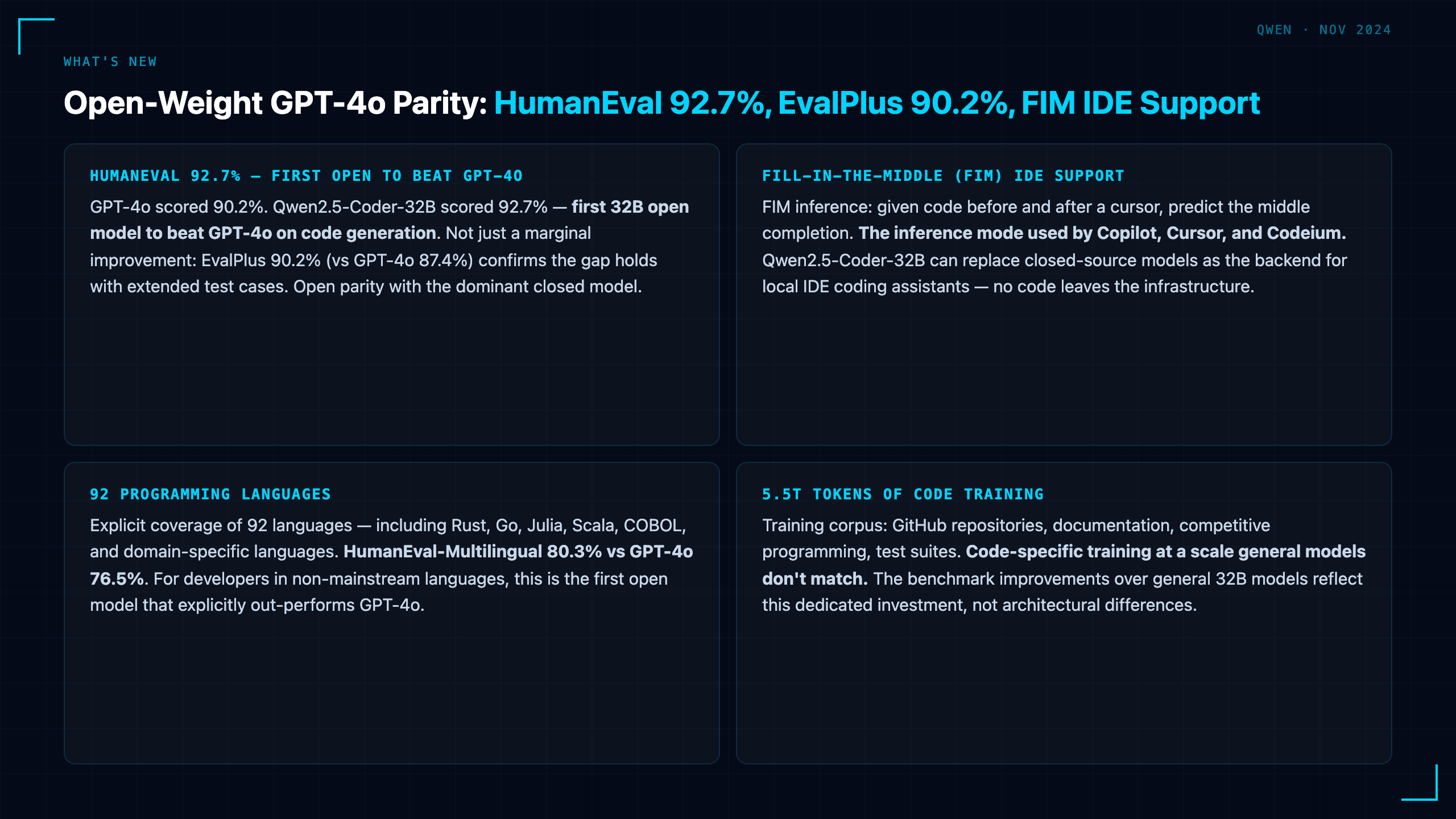
Alibaba released Qwen2.5-Coder in November 2024 — a family of code-specialized models from 0.5B to 72B, trained on 5.5 trillion code tokens. The 32B variant scores 92.7% on HumanEval, surpassing GPT-4o (90.2%), while the 7B variant outperforms the previous-generation 33B Codestral model. Available in Base and Instruct variants under Apache 2.0.
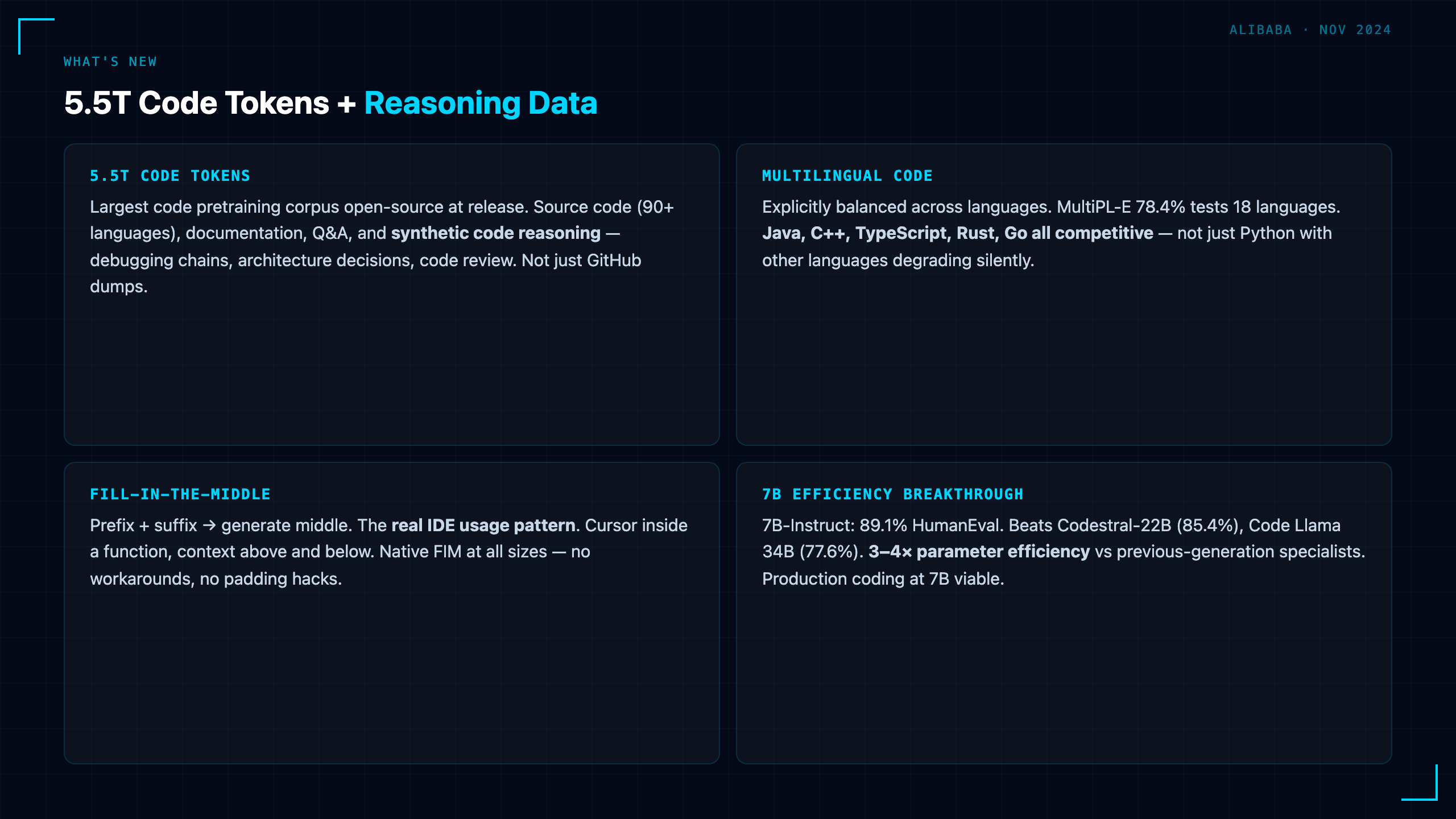
Tencent released Hunyuan-Large in November 2024 — a 389B total parameter MoE model with 52B active per token, trained on 2.6 trillion tokens with a 256K token context window. It outperforms Llama-3.1-70B on all major benchmarks including MMLU, CMMLU, and code tasks, while running on significantly less compute than a 389B dense model. Released as open source under Tencent's Hunyuan Community License.
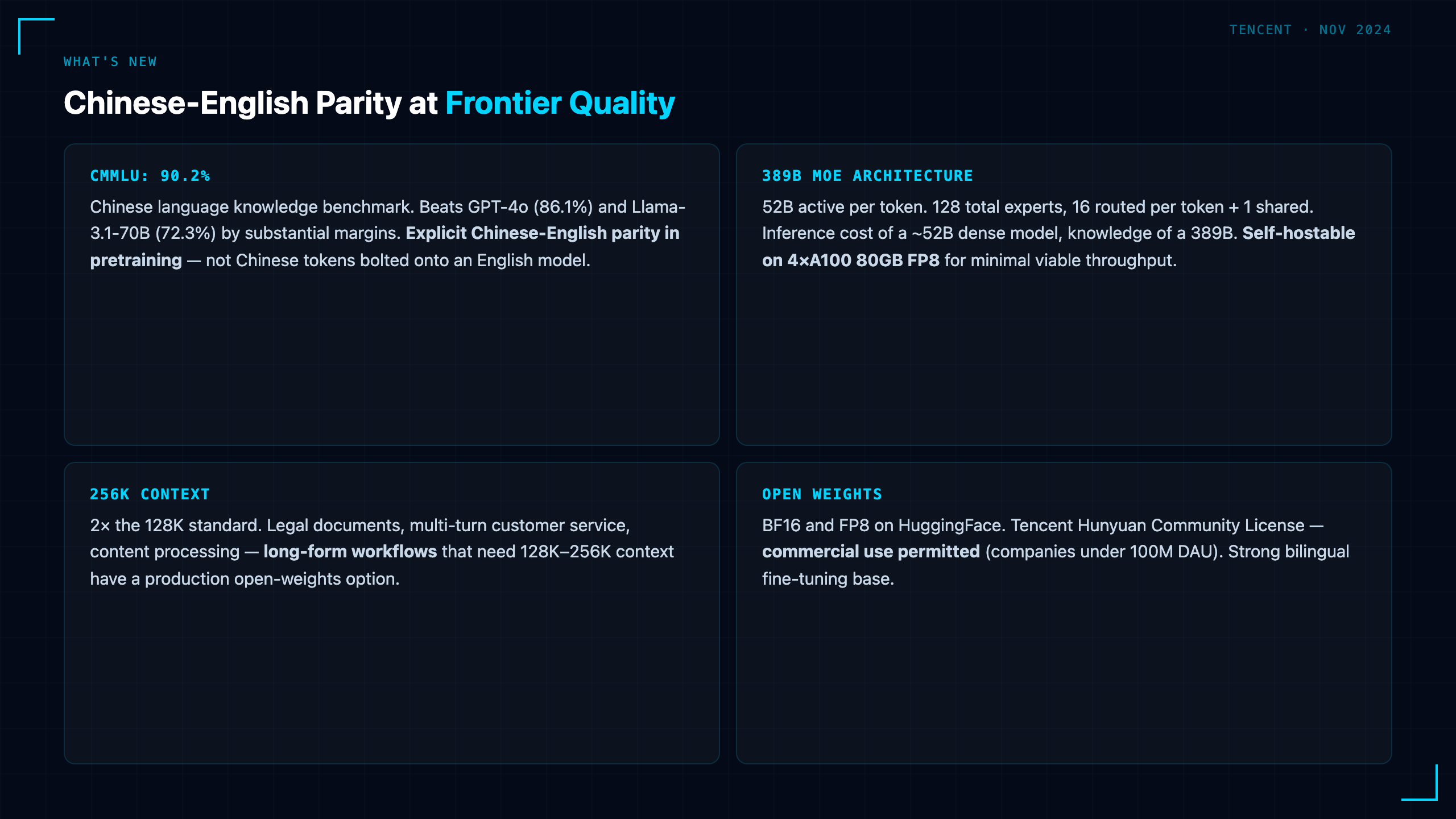
Zhipu AI released AutoGLM in October 2024 — a phone-native GUI agent built on GLM-4V that autonomously completes tasks on Android phones. Combining visual UI understanding with action planning, AutoGLM demonstrated the capability to execute multi-step phone tasks from natural language instructions: booking restaurants, placing food orders, responding to messages, and managing apps without user intervention. It represented one of the first production-ready phone agent deployments from a Chinese AI lab.
01.ai released Yi-Lightning in October 2024 — a model optimized for cost-performance ratio that scored 76.0% on MMLU-Pro and ranked among the top models on the LMSYS Chatbot Arena leaderboard. Priced at $0.14/M tokens for both input and output, Yi-Lightning made frontier-quality responses accessible at commodity pricing.
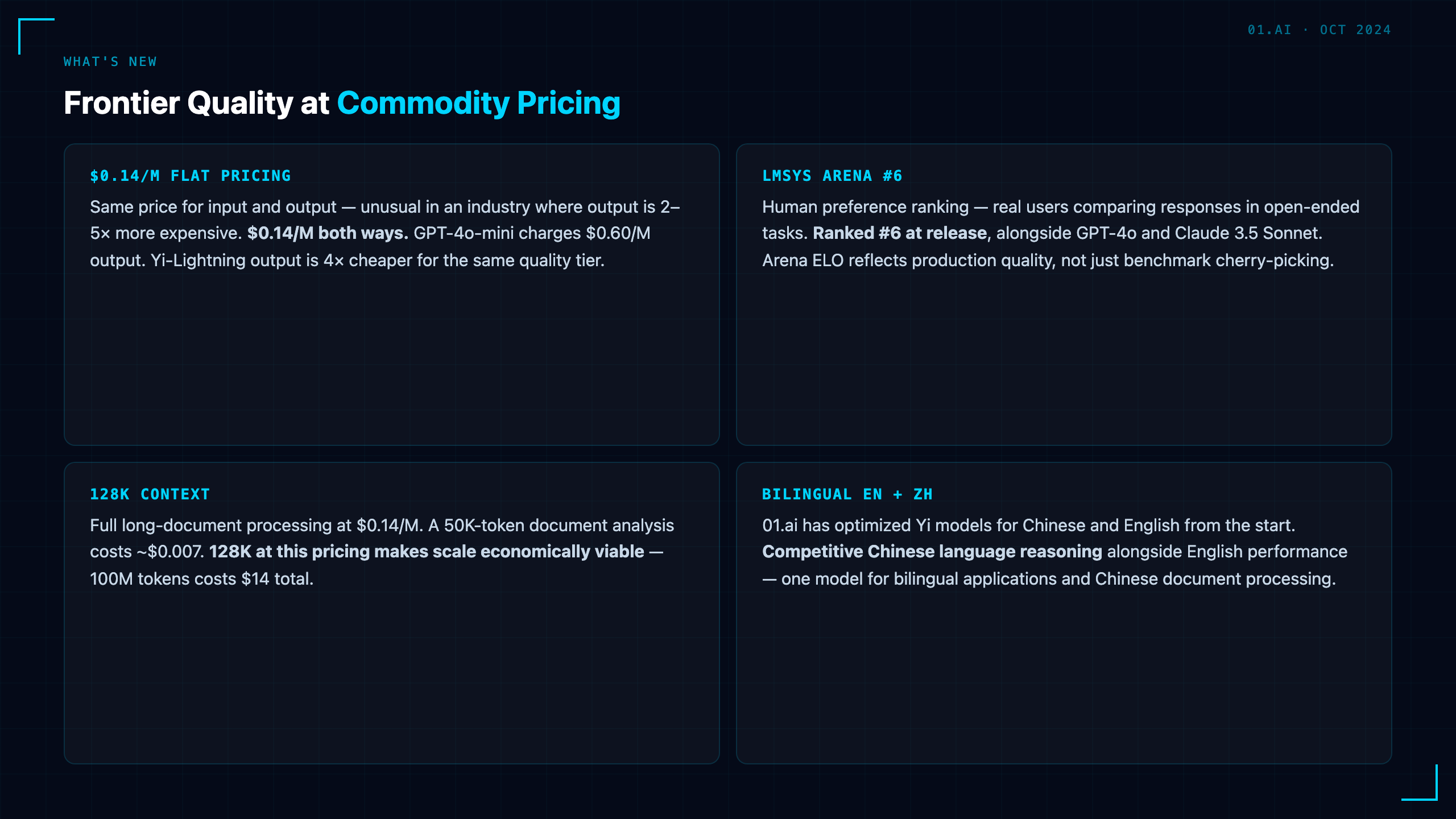
Alibaba released Qwen2.5 in October 2024 — a full model family from 0.5B to 72B trained on 18 trillion tokens, with 128K context length and dramatically improved instruction following, math, and coding. The 72B flagship matches GPT-4o on several key benchmarks at Apache 2.0. Accompanied by specialist releases: Qwen2.5-Coder and Qwen2.5-Math.
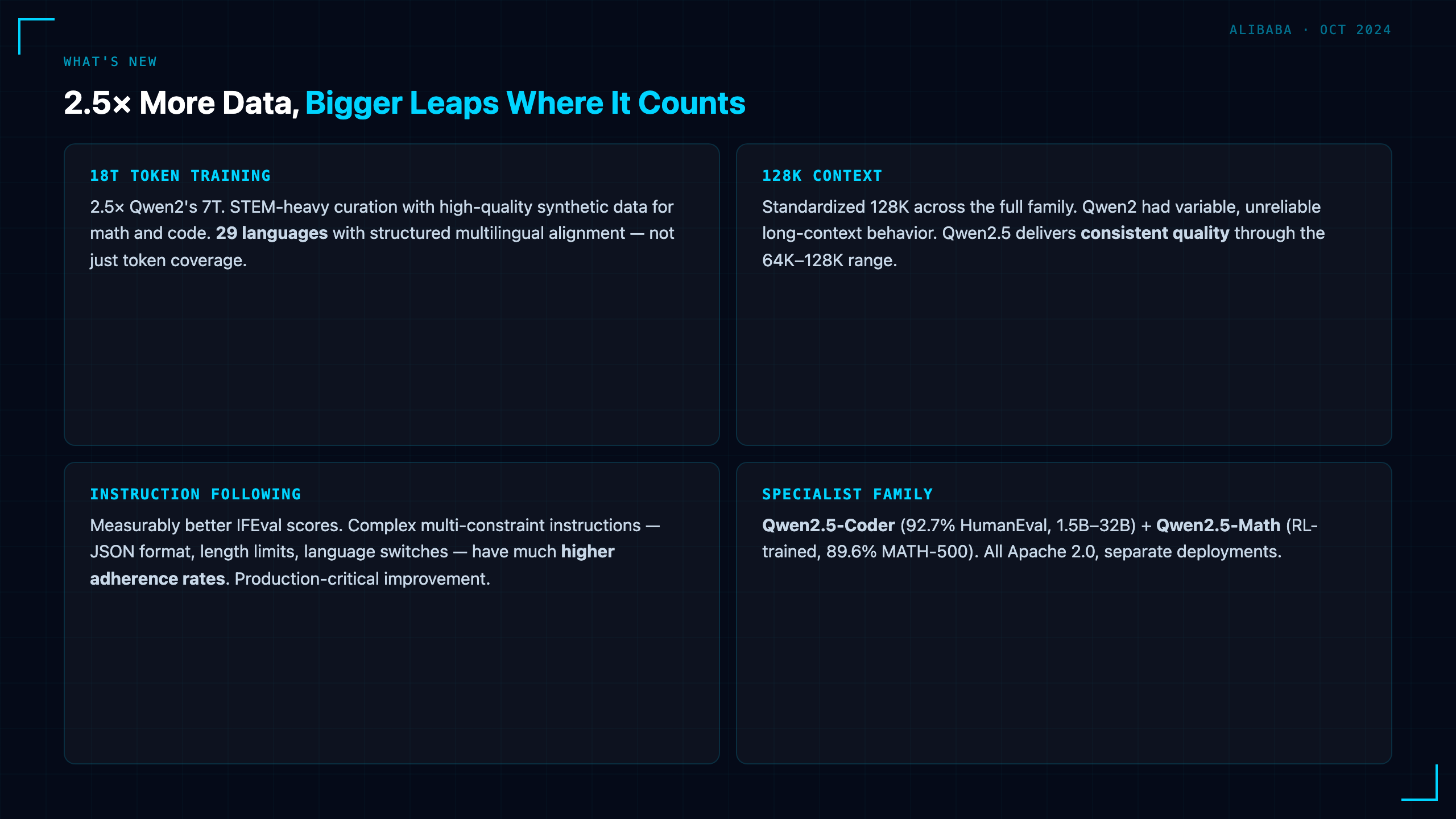
Alibaba released Qwen2-Audio in September 2024 — a 8.4B audio-language model that unified speech recognition, audio analysis, and voice conversation in a single architecture. Using Whisper-Large-V2 as the audio encoder paired with Qwen-7B, Qwen2-Audio achieved state-of-the-art results on AIR-Bench while supporting voice chat mode and audio analysis mode in one model.
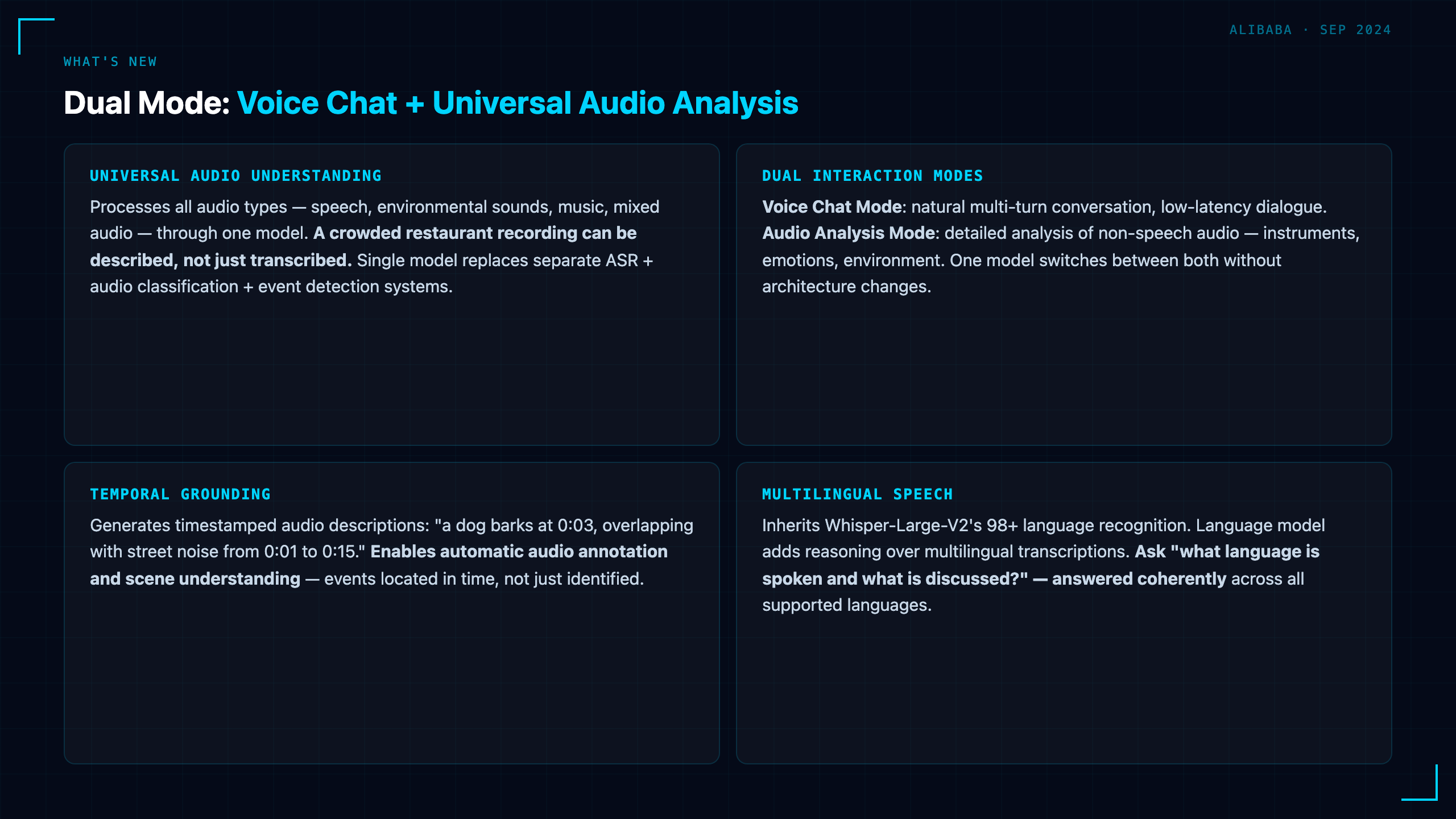
Alibaba released Qwen2-VL in September 2024 — a vision-language model that introduced Naive Dynamic Resolution, allowing the model to process images at their native resolution rather than resizing to fixed dimensions. Available in 2B, 7B, and 72B sizes under Apache 2.0, the 72B variant matched GPT-4V on most benchmarks and significantly outperformed it on document and video tasks.
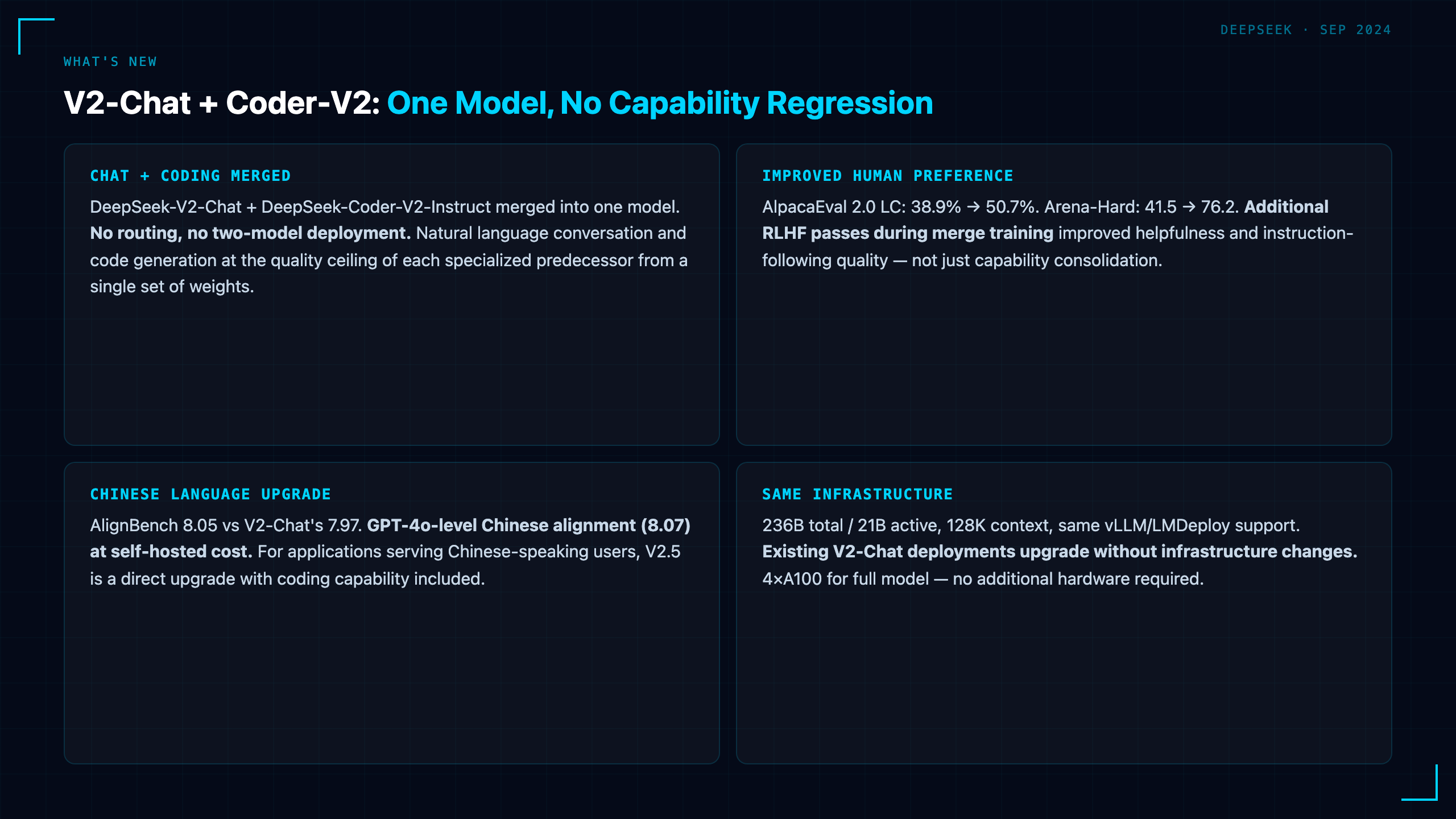
DeepSeek released DeepSeek-V2.5 in September 2024 — a merged upgrade combining DeepSeek-V2-Chat and DeepSeek-Coder-V2-Instruct into a single model. The consolidation eliminated the need to maintain separate chat and coding models while improving AlignBench scores and human preference ratings. Still 236B MoE with 21B active parameters, now handling both natural language conversation and code at the same quality ceiling.
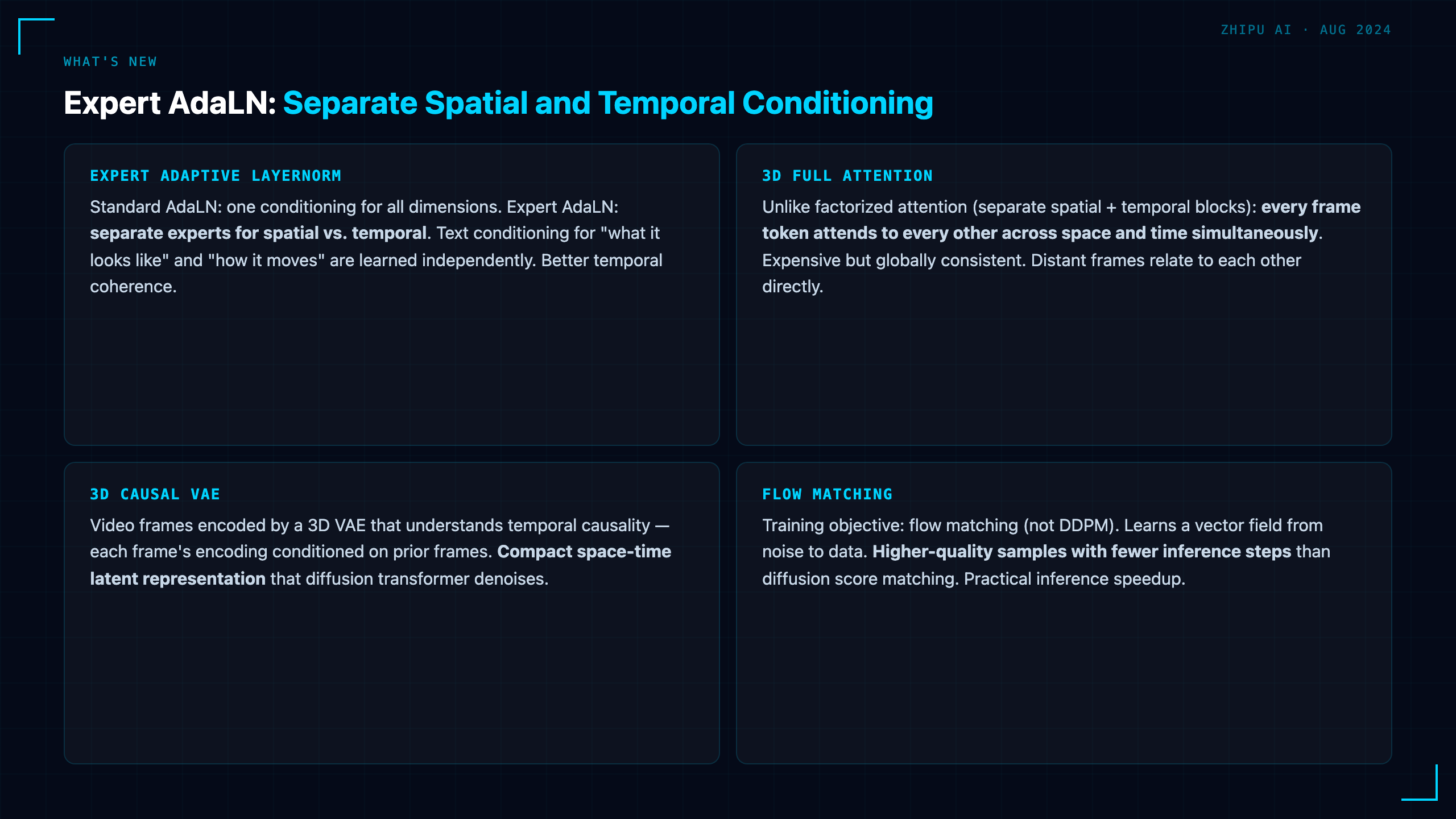
Zhipu AI released CogVideoX in August 2024 — an open-source video generation model using Expert Adaptive LayerNorm and 3D Full Attention. Available in 2B and 5B variants under Apache 2.0, it demonstrated competitive quality with Sora on text-to-video benchmarks while being fully open for commercial use and fine-tuning.
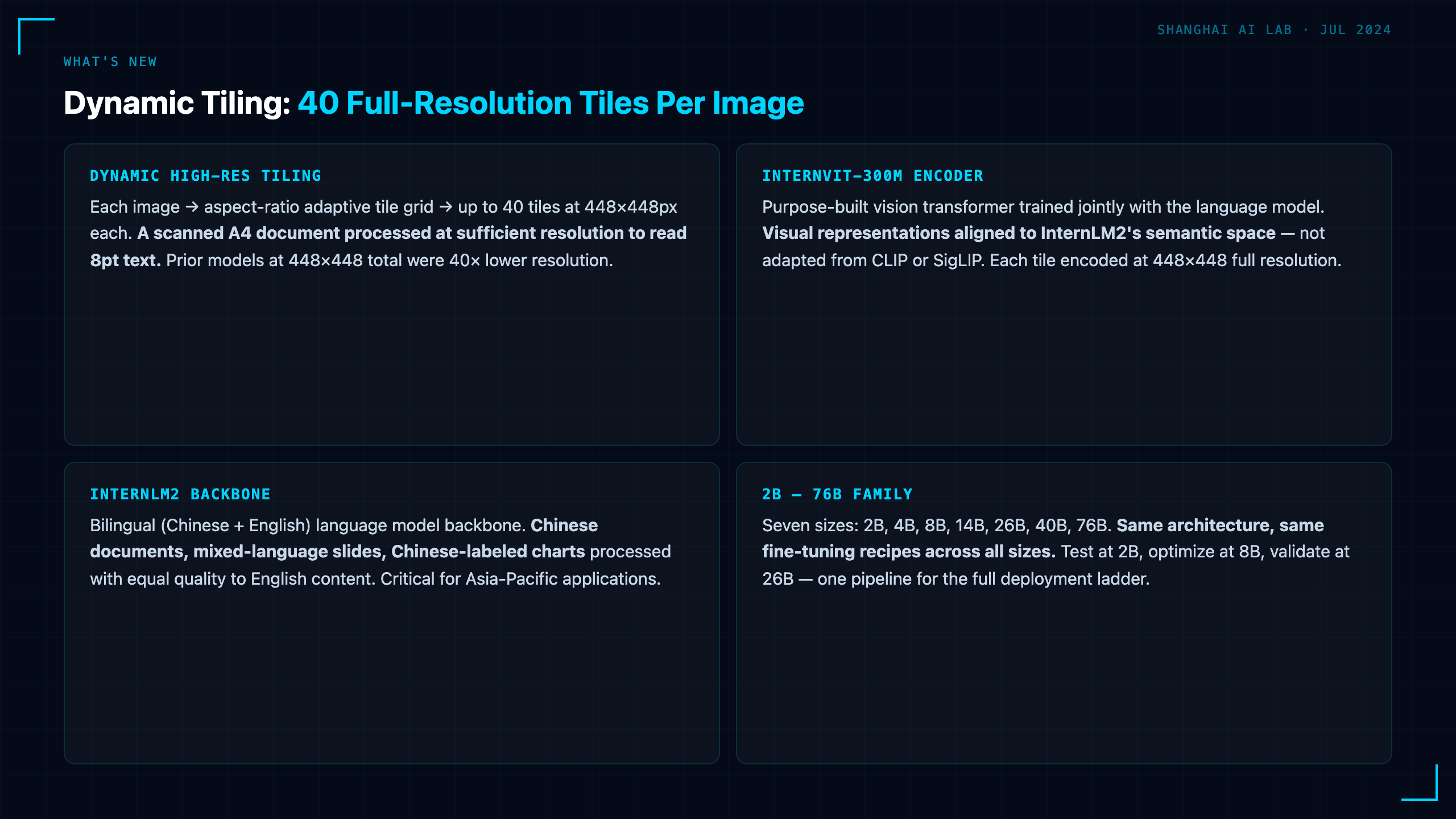
Shanghai AI Lab released InternVL2 in July 2024 — a vision-language model family from 2B to 76B that introduced dynamic high-resolution tiling and became the dominant open-source VLM choice in the second half of 2024. The 76B variant scored 839 on OCRBench and 88.4% on ChartQA, surpassing GPT-4V and setting new open-source records across document, chart, and scientific tasks.
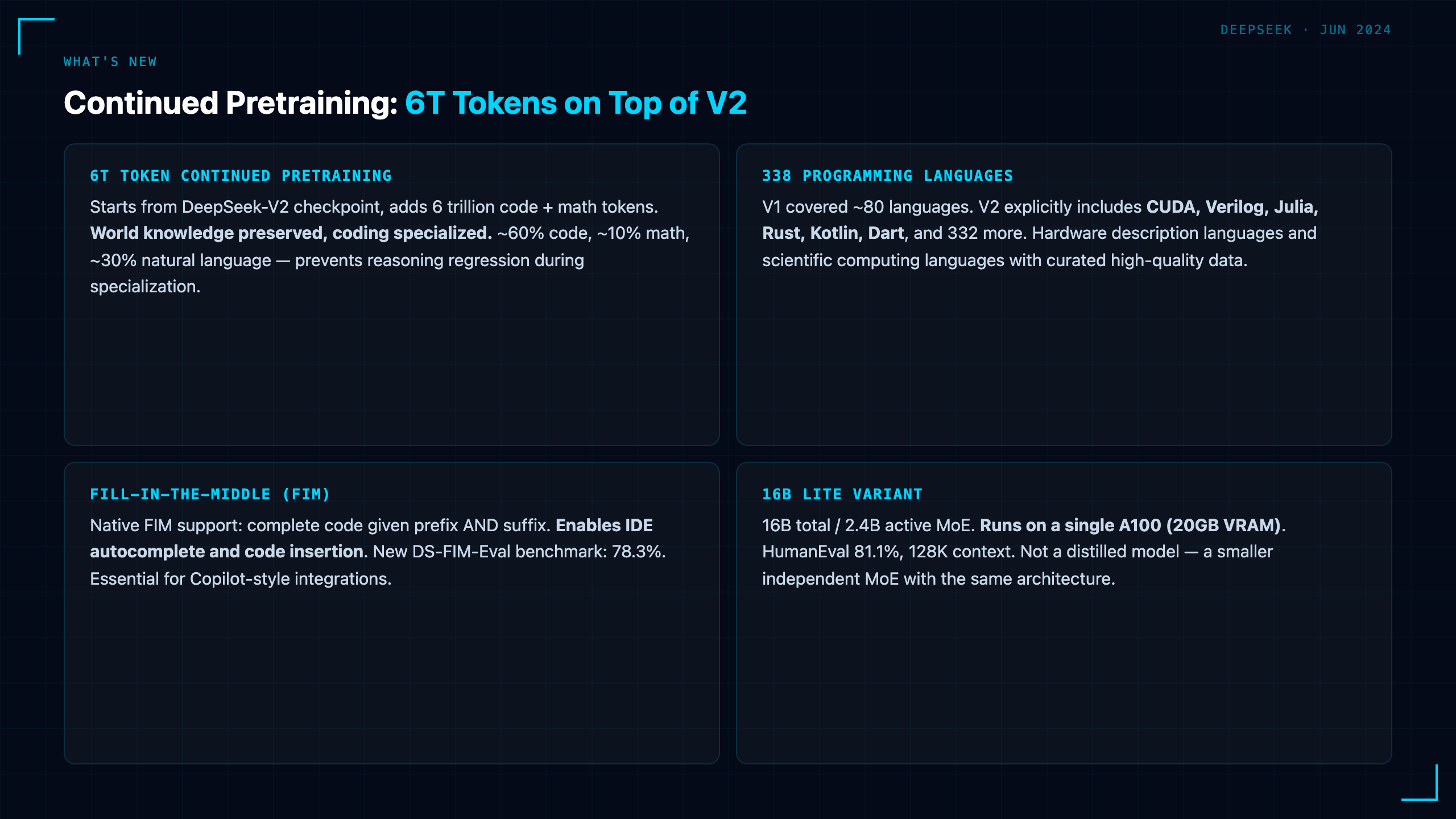
DeepSeek released Coder-V2 in June 2024 — a 236B MoE code model that became the first open-source model to surpass GPT-4 Turbo on HumanEval and LiveCodeBench. Trained on 6 trillion tokens across 338 programming languages with 128K context, the 16B variant runs on a single A100 and matches GPT-4-level coding quality.
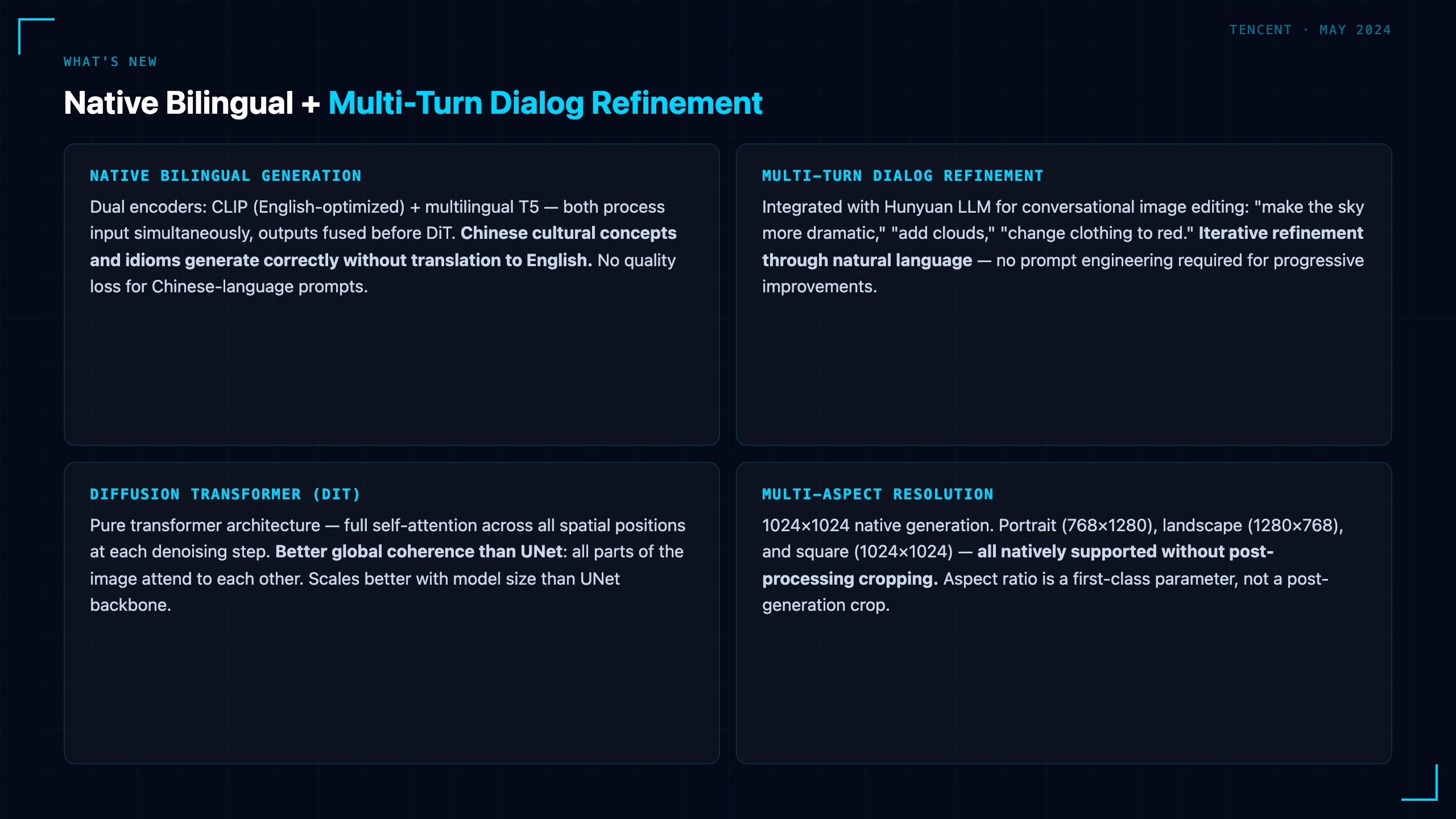
Tencent released Hunyuan-DiT in May 2024 — a 1.5B parameter diffusion transformer for text-to-image generation with native Chinese-English bilingual support. Using a dual-encoder architecture combining CLIP and multilingual T5, and trained on a curated dataset with multi-turn dialog-based refinement capability, Hunyuan-DiT became the first open-source bilingual diffusion model to match proprietary Chinese image generation systems.