Five days after releasing the DeepSeek V4 preview, Moonshot's main competitor quietly started rolling out something it had never offered before in its consumer product: a mode that actually understands images. Chinese users have begun seeing "识图模式" (vision mode) appear alongside "Quick Mode" and "Expert Mode" in both the web interface and the mobile app. Backend configuration strings confirm the feature is in internal beta: name: 识图模式, description: 图片理解功能内测中.
This matters more than it might appear. DeepSeek has spent the past year dominating the text and reasoning benchmarks — V4 is cost-competitive with anything on the market for pure language tasks — but it has been conspicuously absent from multimodal use cases. The open-source research side has been active (DeepSeek-VL2, Janus-Pro), but the commercial product and API have been text-only. Vision mode in the app is the first sign that's changing.
What Just Launched
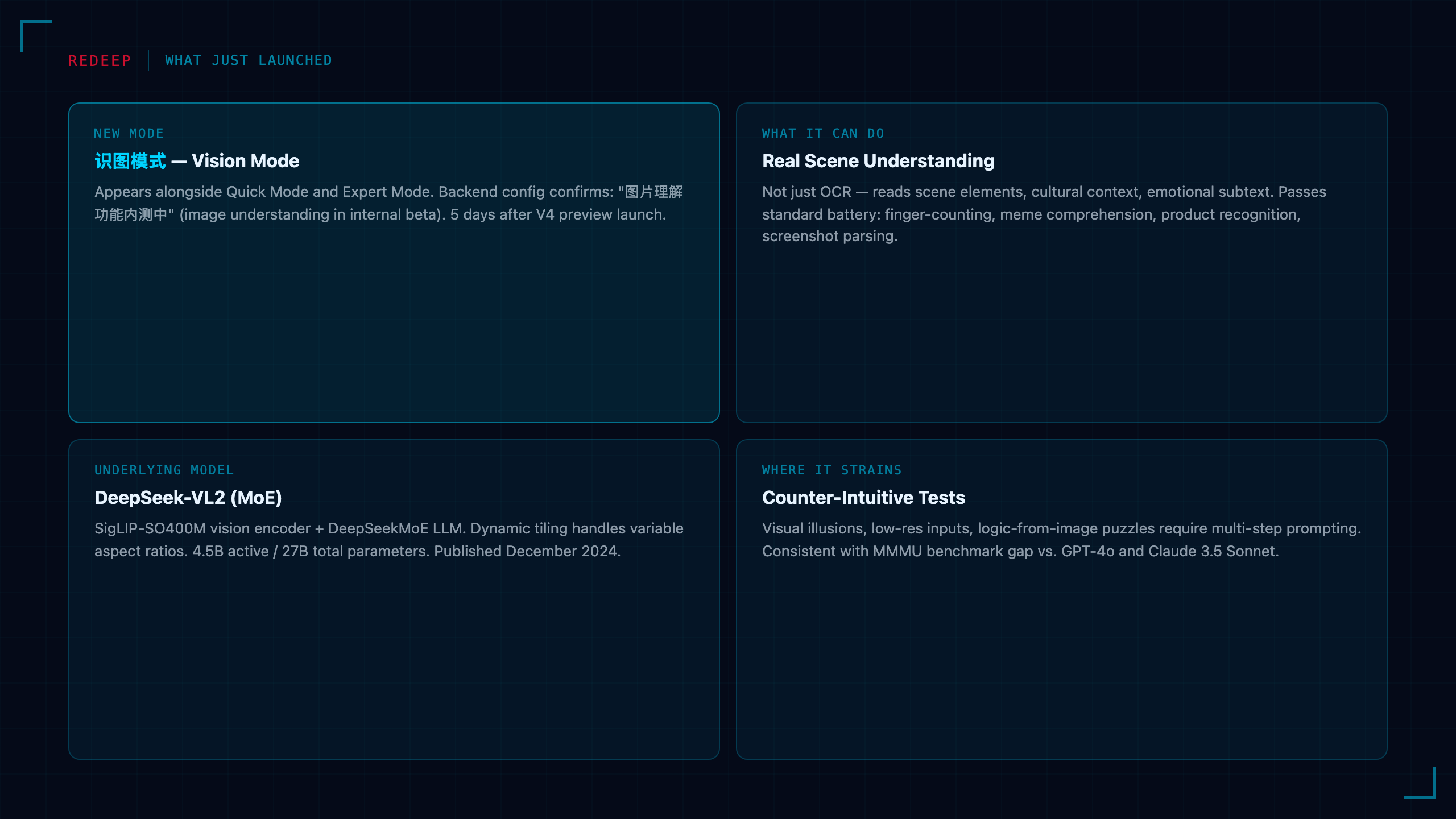
The rollout is grayscale, meaning only a subset of users can see and use the mode. What's visible so far: the vision mode sits as a peer to the existing Quick and Expert modes in the chat interface. Users can upload images directly and ask questions, and the model goes well beyond the OCR-style text extraction that was previously DeepSeek's only image capability.
Early community testing covers the standard battery: counting fingers, identifying animated characters, reading memes, parsing screenshots, recognizing products, spotting hidden information, and reading emotional context from photos. The model passes the basic tests cleanly — it reads scene elements, not just embedded text. It also handles cultural context questions that require world knowledge beyond pure visual processing (identifying public figures, understanding why a particular image is funny).
The harder category — counter-intuitive tests, visual illusions, low-resolution inputs, logic-from-image puzzles — shows more strain. DeepSeek sometimes needs to be prompted to think through these cases step by step before arriving at a correct answer. That's consistent with what the published benchmarks predict.
The underlying technology is almost certainly DeepSeek-VL2, the MoE vision-language model published in December 2024. It uses a SigLIP-SO400M vision encoder paired with DeepSeekMoE, with a dynamic tiling strategy that handles images at variable aspect ratios and high resolutions. The largest variant activates 4.5 billion parameters — a fraction of what closed frontier models run.
What the Benchmarks Actually Say
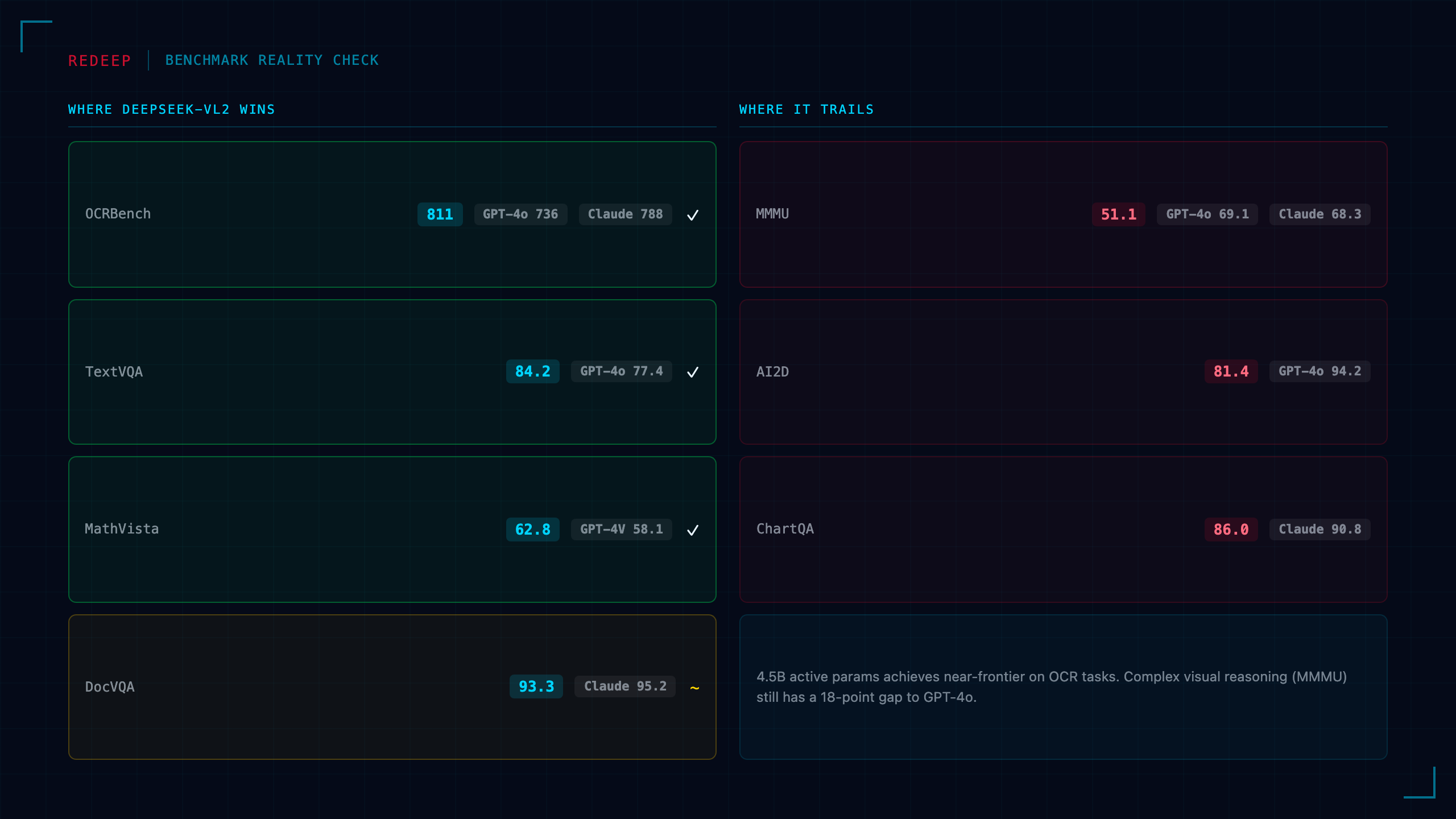
The benchmark picture is genuinely split, and it's worth being specific rather than hand-wavy about where DeepSeek-VL2 stands.
Where it wins: OCR and document tasks. On OCRBench, DeepSeek-VL2 scores 811 — ahead of GPT-4o (736) and Claude 3.5 Sonnet (788). On TextVQA (reading text in natural scene images), it scores 84.2, ahead of GPT-4o's 77.4. For DocVQA (document question answering), it reaches 93.3 — just behind Claude 3.5 Sonnet's 95.2 but ahead of GPT-4V's 87.2. On MathVista (math reasoning with visual inputs): 62.8, above GPT-4V's 58.1 and close to GPT-4o's 63.8.
Where it trails: Complex visual reasoning. On MMMU, the benchmark measuring multi-discipline academic reasoning with images, DeepSeek-VL2 scores 51.1 — well behind GPT-4o's 69.1 and Claude 3.5 Sonnet's 68.3, and roughly matching GPT-4V's 63.1 which came out over a year earlier. On AI2D (science diagram understanding), the gap is also visible.
The efficiency framing is real but contextual. Achieving these numbers with 4.5B activated parameters is a genuine technical accomplishment. The parameter efficiency story is compelling for self-hosting. It doesn't change the absolute capability gap on tasks that require deep visual reasoning.
The API Gap That Still Exists
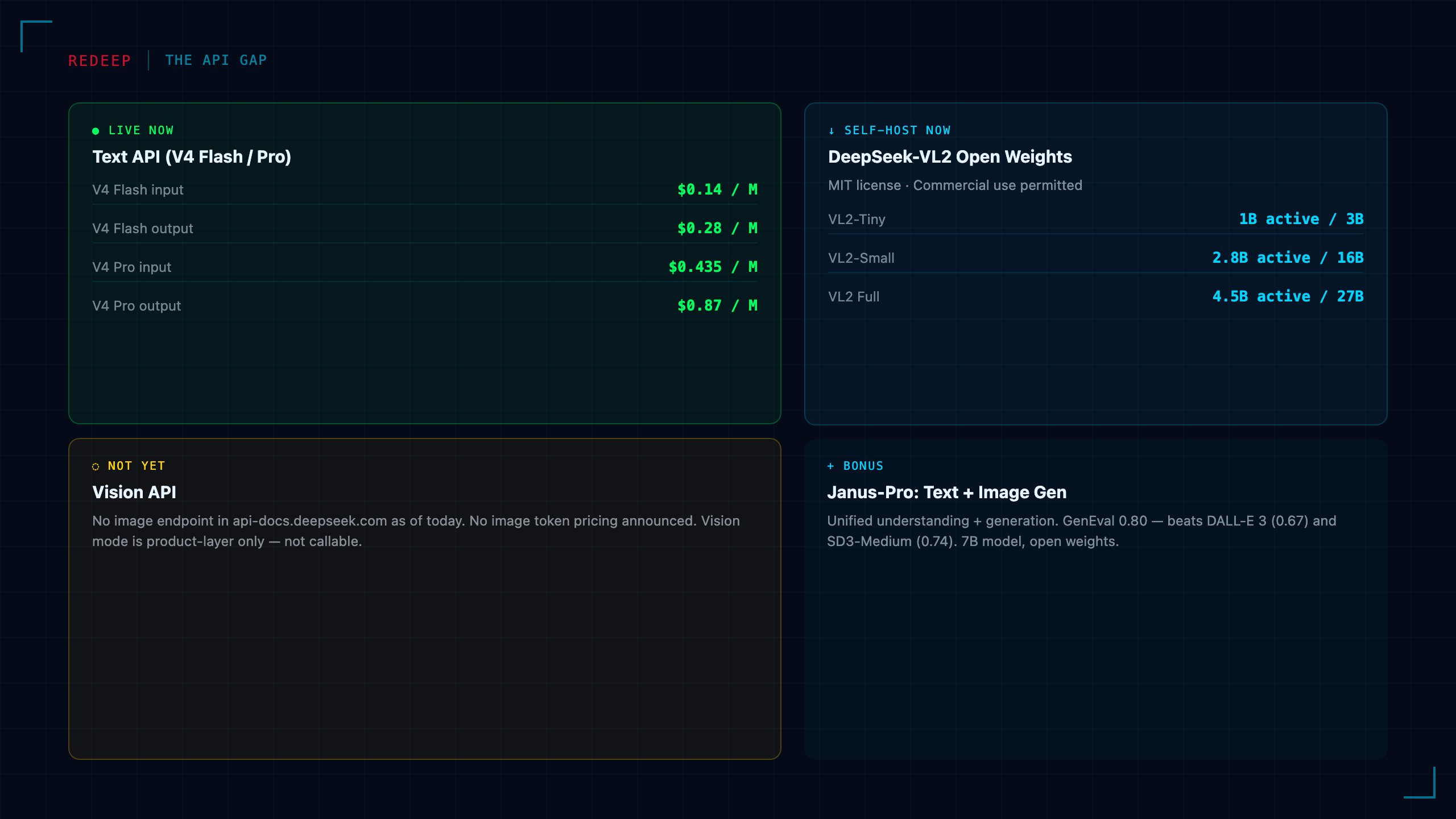
Here's what matters for anyone building products: there is currently no vision API from DeepSeek. The commercial API at api-docs.deepseek.com exposes only deepseek-v4-flash and deepseek-v4-pro, both text-only. DeepSeek-VL2 and Janus-Pro exist as open-weight research models that you can self-host, but they're not endpoints you can call.
The current text API pricing for context: V4 Flash at $0.14/M input tokens (cache miss), $0.28/M output. V4 Pro at $0.435/M input, $0.87/M output. No image token pricing exists because no image endpoint is live.
This is the gap between what the app is testing and what's available for developers. The 识图模式 grayscale rollout is a product-layer feature, not an API release. It's telling you the capability is production-ready enough for user testing, which is a signal — but it's not something you can build on today.
The open-source path is DeepSeek-VL2 on Hugging Face, MIT-licensed, available in three sizes: Tiny (1B active / 3B total), Small (2.8B active / 16B total), and the full model (4.5B active / 27B total). If OCR and document tasks are your use case, self-hosting VL2 is a serious option right now.
What It Means for Developers
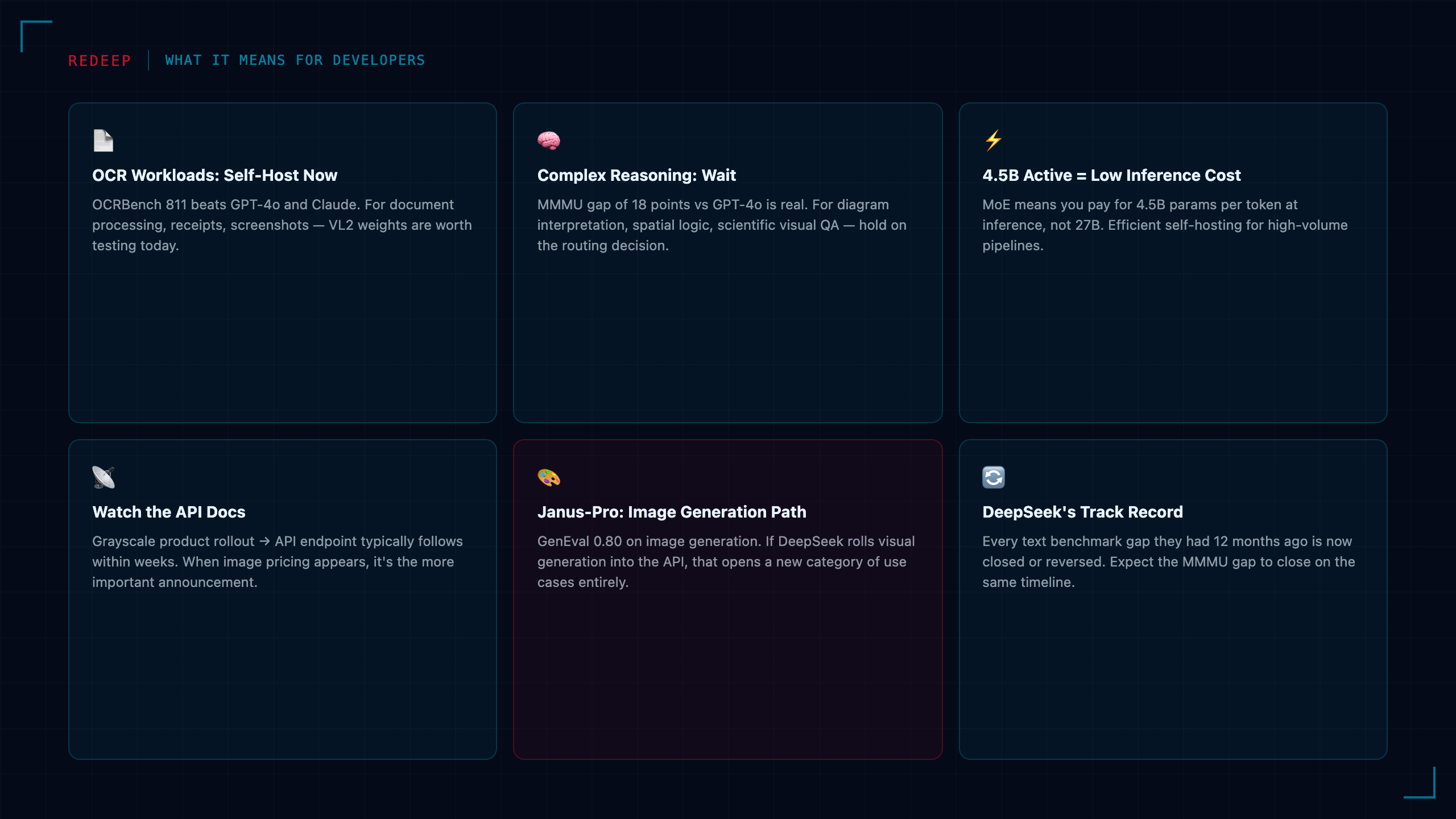
The strategic picture is straightforward: DeepSeek has been the obvious choice for text and reasoning tasks at low cost. The absence of vision has been the single clearest reason to route certain workloads elsewhere. If V4 gets native image input at the same price-performance ratio that the text models offer, the calculus for a large segment of API use cases shifts significantly.
The timing is deliberate. V4 preview launched, vision mode followed within a week. This isn't a research drop — it's a product signal. Expect an API endpoint to follow the grayscale rollout.
For OCR-heavy workflows specifically, the benchmark data suggests DeepSeek-VL2 is already competitive or better than closed alternatives on OCRBench and TextVQA. If you're processing documents, receipts, screenshots, or structured images and can tolerate self-hosting, the VL2 weights are worth testing now ahead of the API launch.
For use cases requiring deep visual reasoning — complex diagram interpretation, spatial reasoning, multi-step visual logic — the MMMU gap (51.1 vs. 69.1 for GPT-4o) is meaningful. This isn't a knock; it's useful information for routing decisions. DeepSeek's likely trajectory is that this gap closes, as it has on every text benchmark, but it's not closed yet.
One thing to watch: Janus-Pro, the unified understanding-plus-generation model, scores GenEval 0.80 on image generation (beating DALL-E 3 at 0.67 and Stable Diffusion 3 Medium at 0.74). If DeepSeek eventually rolls visual generation into the product, that's a different conversation entirely.
Bottom Line
DeepSeek entering multimodal is not surprising; the only question was timing. The grayscale launch confirms vision is close enough to production-quality for user testing. The benchmarks say it's genuinely strong for OCR and document tasks, and still catching up on complex visual reasoning. No API yet — which means the practical impact for developers is deferred, but not far off.
Watch the API docs. When image input pricing appears, it will be the more important announcement.
Resources
- DeepSeek Official Site — main product
- DeepSeek API Docs — current text API (V4 Flash / Pro)
- DeepSeek-VL2 GitHub — open-weight vision model (MIT license)
- DeepSeek-VL2 Paper — arXiv:2412.10302, December 2024
- Janus-Pro GitHub — unified understanding + generation model
DeepSeek's text API is live at api-docs.deepseek.com at $0.14/M input tokens (V4 Flash). Vision API pricing has not been announced; DeepSeek-VL2 open weights are available for self-hosting at github.com/deepseek-ai/DeepSeek-VL2.