For a week in August, something strange happened on OpenRouter. An anonymous model called "ox-alpha" climbed to the top of the weekly usage charts on both OpenRouter and OpenCode, broke call-volume records, and users started a guessing game. The Chinese community nicknamed it "牛来" (Ox Coming). Nobody knew who built it. On August 26, Zhipu AI ended the guessing game: ox-alpha was GLM-5.3-Flash, and it was going open-source.
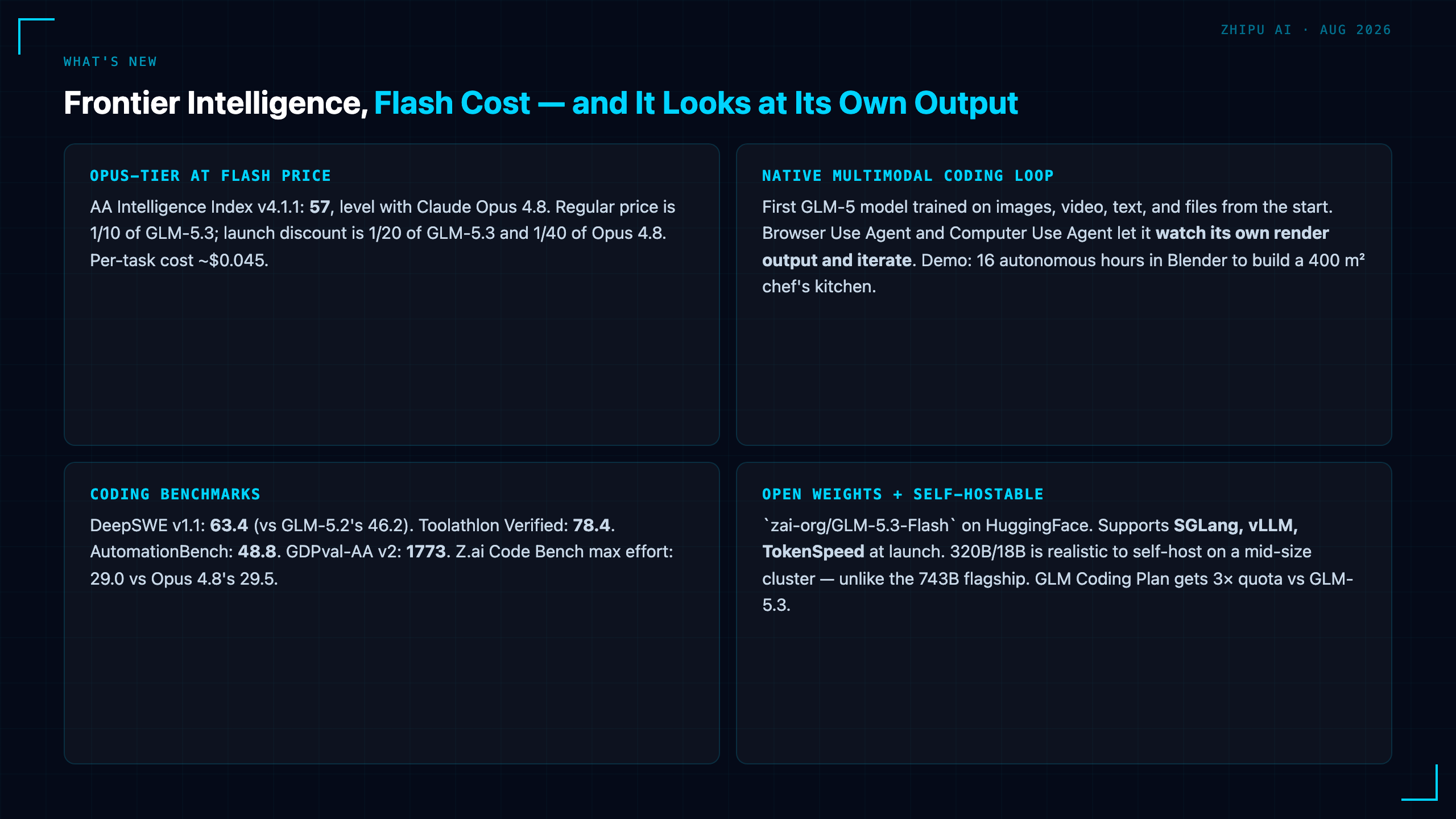
GLM-5.3-Flash is the first native multimodal model in the GLM-5 line. It is 320B total parameters with only 18B activated per token. It scores 57 on the Artificial Analysis Intelligence Index — level with Anthropic's Claude Opus 4.8 — at a launch-discount cost of roughly $0.045 per task, which Zhipu frames as 1/40 of Opus 4.8's price. The product thesis is one sentence: "Frontier Intelligence, Flash Cost." Same frontier intelligence, finally cheap enough that you don't have to ration it.
The anonymous-launch-then-reveal strategy is the story people will copy. But the architecture and the domestic-chip infrastructure underneath are the story developers should actually care about.
What's New: 320B/18B Native Multimodal, Opus-Tier at Flash Price
GLM-5.3-Flash is a different animal from the text-only GLM-5.3 flagship that dropped twelve days earlier. The specs:
- 320B total / 18B active MoE — a deliberately light activation footprint.
- 1M context window, 128K max output.
- Native multimodal: video, image, text, and file input from the ground up. This is not a vision bolt-on; the visual encoder is part of the model's training loop.
- AA Intelligence Index v4.1.1 score of 57 — above GLM-5.2 and tied with Claude Opus 4.8.
- Pricing: regular price is 1/10 of GLM-5.3; during the launch discount it is 1/20 of GLM-5.3 and roughly 1/40 of Opus 4.8. Zhipu's per-task metric is ~$0.045.
- Open weights on HuggingFace (
zai-org/GLM-5.3-Flash), with SGLang, vLLM, and TokenSpeed support at launch.
The benchmark table tells the real story. Against GLM-5.2, DeepSeek-V4-Vision-Exp, Claude Opus 4.8, GPT-5.6 Terra, and Gemini 3.7 Flash:
| Benchmark | GLM-5.3-Flash | GLM-5.2 | DeepSeek-V4-Vision-Exp | Claude Opus 4.8 | GPT-5.6 Terra | Gemini 3.7 Flash |
|---|---|---|---|---|---|---|
| Terminal Bench 2.1 | 84.3 | 81.0 | 83.9 | 85.0 | 87.4 | 85.8 |
| DeepSWE v1.1 | 63.4 | 46.2 | 59.3 | 58.0 | 69.6 | 65.3 |
| NL2Repo | 56.3 | 48.9 | 57.7 | 69.7 | — | — |
| Toolathlon Verified | 78.4 | 59.9 | 75.9 | 76.2 | 74.9 | — |
| AutomationBench v1.0.6 | 48.8 | 26.2 | 38.8 | 41.0 | 37.2 | 52.3 |
| Agents' Last Exam | 26.3 | 20.4 | 27.3 | 27.0 | 28.0 | — |
| GDPval-AA v2 | 1773 | 1504 | 1675 | 1582 | 1571 | 1527 |
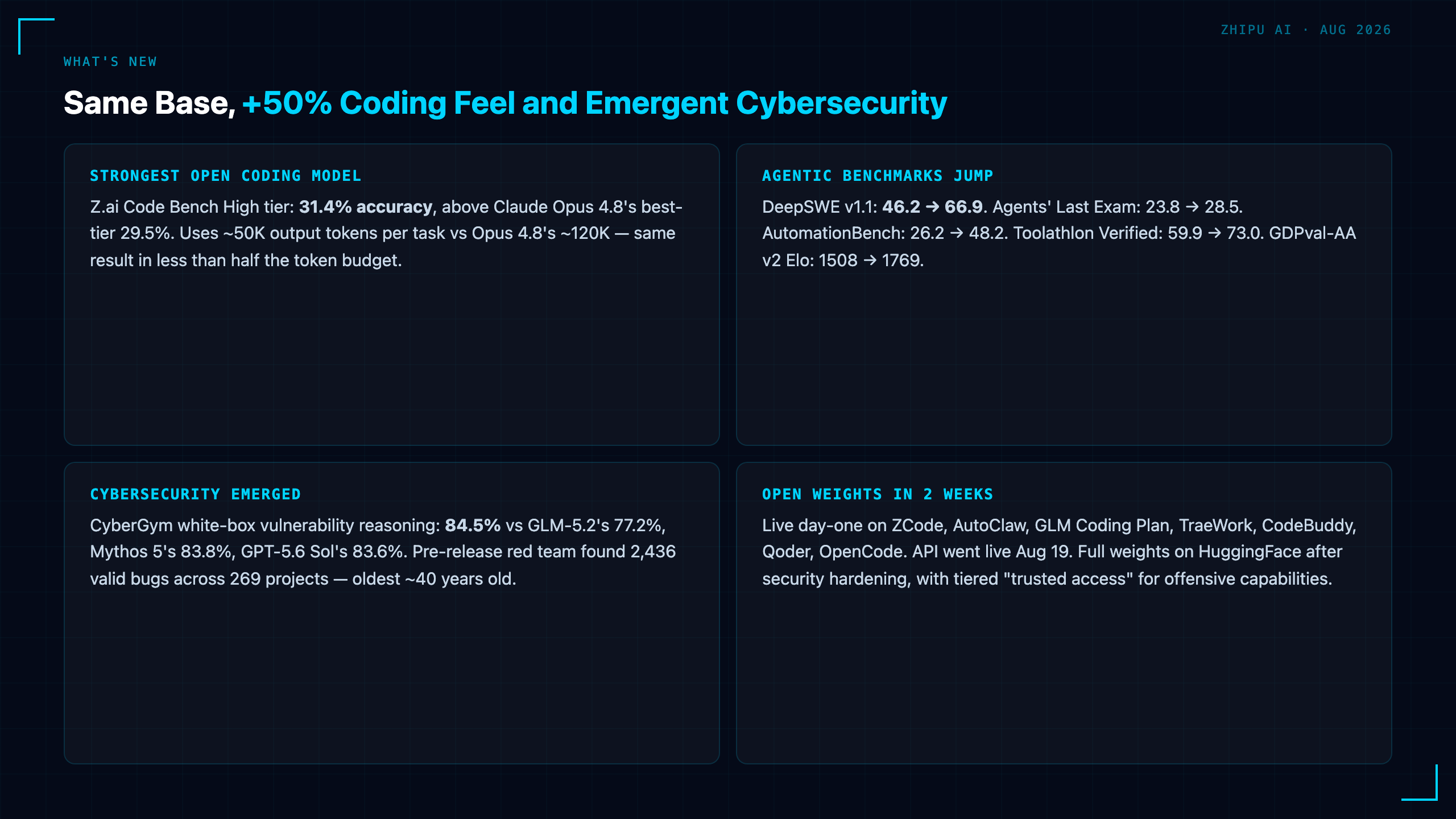
It wins on DeepSWE, Toolathlon, AutomationBench, and GDPval. It is within a point or two of Opus 4.8 on Terminal Bench and Agents' Last Exam. On Z.ai Code Bench v1.0 (run inside Claude Code 2.1.207), it hits 29.0 at max effort versus Opus 4.8's 29.5 — essentially tied, at a fraction of the cost.
The multimodal coding loop is the genuinely new capability. GLM-5.3-Flash doesn't just look at images; it watches its own render output. In ZCode, the Browser Use Agent and Computer Use Agent let the model open a webpage, look at its own UI output, and iterate. The demo that got attention: running autonomously for 16 hours in Blender to build a ~400 m² professional chef's kitchen and test space from scratch, no external assets. Geometry, materials, lighting, spatial consistency across viewpoints — that's world knowledge expressed through 3D construction, not just text.
Architecture: Hybrid Attention Built for 1M Context at Low Cost
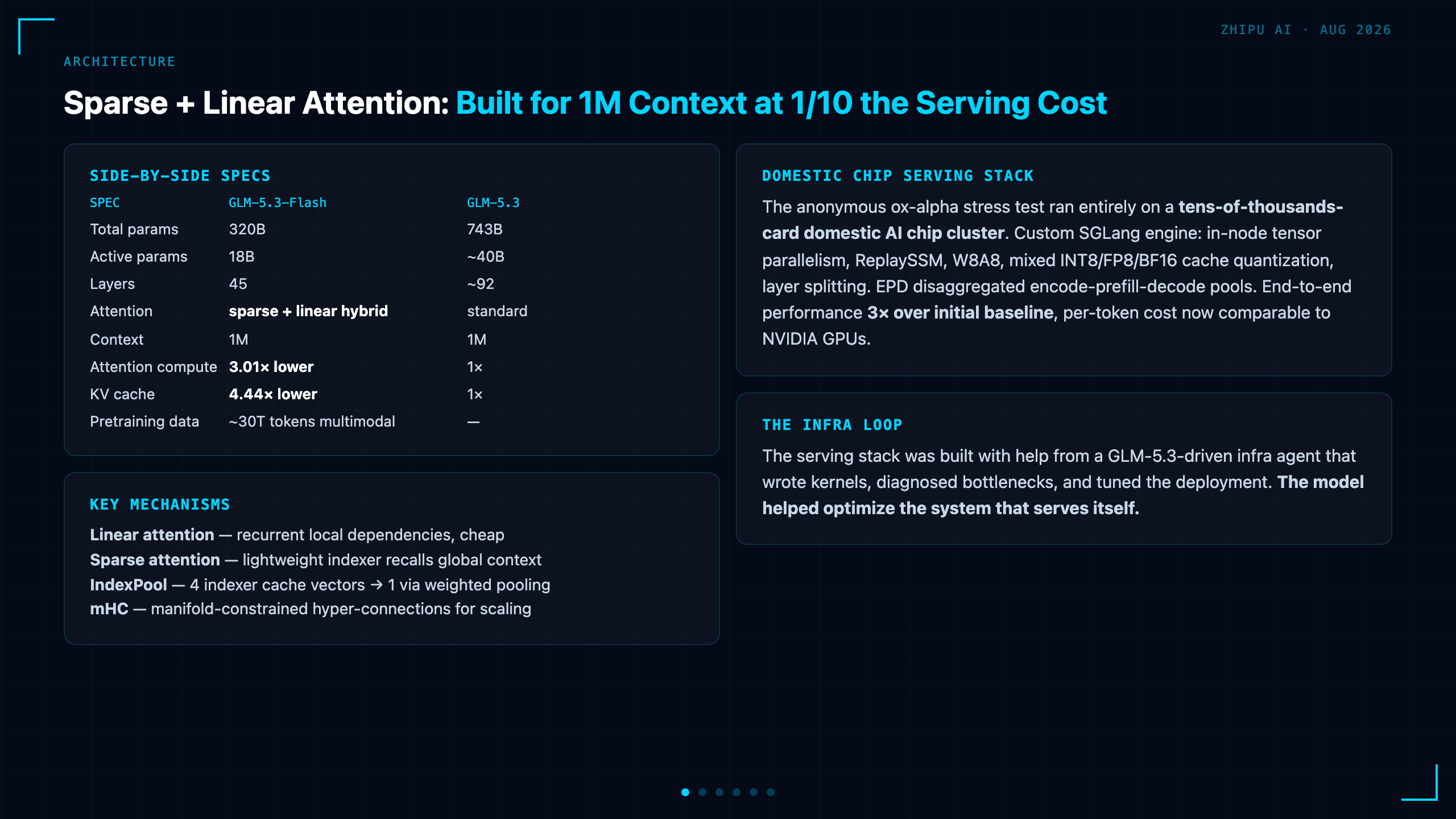
GLM-5.3-Flash is the first open frontier model to combine sparse attention and linear attention in one architecture. The point is cost at long context, not raw benchmark score.
The design:
- Linear attention captures local dependencies through a recurrent state mechanism — cheap, fast, effectively free for nearby tokens.
- Sparse attention uses a lightweight indexer to recall global context — most of the 1M window gets skimmed, only the relevant chunks get full attention.
- IndexPool compresses the indexer's 4 cached vectors into 1 via weighted pooling, cutting latency and memory at 1M context.
- mHC (Manifold-Constrained Hyper-Connections) is a new hyper-connection design to improve scaling behavior for future models.
- Layer count drops to 45 layers versus 92 in the GLM-4.5 generation, while total parameters stay at 320B.
The efficiency numbers are the point: compared to GLM-5.3, attention compute per token drops 3.01× and KV cache size drops 4.44×. Per-layer, it has the lowest attention compute of any model in Zhipu's comparison set (GLM-5.3, DeepSeek-V4, Kimi-K3). KV cache per layer at 1M context is shown roughly 3.8× smaller than GLM-5.3.
That's the engineering reason the price can be 1/10 of GLM-5.3. You're not getting a dumbed-down model; you're getting an architecture that costs a fraction to serve at long context. With ~30T tokens of new multimodal pretraining data on top, the base model (GLM-5.3-Flash-Base) already beats GLM-4.5-Base on MMLU (88.1), BBH (86.6), HellaSwag (87.1), LiveCodeBench-Base (37.6), and SimpleQA (33.5) — and stays competitive with the 744B GLM-5-Base on most components.
The infrastructure underneath is the other half of the story. During the anonymous ox-alpha stress test, every request ran on a domestic Chinese AI chip cluster (tens of thousands of cards), connected by a custom high-bandwidth network. Zhipu built a custom inference engine on top of SGLang, combining in-node tensor parallelism, ReplaySSM, W8A8 quantization, mixed INT8/FP8/BF16 cache quantization, and layer splitting. At the cluster level they use an Encode–Prefill–Decode (EPD) disaggregated architecture that pools multimodal encoding, prompt prefill, and per-token decode separately. End-to-end service performance is 3× above the initial baseline on the same hardware, with per-token cost now comparable to mainstream NVIDIA GPU deployments. And the whole stack was built with help from a GLM-5.3-driven infra agent that helped write kernels, diagnose bottlenecks, and tune the serving layer — the model optimizing the system that serves the model.
Launch Strategy: Anonymous, Viral, Then Revealed
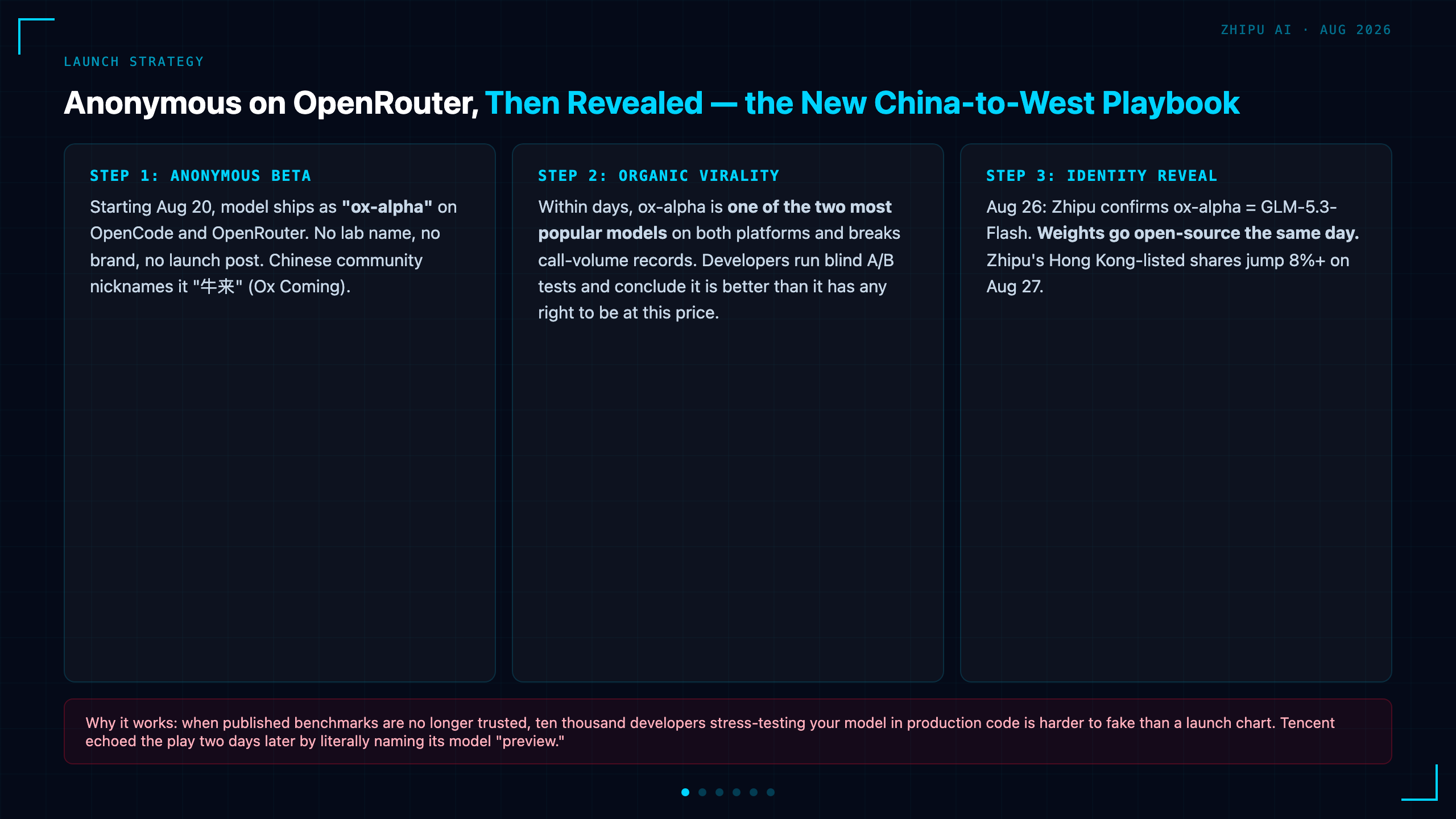
The ox-alpha playbook is the part that other Chinese labs will study. Starting August 20, six days before the official release, Zhipu opened the model anonymously on OpenCode and OpenRouter. No lab name, no brand, no launch post. Just a model endpoint that immediately started beating expectations.
Within days it was one of the two most popular models on both platforms, and it broke call-volume records. Developers compared it against known frontier models in blind A/B tests and concluded it was "better than it had any right to be at this price." The Chinese community started calling it "牛来" — a pun on the codename. The speculation that it came from a Chinese lab was right; the identity was the open secret.
The reveal on August 26 did three things at once:
- It validated the product with real users before the brand announcement. Ten thousand developers had already stress-tested it in production codebases, browser-use agents, and document pipelines. When Zhipu named it, they weren't asking the market to trust a press release — they were confirming what the market had already discovered.
- It de-risked the benchmark skepticism. In an era where published benchmark tables are met with a shrug, actual usage volume and developer sentiment are harder to fake. The anonymous period was a massive, distributed, uncompensated beta test on domestic chips.
- It generated a second news cycle. The reveal itself was a story. Zhipu's Hong Kong-listed shares jumped over 8% on August 27 on the back of the "牛来" reveal.
This is a new template for Chinese models going overseas: ship anonymously on Western developer platforms, let the model's quality create the hype, reveal the lab identity when the market has already fallen in love with the product. It's cheaper than a marketing campaign and more credible than a launch event. Tencent would echo the play two days later by literally putting "preview" in the Hy4 model name and asking users to tell them what's broken.
What It Means for Developers
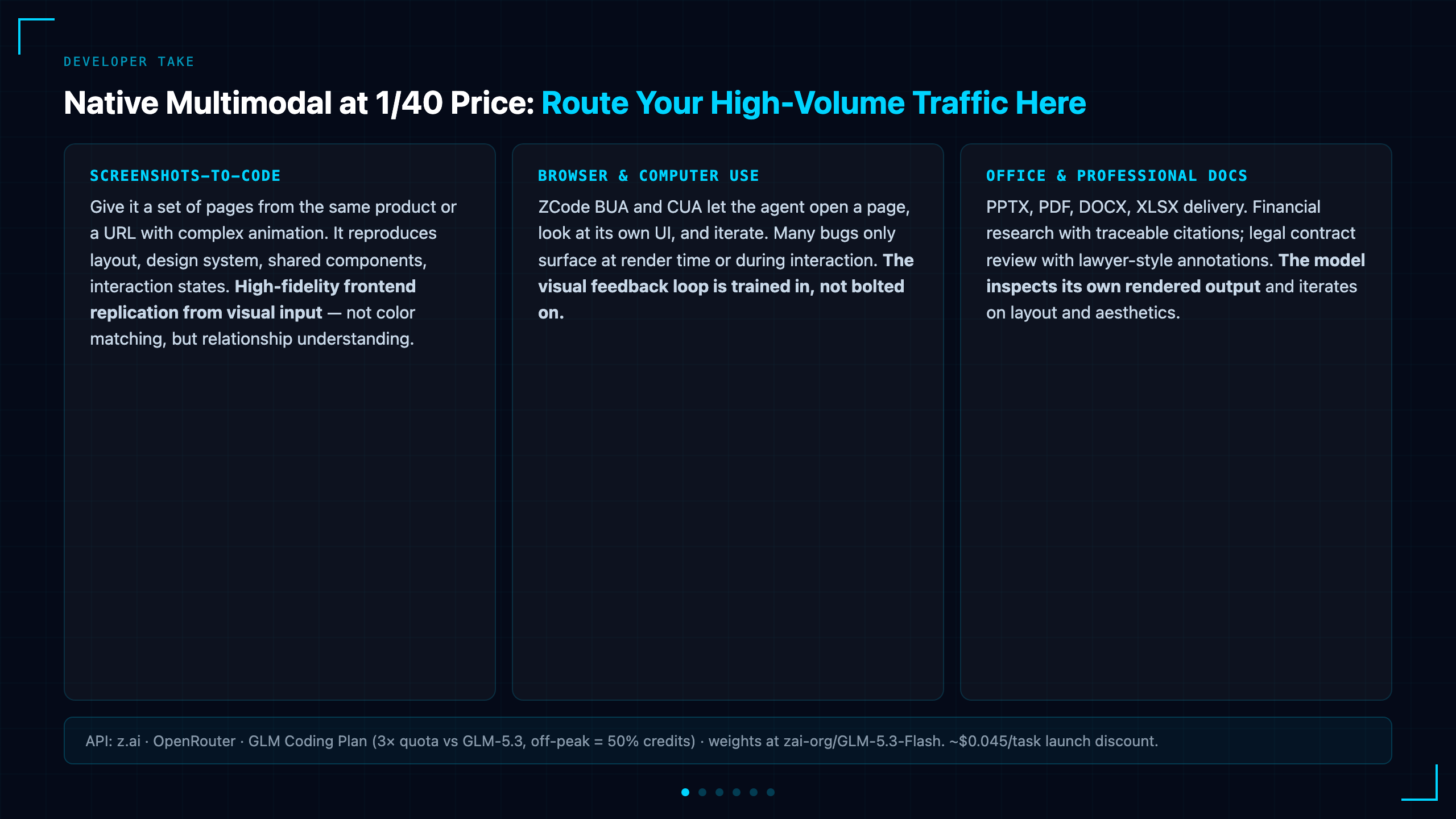
The practical takeaways:
The price-per-task math. At ~$0.045/task during the discount tier, GLM-5.3-Flash sits in a genuinely new zone: Opus-4.8-level coding and agentic performance at Flash-class prices. If you're currently paying Claude Opus rates for high-volume coding agents, this is the model to route the bulk of your traffic to.
Native multimodal coding is the killer feature. If your workload involves screenshots-to-code, UI replication, browser-use agents, or any loop where the model needs to look at its own output and fix it, GLM-5.3-Flash is now the open model to test. The visual feedback loop isn't a demo — it's how the model was trained, with self-visual-judgment data synthesis and environment-feedback RL on frontend coding.
Office and document workflows. For PPTX, PDF, DOCX, and XLSX generation — including financial research, legal contract review, and lawyer-brief drafting — the native vision lets the model inspect its own rendered output and iterate on layout and aesthetics. That's a real step up from text-only document generation.
Self-hosting is plausible here. 320B total with 18B active is meaningfully smaller than the 743B GLM-5.3. With SGLang, vLLM, and TokenSpeed support at launch, plus quantized deployments, a mid-sized GPU cluster can actually serve this — unlike the flagship. For teams that need open weights and can't or won't send data to an API, this is the first GLM-5-class model that's realistic to self-host.
GLM Coding Plan users get 3× quota. Relative to GLM-5.3, subscribers get triple the quota on Flash. Off-peak calls (including all weekends) consume only half the standard credits. That's Zhipu's signal that they expect Flash to be the default workhorse, with GLM-5.3 reserved for the hardest tasks.
Bottom Line
GLM-5.3-Flash is the model that makes "frontier intelligence at Flash cost" stop being a slogan. 320B/18B, native multimodal, 1M context, AA Intelligence Index 57 tied with Opus 4.8, at roughly 1/40 the price. The anonymous ox-alpha launch is a clever playbook, but the substance underneath — sparse+linear hybrid attention with 3× lower compute and 4.4× lower KV cache, plus a domestic-chip serving stack that already matches NVIDIA per-token economics — is what makes it durable. Open weights are on HuggingFace. For developers who need multimodal coding, browser-use, or document generation at volume, this is the August model to route your real traffic through.
Resources
- Zhipu Official Docs: GLM-5.3-Flash — model card, architecture details, and API parameters
- HuggingFace: zai-org/GLM-5.3-Flash — open weights, SGLang/vLLM/TokenSpeed support
- Z.ai Technical Blog — "Frontier Intelligence, Flash Cost" deep dive
- Securities Times Report — launch and "牛来" reveal coverage
- Sina Finance Report — market reaction and Hong Kong listing impact
GLM-5.3-Flash is available via API at z.ai and on OpenRouter. Weights are open-sourced on HuggingFace at zai-org/GLM-5.3-Flash. Pricing during launch discount is roughly 1/20 of GLM-5.3 and 1/40 of Claude Opus 4.8.