The 2026 World Artificial Intelligence Conference (WAIC) opened in Shanghai on July 17, running through July 20 across the Expo, Zhangjiang, and West Bund venues. It was the ninth edition, the largest yet — exhibition area broke 100,000 square meters for the first time, with 1,100+ exhibitors and official delegations from 100+ countries. The theme was "智能伙伴,共创未来" — Intelligent Partners, Co-Creating the Future. Chinese President Xi Jinping gave the keynote opening address, and UN Secretary-General Guterres attended alongside the leaders of Kazakhstan, Cambodia, and Thailand.
But for developers, the signal from the floor was quieter than the state ceremony. Across the booths, the question stopped being "what can your demo do?" and became "can your agent actually finish the job?" Alibaba launched an Agent-Native Cloud suite. Tencent open-sourced three embodied-intelligence foundation models in one shot. Baidu's DuMate and StepFun's STEPX Neo were jointly named the conference's "Hall Treasures" (镇馆之宝). And the night before the opening, Moonshot dropped Kimi K3 — a 2.8T open model — which instantly became the story that overshadowed everything inside the halls.
What's New
The scale of the show itself is the headline number. 100,000+ sqm of exhibition, 1,100+ exhibitors, six program tracks (forums, exhibitions, awards, experiences, incubation, recruitment), and 300+ products making their global debut. The SAIL awards were upgraded for the ninth edition.
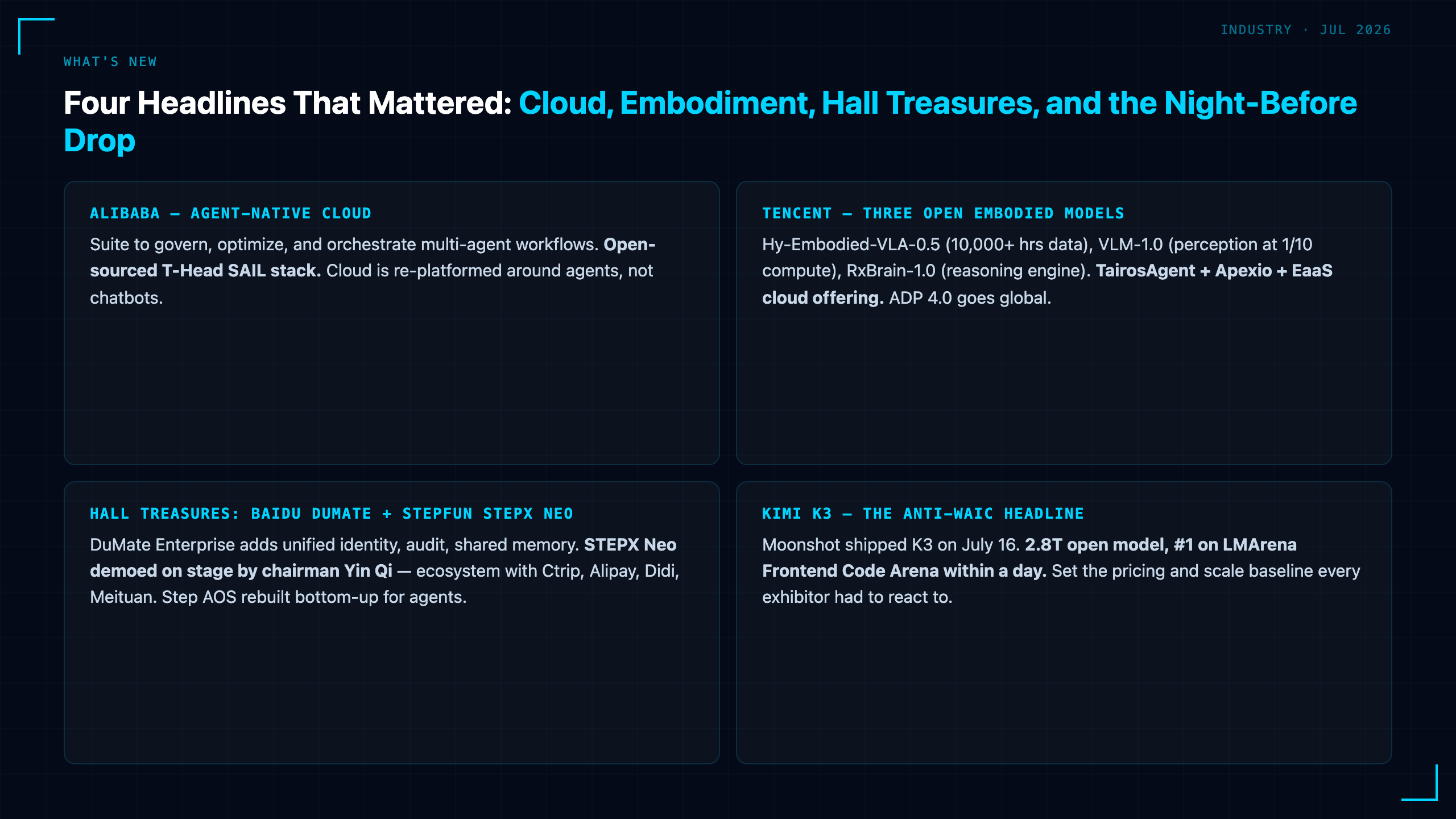
Alibaba Cloud launched the Agent-Native Cloud suite. Announced at WAIC on July 20, the suite is designed to govern, optimize, and orchestrate multi-agent workflows while improving large-model inference efficiency. Alibaba also open-sourced the T-Head SAIL software stack and shipped a team version of its enterprise agent product. The message: cloud is being re-platformed around agents, not chatbots.
Tencent open-sourced three embodied foundation models in one announcement. Hy-Embodied-VLA-0.5 (vision-language-action, trained on 10,000+ hours of data), Hy-Embodied-VLM-1.0 (perception at 1/10 the compute of Tencent's previous flagship), and Hy-Embodied-RxBrain-1.0 (the reasoning engine that ties language and vision into robot decisions). Alongside them came the TairosAgent framework, the Apexio agent, and a cloud-based "Embodied-AI-as-a-Service" offering. Tencent Cloud's ADP 4.0 went global the same week.
Baidu's DuMate and StepFun's STEPX Neo were named "Hall Treasures." DuMate (百度搭子) had just launched its enterprise version in Chengdu on July 10 — adding unified identity, member/resource management, and security audit, after the consumer version saw daily queries jump 20×. StepFun's STEPX Neo was demoed by chairman Yin Qi on stage, with ecosystem partners Ctrip, Alipay, Didi, and Meituan already integrated. StepFun also announced the Step AOS — an OS designed bottom-up for agents, not humans clicking.
Kimi K3 was the night-before the headline. Moonshot shipped Kimi K3 on July 16 — 2.8T parameters, 104B active, native vision, 1M context. It hit #1 on LMArena's Frontend Code Arena within a day. The full open weights landed July 27. By the time WAIC opened, the conversation was already about how a 2.8T open model changes the pricing floor for everyone else.
Trends
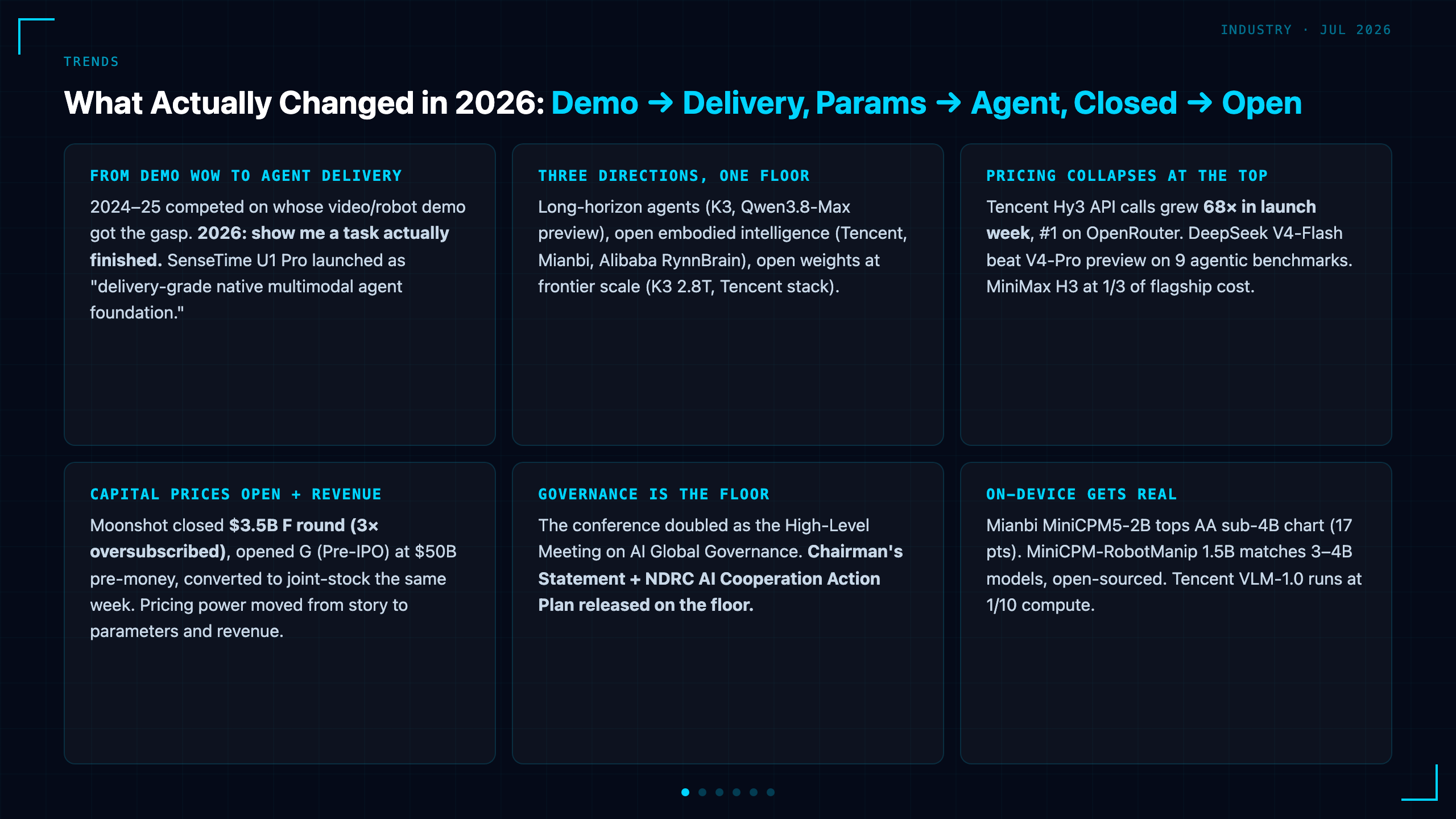
From "demo wow" to "agent delivers." This is the through-line of the show. The 2024–2025 editions competed on whose video generation or robotics demo got the gasp. In 2026, every major announcement was framed around delivery: tasks completed end-to-end, hours saved, tokens billed, tickets closed. SenseTime's SenseNova U1 Pro — launched at WAIC — was positioned as the industry's first "delivery-grade native multimodal agent foundation," explicitly bridging "content generation" to "system-level delivery."
From parameter race to agent + embodied + open-source. Three directions consumed the floor: (1) agents that run for hours and finish jobs (K3, Qwen3.8-Max preview that dropped July 19, SenseTime U1 Pro); (2) embodied intelligence that closes the perception–decision–action loop (Tencent's three models, Mianbi's 1.5B MiniCPM-Robot, Alibaba's RynnBrain); (3) open weights at frontier scale (K3's 2.8T, Tencent's embodied stack, Mianbi's MiniCPM-Robot both open-sourced).
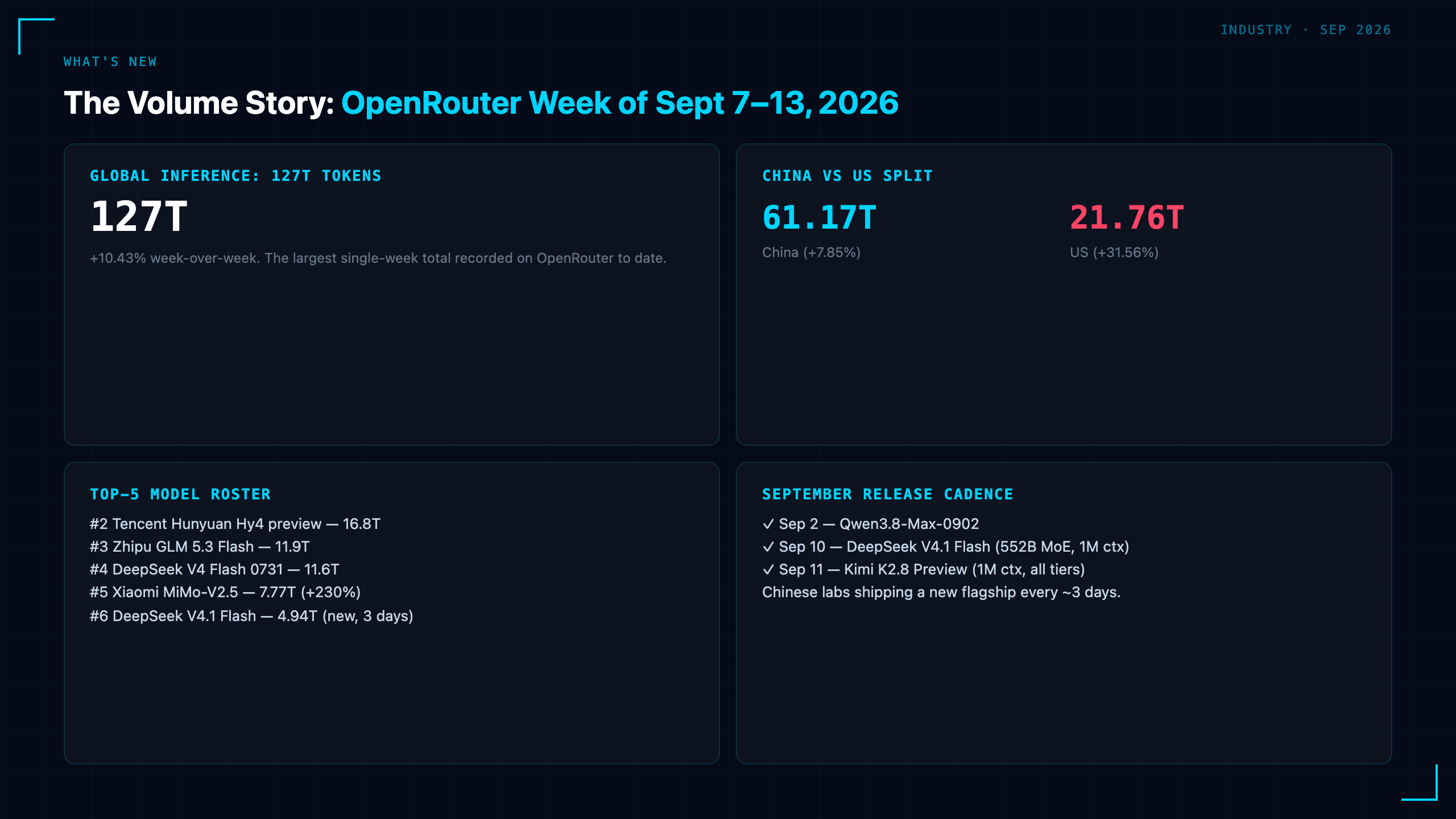
China AI pricing is collapsing at the top. Tencent said Hy3 API calls grew 68× in its launch week and hit #1 on OpenRouter's global usage chart. DeepSeek V4-Flash's official version (July 31) beat its own 1.6T V4-Pro preview on nine agentic benchmarks. MiniMax shipped H3 at roughly one-third the cost of comparable flagship video models. The pricing narrative at WAIC 2026 was "open + cheap + capable" — not "biggest model."
Capital is now pricing on open weights and revenue. Moonshot closed a $3.5B F round (3× oversubscribed) and opened a $50B-pre-money G (Pre-IPO) round the same week it converted to a joint-stock company. The message: the pricing power in Chinese AI moved from "story" to "parameters, open-source, and revenue."
Agents
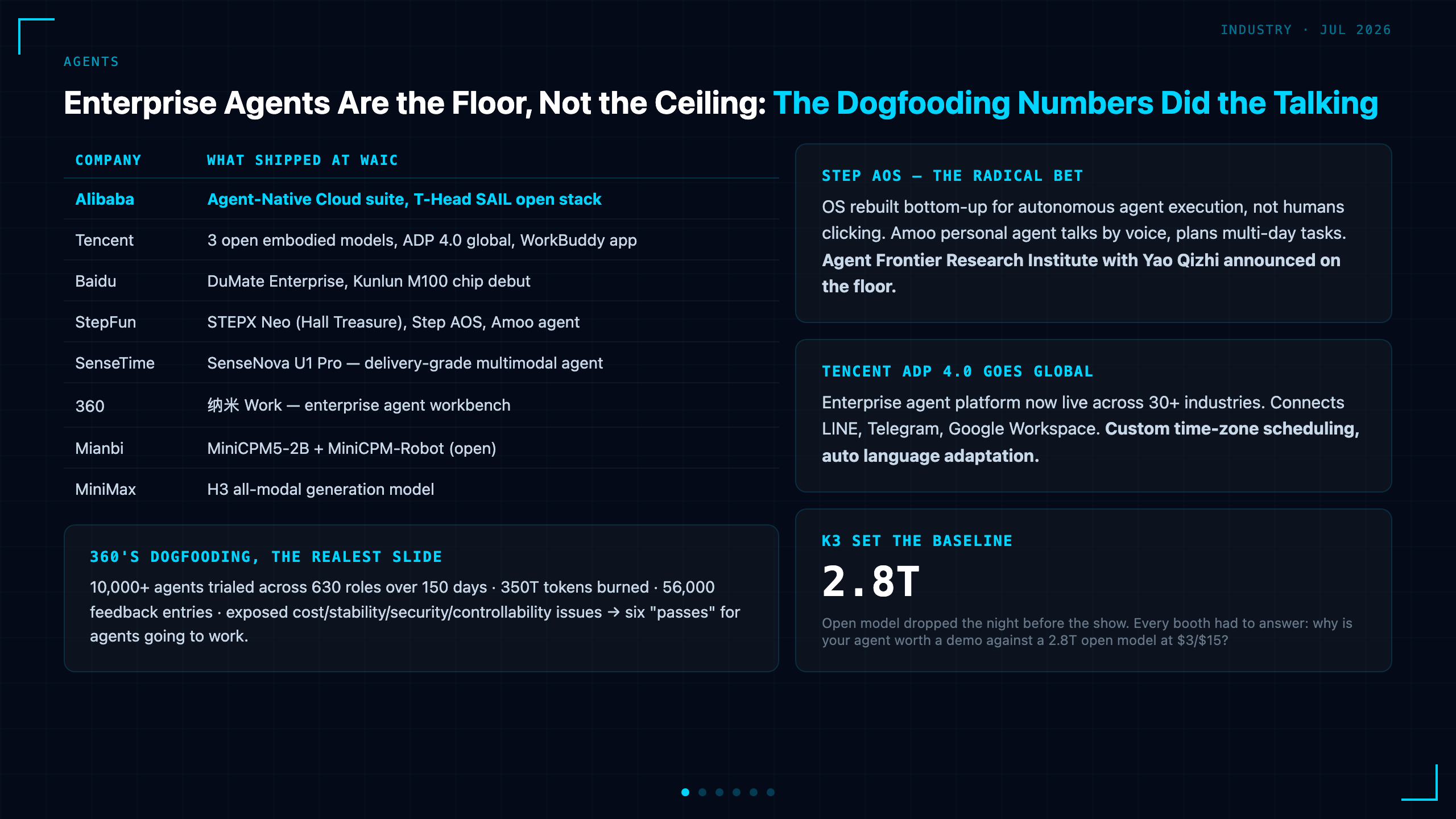
Enterprise agents became the floor, not the ceiling. 360 launched 纳米 Work (Nano Work) on July 28 — an enterprise agent workbench built on 360's own dogfooding: 10,000+ agents trialed across 630 roles over 150 days, burning 350 trillion tokens and collecting 56,000 feedback entries before launch. Tencent's ADP 4.0 went global and is already deployed across 30+ industries, connecting LINE, Telegram, Google Workspace. Baidu DuMate Enterprise added unified identity and audit. The agent-in-the-loop is now the enterprise baseline.
Step AOS is the most radical bet. StepFun's Step AOS is rebuilt bottom-up for autonomous agent execution — not humans clicking. Amoo, the personal agent, talks by voice and plans multi-day tasks. At WAIC, StepFun and Shanghai's Qi Zhi Institute jointly launched an Agent Frontier Research Institute with Yao Qizhi, focused on agent networks, agent economics, and AI safety.
On-device and robot agents closed the loop. Mianbi (面壁智能) shipped MiniCPM5-2B — 2B parameters, topping the Artificial Analysis sub-4B chart at 17 points — plus MiniCPM-RobotManip (1.5B VLA matching 3–4B models, halved streaming cost, 1-minute embodied native memory) and MiniCPM-RobotTrack (5+ Hz, local-only). Both robot models were open-sourced. Tencent's VLM-1.0 runs at 1/10 the compute of its prior flagship perception model.
The K3 launch was the anti-WAIC headline. It happened the night before the conference opened, and it set the pricing and scale baseline every exhibitor had to react to. A 2.8T open model at $3/$15 makes "we have a frontier model" a weaker booth claim than "we have a frontier model that runs as an agent for hours."
What It Means for Developers
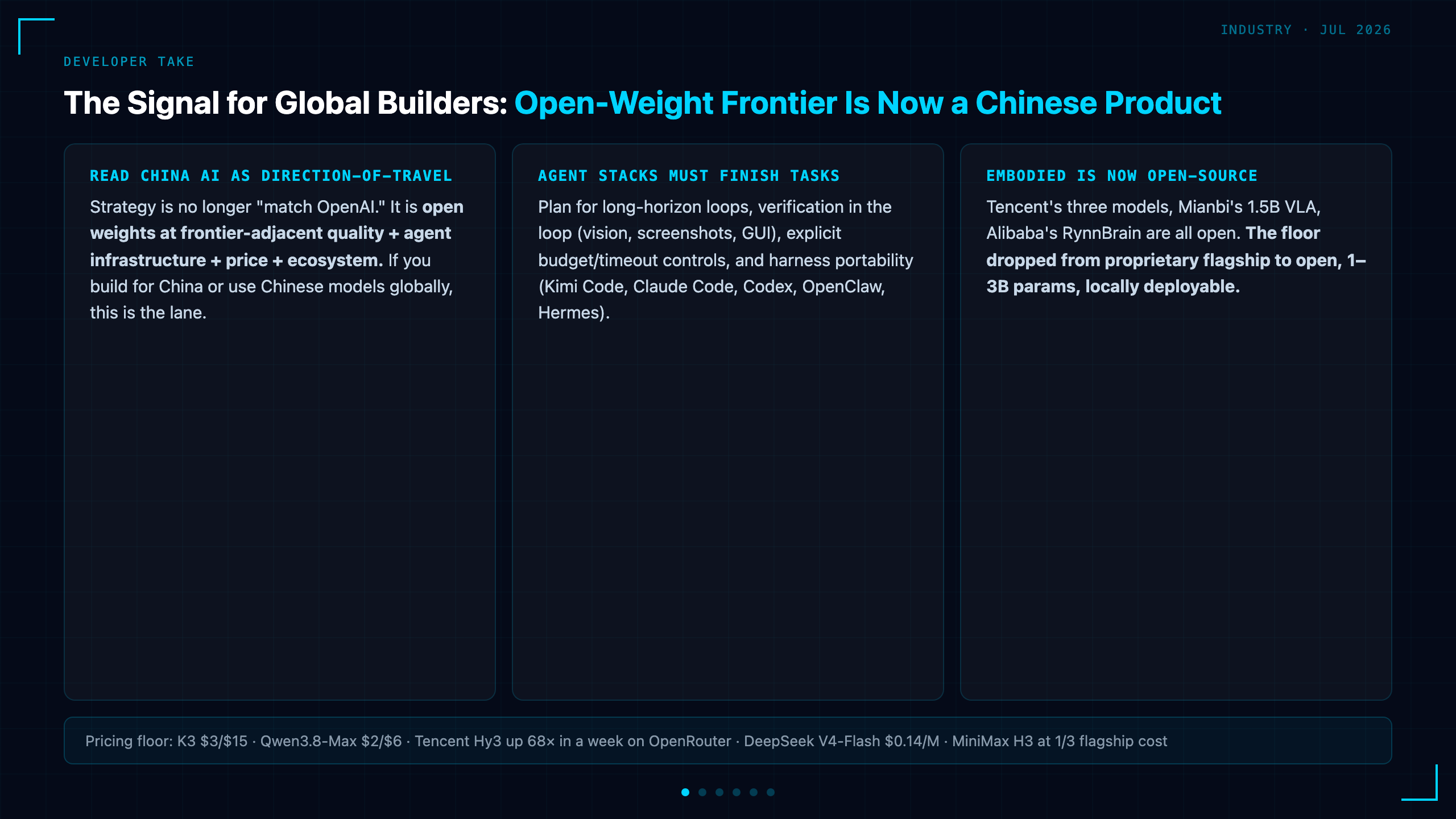
Treat WAIC 2026 as China's AI direction-of-travel signal. For the past two years the West read China AI through DeepSeek's releases. This show made explicit what was already true: the strategy is no longer "match OpenAI's model" — it is "ship open weights at frontier-adjacent quality, wrap them in agent infrastructure, and win on price + ecosystem." If you build for the Chinese market or use Chinese models globally, this is the direction of travel.
Plan your agent stack around delivery, not demos. The booths that got attention in 2026 were the ones that showed a task actually finished. For your own product, that means: long-horizon loops, verification in the loop (vision, screenshots, GUI), explicit budget and timeout controls, and harness compatibility (Kimi Code, Claude Code, Codex, OpenClaw, Hermes). The winners at WAIC were models that worked across harnesses.
Embodied intelligence is now an open-source category. Tencent's three models, Mianbi's MiniCPM-Robot, and Alibaba's RynnBrain are all open. If you are building robotics or on-device perception, the floor just dropped from "proprietary flagship" to "open, 1–3B parameters, locally deployable."
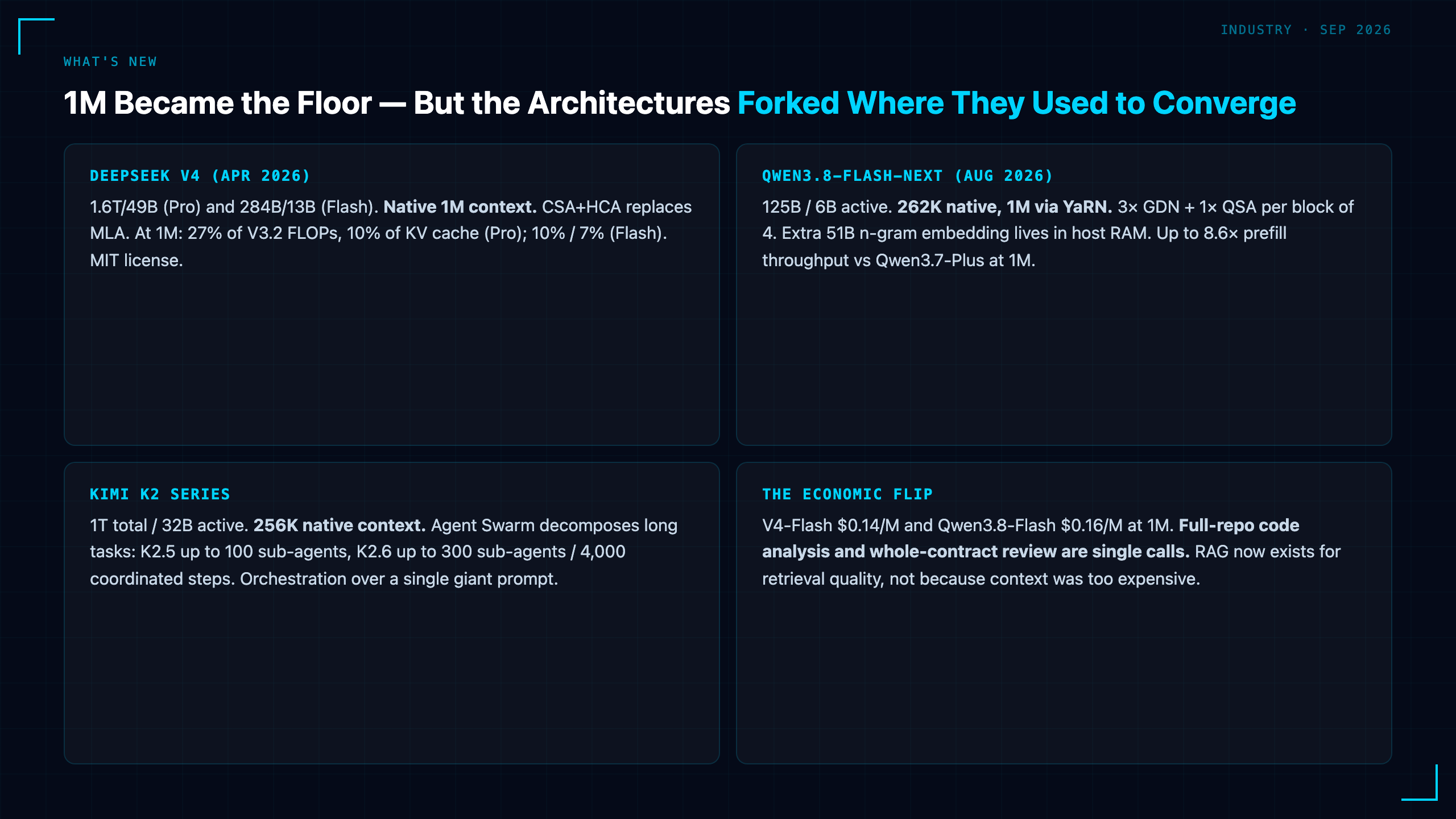
Watch the pricing floor. K3 at $3/$15, Qwen3.8-Max at $2/$6, Tencent Hy3 up 68× in a week on OpenRouter, DeepSeek V4-Flash at $0.14/M. The benchmark leaderboard matters less than the blended cost-to-finish-a-task. Build with cache-aware pricing (K3's >90% cache hit rate, Qwen's explicit cache read at $0.17/M) and your margin changes overnight.
Watch for the geopolitical read. The keynote was given by the head of state, and the conference doubled as the High-Level Meeting on AI Global Governance. The Chairman's Statement and the National Development and Reform Commission's AI Cooperation Action Plan were released on the floor. For global developers, the governance framing — not the demos — is the part with policy consequences.
Bottom Line
WAIC 2026 was the moment China's AI industry stopped selling the future and started shipping it. The theme "Intelligent Partners" was the product roadmap, not a slogan: agents that deliver, embodied models that are open-sourced, cloud platforms re-built around multi-agent orchestration, and a 2.8T open model landing the night before the show to set the pricing floor. For global developers, the signal is simple — the open-weight frontier is now a Chinese product, and the next 18 months are about who can wrap those models in agents that actually finish work.
Resources
- WAIC 2026 Official Site — conference program, exhibition guide, SAIL awards
- Chairman's Statement (Full Text) — AI global governance readout
- Alibaba Cloud at WAIC 2026 — Agent-Native Cloud suite
- Tencent at WAIC 2026 — three open embodied models, ADP 4.0
- Xinhua — WAIC Exhibition Preview — 100,000 sqm, 1,100+ exhibitors
WAIC 2026 ran July 17–20, 2026 in Shanghai; key model releases covered above are available via their respective APIs — Kimi, Alibaba Cloud Model Studio, and Tencent Cloud.