DeepSeek released DeepSeek-Coder-V2 on June 17, 2024 — a moment that marked the first time an open-source code model credibly surpassed GPT-4 Turbo on standard coding benchmarks. Built on the DeepSeek-V2 MoE architecture and continued-pretrained on 6 trillion additional code tokens, the model covered 338 programming languages and a 128K context window, while remaining fully open under the DeepSeek license.
The implications were immediate: developers could self-host GPT-4-level code generation at a fraction of the API cost, and the 16B variant made this accessible on a single A100 GPU.
What's New
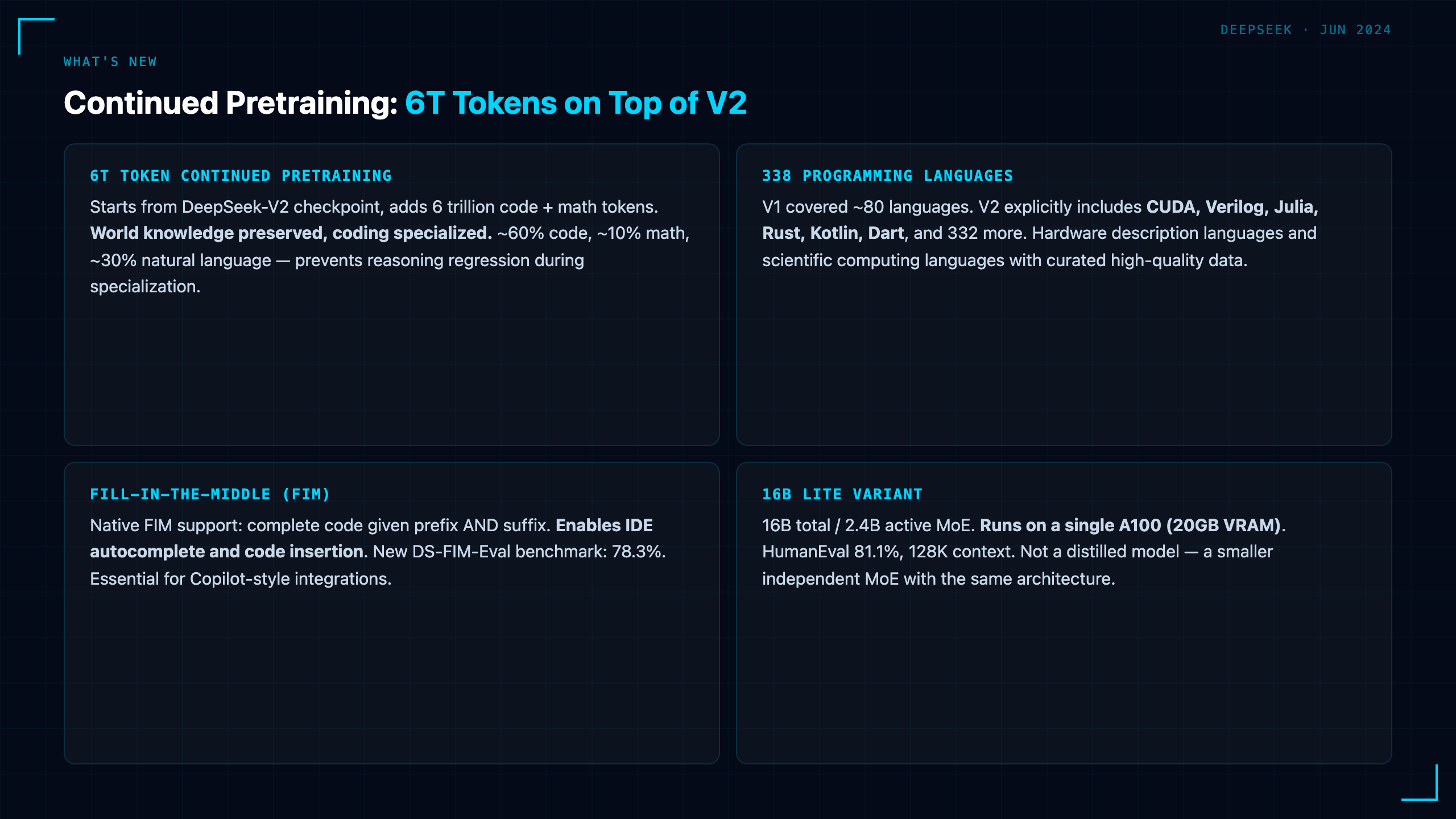
Continued pretraining from DeepSeek-V2: Rather than training from scratch, DeepSeek-Coder-V2 started from the DeepSeek-V2 checkpoint and continued pretraining on 6 trillion tokens of code and math data. The base model's broad world knowledge is preserved while the additional training specializes it for code. This is the same recipe as Llama-based code models — but at 236B MoE scale with V2's efficiency.
338 programming languages: Coder-V2 dramatically expanded language coverage from Coder-V1's ~80 languages to 338. This isn't just tail-end coverage — the training corpus was specifically curated to include high-quality data for less-represented languages. Rust, Julia, Kotlin, Swift, and domain-specific languages like CUDA and Verilog were explicitly included.
Fill-in-the-Middle (FIM): Native FIM support allows the model to complete code given both a prefix and suffix — essential for IDE autocomplete and code insertion tasks. DeepSeek introduced DS-FIM-Eval, a new benchmark measuring FIM quality on real-world code completion scenarios.
Two sizes: DeepSeek-Coder-V2-Instruct (236B total / 21B active) for maximum performance, and DeepSeek-Coder-V2-Lite-Instruct (16B total / 2.4B active) for practical single-GPU deployment. Both use the MoE architecture — the Lite model is not a distilled version but a smaller MoE in its own right.
Architecture
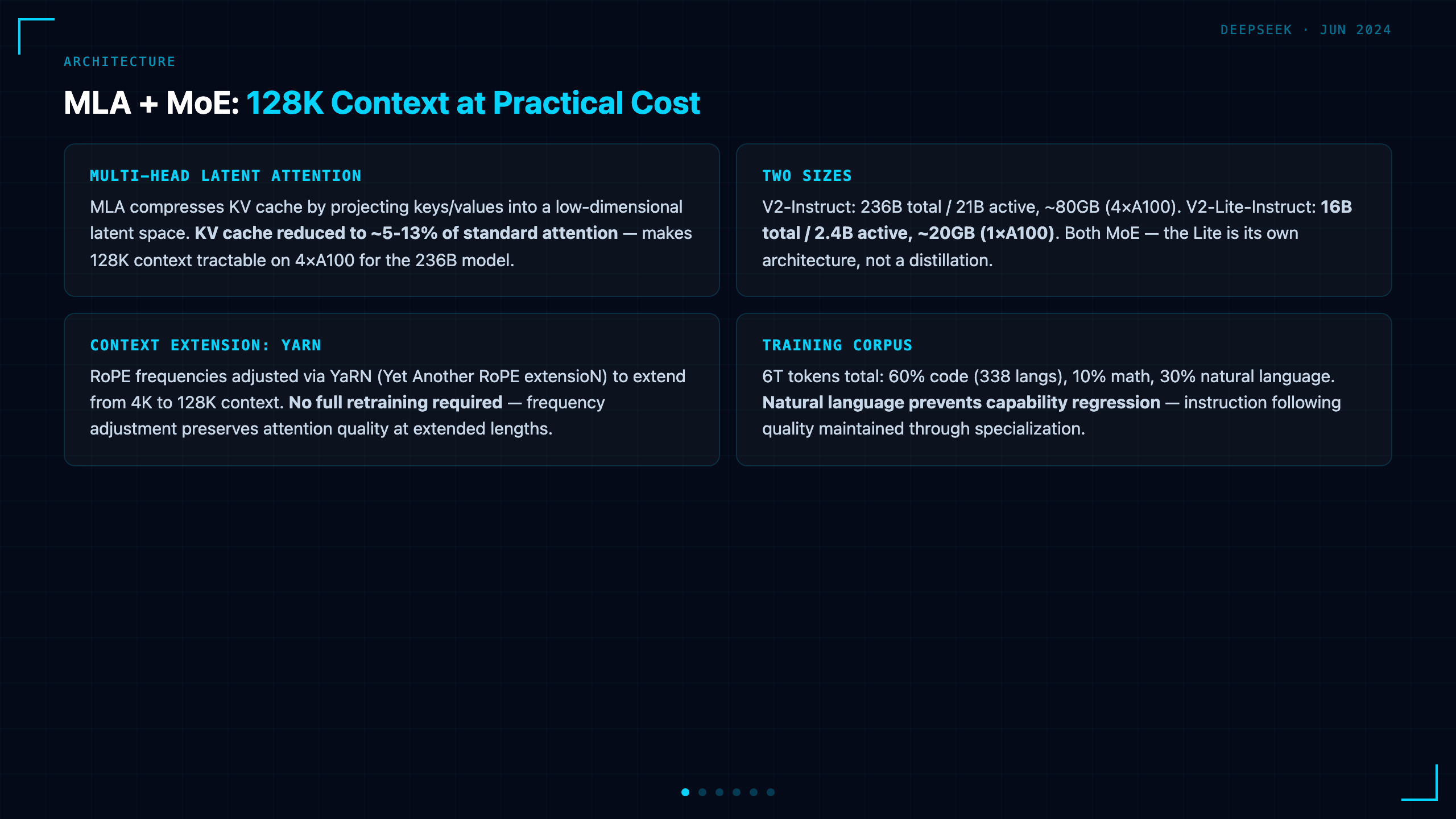
DeepSeek-Coder-V2 inherits the DeepSeek-V2 Multi-head Latent Attention (MLA) and Mixture-of-Experts design:
| Variant | Total Params | Active Params | Context | VRAM |
|---|---|---|---|---|
| V2-Instruct | 236B | 21B | 128K | ~80GB (4×A100) |
| V2-Lite-Instruct | 16B | 2.4B | 128K | ~20GB (1×A100) |
Multi-head Latent Attention (MLA): Compresses the KV cache by projecting keys and values into a low-dimensional latent space before attention. For a 128K context, standard attention would require enormous KV cache memory; MLA makes this tractable by reducing KV cache to ~5-13% of standard attention's size.
Continued pretraining corpus: The 6T additional tokens break down as ~60% code, ~10% math, ~30% natural language. The natural language portion preserves instruction-following quality and prevents the model from "forgetting" general reasoning during code specialization.
Context extension: V2's RoPE position encodings were extended from 4K to 128K using YaRN (Yet another RoPE extensioN) — a technique that adjusts rotary position frequencies to maintain attention quality at long contexts without retraining from scratch.
Benchmarks
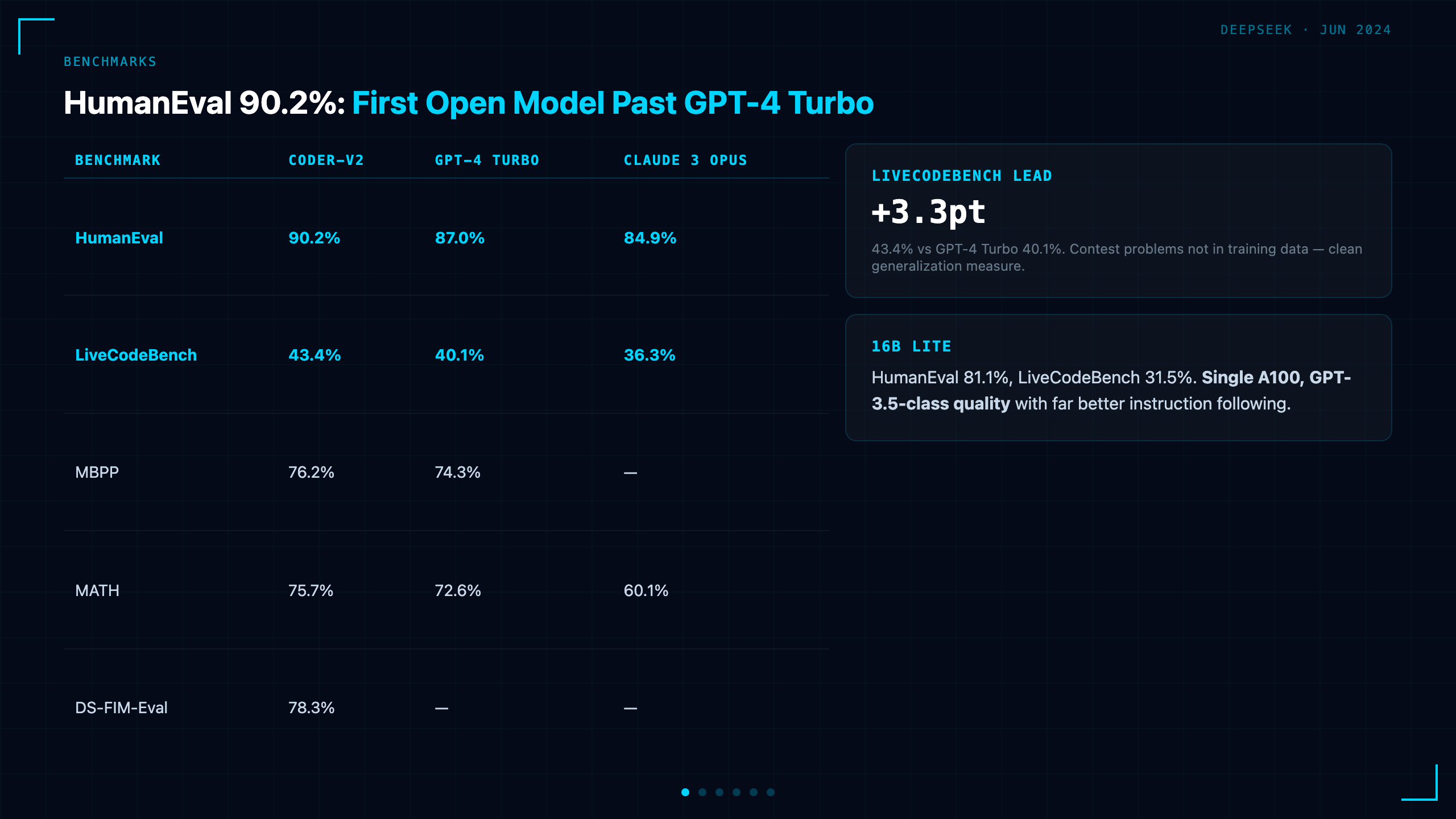
DeepSeek-Coder-V2-Instruct at June 2024 release:
| Benchmark | Coder-V2 | GPT-4 Turbo | Claude 3 Opus | Gemini 1.5 Pro | Notes |
|---|---|---|---|---|---|
| HumanEval | 90.2% | 87.0% | 84.9% | 71.9% | Python code gen |
| MBPP | 76.2% | 74.3% | — | 75.5% | Python problems |
| LiveCodeBench | 43.4% | 40.1% | 36.3% | 37.2% | Contest problems |
| SWE-bench | 12.7% | — | — | — | Real GitHub issues |
| MATH | 75.7% | 72.6% | 60.1% | 67.7% | Math reasoning |
| DS-FIM-Eval | 78.3% | — | — | — | Fill-in-middle |
HumanEval 90.2% surpassed GPT-4 Turbo's 87.0% — the first time an open-source model did so on this benchmark. LiveCodeBench 43.4% (+3.3 over GPT-4 Turbo) is more significant because LiveCodeBench uses recent contest problems that weren't in any model's training data, making it a cleaner measure of generalization.
The 16B Lite variant reaches HumanEval 81.1% and LiveCodeBench 31.5% — strong performance for a single-GPU model, competitive with the original DeepSeek-Coder 33B.
What 338 Languages Means in Practice
Prior code models' language coverage often suffered from two failure modes: (1) adequate coverage of top-10 languages, poor coverage elsewhere, and (2) models that claimed broad coverage but had poor quality for less-common languages due to training data scarcity.
Coder-V2's coverage includes:
- Systems: C, C++, Rust, Go, Zig, Verilog, CUDA
- Scientific: Julia, R, MATLAB, Fortran
- Web: JavaScript, TypeScript, HTML/CSS, PHP, Ruby
- Mobile: Swift, Kotlin, Dart/Flutter
- Data: SQL (multiple dialects), dbt, Spark SQL
- Infrastructure: Terraform, HCL, Bash, Dockerfile
The CUDA and Verilog coverage is notable — hardware description languages are essentially absent from most code models' training data. Coder-V2's explicit inclusion reflects DeepSeek's interest in hardware-adjacent development.
What It Means for Developers
GPT-4 coding quality at self-host cost: The 236B model on 4×A100 GPUs delivers GPT-4 Turbo-level code generation. For organizations with GPU infrastructure, this eliminates per-token API costs for code generation workloads.
16B Lite for practical deployment: The Lite variant on a single A100 (20GB VRAM) makes frontier-adjacent coding capability accessible for small teams and edge deployments. HumanEval 81.1% is competitive with older GPT-3.5-class models but with dramatically better instruction following.
FIM for IDE integration: DS-FIM support makes Coder-V2 suitable as a backend for code completion tools (Copilot-style). The 128K context handles large files and multi-file contexts that break smaller models.
Math + code: MATH 75.7% means Coder-V2 handles mathematical reasoning alongside code — useful for numerical computing, algorithm design, and scientific computing workflows where code and math are interleaved.
Availability
- HuggingFace: deepseek-ai/DeepSeek-Coder-V2-Instruct and Lite variant
- API: api.deepseek.com —
deepseek-coderendpoint - License: DeepSeek License (commercial use permitted for most applications)
- vLLM and SGLang: Both supported
Bottom Line
DeepSeek-Coder-V2 was the first open-source code model to credibly beat GPT-4 Turbo — HumanEval 90.2%, LiveCodeBench 43.4%, 338 languages, 128K context. The 16B Lite variant made this capability accessible on a single A100.
For the developer community, the message was clear: GPT-4-level code generation was no longer exclusively available through a closed API.
Resources
- Technical Report (arXiv 2406.11931) — architecture and training details
- HuggingFace — DeepSeek-Coder-V2-Instruct
- HuggingFace — DeepSeek-Coder-V2-Lite-Instruct
- GitHub — DeepSeek-Coder-V2
- DeepSeek API —
deepseek-coderendpoint
DeepSeek-Coder-V2 is available via API at api.deepseek.com and as open weights on HuggingFace.