Shanghai AI Lab released InternVL2 in July 2024 as a comprehensive open-source vision-language model family spanning 2B to 76B parameters. By the end of 2024, InternVL2 had become the de facto open-source VLM baseline — the model that other VLMs were measured against, and the one most developers reached for when building multimodal applications.
The key innovation: dynamic high-resolution tiling. Instead of forcing all images through a fixed encoder size, InternVL2 splits images into up to 40 tiles and encodes each at full resolution. Documents, charts, diagrams, and screenshots — tasks where pixel-level detail matters — saw dramatic accuracy improvements.
What's New
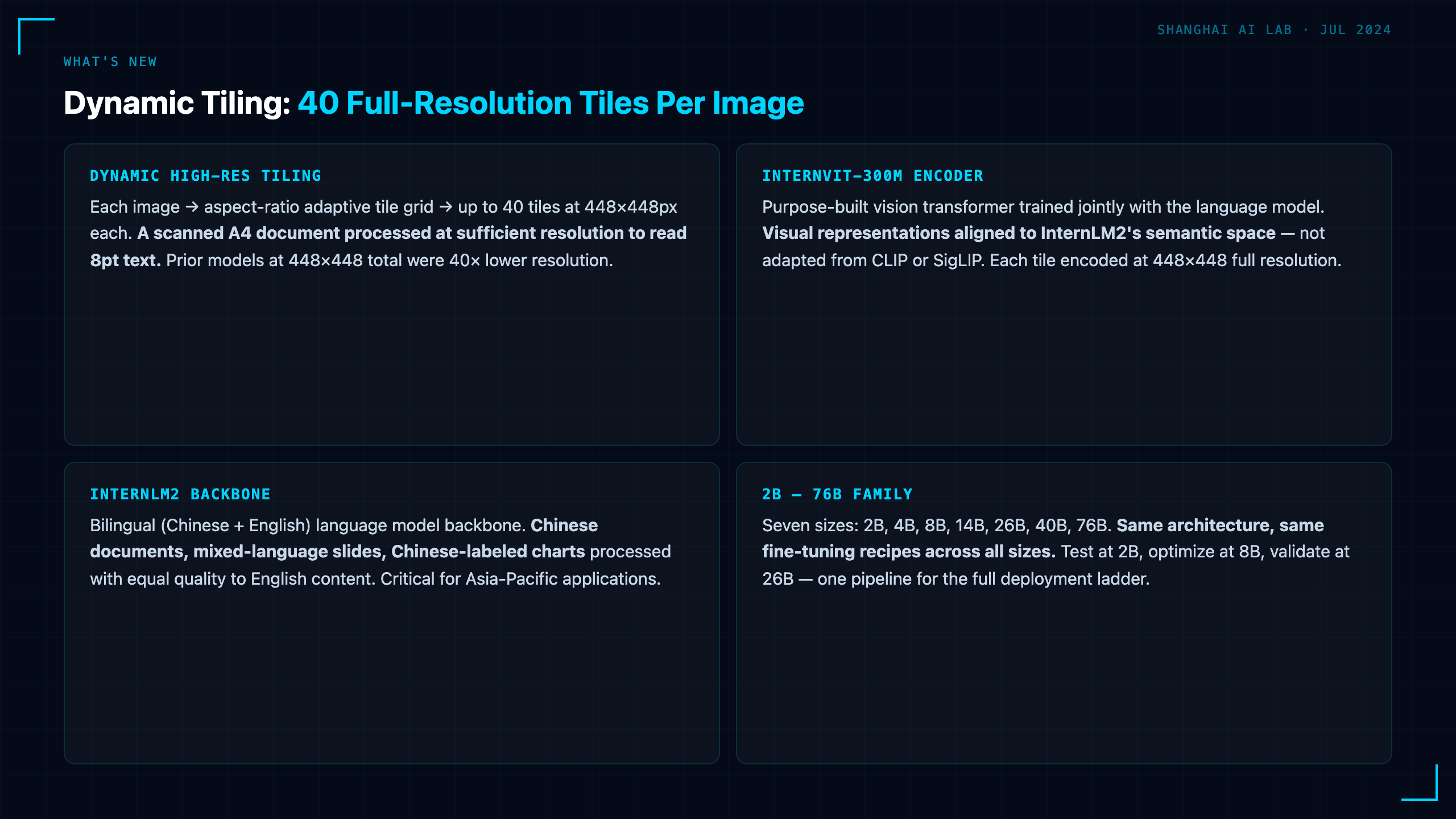
Dynamic high-resolution tiling: InternVL2 analyzes each image's aspect ratio and complexity, then splits it into a grid of up to 40 tiles (each 448×448 pixels). Every tile is encoded by InternViT-300M at full resolution. The result: a 2480×3508 scanned document isn't compressed to a blurry thumbnail — it's processed at sufficient resolution to read 8pt text. This is the architecture that enables OCRBench 839 and the document-centric benchmark leads.
InternLM2 language backbone: All sizes use InternLM2 as the language model component — a strong bilingual (Chinese + English) foundation that extends the VLM's multilingual capability to visual tasks. Chinese document understanding, multilingual chart analysis, and mixed-language screenshots all benefit.
2B–76B family: Seven sizes covering the full deployment spectrum: 2B, 4B, 8B, 14B, 26B, 40B, 76B. This matters for production: developers can test with the 8B, deploy with the 26B, and have the 76B as a quality ceiling — all with the same architecture and same fine-tuning recipes.
InternViT-300M encoder: A purpose-built vision transformer rather than adapting CLIP or SigLIP. InternViT-300M is trained jointly with the language model, allowing the visual representations to align specifically with InternLM2's semantic space.
Architecture
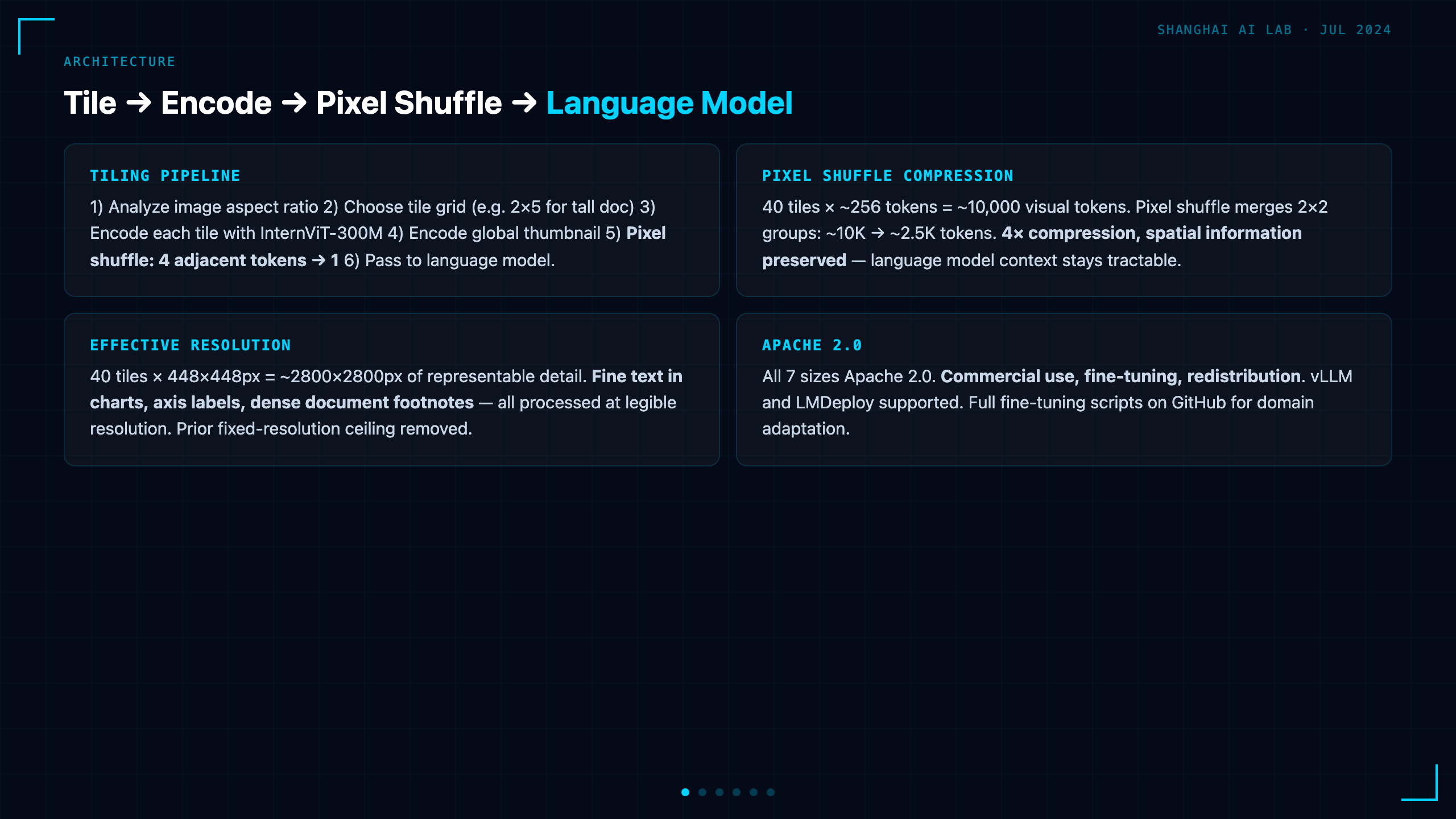
InternVL2's three-component architecture:
| Component | Details |
|---|---|
| Vision encoder | InternViT-300M, 448×448 per tile |
| Tiling | Dynamic: 1–40 tiles, aspect-ratio adaptive |
| Pixel compression | Pixel shuffle (2×2 → 1 token), 4× reduction |
| Language model | InternLM2 (2B/7B/20B depending on VLM size) |
| Context | 8K–32K depending on size |
How dynamic tiling works: An image is first analyzed for dimensions. Then a tile grid is chosen that preserves the aspect ratio — a tall document gets a tall grid (e.g., 2×5), a wide panoramic gets a wide grid (e.g., 5×2). Each tile is encoded independently by InternViT-300M. A global thumbnail is also encoded for spatial context. Pixel shuffle merges adjacent tokens (4 → 1) before the language model, keeping the sequence tractable.
Why this beats fixed-resolution: At 448×448 per tile with 40 tiles, InternVL2 can represent ~2800×2800 pixels of original image content at full detail. Prior models resizing to 448×448 total were operating at roughly 40× lower resolution for large images.
Benchmarks
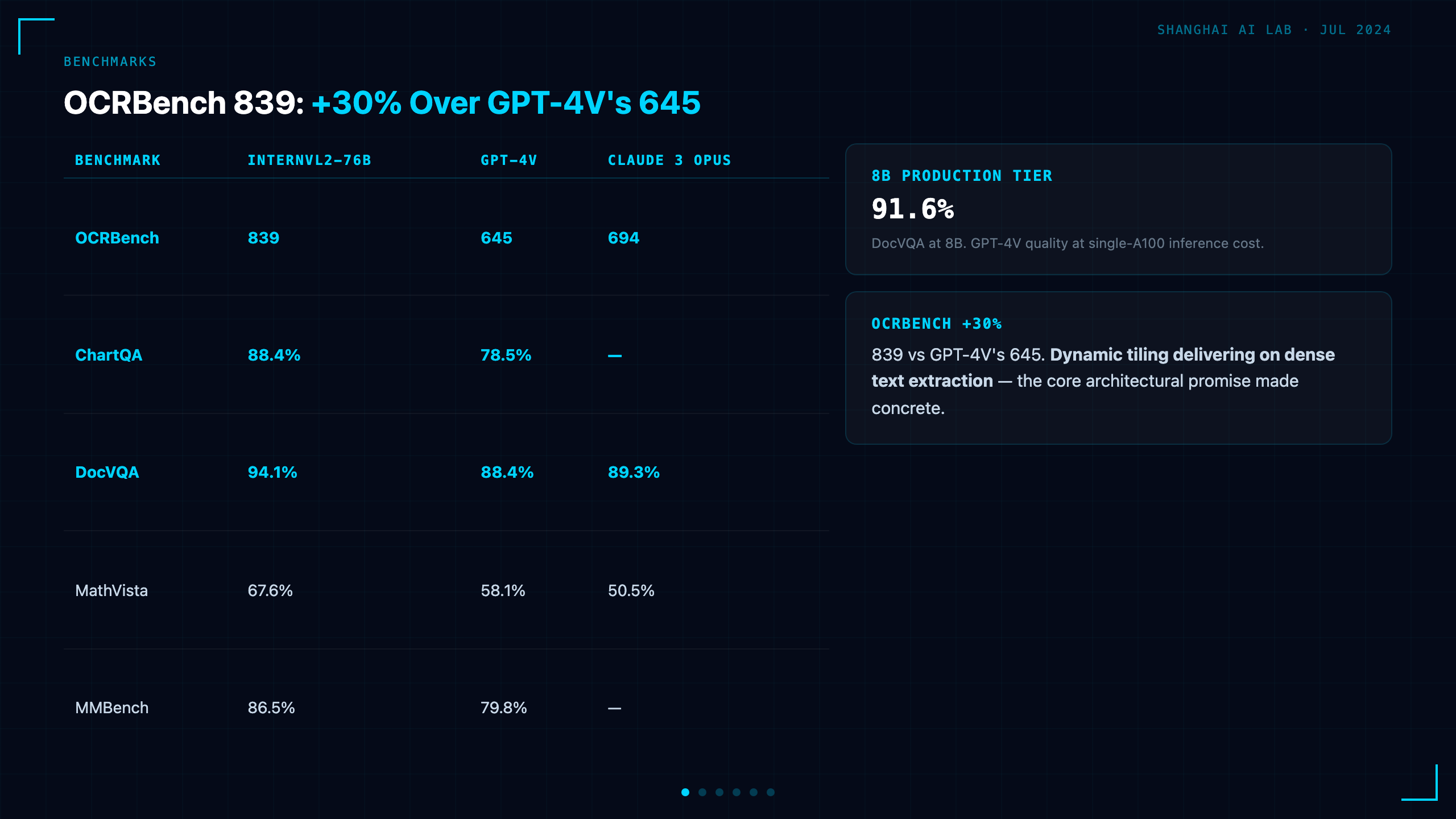
InternVL2-76B at July 2024 release:
| Benchmark | InternVL2-76B | GPT-4V | Claude 3 Opus | Notes |
|---|---|---|---|---|
| OCRBench | 839 | 645 | 694 | Text recognition |
| ChartQA | 88.4% | 78.5% | — | Chart understanding |
| DocVQA | 94.1% | 88.4% | 89.3% | Document QA |
| MathVista | 67.6% | 58.1% | 50.5% | Visual math |
| MMBench | 86.5% | 79.8% | — | General visual |
| MMStar | 62.2% | 56.0% | — | Multi-hop visual |
OCRBench 839 (vs GPT-4V's 645) is a +30% improvement — the dynamic tiling delivering on its promise for dense text extraction. ChartQA 88.4% (+9.9pt over GPT-4V) shows the tiling benefit extends to structured visual data.
The 8B variant (InternVL2-8B) reaches DocVQA 91.6% and ChartQA 83.3% — competitive with GPT-4V at 8B inference cost, which fundamentally changes the production economics for document processing.
The Family Advantage
InternVL2's size range creates a practical deployment ladder:
| Size | Best For | Approx VRAM |
|---|---|---|
| 2B | Edge, on-device | ~8GB |
| 8B | Production document/chart | ~20GB |
| 26B | High-accuracy extraction | ~60GB |
| 76B | Research, quality ceiling | ~160GB |
All sizes share the same tiling architecture — fine-tuning on the 8B transfers understanding of the approach to the 26B. Developers can validate their pipeline at 2B scale, optimize at 8B, and validate quality at 26B before deciding whether 76B is needed.
What It Means for Developers
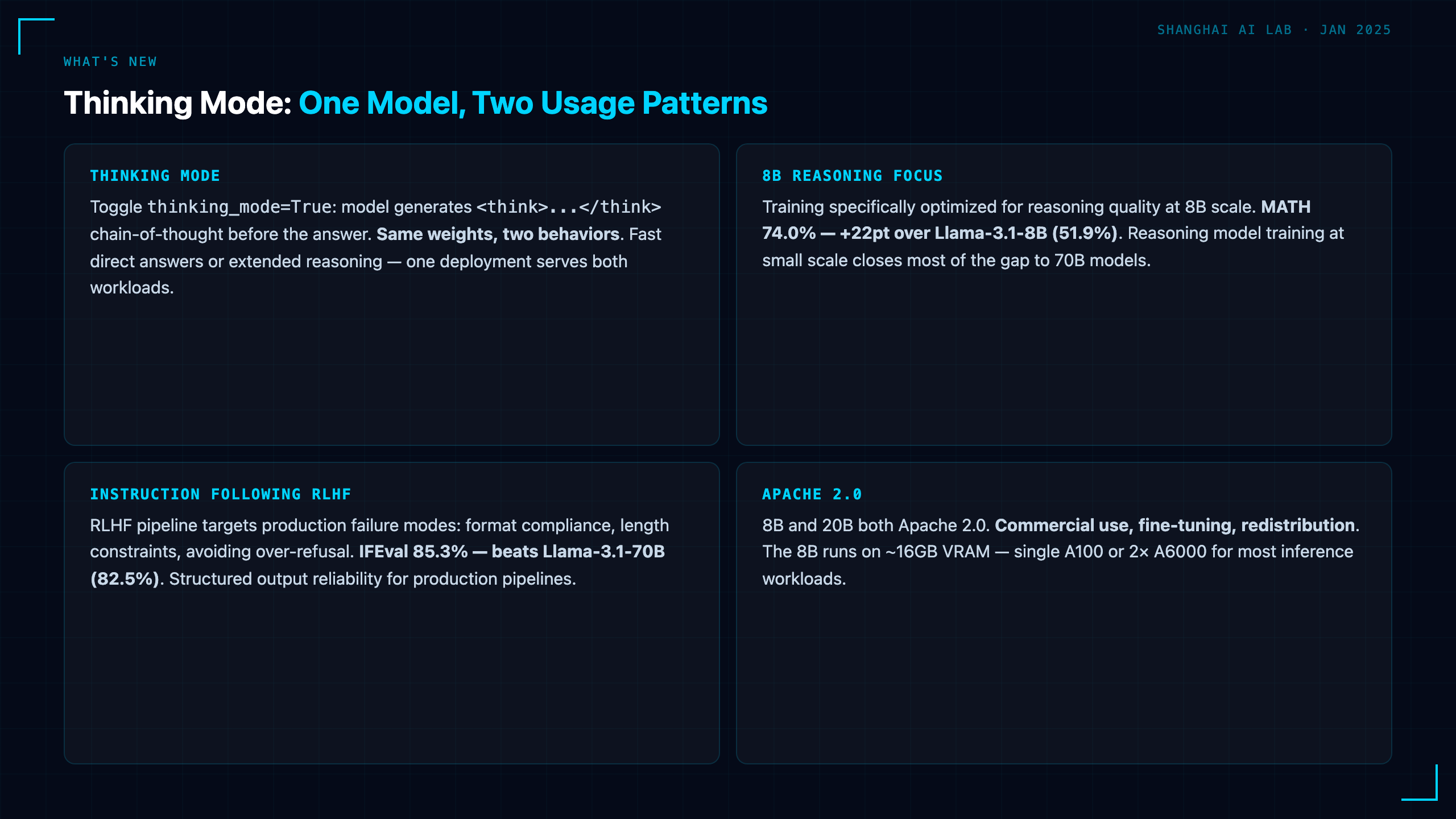
Document processing at 8B cost: InternVL2-8B with DocVQA 91.6% handles invoice extraction, contract parsing, and form processing at 8B inference cost. Prior to InternVL2, this quality required 70B+ models. A single A100 handles the 8B with room for reasonable batch sizes.
Chart and diagram understanding: ChartQA 88.4% (76B) and 83.3% (8B) make InternVL2 practical for financial chart analysis, scientific figure extraction, and data visualization parsing — tasks where prior VLMs would misread axes, legends, and trend lines.
Bilingual for Chinese markets: InternLM2's bilingual foundation extends to visual tasks. Chinese documents, mixed Chinese-English slides, and Chinese-labeled charts are processed with the same quality as English content — relevant for applications serving Chinese-speaking markets.
Apache 2.0 across all sizes: Commercial use, fine-tuning, redistribution — no licensing constraints. The architecture is documented in sufficient detail that domain-specific fine-tuning (medical imaging, industrial inspection, legal documents) is straightforward.
Availability
- HuggingFace: OpenGVLab/InternVL2-76B and all sizes from 2B
- License: Apache 2.0
- Inference: vLLM and LMDeploy supported
- GitHub: OpenGVLab/InternVL — fine-tuning scripts included
Bottom Line
InternVL2 established dynamic high-resolution tiling as the architectural standard for open-source VLMs in 2024. OCRBench 839, ChartQA 88.4%, DocVQA 94.1% — all surpassing GPT-4V while remaining Apache 2.0. The 2B–76B family made the architecture accessible across the full deployment spectrum, from edge devices to multi-GPU server clusters.
InternVL2 is the model that defined what "open-source VLM" meant in H2 2024 — the baseline that InternVL3, Qwen2-VL, and every subsequent model was measured against.
Resources
- GitHub — InternVL — codebase and fine-tuning
- HuggingFace — InternVL2-76B
- HuggingFace — InternVL2-8B — production tier
- Technical Report (arXiv 2404.16821)
InternVL2 models are available on HuggingFace under Apache 2.0. All sizes including commercial use.