Ask any medical researcher what they fear most about AI-assisted literature reviews, and you'll get the same answer: hallucinated references. The paper title sounds plausible, the journal name checks out, the author list looks real — but search PubMed and the paper doesn't exist. In clinical research, that's not an inconvenience. It's a career-ending mistake.
DeepSeek has built a solution that directly addresses this fear. The company's V4 model, released in April 2026, now integrates natively with PubMed — the U.S. National Library of Medicine's database of over 36 million biomedical citations. It's not a bolt-on search feature. It's a retrieval-grounded pipeline where every cited paper comes with a verifiable PMID and a clickable link back to PubMed.
This is the first time a major Chinese AI lab has built a domain-specific literature product this tightly coupled to a Western academic database. The implications go beyond convenience.
What's New: PubMed-Native Retrieval
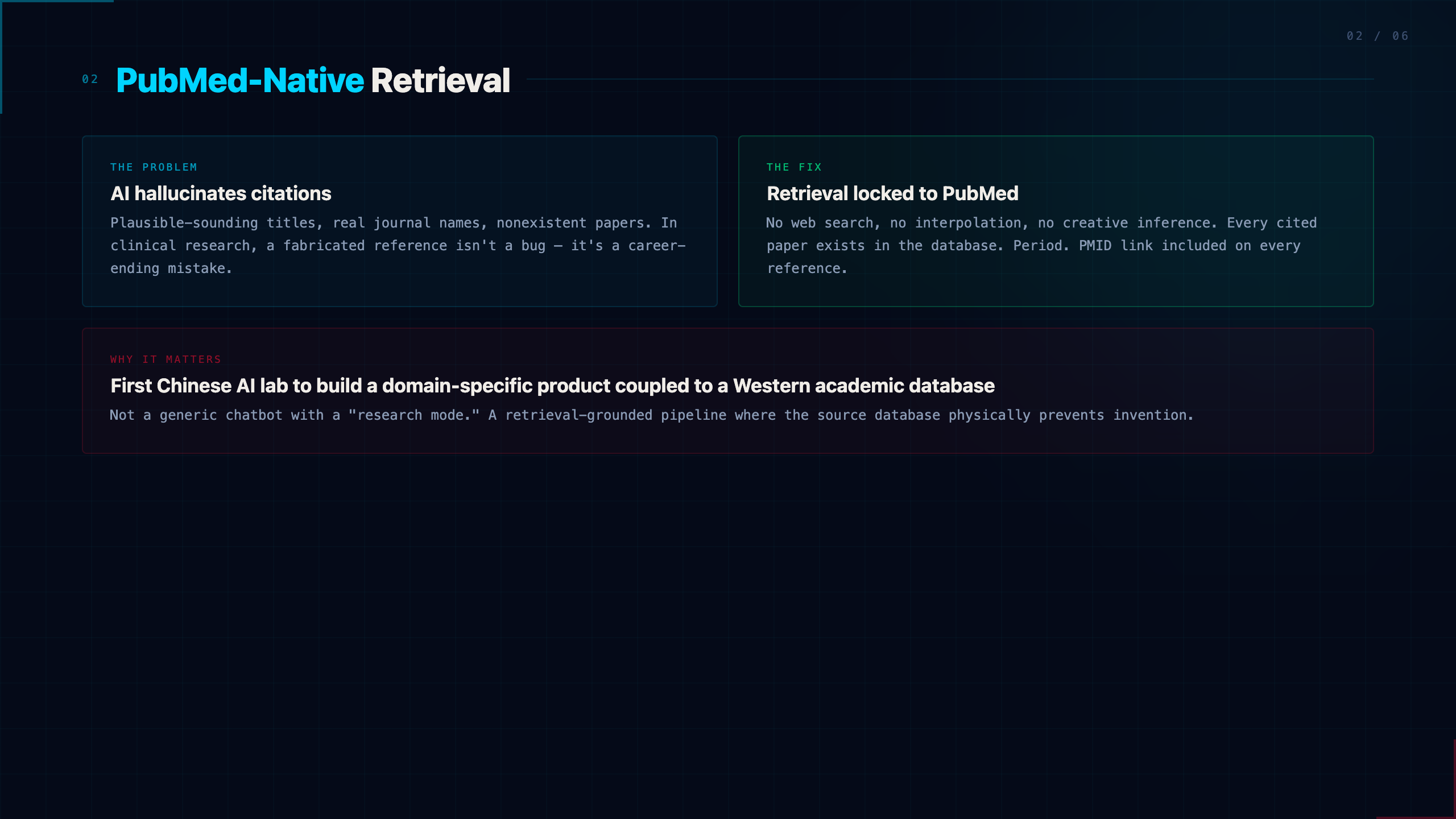
The core innovation is simple but critical: DeepSeek V4's PubMed mode restricts its retrieval source exclusively to PubMed. No web search, no general knowledge interpolation, no creative inference. When the model cites a paper, it pulls from a real database record.
Every citation includes:
- PMID link — clickable, takes you directly to the PubMed entry
- Full metadata — journal, authors, publication date, DOI
- Source transparency — the model shows which keywords it used and why it selected specific papers
This is fundamentally different from asking a general-purpose LLM to "find papers about X." Those queries often synthesize plausible-sounding but nonexistent references. DeepSeek's PubMed mode can't invent a paper that isn't in the database — the retrieval layer physically prevents it.
For researchers writing systematic reviews or meta-analyses, this is the difference between a tool you can cite in your methods section and a tool you quietly use but never acknowledge.
Deep Thinking: Transparent Reasoning Chains
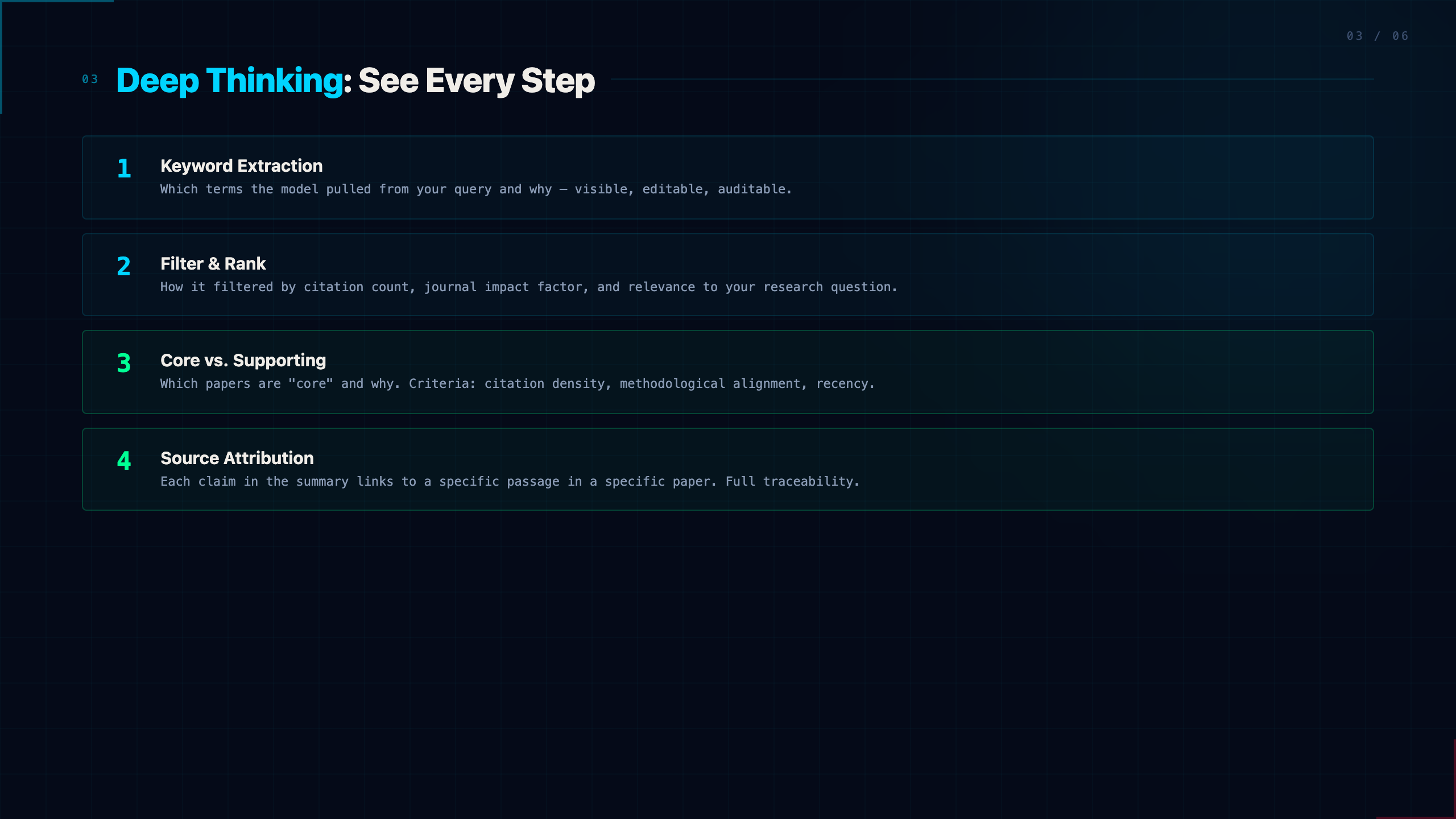
DeepSeek V4 defaults to what the company calls "deep thinking mode" — a visible chain-of-thought that exposes every step of the model's reasoning. In the PubMed context, this means you can see exactly:
- Which keywords the model extracted from your query and why
- How it filtered results — by citation count, journal impact factor, or relevance to your specific research question
- Which papers it designated as "core" versus "supporting" and the criteria for that distinction
- Which specific passage in a source paper backs each claim in the generated summary
This transparency serves two purposes. Practically, it lets you audit the output before trusting it — you can verify that the model's conclusions actually follow from the cited evidence. Pedagogically, it models a systematic approach to literature analysis: define search terms, filter by quality metrics, identify core contributions, synthesize with attribution. For early-career researchers learning how to read papers critically, watching the model work is itself a training exercise.
The deep thinking mode is powered by the same reasoning infrastructure that drives DeepSeek V4's general-purpose "Think High" and "Think Max" modes (49B active parameters, 1M-token context window). But in the PubMed product, the reasoning is constrained to the retrieval pipeline rather than open-ended generation.
The Full Literature Workflow
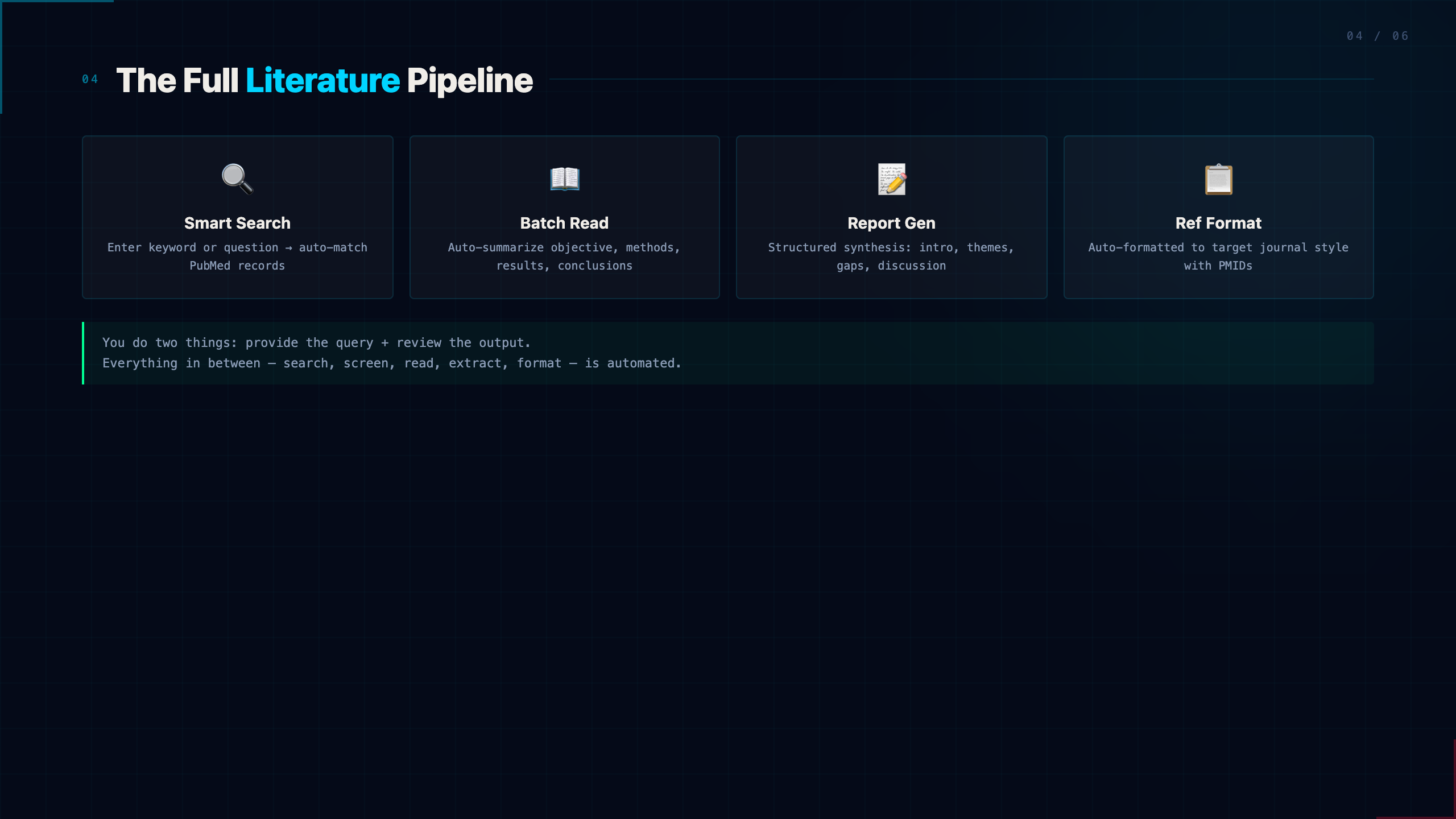
DeepSeek's PubMed product covers the complete literature workflow, not just search:
| Step | What It Does |
|---|---|
| Smart Search | Enter a keyword or research question; the system matches the most relevant PubMed records |
| Batch Reading | Automatically summarizes each paper's objective, methods, key results, and conclusions |
| Report Generation | Produces a structured report with sections: introduction, thematic synthesis, discussion, and research gaps |
| Reference Formatting | Outputs a formatted reference list matching your target journal's style requirements |
The workflow is designed so that the researcher only needs to do two things: provide the initial query and review the final output. Everything in between — searching, screening, reading, extracting, formatting — is automated.
In practice, this means a task that previously took a week (search 30,000 results, screen to 50, read all 50, write a synthesis) can be compressed into a single session. The tradeoff is that you still need to verify the output — the model can surface relevant papers and summarize them accurately, but the interpretive leap from summary to insight remains a human responsibility.
Pricing, Access, and Limitations
DeepSeek's PubMed integration is available through the DeepSeek web interface and app as a dedicated mode. Basic access is free; premium features (higher volume, longer reports, advanced filtering) require a membership subscription.
On the API side, DeepSeek V4 is available in two tiers:
| Model | Input Price (per 1M tokens) | Output Price (per 1M tokens) |
|---|---|---|
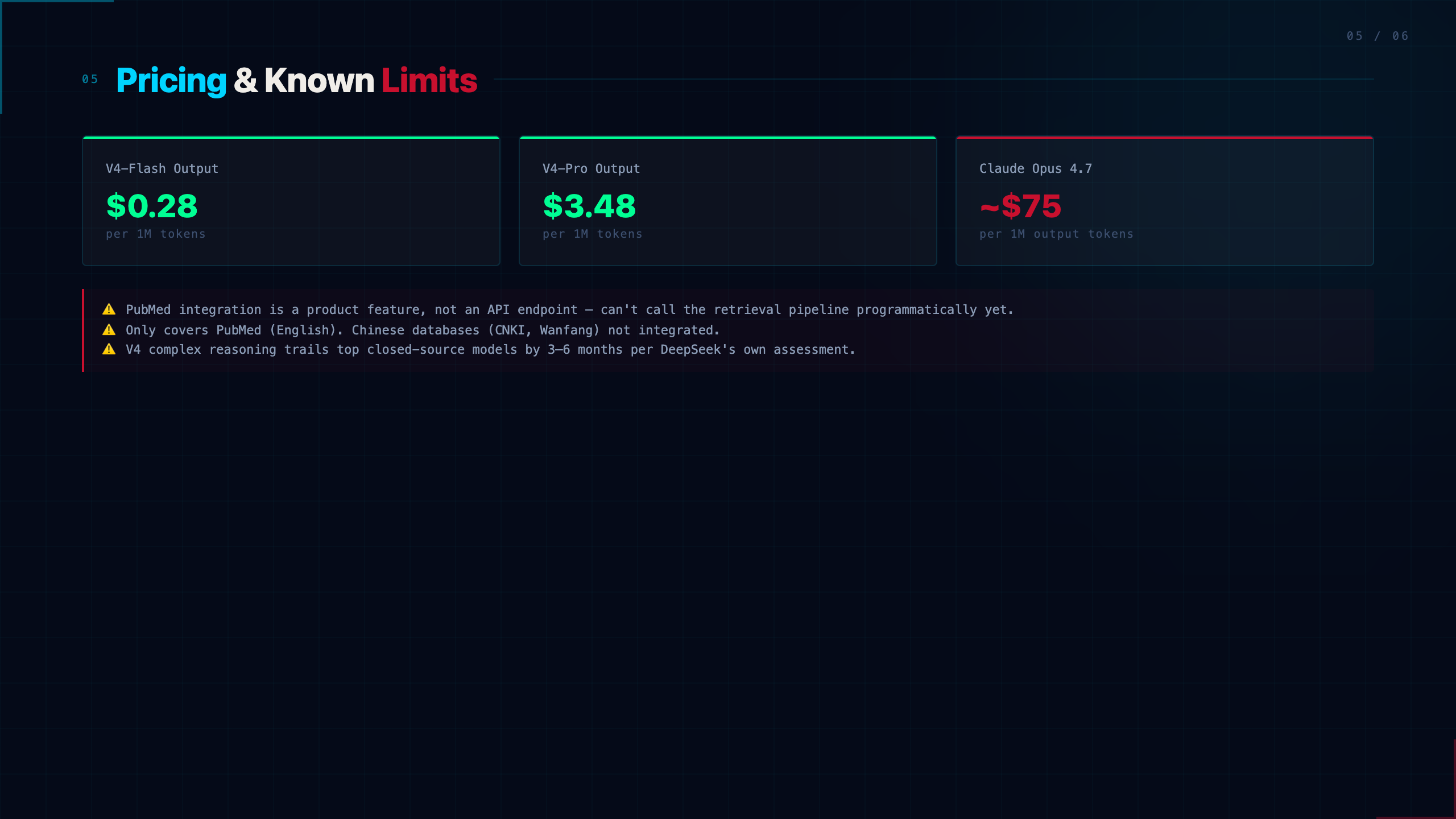
| V4-Flash | ¥1 (~$0.14) cached miss | ¥2 (~$0.28) |
| V4-Pro | ¥12 (~$1.74) cached miss | ¥24 (~$3.48) |
For context, Claude Opus 4.7 charges ~$15/M input and ~$75/M output. DeepSeek V4-Flash costs roughly 1/100th of that on the output side.
The PubMed integration itself is currently a product feature, not an API endpoint — meaning you can't programmatically call the PubMed-specific retrieval pipeline through the API alone. Developers who want to replicate this workflow would need to build their own retrieval layer using PubMed's E-utilities API and pipe results into the V4 API.
Known limitations:
- The PubMed product only covers English-language papers indexed in PubMed. Chinese medical databases (CNKI, Wanfang) are not integrated.
- DeepSeek itself acknowledges that V4's complex reasoning capabilities still trail top-tier closed-source models by 3–6 months. For multi-step clinical reasoning — differential diagnosis chains, nuanced trial design critique — the model can still miss subtle methodological issues.
- Throughput on V4-Pro is capped by GPU availability, which means high-demand periods can introduce latency.
What It Means for Developers
This product signals something broader than a feature update. Chinese AI labs have been building general-purpose models that compete on benchmarks. DeepSeek's PubMed integration is a deliberate move into vertical-domain products — tools built for a specific professional workflow rather than a general chat audience.
For developers building in healthcare AI, the takeaway is threefold:
-
Retrieval-grounded generation is now table stakes. Any medical AI product that doesn't anchor citations to a verifiable database will be dismissed by clinicians and researchers. DeepSeek has set the bar: every claim needs a PMID.
-
Reasoning transparency is a feature, not a cost. The deep thinking mode adds latency and token cost, but it also adds trust. In regulated domains, the ability to audit an AI's reasoning chain isn't optional — it's the difference between adoption and rejection.
-
The workflow gap is still open. DeepSeek automates search-to-reference, but it doesn't integrate with reference managers (Zotero, Mendeley), electronic health records, or clinical trial registries. A developer who builds the connective tissue between this kind of AI literature tool and the rest of a researcher's stack has a clear product opportunity.
Bottom Line
DeepSeek V4's PubMed integration is the most credible AI-assisted literature tool to emerge from a Chinese lab. It solves the single biggest trust barrier — fabricated citations — by constraining retrieval to a single, verifiable database and making every reasoning step visible. The full workflow from search to formatted references is genuinely useful for researchers, even if the final interpretive step still requires human judgment.
The product also reveals DeepSeek's strategic direction: after establishing benchmark credibility with V4's coding and reasoning performance, the company is now pushing into domain-specific tools where trust and verifiability matter more than raw capability. It's a smart play — and one that competitors in both China and the West will need to match.
Resources
- DeepSeek Official Site — company homepage and product access
- DeepSeek API Platform — API access, documentation, and pricing
- DeepSeek V4 Technical Report — architecture, benchmarks, and model specifications
- PubMed — the underlying database, 36M+ citations
DeepSeek V4 is available via API at platform.deepseek.com. The PubMed integration is currently a product feature on the DeepSeek web interface and app.