When Hugging Face co-founder Thomas Wolf called Kimi K2 Thinking "another DeepSeek moment," the comparison landed precisely. Like DeepSeek V3 before it, Moonshot AI's new model challenges the assumption that frontier reasoning capability requires a billion-dollar training budget and closed-source distribution. The reported training cost: $4.6 million. The result: benchmark numbers that beat GPT-5 on at least one major reasoning test.
This isn't just a strong open-source model. Kimi K2 Thinking was designed from the ground up as an agentic reasoning model — meaning it doesn't just answer questions, it plans multi-step tool-use chains and executes them to completion without human intervention. That distinction matters more than most benchmark tables will show you.
Architecture: 1T Parameters, 32B Active
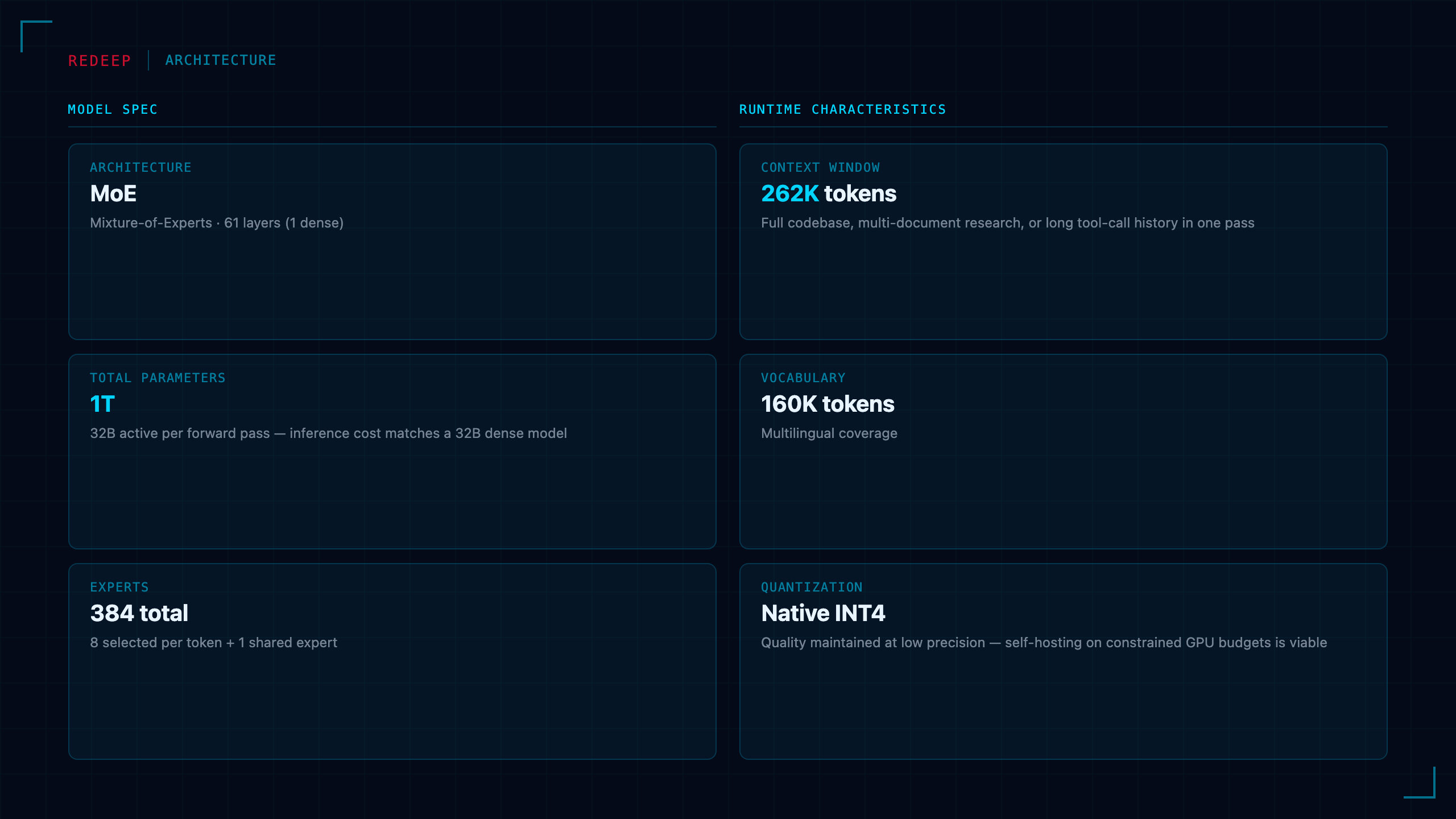
Kimi K2 Thinking uses a Mixture-of-Experts architecture with 1 trillion total parameters, of which 32 billion activate per forward pass. The router selects 8 experts per token from a pool of 384, plus 1 shared expert. The model has 61 layers (including 1 dense layer) and a vocabulary of 160,000 tokens.
The context window is 262K tokens — enough to load entire codebases, multi-document research sets, or long planning chains in a single pass. For agentic workloads where the model needs to track tool call history across hundreds of steps, this matters operationally.
Native INT4 quantization support is built in, which means the model can run at reduced precision without substantial quality degradation. For developers self-hosting on limited GPU budgets, this makes K2 Thinking more accessible than models of comparable capability that require FP16 throughout.
The weights are available on Hugging Face under a modified MIT license that permits commercial use. This is not the "open weights but no commercial use" pattern — you can build products on it.
Benchmark Results: Where It Actually Wins
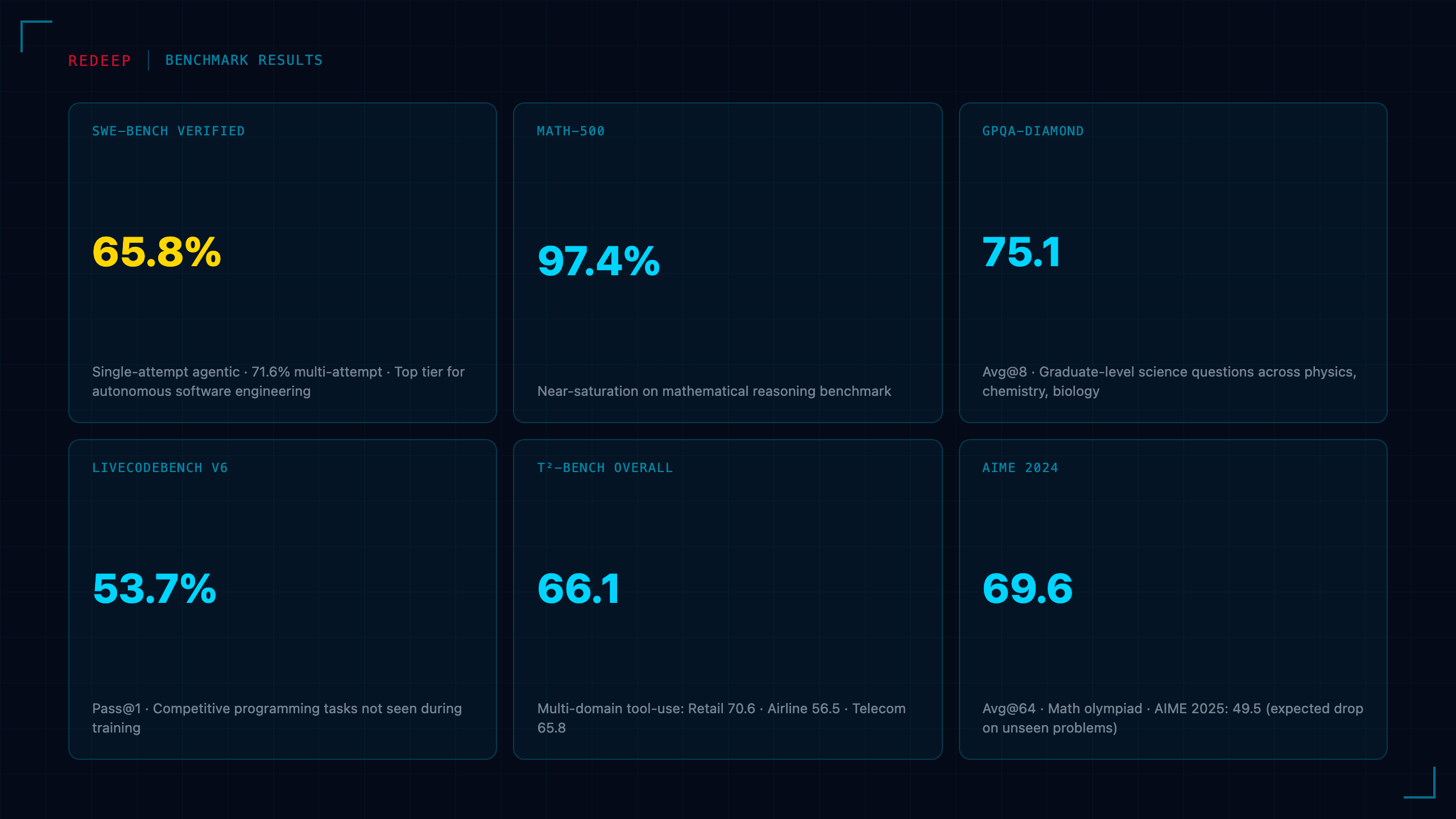
The headline number is SWE-bench Verified: 65.8% on single-attempt agentic evaluation, 71.6% with multiple attempts. For context, most frontier models were competing in the 30–40% range when this benchmark first gained traction. Getting above 65% on a single attempt puts K2 Thinking in the upper tier for autonomous software engineering tasks.
On MATH-500, it scores 97.4% — essentially saturating the benchmark. GPQA-Diamond (graduate-level science questions) lands at 75.1 avg@8. MMLU reaches 89.5% EM, MMLU-Pro 81.1% EM. LiveCodeBench v6 competitive programming: 53.7% pass@1.
For math olympiad-style reasoning, AIME 2024 scores 69.6 avg@64 and AIME 2025 49.5 avg@64. The 2025 drop is expected — newer competition problems haven't been seen in training data.
On τ²-bench, the multi-domain tool-use benchmark, the overall average is 66.1: retail 70.6 avg@4, airline 56.5 avg@4, telecom 65.8 avg@4.
The WeChat-circulated figures for HLE (44.9%, claimed to beat GPT-5's 41.7%) and BrowseComp (60.2% SOTA) aren't independently verified in official documentation yet, but the numbers are consistent with the model's strong showing across adjacent reasoning benchmarks. Take them as directionally accurate rather than audited.
The Agentic Angle: 200+ Tool Calls Without Drift
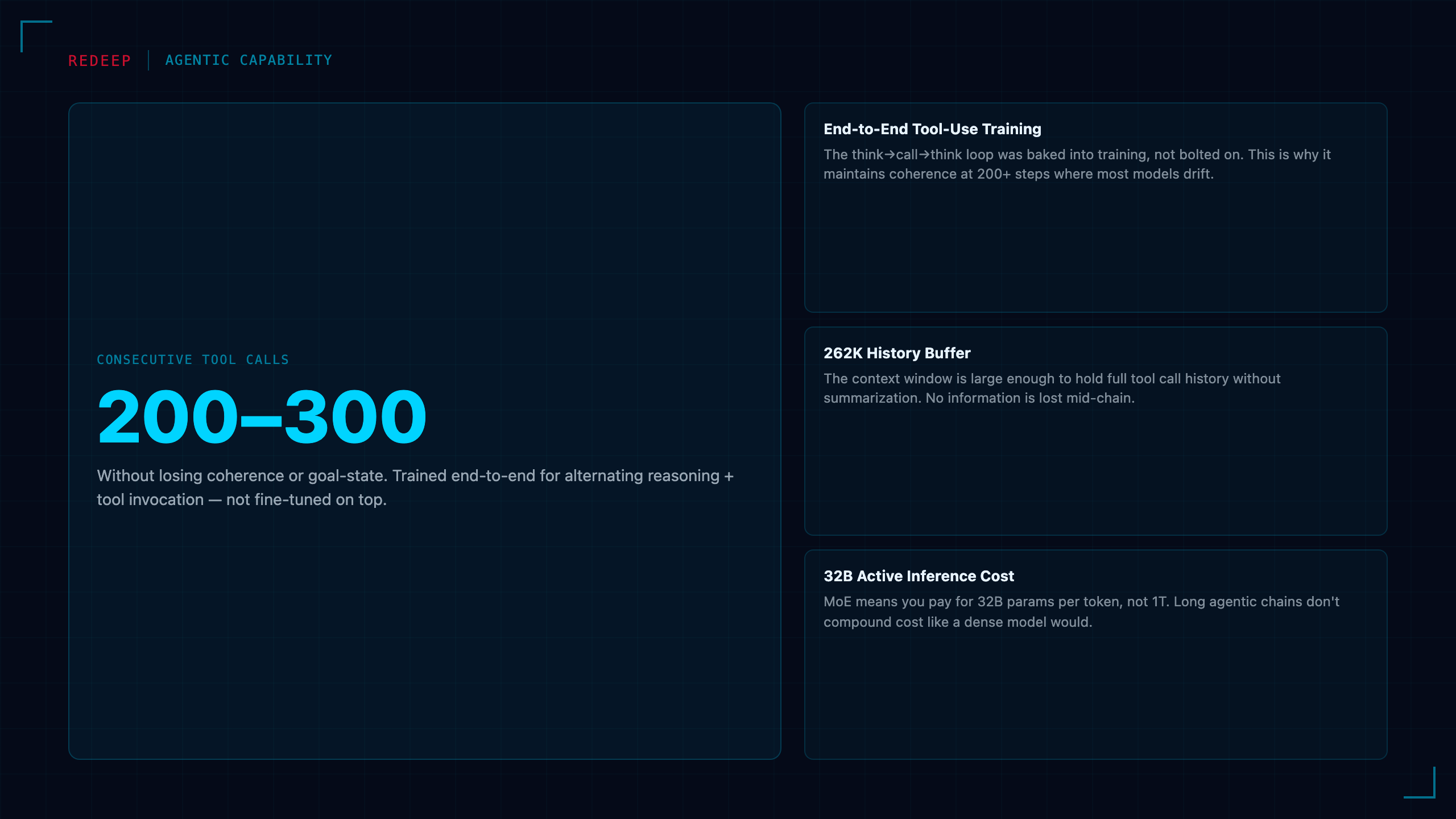
This is the distinguishing feature of K2 Thinking versus K2-Instruct and most other open-source models: it was trained end-to-end to alternate between reasoning and tool invocation. Not fine-tuned on top of a base model — trained from the ground up with this loop as the core objective.
The practical result is that it can maintain coherent planning across 200–300 consecutive tool calls. Most agent frameworks fall apart at much lower depths: the model loses track of the goal state, starts contradicting earlier decisions, or produces tool calls that are increasingly disconnected from the original intent. K2 Thinking was specifically optimized against this failure mode.
What this enables: research-style agents that query multiple data sources and synthesize results, automated software engineering workflows that write and debug iteratively, multi-step reasoning chains for complex analytical tasks. The 262K context window is load-bearing here — the model can look back at its entire tool call history without truncation.
The architecture choice (MoE with 32B active parameters) also matters for latency. You're not paying the compute cost of 1T parameters on every token — 32B active parameters means inference cost is substantially lower than the total parameter count implies.
What It Means for Developers
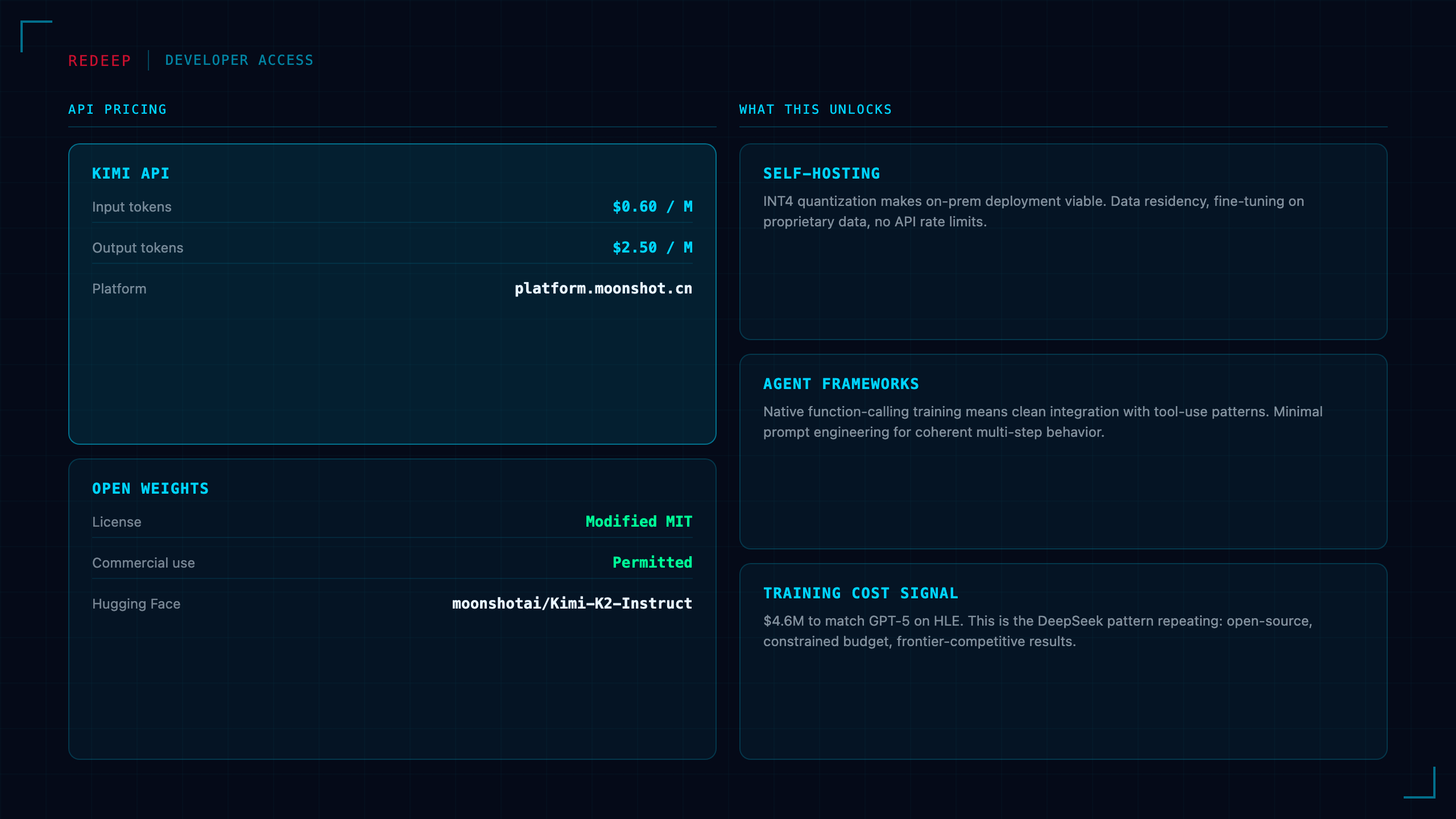
API access via Kimi's platform is priced at $0.60/M input tokens, $2.50/M output tokens. For a model at this capability tier, that's competitive — DeepSeek V3 at comparable reasoning quality runs in a similar range.
The open weights on Hugging Face under modified MIT mean self-hosting is viable for teams with GPU resources. INT4 quantization support makes this more tractable. If you're building a product where data residency matters or you need to fine-tune on proprietary data, this model is now a real option.
For agent framework developers specifically: K2 Thinking's native tool-use training means it integrates cleanly with function-calling patterns without requiring extensive prompt engineering to get coherent multi-step behavior. The 262K context window is large enough that you can pass substantial tool call history without aggressive summarization.
The LMSYS Arena community has reportedly ranked it as the top open-source model and #5 overall, though these standings shift constantly. The more durable signal is the SWE-bench and τ²-bench numbers — those are stable benchmarks with reproducible methodology.
One caveat: "Kimi K2 Thinking" and "Kimi K2 Instruct" are distinct model variants. The Thinking variant is the extended reasoning/agentic version; Instruct is the standard chat completion model. Make sure you're hitting the right endpoint for your use case.
Bottom Line
Kimi K2 Thinking is the clearest evidence yet that the DeepSeek pattern generalizes: small teams, constrained budgets, and the right architectural choices can produce open-source models that compete with the top closed-source frontier. A 1T/32B MoE at $4.6M training cost, MIT-licensed, with 262K context and genuine agentic tool-use capability — that's a different category of open-source model than what existed a year ago.
The benchmark that matters most for real deployments is SWE-bench Verified: 65.8% single-attempt is a number that means something for production software engineering agents. If you're building in that space and haven't evaluated K2 Thinking yet, that's the experiment worth running.
Resources
- Moonshot AI Official Site — company homepage
- Kimi API Platform — API access at $0.60/M input, $2.50/M output
- Hugging Face — Kimi K2 Instruct — open weights (modified MIT)
- arXiv Paper — "Kimi K2: Open Agentic Intelligence"
- GitHub — official repository with benchmark details
Kimi K2 Thinking is available via API at platform.moonshot.cn at $0.60/M input and $2.50/M output tokens. Open weights are available at huggingface.co/moonshotai/Kimi-K2-Instruct under a modified MIT license permitting commercial use.