DeepSeek released R1-0528 as a mid-cycle model update in May 2025 — not a new model family, but a substantially improved R1 that demonstrated something more interesting than a new architecture: that continued RL training on the existing R1 foundation could close much of the remaining gap with o3.
The headline: AIME 2025 improved from 79.8% to 86.7% — a 6.9 percentage point gain. Combined with tool call support added in the same update, R1-0528 became a substantially more capable model without any change to the underlying architecture.
What Changed
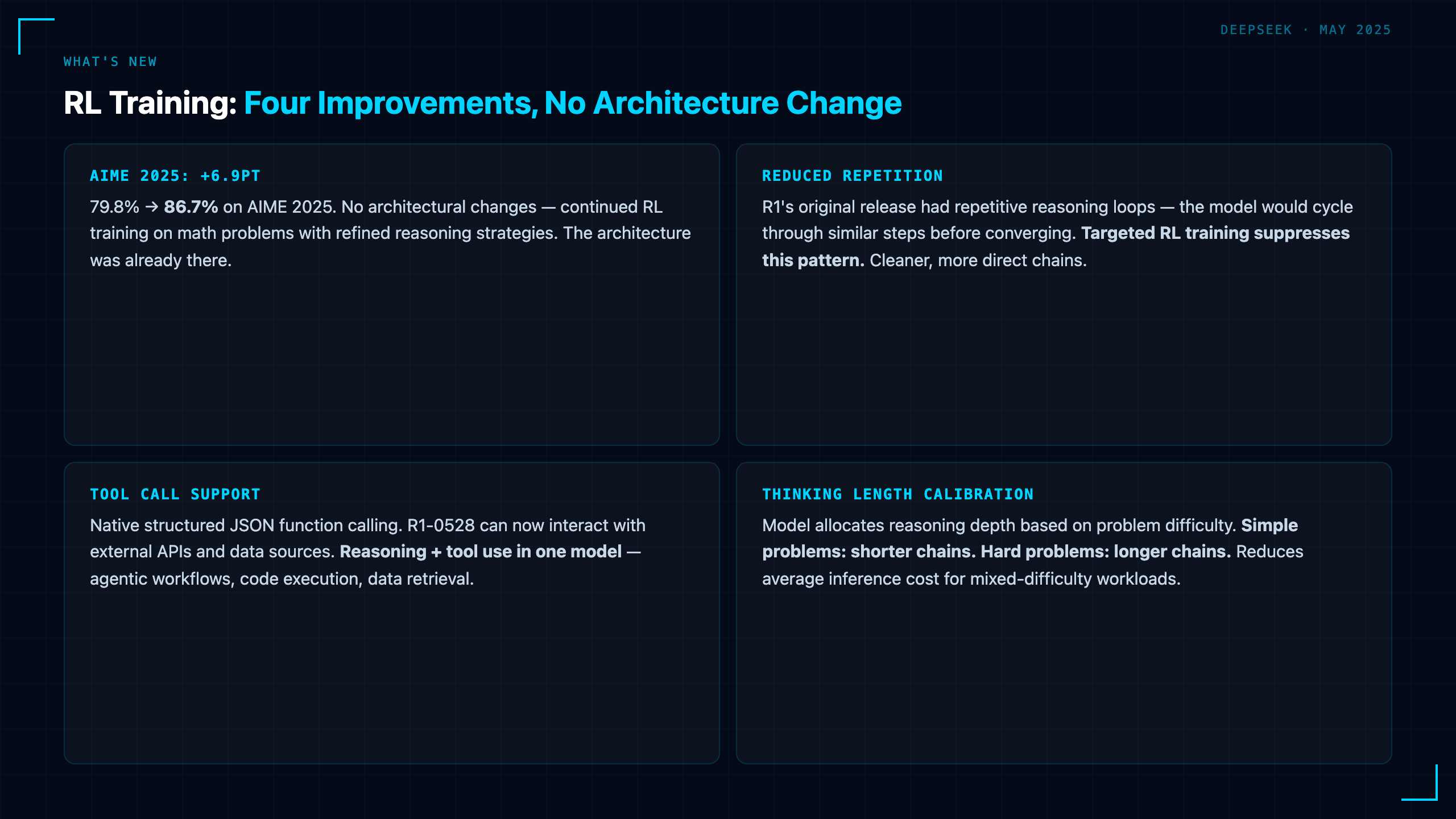
R1-0528 is the same 671B MoE architecture as R1. The differences come from continued training:
AIME improvement: 79.8% → 86.7% on AIME 2025. For hard mathematical reasoning, this is a substantial gain. The training approach involved additional RL on mathematical problems with continued refinement of the reasoning strategy.
Reduced repetition and verbose patterns: R1's original release had a known issue with repetitive reasoning chains — the model would sometimes loop through similar reasoning steps multiple times before converging. R1-0528 includes targeted training to suppress this pattern, producing cleaner, more efficient reasoning chains.
Tool call support: R1-0528 adds native function calling — structured JSON tool calls that allow the model to interact with external APIs and data sources. This extends R1's reasoning capabilities to agentic workflows where mathematical and logical reasoning needs to interact with external systems.
Thinking length calibration: The model learns to allocate reasoning depth more appropriately to problem difficulty. Simple problems get shorter chains; hard problems get longer ones. This reduces the average inference cost for mixed workloads.
Benchmarks
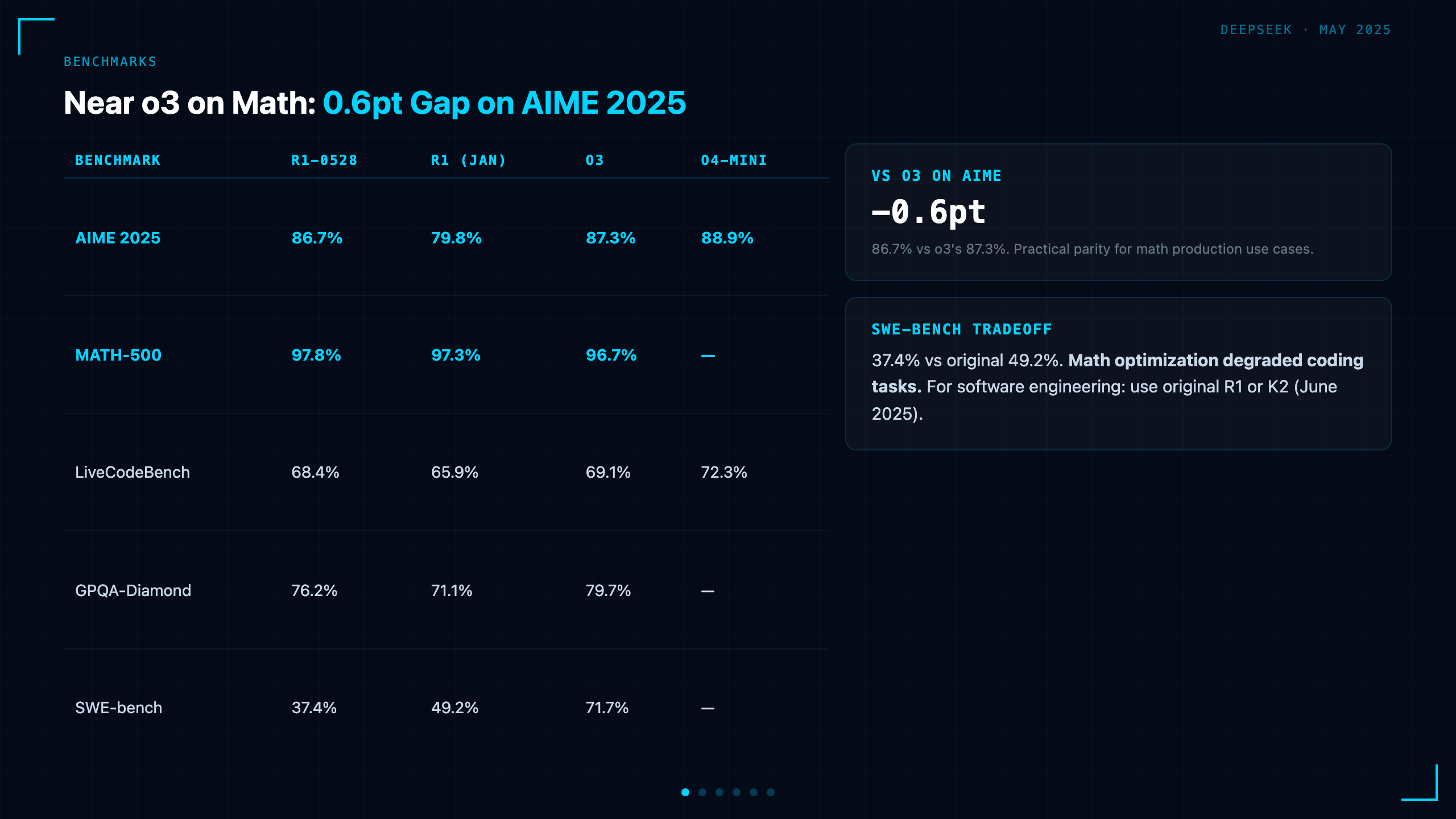
R1-0528 vs. R1 original and frontier reasoning models (May 2025):
| Benchmark | R1-0528 | R1 (Jan) | o3 | o4-mini |
|---|---|---|---|---|
| AIME 2025 | 86.7% | 79.8% | 87.3% | 88.9% |
| MATH-500 | 97.8% | 97.3% | 96.7% | — |
| LiveCodeBench | 68.4% | 65.9% | 69.1% | 72.3% |
| GPQA-Diamond | 76.2% | 71.1% | 79.7% | — |
| SWE-bench | 37.4% | 49.2% | 71.7% | — |
The AIME 2025 result puts R1-0528 within 0.6 points of o3 (87.3%) — essentially at parity on hard mathematical reasoning. On MATH-500 (97.8%), R1-0528 edges o3 (96.7%).
GPQA-Diamond improvement to 76.2% (from 71.1%) shows the RL training improvements also transferred to graduate-level scientific reasoning.
SWE-bench regression (37.4% vs original 49.2%) is worth noting — the update optimized for mathematical reasoning, and some coding benchmark performance degraded. K2, released two months later, was the answer to SWE-bench performance. R1-0528 wasn't designed to compete there.
The Iterative RL Story
R1-0528's improvement over the January R1 without architectural changes demonstrates the potential of iterative RL training on a strong foundation. The reasoning model training cycle:
- Train base reasoning model (R1 January 2025)
- Identify failure modes in production: repetition, suboptimal depth allocation, missing tool use
- Targeted RL training to address failure modes while maintaining existing capabilities
- Update release with improved performance + new capabilities
This is qualitatively different from releasing a new model — it's more like software maintenance for an RL-trained model. The architecture is stable; the training can continue to improve.
The implication: the gap between R1 and o3 was not primarily architectural. It was training. Six months of continued RL refinement closed most of the gap on mathematical reasoning.
Tool Calls: What Changes
R1-0528's tool call support means the reasoning model can now be used in agentic contexts where it previously required prompt engineering workarounds:
Math + code execution: R1-0528 can reason about a math problem, call a code interpreter to verify intermediate steps, and incorporate the verified results into the reasoning chain. This combines R1's reasoning with external computation.
API-backed reasoning: Tasks like "calculate the number of days between these two dates" or "retrieve the current exchange rate and compute the converted amount" become natural tool calls rather than requiring the model to approximate from training data.
Structured agent integration: Standard function calling JSON format means R1-0528 works directly with existing agent frameworks (LangChain, LlamaIndex, custom orchestration) without special handling.
Availability
R1-0528 is the updated default R1 endpoint on DeepSeek's API:
- API: api.deepseek.com under the
deepseek-reasonerendpoint - Pricing: Same as R1 original — $0.55/M input (cache miss), $0.14/M input (cache hit), $2.19/M output
- Open weights: Available at huggingface.co/deepseek-ai/DeepSeek-R1-0528
- License: MIT — same as original R1
What It Means for Developers
Near-o3 math reasoning at R1 pricing: If you're using R1 for mathematical reasoning tasks, the upgrade is free and automatic on the API. AIME 86.7% vs o3's 87.3% is practical parity for production use cases.
Tool calls unlock new workflows: R1-0528's reasoning + tool calls enables multi-step mathematical workflows that previously required prompt engineering to fake. Code verification, data retrieval, and API interaction become first-class in the reasoning chain.
SWE-bench tradeoff: If your primary use case is coding on real GitHub issues, the original R1 or K2 (released June 2025) is a better choice. R1-0528 optimized for math reasoning, not software engineering tasks.
Bottom Line
R1-0528 demonstrated that the path from R1 to o3-parity on mathematical reasoning was continuous RL improvement on a strong foundation, not a new architecture. Six months of iterative training reduced AIME gap from ~8 points to under 1 point.
Combined with tool calls, R1-0528 is a substantially more production-ready model than the January release — the same MIT license and API pricing, with notably better reasoning quality and expanded functionality.
Resources
- DeepSeek API —
deepseek-reasonerendpoint (defaults to R1-0528) - HuggingFace — DeepSeek-R1-0528 — open weights
- DeepSeek Blog — release announcement
DeepSeek R1-0528 is available via API at api.deepseek.com under the deepseek-reasoner endpoint. MIT license open weights on HuggingFace.