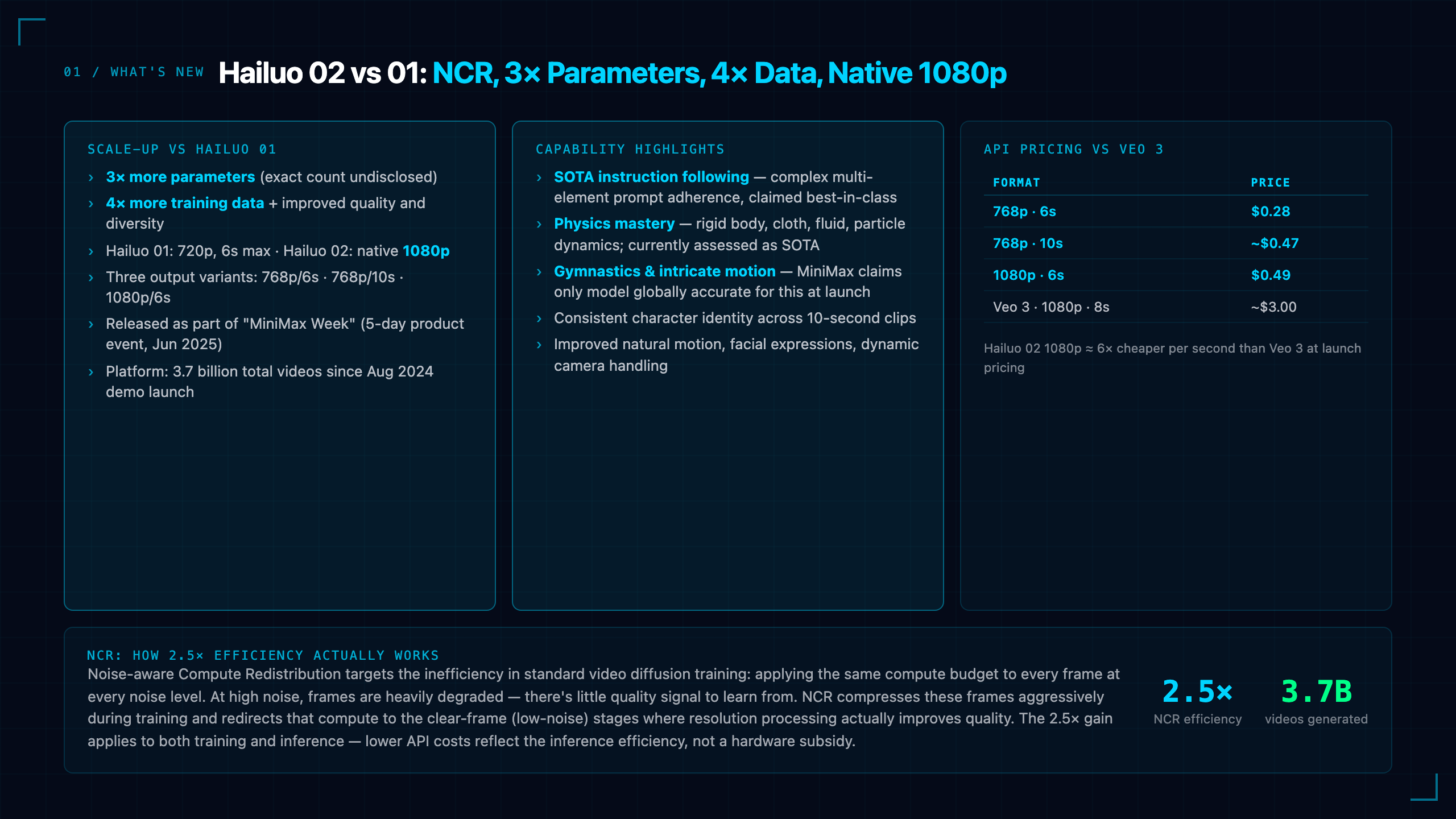
MiniMax released Hailuo 02 on June 18, 2025 as part of "MiniMax Week" — a five-day product event that also unveiled the open-source MiniMax-M1 language model. Where Hailuo 01 proved video generation at scale (3.7 billion videos generated since the August 2024 demo launch), Hailuo 02 is the architectural rethink: 3× more parameters, 4× more training data, native 1080p output, and a new training architecture called Noise-aware Compute Redistribution (NCR) that MiniMax claims delivers 2.5× training and inference efficiency.
The practical result: Hailuo 02 finished second in the Artificial Analysis Video Arena's image-to-video leaderboard at launch — behind Seedance 1.0, ahead of Google Veo 3 (without audio). At $0.49 per 1080p 6-second clip via API versus Veo 3's ~$3 for an 8-second 1080p clip, the price-to-quality ratio is the primary commercial argument.
What's New: NCR Architecture and Scale-Up
The central technical contribution is Noise-aware Compute Redistribution (NCR). MiniMax has published high-level descriptions but not full technical details.
The mechanism: NCR handles long video sequences differently depending on the stage of the diffusion training process. Early in training, when artificial noise is heavily introduced into the data, videos are compressed as much as possible — fewer compute resources applied to noise-heavy frames. Later, when the training videos are cleaner (less noise added), the model processes them at full resolution. The insight is that high-noise frames don't benefit from full-resolution compute during training; the quality information isn't there yet. By redirecting that compute to the clear-frame stages, NCR achieves a 2.5× efficiency gain without proportionally increasing hardware requirements.
The scale-up relative to Hailuo 01:
- 3× more parameters (exact count undisclosed)
- 4× more training data with improved data quality and diversity
- Native 1080p output — the previous model was limited to 720p at 25 fps
- Three resolution variants: 768p/6s, 768p/10s, 1080p/6s
Key capability improvements highlighted by MiniMax:
- Instruction following: SOTA for complex, multi-element prompt adherence
- Physics mastery: accurate simulation of rigid body dynamics, cloth, fluid, and complex motion sequences
- Gymnastics and intricate motion: MiniMax claims Hailuo 02 is "the only model globally capable" of accurate gymnastics rendering at time of release
Architecture: NCR and the Efficiency Argument
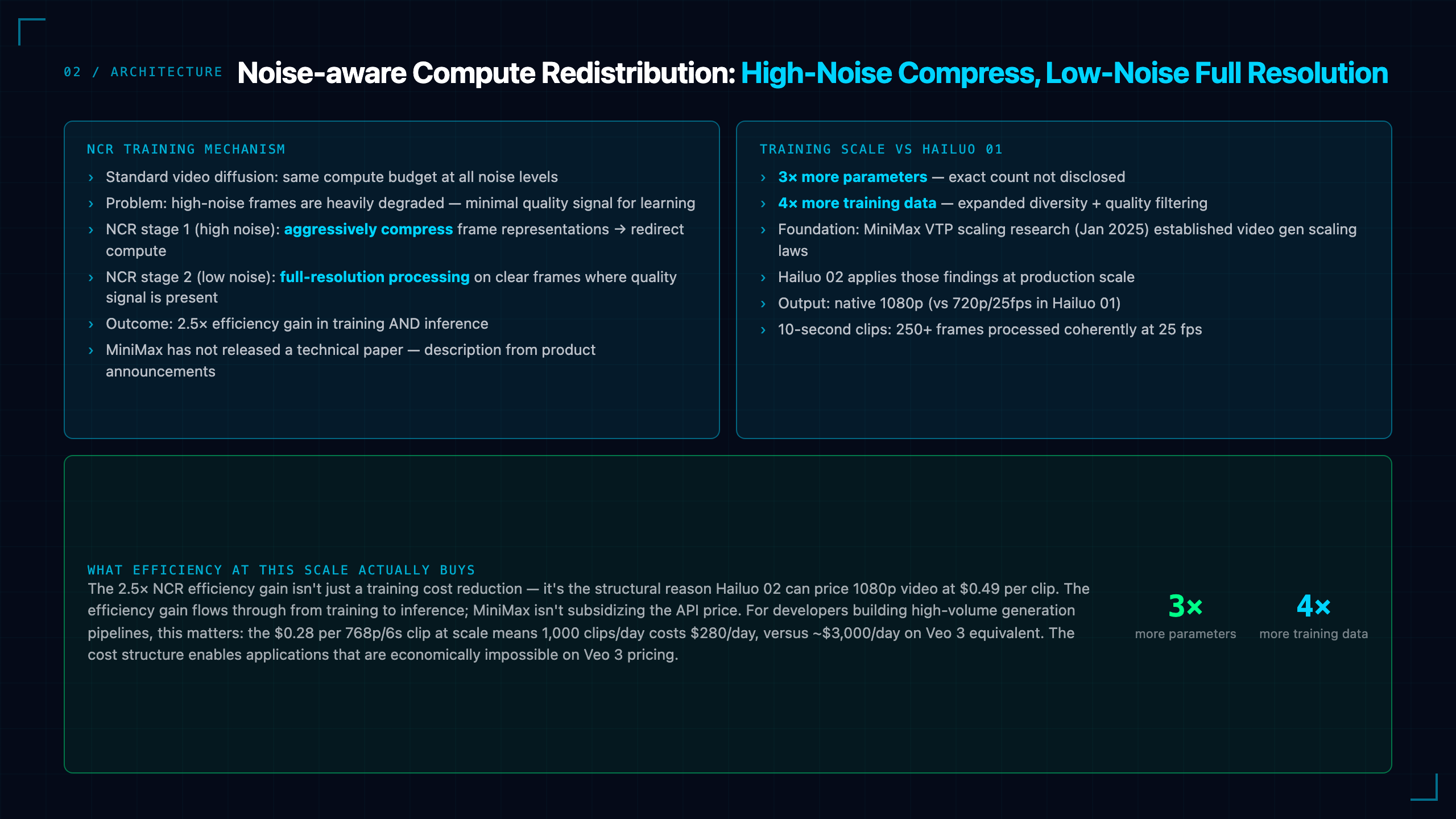
The NCR architecture addresses a structural problem in video diffusion training. Standard video diffusion models apply the same compute budget to every frame at every noise level. For a model processing 10-second clips (250+ frames at 25 fps), this is computationally expensive regardless of whether the frame content has enough fidelity to benefit from high-resolution processing.
NCR's adaptive compression strategy:
- High-noise stage: heavily compressed frame representations; compute redirected elsewhere
- Low-noise stage: full-resolution processing on clean frame representations where quality signal is present
- Training efficiency: 2.5× overall gain in both training and inference compute
The training data improvements (4× scale, quality filtering, diversity expansion) compound the architecture gains. MiniMax's VTP scaling research (published January 2025) established the video generation scaling laws; Hailuo 02 is the production model that applies that research at scale.
MiniMax has not published the parameter count, training data composition, or a technical report. The NCR architecture description is from product announcements and press coverage, not a paper.
Benchmarks: Video Arena #2, User-Validated Performance
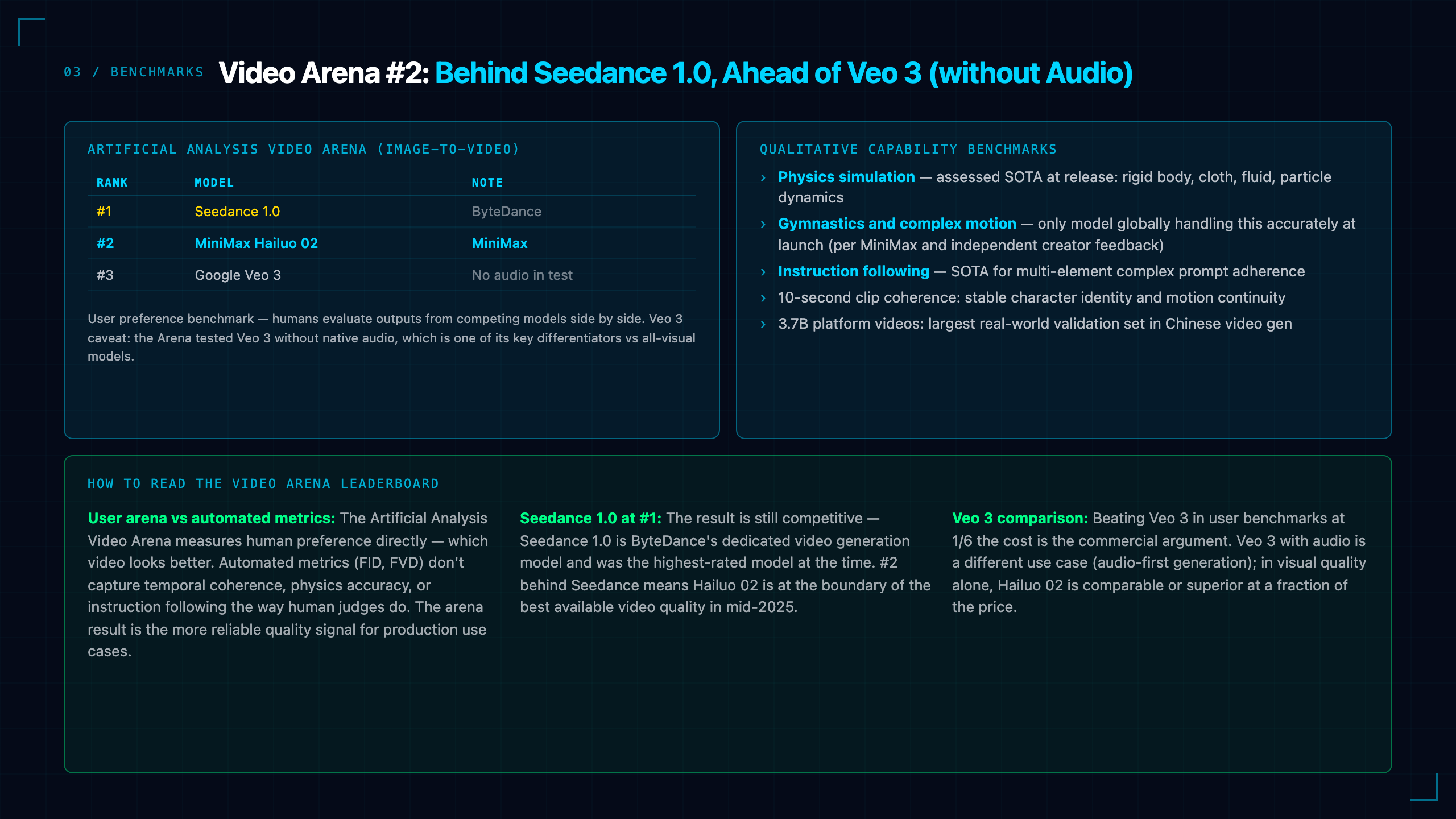
At launch (June 2025), Hailuo 02 placed in the Artificial Analysis Video Arena — a user preference benchmark where humans evaluate outputs from competing models side by side:
| Model | Arena Category | Position |
|---|---|---|
| Seedance 1.0 | Image-to-video | #1 |
| Hailuo 02 | Image-to-video | #2 |
| Google Veo 3 (no audio) | Image-to-video | #3 |
The Veo 3 comparison has a caveat: the version tested in the Arena doesn't support native audio, which is one of Veo 3's differentiated features. Veo 3 with audio is a different competitive comparison.
Qualitative benchmarks highlighted by MiniMax:
- Physics simulation: currently assessed as SOTA — rigid body, cloth, fluid, particle dynamics
- Instruction following: claimed SOTA for complex multi-element prompt adherence
- Gymnastics and intricate motion: assessed as only model globally handling this category accurately at launch
Community assessment (based on creator feedback):
- Reliable for highly complex motion scenarios that fail in other models
- Fast generation relative to comparable quality competitors
- Consistent character identity and motion across 10-second clips
- 3.7 billion total videos generated on Hailuo platform since August 2024 demo launch
Access and Pricing
Hailuo 02 is available through:
- Hailuo AI Video: web interface and mobile app
- MiniMax API Platform: programmatic access
API pricing:
| Format | Duration | Cost |
|---|---|---|
| 768p | 6 seconds | $0.28 |
| 768p | 10 seconds | ~$0.47 |
| 1080p | 6 seconds | $0.49 |
For comparison, Google Veo 3 costs approximately $3 per 8-second 1080p clip — roughly 6× more expensive per second of 1080p video.
What It Means for Developers
Hailuo 02 is relevant for video production workflows where generation quality, physics fidelity, and cost all matter simultaneously. The positioning in the Video Arena (ahead of Veo 3 at 1/6 the cost) makes it the default benchmark for cost-conscious production use cases.
The NCR efficiency gain has an operational implication beyond training: inference is also 2.5× more efficient, which translates to lower API costs and faster generation times at equivalent hardware. The $0.28/$0.49 price points reflect this.
For specific use case fit:
- Complex motion and physics scenarios (gymnastics, fluid dynamics, cloth simulation): Hailuo 02 is the reference model
- Long clip generation (10-second): the 768p/10s variant extends the content budget per API call
- Professional production (1080p): native 1080p output at $0.49 per clip vs upgrading from 720p in post
- High-volume pipelines: cost efficiency at $0.28/clip supports large-scale generation workflows
What Hailuo 02 doesn't do yet: native audio generation (Veo 3's differentiating feature), advanced camera control (Runway's differentiator), or dynamic scene transitions between multiple subjects. MiniMax has acknowledged these as future roadmap items.
Bottom Line
Hailuo 02 is the Hailuo architecture rebuilt: NCR brings 2.5× efficiency, 3× more parameters and 4× more data bring capability, and the Video Arena placing (#2 overall, ahead of Veo 3) validates the output quality. At $0.49 per 1080p 6-second clip, it costs approximately 6× less than Veo 3 per unit of content. For video generation applications where physics fidelity, instruction following, and complex motion matter — and where cost at scale matters — Hailuo 02 is the cost-quality reference as of its June 2025 release.
Resources
- MiniMax Hailuo 02 Announcement — official release page
- Hailuo AI Video — web and mobile interface
- MiniMax API Platform — API access and documentation
- Artificial Analysis Video Arena — benchmark leaderboard
- The Decoder Coverage — technical summary
Hailuo 02 is available via web at hailuoai.video and via API at platform.minimax.io. API pricing: $0.28 for 6s 768p, $0.49 for 6s 1080p.