DeepSeek released DeepSeek-V2.5 on September 5, 2024, as a practical consolidation move: merging their two strongest V2-era models — the general-purpose DeepSeek-V2-Chat and the coding-specialized DeepSeek-Coder-V2-Instruct — into a single unified model. The architecture remained the same (236B MoE, 21B active parameters, 128K context), but the merged model delivered both chat and coding capability from a single set of weights.
The motivation was straightforward: maintaining separate chat and code models doubles deployment infrastructure. V2.5 merged these without capability regression on either task, and added improvement on Chinese AlignBench and human preference benchmarks.
What's New
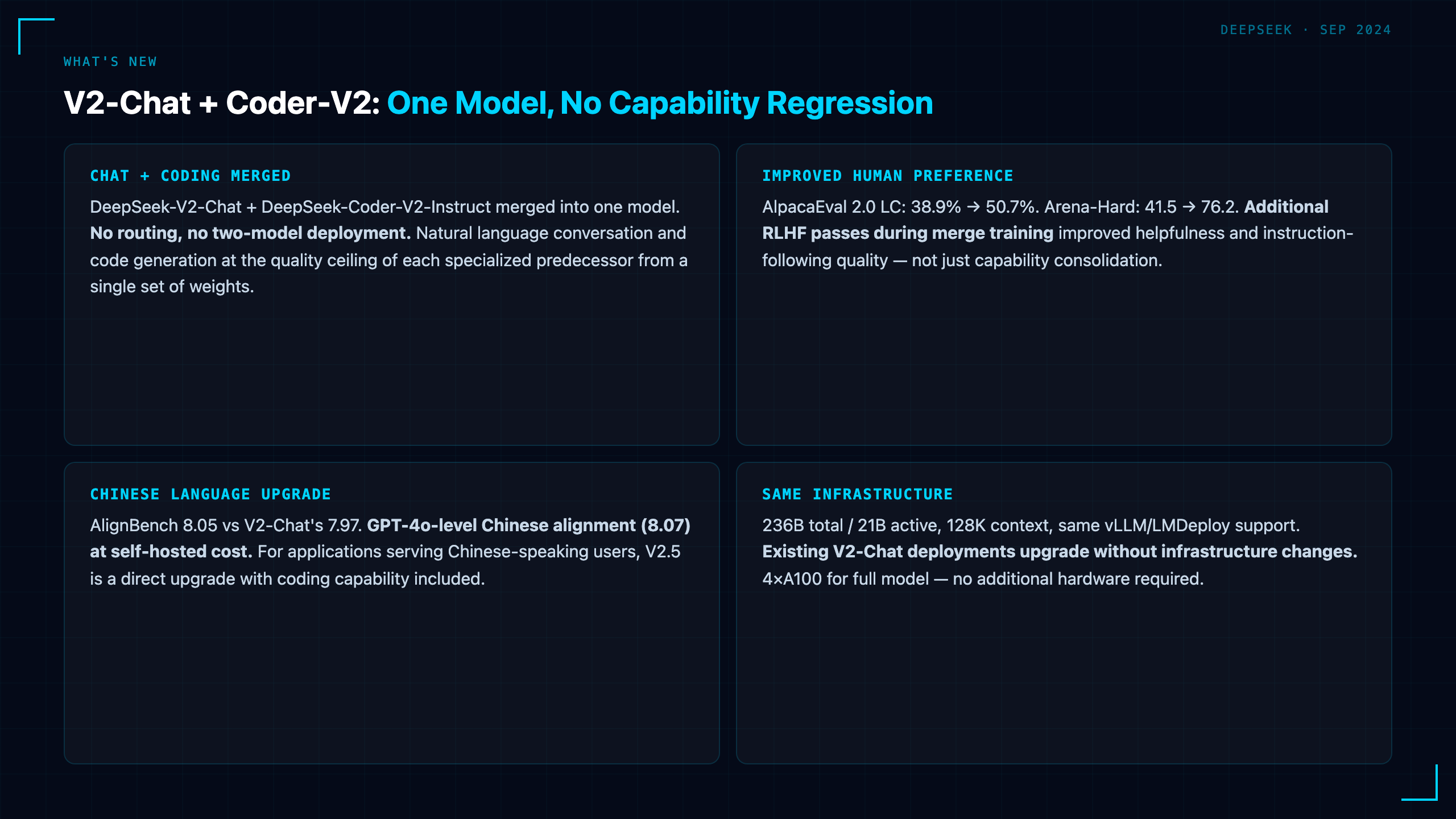
Chat + Coding merged: DeepSeek-V2.5 combines DeepSeek-V2-Chat's conversational quality with DeepSeek-Coder-V2-Instruct's code generation capability. One model handles both natural language tasks and programming tasks at the quality level of the specialized predecessors — no routing, no two-model deployment.
Improved human preference alignment: V2.5 shows improved scores on AlpacaEval 2.0 and Arena-Hard compared to V2-Chat. The merge included additional RLHF training passes to improve helpfulness and instruction-following quality, not just capability consolidation.
Chinese language improvements: AlignBench (Chinese language alignment benchmark) scores improved over V2-Chat. For applications serving Chinese-speaking users, V2.5 is a direct upgrade from V2-Chat without the coding capability trade-off.
Writing quality upgrade: Human evaluation shows improved long-form writing quality — more coherent multi-paragraph responses, better structure in reports and essays. The improvement is attributed to the merge training process rather than just the capability combination.
Same infrastructure requirements: 236B total / 21B active parameters, 128K context, same vLLM and LMDeploy support. Existing V2-Chat deployments upgrade without infrastructure changes.
Architecture
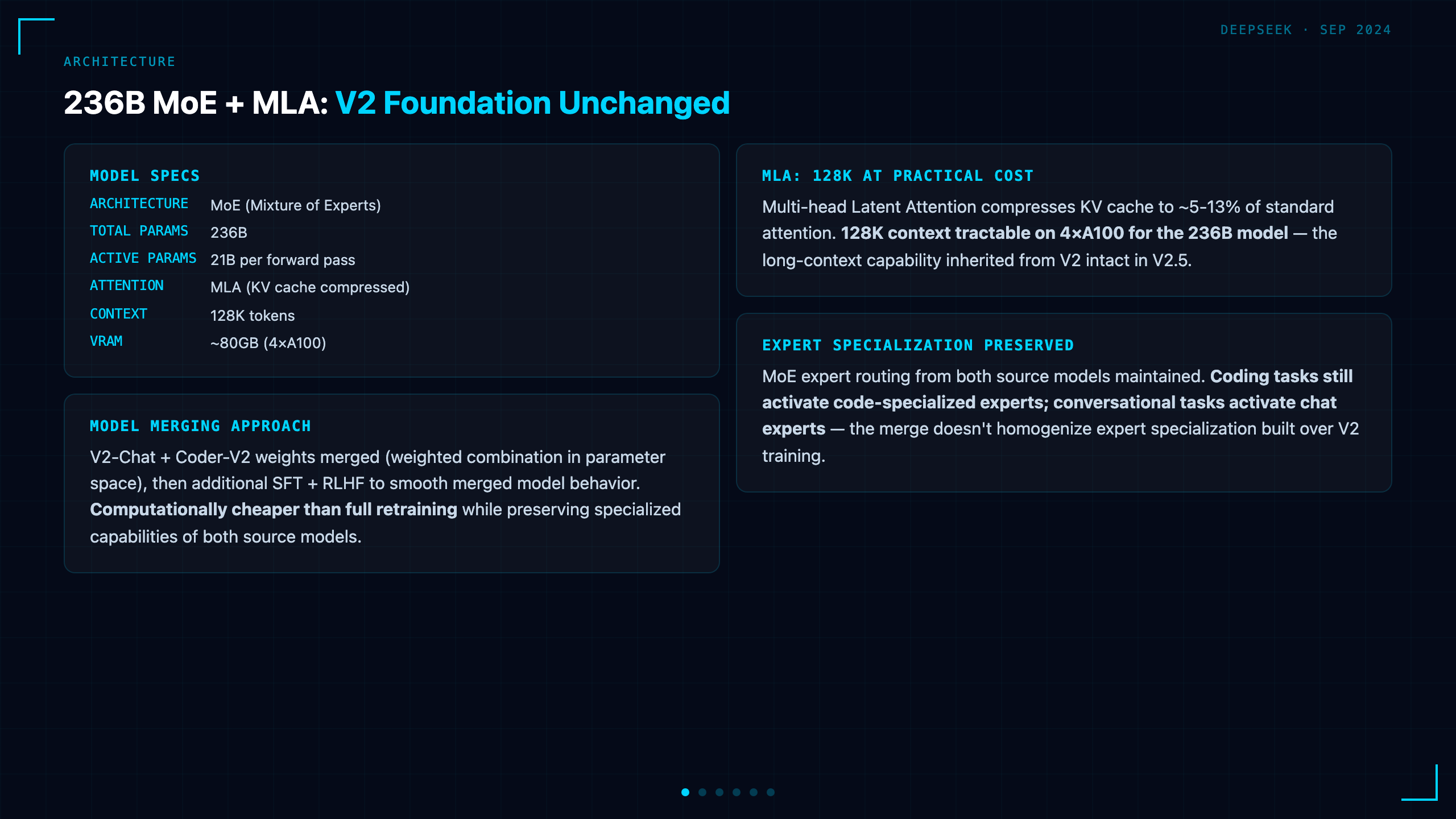
DeepSeek-V2.5 preserves the V2 MoE architecture exactly:
| Component | Details |
|---|---|
| Architecture | MoE (Mixture of Experts) |
| Total parameters | 236B |
| Active parameters | 21B per forward pass |
| Attention | Multi-head Latent Attention (MLA) |
| Context window | 128K tokens |
| Training | V2-Chat + Coder-V2 merged + continued fine-tuning |
MLA (Multi-head Latent Attention): The KV cache compression from V2 is preserved — keys and values are projected into a low-dimensional latent space, reducing KV cache to ~5-13% of standard attention. This makes 128K context tractable on 4×A100s for the 236B model.
Model merging approach: Rather than training V2.5 from scratch, DeepSeek merged the chat and coding model weights (weighted combination in parameter space) and then ran additional supervised fine-tuning and RLHF to smooth the merged model's behavior. This is computationally much cheaper than full retraining while preserving the specialized capabilities of both source models.
Expert specialization preserved: The MoE expert routing from both V2-Chat and Coder-V2 is maintained in the merged model. Coding tasks continue to activate code-specialized experts, and conversational tasks activate the relevant chat experts — the merge doesn't homogenize the expert specialization.
Benchmarks
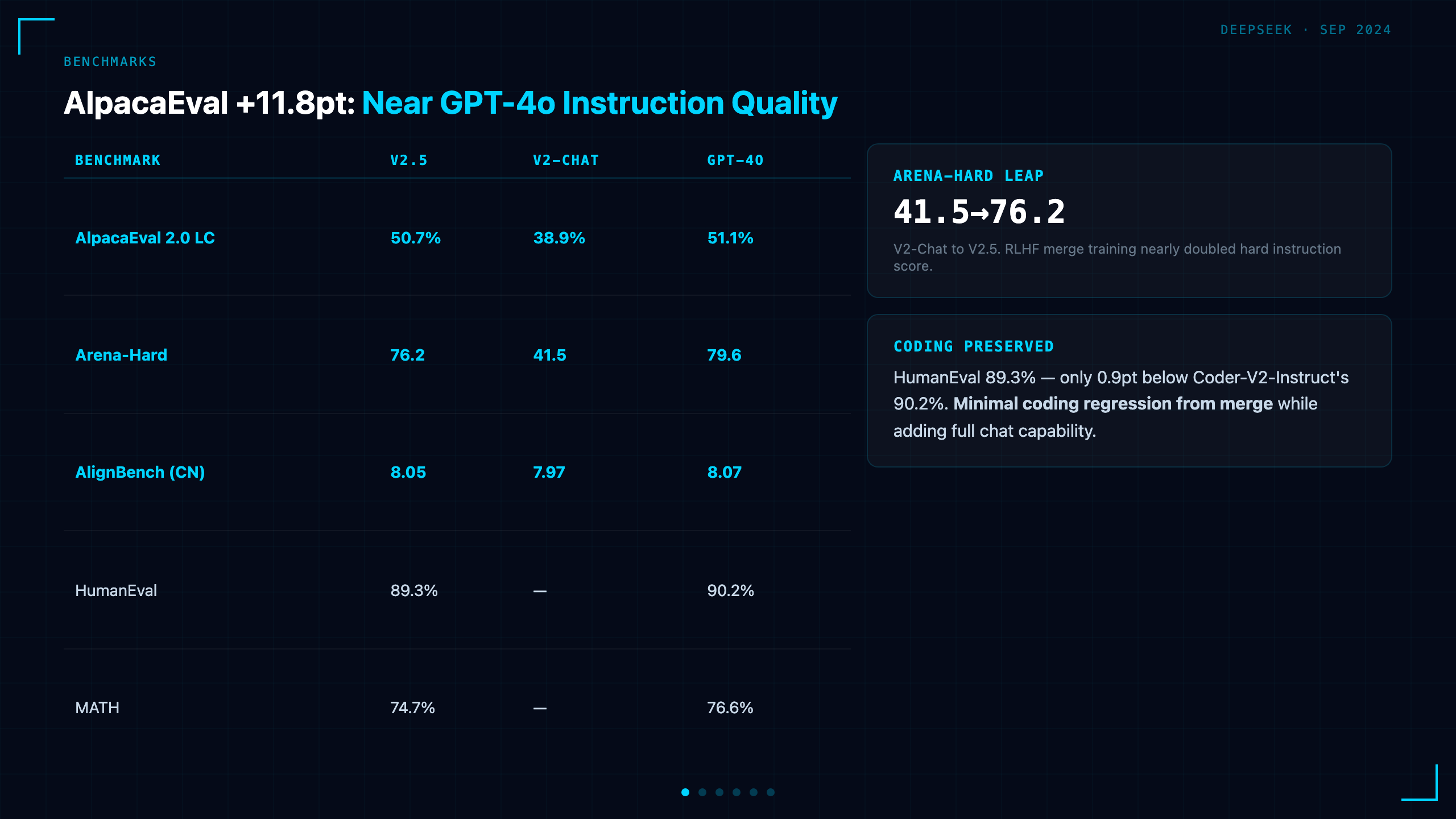
DeepSeek-V2.5 at September 2024 release:
| Benchmark | V2.5 | V2-Chat | Coder-V2-Instruct | GPT-4o | Notes |
|---|---|---|---|---|---|
| AlpacaEval 2.0 LC | 50.7% | 38.9% | — | 51.1% | Instruction following |
| Arena-Hard | 76.2 | 41.5 | — | 79.6 | Hard instruction quality |
| AlignBench | 8.05 | 7.97 | — | 8.07 | Chinese language alignment |
| HumanEval | 89.3% | — | 90.2% | 90.2% | Code generation |
| MATH | 74.7% | — | 75.7% | 76.6% | Mathematical reasoning |
The AlpacaEval 2.0 jump from 38.9% (V2-Chat) to 50.7% (V2.5) is the headline — a +11.8pt improvement in instruction-following quality from the merge and additional RLHF. Arena-Hard follows the same pattern: 41.5 → 76.2, near GPT-4o's 79.6.
HumanEval 89.3% (vs Coder-V2-Instruct's 90.2%) shows minimal coding capability loss from the merge — the 0.9pt gap is within noise for this benchmark.
What It Means for Developers
One deployment instead of two: Organizations running both DeepSeek-V2-Chat for general queries and DeepSeek-Coder-V2-Instruct for code tasks can consolidate to a single V2.5 deployment. 4×A100 instead of 8×A100, one inference server instead of two, one model update lifecycle.
Upgrade path from V2-Chat: V2.5 is a direct upgrade for existing V2-Chat deployments — same API format, same infrastructure requirements, meaningfully better AlpacaEval/Arena-Hard scores, plus code capability included. No capability regression on chat tasks.
Near-GPT-4o instruction following at open-source cost: AlpacaEval 50.7% vs GPT-4o 51.1% — effectively the same quality on instruction-following at self-hosted open-source cost. For applications where instruction quality is the primary metric, V2.5 reached that tier in September 2024.
Chinese production deployment: AlignBench 8.05 (vs GPT-4o 8.07) places V2.5 at parity with GPT-4o on Chinese language alignment. For Chinese-language applications, V2.5 delivers GPT-4o quality at self-hosted cost with no API dependency.
Availability
- HuggingFace: deepseek-ai/DeepSeek-V2.5
- API: DeepSeek Platform — available via API
- License: Model weights available; API access for production
- Context: 128K tokens
Bottom Line
DeepSeek-V2.5 was a practical consolidation that delivered a measurable improvement: AlpacaEval 2.0 jumped from 38.9% to 50.7%, Arena-Hard from 41.5 to 76.2, while preserving coding capability at 89.3% HumanEval. One model covering both conversational and coding use cases at near-GPT-4o instruction quality on a self-hosted 4×A100 setup. For teams running V2-era DeepSeek models, V2.5 was the obvious upgrade.
Resources
- HuggingFace — DeepSeek-V2.5
- DeepSeek Platform API
- GitHub — DeepSeek-V2 — architecture and training details
- DeepSeek Blog — release notes
DeepSeek-V2.5 is available via the DeepSeek API platform and on HuggingFace. Model weights available for self-hosting.