Alibaba's Qwen team released Qwen2-VL in September 2024 with an architectural insight that solved a persistent problem in vision-language models: the fixed-resolution bottleneck. Most VLMs processed images by resizing them to a fixed dimension — typically 224×224 or 448×448 pixels. This destroyed detail in high-resolution images and wasted compute on small images.
Qwen2-VL's Naive Dynamic Resolution approach changed this: images are encoded at their native resolution, with visual tokens dynamically allocated based on content complexity. The result was a model that significantly outperformed same-size contemporaries on document understanding, chart analysis, and video — exactly the tasks where fixed-resolution bottlenecks cause the most damage.
Naive Dynamic Resolution
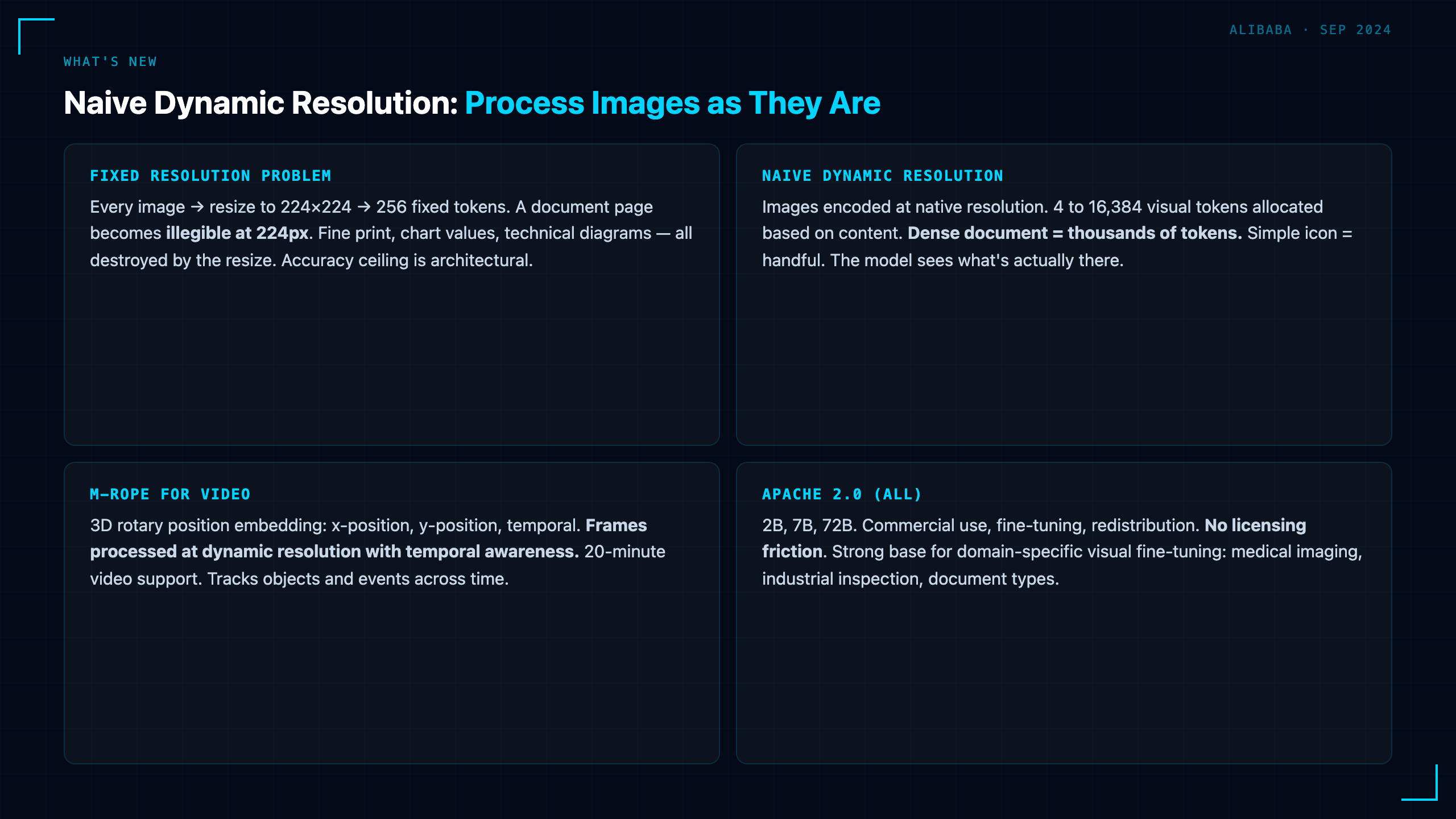
The core innovation: the model handles variable-length visual token sequences, allowing images of any size to be encoded at their natural resolution.
How standard VLMs work: Every image → resize to 224×224 → fixed 256 visual tokens → process. A high-resolution document page with dense text gets compressed to a thumbnail. A 16×16 icon gets padded to 224×224.
Naive Dynamic Resolution: Every image → split into patches at native resolution → variable number of visual tokens (anywhere from 4 to 16,384 in Qwen2-VL) → process. A dense document gets thousands of tokens. A simple icon gets a handful.
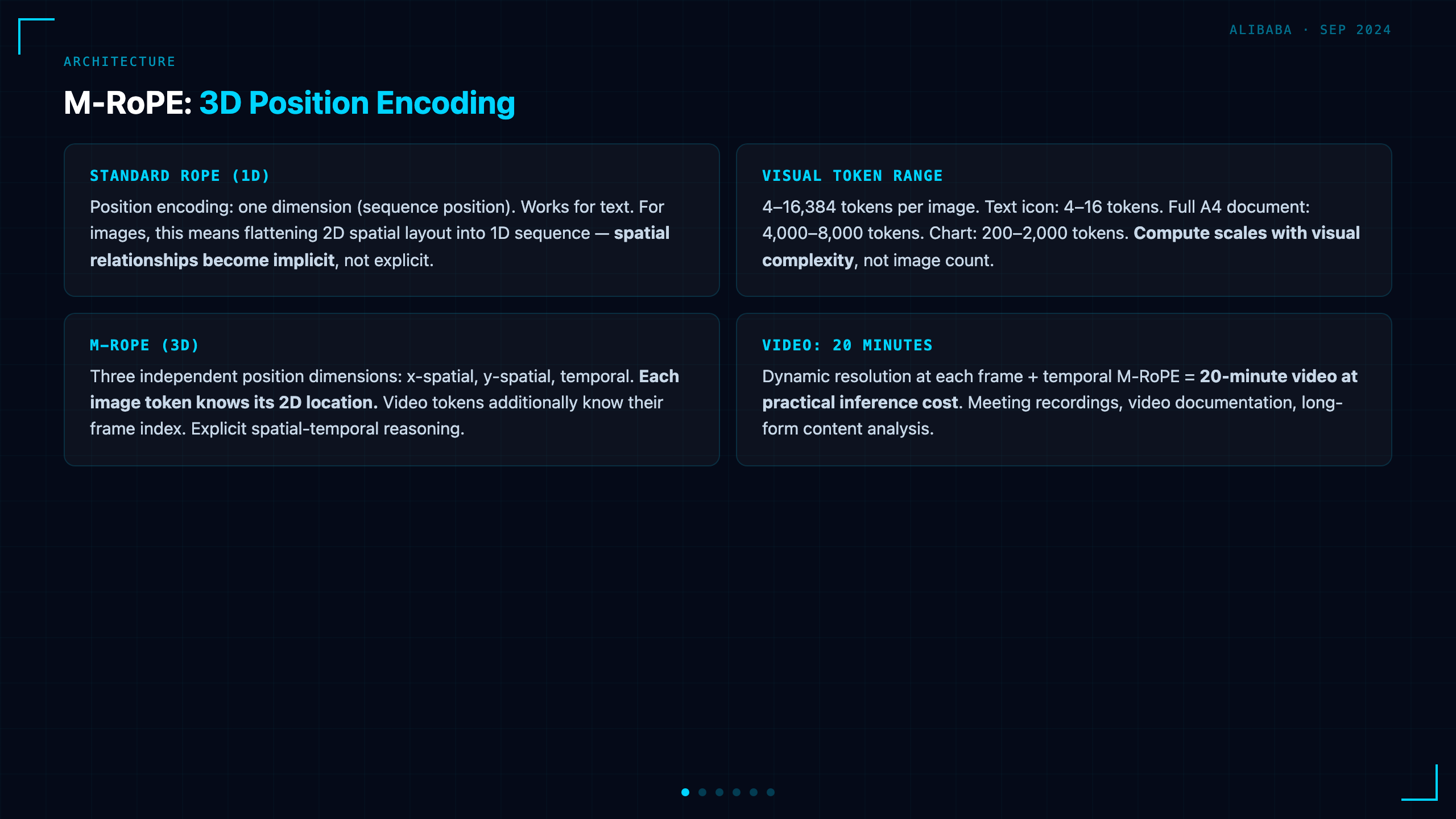
The architectural requirement: the transformer must handle variable-length visual token sequences, which requires positional encoding that generalizes across scales. Qwen2-VL uses M-RoPE (Multi-dimensional Rotary Position Embedding) — extending RoPE to handle both spatial dimensions and temporal (for video) simultaneously.
Architecture and Variants
Qwen2-VL ships in three sizes:
| Model | Parameters | Visual Tokens | Context |
|---|---|---|---|
| 2B-Instruct | 2B | 4–16,384 | 128K |
| 7B-Instruct | 7B | 4–16,384 | 128K |
| 72B-Instruct | 72B | 4–16,384 | 128K |
All three use the same dynamic resolution mechanism. The 72B is the benchmark headline; the 7B is the practical production tier.
Video processing: M-RoPE's temporal dimension extends to video — frames are treated as sequences of images with temporal position encoding. Qwen2-VL supports video inputs of up to 20 minutes, processing each frame at dynamic resolution. For video question answering and temporal analysis, this is the relevant capability.
M-RoPE: Standard RoPE uses a 1D position encoding. M-RoPE extends it to 3D (x-position, y-position, temporal) for visual content. This allows the model to reason about spatial relationships within frames and temporal relationships across frames without separate position encoders for each.
Benchmarks
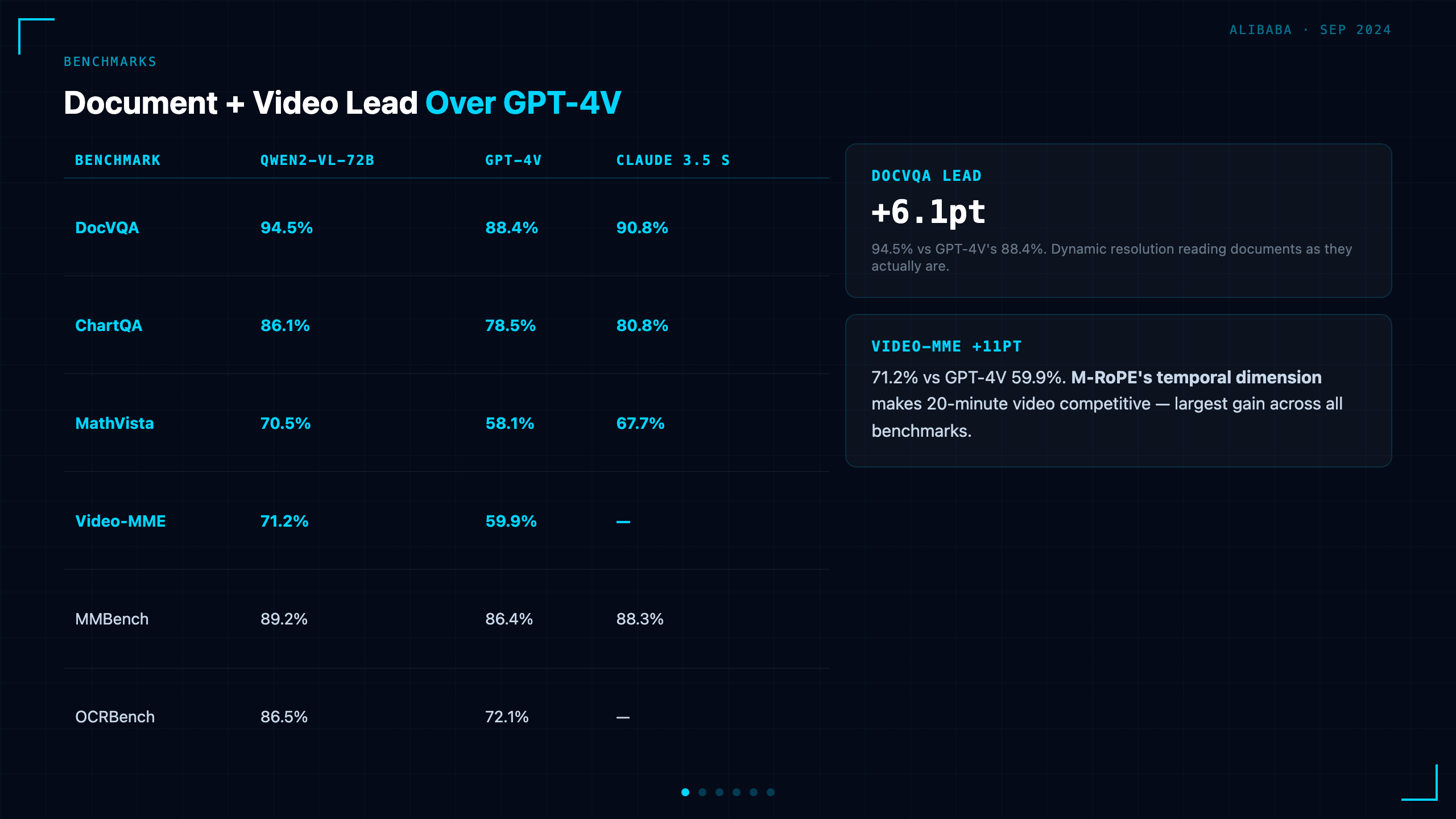
Qwen2-VL-72B-Instruct at September 2024 release:
| Benchmark | Qwen2-VL-72B | GPT-4V | Claude 3.5 Sonnet | Notes |
|---|---|---|---|---|
| DocVQA | 94.5% | 88.4% | 90.8% | Document QA |
| ChartQA | 86.1% | 78.5% | 80.8% | Chart understanding |
| MMBench | 89.2% | 86.4% | 88.3% | General visual |
| MathVista | 70.5% | 58.1% | 67.7% | Visual math |
| Video-MME | 71.2% | 59.9% | — | Video understanding |
| OCRBench | 86.5% | 72.1% | — | Text recognition |
The DocVQA lead (+6.1 over GPT-4V, +3.7 over Claude 3.5 Sonnet) reflects the dynamic resolution advantage directly — document pages get full-resolution encoding rather than compressed thumbnails.
MathVista (+12.4 over GPT-4V) shows the benefit for visual math — diagrams, geometric figures, and mathematical charts are processed at their native detail level.
Video-MME (+11.3 over GPT-4V) demonstrates that M-RoPE's temporal dimension extends the dynamic resolution benefit to video understanding.
Why the Resolution Fix Matters
To understand why fixed resolution was such a problem:
A standard A4 document page scanned at 300 DPI is 2480×3508 pixels. Resize to 448×448: the text is illegible to a human at that resolution. Models trained to process this resolution "learn" to work with blurry text — they're essentially learning OCR at very low resolution. The quality ceiling is architectural, not a matter of training more data.
Naive Dynamic Resolution removes this ceiling. A document page gets processed at whatever resolution preserves legibility. The visual encoder can attend to fine text detail. DocVQA accuracy improves because the model can actually read the document.
This isn't specific to documents — any task involving fine detail (charts, diagrams, screenshots, technical drawings) benefits from the same mechanism.
What It Means for Developers
Document processing pipelines: Qwen2-VL-7B-Instruct processes documents at native resolution with 7B parameter inference cost. For invoice extraction, contract analysis, form processing — the 7B delivers accuracy previously only available from 72B+ models.
Replacing GPT-4V for visual tasks: On DocVQA (94.5% vs 88.4%) and ChartQA (86.1% vs 78.5%), the 72B Qwen2-VL substantially outperforms GPT-4V. For document-heavy visual applications, this is a quality improvement alongside moving to open-source.
Video analysis: 20-minute video at dynamic resolution is a practical capability for meeting transcription, video documentation analysis, and similar workflows. The temporal M-RoPE means the model tracks objects and events across time without explicit frame selection.
Fine-tuning: Apache 2.0 on all three sizes means domain-specific fine-tuning is straightforward. For medical imaging, technical diagram analysis, or industrial inspection, the dynamic resolution base is strong for domain adaptation.
Availability
All three models are available at huggingface.co/Qwen:
- Qwen2-VL-2B-Instruct, 7B-Instruct, 72B-Instruct
- Apache 2.0 license
- vLLM, transformers, and SGLang support
Bottom Line
Qwen2-VL established that vision-language models didn't have to choose between resolution and efficiency. Dynamic allocation of visual tokens based on content complexity made high-resolution document processing viable at every model size, not just at the largest variants with massive token budgets.
The benchmark results — leading on DocVQA, ChartQA, and Video-MME vs. GPT-4V and Claude 3.5 Sonnet — demonstrated that this wasn't an incremental improvement but a capability class change for document-centric and video applications.
Resources
- Blog Post — release announcement and technical details
- Technical Report (arXiv 2409.12191) — Naive Dynamic Resolution, M-RoPE, benchmarks
- HuggingFace — Qwen2-VL-72B-Instruct — 72B flagship
- HuggingFace — Qwen2-VL-7B-Instruct — production tier
Qwen2-VL models are available on HuggingFace under Apache 2.0. All sizes including commercial use.