DeepSeek released V3.2-Exp just before China's National Day holiday — a timing pattern the company has repeated enough that it's become a joke in the local ML community. The model itself is not a joke: it runs at V3.1 performance across all benchmarks while consuming significantly fewer tokens per task, and it came with a pricing update that cuts output token costs by 75%.
The technical driver is DSA (DeepSeek Sparse Attention), an implementation of Native Sparse Attention (NSA) — the method that won ACL 2025 Best Paper, developed in collaboration with Peking University and DeepSeek's Liang Wenfeng. The experiment demonstrates that sparse attention isn't a quality tradeoff; it's an efficiency free lunch when implemented correctly.
The Problem DSA Solves
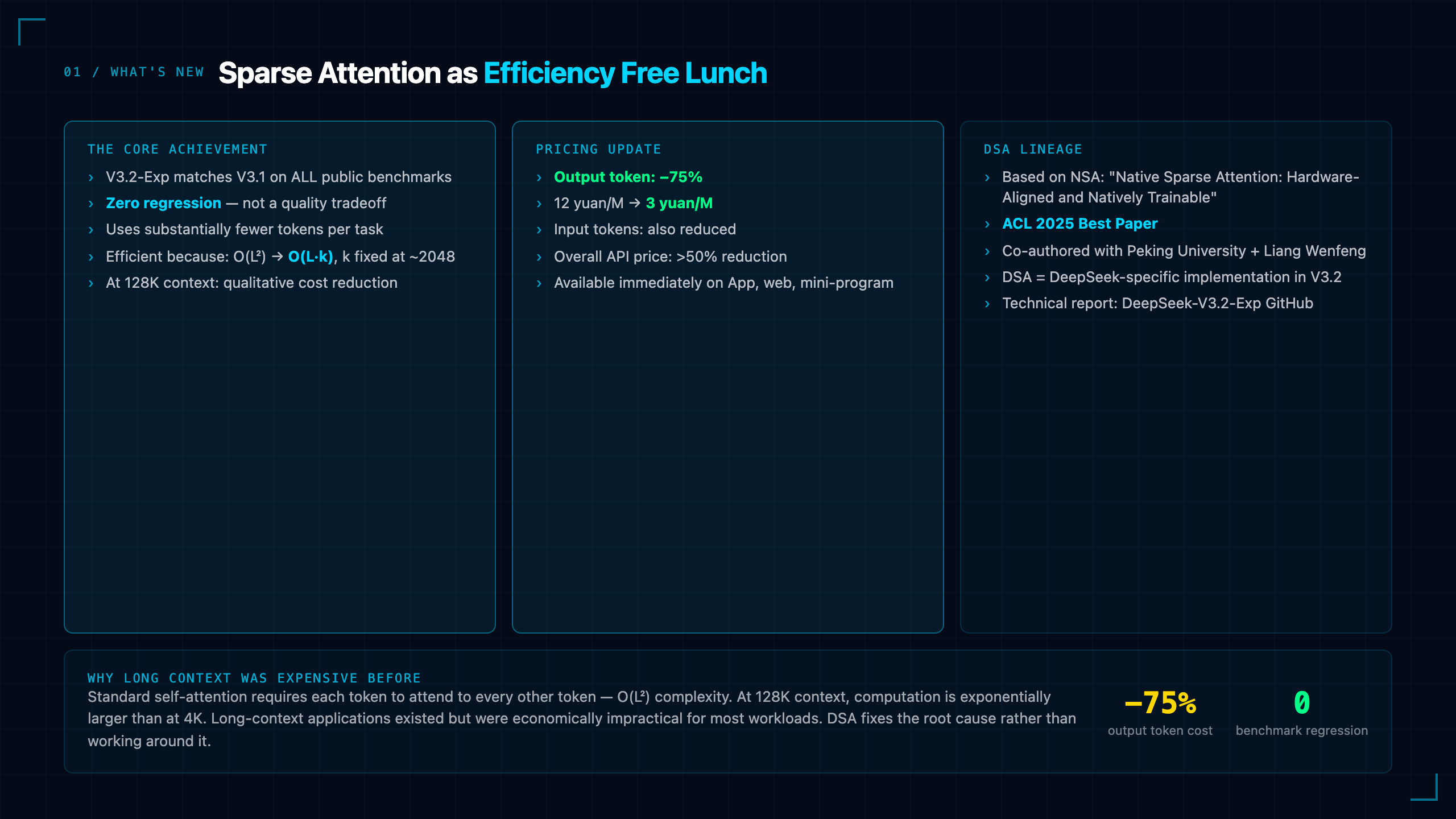
Standard self-attention is O(L²) in sequence length. At 128K context — a realistic length for code repositories, legal documents, or long research papers — the computation for every forward pass is astronomically larger than at 4K. This is why long-context applications remain expensive despite widespread support for large context windows: the window exists, but the cost to use it is prohibitive.
DeepSeek Sparse Attention addresses the root cause. Instead of every token attending to every other token, DSA selects only the most relevant k tokens for full attention. The complexity drops from O(L²) to O(L·k), where k is a fixed budget (approximately 2,048 tokens). L can be hundreds of thousands; k is constant. For very long contexts, this is a qualitative change, not an incremental optimization.
The technical report is available at github.com/deepseek-ai/DeepSeek-V3.2-Exp. The NSA paper was published as "Native Sparse Attention: Hardware-Aligned and Natively Trainable Sparse Attention" (ACL 2025).
The DSA Mechanism
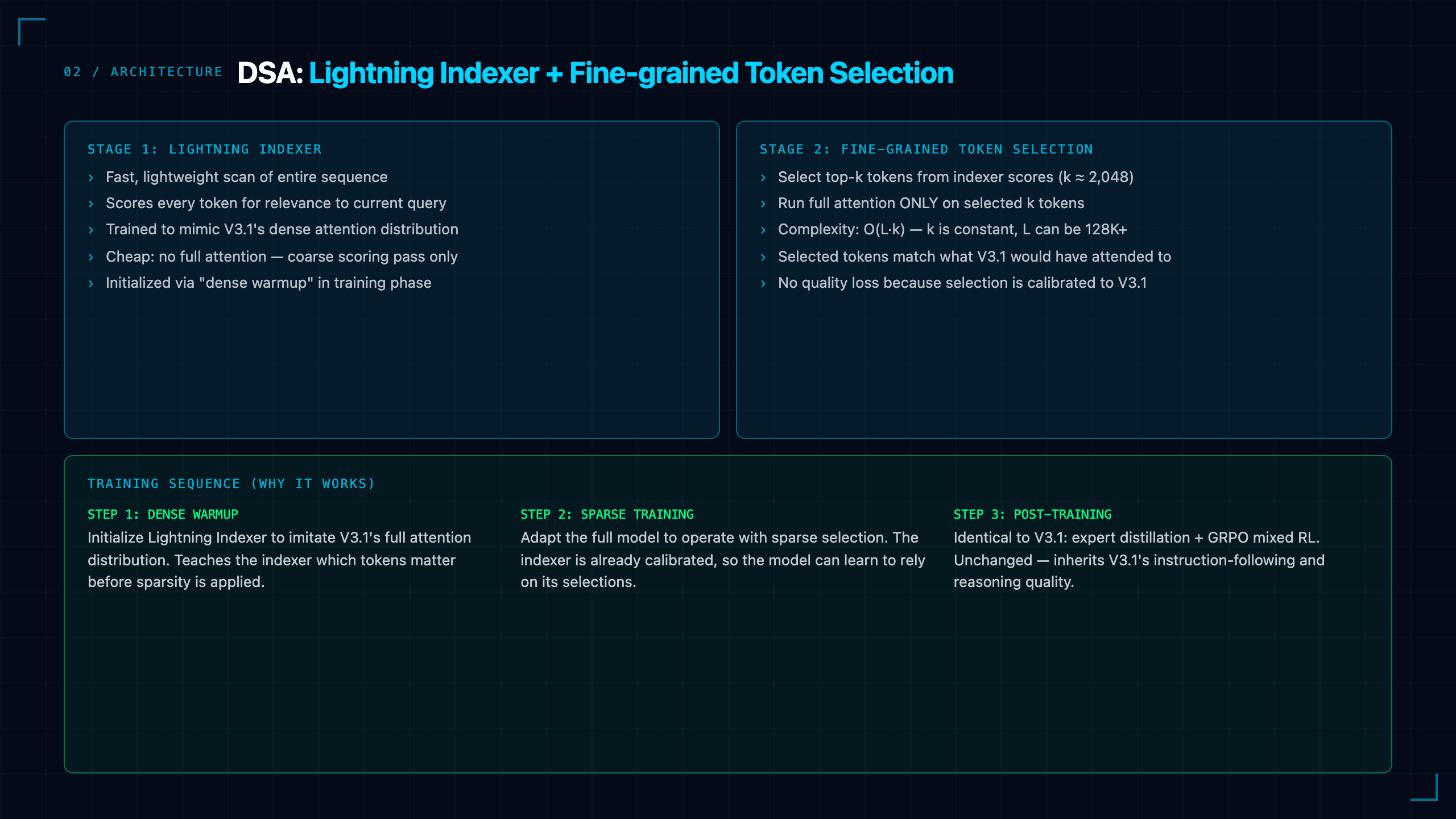
DSA operates in two stages:
Lightning Indexer (Stage 1) — Before full attention, a lightweight indexer performs a fast pass over the entire sequence and scores every token for relevance to the current query. This is described as sending a "scout" ahead: cheap, fast, coarse-grained. The indexer learns to approximate the attention distribution of the original dense model — initialized during training to mimic V3.1's full attention pattern before the sparse phase begins.
Fine-grained Token Selection (Stage 2) — Armed with the indexer's scores, the model selects the top-k highest-scoring tokens (approximately 2,048) and runs full attention only on those. The rest of the sequence is not attended to in this pass. Because the indexer was calibrated against V3.1's actual attention distribution, the selected tokens are the ones that would have received the most weight anyway.
The training sequence: dense warmup to initialize the Lightning Indexer → sparse training to adapt the full model to the new pattern → post-training identical to V3.1 (expert distillation + GRPO mixed reinforcement learning). The post-training stage being unchanged is significant — it means the sparse model inherits V3.1's instruction-following and reasoning capabilities without re-training from scratch.
Benchmark Results and Pricing
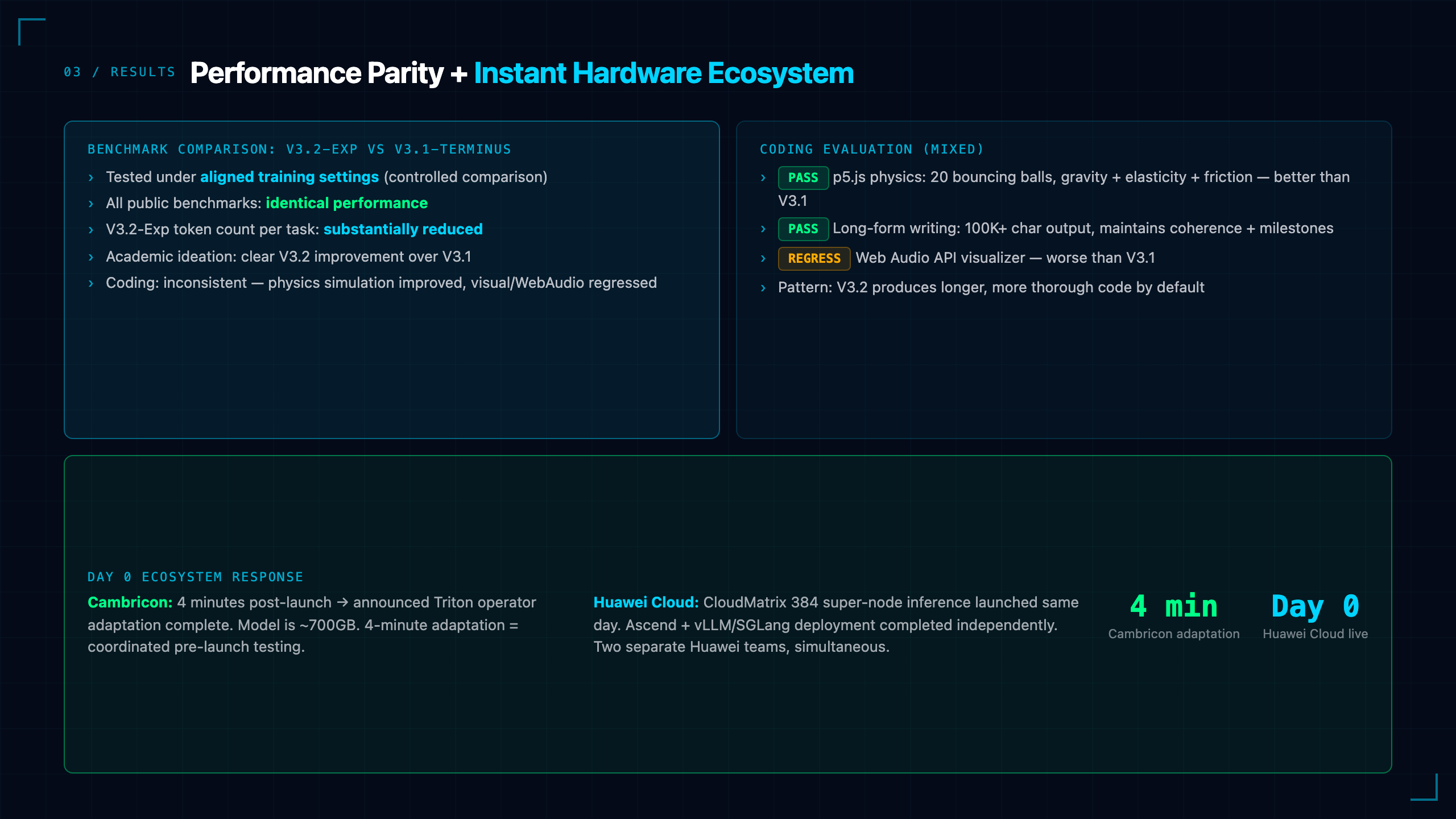
The controlled comparison was V3.2-Exp vs V3.1-Terminus under aligned training settings. On all published public benchmarks, the two models perform identically. V3.2-Exp does not regress. The difference is that V3.2-Exp uses substantially fewer tokens to complete the same tasks — the efficiency gain translates directly to throughput and cost.
The pricing update that accompanied the release:
- API price reduction: >50% overall
- Output tokens: 12 yuan/M → 3 yuan/M (75% reduction)
- Input tokens: also reduced
The 75% output token price cut is the number developers will care about most. For any workload where output length is significant — agentic tasks, code generation, long-form synthesis — the per-task cost drops by approximately 4×.
At the model level, the practical evaluation showed mixed results:
- Academic ideation: V3.2 substantially better than V3.1 — richer reasoning, more complete argumentation, better "storytelling" around research ideas.
- Long-form writing: V3.2 produces longer, more comprehensive responses; tested on 100K+ character output, the model maintained coherence and internal milestones.
- Coding (complex): Inconsistent. Web Audio API visualization regressed from V3.1. p5.js physics simulation (bouncing balls with gravity, elasticity, friction) improved significantly — better physics accuracy, cleaner visual output.
- Observation: V3.2 tends to produce longer, more thorough code by default, suggesting a bias toward completeness over brevity in generation strategy.
Ecosystem Response
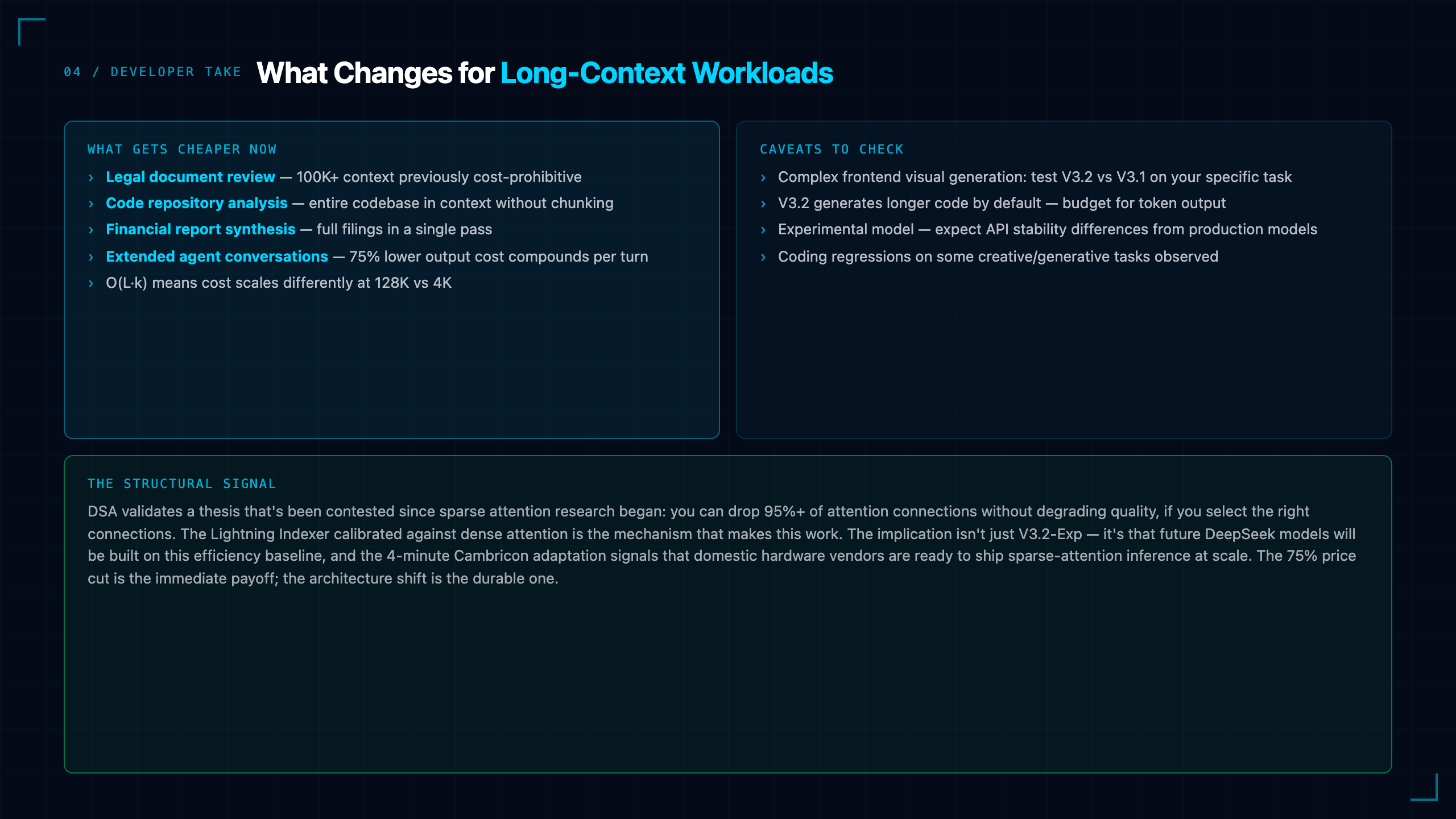
The ecosystem response on Day 0 was immediate:
Cambricon announced successful adaptation via Triton operator development within 4 minutes of model publication. The model weights are approximately 700GB; 4 minutes from release to adaptation is only plausible with prior coordination.
Huawei Cloud launched the model on their platform the same day, running inference on CloudMatrix 384 super-node infrastructure. Huawei Computing's Ascend division separately completed deployment via vLLM/SGLang frameworks.
This is not a typical open-source adoption curve. The coordinated hardware-side response suggests V3.2-Exp was being validated on domestic hardware in parallel with its development, which has implications for domestic AI infrastructure strategy.
The model is available via HuggingFace and ModelScope. It runs on DeepSeek's App, web interface, and mini-program immediately post-launch.
What It Means for Developers
The immediate practical effect of V3.2-Exp: long-context applications that were previously dismissed as too expensive become financially viable.
The O(L·k) complexity means the model's token cost at 128K context is dramatically lower than at equivalent performance with full attention. For developers building applications around legal document review, code repository analysis, financial report synthesis, or extended agent conversations — the cost ceiling just moved up. Tasks that required context window truncation or expensive chunking can now be run end-to-end at a fraction of previous cost.
The 75% output token price cut stacks on top of the efficiency gain. If your workflow generates long outputs — detailed reports, full code files, multi-step plans — the per-call cost is now roughly 4× lower than before the update.
The caveat is the coding regression on complex visual tasks. V3.2-Exp's coding performance is not uniformly better than V3.1. For teams using DeepSeek as a primary coding model, evaluating against your specific task type before switching is warranted. Academic, analytical, and writing use cases see clear improvement. Complex creative frontend work is inconsistent.
Bottom Line
DSA validates a thesis: sparse attention can replace dense attention without performance loss when the selection mechanism is properly calibrated. The Lightning Indexer approach — learn to mimic the dense model's attention distribution, then use that as the selection criterion — is an elegant solution to the calibration problem that has made sparse attention inconsistent in previous implementations.
The practical output: a model that matches V3.1 quality, costs 75% less per output token, and enables long-context applications that were previously blocked by economics. The ecosystem adoption — 4-minute Cambricon adaptation, same-day Huawei Cloud deployment — signals that domestic hardware infrastructure is treating DeepSeek releases as first-class events.
Resources
- DeepSeek-V3.2-Exp on HuggingFace — model weights
- Technical Report (PDF) — DSA architecture details
- ModelScope — alternative hosting
- DeepSeek Platform — API access and pricing
DeepSeek-V3.2-Exp is available via the DeepSeek API at platform.deepseek.com. Output token price: 3 yuan/M. Open weights on HuggingFace and ModelScope.