Alibaba's Qwen team just shipped something the open-source safety ecosystem has been missing: a guardrail model that can moderate responses as they're being generated, token by token, without waiting for the full output. Qwen3Guard comes in two variants — Gen for offline classification, Stream for real-time intervention — across three sizes (0.6B, 4B, 8B), supporting 119 languages. All open-source.
The timing matters. Every production LLM deployment needs safety moderation, but the standard approach — generate the full response, then classify it — means users might see harmful content before the filter catches it. Qwen3Guard-Stream solves this by attaching classification heads directly to the transformer's final layer, classifying safety at every token position during generation.
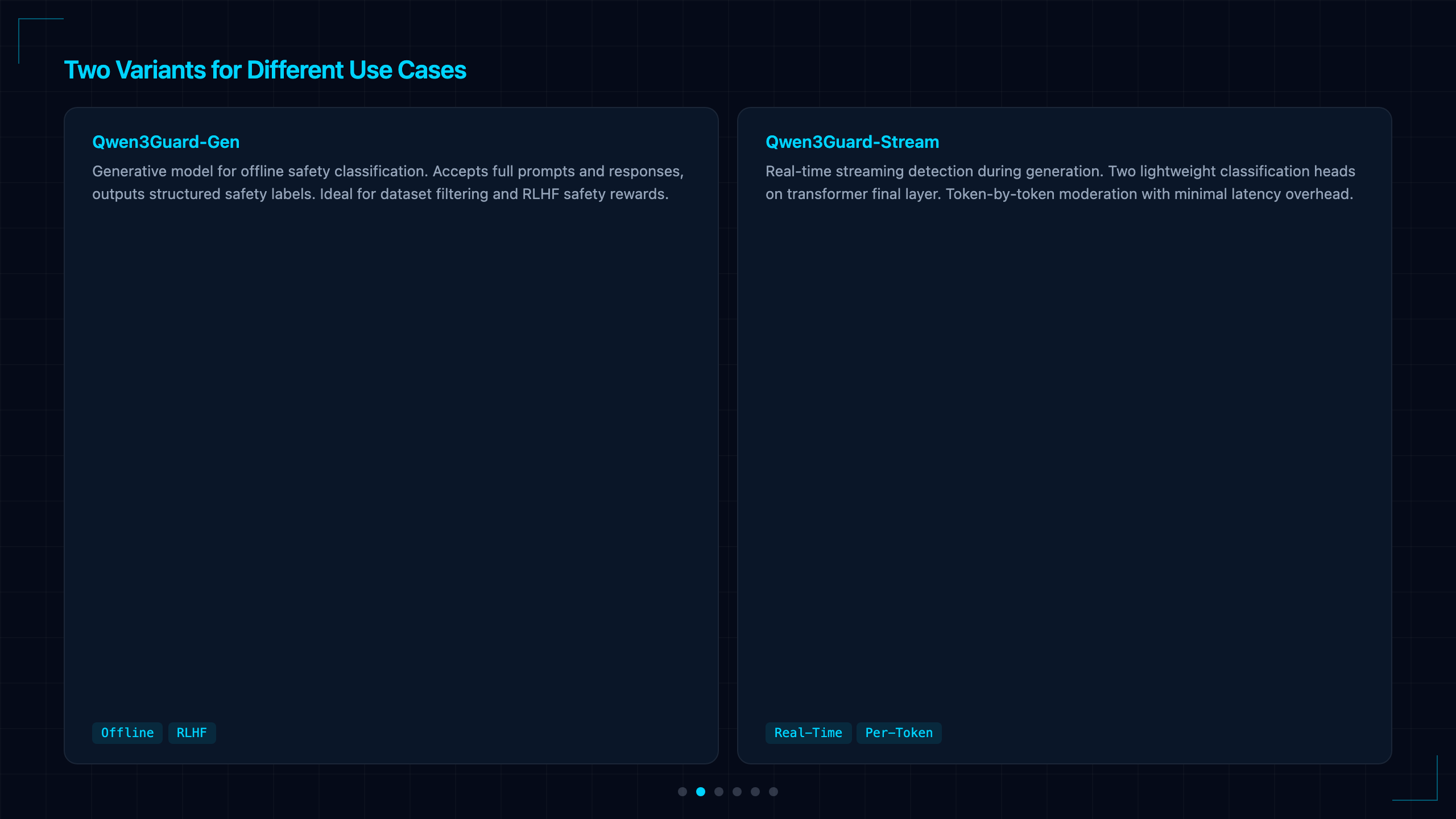
Two Variants, Different Use Cases
Qwen3Guard-Gen operates like a standard LLM — it takes a full user prompt and model response, then outputs a structured safety classification. Best for:
- Offline dataset filtering and annotation
- Safety-based reward signals for RLHF
- Post-hoc moderation pipelines
Qwen3Guard-Stream is the architectural innovation. It adds two lightweight classification heads to the transformer's final layer, receiving the response token-by-token as it's being generated. This enables:
- Real-time intervention (stop generation mid-sentence when unsafe content is detected)
- Sub-token latency overhead (classification happens in parallel with generation)
- No separate inference pass needed for moderation
Both variants come in 0.6B, 4B, and 8B parameter sizes. The 0.6B Stream variant is small enough to run alongside most production models without meaningful latency impact.
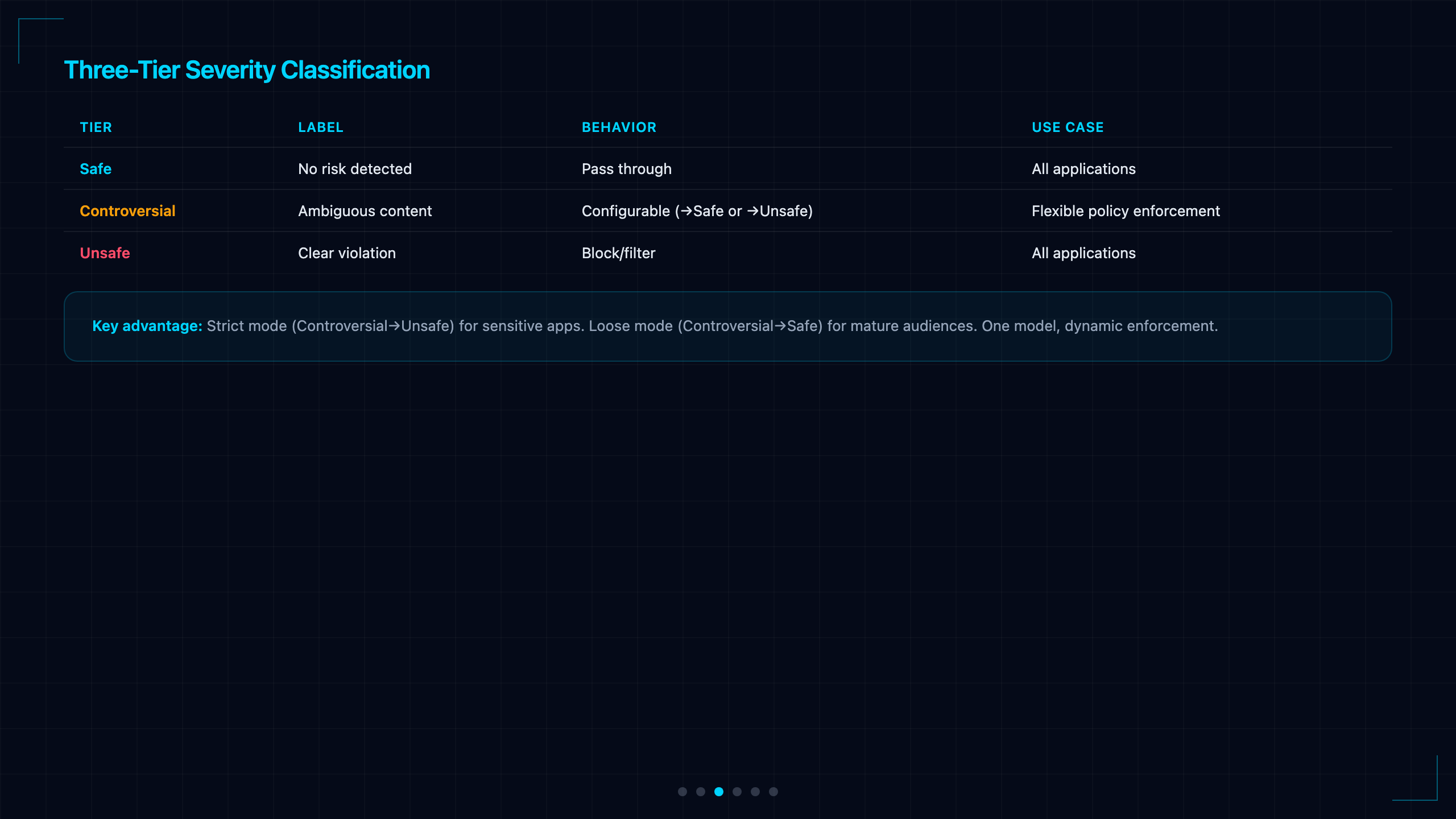
Three-Tier Severity: The Flexible Middle Ground
Most safety classifiers use binary Safe/Unsafe labels. Qwen3Guard introduces a third tier: Controversial. This isn't fence-sitting — it's a deliberate engineering choice that solves a real deployment problem.
Different applications have different safety thresholds. A children's education app needs strict moderation. A research assistant for adults can tolerate more nuance. With binary labels, you're forced to choose one threshold at training time. With three tiers, you can dynamically reclassify Controversial content as Safe or Unsafe at deployment time:
- Strict mode: Controversial → Unsafe (suitable for sensitive applications)
- Loose mode: Controversial → Safe (suitable for mature audiences)
The paper demonstrates that existing binary-label guardrails struggle to adapt to different dataset standards simultaneously. Qwen3Guard achieves consistent performance across both strict and loose evaluation modes by handling the ambiguous middle ground explicitly.
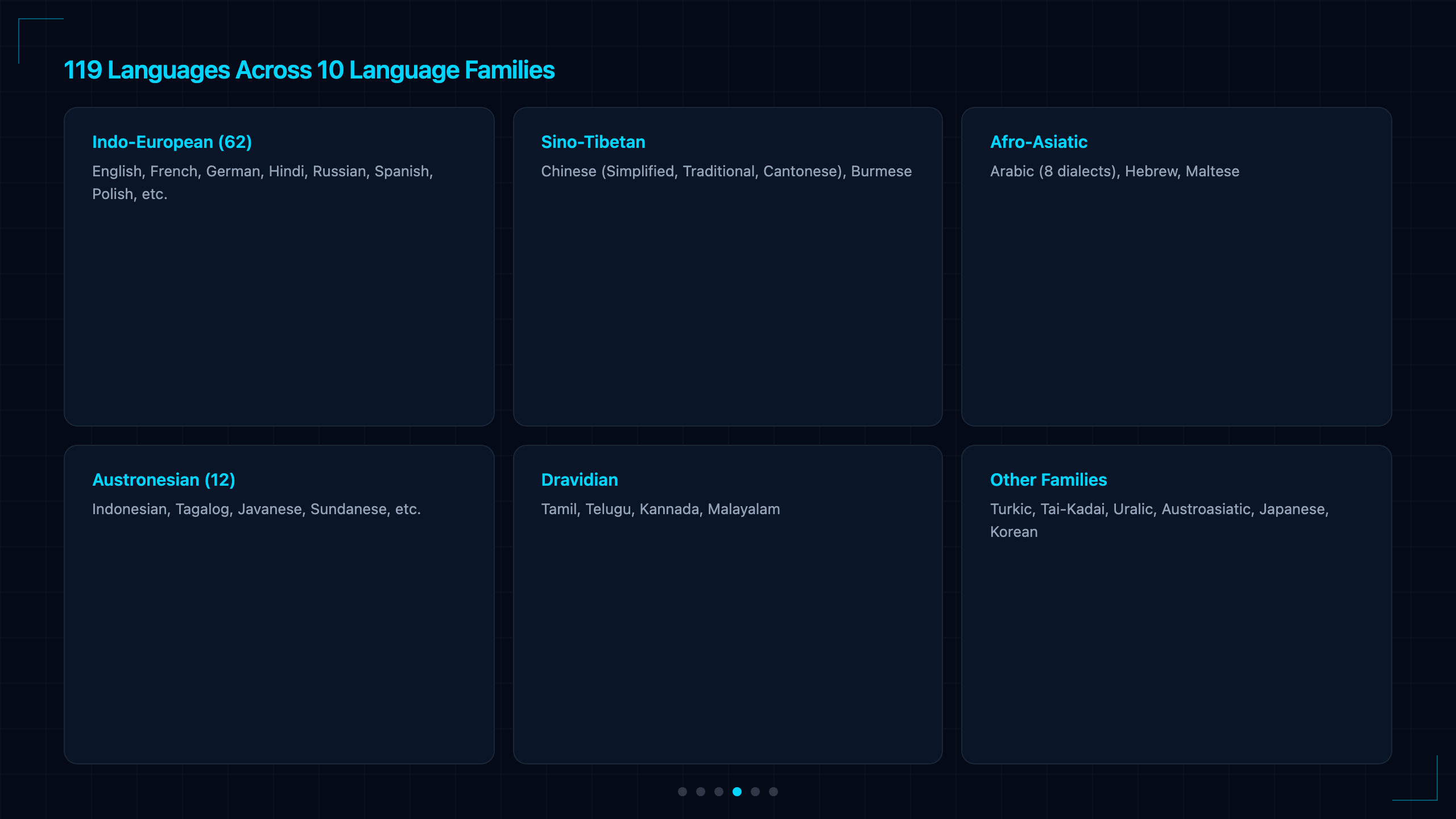
119 Languages
Qwen3Guard supports safety classification across 119 languages and dialects spanning 10 language families:
| Language Family | Coverage |
|---|---|
| Indo-European | 62 languages (English, French, German, Hindi, Russian, etc.) |
| Sino-Tibetan | Chinese (Simplified, Traditional, Cantonese), Burmese |
| Afro-Asiatic | Arabic (8 dialects), Hebrew, Maltese |
| Austronesian | 12 languages (Indonesian, Tagalog, Javanese, etc.) |
| Dravidian | Tamil, Telugu, Kannada, Malayalam |
| Turkic | Turkish, Azerbaijani, Uzbek, Kazakh, Bashkir, Tatar |
| Other | Thai, Vietnamese, Japanese, Korean, Finnish, etc. |
This is notably broader than most open-source safety models, which typically handle English and Chinese only.
Safety Categories
Qwen3Guard classifies content into 9 risk categories plus "None":
- Violent content
- Non-violent illegal acts
- Sexual content
- PII (personally identifiable information)
- Suicide & self-harm
- Unethical acts
- Politically sensitive topics
- Copyright violation
- Jailbreak attempts
Each classification includes both the severity tier and the specific category, giving downstream systems enough information to make nuanced enforcement decisions.
Integration Pattern
Qwen3Guard-Gen uses a standard chat template optimized for classification:
from transformers import AutoModelForCausalLM, AutoTokenizer

model = AutoModelForCausalLM.from_pretrained(
    "Qwen/Qwen3Guard-Gen-4B",
    torch_dtype="auto",
    device_map="auto"
)
Output format is structured: Safety: Safe|Unsafe|Controversial followed by category labels. For Stream, you attach the classification heads to your generation pipeline and get per-token safety signals with minimal overhead.
The team also demonstrates two advanced use cases in the technical report: (1) using Gen as a reward model for safety RL (improve model safety without hurting helpfulness), and (2) using Stream for real-time intervention that ensures safe outputs without model retraining.
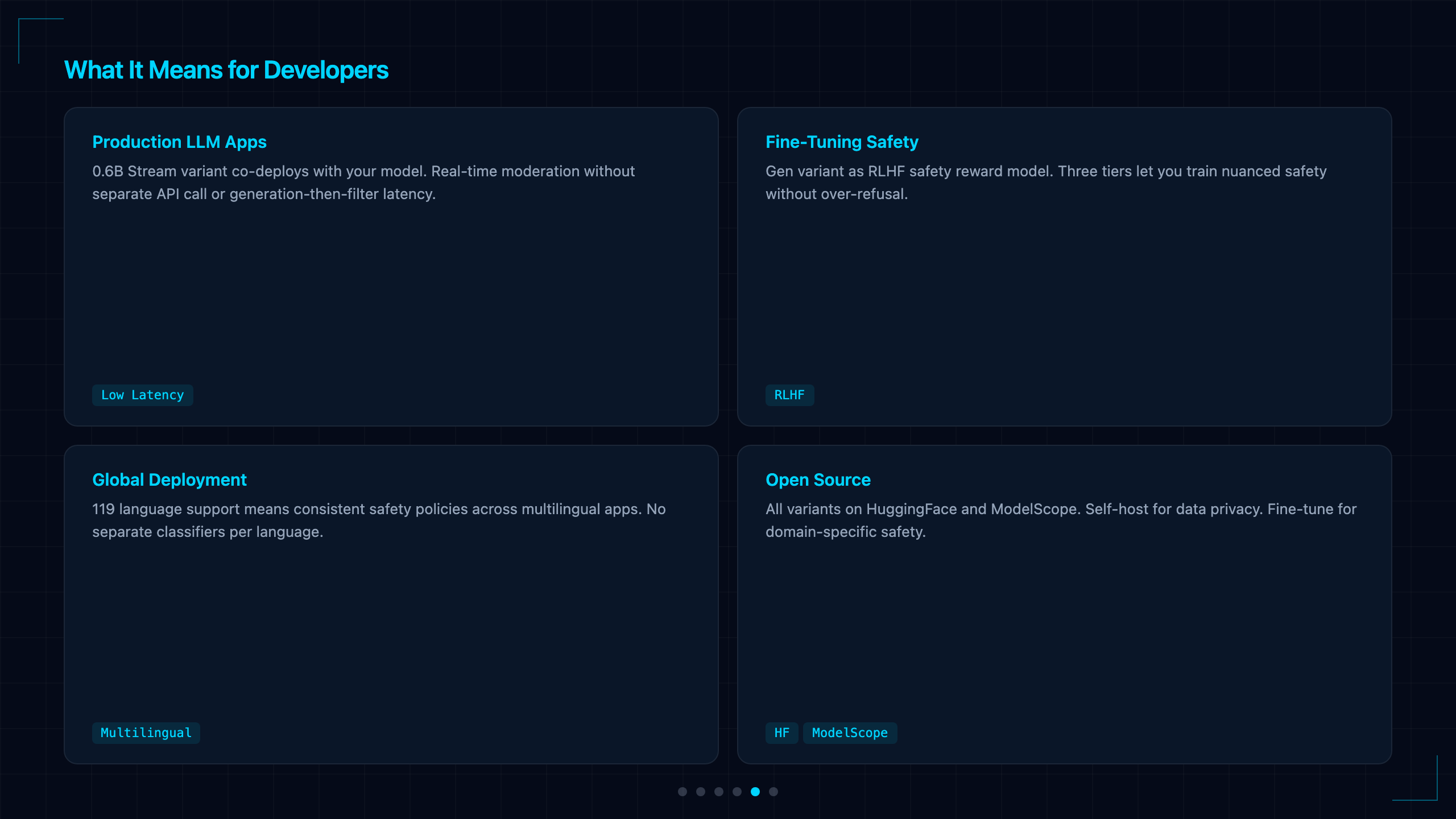
What It Means for Developers
If you're building production LLM applications: The 0.6B Stream variant gives you real-time safety moderation that's small enough to co-deploy with your model. No separate API call, no generation-then-filter latency.
If you're fine-tuning models: Gen makes an excellent safety reward model for RLHF. The three-tier system means you can train models that avoid clearly unsafe content while preserving nuanced discussion of controversial topics.
If you serve global users: 119 language support means you can apply consistent safety policies across multilingual deployments without maintaining separate classifiers per language.
Bottom Line
Qwen3Guard fills the "real-time open-source safety" gap that forced production teams to either build in-house solutions or accept post-hoc filtering latency. Stream mode's per-token classification is the key innovation — lightweight classification heads on the transformer's final layer, no separate inference pass. Three severity tiers solve the "one threshold doesn't fit all applications" problem cleanly. 119 languages, 0.6B to 8B params, fully open-source.
Resources
- HuggingFace Models — Qwen3Guard-Gen and Stream variants
- ModelScope — alternative download
- Technical Report — full methodology and benchmarks
- Alibaba Cloud AI Guardrails — managed service powered by Qwen3Guard
Qwen3Guard models are available on HuggingFace and ModelScope. Cloud deployment available via Alibaba Cloud AI Guardrails service.