DeepSeek released VL2 in December 2024 as the multimodal counterpart to V3 — the same week, actually. While V3 dominated conversation with its cost efficiency and benchmark results, VL2 quietly reset the open-source vision-language benchmarks with an architectural approach that made efficient MoE work for visual understanding.
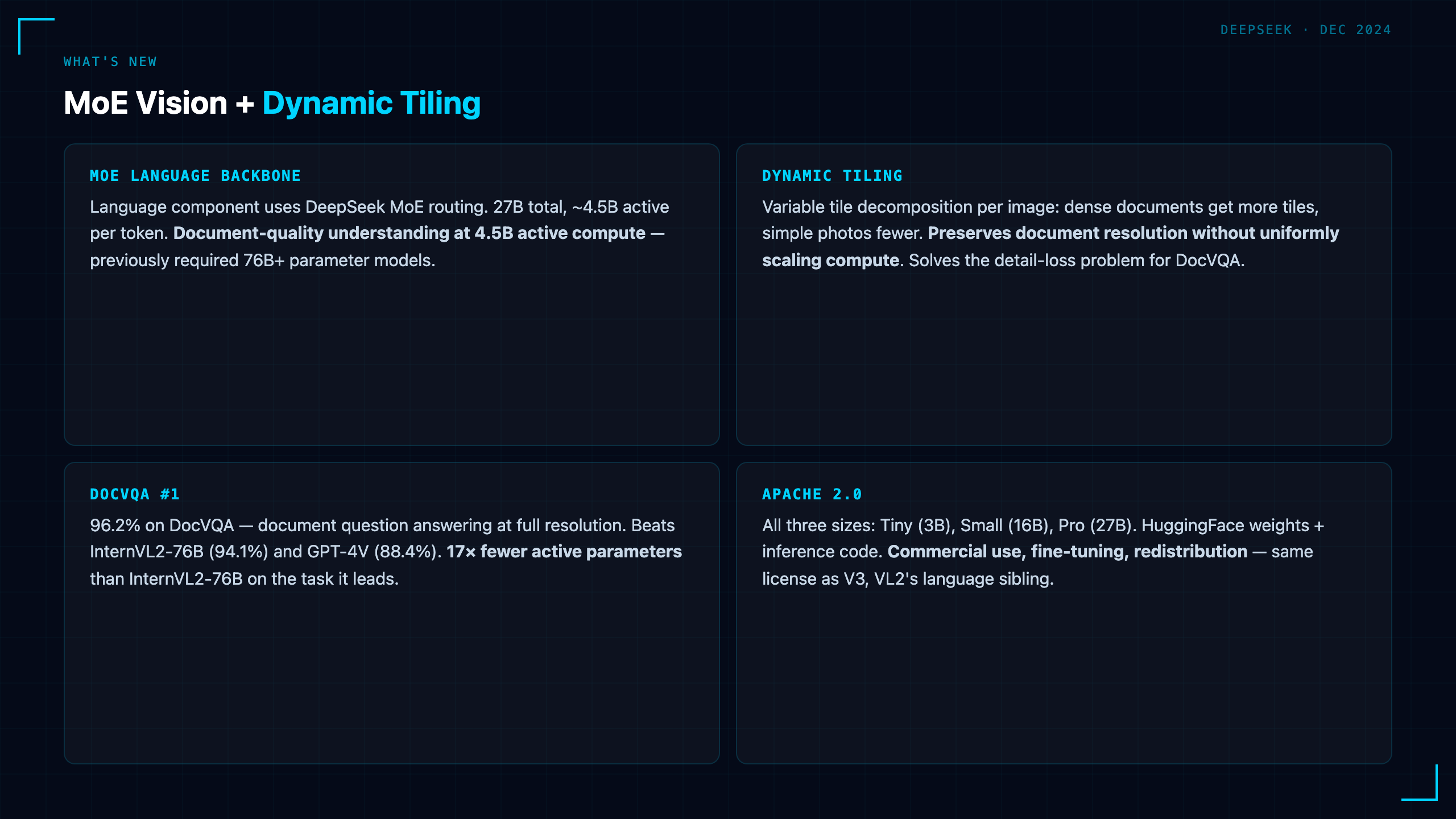
The result: DeepSeek-VL2-Pro (27B total, ~4.5B active) matched models three times its active parameter size on document understanding benchmarks, while remaining practical to deploy.
The MoE Vision Approach
DeepSeek-VL2's architecture combines two design choices that hadn't been combined before in open-source VLMs:
MoE for the language backbone: The language model component uses DeepSeek's MoE architecture (similar to V3), routing tokens to specialist experts. This keeps active compute low while enabling large total model capacity.
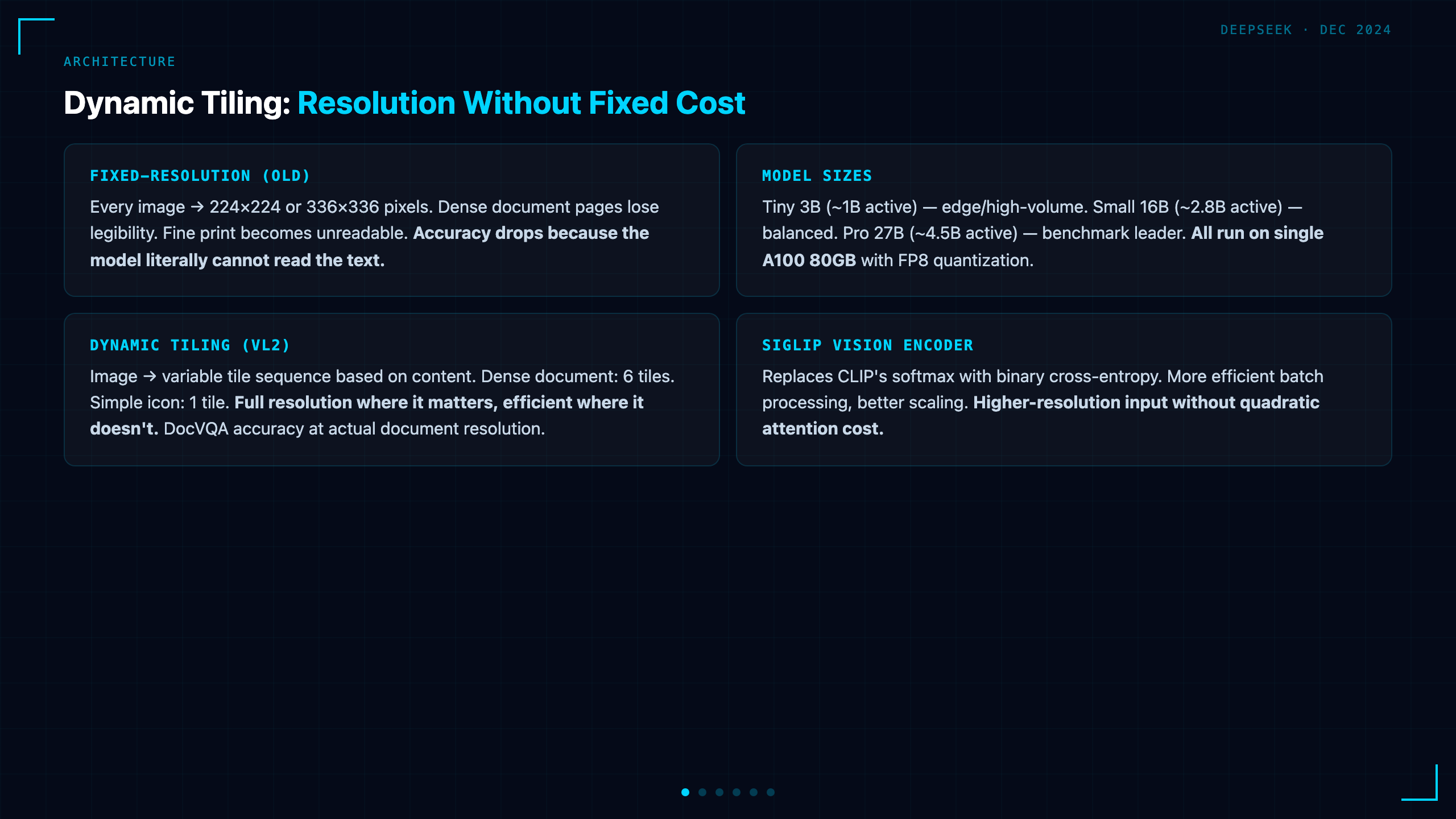
Dynamic tiling for vision: Instead of encoding every image at a fixed resolution, VL2 splits high-resolution images into variable-length tile sequences based on the image's natural resolution and content complexity. A detailed document page gets more tiles than a simple photograph. This preserves document-critical detail without uniformly scaling up compute for every image.
The combination: a VLM that can process high-resolution documents accurately (solving the detail-loss problem that plagued earlier VLMs) while keeping inference costs at MoE-active-parameter levels (solving the deployment cost problem).
Model Family
DeepSeek-VL2 ships in three sizes:
| Model | Total Params | Active Params | Vision Encoder |
|---|---|---|---|
| VL2-Tiny | 3B | ~1B | SigLIP |
| VL2-Small | 16B | ~2.8B | SigLIP |
| VL2-Pro | 27B | ~4.5B | SigLIP |
All three use the same dynamic tiling approach for vision. The 27B Pro variant is the benchmark headline, but the 3B Tiny variant delivers competitive performance on many tasks at extremely low compute cost — making it practical for edge deployment and high-volume inference.
The vision encoder is SigLIP (Sigmoid Loss for Language Image Pre-training) — a more efficient alternative to CLIP that removes the softmax normalization requirement for contrastive learning. SigLIP trains with binary cross-entropy over image-text pairs, allowing more efficient batch processing and better scaling.
Dynamic Tiling: Why It Matters
Standard VLMs encode images at a fixed resolution — typically 224×224 or 336×336 pixels. This works for natural scene photos but fails for:
- Dense documents (newspaper columns, technical tables)
- Fine-print images (contracts, research figures)
- High-resolution charts (where detail at 336px is illegible)
Dynamic tiling works differently: each image is analyzed to determine its optimal tile decomposition. A 1920×1080 document might be split into 6 tiles of 640×360 each; a simple icon gets one tile. The model processes the variable-length tile sequence as a unified input.
The result: DocVQA accuracy at full document resolution rather than downscaled thumbnails. This is why VL2 scores so much higher on document-heavy benchmarks relative to its parameter count.
Benchmarks
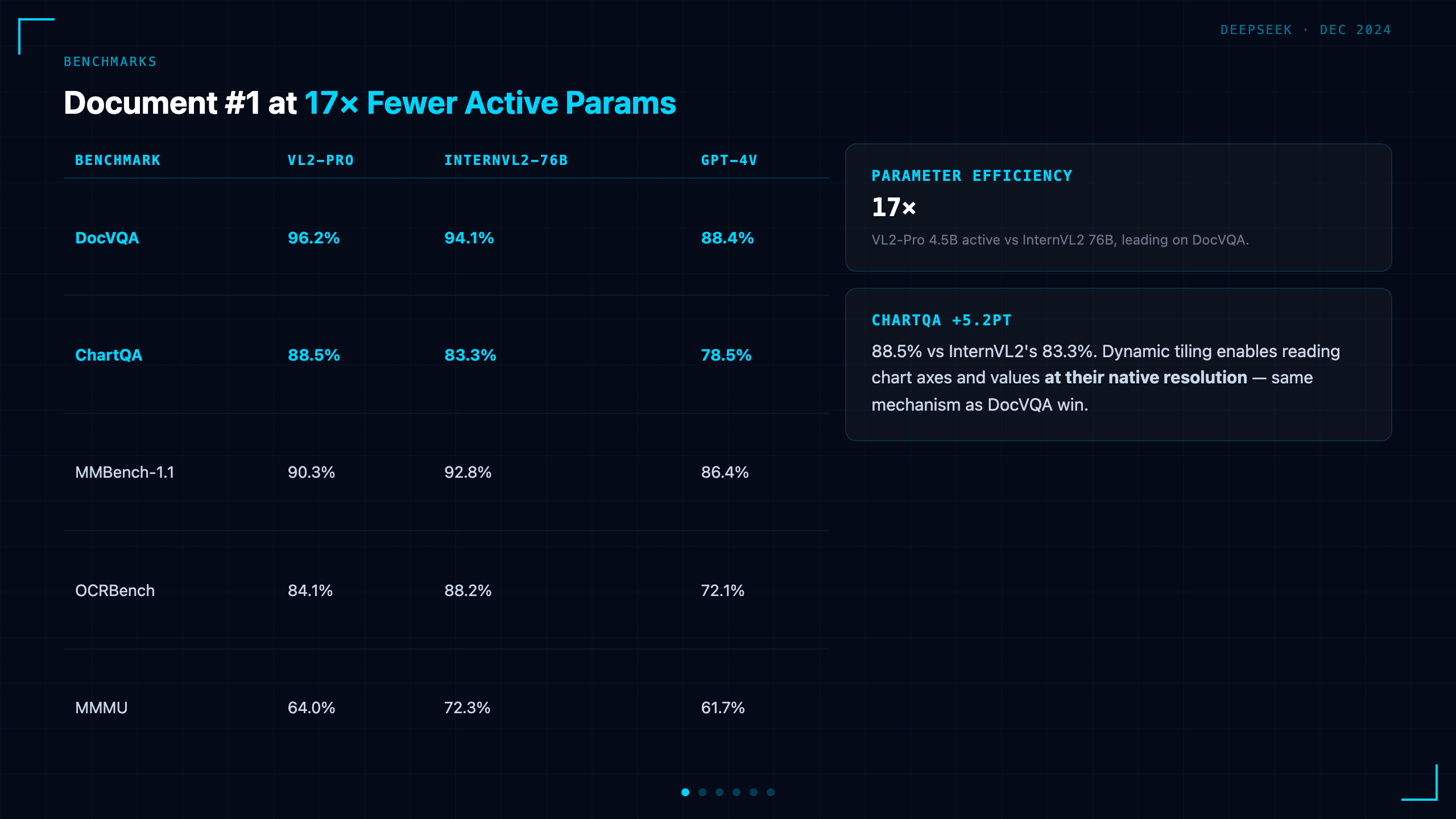
DeepSeek-VL2-Pro (27B, ~4.5B active) vs. comparisons:
| Benchmark | VL2-Pro | InternVL2-76B | GPT-4V | Notes |
|---|---|---|---|---|
| DocVQA | 96.2% | 94.1% | 88.4% | Document VQA |
| ChartQA | 88.5% | 83.3% | 78.5% | Chart understanding |
| MMBench-1.1 | 90.3% | 92.8% | 86.4% | General vision |
| MMMU | 64.0% | 72.3% | 61.7% | Multimodal reasoning |
| OCRBench | 84.1% | 88.2% | 72.1% | Text recognition |
VL2-Pro leads on DocVQA (+2.1 points over InternVL2-76B) and ChartQA (+5.2 points) — the document understanding tasks where dynamic tiling provides the most benefit. On general visual reasoning (MMMU) and broad image understanding (MMBench), InternVL2-76B leads — the larger active parameter count matters more for tasks that don't require document-level detail.
The key ratio: VL2-Pro achieves DocVQA parity with InternVL2-76B using ~4.5B active parameters vs. InternVL2's 76B. For document-heavy deployments, this is roughly 17× the parameter efficiency on the benchmark that matters most.
What It Means for Developers
Document processing pipelines: If you're building a system that processes documents — contracts, invoices, financial reports, scientific papers — VL2 is the most parameter-efficient open-source option for high-accuracy extraction. The DocVQA 96.2% result translates directly: that's the percentage of questions the model answers correctly about document content.
Chart and data visualization analysis: ChartQA 88.5% represents the model's ability to extract data from charts, understand axes, compare values, and reason about trends. For financial analysis, research paper reading, or business intelligence applications, this is the relevant benchmark.
Deployment at the 3B tier: The Tiny variant (3B total, ~1B active) delivers competitive document understanding at a compute cost that enables high-volume inference. For applications where most queries are document extraction (not open-ended visual reasoning), the Tiny variant covers a large fraction of use cases.
Self-hosted multimodal: VL2-Pro at 4.5B active parameters can run on a single A100 80GB with reasonable throughput — the first open-source VLM to achieve InternVL2-76B-quality document understanding on single-GPU hardware.
Limitations
VL2's strengths are concentrated in document and chart understanding. For tasks requiring deeper visual reasoning (MMMU-style questions), or for complex scene understanding (OCRBench at 84.1% trails InternVL2's 88.2%), larger parameter count matters more than efficient tiling.
Video understanding is not supported in VL2 — the architecture processes still images only.
Availability
All three models are available under Apache 2.0 at:
- huggingface.co/deepseek-ai/deepseek-vl2-pro
- huggingface.co/deepseek-ai/deepseek-vl2-small
- huggingface.co/deepseek-ai/deepseek-vl2-tiny
Bottom Line
DeepSeek-VL2 demonstrated that MoE architecture — which V3 used to achieve cost-efficient LLM performance — could be applied effectively to vision-language models. The dynamic tiling approach solved the resolution-vs-compute tradeoff that had limited document understanding in earlier VLMs, producing a model that leads on DocVQA and ChartQA while running on single-GPU hardware.
For developers building document-centric multimodal applications, VL2 changed the deployment calculus: frontier-quality document understanding no longer required running 76B+ parameter models.
Resources
- Technical Report (arXiv 2412.10302) — MoE VLM architecture, dynamic tiling, benchmarks
- HuggingFace — DeepSeek-VL2-Pro — 27B model weights
- GitHub — DeepSeek-VL2 — inference code and examples
- DeepSeek Platform — API access
DeepSeek-VL2 models are available as open weights at HuggingFace under Apache 2.0. API access via DeepSeek Platform.