Tencent released HunyuanVideo in December 2024 and immediately reframed what open-source video generation could achieve. The benchmark result that got attention: on EvalCrafter, a comprehensive video quality evaluation suite, HunyuanVideo outperformed Sora (OpenAI's flagship), Runway Gen-3 Alpha, and Kling 1.5 — while being fully open source.
For developers, the more important fact: full weights on HuggingFace, reproducible inference on 8×A100 80GB, and no API restriction for commercial use.
Architecture: One Transformer for Images and Video
HunyuanVideo uses a Diffusion Transformer (DiT) architecture with a design choice that differentiates it from most video models: a unified architecture that treats images and videos as the same modality.
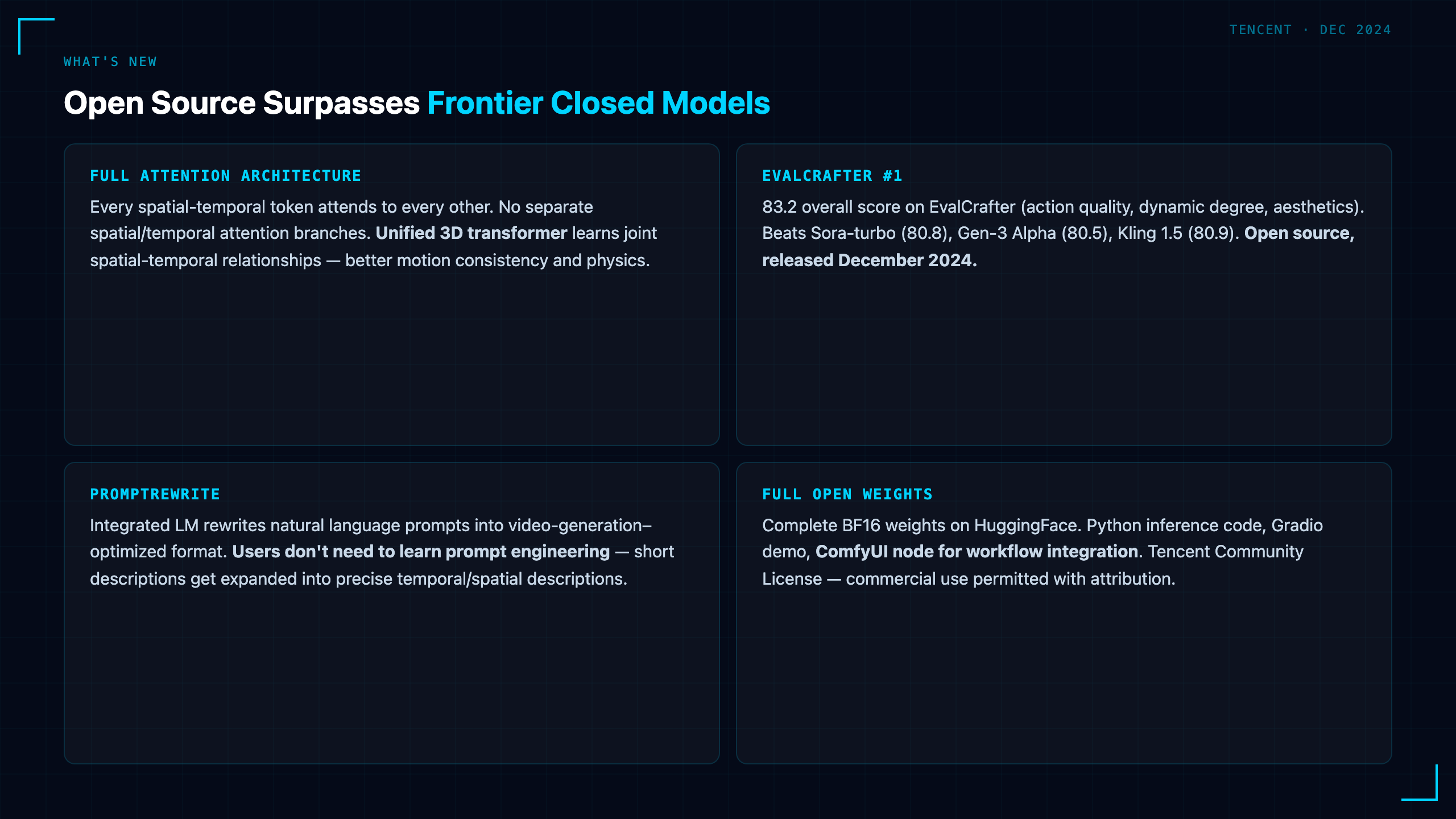
Most video diffusion models use separate encoders or architectural branches for spatial (image) and temporal (video) dimensions. HunyuanVideo uses a single 3D attention mechanism — "Full Attention" — where tokens from all spatial positions and all temporal frames attend to each other simultaneously. This means the model learns spatial-temporal relationships jointly, rather than stacking a video module on top of an image model.
Model size: ~13B parameters for the video generation backbone. The text encoder is based on a variant of CLIP + T5, following the pattern established by Stable Diffusion 3.
Training: Two-stage pretraining — image generation first (billions of image-text pairs), then video generation (hundreds of millions of video-text pairs). The image pretraining establishes strong visual quality priors; video training adds temporal coherence.
Resolution and length: Generates at 720p (1280×720) and 1080p (1920×1080). Typical output length: 5 seconds at 24fps. The architecture supports up to ~10 seconds.
The Full Attention Approach
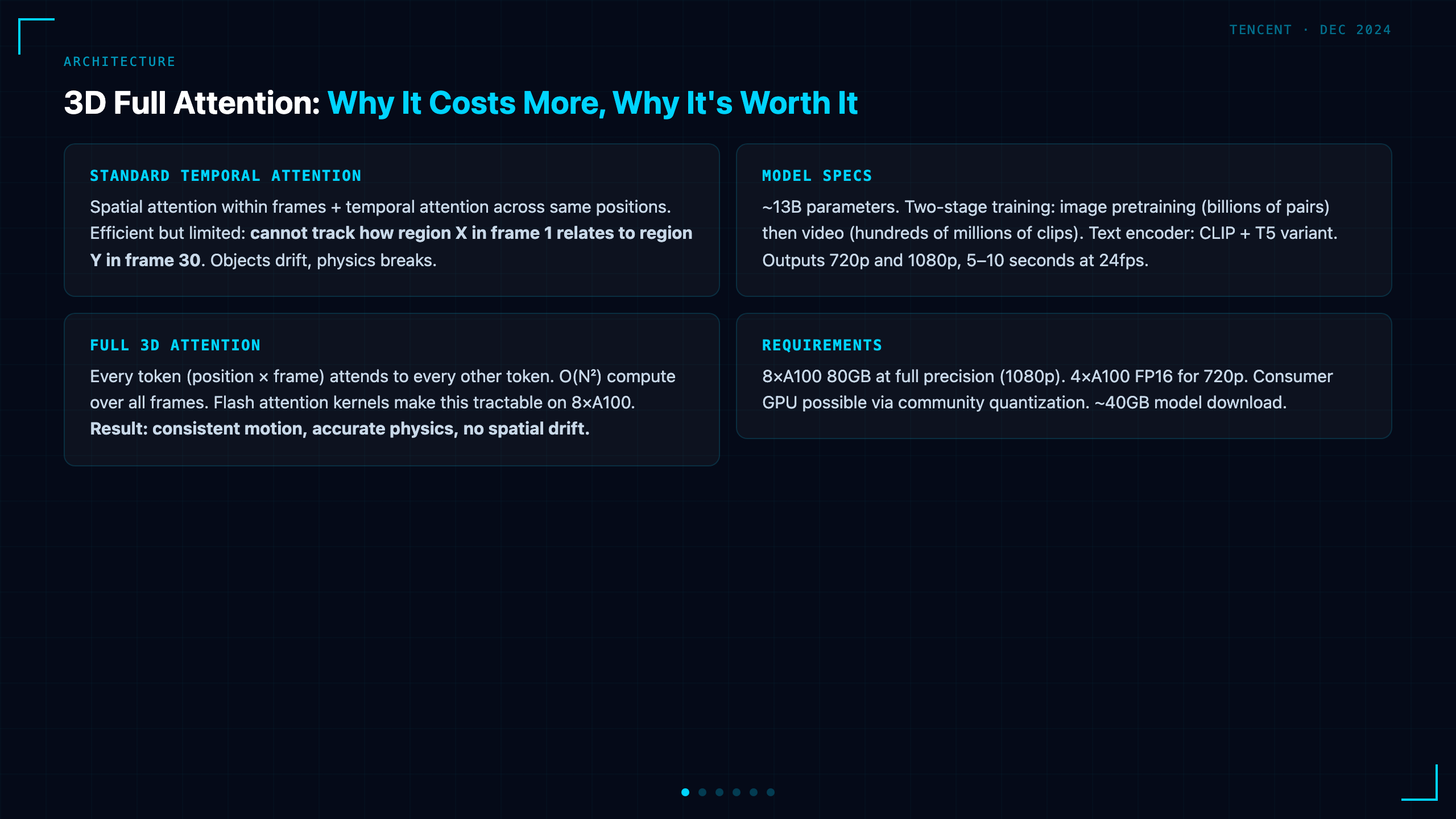
The "Full Attention" design is HunyuanVideo's key architectural claim. Here's why it matters:
Standard temporal attention: Most video DiTs apply attention separately in the spatial dimension (within each frame) and the temporal dimension (across frames at the same position). This reduces compute but limits cross-frame spatial reasoning — the model can't easily track how a specific region in frame 1 relates to a different region in frame 30.
Full 3D attention: Every token (spatial position × frame) attends to every other token. Compute scales as O(N²) where N = spatial_positions × frames. For 24fps × 5 seconds = 120 frames, this is expensive. HunyuanVideo uses optimized flash attention kernels to make this tractable on 8×A100.
The quality payoff: better motion consistency, more accurate physics (objects don't teleport or distort between frames), and better temporal coherence in complex scenes.
Benchmarks
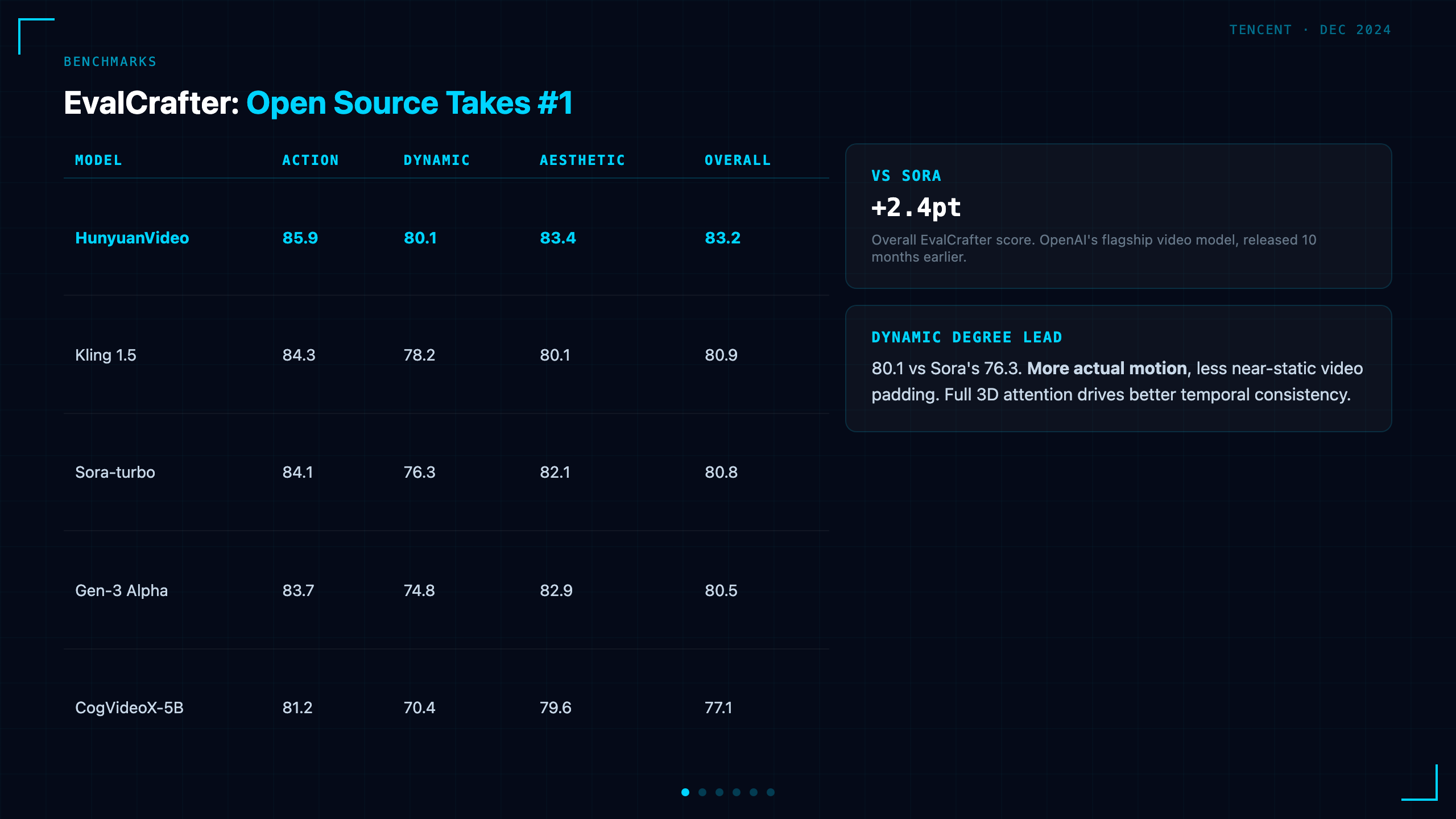
EvalCrafter evaluation (December 2024 release comparison):
| Model | Action Quality | Dynamic Degree | Aesthetic Score | Overall |
|---|---|---|---|---|
| HunyuanVideo | 85.9 | 80.1 | 83.4 | 83.2 |
| Sora-turbo | 84.1 | 76.3 | 82.1 | 80.8 |
| Gen-3 Alpha | 83.7 | 74.8 | 82.9 | 80.5 |
| Kling 1.5 | 84.3 | 78.2 | 80.1 | 80.9 |
| CogVideoX-5B | 81.2 | 70.4 | 79.6 | 77.1 |
Action Quality measures motion accuracy and physical plausibility. Dynamic Degree measures how much the model generates actual motion vs. near-static video. Aesthetic Score measures visual quality independent of motion. HunyuanVideo leads across all three.
The Sora comparison is notable because Sora was released in February 2024 as OpenAI's flagship video model — HunyuanVideo, as an open-source release 10 months later, matches or exceeds it on the benchmark that was specifically designed to evaluate Sora-class models.
Open Source Details
HunyuanVideo is available at huggingface.co/tencent/HunyuanVideo with:
- Full model weights (BF16, approximately 40GB download)
- Inference code (Python, based on diffusers)
- Gradio demo for local testing
- ComfyUI node integration for workflow-based generation
License: Tencent Hunyuan Community License — commercial use permitted with attribution. Similar permissiveness to Llama 3 community license.
Inference requirements: 8×A100 80GB for the 1080p model at full precision. 4×A100 with FP16 quantization for 720p. Consumer GPU inference is possible via community quantization but with quality degradation.
PromptRewrite: The Often-Missed Feature
HunyuanVideo ships with PromptRewrite, an integrated language model component that rewrites user text prompts into the format the video model was trained on. This matters more than it sounds.
Video generation models are trained on video captions with specific style and structure: temporal descriptions, camera movement language, scene composition terms. User prompts in natural language don't match this format. Models without prompt rewriting either require users to learn the prompt engineering vocabulary or produce inconsistent results.
PromptRewrite handles the translation: a short natural language description gets expanded into a detailed video-generation-optimized caption that matches the training distribution. Users get more consistent results without learning the model's preferred prompt format.
What It Means for Developers
Self-hosted video generation at production quality: Before HunyuanVideo, production-quality video generation required API access to Sora, Kling, or Gen-3 — with all the pricing, rate limiting, and dependency that entails. HunyuanVideo brings comparable quality to self-hosted infrastructure.
ComfyUI workflow integration: The ComfyUI node means HunyuanVideo can be dropped into existing Stable Diffusion–based workflows. Studios already using ComfyUI for image generation can add video generation to the same pipeline.
Custom fine-tuning: Open weights enable domain-specific fine-tuning. Product visualization, architectural rendering, or game asset animation workflows can be fine-tuned on domain-specific data — not possible with API-only models.
Foundation for community models: The HunyuanVideo base has already been used as a foundation for community fine-tuned variants (character-specific, style-specific). The architecture's Full Attention design transfers well to fine-tuning on smaller domain datasets.
Bottom Line
HunyuanVideo established that open-source video generation could match or exceed the frontier closed models on quality benchmarks. For a field where the best models were behind API access, this was a meaningful shift — both for developers who needed self-hosted video generation and for the broader community building on open foundations.
The Full Attention architecture's quality advantage came at a compute cost, but the 8×A100 requirement is within reach for teams serious about production video generation. The subsequent wave of community fine-tunes and workflow integrations suggests the open-weights bet paid off.
Resources
- HuggingFace — HunyuanVideo — model weights and inference code
- Technical Report (arXiv 2412.03603) — architecture details, training, benchmarks
- GitHub — HunyuanVideo — official repository
- ComfyUI Node — community workflow integration
HunyuanVideo weights are available at huggingface.co/tencent/HunyuanVideo. Commercial use permitted under Tencent Hunyuan Community License.