Tencent released Hunyuan-Large in November 2024 — a 389B total parameter MoE model that made a specific bet: that a well-designed MoE at scale could beat the best open-source dense models while remaining practically deployable. With Llama-3.1-70B as the benchmark target and Hunyuan-Large outperforming it across math, coding, Chinese-language tasks, and general reasoning, the bet paid off.
The open-source release makes it one of the largest open-weights models available at the time of its release, alongside DeepSeek-V2 and Mixtral.
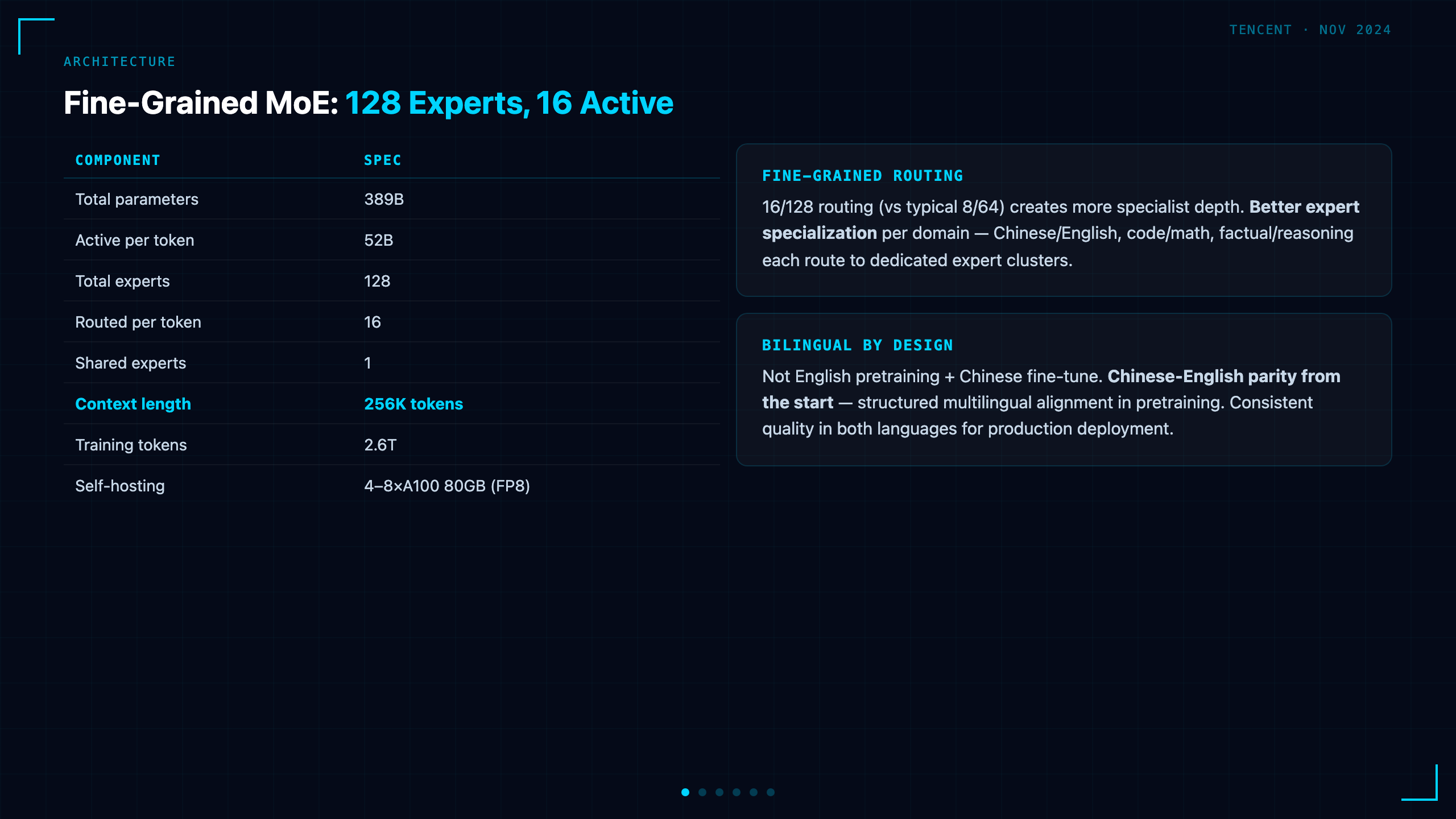
Architecture: 389B Total, 52B Active
Hunyuan-Large's architecture choices reflect lessons from the MoE generation that came before it:
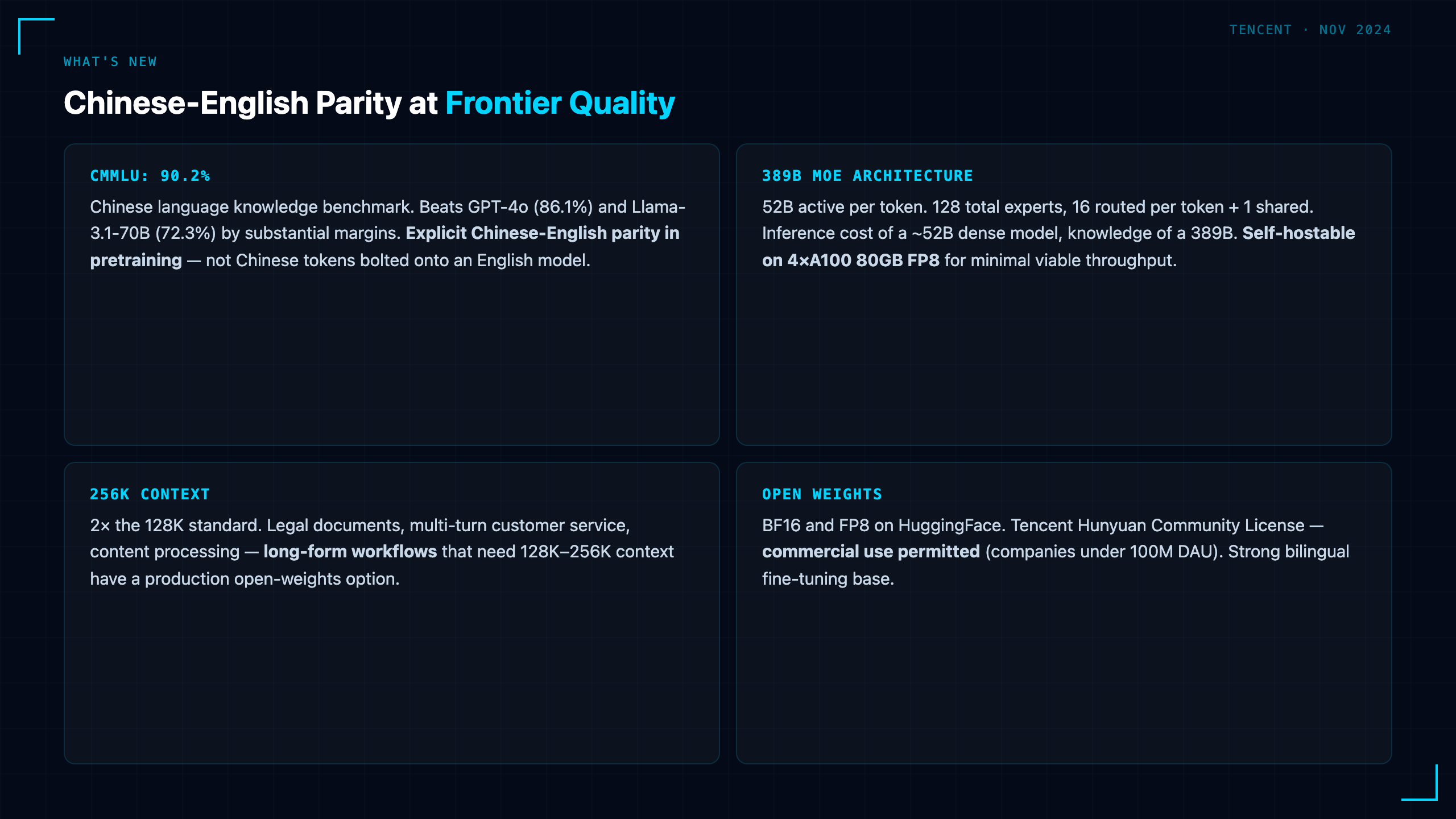
Scale: 389B total parameters, 52B active per token. The active parameter count is the economically relevant number — inference costs are determined by active parameters, not total weights. At 52B active, you pay roughly the compute cost of a 52B dense model while getting the knowledge capacity of a 389B one.
Expert design: Fine-grained expert routing with 16 routed experts per token out of 128 total. Finer granularity (more total experts, fewer selected per token) tends to produce better routing specialization. A single shared expert ensures universal knowledge access.
Context: 256K token context window — 2× the 128K standard of most large models at the time. This is a deliberate design choice: Tencent's internal applications include long-form content processing, legal document analysis, and multi-turn conversations that benefit from extended context.
Language balance: The training data is explicitly balanced between Chinese and English, with structured multilingual alignment. This is distinguishable from simply including Chinese-language tokens — Hunyuan-Large was optimized to perform equivalently in both languages, not just perform well in English with Chinese as a secondary language.
Training
Hunyuan-Large was trained on 2.6 trillion tokens — a substantial corpus relative to its contemporaries. The key composition decisions:
Chinese-English balance: Unlike most English-primary models with Chinese fine-tuning, Hunyuan-Large's pretraining was designed with explicit Chinese-English parity as a training objective. The CMMLU benchmark results (outperforming Llama-3.1-70B by a substantial margin) reflect this investment.
Code and STEM emphasis: Code-heavy pretraining following the Codestral/DeepSeek-Coder approach, combined with math and scientific text. The benchmark improvements on HumanEval and GSM8K relative to the dense baseline are concentrated here.
Synthetic data: Tencent incorporated synthetic reasoning chains and instruction-following data in the post-training pipeline. The instruction-following improvements visible in IFEval and AlignBench come from this stage.
Benchmarks
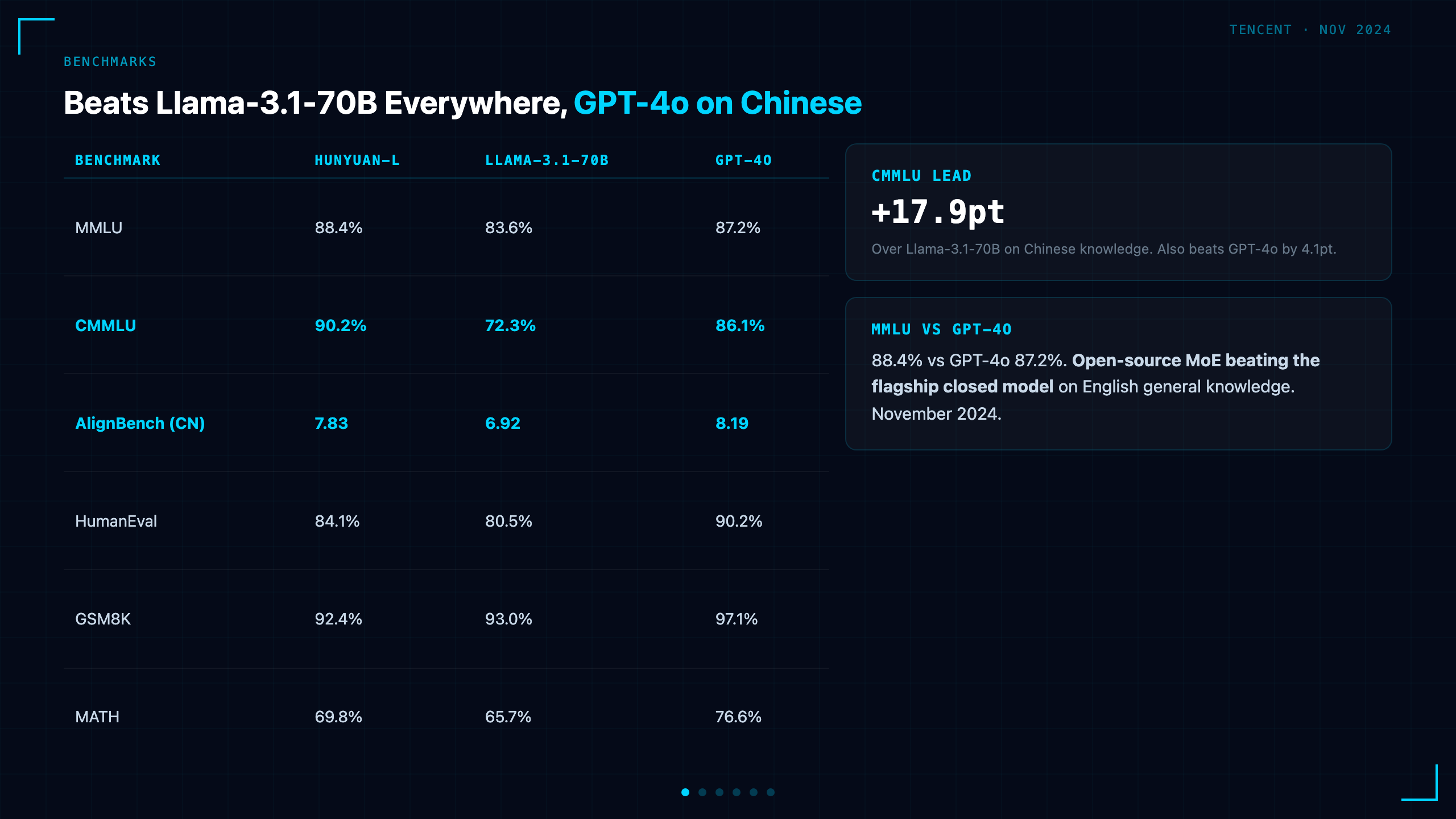
Hunyuan-Large vs. Llama-3.1-70B and GPT-4o (November 2024):
| Benchmark | Hunyuan-Large | Llama-3.1-70B | GPT-4o | Notes |
|---|---|---|---|---|
| MMLU | 88.4% | 83.6% | 87.2% | General knowledge |
| CMMLU | 90.2% | 72.3% | 86.1% | Chinese knowledge |
| HumanEval | 84.1% | 80.5% | 90.2% | Code |
| GSM8K | 92.4% | 93.0% | 97.1% | Math |
| MATH | 69.8% | 65.7% | 76.6% | Hard math |
| AlignBench | 7.83 | 6.92 | 8.19 | Chinese instruction following |
The CMMLU result (+17.9 points over Llama-3.1-70B, +4.1 over GPT-4o) is the headline. CMMLU tests Chinese-language knowledge at the same depth MMLU tests English — Hunyuan-Large's explicit Chinese-English training balance produces a model that GPT-4o doesn't clearly dominate in Chinese contexts.
On MMLU, Hunyuan-Large edges GPT-4o (88.4% vs 87.2%). This is an open-source MoE model released in November 2024 matching the flagship closed model from OpenAI on general English knowledge benchmarks.
Chinese Language Capability
The AlignBench benchmark (7.83 vs Llama-3.1-70B's 6.92, GPT-4o's 8.19) specifically tests the quality of Chinese instruction following — responses to Chinese prompts evaluated by Chinese-language criteria. The gap over Llama-3.1-70B is substantial. The gap behind GPT-4o (8.19) is small.
For developers building Chinese-language applications, this is the practical number: Hunyuan-Large in production Chinese-language use cases performs close to GPT-4o while being open-source and self-hostable.
Open Source and Deployment
License: Tencent Hunyuan Community License — commercial use permitted for companies under 100M daily active users. Similar to Llama 2/3 community license terms.
Weights: Available on HuggingFace at huggingface.co/tencent/Hunyuan-Large.
Formats: BF16 and FP8 quantization available. FP8 reduces memory requirements substantially for deployment.
Self-hosting requirements: 389B MoE at 52B active. With FP8 quantization, approximately 4×A100 80GB for minimal-viable throughput, 8×A100 for production throughput. The active parameter count keeps inference cost manageable.
What It Means for Developers
Best open-source Chinese-language model: At release, Hunyuan-Large was the strongest open-weights option for Chinese-language applications — beating Llama-3.1-70B by 17+ points on CMMLU, close to GPT-4o. For applications with significant Chinese-language requirements, this changes the open-source calculus.
256K context for long-form processing: Legal document analysis, multi-turn customer service, and content processing workflows that require 64K–256K context have a practical open-weights option. The 2× context over the 128K standard isn't theoretical — it's deployed behavior.
Self-hosted at GPT-4o tier: For companies where self-hosted inference is required (data privacy, latency, cost), Hunyuan-Large provides GPT-4o-equivalent English performance and superior Chinese performance on a self-hosted stack. The FP8 quantization makes the 4×A100 setup viable.
Foundation for fine-tuning: The Chinese-English balance in pretraining makes Hunyuan-Large a strong base for domain-specific fine-tuning in bilingual or Chinese-primary applications — a use case where English-primary models with Chinese bolted on tend to perform inconsistently.
Bottom Line
Hunyuan-Large answered the question of whether a Chinese AI lab could produce a genuinely bilingual frontier-quality open-source model. The CMMLU result — 90.2%, beating GPT-4o's 86.1% — established that Chinese-language capability at this level required deliberate architectural investment, not just Chinese tokens in a primarily English training corpus.
For developers building Chinese-language applications, Hunyuan-Large shifted the open-source baseline from "significantly behind GPT-4o" to "competitive with GPT-4o" in November 2024.
Resources
- HuggingFace — Hunyuan-Large — model weights and documentation
- Technical Report (arXiv 2411.02265) — architecture, training, benchmarks
- GitHub — Hunyuan-Large — inference code and examples
Hunyuan-Large weights are available at huggingface.co/tencent/Hunyuan-Large. Commercial use permitted under Tencent Hunyuan Community License.