Moonshot AI just shipped something the LLM API ecosystem desperately needs: a verification system that lets you prove the model behind an API is actually what the vendor claims. Kimi Vendor Verifier (K2VV) is Moonshot's answer to the growing "model substitution" problem — vendors advertising frontier capabilities while serving cheaper, smaller models behind the same endpoint.
The concept is straightforward: define a certified set of benchmark scores that a specific model achieves under specific inference settings (temperature, top_p, max_tokens), then provide a verification protocol that third parties can run to confirm they're getting genuine outputs. It's a "chain of trust" from model training to API delivery.
Two Verification Modes
K2VV verifies Kimi's API across two distinct inference modes, each with certified benchmark scores:
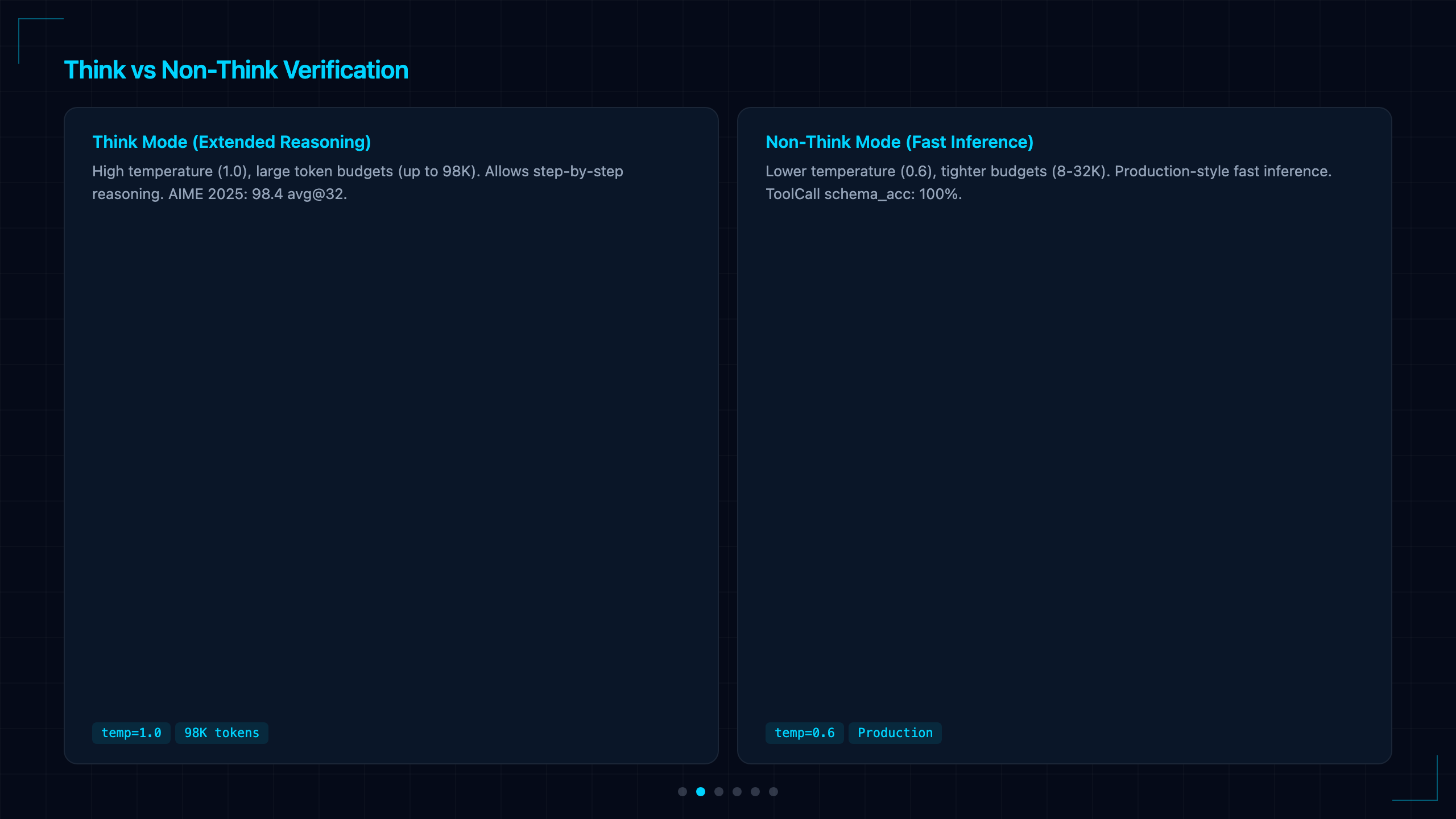
Think Mode (Extended Reasoning)
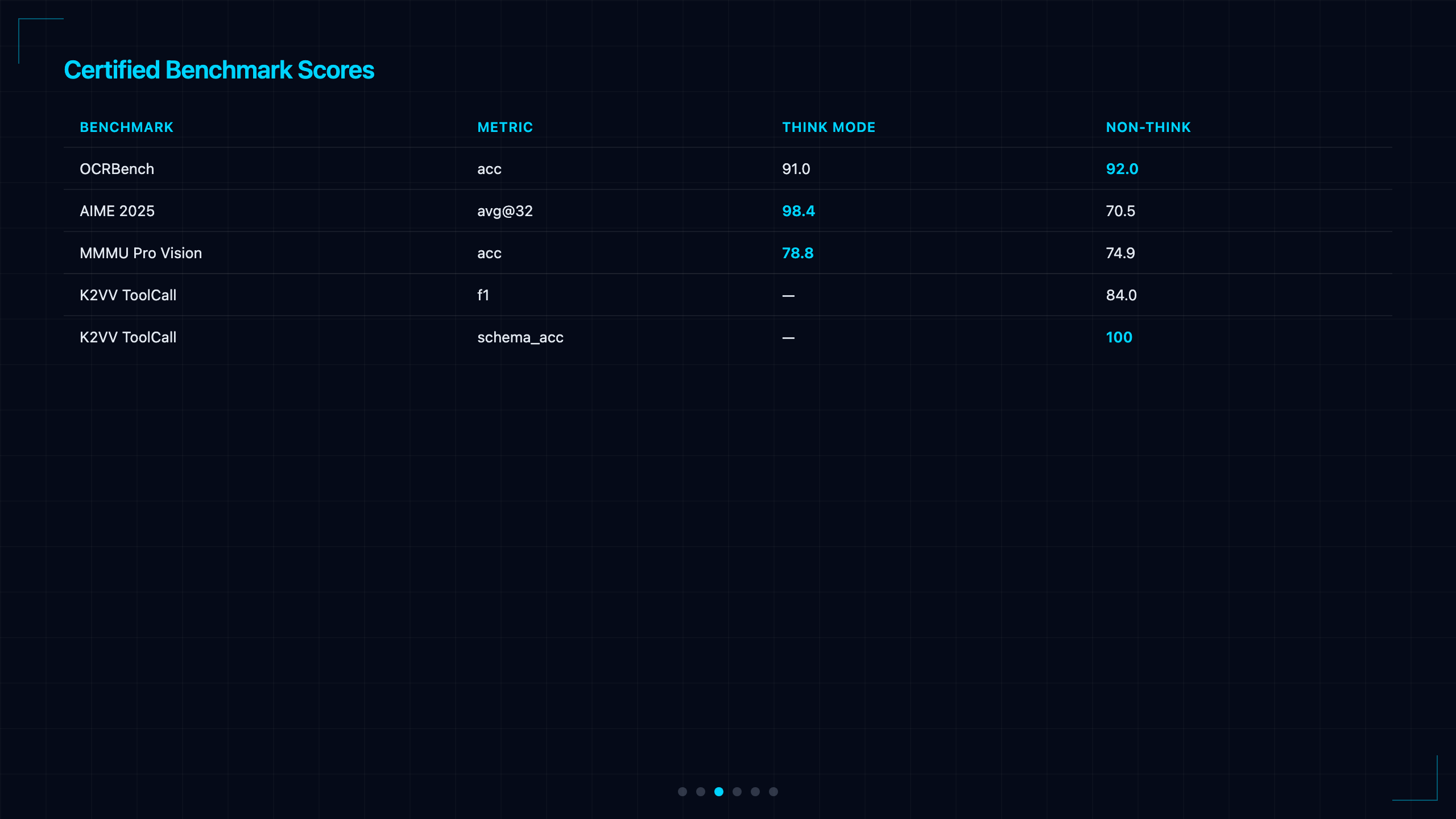
| Benchmark | Metric | Score | Settings |
|---|---|---|---|
| OCRBench | acc | 91.0 | temp=1.0, top_p=0.95, max_tokens=16384 |
| AIME 2025 | avg@32 | 98.4 | temp=1.0, top_p=0.95, max_tokens=98304 |
| MMMU Pro Vision | acc | 78.8 | temp=1.0, top_p=0.95, max_tokens=65536 |
Think mode uses extended token budgets (up to 98K tokens for AIME) and higher temperature, allowing the model to reason through problems step by step. The 98.4 on AIME 2025 places Kimi's thinking mode among the top mathematical reasoning systems globally.
Non-Think Mode (Fast Inference)
| Benchmark | Metric | Score | Settings |
|---|---|---|---|
| OCRBench | acc | 92.0 | temp=1.0, top_p=0.95, max_tokens=8192 |
| AIME 2025 | avg@32 | 70.5 | temp=0.6, top_p=0.95, max_tokens=16384 |
| MMMU Pro Vision | acc | 74.9 | temp=0.6, top_p=0.95, max_tokens=32768 |
| K2VV ToolCall | f1 | 84.0 | temp=0.6, top_p=0.95, max_tokens=8192 |
| K2VV ToolCall | schema_acc | 100 | temp=0.6, top_p=0.95, max_tokens=8192 |
Non-Think mode uses tighter token budgets and lower temperature for production-style fast inference. The 100% schema accuracy on tool calling is particularly notable — every tool call output perfectly matches the expected JSON schema, which matters enormously for production API integrations.
Why This Matters
The LLM API market has a trust problem that's getting worse as competition intensifies:
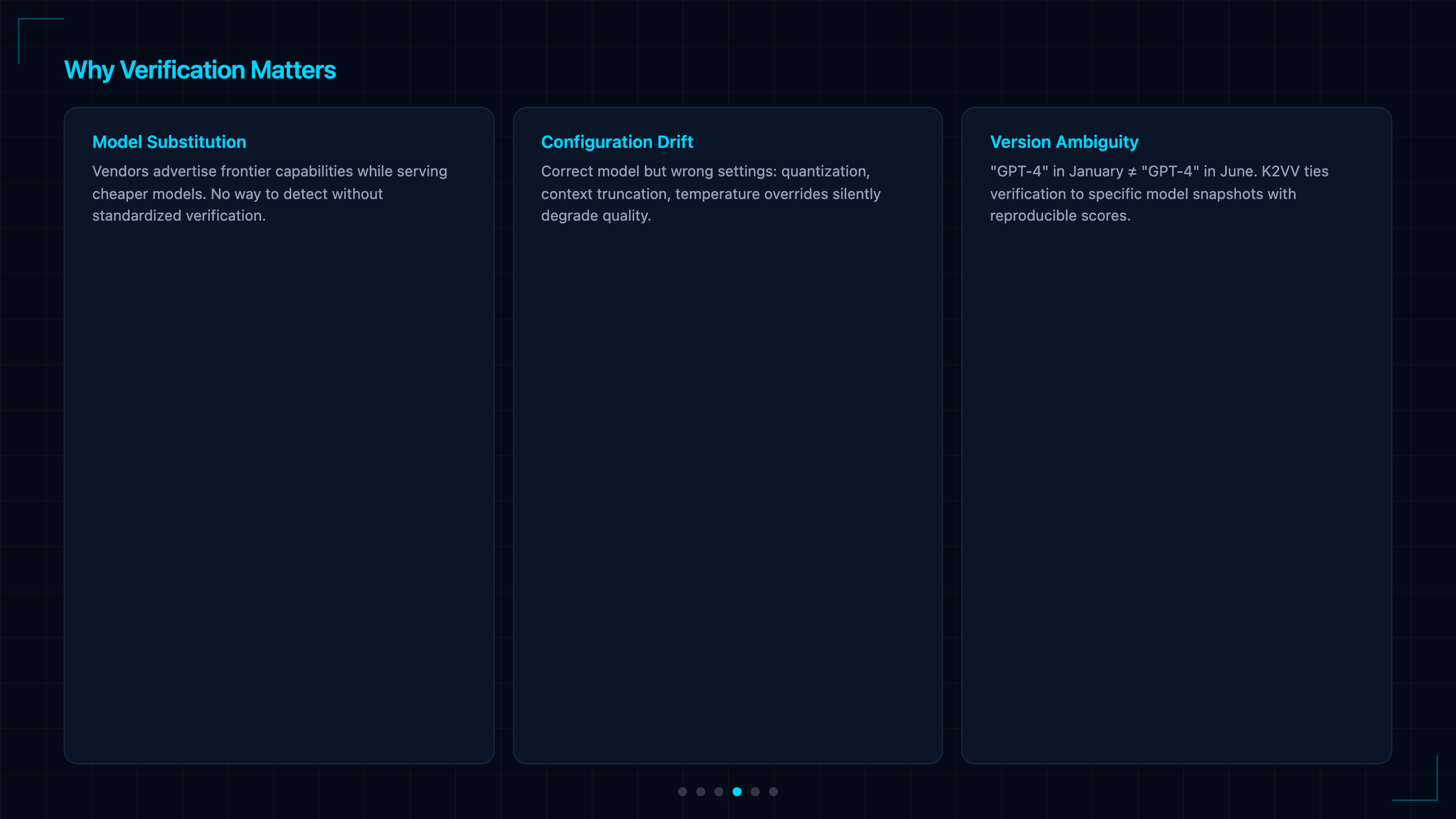
Model substitution: Some vendors advertise "powered by [frontier model]" while actually routing requests to cheaper alternatives. Without standardized verification, customers have no way to detect this.
Configuration drift: Even when vendors serve the correct model, inference settings (quantization level, context window truncation, temperature overrides) can silently degrade output quality. K2VV pins specific inference parameters to specific benchmark scores.
Version ambiguity: Models get updated continuously. "GPT-4" in January is not the same model as "GPT-4" in June. K2VV ties verification to a specific model snapshot with reproducible benchmark scores.
The verification approach is deliberately simple: run standardized benchmarks with exact inference parameters, compare against certified scores. If the scores match within statistical tolerance, the API is serving what it claims.
The ToolCall Benchmark
K2VV introduces its own tool-calling benchmark alongside established ones. Two metrics:
- F1 (84.0): Measures whether the model calls the right tools with the right parameters. An 84% F1 is strong — most production failures come from tool call accuracy, not raw reasoning.
- Schema Accuracy (100%): Measures whether tool call outputs perfectly conform to the expected JSON schema. This is binary — either the output parses correctly or it doesn't. 100% means zero malformed tool calls in the benchmark set.
For developers building agentic applications, schema accuracy is arguably more important than F1. A model that sometimes calls the wrong tool is annoying; a model that produces unparseable tool calls crashes your application.
What It Means for Developers
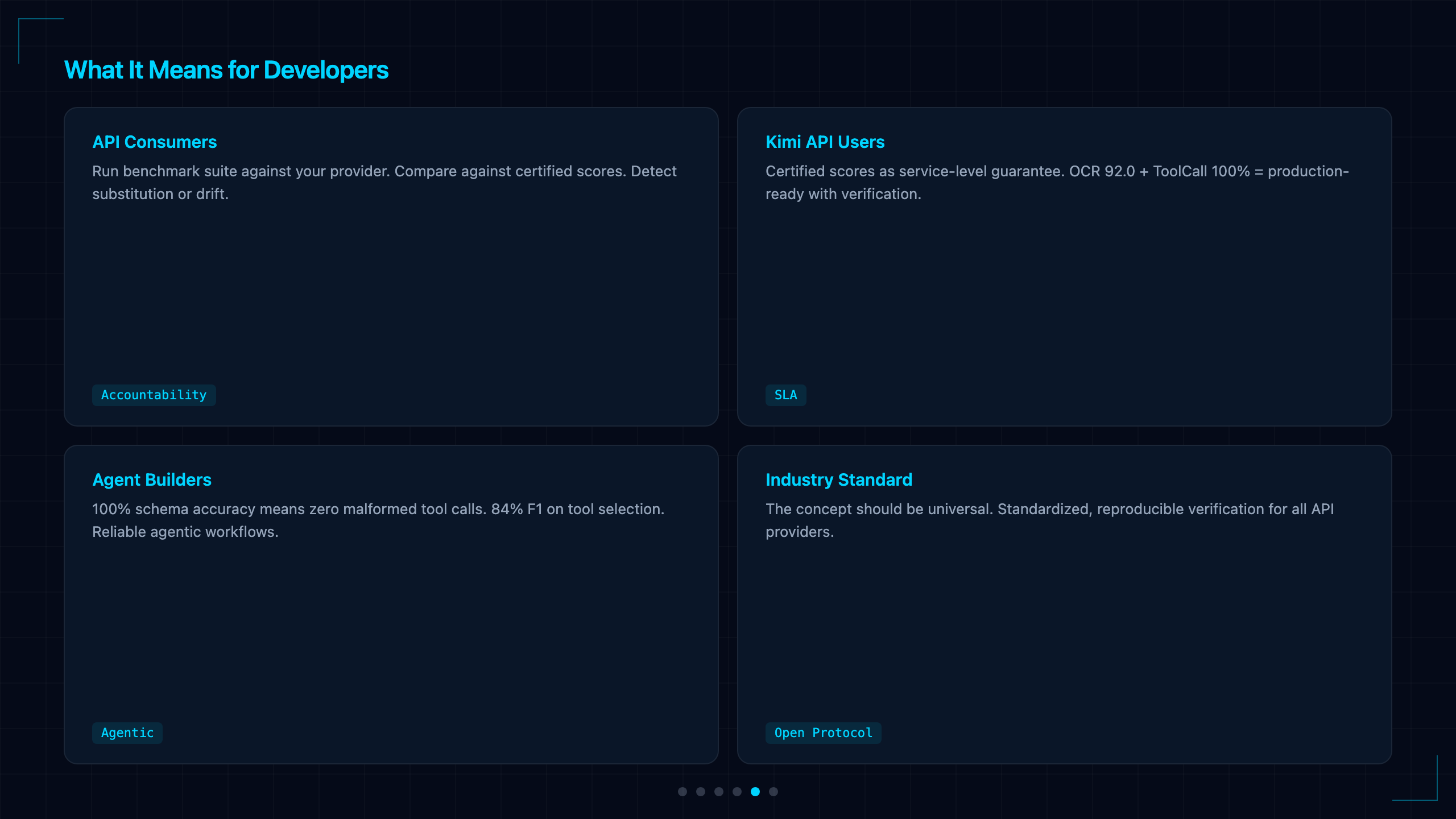
If you're an API consumer: K2VV gives you a framework for holding vendors accountable. Run the benchmark suite against your API provider and compare against certified scores. Significant deviations suggest model substitution or configuration issues.
If you're building on Kimi's API: The certified scores serve as a service-level guarantee. If Kimi's API is returning OCRBench 92.0 and ToolCall schema_acc 100%, you know you're getting the real model with correct inference settings.
If you're an API provider: This is where the industry needs to go. Standardized, reproducible verification protocols that let customers confirm they're getting what they pay for. K2VV is Moonshot's implementation, but the concept should be universal.
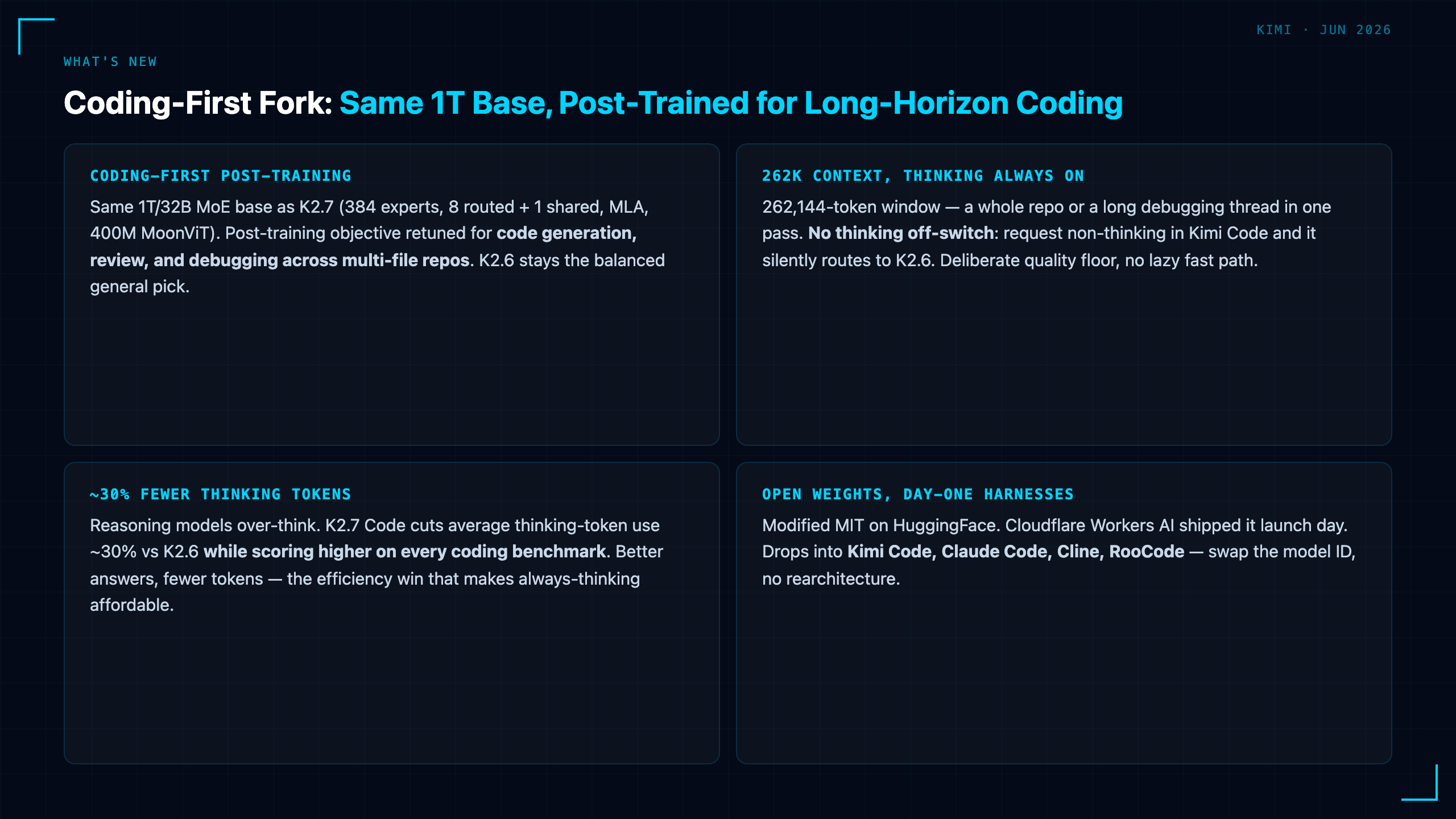
For the agentic ecosystem: The 100% schema accuracy and 84% tool call F1 validate Kimi as a production-ready tool-calling model. Combined with the K2.6 model release (open-source, 1T params, 32B active), Moonshot is positioning Kimi as the reliability-first choice for agent builders.
Bottom Line
Kimi Vendor Verifier addresses the API trust gap by publishing certified benchmark scores tied to specific inference configurations. The headline numbers — AIME 2025 98.4 in Think mode, 100% tool call schema accuracy in Non-Think mode — establish Kimi's frontier capabilities. But the real contribution is the verification protocol itself: a reproducible way to confirm you're getting the model you're paying for. As the LLM API market matures and price competition intensifies, this kind of accountability infrastructure becomes essential.
Resources
- Kimi Blog — Vendor Verifier — full technical details
- Kimi API Platform — API access
- Kimi K2.6 Release — latest model powering the API
Kimi's verified API is available at platform.moonshot.cn. Open-source model weights for K2.6 are on HuggingFace.