Moonshot AI released Kimi-VL on April 11, 2025, extending their MoE efficiency approach from language models into multimodal territory. The model — formally called Kimi-VL-A3B, indicating its 2.8B (~3B) active parameter count — packed competitive performance on visual agent benchmarks into a model that runs at the cost of a 3B dense model.
The result was notable: OSWorld performance (desktop GUI agent tasks) competitive with models 10× larger, using the same MoE architecture and Muon optimizer that powered Kimi-K2's efficiency in pure language tasks.
What's New
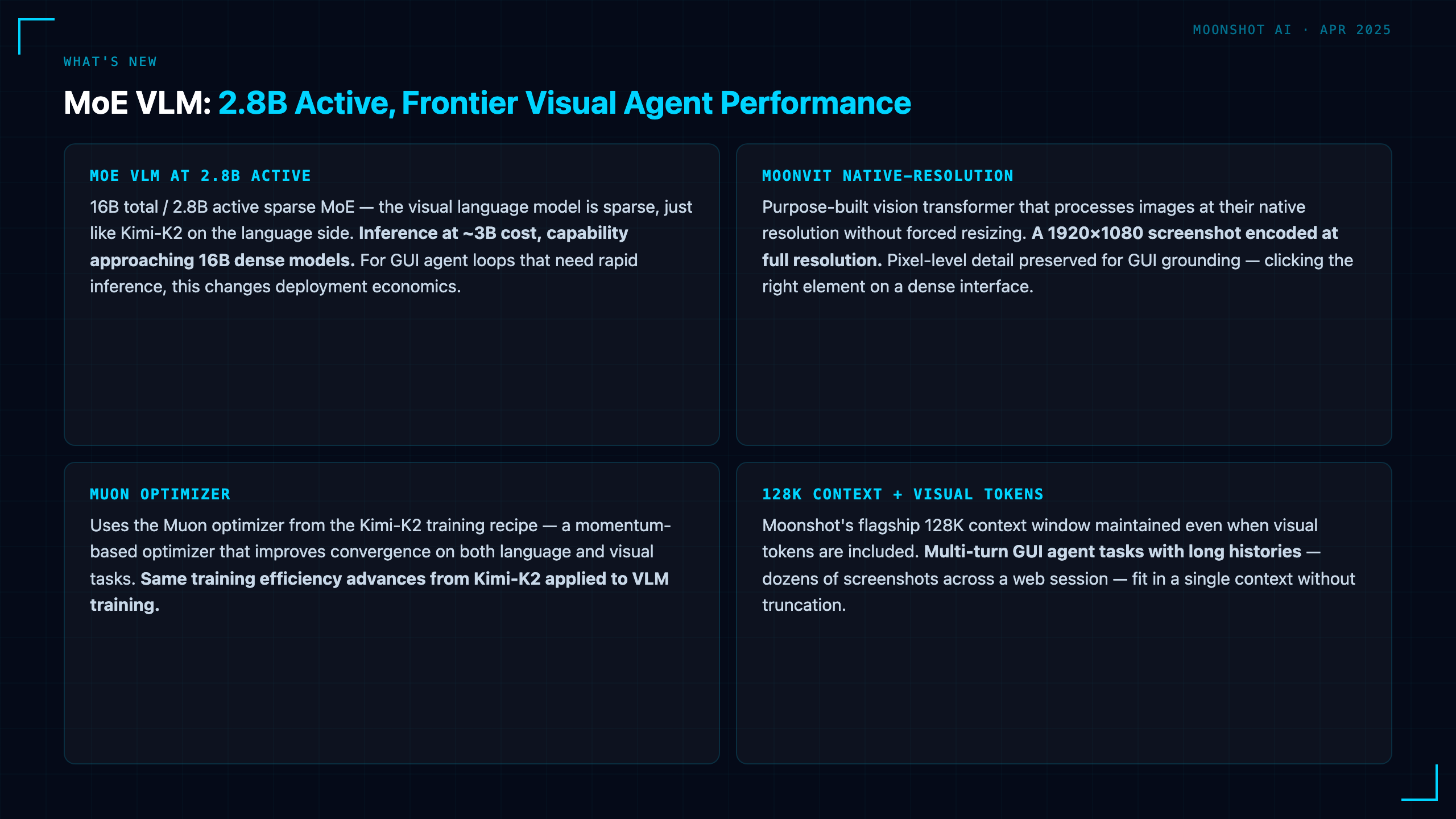
MoE VLM at 2.8B active: Kimi-VL uses a 16B total / 2.8B active MoE architecture — the visual language model is sparse, just like Kimi-K2 on the language side. The practical implication: inference at ~3B parameter cost, capability approaching 16B dense models. For visual agent tasks that need rapid inference (GUI interaction loops), this matters.
MoonViT native-resolution encoder: Rather than using CLIP or SigLIP adapted from image classification, Kimi-VL uses MoonViT — a purpose-built vision transformer that processes images at their native resolution without forced resizing. A 1920×1080 screenshot is encoded at full resolution, preserving the pixel-level detail needed for GUI grounding (clicking the right element on screen).
Muon optimizer: Kimi-VL uses the Muon optimizer from the Kimi-K2 training recipe — a momentum-based optimizer that improves convergence on both language and visual tasks. The same optimization advances that improved Kimi-K2's training efficiency are applied here.
128K context with visual tokens: Kimi-VL maintains Moonshot's flagship 128K context window even when visual tokens are included. For multi-turn agent tasks with long histories — navigating a website across many steps, referencing earlier screenshots — 128K allows much longer agentic trajectories than models with shorter contexts.
Architecture
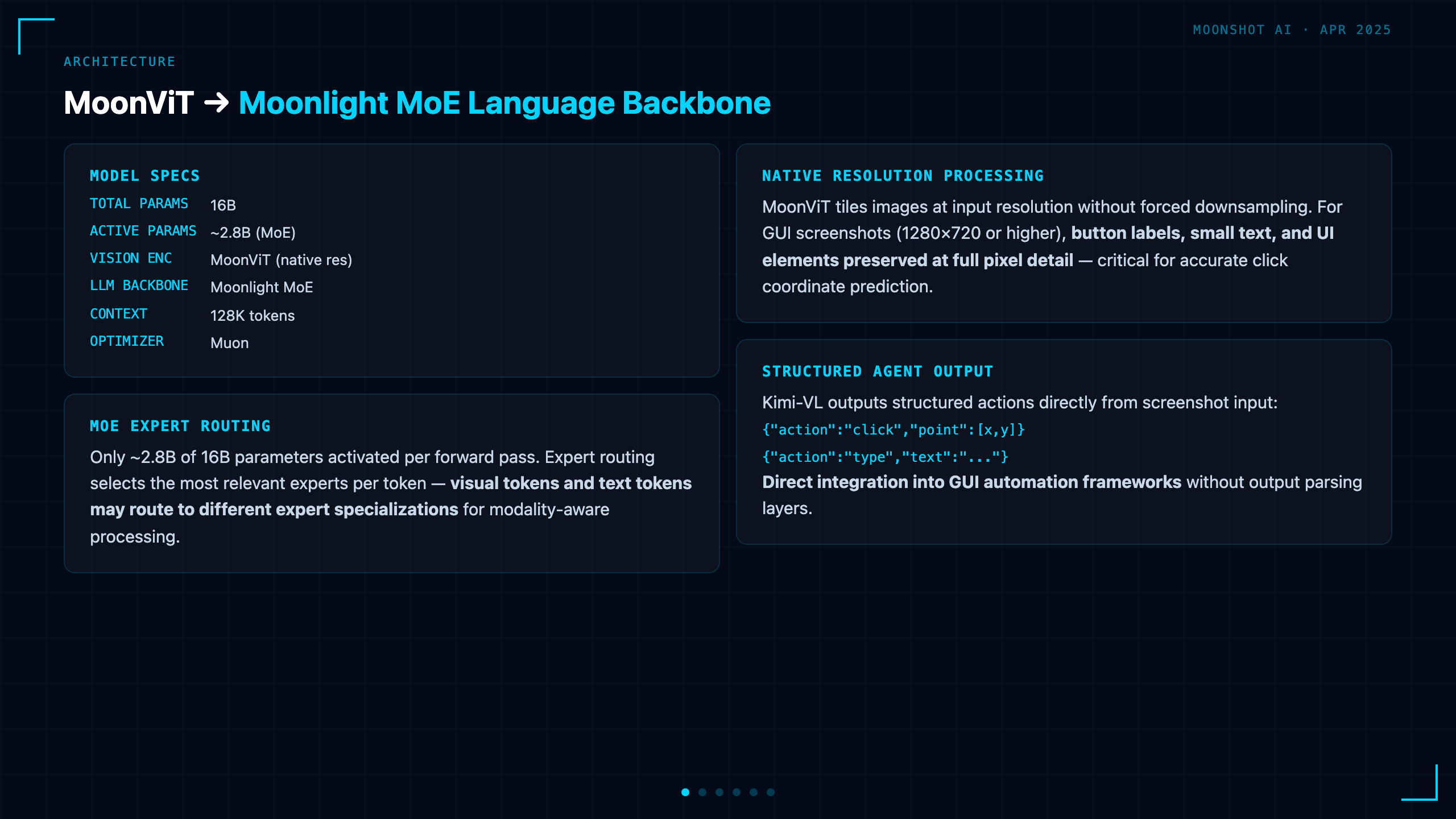
Kimi-VL-A3B architecture:
| Component | Details |
|---|---|
| Total parameters | 16B |
| Active parameters | ~2.8B (MoE) |
| Vision encoder | MoonViT (native resolution) |
| Language backbone | Moonlight MoE |
| Context window | 128K tokens |
| Optimizer | Muon |
MoE structure: Like Kimi-K2, Kimi-VL uses a sparse MoE where only ~2.8B of 16B parameters are activated per forward pass. The expert routing mechanism selects the most relevant experts for each token — visual tokens and text tokens may route to different expert specializations.
Native resolution processing: MoonViT processes images at their input resolution, tiling them into patches without forced downsampling. For GUI screenshots (typically 1280×720 or higher), this means button labels, small text, and UI elements are preserved at full pixel detail — essential for accurate click coordinate prediction.
Visual agent output format: Kimi-VL outputs structured actions in a format compatible with GUI automation: {"action": "click", "point": [x, y]} or {"action": "type", "text": "..."}. The model generates these directly from screenshot input, enabling integration into automation frameworks.
Benchmarks
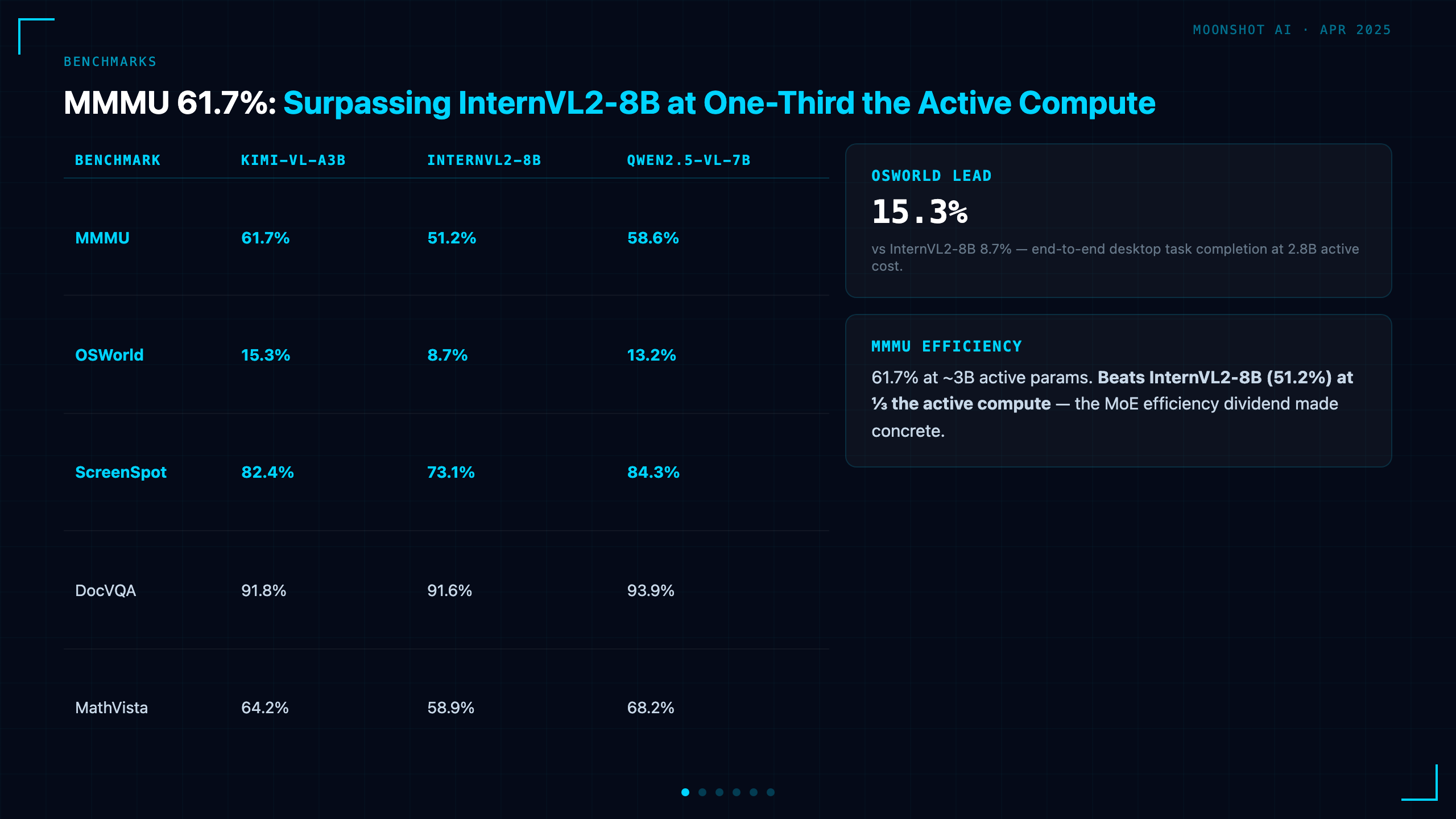
Kimi-VL-A3B at April 2025 release:
| Benchmark | Kimi-VL-A3B | InternVL2-8B | Qwen2.5-VL-7B | Notes |
|---|---|---|---|---|
| MMMU | 61.7% | 51.2% | 58.6% | College-level multimodal |
| MathVista | 64.2% | 58.9% | 68.2% | Visual math |
| DocVQA | 91.8% | 91.6% | 93.9% | Document QA |
| ScreenSpot | 82.4% | 73.1% | 84.3% | GUI element grounding |
| OSWorld | 15.3% | 8.7% | 13.2% | Desktop task completion |
MMMU 61.7% at ~3B active parameters is the headline — surpassing InternVL2-8B (51.2%) on college-level multimodal reasoning at roughly one-third the active compute. ScreenSpot 82.4% shows strong GUI grounding, and OSWorld 15.3% is competitive with Qwen2.5-VL-7B (13.2%) despite the active parameter gap.
OSWorld measures end-to-end desktop task completion — the model must complete multi-step tasks like "find the email from Alice and forward it to Bob" by taking actions in a simulated desktop environment. 15.3% at 2.8B active parameters is a meaningful result.
What It Means for Developers
3B cost, 16B capability: Kimi-VL's MoE design means deploying it costs roughly the same as a 3B dense model in terms of memory bandwidth and compute. MMMU 61.7% at this inference cost opens up visual reasoning for applications that couldn't justify a 7B+ VLM.
GUI agents on consumer hardware: With ~2.8B active parameters, Kimi-VL can run GUI agent inference on a 16GB consumer GPU (RTX 4080, RTX 4090). For browser automation, UI testing, and desktop agent prototyping — accessible local inference without cloud API dependency.
Long agentic trajectories: 128K context with visual tokens means Kimi-VL can maintain context across dozens of screenshots in a GUI agent session. Most competitor models truncate after a few turns; Kimi-VL can hold a full browser session history.
Native resolution for precision: MoonViT's native-resolution encoding makes Kimi-VL more reliable on small UI elements — tiny buttons, small input fields, dense icon grids. For GUI automation precision matters: clicking the wrong element is a hard failure.
Availability
- HuggingFace: moonshotai/Kimi-VL-A3B-Instruct
- License: MIT
- Thinking variant: Kimi-VL-A3B-Thinking (extended reasoning mode, same architecture)
- Paper: arXiv 2504.07491
Bottom Line
Kimi-VL applied Moonshot's MoE efficiency philosophy to vision-language models — 16B total, 2.8B active, competitive with 7B-8B dense models on visual reasoning and GUI tasks. For developers building agentic applications where inference cost matters, Kimi-VL's MMMU 61.7% and ScreenSpot 82.4% at ~3B active compute is a compelling tradeoff.
Resources
- HuggingFace — Kimi-VL-A3B-Instruct
- HuggingFace — Kimi-VL-A3B-Thinking
- Technical Report (arXiv 2504.07491)
- Moonshot AI — Kimi platform
Kimi-VL is available on HuggingFace under MIT license. Commercial use permitted.