Alibaba Cloud open-sourced four models of the Wan 2.1 series in February 2025 — the latest generation of Tongyi Wanxiang, Alibaba's video foundation model. The release covers text-to-video and image-to-video at both 1.3B and 14B parameter scales, all under Apache 2.0 license with no commercial restrictions.
In April 2025, a fifth model joined the family: Wan2.1-FLF2V-14B (First-Last Frame to Video), which accepts user-provided start and end frames as control conditions and generates the intermediate transition. Together, the Wan 2.1 series has accumulated over 2.2 million downloads on HuggingFace and ModelScope.
What's New: The Wan 2.1 Family
Wan 2.1 is Alibaba's public answer to closed-source video models. The series covers the full practical deployment range — from a model that runs on a personal laptop (1.3B) to a flagship 14B model for production-quality output.
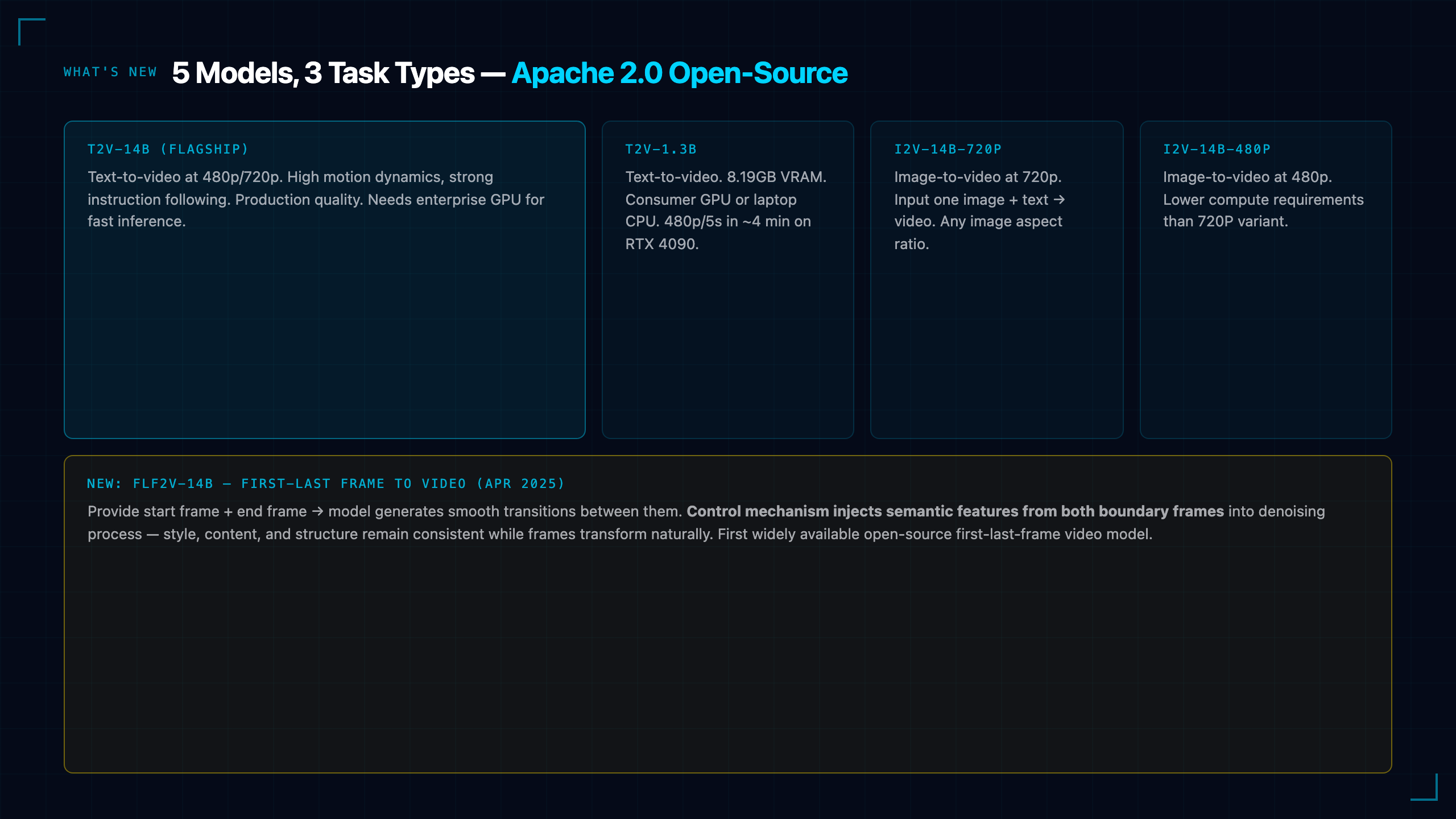
Five models in the family:
| Model | Size | Task | Resolution |
|---|---|---|---|
| T2V-14B | 14B | Text-to-video | 480p / 720p |
| T2V-1.3B | 1.3B | Text-to-video | 480p |
| I2V-14B-720P | 14B | Image-to-video | 720p |
| I2V-14B-480P | 14B | Image-to-video | 480p |
| FLF2V-14B | 14B | First-last frame to video | 720p |
The T2V-14B is the flagship: complex motion dynamics, high instruction following, production-quality output. The T2V-1.3B is the accessibility variant — it generates a 5-second 480p video on a standard laptop in about 4 minutes on CPU, or faster on an RTX 4090.
FLF2V (First-Last Frame to Video) is the April 2025 addition. Rather than describing what should happen in the middle of a video, you provide the start frame and end frame — the model generates a coherent transition between them. The technical mechanism is a control adjustment layer that injects semantic features from both frames into the generation process, maintaining consistency in style, content, and structure across the generated intermediate frames.
First supported Chinese and English text effects. Wan 2.1 is the first video generation model to support on-screen text effects in both languages — animated text overlays that integrate naturally into the generated video.
Architecture: Diffusion Transformer for Video
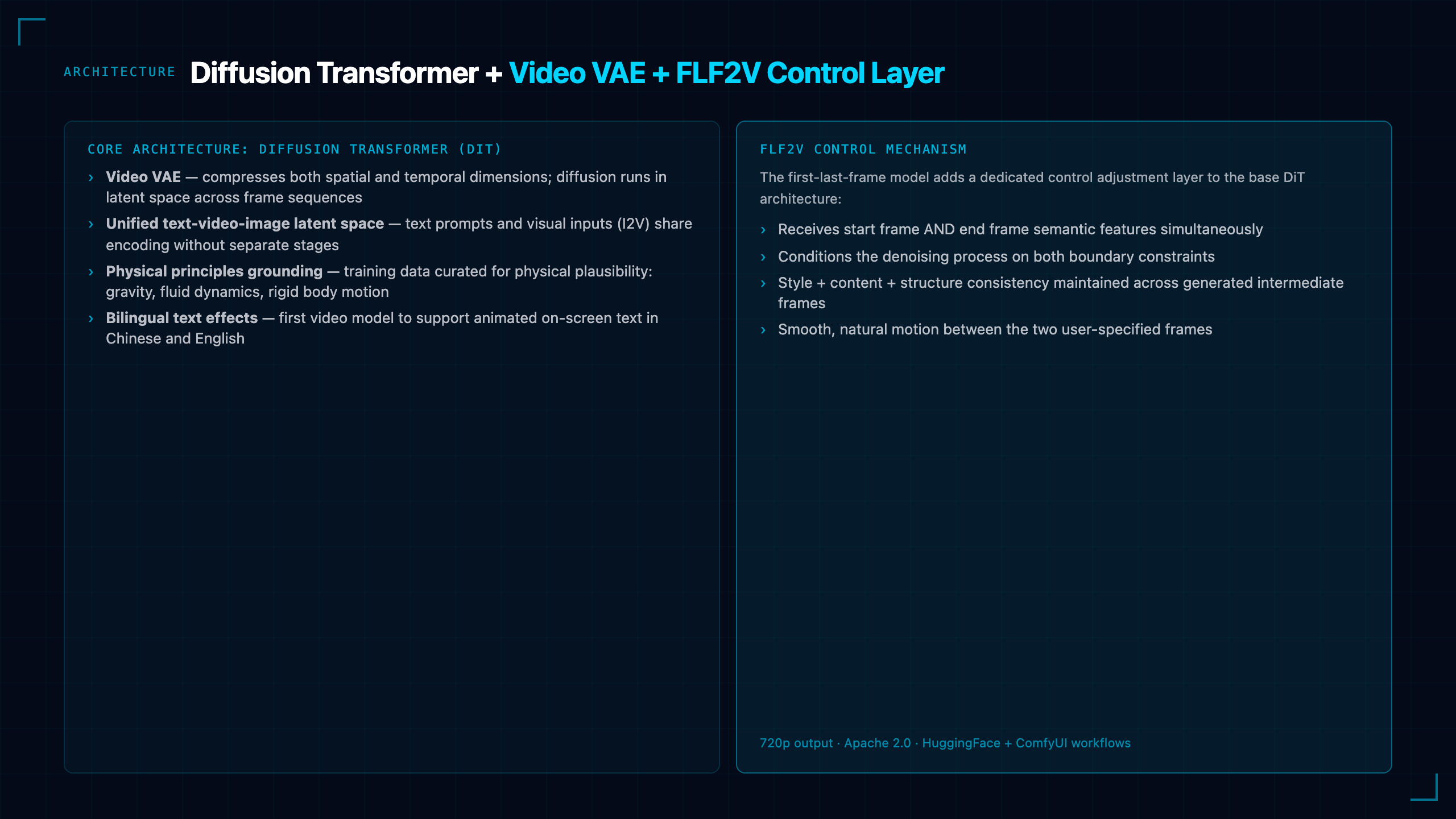
The Wan 2.1 architecture is built on a Diffusion Transformer (DiT) foundation — the same architectural family as Sora and many other recent video generation models — with several design decisions specific to Alibaba's implementation:
Video VAE for temporal compression. Wan 2.1 uses a video-native variational autoencoder that compresses both spatial and temporal dimensions, allowing the diffusion process to operate in a lower-dimensional latent space across frame sequences.
Unified text-video-image latent space. The model processes text prompts and visual inputs (for I2V) in a shared latent representation, enabling cross-modal conditioning without separate encoding stages.
Physical principles grounding. Alibaba explicitly benchmarks on physical plausibility: accurate handling of complex movements, gravity, fluid dynamics, and rigid body interactions. The training data curation emphasizes physically coherent sequences.
FLF2V control mechanism. For the first-last-frame model, the architecture adds a dedicated control adjustment layer that receives both start and end frame semantic features simultaneously and conditions the denoising process on both boundary conditions. This produces smooth transitions that respect both constraints rather than ignoring one.
Key hardware requirements:
- T2V-14B / I2V-14B: Requires a modern GPU with substantial VRAM (H100/A100 class for fast inference; high-end consumer GPU for slow inference)
- T2V-1.3B: 8.19 GB VRAM — compatible with almost all consumer GPUs; or CPU-only on a laptop
- FLF2V-14B: Comparable to I2V-14B; 720p output
VBench #1: Benchmarks
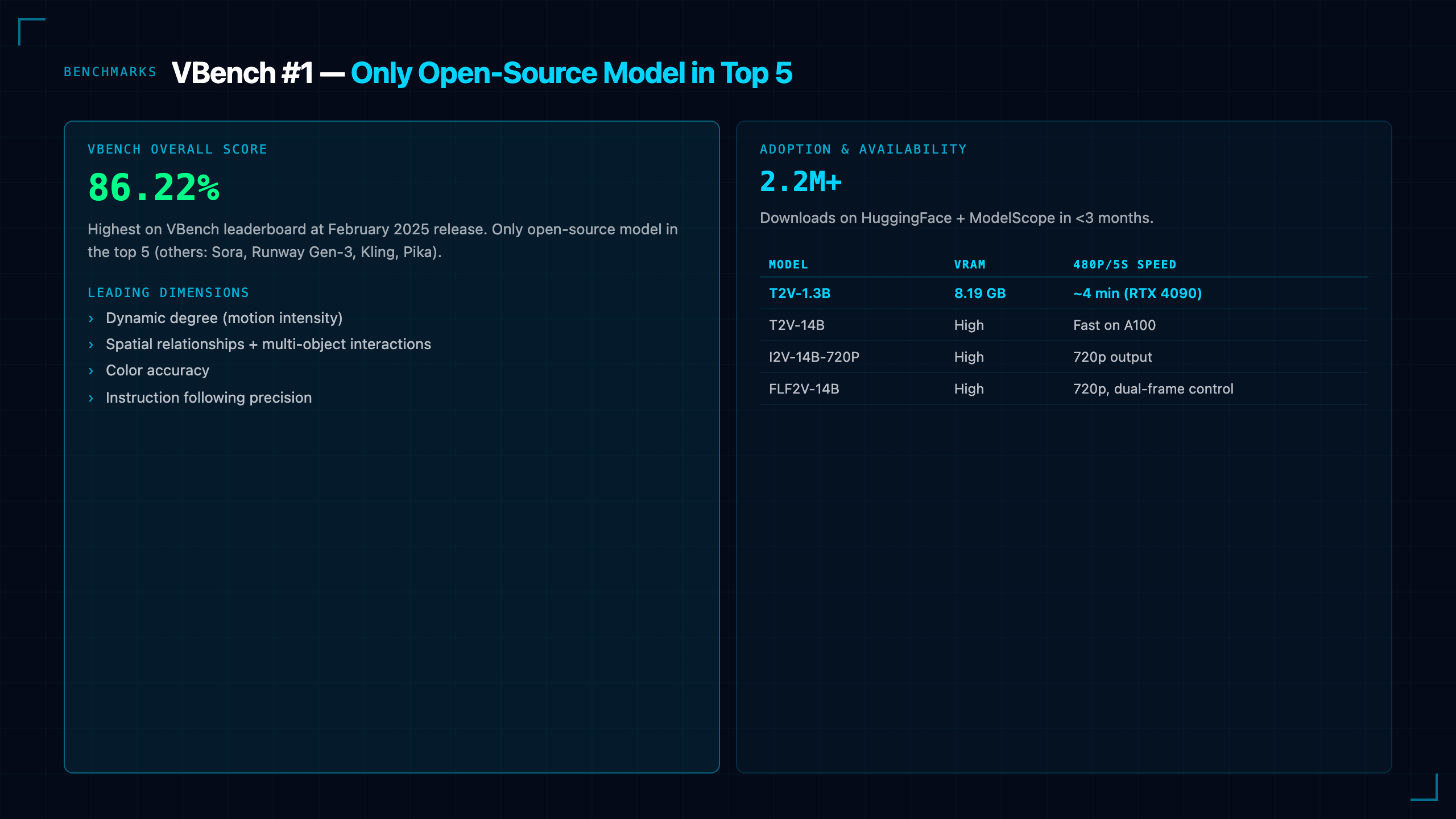
Wan 2.1 leads the VBench leaderboard at release — the most widely referenced automatic benchmark suite for text-to-video models.
VBench overall score: 86.22% — the highest score among all models on the leaderboard at the time of the February 2025 release. VBench is a comprehensive evaluation across 16 dimensions including subject consistency, background consistency, temporal flickering, motion smoothness, dynamic degree, aesthetic quality, and imaging quality.
Wan 2.1 leads on:
- Dynamic degree (motion intensity)
- Spatial relationships (multi-object interactions)
- Color accuracy
- Instruction following
Competitive positioning:
- Only open-source model in the VBench top 5 at release
- Comparable to or ahead of Sora, Runway Gen-3, Kling 1.0, and other commercial models on VBench metrics
- Does not claim to lead on aesthetic preference — VBench measures technical quality, not stylistic appeal
The VBench results should be read alongside qualitative evaluation. VBench rewards faithfulness to prompts and physical plausibility; subjective aesthetic quality (what looks "cinematic" or "beautiful") is harder to capture quantitatively. The Wan 2.1 benchmarks establish technical competence — real-world aesthetic preference is use-case dependent.
Access and Availability
Wan 2.1 is fully open-source under Apache 2.0 license:
Model weights:
- HuggingFace — all five models
- ModelScope — Alibaba's model community (often faster for China-based developers)
- GitHub — inference code, ComfyUI integration, Gradio demo
Usage:
- Online demo: tongyi.aliyun.com/wanxiang — free 5-second 720p generation
- ComfyUI workflows: available for all variants including FLF2V
- API: Alibaba Cloud Model Studio
License: Apache 2.0 — no commercial restrictions, derivative models permitted, no revenue sharing requirements. This is more permissive than some competing models (e.g., Wan 2.1 vs Hunyuan Video's restrictive commercial terms at the time).
2.2+ million downloads across HuggingFace and ModelScope as of the April 2025 FLF2V announcement.
What It Means for Developers
The Wan 2.1 release changes the economics of open-source video generation significantly. Before Wan 2.1, the gap between open-source video models and commercial APIs (Runway, Kling, Pika) was large enough that most production workflows defaulted to proprietary APIs. Wan 2.1's VBench-leading performance with an Apache 2.0 license means that gap effectively closed for technically capable teams.
Selection framework:
T2V-1.3B — prototype workflows, academic research, demos on consumer hardware. RTX 4090 generates 480p/5s in ~4 minutes; a laptop CPU takes ~4 minutes at reduced quality. This is the easiest path to running video generation locally.
T2V-14B — production text-to-video. High motion dynamics, strong instruction following. Requires enterprise GPU for reasonable generation speed.
I2V-14B-720P — image animation. Give a reference frame, get a video. Higher resolution output; useful for product demos, character animation, concept visualization.
FLF2V-14B — the most distinctive offering. No other widely-available open-source model offered first-last-frame control at April 2025 release. Use cases: transitions between specific keyframes, "journey from A to B" video creation, predictable outcome control without full scripting.
Wan 2.1 vs proprietary alternatives:
- vs Runway Gen-4 (2025): Gen-4 leads on cinematic aesthetic quality and consistency; Wan 2.1 leads on openness, cost, and instruction following metrics
- vs Kling 3.0: Similar tier on quality; Wan 2.1 wins on self-hosting and cost for high-volume workflows
- vs Sora: Not directly comparable on creative output; Wan 2.1 is self-hostable, Sora is API-only
The FLF2V model is the developer-specific recommendation for anyone building structured video workflows where the endpoint matters — ad formats, story continuations, data augmentation with specific start/end states.
Bottom Line
Wan 2.1 delivers VBench #1 performance under Apache 2.0 at a 1.3B-to-14B parameter range that covers everything from laptop inference to enterprise production. The FLF2V first-last-frame model is the most technically distinctive addition — offering frame-boundary control that enables structured video creation workflows not easily replicated with prompt-only models. 2.2+ million downloads in under two months signals genuine developer adoption, not just benchmark attention.
Resources
- GitHub Repository — code, inference scripts, ComfyUI support
- HuggingFace Models — all five model weights, Apache 2.0
- Technical Report (arXiv 2503.20314) — full architecture and training details
- Online Demo — free 5s/720p generation
- VBench Leaderboard — benchmark context
Wan 2.1 models available at huggingface.co/Wan-AI under Apache 2.0 license. Online demo at tongyi.aliyun.com/wanxiang.