Most teams integrating a new model provider do it the wrong way: they scatter vendor-specific logic across the codebase until the model is impossible to swap out. Agentium, a research project from a joint team, takes the opposite approach. Its DeepSeek V4 adapter is a case study in how to contain vendor differences inside a single layer — and why that matters for anyone building production agent systems.
The core problem is real. DeepSeek V4 (deepseek-v4-flash, deepseek-v4-pro) introduced three protocol conventions that don't exist in legacy DeepSeek or standard OpenAI tool JSON: a Thinking envelope in the HTTP request, Think Max system augmentation, and DSML tool blocks in model output. Mix those with a generic tool loop and you get a predictable class of bugs: the model doesn't call tools, reasoning fields go missing, or DSML accidentally activates on a non-V4 model.
Agentium's answer is a vendor adapter subpackage with a model gate. Here's how it works.
The Model Gate: One Boolean, Everything Follows
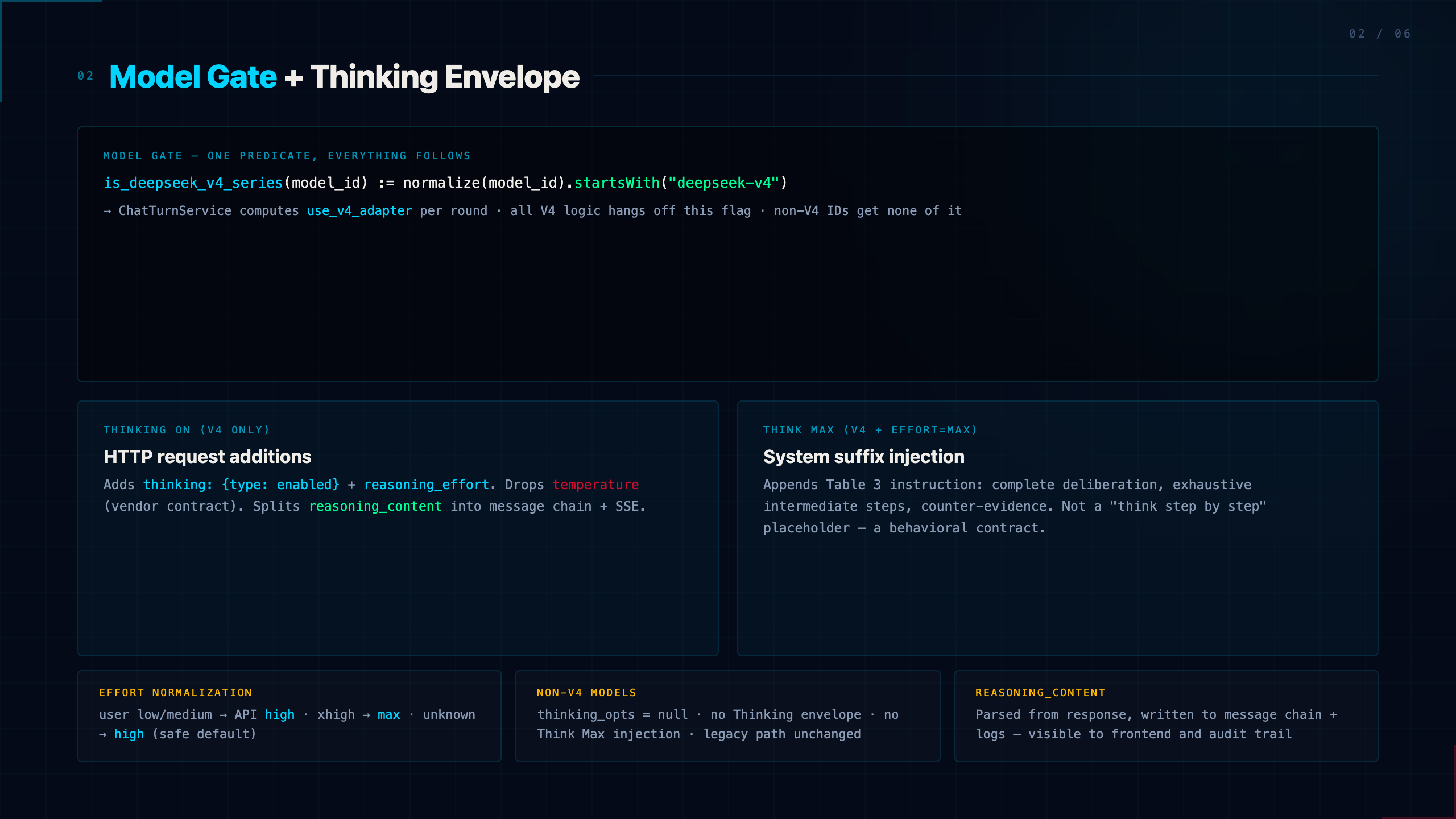
The entire V4 code path is gated by a single predicate:
is_deepseek_v4_series_model(model_id) :=
    normalize(model_id).startsWith("deepseek-v4")
ChatTurnService computes effective_completion_model before assembling each turn — either from a per-request override or the deployment default — and derives a use_v4_adapter boolean. Every downstream decision (Thinking, Think Max, DSML) hangs off this flag. Non-V4 model IDs get none of it.
The Thinking path, when enabled, modifies the HTTP request body: it adds thinking: {type: enabled} and reasoning_effort (mapped from user-facing levels), and drops temperature — which the vendor contract requires. The response parser then splits reasoning_content from assistant content and feeds both into the message chain and SSE stream.
Effort level normalization is explicit: user-facing low/medium maps to API high, xhigh maps to max, and unknowns default to high to avoid hard failures. Think Max — activated only when V4 + thinking + effort=max + config flag — injects a fixed system instruction based on the paper's Table 3 language, requiring complete deliberation and exhaustive intermediate steps. It's not a "think step by step" placeholder. It's a specific behavioral contract.
Non-V4 models: thinking_opts is set to null, the V4 thinking envelope is never sent.
DSML: Why Tool Descriptions Go in System, Not Just tools
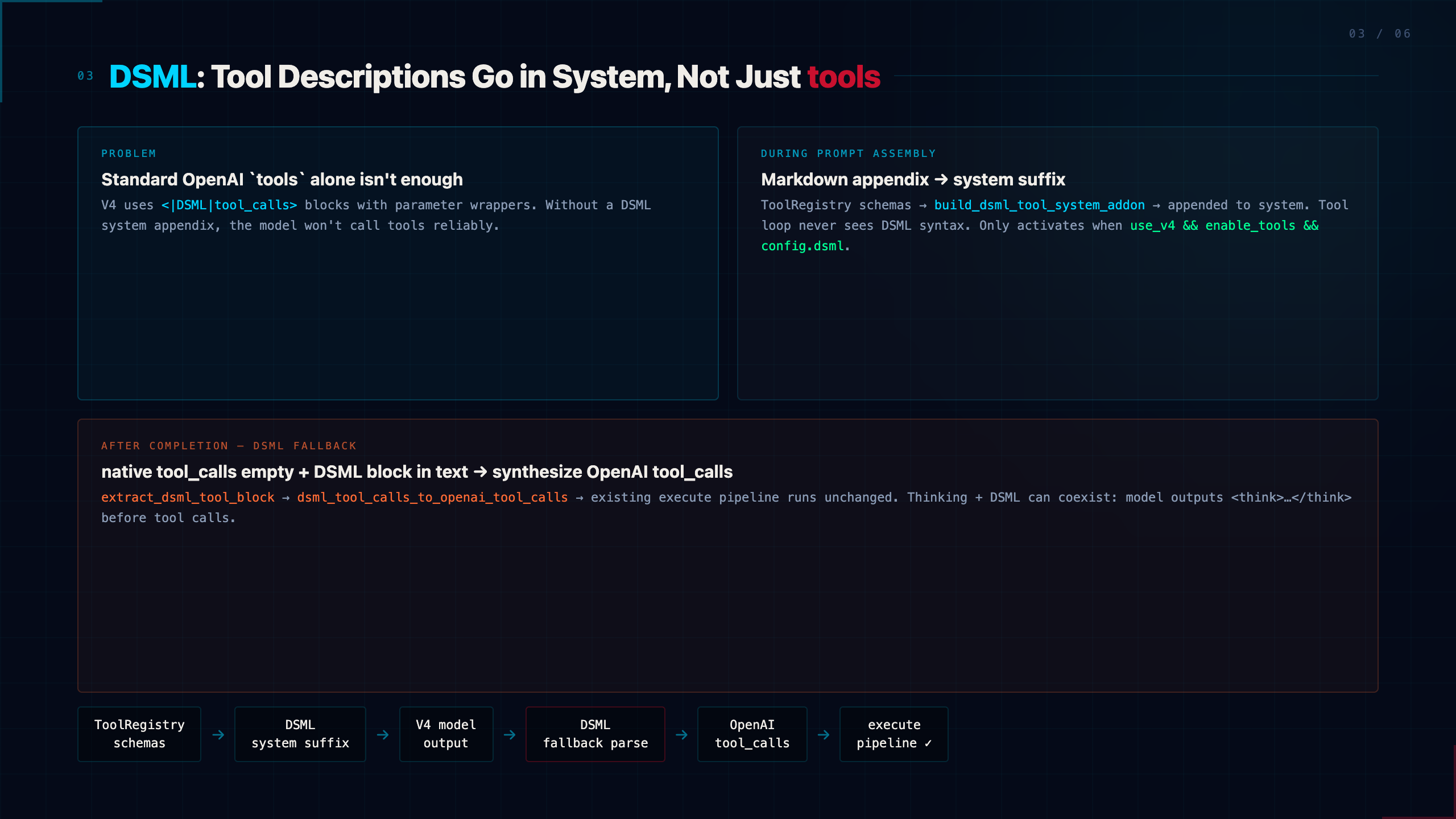
DeepSeek V4's Table 4 specifies that the model names tools using <|DSML|tool_calls> blocks with <|DSML|parameter name=… string=true|false> wrappers. If you only pass the standard OpenAI tools parameter without a DSML system appendix, the model won't use the tools reliably.
Agentium's adapter handles this in two places:
During prompt assembly (only when use_v4_adapter && enable_tools && config.dsml_tool_prompt): the tool schemas from ToolRegistry are converted to a Markdown appendix and appended to the system suffix via build_dsml_tool_system_addon. The tool loop and Registry never see this — it's purely a surface protocol transformation.
After completion (only when config.dsml_fallback): if native tool_calls is empty but the response text contains a DSML block, the fallback parser runs extract_dsml_tool_block → dsml_tool_calls_to_openai_tool_calls, synthesizing a standard OpenAI-shaped tool_calls array. The existing execute pipeline runs unchanged.
The constraint matters: DSML and Thinking can coexist, and the DSML appendix documents this — in thinking mode, the model should output <think>…</think> before tool calls. This is the right place to specify that contract, because it's a vendor-specific behavioral detail that doesn't belong in your generic tool loop.
Six Optimizations: From "Correct" to "Efficient"
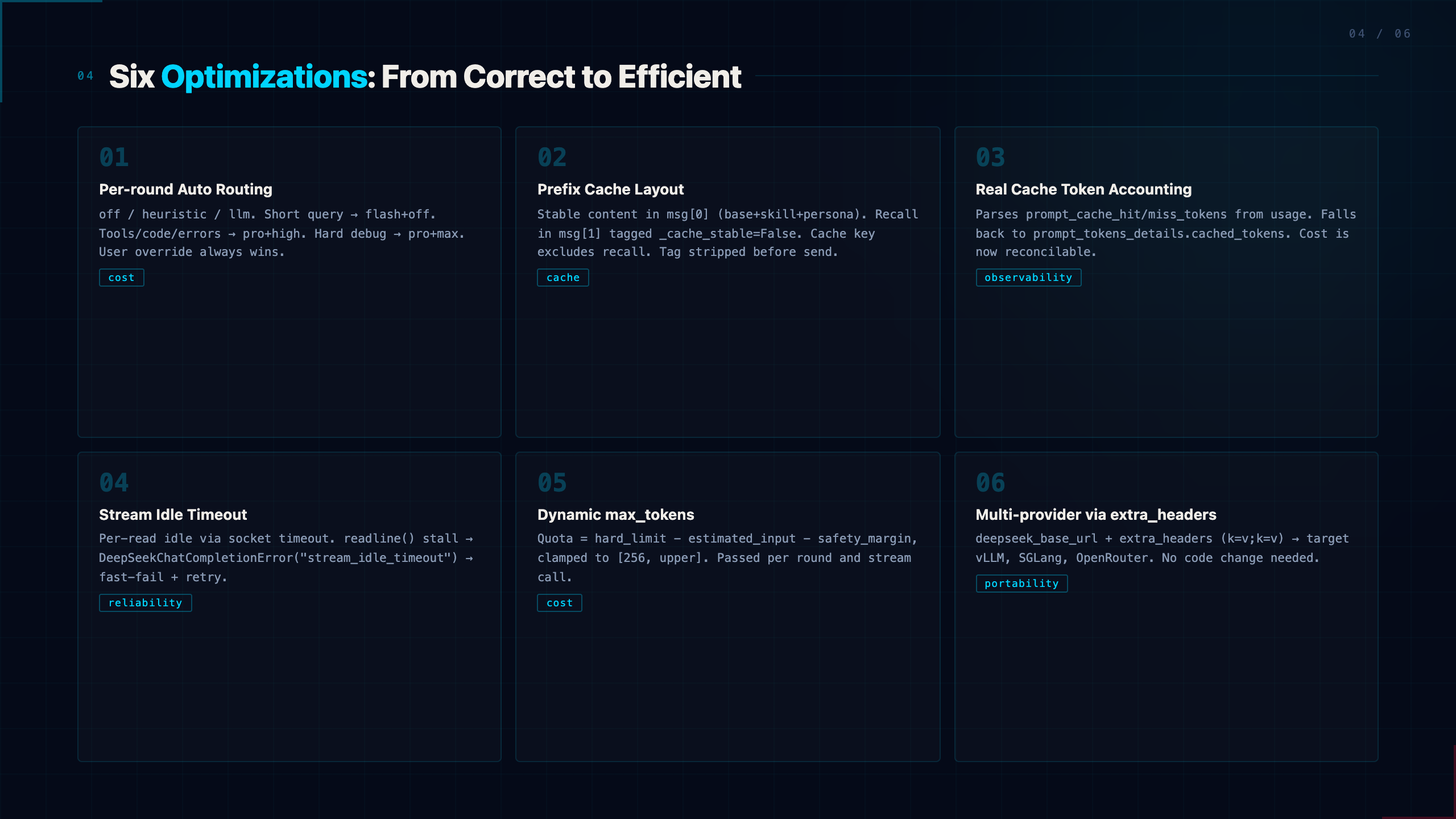
Getting the protocol right is table stakes. Agentium's V4 adapter also addresses cost, latency, and reliability — all as default-safe switches that don't touch V4 adapter semantics when disabled.
1. Per-round auto routing (off / heuristic / llm). The default (off) uses a fixed model + thinking setting. heuristic mode inspects structural features: short queries → flash + thinking off; requests with tools, code blocks, multi-step keywords, or recent tool errors → pro + high; hard debugging or long reasoning → pro + max. llm mode fires a cheap flash call (thinking off) to return a {"model","thinking"} JSON, with fallback to heuristic on parse failure. User explicit overrides always win. This is the gateway's job, kept separate from the orchestration-mode routing in coordination/turn_router.py.
2. Prefix cache–friendly message layout. DeepSeek caches stable prefixes. The original implementation appended recall (per-turn memory, changes every round) to the first system message — effectively busting the cache every turn. The fix: the first system message contains only stable content (base + skill + persona + DSML/ThinkMax suffixes, byte-for-byte identical each turn). Recall goes in a second system message immediately before the dialogue, tagged _cache_stable=False. The cache key derivation excludes recall. The tag is stripped before the request goes out — vendors never see it.
3. Real cache hit/miss token accounting. Rather than estimating locally, the adapter parses usage.prompt_cache_hit_tokens and prompt_cache_miss_tokens from the response (with fallback to prompt_tokens_details.cached_tokens and derived miss when the field is absent), and logs them in deepseek_completion_response. Cost is now reconcilable against actual billing.
4. Stream idle timeout. Streaming previously had only a total timeout. A half-hung server connection would hold a session lease indefinitely. Using urllib's socket timeout as a per-read idle check, readline() now throws socket.timeout on stall, converted to DeepSeekChatCompletionError("stream_idle_timeout") for fast-fail and retry.
5. Dynamic max_tokens. Without a ceiling, long inputs risk truncation or over-spending. The adapter computes available quota as hard_limit − estimated_input − safety_margin, clamped to [256, upper_limit], and passes it through per round and stream call.
6. Multiple providers via extra_headers. Since deepseek_base_url is already configurable, adding extra_headers (k=v;k=v format) injected into every request lets the same adapter target vLLM, SGLang, or OpenRouter — any OpenAI-compatible endpoint — without code changes.
What It Means for Developers
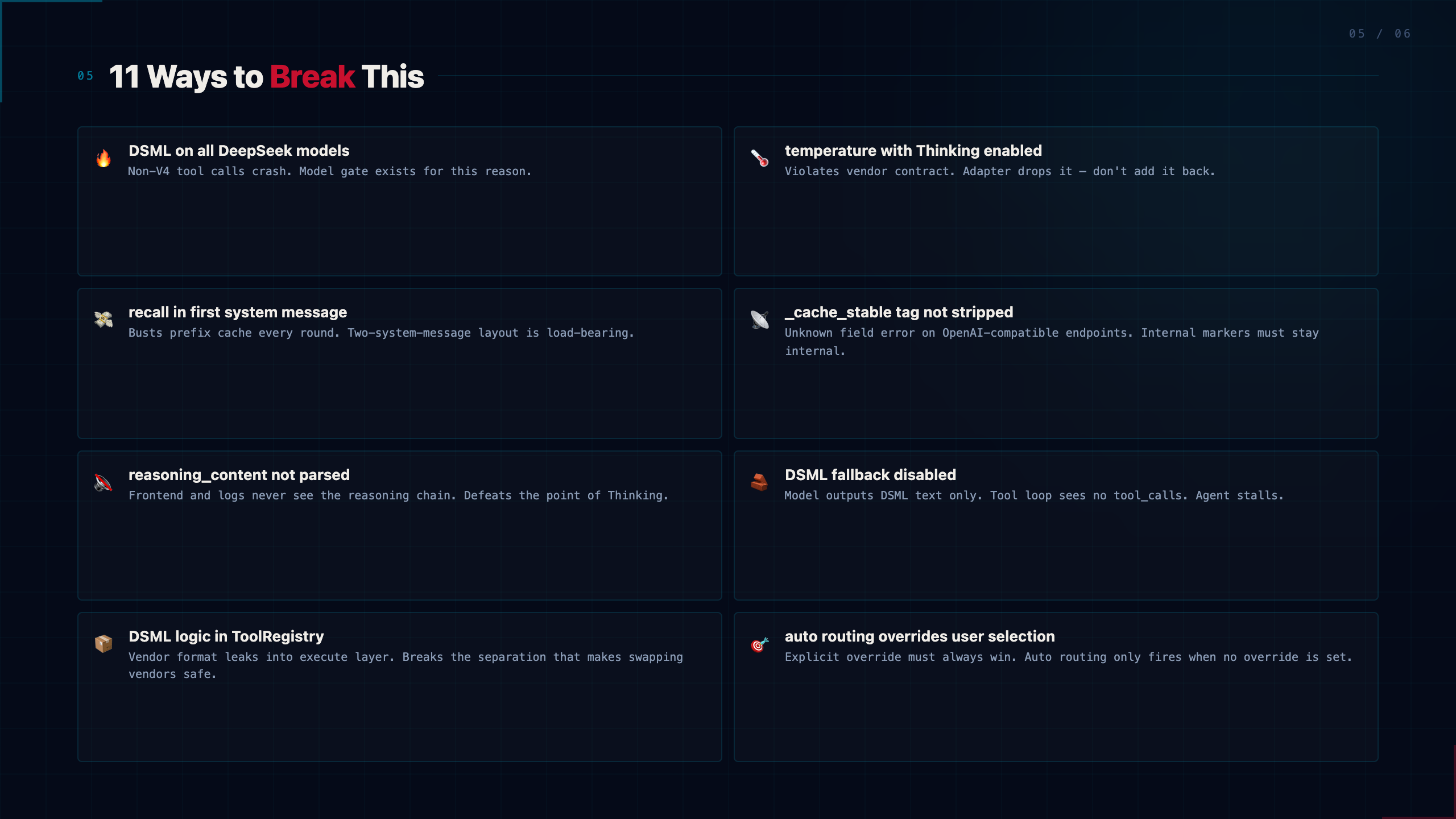
Agentium identifies eleven specific ways this adapter can go wrong. The most instructive ones:
Enabling DSML on all DeepSeek models — not just V4 — breaks non-V4 tool calls entirely. The model gate exists precisely to prevent this.
Sending temperature with Thinking enabled violates the vendor contract. The adapter drops it; if you implement this yourself, don't forget.
Putting recall back in the first system message — after adding prefix caching — undoes all the cache savings. The two-system-message layout is load-bearing.
Forgetting to strip _cache_stable before the request goes out causes unknown field errors on OpenAI-compatible endpoints. Internal markers must stay internal.
Not parsing reasoning_content means your logs and frontend never see the reasoning chain, which defeats the point of enabling Thinking.
The broader pattern here is a clean separation of concerns: the model gate and format conversion live in ai_gateway/deepseek_v4_agent/, the execute pipeline (five steps from episode 05) is untouched, and the tool loop never sees DSML syntax. When a new vendor with different conventions arrives, you copy the gate + format conversion pattern, not the whole system.
Bottom Line
Agentium's DeepSeek V4 adapter is worth reading not just for its DeepSeek-specific content, but for the architectural template it demonstrates: a predicate-gated vendor subpackage that contains all protocol differences, with explicit flags for each behavioral variant, and zero leakage into the core tool loop.
The six cost/reliability optimizations are equally practical — especially the prefix cache layout change, which is easy to get wrong and expensive when you do.
For teams building agent systems on top of DeepSeek V4 (or planning to), this is a concrete reference for what "gateway-layer adaptation" should look like in practice.
Resources
- Agentium GitHub — open-source project and paper
- DeepSeek V4 API Documentation — Thinking, DSML, and tool call specs
- DeepSeek Platform — API access and pricing
DeepSeek V4 API is available at platform.deepseek.com. Agentium is open-source at github.com/agentium.