Three years ago, China's AI industry had a convenient shorthand: the "AI Six Dragons" — six startups that launched within months of each other in 2023, all chasing GPT-4, all burning through venture capital, all making similar claims about benchmark performance.
By mid-2026, that label no longer applies. MiniMax just posted a SWE-Bench Pro score above GPT-5.5 — a benchmark you can't game by memorizing answers. Two of the original six have effectively exited general-purpose AI. The remaining four, plus DeepSeek, are competing with different models, different customers, and different capital structures.
The question that once defined the industry — "how many generations behind GPT-4 are we?" — has been answered. The new question is harder: who can turn this into a sustainable business?
M3 and the Benchmark That Actually Matters
MiniMax M3, released June 1, scored 59.0% on SWE-Bench Pro — the first time a Chinese lab has beaten OpenAI's flagship on this specific evaluation. It also took world #1 on Claw-Eval (autonomous computer control) and scored 83.1 on BrowseComp, above Claude Opus 4.7's 79.3.
Why these benchmarks specifically? SWE-Bench Pro tests real GitHub open-source bug fixes from community submissions. The task pool rotates; you cannot contaminate it by overlapping with training data. Claw-Eval and BrowseComp require multi-step autonomous reasoning, not pattern recall.
The underlying architecture: MSA (MiniMax Sparse Attention). Instead of quadratic attention over a 1M-token context, MSA identifies high-relevance tokens in a fast first pass and concentrates computation there. Result: ~1/20th the per-token compute of the previous generation, 15× faster inference. M3 is, by MiniMax's account, the only open-source model simultaneously offering frontier coding performance, 1M context, and native multimodality.
Three legitimate controversies exist: MiniMax used Claude Code as evaluation scaffolding (drawing questions about testing yourself with a competitor's tool), model weights were not released at launch (promised within 10 days, initial access API-only), and pricing is higher than domestic competitors. These don't invalidate the scores, but they're context worth having.
In real-world testing, M3 ran nearly 12 hours unattended to reproduce a complete ICLR award paper, producing 18 code commits and 23 experimental charts. On a CUDA kernel optimization task, it raised hardware peak utilization from 7.6% to 71.3% across 147 commits — ~9.4× improvement. The gap between benchmark performance and production polish is real (frontend generation, spatial reasoning, geolocation all show limitations), but the core coding capability is genuine.
From Six to Five: Who Dropped Out
The "AI Six Dragons" of 2023: Zhipu, MiniMax, Baichuan, Moonshot (Kimi), StepFun, and 01.AI.
Baichuan effectively exited in April 2025. Founder Wang Xiaochuan published an all-staff letter acknowledging "overextended fronts" and pivoted the company entirely to medical AI. They are no longer competing in general-purpose models.
01.AI, founded by Kai-Fu Lee, announced in 2025 it would abandon pre-training of models above trillion parameters — the first Chinese AI startup to explicitly say "we're not competing on model scale." The company now deploys DeepSeek and other third-party models for enterprise customers. It's a pivot to a services and deployment model.
The remaining four — DeepSeek, Zhipu, MiniMax, Moonshot — plus the independently-founded DeepSeek make up what's now called the "Five Strong" of Chinese frontier AI.
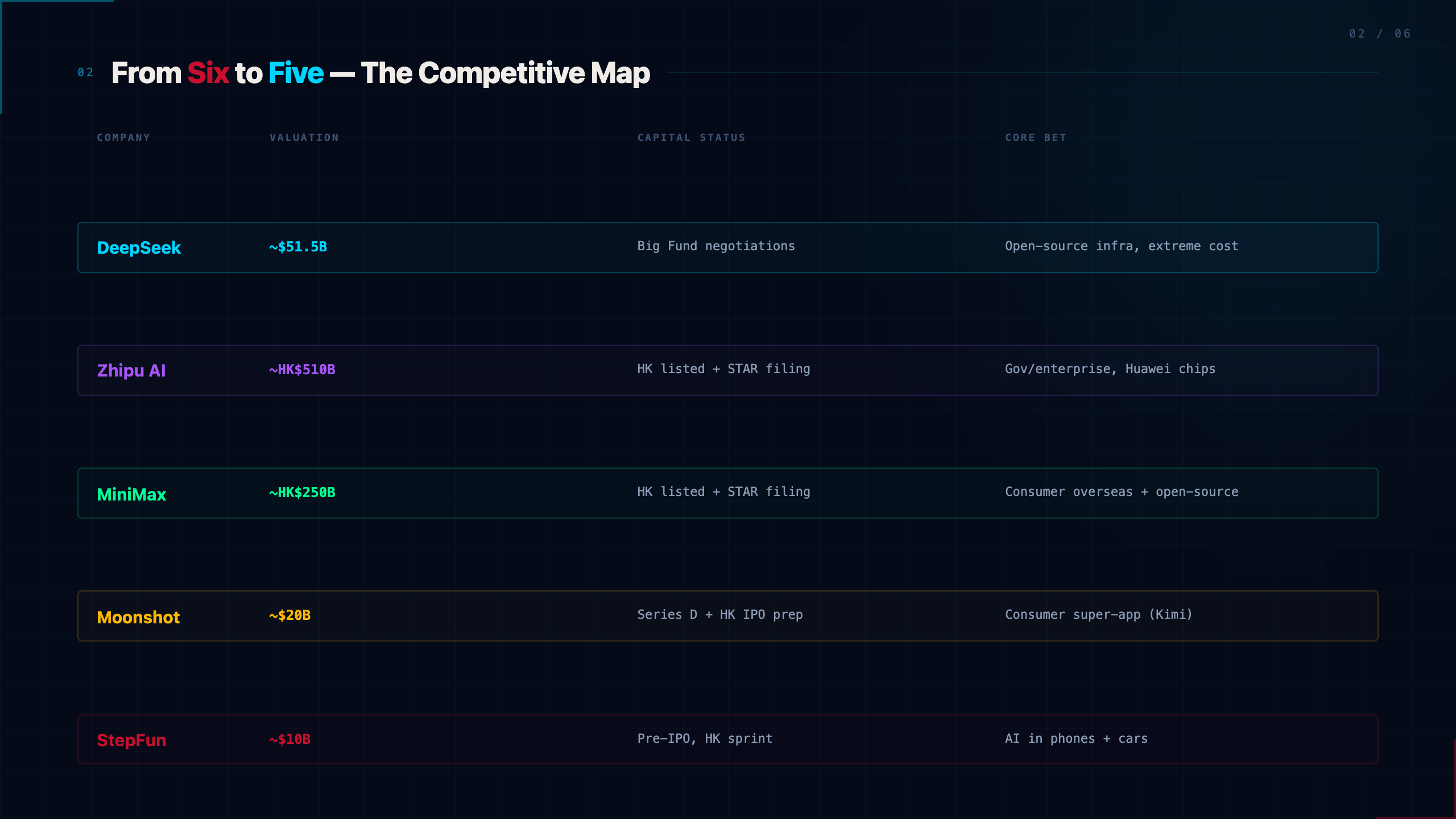
| Company | Valuation | Capital Status | Core Bet |
|---|---|---|---|
| DeepSeek | ~$51.5B | First-round negotiations | Open-source infrastructure, extreme cost efficiency |
| Zhipu AI | ~HK$510B | HK listed + STAR Market filing | Government/enterprise MaaS, domestic chip training |
| MiniMax | ~HK$250B | HK listed + STAR Market filing | Consumer overseas + open-source model |
| Moonshot (Kimi) | ~$20B | Series D complete, HK IPO prep | Consumer super-app + enterprise |
| StepFun | ~$10B | Pre-IPO, HK IPO sprint | AI embedded in phones and cars |
Five Different Bets
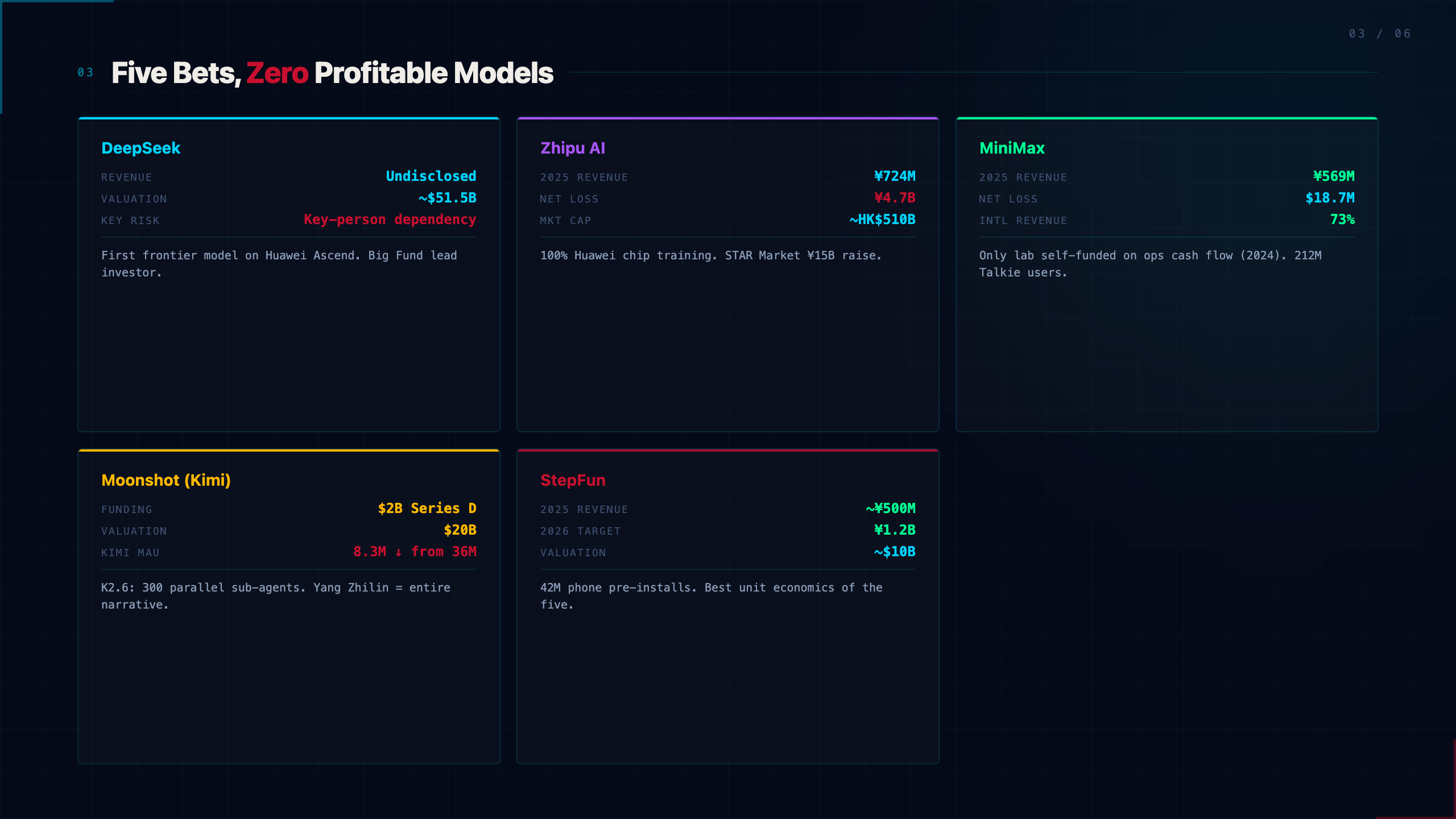
DeepSeek, led by Liang Wenfeng, rewrote the industry narrative in January 2025: training costs at roughly 1% of US frontier labs, open-source performance matching closed-source flagship models. Jensen Huang called it "a wake-up call." DeepSeek V4 has completed full migration from Nvidia CUDA to Huawei Ascend CANN — the first frontier AI model not dependent on Nvidia hardware. China's National Integrated Circuit Industry Investment Fund (the "Big Fund") is in lead-investor negotiations for a first funding round at a possible post-money valuation of $45B.
The risks: DeepSeek has never disclosed revenue. The company's intellectual architecture concentrates heavily around Liang Wenfeng personally. Several senior researchers have departed recently. Open-source ecosystems don't inherently produce business moats — Meta's Llama experience provides the reference case.
Zhipu AI, founded by Tsinghua professor Tang Jie, listed on the Hong Kong Stock Exchange in January 2026 to 1,159× oversubscription. Its flagship GLM-5.1 briefly held world #1 on SWE-Bench Pro. More strategically significant: it was trained entirely on 100,000 Huawei Ascend 910B chips, with zero Nvidia GPUs — a deliberate hedge against US chip export controls that gives it unique positioning in the China government procurement market. Zhipu has now filed for STAR Market listing targeting ¥15B in fundraising, building toward an A+H dual-market capital structure. 2025 revenue: ¥724M. Net loss: ¥4.7B.
MiniMax is the outlier in business model terms. Its primary revenue source is Talkie (branded "Xinye" domestically) — an AI companion app with 212M global users across 200+ countries. In 2024, MiniMax became the only independent Chinese large model company to achieve self-funding on operational cash flow. HK listing in January 2026 at HK$165 per share; shares briefly hit HK$1,330 before settling around HK$840, market cap ~HK$263B. 2025 revenue: ¥569M (~$79M). Net loss: $18.72M (substantially smaller than peers). International revenue: 73% of total. The vulnerability: AI companion products face tightening regulation globally, and a revenue base predominantly offshore creates complications for the STAR Market listing review process.
Moonshot (Kimi), founded by Yang Zhilin (born 1992, Tsinghua Yao Class, Carnegie Mellon PhD), completed a $2B Series D in May 2026 at $20B valuation, cumulative funding over ¥37.6B. After 172 days out of public view following DeepSeek-R1's release, Yang returned with Kimi K2, and the latest K2.6 supports 300 parallel sub-agent orchestration. The structural risk: Kimi's monthly active users have fallen from a peak of 36M to ~8.33M, while ByteDance's Doubao approaches 350M MAU. Yang Zhilin is effectively the entire technical narrative, creating concentration risk that's unusually high even by startup standards.
StepFun, run by dual founders Jiang Daxin (former Microsoft VP, IEEE Fellow) and Yin Qi (former Megvii co-founder), has taken the most differentiated strategic position: not chasing consumer apps or ultra-cheap APIs, but embedding AI capabilities into end-user hardware. Pre-installed on over 42M phones across 60% of major domestic handset brands; intelligent cockpit systems shipped in ~40,000 vehicles in three months. 2025 revenue: ~¥500M, 2026 target: ¥1.2B. Lowest valuation of the five (~$10B) but the most grounded unit economics of the group.
Three Industry Signals
Coding has become the dominant value driver. Per an OpenRouter/a16z joint report, coding tasks grew from 11% of paid model token consumption in early 2025 to over 50% by year-end. The metrics that defined the previous cycle — long-context benchmarks, AI assistant DAU, consumer app growth — are yielding to a single measure: can the model write and debug code across complex real-world projects? MiniMax only began serious investment in coding capabilities with the M2 series in October 2025, roughly two quarters behind competitors. M3's catch-up speed is impressive; whether the iteration cadence sustains is unresolved.
Capital structures are fundamentally shifting. DeepSeek's first round involves the National Big Fund; StepFun has HKIC and supply-chain industrials (Huaqin, Longcheer, OmniVision) as investors; Moonshot brought in China Mobile; Zhipu and MiniMax are both pursuing A+H dual listings. This isn't primarily a strategic choice — US dollar venture capital has reached its capacity ceiling at current valuations. State capital and industrial investors offer more stable funding but bring different return expectations and strategic constraints. The implication: the companies that raise from state-adjacent sources are implicitly accepting a degree of strategic alignment with national priorities.
The valuation-to-revenue gap is extreme and structurally unstable. Zhipu: market cap ~HK$510B, 2025 revenue ¥724M, net loss ¥4.7B. MiniMax: market cap ~HK$250B, 2025 revenue ¥569M. For comparison: iFlytek, a profitable AI company with 2025 revenue of ¥27.1B and net profit of ¥839M, has a market cap of only ~¥118.7B. Loss-making companies trade at large premiums while profitable ones trade at discounts. This is coherent if AI represents a fundamental platform shift — the market is pricing the future option value, not current earnings. But option value requires a credible path to monetization. None of the five have yet demonstrated a complete, self-sustaining revenue loop.
What It Means for Developers
The practical takeaway from this landscape depends on what you're building:
If you need frontier coding capability, M3 is now legitimately in the conversation alongside Claude and GPT-5.5. The SWE-Bench Pro score reflects real capability, not benchmark gaming. Test it against your actual use case — the gaps in frontend generation and spatial reasoning are real, but for pure code tasks, it holds up.
If you're choosing a Chinese model for production, DeepSeek V4 remains the cost-performance leader for most workloads, and its Ascend migration means supply chain risk is lower than it was a year ago. Zhipu's government/enterprise orientation means its pricing and availability will remain stable. MiniMax's coding strength is new enough that it hasn't been stress-tested at production scale.
If you're watching for what comes next, the coding benchmark competition will intensify through 2026. All five labs are now treating SWE-Bench as the primary proving ground, which means the models will keep improving rapidly on exactly the tasks developers care most about.
Bottom Line
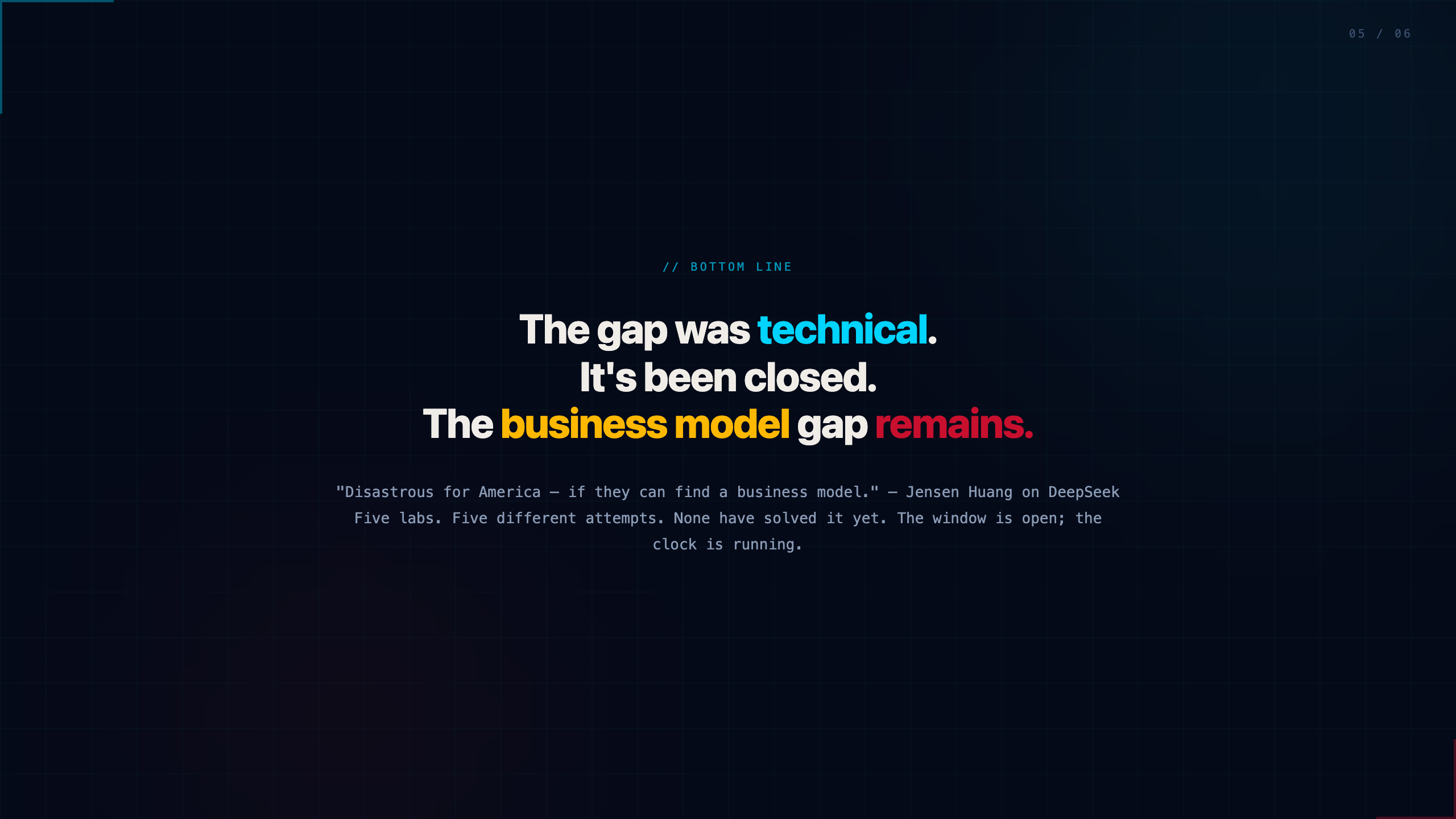
Chinese AI has moved from catching up to locally leading — on specific benchmarks that matter, with real architectural innovations behind the scores. The remaining gap is not technical capability; it's the conversion of that capability into sustainable businesses.
M3 beating GPT-5.5 on SWE-Bench Pro is the marker. Nvidia's Huang said of DeepSeek: "disastrous for America" — and then added the part that rarely gets quoted: "if they can find a business model." Five companies, five different attempts at that problem. None have solved it yet.
The window is open. The clock is running.
Resources
- MiniMax Official — M3 model and API access
- DeepSeek Platform — DeepSeek V4 API
- Zhipu AI — GLM series and enterprise offering
- Moonshot / Kimi — Kimi K2 model
- StepFun — Step series models
Data sourced from company financials, HK Exchange filings, and public reporting as of June 4, 2026. MiniMax M3 is available at platform.minimaxi.com. DeepSeek V4 is available at platform.deepseek.com.