MiniMax's pitch for M2.5 is a direct challenge to the logic of parameter scaling: 10 billion active parameters, agent-class performance that the company claims matches Opus 4.6 on coding and agentic tasks, and 100 TPS throughput at 3× Opus inference speed. For enterprises evaluating private deployment, the memory footprint argument alone is significant — same VRAM budget that runs one Opus-class instance can run three M2.5 instances.
The interesting question is not whether a 10B model can match performance on benchmark tables. It's whether the agent loop actually holds together under real multi-step, multi-file conditions. The answer from first-party testing is: mostly yes on execution, with a specific and predictable failure mode on large cross-file projects.
What M2.5 Is
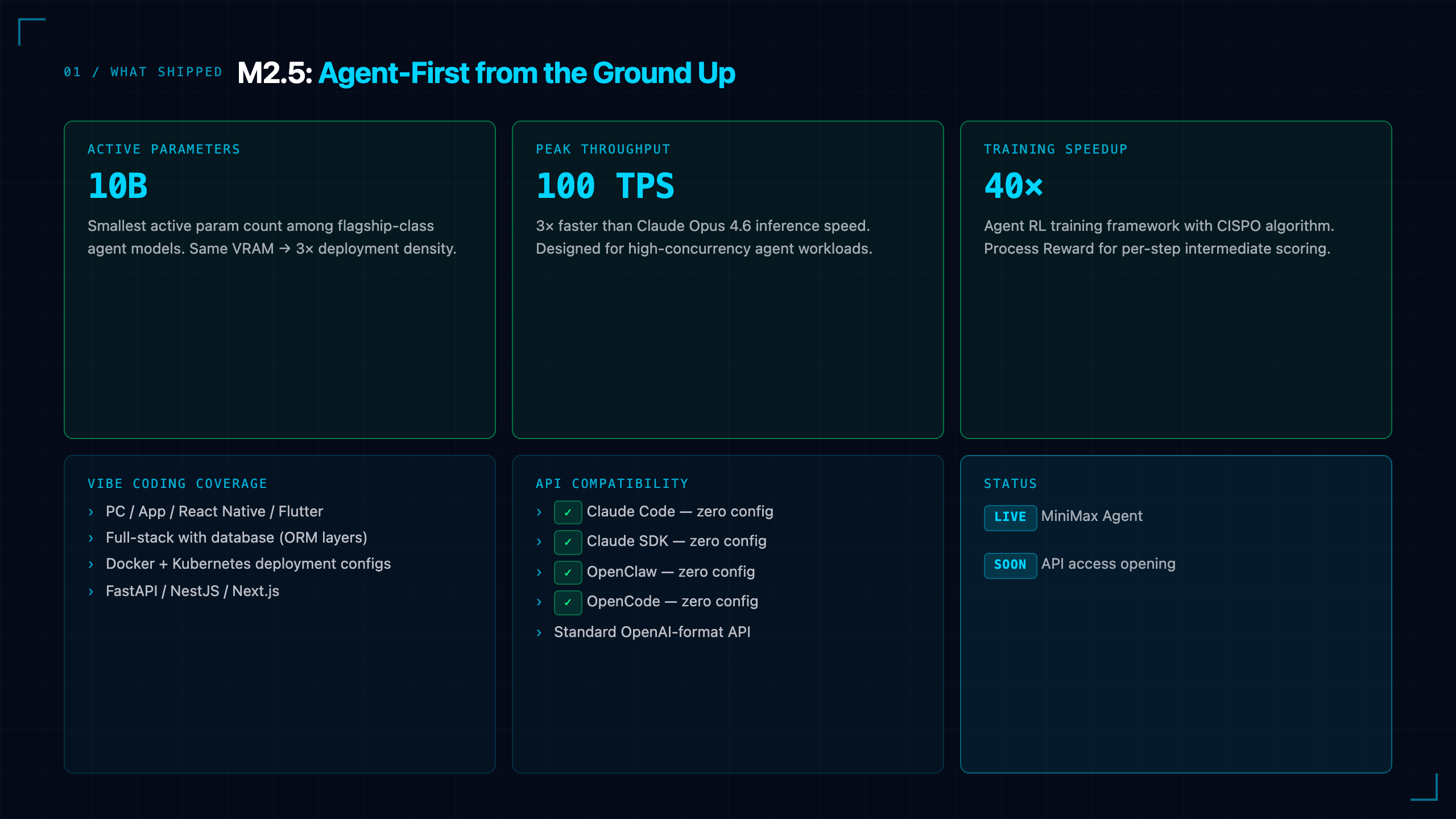
MiniMax M2.5 is an agent-first model with 10B active parameters (MoE architecture with a larger total parameter count). It ships as the engine behind MiniMax Agent and will open API access shortly. Compatible out of the box with Claude Code, Claude SDK, OpenClaw, and OpenCode via standard OpenAI-format API — zero adapter code required.
The headline specs:
- 100 TPS peak throughput
- 3× inference speed vs Claude Opus 4.6
- Agent-native training pipeline with CISPO reinforcement learning
- Vibe Coding support: PC, App, React Native, Flutter — full-stack with database
- OpenAI-compatible API
Three Cases, Measured Results
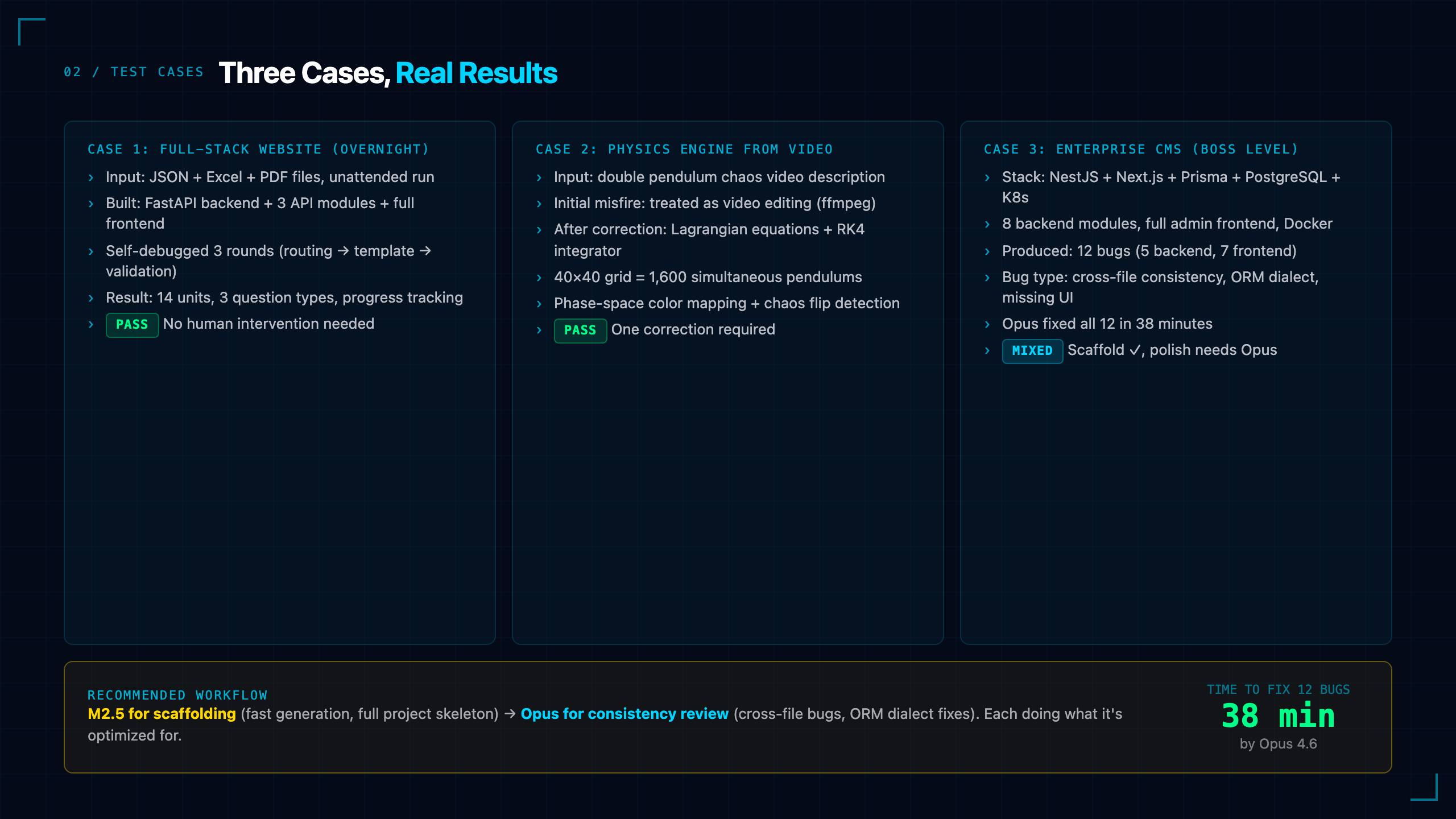
Case 1: Full-stack educational website (overnight run)
Prompt: build an interactive learning website from JSON knowledge points + Excel vocabulary + PDF source text. Unattended.
M2.5 completed the full loop without human intervention: read three file formats, installed dependencies, built a FastAPI backend with three API modules (unit content, quiz system, progress tracking), wrote a complete frontend, launched the service, and self-tested. The site covered 14 curriculum units, three question types, a progress tracker, and responsive layout.
One debug cycle of 3 rounds was required when the index route returned bare JSON instead of rendering the page. M2.5 caught the issue, diagnosed the routing misconfiguration, fixed template rendering, and validated. No human intervention needed. Build time: completed overnight.
Case 2: Physics engine from a video description
Prompt: understand a double pendulum chaos video + written description, reproduce the visualization in code.
Initial misfire: M2.5 treated "reproduce" as video editing and launched ffmpeg. One correction later, it delivered a full physics engine: Lagrangian equations of motion, 4th-order Runge-Kutta integrator, phase-space color mapping, chaos flip detection, and a 40×40 grid simulation running 1,600 pendulums simultaneously. The chaotic stability concepts from the original video ("almond-shaped stable regions," "stability islands in a chaos ocean") were correctly implemented. Final output: a Remotion video project with three scenes.
Case 3: Enterprise CMS — the stress test
Stack: NestJS + Next.js + Prisma ORM + PostgreSQL + Docker Compose + Kubernetes. Enterprise CMS with role-based permissions, content publishing, search, and analytics dashboard.
M2.5 built the full system. 8 backend service modules, complete admin frontend, Docker and K8s configuration. Estimated equivalent effort for a human team: one week for a small team. M2.5's version had 12 bugs — 5 backend, 7 frontend.
The failure pattern was specific: not logic errors within single modules (those were clean), but cross-file consistency issues. The same extractData unpacking pattern appeared in 3 different files with 3 inconsistent implementations. Some ORM queries were SQLite-compatible but failed on PostgreSQL. A few UI operations were missing.
All 12 bugs were handed to Claude Opus 4.6, which fixed them in 38 minutes. The M2.5-for-scaffolding + Opus-for-debug workflow has a real efficiency argument: M2.5's speed on project generation plus Opus's precision on consistency checking is faster than using either alone for the full task.
Why 10B Active Parameters Works
The answer according to MiniMax: specialized training, not general scaling.
Traditional LLM training builds a general base then fine-tunes for specific tasks. M2.5 inverts this by putting agent scenarios at the center of training from the start. MiniMax built a native Agent RL training framework that decouples the training engine from the agent environment. The engine processes token data and exposes a standard OpenAI interface. The agent side handles environment interaction and context management. The decoupling means any agent framework can plug in during training — Claude Code, OpenClaw, and third-party tooling were all present in the training loop.
The RL algorithm is CISPO (MiniMax's proprietary variant), extended with Process Reward — per-step scoring of intermediate outputs in multi-turn agent conversations, not just final-result scoring. This matters for agent tasks where a 50-turn conversation has correctness requirements at every intermediate step, not just the last output.
An execution timing evaluation is used to balance intelligence and speed: the model actively learns to find the optimal tradeoff between response quality and latency in agent contexts. The claimed result of 40× training acceleration from these engineering choices is what enables a 10B model to train at the quality level that would normally require much larger parameter counts.
API Compatibility: The Silent Differentiator

M2.5 passes zero-modification compatibility with Claude Code, Claude SDK, OpenClaw, and OpenCode. Standard OpenAI API format, no custom client wrappers. Switching a Claude Code session to M2.5 requires changing the API endpoint and key, nothing else.
For Chinese AI models, this level of API compatibility with the dominant Western agentic tooling is unusual. Most Chinese models require custom client code or a compatibility proxy. M2.5's native function calling, tool use, and multi-turn context handling implement the same contract that Claude Code expects, which is why the Claude Code integration works without modification.
This matters beyond convenience. Enterprises evaluating private deployment need to know the model works with their existing toolchain before they can evaluate it seriously. Zero adaptation cost removes that barrier.
What It Means for Developers
Agentic coding workflows: M2.5 at 100 TPS and 3× Opus speed is meaningfully faster for scaffolding and generation tasks. The known limitation is cross-file consistency on large projects (12+ files). The practical workflow: M2.5 for initial generation, Opus-class model for consistency review and bug fixing.
Private deployment: 10B active parameters versus 32B-100B for Opus-class models means roughly 3× the deployment density on the same hardware. For teams that need inference on-premises or in a private VPC, this is the concrete efficiency argument.
Vibe Coding / full-stack generation: M2.5's training coverage includes React, React Native, Flutter, Node, Python backends, ORM layers, and containerization. For typical product scaffolding tasks, the coverage appears broad enough to be practical.
API status: M2.5 is live on MiniMax Agent, with API access opening soon. Pricing has not been published at this writing. The existing MiniMax M3 API pricing ($1.50/M input, $3.00/M output) suggests M2.5 pricing may be positioned lower given the smaller active parameter count.
Bottom Line
M2.5 is the first credible argument from a Chinese lab that agent-specific training beats parameter count for agentic tasks. 10B active parameters, 3× Opus speed, zero toolchain adapter cost, and a known failure mode (cross-file consistency on large projects) that is addressable with a 38-minute Opus cleanup run. The deployment density argument for private hosting is real. The API hasn't opened yet, so the pricing question is open — watch minimax.io for API launch details.
Resources
- MiniMax Official Site — company homepage
- MiniMax Agent — M2.5 product (live)
- MiniMax API Platform — API access (opening soon)
- OpenClaw — compatible third-party agent framework
- CISPO Research — RL training algorithm background
MiniMax M2.5 is available via MiniMax Agent. API access is opening soon at api.minimax.chat. Pricing not yet announced.