DeepSeek just released DeepSeek-Math-V2, and the framing alone is worth paying attention to: this isn't another "we fine-tuned on more AIME problems" release. It's an architecture-level bet that the next frontier in mathematical AI isn't getting more correct answers — it's building models that can verify their own reasoning. The results back the bet: gold-level scores on IMO 2025, 118/120 on Putnam 2024, and a clean sweep of CMO 2024.
The key insight is deceptively simple but hard to execute: correct final answers don't guarantee correct reasoning, and many mathematical tasks (theorem proving, proof construction) require rigorous step-by-step derivation where final-answer rewards are inapplicable. Math-V2 addresses this head-on with a self-verification loop.
The Self-Verification Architecture
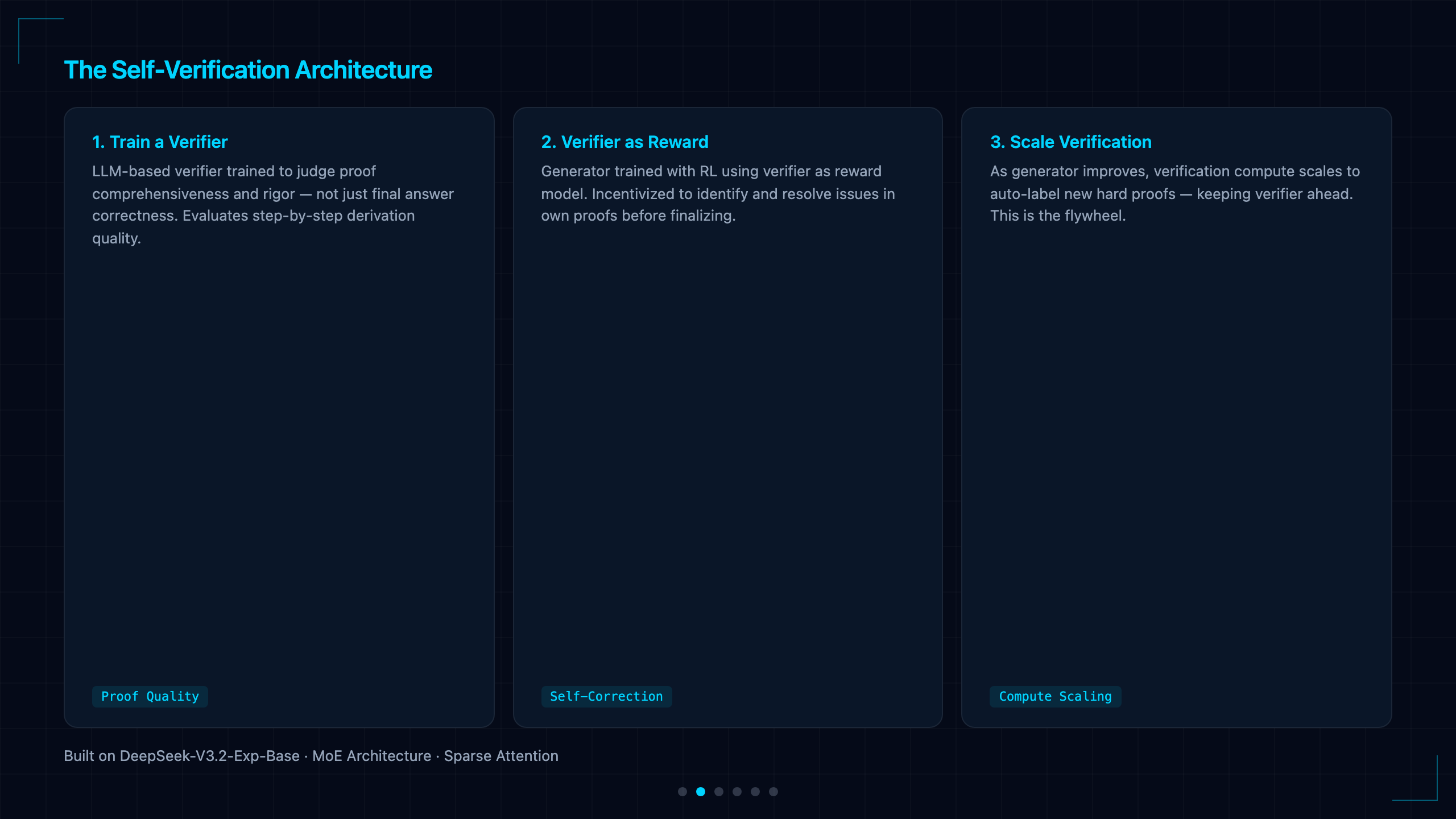
Math-V2's approach has three interlocking components:
1. Train an accurate LLM-based verifier for theorem proving. This isn't a simple reward model — it's trained to judge the comprehensiveness and rigor of mathematical proofs, not just whether the final answer is correct.
2. Use the verifier as a reward model for the generator. The proof generator is trained with RL where the verifier provides the reward signal. Critically, the generator is incentivized to identify and resolve issues in its own proofs before finalizing them — self-correction as a trained behavior, not a prompting hack.
3. Scale verification compute to maintain the gap. As the generator improves, the verifier must stay ahead. Math-V2 scales verification compute to automatically label new hard-to-verify proofs, creating fresh training data to keep the verifier stronger than the generator. This is the flywheel that makes the system scale.
The model is built on DeepSeek-V3.2-Exp-Base, inheriting the MoE architecture and sparse attention infrastructure from DeepSeek's production models.
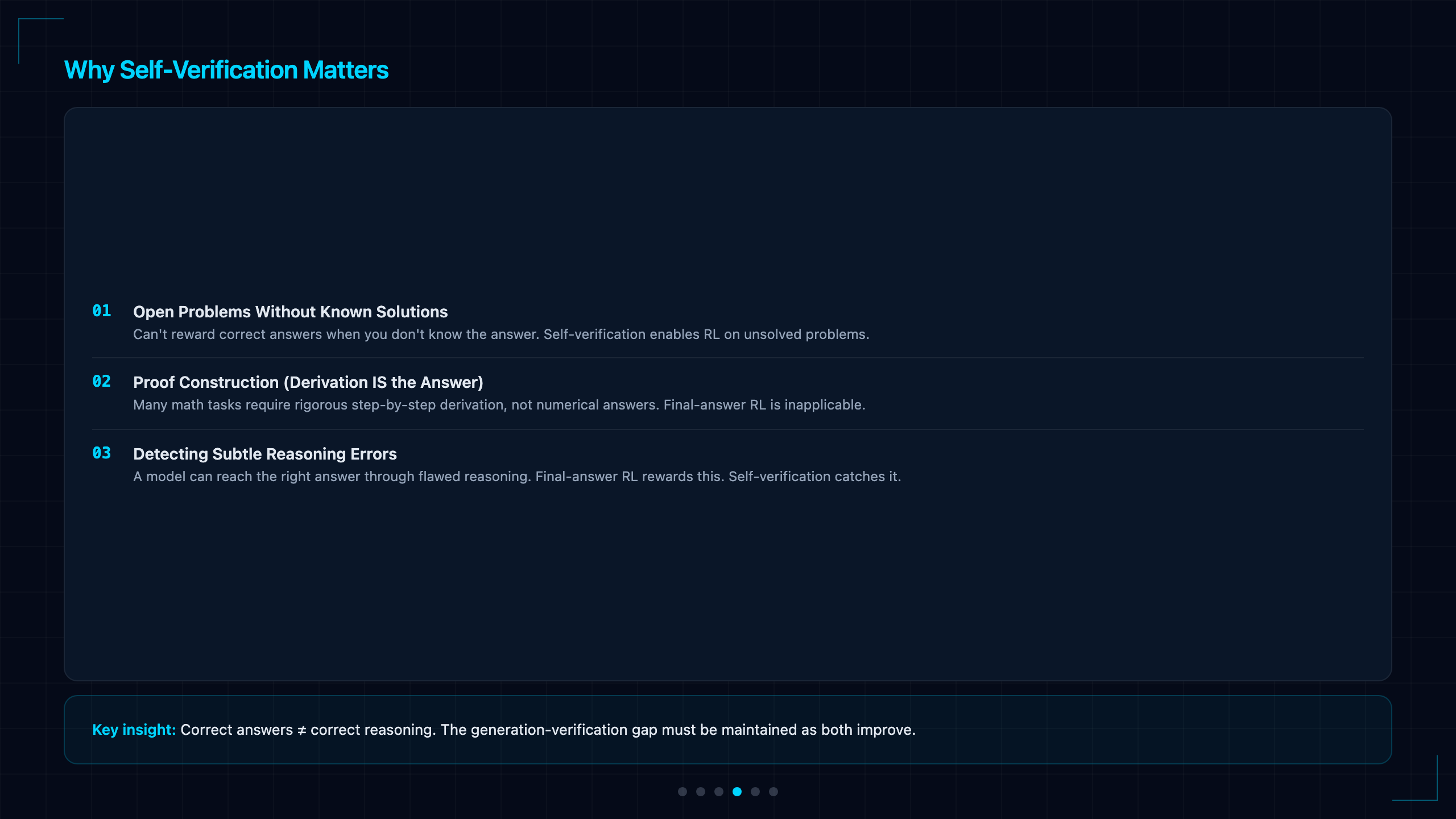
Competition Results
The headline numbers are extraordinary:
| Competition | Score | Notes |
|---|---|---|
| IMO 2025 | Gold-level | Full formal proofs, not just answer matching |
| Putnam 2024 | 118/120 | Near-perfect on one of the hardest undergraduate math exams |
| CMO 2024 | Solved | Chinese Mathematical Olympiad |
| IMO-ProofBench | State-of-the-art | DeepMind's benchmark for superhuman theorem proving |
These results use scaled test-time compute — the model generates multiple proof attempts and uses its verifier to select the best ones. But the verifier isn't just picking the shortest proof; it's evaluating logical rigor at each step.
On IMO-ProofBench (developed by the DeepMind team behind DeepThink IMO-Gold), Math-V2 sets a new state-of-the-art. This is notable because IMO-ProofBench specifically tests formal proof generation, not answer extraction.
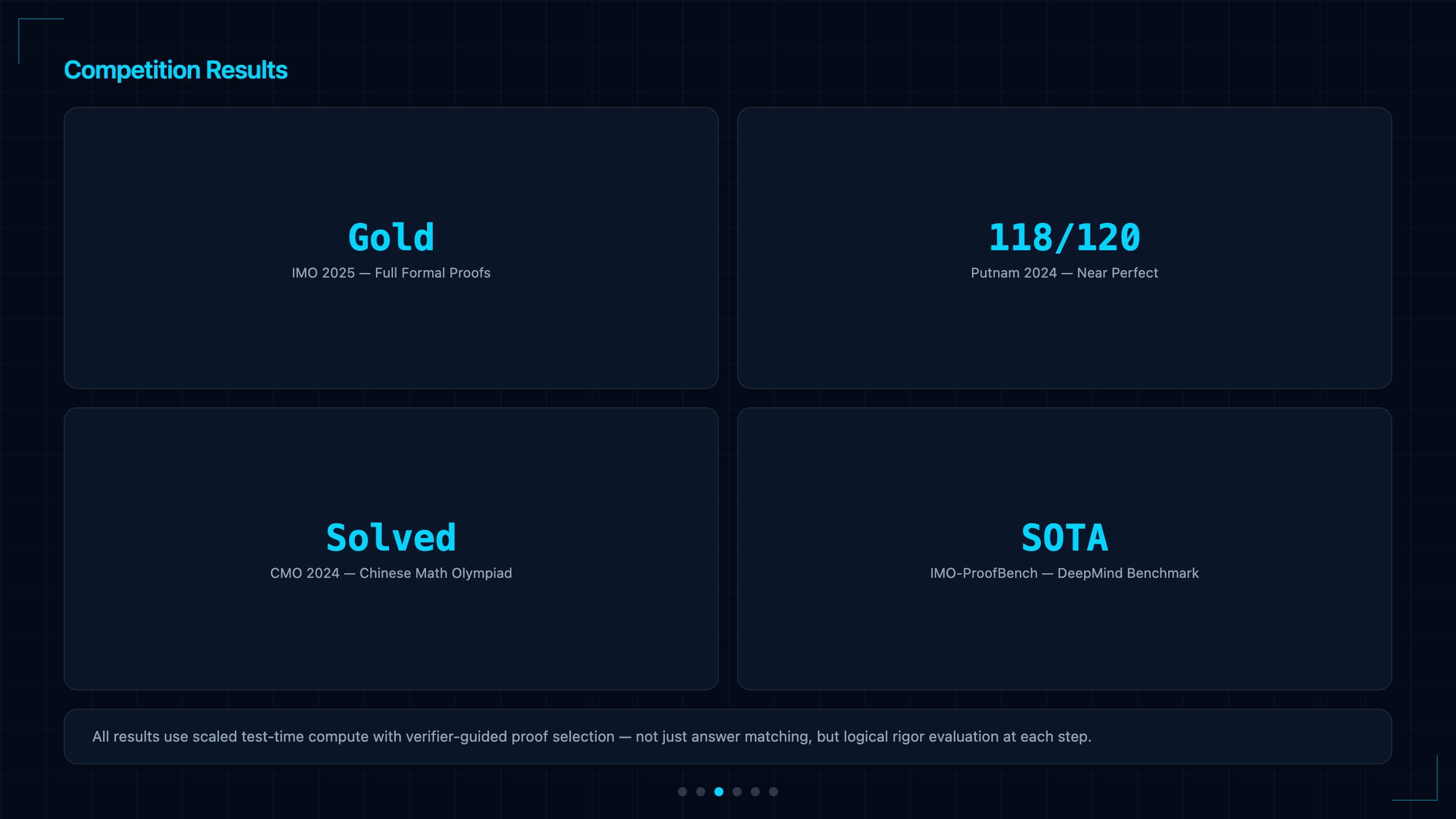
Why Self-Verification Matters
Previous mathematical reasoning models (including DeepSeek's own Prover-V2) relied heavily on final-answer RL: generate solutions, check if the answer is right, reward correct ones. This works for competition problems with numerical answers but fundamentally can't scale to:
- Open problems without known solutions — you can't reward what you can't verify externally
- Proof construction where the derivation is the answer
- Detecting subtle errors — a model might reach the right answer through flawed reasoning, and final-answer RL will reward this
Math-V2's self-verification approach addresses all three. The verifier learns to judge proof quality independently of whether a ground-truth answer exists. This is the key architectural difference from everything that came before.
The scaling compute strategy is particularly clever: as the generator gets better, it produces proofs that are harder to verify (more sophisticated, longer, subtler errors). Rather than letting the verifier fall behind, Math-V2 automatically uses the new hard proofs as training data for the verifier, maintaining the gap.
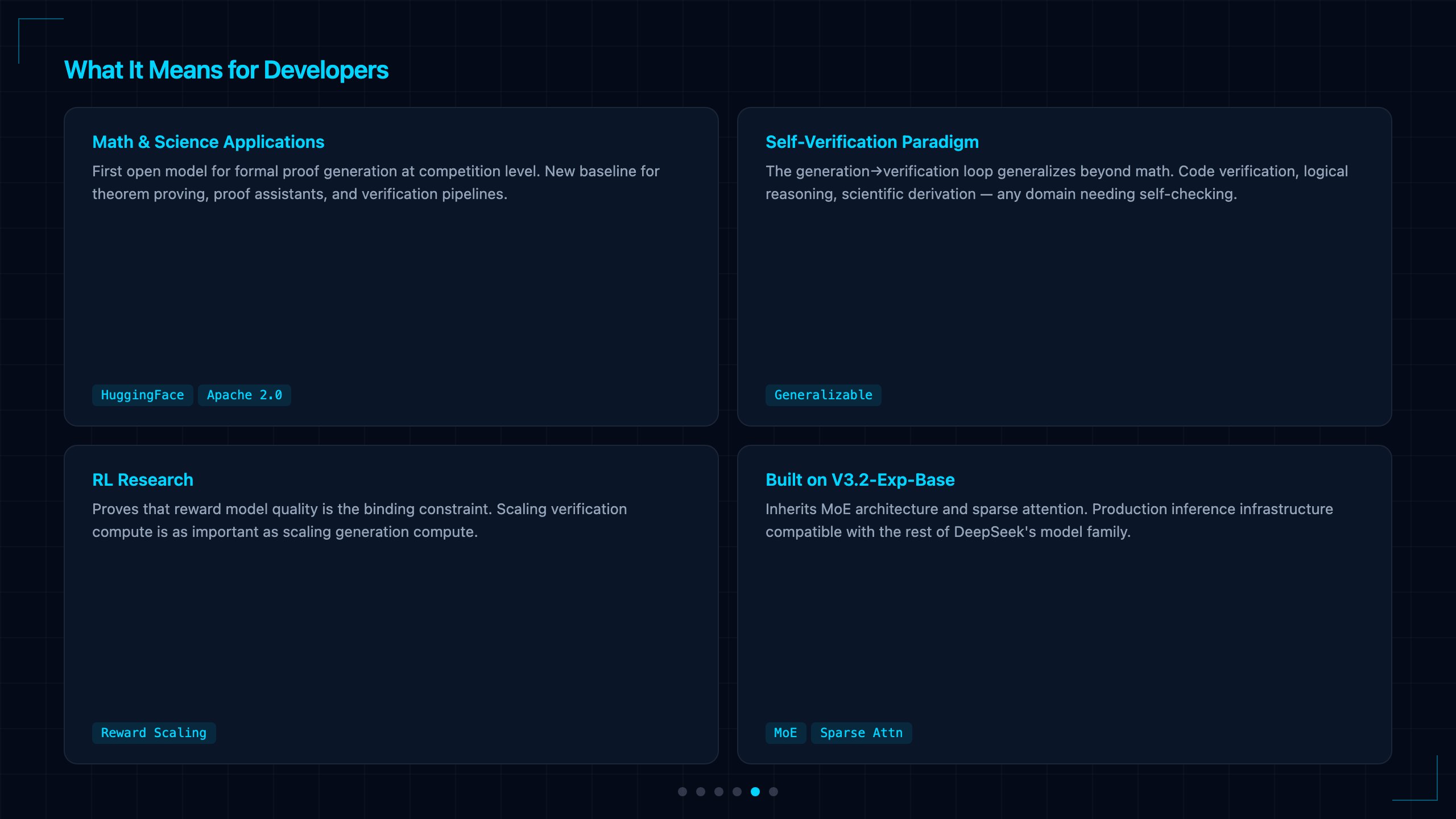
What It Means for Developers
For math/science applications: This is the first open model that can produce and verify formal proofs at competition level. If you're building tools for automated theorem proving, proof assistants, or mathematical verification pipelines, Math-V2 is the new baseline.
For the self-verification paradigm: The generation-verification loop is generalizable beyond math. Any domain where you need models to check their own work — code verification, logical reasoning, scientific derivation — can potentially adopt this architecture. The key engineering challenge is maintaining the verifier's edge as the generator improves.
For RL researchers: The paper demonstrates that reward model quality is the binding constraint on generator performance. Scaling verification compute is as important as scaling generation compute. This has implications for RLHF broadly.
Bottom Line
DeepSeek-Math-V2 shifts mathematical AI from "solve more problems" to "prove things rigorously." The self-verification architecture — train a verifier, use it as reward, scale it to stay ahead — is a clean engineering solution to the fundamental limitation of final-answer RL. Gold on IMO 2025 with formal proofs (not answer matching) is the proof that the approach works. Built on V3.2-Exp-Base, Apache 2.0 licensed, weights on HuggingFace.
Resources
- GitHub Repository — model code and outputs
- HuggingFace Weights — model download
- DeepSeek Platform — API access
- IMO-ProofBench — evaluation benchmark
DeepSeek-Math-V2 is available for download at huggingface.co/deepseek-ai/DeepSeek-Math-V2. Built on DeepSeek-V3.2-Exp-Base.