DeepSeek V3.2 launched this week. Inside the technical changelog, one item stood out: "Thinking in Tool-Use." The feature lets the model reason between tool calls rather than treating each call as a stateless operation.
Within 24 hours, comments were pointing out this wasn't a DeepSeek first. MiniMax called it Interleaved Thinking. Anthropic called it Extended Thinking. Kimi called it "thinking while using tools." The capability is the same: reasoning state preserved and extended across tool call boundaries.
What Interleaved Thinking Actually Is
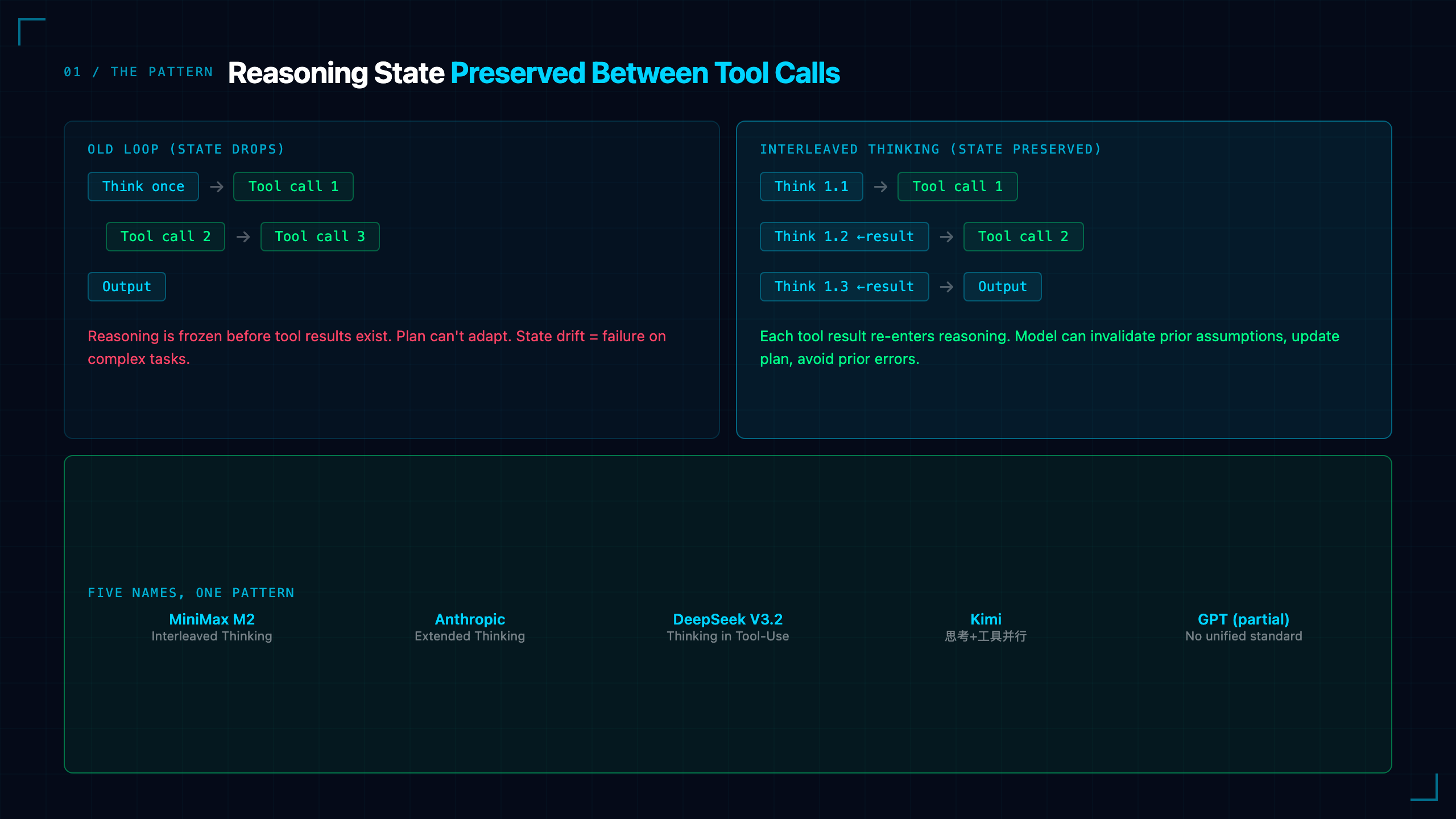
The traditional LLM-in-agent loop:
- Receive task
- Think (once)
- Execute tool calls sequentially
- Return final output
The problem with this pattern: after tool call 1 returns, the model doesn't re-evaluate. It continues executing the plan it formed before any tool results existed. When the results contradict the plan, the model has no mechanism to adjust mid-execution. The failure modes are well-known: logic breaks between tool calls, plan skips when tool results don't match expectations, repeated errors because the prior attempt isn't retained in active reasoning.
Interleaved Thinking inserts a reasoning step after each tool result:
- Think → decide which tool to call
- Call tool
- Receive result
- Think again — does this result update or invalidate the current plan?
- Decide: call another tool or return final answer
- Repeat
The thinking content isn't discarded. It's preserved and fed into the next reasoning step as context. The model can explicitly note "step 1 returned X, which means my assumption about Y was wrong, so I'm now changing the approach to Z."
This is what transforms a model that executes tool sequences into a model that reasons through tasks — what developers mean by "actually agentic."
Why Everyone Is Building This
The convergence across labs is not coincidental — it reflects the same engineering constraint.
As agent workflows get more complex (multi-step research, iterative code writing, multi-tool orchestration), task length becomes the main failure axis. A 3-step task is forgiving. A 15-step task with 10 tool calls requires the model to:
- Remember which strategies it already tried
- Track state changes across multiple tool outputs
- Avoid repeating errors
- Maintain goal coherence across a conversation that has grown long
Without Interleaved Thinking, models in multi-step agent loops exhibit "state drift" — they begin losing track of their own prior reasoning, which cascades into contradictory decisions. With it, the reasoning chain is a first-class artifact that persists across the entire task.
MiniMax's Quantified Results
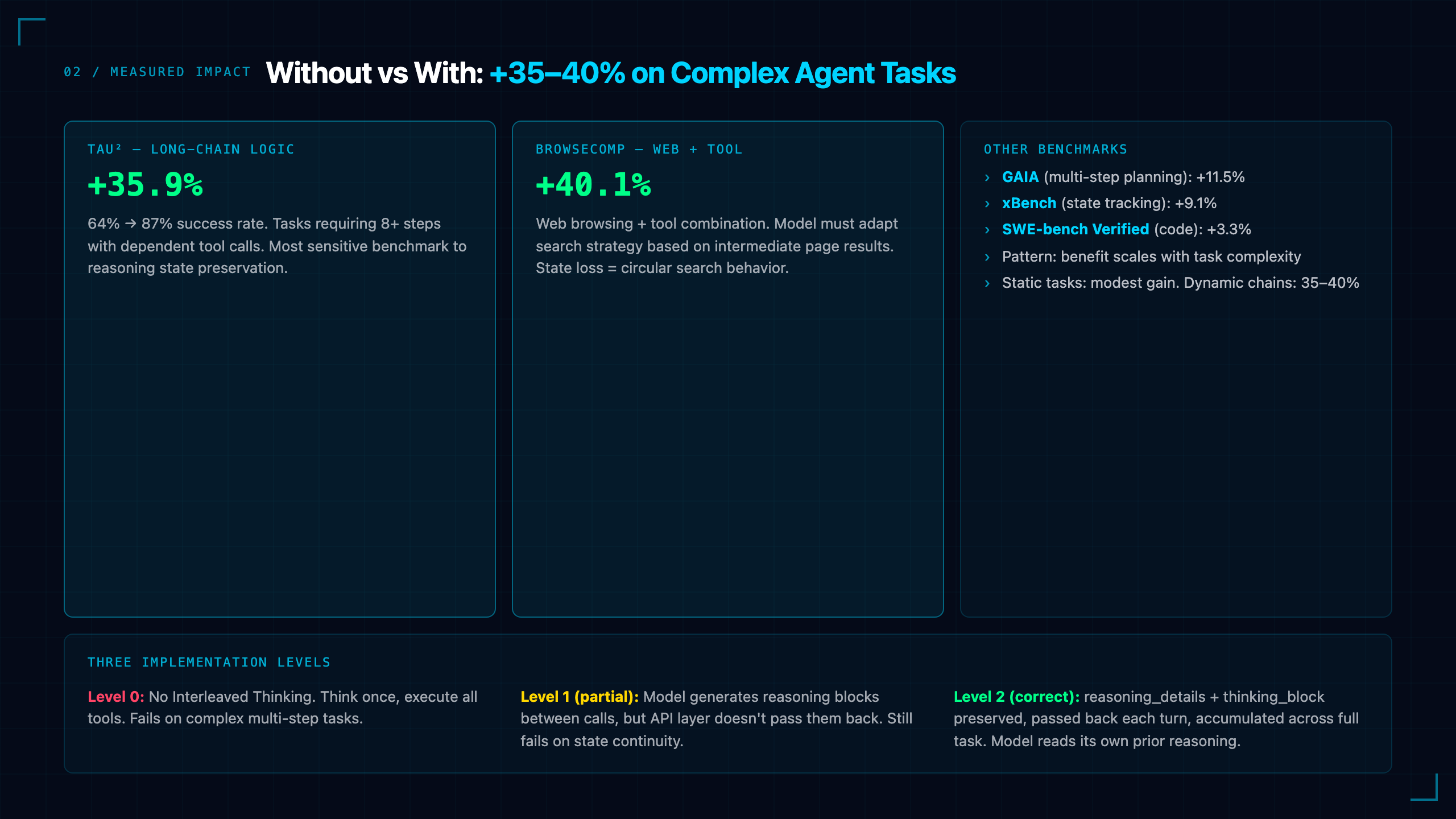
MiniMax M2 was among the first to publish benchmarks measuring the effect of Interleaved Thinking specifically. Testing with and without the capability enabled, on tasks directly relevant to agentic workflows:
| Benchmark | Without | With | Delta |
|---|---|---|---|
| Tau² (long-chain logic) | 64% | 87% | +35.9% |
| BrowseComp (web + tool) | baseline | +40.1% | +40.1% |
| GAIA (multi-step planning) | baseline | +11.5% | +11.5% |
| xBench (state tracking) | baseline | +9.1% | +9.1% |
| SWE-bench Verified (code) | baseline | +3.3% | +3.3% |
The pattern: benefit scales with task complexity. Static code tasks (+3.3%) see modest gains. Tasks requiring iterative tool use and state tracking (Tau², BrowseComp) see 35–40% improvement. The implication is that the capability becomes increasingly critical as agent tasks become more complex — which is the direction the industry is moving.
Three Implementation Levels
The article distinguishes three failure modes in Interleaved Thinking implementations:
Level 0 (no Interleaved Thinking) — standard pattern: model thinks at start, executes all tool calls, reasoning is not preserved or reused. Fails on complex multi-step tasks.
Level 1 (partial) — model generates reasoning between tool calls, but the API layer doesn't pass those reasoning blocks back to the model in subsequent turns. The model can generate thinking content, but can't read its own prior reasoning. Still fails on tasks requiring state continuity.
Level 2 (correct implementation) — reasoning blocks are preserved in API calls with proper field structure (reasoning_details, thinking_block), passed back to the model in each subsequent turn, and accumulated across the full task. The model can explicitly reference and update its own prior reasoning at each step.
Most implementations are Level 1. Level 2 requires both model-level support (the model is trained to use persistent reasoning state) and API-level support (the interface exposes and accepts the reasoning fields).
MiniMax's Ecosystem Push
Following the M2 release, MiniMax took three steps to turn the capability into an industry standard rather than a lab-internal feature:
Mini-Agent open-source reference implementation — 700+ GitHub stars as a minimal, correct implementation of the full Interleaved Thinking loop. Provides developers a working example of the "think → act → return result → think again" cycle without proprietary dependencies.
Third-party platform integration — submitted PRs to Kilo Code, Cline, RooCode, OpenRouter, and Ollama to add native Interleaved Thinking support. Cross-platform testing to verify consistent behavior across different tool call implementations.
API field standardization — published formal field specifications for reasoning_details and thinking_block, making the interface implementable by other providers and enabling benchmarking across implementations.
The direct payoff: MiniMax M2 was added to Amazon Bedrock at AWS re:Invent 2025, alongside Google Gemma and NVIDIA Nemotron — one of the first Chinese models named directly in the AWS CEO keynote. The Bedrock listing validates that the API interface meets enterprise integration standards, not just performance benchmarks.
What It Means for Developers
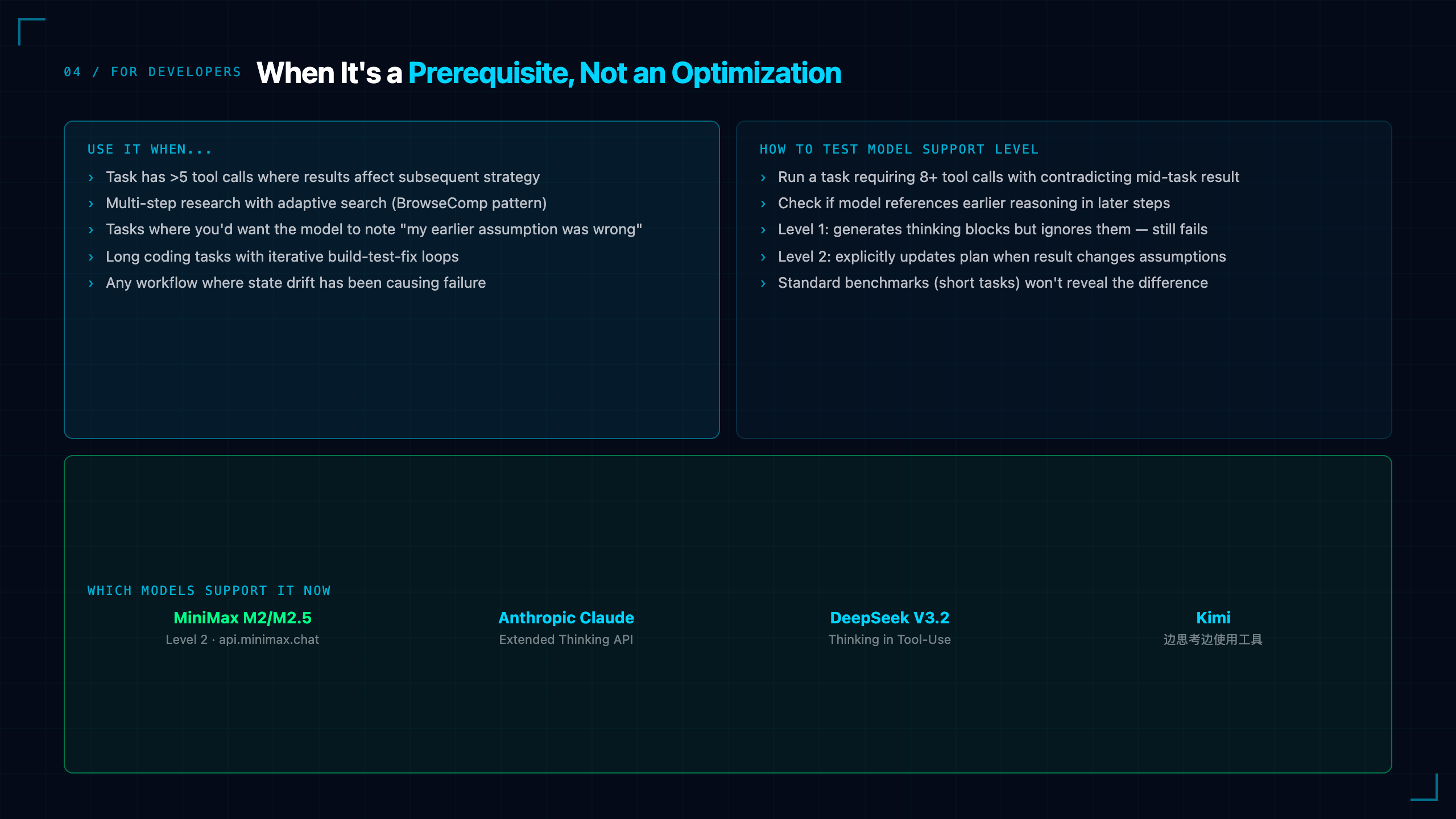
For agent framework developers: The capability is now available across MiniMax M2/M2.5, Anthropic Claude, DeepSeek V3.2, Kimi. The convergence means developers can write agent frameworks against a consistent pattern without provider lock-in, and expect similar behavior across models.
For tool-heavy workflows: If your agent calls more than 5 tools in sequence, or handles tasks that require adapting strategy based on intermediate results, Interleaved Thinking is not an optimization — it's a prerequisite for reliable execution. The +35.9% on Tau² and +40.1% on BrowseComp are not edge-case improvements; they reflect the baseline difference between a model that can handle dynamic multi-step tasks and one that can't.
For Claude Code users specifically: The Extended Thinking + Tool Use combination is the production-ready version of this pattern in Claude's API. For tasks that mix research (web search, document analysis) with execution (code writing, file editing), enabling extended thinking allows the model to maintain coherent strategy across the full task rather than re-planning from scratch after each tool call.
What to evaluate: When comparing models for agent use cases, test against long-chain tasks (>8 tool calls) where results can invalidate prior assumptions. Standard benchmark tasks are often too short to distinguish Level 1 from Level 2 implementations. The difference only becomes visible at task lengths that force the model to use its accumulated reasoning history.
Bottom Line
Interleaved Thinking is not a single lab's innovation — it emerged independently at several companies because it addresses the same fundamental problem in agentic AI. The feature has different names (Interleaved Thinking, Extended Thinking, Thinking in Tool-Use) but identical mechanics: reasoning state preserved and updated between tool calls.
MiniMax's contribution was converting it from a capability into an engineering standard: benchmarked, open-sourced, integrated across the agent tool ecosystem, and validated at enterprise scale via AWS Bedrock. DeepSeek V3.2 joining is not competition — it's confirmation that this pattern is the baseline for serious agent model work.
The models that don't support it are disqualifying themselves from complex agent tasks. The ones that do are competing on implementation quality — reasoning preservation depth, context length during tool chains, and API design that makes the reasoning state accessible and returnable.
Resources
- Mini-Agent GitHub — MiniMax's open-source reference implementation
- MiniMax API — M2/M2.5 with Interleaved Thinking support
- Anthropic Extended Thinking docs — Extended Thinking + Tool Use documentation
- DeepSeek V3.2 — DeepSeek's Thinking in Tool-Use release
MiniMax M2 and M2.5 with Interleaved Thinking are available via API at api.minimax.chat. The Mini-Agent reference implementation is open-source at github.com/MiniMax-AI/Mini-Agent.