Two weeks after launch, MiniMax M2 has hit OpenRouter's Top 5 by token volume — the fastest-growing Chinese model on the platform, and actual usage data, not marketing benchmarks. The free period ended, and MiniMax followed with a subscription pricing model aimed directly at developers who use coding tools daily.
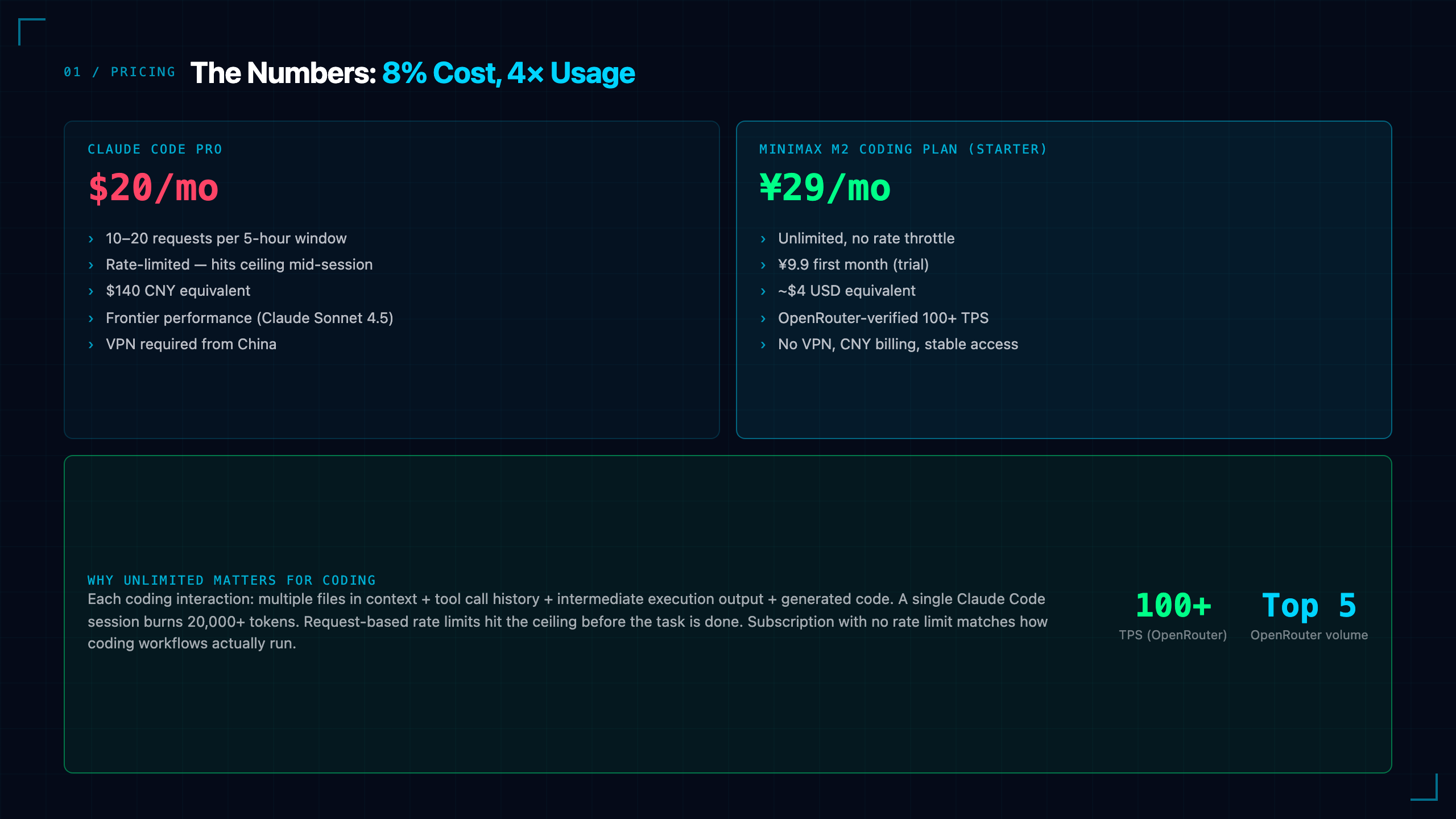
The pricing is aggressive: ¥9.9 first month (Starter tier), then ¥29/month for unlimited, rate-limit-free access to M2. The comparison to Claude Code Pro ($20/month, which rate-limits to 10–20 requests per 5-hour window) is stark — 8% of the cost at 4× the usage allowance.
The Coding Plan Tiers
Three tiers:
| Tier | Price | Usage |
|---|---|---|
| Starter | ¥29/month (¥9.9 first month) | Unlimited, unthrottled |
| Standard | Higher | More capacity |
| Pro | Highest | Enterprise scale |
"Unlimited, unthrottled" is the key claim. Coding workflows are token-heavy — each interaction involves multiple files in context, tool call history, intermediate execution output, and generated code. A Claude Code session can easily burn 20,000+ tokens in a single task. Subscription plans that meter by request rather than by token are better suited to this usage pattern.
At ¥29/month with no rate limits, the comparison to Claude Code's $20/month with 10–20 requests per 5-hour cap is not close. For developers who push against Claude's rate limits regularly, this is a material cost and workflow difference.
Sign up: platform.minimaxi.com/subscribe/coding-plan
Why OpenRouter Top 5 Matters
The OpenRouter token volume data is not a promotional metric — it's aggregated across real API calls from independent developers and tools. Hitting Top 5 in two weeks means:
- The post-free-period conversion is real: developers tried M2, liked it enough to pay
- Quality holds at scale: performance under load is consistent with benchmark claims
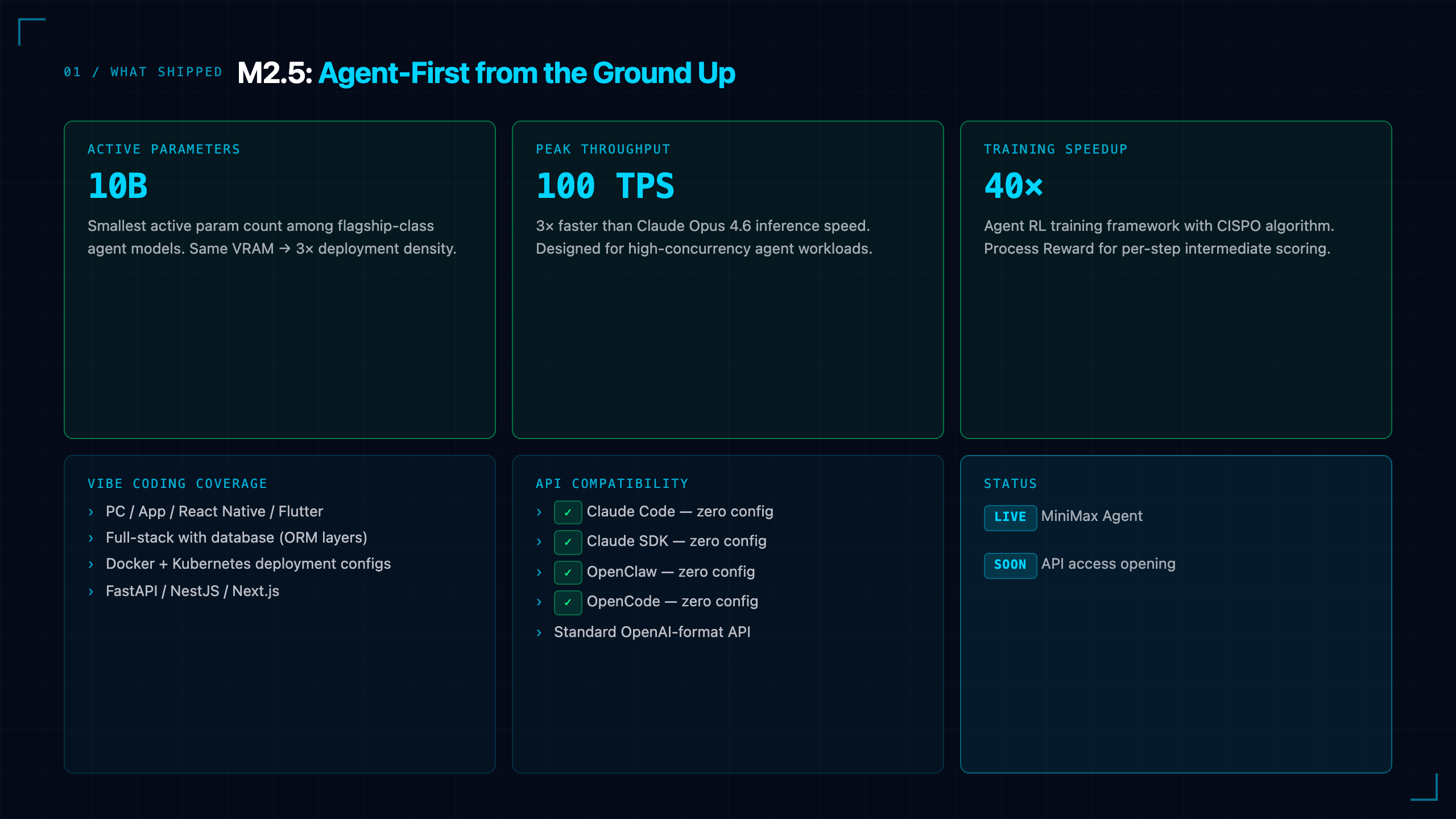
- The API ecosystem integration is working: Claude Code, Cursor, Cline, OpenRouter, Ollama all support M2 with minimal configuration
Token speed is another practical advantage. OpenRouter's instrumentation shows M2 sustaining 100+ TPS. For coding workflows, generation speed matters because it's in the critical path of the development loop — a model that generates 3× faster allows tighter iteration cycles.
5-Minute Setup for Claude Code
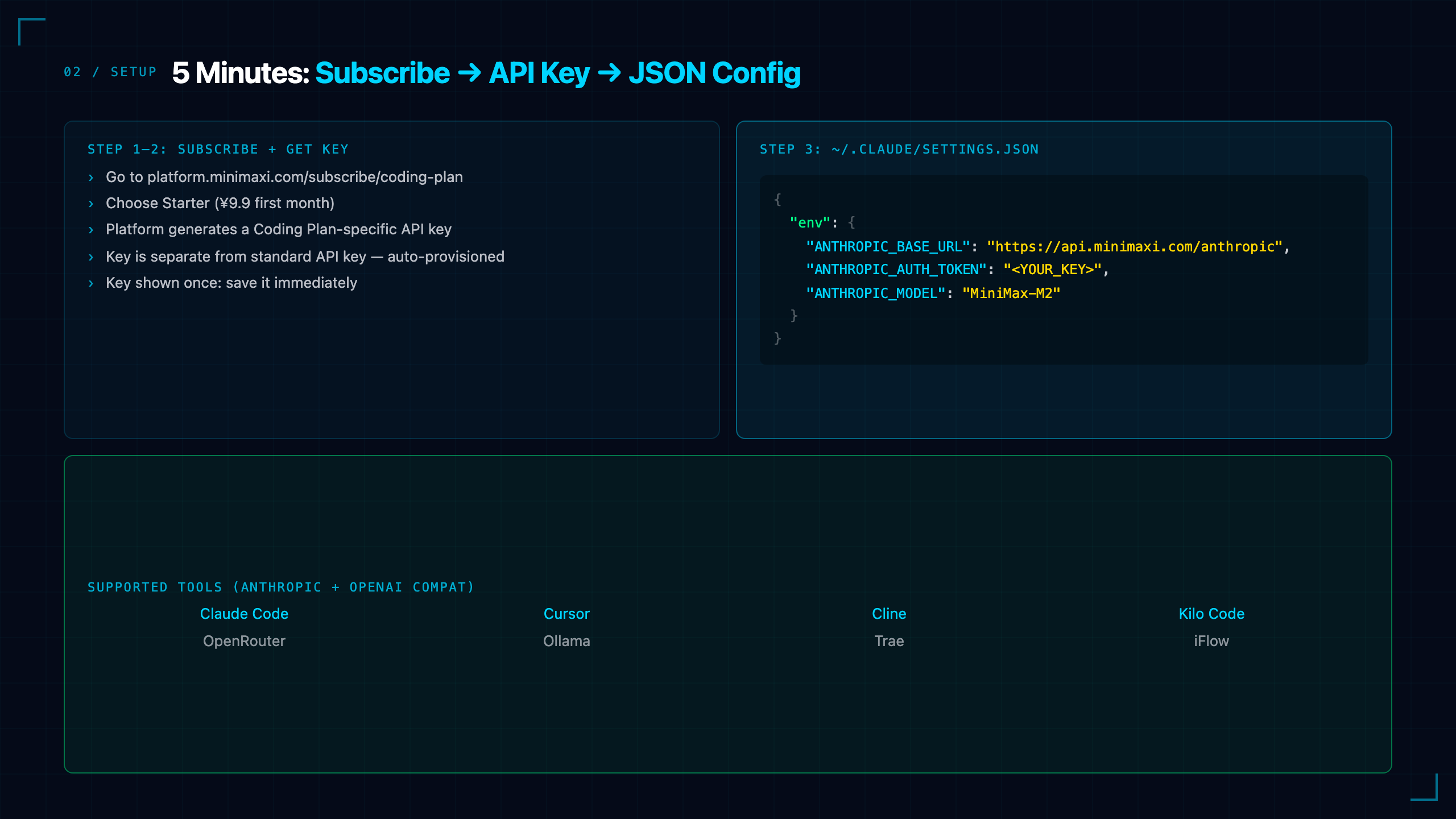
MiniMax supports both Anthropic and OpenAI API formats. For Claude Code:
Step 1 — Subscribe at platform.minimaxi.com/subscribe/coding-plan. The platform generates a Coding Plan-specific API key automatically.
Step 2 — Add to ~/.claude/settings.json:
{
  "env": {
    "ANTHROPIC_BASE_URL": "https://api.minimaxi.com/anthropic",
    "ANTHROPIC_AUTH_TOKEN": "<YOUR_MINIMAX_API_KEY>",
    "API_TIMEOUT_MS": "3000000",
    "CLAUDE_CODE_DISABLE_NONESSENTIAL_TRAFFIC": 1,
    "ANTHROPIC_MODEL": "MiniMax-M2",
    "ANTHROPIC_SMALL_FAST_MODEL": "MiniMax-M2"
  }
}
That's it. Claude Code's existing tool integrations, file operations, and workflow all work through M2's Anthropic-compatible endpoint. No new client library, no API wrapper.
Same pattern applies for Cursor (Settings → Model → Override OpenAI Base URL to https://api.minimaxi.com/v1), Cline, Kilo Code, and other tools that support custom API endpoints.
What M2 Handles Well
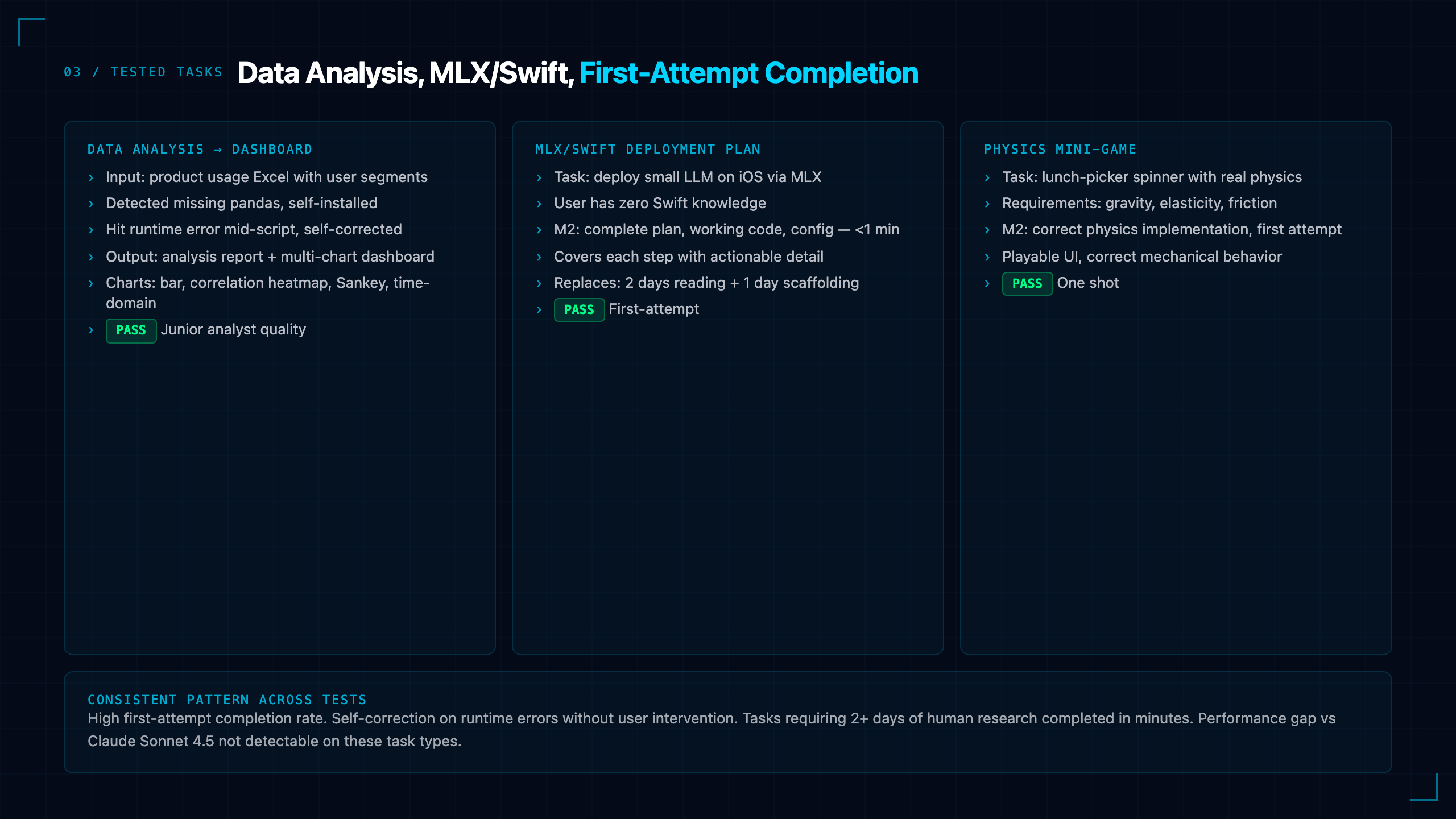
Three practical tasks tested:
Data analysis to dashboard — input: Excel file with product usage data by user segment. Task: cluster by different dimensions, produce a dashboard. M2 detected missing Python packages (pandas), installed them, wrote the analysis script, hit a runtime error, self-corrected, and returned a multi-chart dashboard: bar charts, query feature correlation heatmap, time-domain heatmap, user behavior Sankey diagram. Quality consistent with junior analyst output.
MLX/Swift deployment plan — task: deploy a small language model on iOS using MLX. No prior Swift knowledge provided. M2 produced a complete, structured plan with working code and config for each step in under one minute. Assessment: replaces 2 days of reading + 1 day of scaffolding.
Physics-aware mini-game — task: build a lunch-picker spinner with realistic physics (gravity, elasticity, friction). M2 generated a working implementation on first attempt with correct physics modeling.
The pattern across tasks: first-attempt completion rate is high, self-correction on runtime errors is functional, and tasks that previously required extended iteration complete in one pass.
Why Chinese Models Make Sense Now
The gap between frontier Chinese and Western AI models has narrowed significantly in 2025. Two years ago, the capability difference was 1–2 generations. Now it's task-specific: Chinese models often outperform on Chinese-language tasks, and performance on code generation and multi-step tool use has converged for most practical development work.
The remaining advantages for Chinese models over Claude/GPT for developers in China:
- No VPN required, stable API connectivity
- CNY pricing removes currency exchange overhead
- Anthropic/OpenAI API rate limits become the binding constraint well before capability does
For developers who've been using Claude Code but hitting rate limits, M2 is not a compromise — it's a parallel option with different tradeoffs on cost, speed, and access.
Bottom Line
MiniMax M2 at ¥29/month unlimited vs Claude Code Pro at $20/month rate-limited is a pricing decision that's easy to make if you're already using M2 on OpenRouter and like the results. The Anthropic-compatible API means zero migration cost — one config file change.
The Coding Plan is a subscription play, not a one-off promotion. The bet is that developers who start with ¥9.9/month will stick at ¥29/month because M2's performance at coding tasks is close enough to Claude that the cost differential wins.
For developers who use Claude Code daily and push against the rate limits, it's worth running both for a week and measuring completion quality vs cost.
Resources
- MiniMax Coding Plan — subscription link
- MiniMax API Platform — API keys and dashboard
- Anthropic API Compatibility docs — setup guide
- OpenRouter MiniMax listing — usage metrics and per-call access
MiniMax M2 Coding Plan is available at platform.minimaxi.com/subscribe/coding-plan. Starter tier: ¥9.9 first month, ¥29/month thereafter.