Shanghai AI Lab released InternLM3-8B-Instruct in January 2025, demonstrating that strong mathematical reasoning didn't require a 70B+ model. The 8B variant achieved 74.0% on MATH and 83.6% on MMLU-Pro — benchmark results that were competitive with Llama-3.1-70B at 8B inference cost.
The headline feature: Thinking Mode. InternLM3 can operate in two modes using the same model weights — as a reasoning model that produces extended chain-of-thought output, or as a direct-answer model without the overhead. This lets developers use one model for both latency-sensitive and accuracy-critical workloads.
What's New
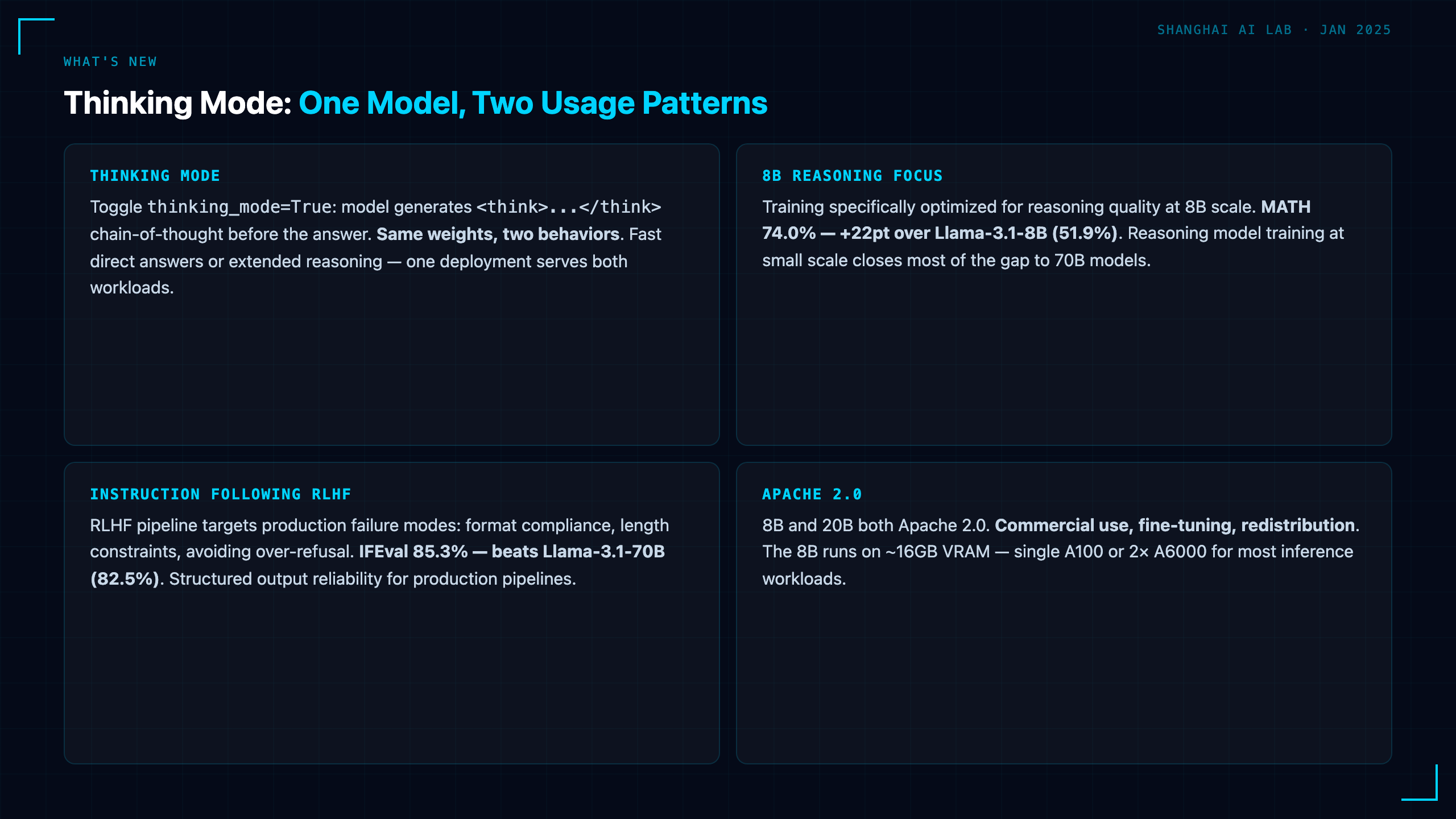
Thinking Mode: InternLM3-8B supports a thinking_mode flag that switches the model between extended chain-of-thought reasoning and direct response. In thinking mode, the model produces <think>...</think> blocks with step-by-step reasoning before the final answer — similar to DeepSeek-R1's extended thinking, but in an 8B model. The same weights, two usage patterns.
8B reasoning efficiency: InternLM3 was specifically trained to maximize reasoning quality at the 8B scale. The training pipeline uses a mix of supervised fine-tuning on reasoning traces and RLHF to improve both accuracy and calibration. The result is an 8B model that substantially outperforms Llama-3.1-8B on math and science benchmarks.
Instruction following improvements: Beyond reasoning, InternLM3 focuses on reliable instruction following — following complex multi-step instructions, outputting in specified formats, respecting length constraints, and avoiding common failure modes like over-refusal. The RLHF pipeline specifically targets these production-critical behaviors.
Apache 2.0 license: All InternLM3 variants are Apache 2.0 — commercial use, fine-tuning, and redistribution. The 8B model runs comfortably on a single A100 or 3× A6000 GPUs.
Architecture
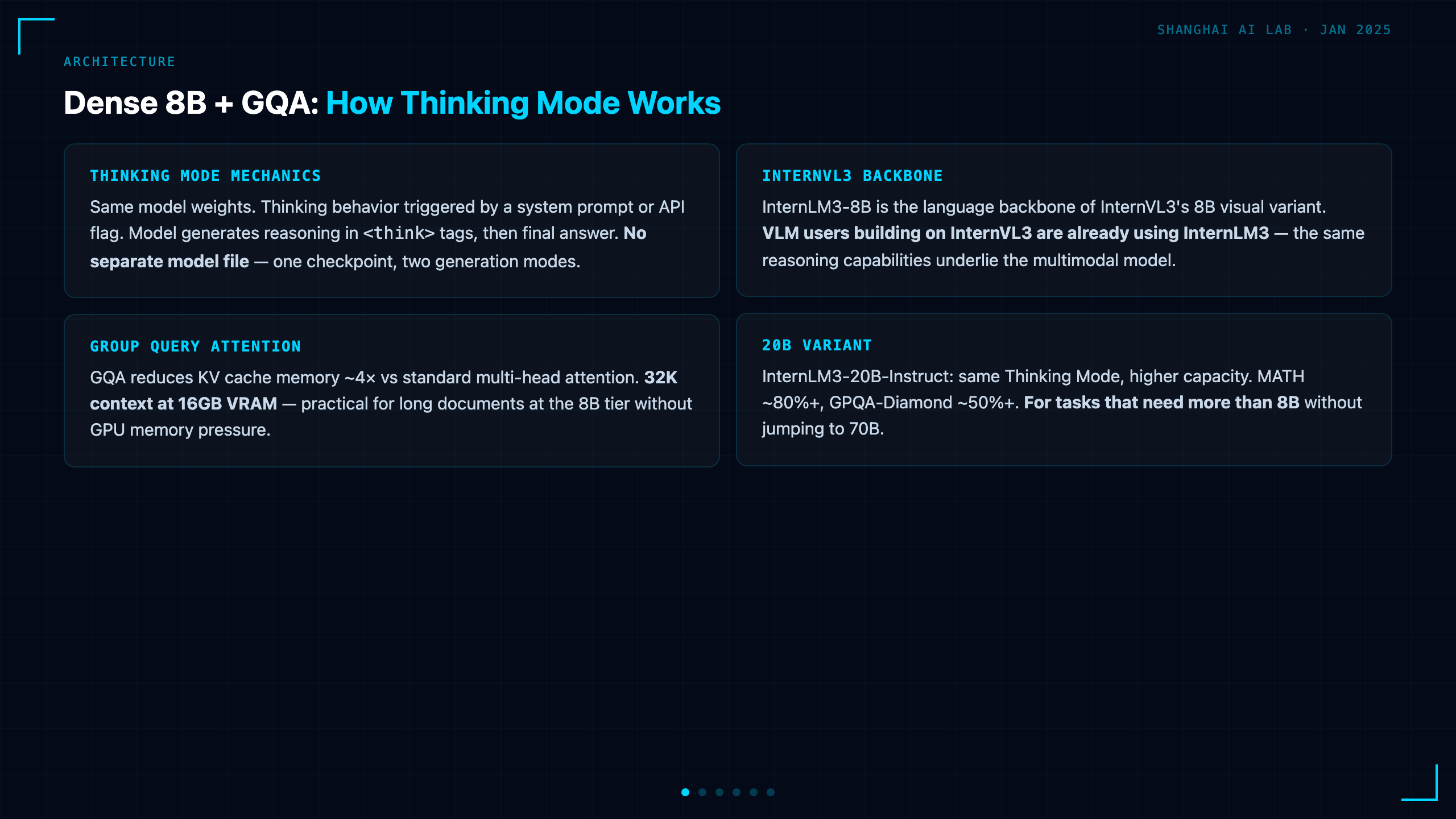
InternLM3-8B uses a standard transformer architecture with several targeted improvements:
| Specification | Value |
|---|---|
| Parameters | 8B |
| Architecture | Dense transformer |
| Context window | 32K tokens |
| Thinking Mode | Yes (same weights) |
| License | Apache 2.0 |
| VRAM (inference) | ~16GB |
Thinking Mode implementation: When thinking_mode=True, the model generates a reasoning trace in <think> tags before the response. The model was trained with both thinking and non-thinking outputs — the same weights support both modes by conditioning the generation differently at the start. This is different from having two separate models; the reasoning capability is baked into the weights.
Group Query Attention: InternLM3 uses GQA (Group Query Attention) — sharing key/value heads across query groups — which reduces the KV cache memory footprint by ~4× compared to multi-head attention. At 8B scale with 32K context, this makes the model practical on 16GB VRAM with room for a reasonable context length.
InternLM3 family: Beyond the 8B-Instruct, the InternLM3 family includes:
- InternLM3-8B-Instruct (this model)
- InternLM3-20B-Instruct (higher capacity, same Thinking Mode)
- InternLM3-38B (used as backbone in InternVL3-78B)
Benchmarks
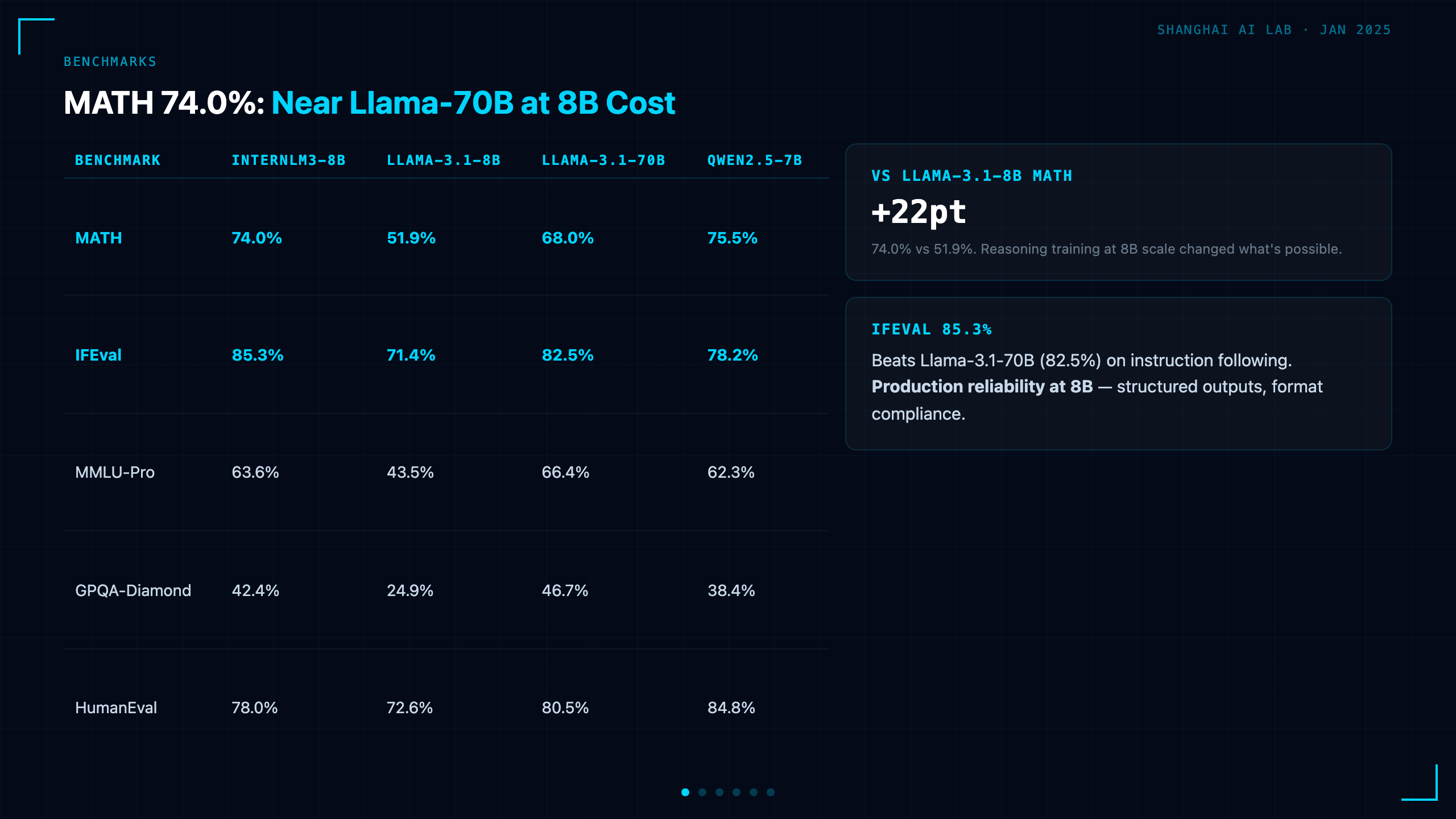
InternLM3-8B-Instruct vs. comparable models (January 2025):
| Benchmark | InternLM3-8B | Llama-3.1-8B | Llama-3.1-70B | Qwen2.5-7B | Notes |
|---|---|---|---|---|---|
| MATH | 74.0% | 51.9% | 68.0% | 75.5% | Mathematical reasoning |
| MMLU-Pro | 63.6% | 43.5% | 66.4% | 62.3% | Knowledge breadth |
| GPQA-Diamond | 42.4% | 24.9% | 46.7% | 38.4% | Graduate science |
| HumanEval | 78.0% | 72.6% | 80.5% | 84.8% | Code generation |
| IFEval | 85.3% | 71.4% | 82.5% | 78.2% | Instruction following |
MATH 74.0% at 8B is the headline number — +22.1pt over Llama-3.1-8B (51.9%) and only -1.5pt behind Qwen2.5-7B (75.5%). For an 8B model, 74% on MATH represents a genuine step change from the previous generation of small models.
IFEval 85.3% (instruction following) is notably high — the RLHF work on instruction compliance shows clearly here. For production applications where the model needs to reliably follow structured instructions, InternLM3's IFEval score is competitive with 70B models.
GPQA-Diamond 42.4% vs Llama-3.1-70B's 46.7% shows the remaining gap to larger models on graduate-level science — the 8B capacity limit shows up in complex multi-step scientific reasoning.
Thinking Mode in Practice
Standard response:
User: What is the integral of x^2?
Assistant: x³/3 + C
Thinking mode response:
User: What is the integral of x^2?
Assistant: <think>
To find ∫x² dx, I apply the power rule:
∫xⁿ dx = xⁿ⁺¹/(n+1) + C for n ≠ -1
Here n=2, so: x²⁺¹/(2+1) = x³/3
Verify by differentiating: d/dx(x³/3) = x² ✓
</think>
x³/3 + C
Thinking mode adds latency but improves accuracy on harder problems. The same API endpoint, toggled by parameter — developers choose based on workload requirements.
What It Means for Developers
70B math quality at 8B cost: MATH 74.0% puts InternLM3-8B in range of Llama-3.1-70B (68.0%) and competitive with Qwen2.5-7B (75.5%). For math-heavy applications — tutoring, problem solving, scientific computing assistants — InternLM3-8B provides near-70B quality at 8B inference cost.
One model, two modes: Thinking Mode eliminates the need to maintain separate reasoning and non-reasoning models. Fast responses for simple queries, extended reasoning for hard problems — same deployment, same weights, same API.
IFEval for production reliability: 85.3% IFEval means the model reliably follows complex formatting instructions, length constraints, and output specifications. Important for production pipelines where structured output reliability is a requirement.
InternVL3 backbone: InternLM3-8B is the language backbone for InternVL3's smaller vision variants. If you're building on InternVL3, you're already building on InternLM3 capabilities.
Availability
- HuggingFace: internlm/internlm3-8b-instruct
- License: Apache 2.0
- VRAM: ~16GB for 8B-Instruct at 32K context
- vLLM: Supported for production deployment
- 20B variant: internlm/internlm3-20b-instruct
Bottom Line
InternLM3-8B demonstrated that reasoning model training at 8B scale could close most of the gap to 70B models on mathematical reasoning. MATH 74.0% and IFEval 85.3% show strong math and instruction following at a model size that's deployable on a single GPU.
Thinking Mode's implementation — same weights, toggled behavior — is a practical design choice: one deployment serves both latency-sensitive and accuracy-critical workloads without model management overhead.
Resources
- HuggingFace — InternLM3-8B — instruct model
- HuggingFace — InternLM3-20B — larger variant
- GitHub — InternLM — codebase and training details
- Shanghai AI Lab — research organization
InternLM3 models are available on HuggingFace under Apache 2.0. Commercial use including fine-tuning.