MiniMax open-sourced VTP (Visual Tokenizer Pre-training) — the first technical release from Hailuo Video, their video generation product. The paper documents something the field had largely given up on: Scaling Law in visual generation. Specifically, it identifies why scaling the visual tokenizer stage had been impossible, and shows a method that makes it work.
The core problem is a paradox that the industry had quietly accepted: training visual tokenizers harder produces better reconstruction quality but worse generation quality. MiniMax quantifies this, explains why it happens, and resolves it.
The Reconstruction-Generation Paradox
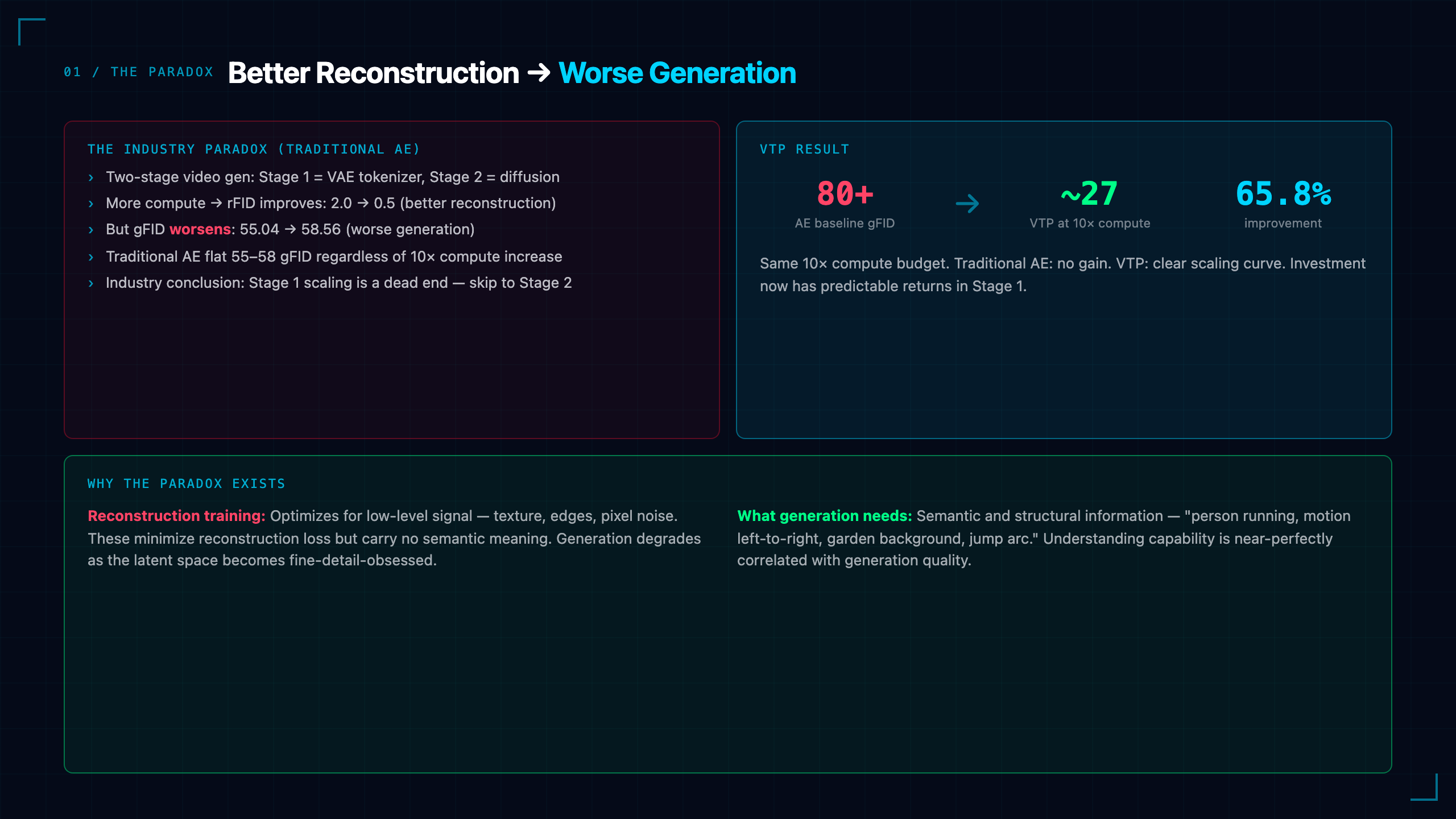
Modern video generation models (Sora, Hailuo, Kling) share a two-stage architecture. Stage 1: a visual tokenizer (typically a VAE) compresses images into a low-dimensional latent space. Stage 2: a diffusion model generates new content in that latent space.
The intuition says: better Stage 1 → better Stage 2. The data says otherwise.
In the standard approach, increasing training compute improves reconstruction quality — rFID drops from 2.0 to 0.5, which is a clean win. But generation quality (gFID) moves from 55.04 to 58.56 — worse as you invest more. The more carefully you train the tokenizer for reconstruction, the worse the downstream generation becomes.
This had two practical consequences:
- The field gave up on scaling the tokenizer stage — compute there was treated as wasted
- All effort went into Stage 2 (diffusion model), which is why video generation improvements were dominated by diffusion architecture work
VTP's result changes both. With the same 10× compute increase that traditional AE wastes, VTP drops gFID from 80+ to ~27 — a 65.8% improvement. The investment now has predictable returns.
Why Reconstruction Training Fails for Generation
The explanation is about what reconstruction training optimizes for. A tokenizer trained purely on reconstruction learns to preserve low-level signal: texture, edges, pixel-level noise, fine detail. These features minimize reconstruction loss. They are not the features that help a diffusion model generate coherent motion.
What generation needs is semantic and structural information: "this is a person running, the action changes left-to-right, the background is a garden, this is the arc of a jump." These are not what reconstruction loss captures, and they degrade in latent representations optimized for pixel-fidelity.
The paper demonstrates this through a correlation plot: traditional AE models cluster in the lower-left — low understanding capability, poor generation quality. VTP models form a clean diagonal from lower-left to upper-right. Understanding capability and generation quality are near-perfectly correlated. The fix is to teach the tokenizer to understand, not just reconstruct.
VTP: Three-Loss Joint Training
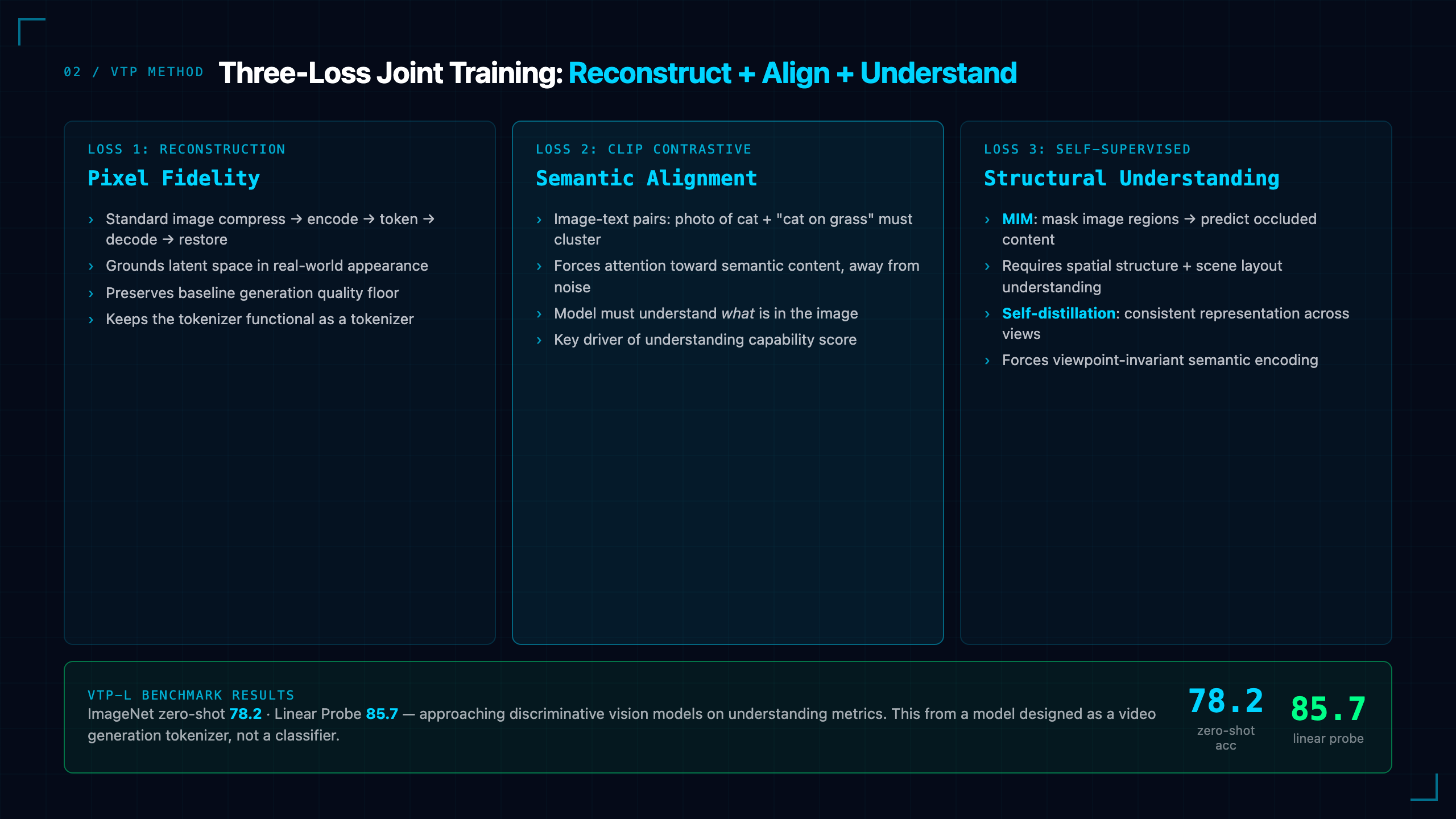
VTP trains the visual tokenizer with three objectives simultaneously:
Reconstruction — standard pixel-level image compression and restoration. This preserves the baseline function: the latent space must still faithfully represent real-world content.
CLIP contrastive learning — image-text alignment forces the tokenizer to learn semantic correspondence. A photo of a cat on grass must cluster with the text "cat on grass" in representation space. This forces attention away from pixel-level noise toward semantic content.
Self-supervised learning (SSL) — two techniques:
- Masked Image Modeling (MIM): predict masked regions from visible context. This requires the model to understand spatial structure and scene layout
- Self-distillation: maintain consistent representations across different augmented views of the same image. This forces viewpoint-invariant semantic encoding
The three losses together push the tokenizer to encode both pixel-level reconstruction capability and semantic understanding. The reconstruction loss keeps the latent space grounded in real-world appearance; CLIP and SSL force it to also carry semantic and structural meaning.
Scaling Across Three Dimensions
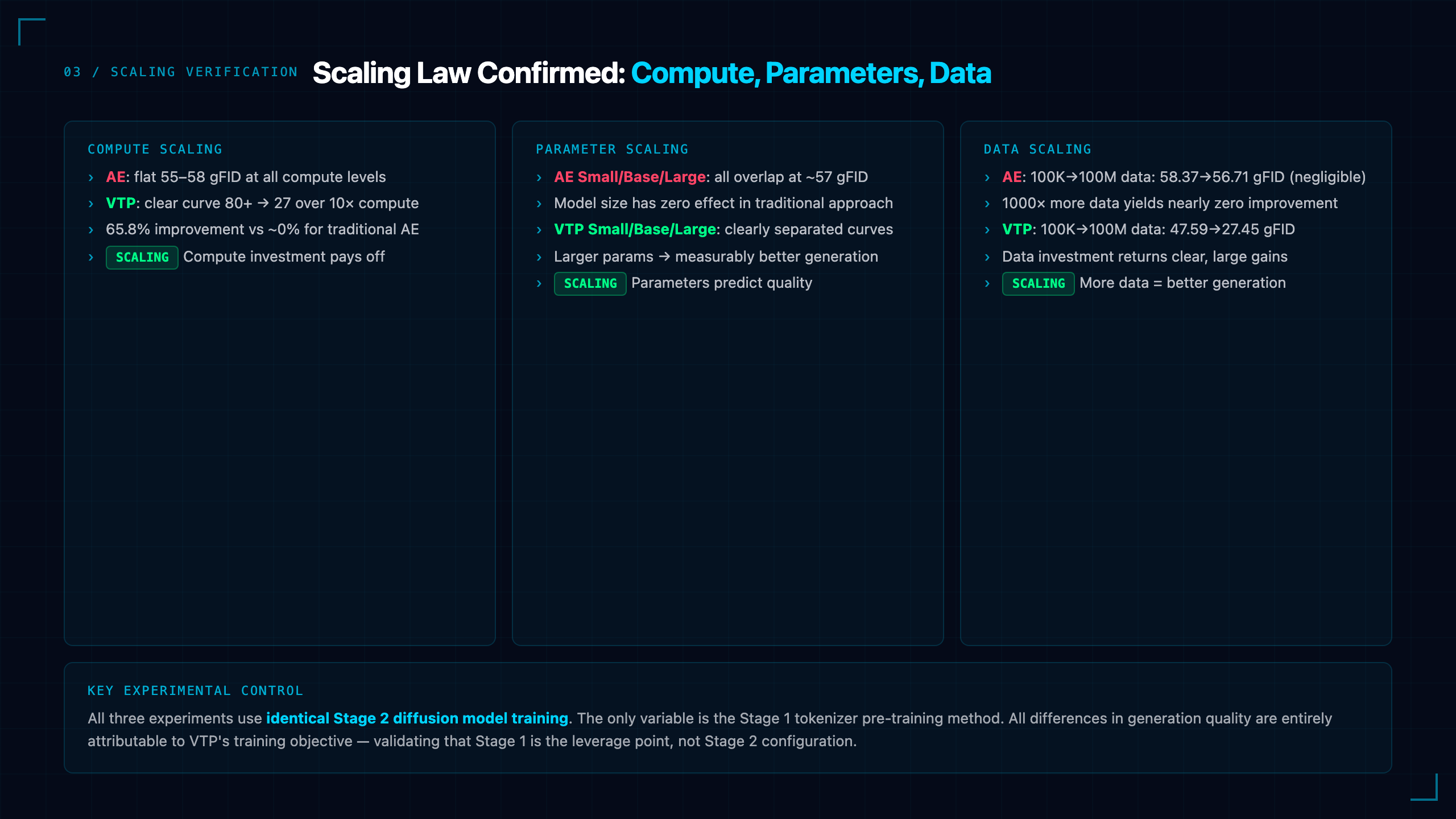
The paper validates scaling behavior on three independent axes, with identical Stage 2 diffusion model training across all experiments:
Compute scaling — traditional AE gFID stays flat at 55–58 regardless of compute. VTP traces a consistent improvement curve from 80+ to 27. The traditional model shows no returns on compute investment; VTP shows clear returns.
Parameter scaling — traditional AE Small/Base/Large models produce nearly identical gFID curves, indistinguishable from each other. VTP's Small/Base/Large curves diverge clearly — larger models consistently outperform smaller ones. Parameter count now predicts quality.
Data scaling — traditional AE goes from 58.37 gFID at 100K training samples to 56.71 at 100M samples — a negligible change across 1000× more data. VTP drops from 47.59 to 27.45 across the same data range. Data investment now returns clear improvement.
All three experiments use identical Stage 2 configuration. The differences are entirely attributable to Stage 1 tokenizer pre-training quality.
Benchmark result (VTP-L): ImageNet zero-shot 78.2, Linear Probe 85.7 — approaching discriminative vision models on understanding metrics. This from a model designed primarily as a video generation tokenizer, not a classifier.
What It Means for the Field
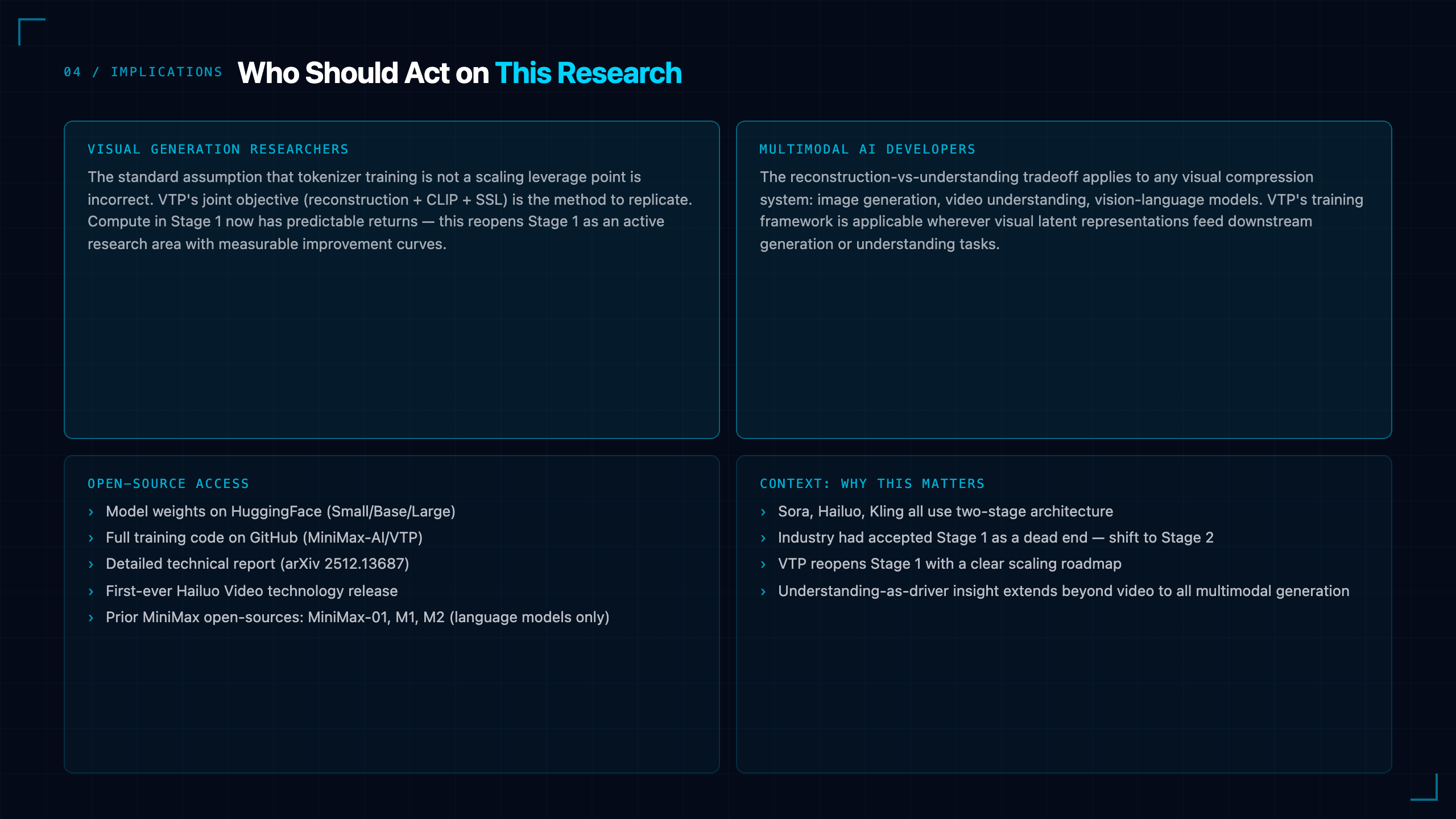
Visual generation researchers: The standard assumption that tokenizer training is not a leverage point is wrong when the training objective is correct. VTP's formulation — joint reconstruction + semantic alignment + self-supervised understanding — is the method to replicate. The Scaling Law finding means compute in Stage 1 now has predictable returns.
Multimodal AI developers: The paper's insight applies beyond video generation. Any system that compresses visual input into latent representations faces the same tradeoff between reconstruction fidelity and semantic richness. VTP's training framework is applicable to image generation, video understanding, and visual-language models.
Practitioners using Hailuo Video or similar: This release explains why Hailuo Video's generation quality has held up at scale. The tokenizer is not the standard reconstruction-optimized VAE — it carries semantic information that makes downstream generation more coherent.
Open-source access: VTP is fully released — model weights, training code, and technical report. This is MiniMax's first open-source release from Hailuo Video after multiple language model open-sources (MiniMax-01 in January 2025, M1 in June, M2 in November). The tokenizer is now a research artifact, not a black box.
Bottom Line
VTP resolves a well-known but rarely articulated problem: scaling compute into the visual tokenizer stage had been a dead end. The paper identifies the mechanism (reconstruction training optimizes for low-level detail, not semantic structure), quantifies the paradox (better reconstruction → worse generation in traditional AE), and demonstrates the fix (joint training with semantic objectives unlocks consistent scaling across compute, parameters, and data).
The 65.8% generation quality improvement at 10× compute, combined with clean scaling curves on all three axes, is the result that validates the approach. The open release makes it immediately available for replication and extension.
Resources
- MiniMax VTP GitHub — code, weights, training config
- Paper (arXiv 2512.13687) — full technical report
- MiniMax Official Site — company homepage
- Hailuo Video — product page
VTP model weights and training code are available at github.com/MiniMax-AI/VTP.