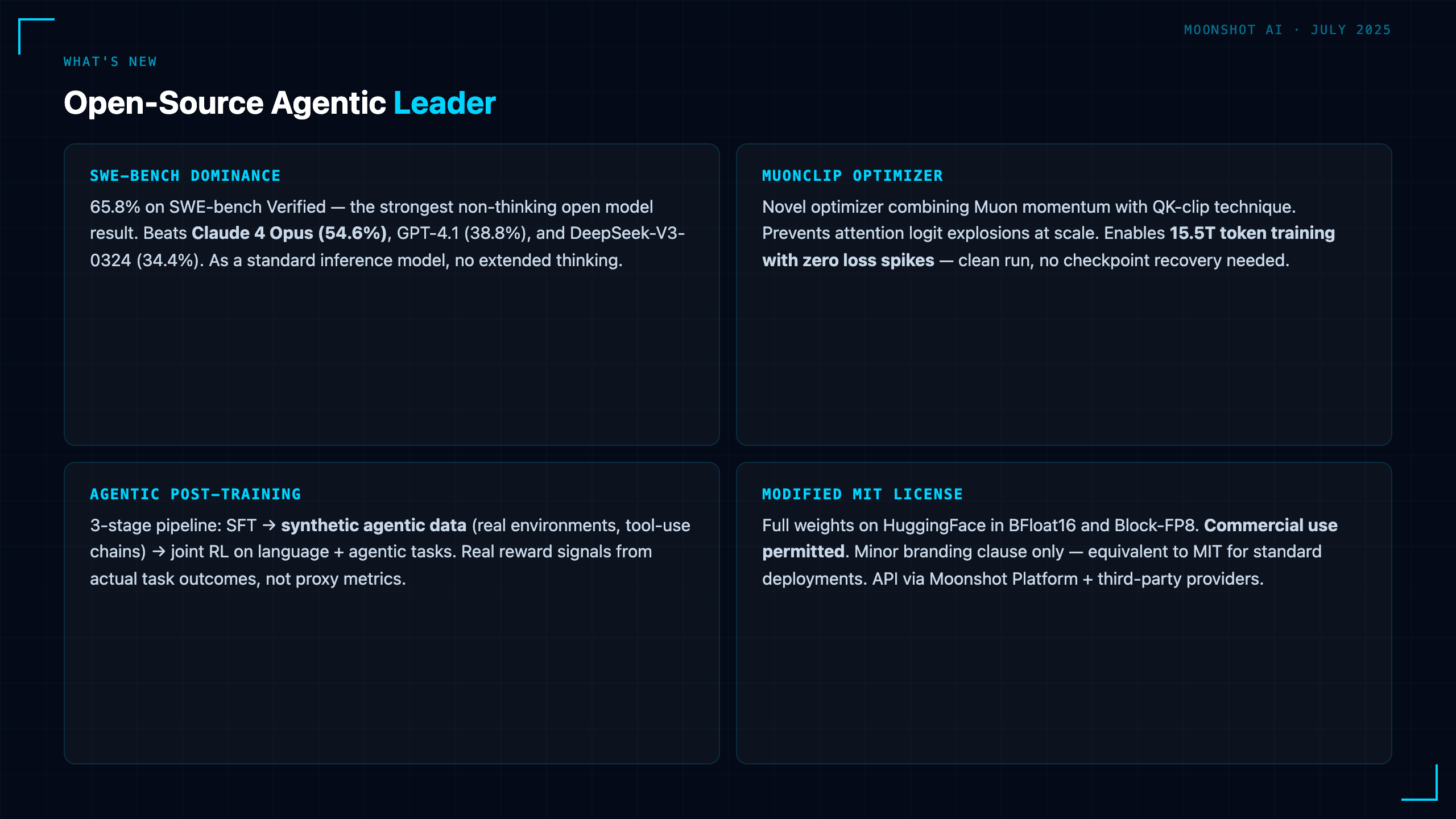
Moonshot AI released Kimi K2 in July 2025 and immediately reset the open-source agentic benchmark. The headline number: 65.8% on SWE-bench Verified — beating Claude 4 Opus (54.6%), GPT-4.1 (38.8%), and DeepSeek-V3-0324 (34.4%) without extended thinking. As a non-thinking model.
The architecture is 1 trillion total parameters, 32B active per token — a MoE design borrowed from the DeepSeek lineage but with a training innovation that made the difference: the MuonClip optimizer, which enabled 15.5 trillion token pre-training with zero loss spikes.
Full weights on HuggingFace, Modified MIT license including commercial use.
Why It Matters
Before K2, the best open-source models for agentic work (coding, tool use, multi-step tasks) were noticeably behind Claude Opus and GPT-4.1 on SWE-bench and similar benchmarks. The gap wasn't a quirk of one benchmark — it reflected a real difference in how well models handled long tool-use chains, error recovery, and real-world software tasks.
K2 closes that gap and inverts the ranking on several key metrics:
| Benchmark | K2-Instruct | Claude 4 Opus | GPT-4.1 | DS-V3-0324 |
|---|---|---|---|---|
| SWE-bench Verified | 65.8% | 54.6% | 38.8% | 34.4% |
| SWE-bench Multilingual | 47.3% | 51.0% (Sonnet) | 25.8% | 31.5% |
| Tau2-Bench | 66.1% | 48.8% | 37.3% | 41.0% |
| ACEBench (En) | 76.5% | 72.7% | 70.5% | 74.5% |
| LiveCodeBench v6 | 53.7% | 46.9% | 37.0% | 44.7% |
| AIME 2025 | 49.5% | 46.7% | 24.7% | 33.9% |
| GPQA-Diamond | 75.1% | 68.4% | 62.9% | 68.2% |
These are non-thinking model comparisons — K2 achieves this without extended reasoning chains.
Architecture: MoE at 1T Scale
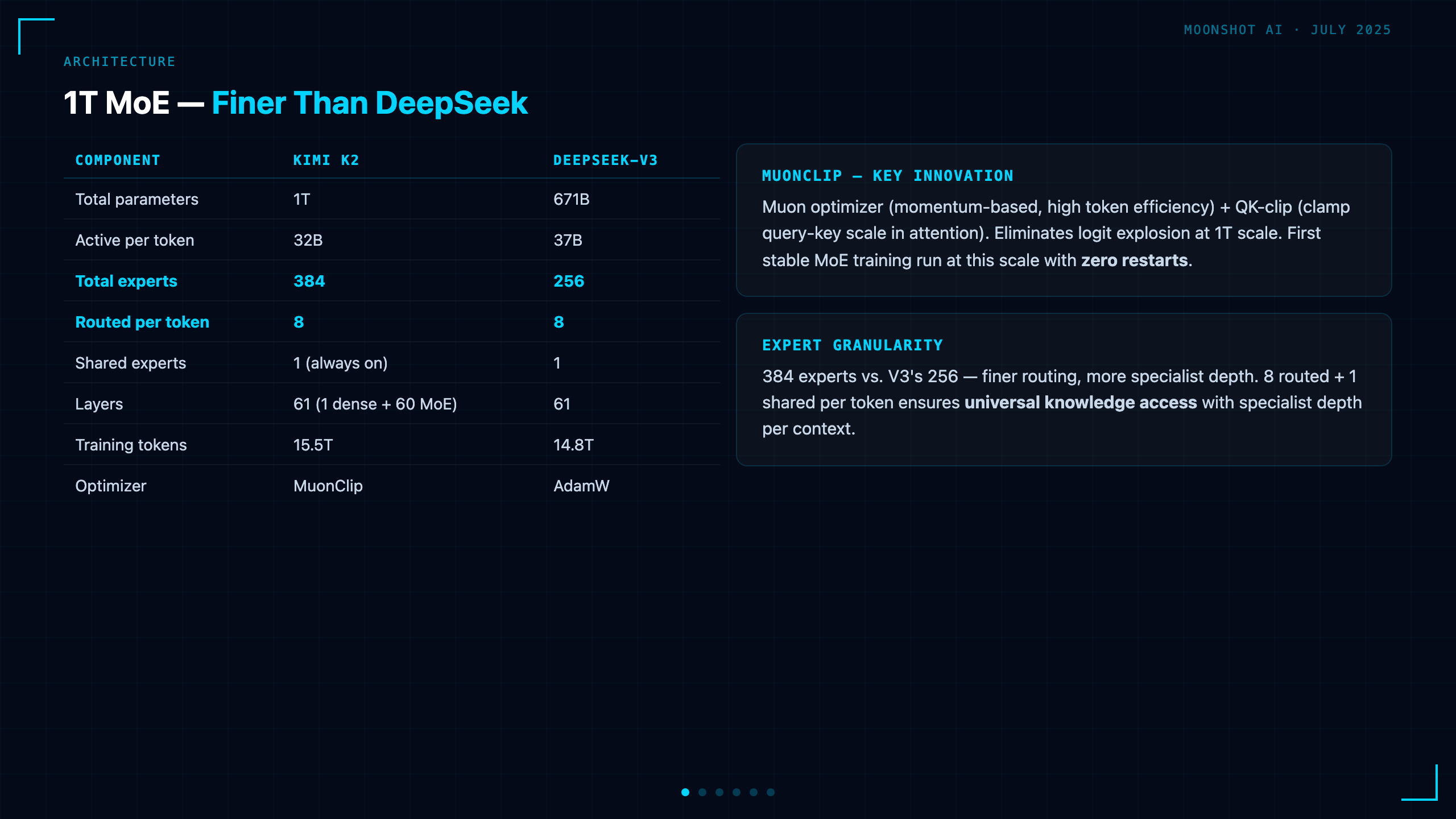
The architecture has 61 layers — 1 dense normalization layer at the base, then 60 MoE layers. Each MoE layer routes tokens to 8 specialist experts plus 1 always-active shared expert, out of a total of 384 expert networks.
This is finer-grained than DeepSeek-V3's design (256 routed experts, 8 active) while operating at comparable total parameter scale. The shared expert ensures universal knowledge access; the 8 specialists bring depth for the specific token and context.
MuonClip optimizer is the key innovation. Standard training instability in large MoE models comes from optimizer dynamics: Muon (a momentum-based optimizer with strong token efficiency) showed instability at scale from attention logit explosions. MuonClip adds a QK-clip technique — clamping the scale of query-key products in attention to prevent runaway logits.
The result: 15.5T token pre-training with zero loss spikes. For comparison, many MoE training runs at this scale historically required restarts and checkpoint recovery. K2's training was clean.
Post-Training: Agentic Data Synthesis
The model's edge on agentic benchmarks comes from the post-training pipeline:
Stage 1 — SFT: Standard supervised fine-tuning on a curated instruction dataset.
Stage 2 — Agentic data synthesis: Moonshot's pipeline generates large-scale synthetic agentic scenarios — multi-step coding tasks, tool-use chains, software engineering workflows — using the pre-trained model and real environments (sandboxed code execution, file systems). This creates training data that reflects the actual distribution of real agentic work rather than idealized demonstrations.
Stage 3 — Joint RL: Reinforcement learning across both language modeling and agentic task completion simultaneously. The model improves by interacting with real and synthetic environments, getting reward signals from actual task outcomes (code passes tests, tool calls return expected results) rather than proxy metrics.
This pipeline is why K2 performs so much better on real-world agentic benchmarks (SWE-bench, Tau2-bench) than on simpler knowledge tasks where the advantage narrows.
Benchmarks Deep Dive
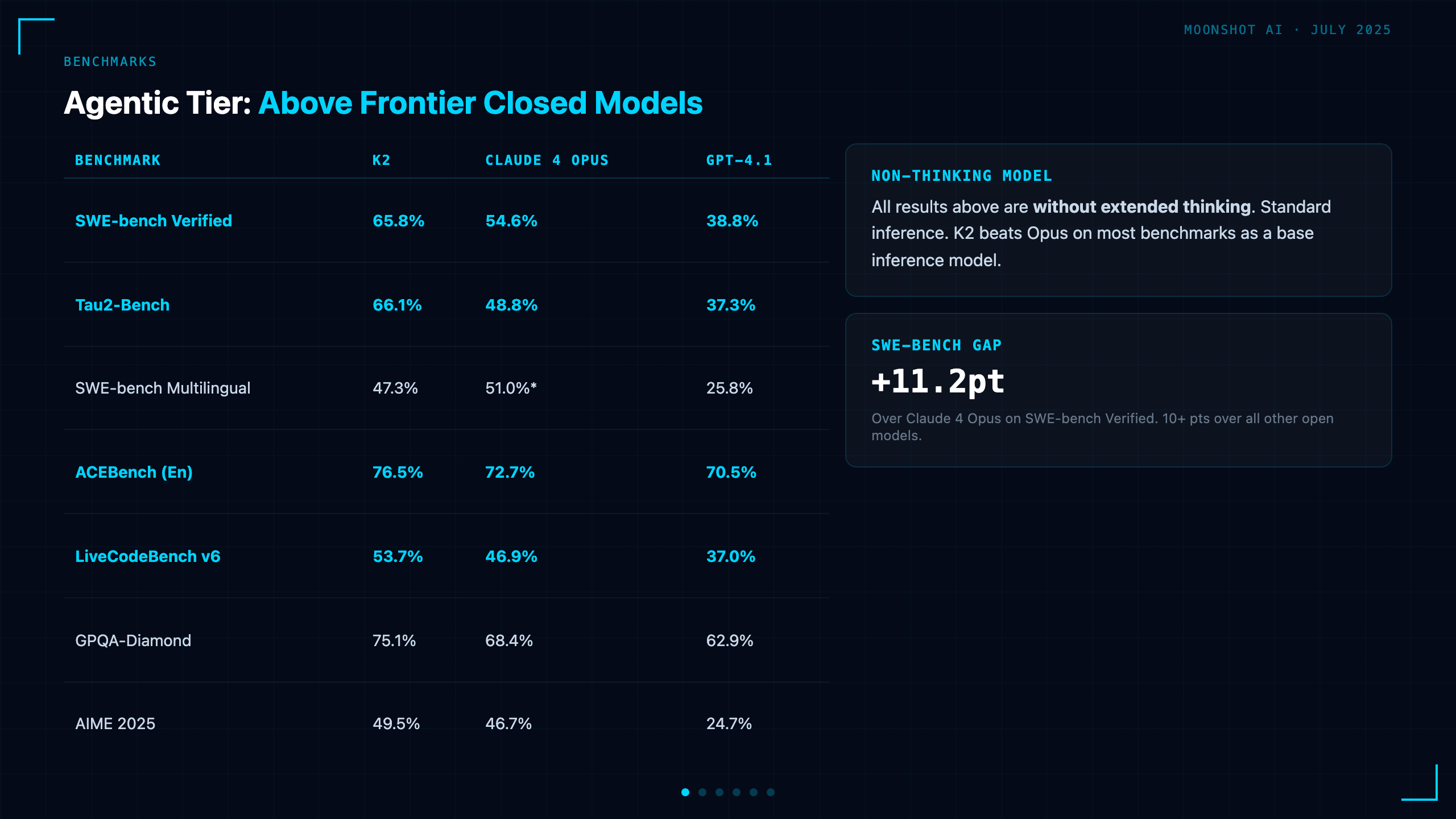
SWE-bench Verified tests whether a model can autonomously fix real GitHub issues in professional codebases — clone the repo, understand the issue, write and test a fix, submit a PR. K2's 65.8% is the strongest non-thinking open model result by a wide margin.
Tau2-Bench is a multi-turn tool-use benchmark for airline and retail customer service agents. 66.1% micro-average. This tests practical agentic reliability — the kind of behavior that matters in production deployments.
SWE-bench Multilingual (47.3%) tests software engineering across codebases in Python, Java, JavaScript, C++, and other languages. K2 trails Claude 4 Sonnet (51.0%) but leads GPT-4.1 (25.8%) and DeepSeek-V3 (31.5%).
OJBench (27.1%) tests competitive programming problems at the IOI/ICPC difficulty level — among the hardest code reasoning tasks available. K2 leads all comparison models including Claude 4 Opus (24.0%) and GPT-4.1 (11.3%).
The pattern: K2's edge is concentrated in agentic and coding-heavy tasks. On pure knowledge (MMLU-type) benchmarks, the advantage is smaller.
Availability
Weights: Released on HuggingFace in BFloat16 and Block-FP8 formats:
License: Modified MIT — commercial use permitted without restrictions for most use cases. "Modified" refers to minor clauses about Moonshot branding in derivative products; the effective open-source status is equivalent to MIT for standard commercial deployments.
API: Available via Moonshot Platform and multiple third-party providers (Together AI, Fireworks, DeepInfra).
Self-hosting: 1T MoE at 32B active per token requires ~20×A100 80GB for reasonable throughput, or 8×H100s with higher efficiency. Block-FP8 format reduces memory requirements vs. BF16.
What It Means for Developers
SWE-bench as a signal: The 65.8% SWE-bench number translates to real capability differences in production code work. Models above the ~50% threshold on SWE-bench can handle complex multi-file refactors, debug intricate bugs, and write production-ready code from requirements. K2 is in a different tier than models scoring in the 30-40% range.
Agentic deployment: K2's post-training with real environment interactions makes it significantly more reliable in multi-step tool-use chains. For coding agents, customer service automation, and research assistants — where the model needs to handle errors, iterate, and adapt — the Tau2-bench and SWE-bench results translate directly.
Cost vs. Claude Opus: K2 API pricing at third-party providers is roughly 5× cheaper than Claude 4 Opus while beating Opus on several key agentic benchmarks. For high-volume agentic workloads, this changes the cost structure substantially.
Open weights advantage: Self-hosting K2 enables custom fine-tuning for domain-specific agentic workflows — something not available with Claude or GPT-4.1. The base model is particularly valuable for research teams building on top of the pre-trained representations.
Bottom Line
K2 is the first open-source model that can credibly replace Claude Opus in agentic coding workflows based on benchmark performance. The combination of 1T parameter scale, MuonClip's stable training, and the synthetic agentic post-training pipeline produced a model that leads the non-thinking open-source category on SWE-bench by 10+ percentage points.
For developers building coding agents, software automation, or any agentic application where Claude Opus was the default choice: K2 is worth serious evaluation. The Modified MIT license removes the compliance friction that often makes frontier-quality open models impractical in enterprise contexts.
Resources
- Technical Report (arXiv 2507.20534) — architecture, MuonClip, post-training pipeline
- HuggingFace — Kimi-K2-Instruct — post-trained model
- HuggingFace — Kimi-K2-Base — base model
- Moonshot Platform — API access
- GitHub — open-source code
Kimi K2 weights are available at huggingface.co/moonshotai. API access via Moonshot Platform and third-party providers including Together AI and DeepInfra.