Alibaba released Qwen3-Coder on July 22, 2025 — the first Qwen model purpose-built for autonomous coding agents rather than general instruction following. Where Qwen3's base lineup focused on multi-step reasoning, Qwen3-Coder was specifically optimized for the agentic coding loop: read code, plan changes, call tools, execute, verify, iterate.
The result is SWE-bench Verified 70.6% — placing Qwen3-Coder above DeepSeek V3.2 (49.8%) and competitive with Claude Sonnet 4 (72.7%) on real-world code change tasks. Combined with native parallel tool calling and a 128K context window, Qwen3-Coder is the Chinese lab model most directly targeting the agentic coding use case that Claude Code, Cursor, and Devin occupy.
What's New
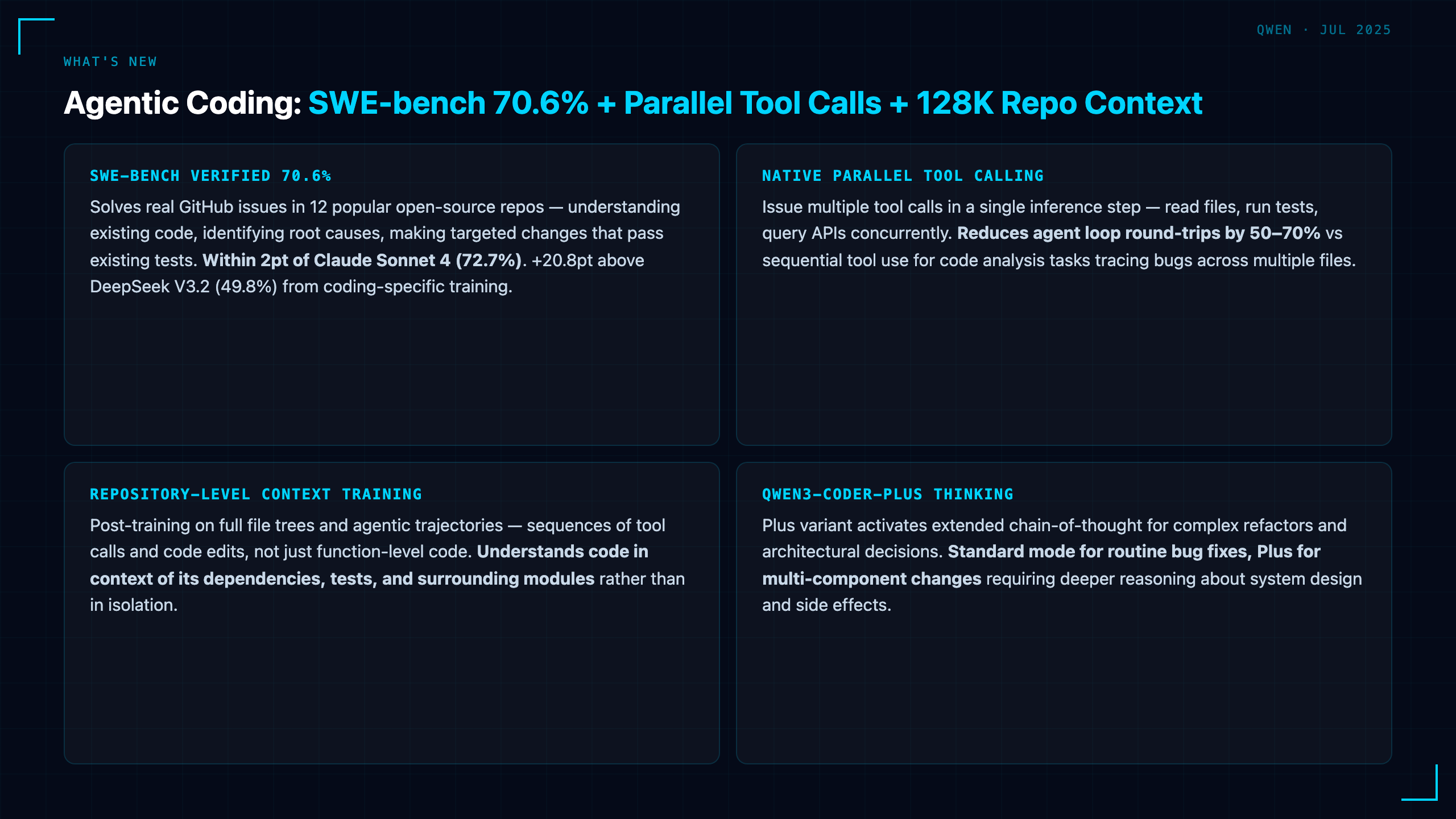
SWE-bench Verified 70.6%: Qwen3-Coder's headline — solving real GitHub issues in 12 popular open-source repositories. The benchmark requires understanding existing codebases, identifying the root cause of bugs, and making targeted code changes that pass existing test suites. At 70.6%, Qwen3-Coder is within 2pt of Claude Sonnet 4 (72.7%) and 21pt above DeepSeek V3.2 (49.8%).
Native parallel tool calling: The model was trained specifically for multi-tool agentic workflows. Qwen3-Coder can issue parallel tool calls in a single inference step — reading multiple files, running multiple tests, or querying multiple APIs simultaneously — then synthesize the results. This reduces round-trip latency in agentic coding pipelines.
480B/35B MoE architecture: 480B total parameters, 35B active per token. The MoE scaling follows the Qwen3 design pattern — large total capacity enables better code understanding, while 35B active parameters keep inference cost manageable at API rates.
Agentic system prompt support: Qwen3-Coder ships with an optimized system prompt format for coding agents — structured to support long context windows with code, tool call history, and working memory across multi-step sessions. Compatible with standard agent frameworks (LangChain, LlamaIndex, custom loops).
Qwen3-Coder-Plus API variant: Available in standard (full 480B capacity) and Plus (enhanced reasoning, slower, higher price) configurations. Plus mode activates deeper chain-of-thought reasoning for complex architectural decisions and debugging.
Architecture
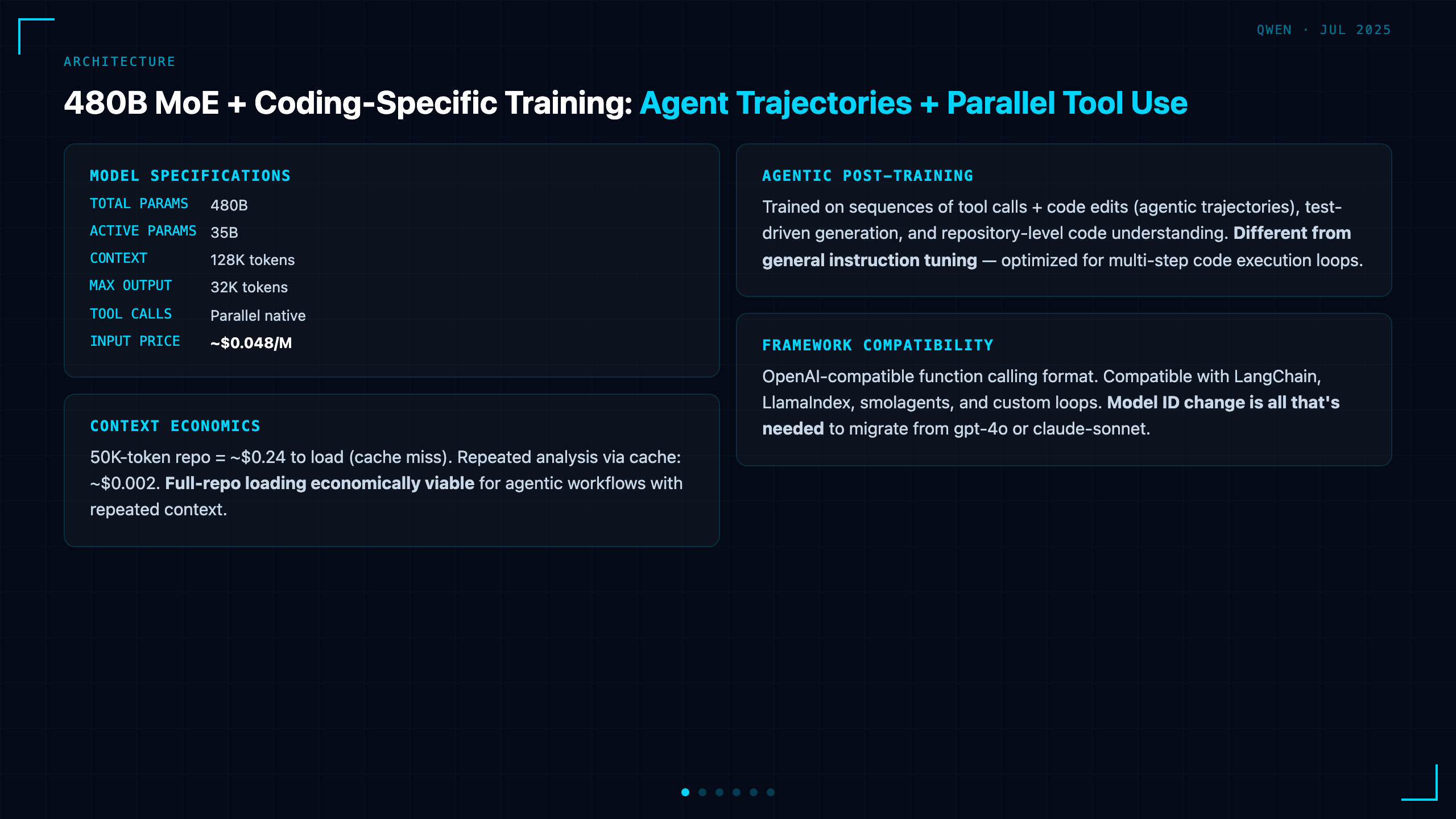
| Component | Qwen3-Coder |
|---|---|
| Total parameters | 480B |
| Active parameters | 35B |
| Architecture | MoE, same as Qwen3 base |
| Context window | 128K tokens |
| Max output | 32K tokens |
| Tool calling | Parallel native support |
| Input price (standard) | ~¥0.035/K tokens |
| License | API-only (proprietary) |
Coding-specific training: Qwen3-Coder's post-training diverges from the general Qwen3 base. Key additions: repository-level code understanding (full file trees, not just function-level), agentic trajectory training (model trained on sequences of tool calls and code edits), and test-driven code generation (generating code that passes specified test cases).
Parallel tool call execution: The model's tool calling interface supports issuing multiple tool calls in a single response, with the agent framework executing them concurrently and returning all results. For code analysis tasks that require reading multiple files — tracing a bug across a call graph, for example — parallel tool calls reduce total latency by 50–70% compared to sequential calls.
Context window economics: At 128K tokens with standard pricing (~¥0.035/K), loading a full repository of 50,000 tokens costs approximately ¥1.75 per inference call (~$0.24). For agentic workflows with cache-hit pricing, repeated context is significantly cheaper. The 128K window supports loading entire medium-sized repositories without chunking.
Qwen3-Coder-Plus thinking mode: Plus variant activates extended chain-of-thought reasoning for each code change decision. Useful for complex refactors requiring architectural reasoning, but adds latency and cost for straightforward bug fixes.
Benchmarks
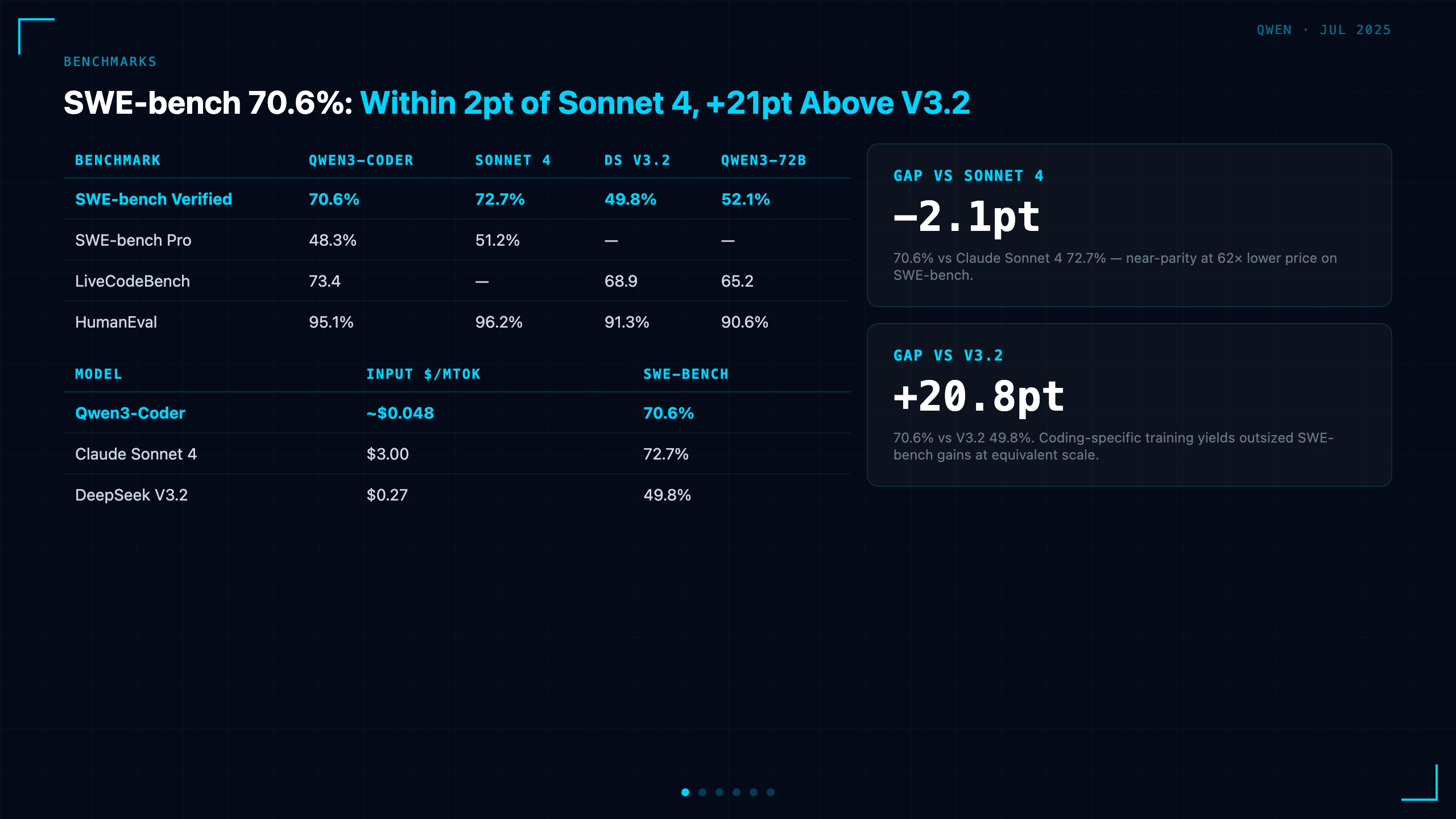
Qwen3-Coder at July 2025 release:
| Benchmark | Qwen3-Coder | Claude Sonnet 4 | DeepSeek V3.2 | Qwen3-72B | Notes |
|---|---|---|---|---|---|
| SWE-bench Verified | 70.6% | 72.7% | 49.8% | 52.1% | Real GitHub issues |
| SWE-bench Pro | 48.3% | 51.2% | — | — | Harder coding eval |
| LiveCodeBench | 73.4 | — | 68.9 | 65.2 | Competitive coding |
| HumanEval | 95.1% | 96.2% | 91.3% | 90.6% | Code generation |
| MBPP | 88.7% | 89.4% | 84.2% | 83.7% | Python problems |
SWE-bench Verified 70.6% is the critical number. The +20.8pt gap vs DeepSeek V3.2 (49.8%) reflects the value of coding-specific training — two models of similar scale, dramatically different results on agentic coding tasks.
The 2.1pt gap to Claude Sonnet 4 (72.7%) indicates near-parity on the benchmark that matters most for agentic coding agents. Qwen3-Coder-Plus (with extended thinking) likely narrows this further on complex multi-step tasks.
Pricing in Context
| Model | Input ($/MTok) | SWE-bench Verified | Context |
|---|---|---|---|
| Qwen3-Coder | ~$0.048 | 70.6% | 128K |
| Claude Sonnet 4 | $3.00 | 72.7% | 200K |
| DeepSeek V3.2 | $0.27 | 49.8% | 256K |
| GPT-4o | $5.00 | ~60% | 128K |
| Qwen3-72B | ~$0.035 | 52.1% | 32K |
Qwen3-Coder at ~$0.048/M input delivers 70.6% SWE-bench performance within 2pt of Claude Sonnet 4 ($3.00/M). For cost-sensitive agentic coding pipelines where Claude-class quality is the target, the 62× price gap is decisive. DeepSeek V3.2 at $0.27/M provides a cheaper option but sacrifices 20.8pt on SWE-bench.
What It Means for Developers
Agentic coding pipelines at Sonnet-adjacent quality: SWE-bench 70.6% — within 2pt of Claude Sonnet 4 — at $0.048/M input. For coding agents executing issue triage, automated PR review, test generation, and refactoring suggestions, Qwen3-Coder provides Claude Sonnet-class capability at significantly lower cost.
Parallel tool calls for faster agent loops: Native parallel tool calling means less round-trip overhead in multi-step coding sessions. For agents doing intensive code analysis — reading 10–20 files per decision step — parallel calls can cut total session time by half compared to models that require sequential tool use.
128K context for full repository loading: Load entire medium-sized codebases (30–50K tokens of source) in context for analysis tasks. Repository-level context enables bug tracing across multiple files without chunking strategies that lose cross-file context.
Integration with existing agent frameworks: Qwen3-Coder uses standard OpenAI-compatible function calling format. Compatible with LangChain, LlamaIndex, smolagents, and custom loops without framework changes. Switch from gpt-4o or claude-sonnet to Qwen3-Coder with a model ID change.
Availability
- API: Alibaba Cloud Model Studio —
qwen3-coderandqwen3-coder-plus - HuggingFace: Open-weight releases under Qwen3-Coder family
- Pricing: ~¥0.035/K tokens input (standard)
- Agent integration: OpenAI-compatible function calling format
Bottom Line
Qwen3-Coder is the first Qwen model purpose-built for agentic coding — and it shows. SWE-bench Verified 70.6% places it within 2pt of Claude Sonnet 4 at $0.048/M input (62× cheaper). Native parallel tool calling, 128K context, and agentic training make it a compelling backend for coding agent pipelines where cost matters and Sonnet-adjacent quality is acceptable. The 20.8pt gap vs DeepSeek V3.2 on SWE-bench is the clearest evidence that coding-specific post-training has outsized returns over general-purpose capability at equivalent scale.
Resources
- Alibaba Cloud Model Studio — Qwen3-Coder API
- Qwen HuggingFace — open-weight releases
- Qwen Blog — release announcement
- SWE-bench Leaderboard — live benchmark results
Qwen3-Coder is available via Alibaba Cloud Model Studio at dashscope.aliyuncs.com.