Moonshot AI released Kimi K2.5 on January 27, 2026. The model is open-source, natively multimodal, and trained on roughly 15 trillion mixed visual and text tokens. But the defining technical contribution isn't a benchmark score — it's Agent Swarm: a framework where the model autonomously creates and orchestrates up to 100 specialized sub-agents running in parallel, coordinated by the model itself without any predefined workflow.
The practical result: tasks that bottleneck on sequential tool execution can be completed 4.5× faster. For complex agentic workloads — projects requiring simultaneous research, design, and development streams — Agent Swarm changes the architecture from a single sequential chain to a parallel compute graph, managed entirely by the model.
Agent Swarm: What "Self-Directed" Actually Means
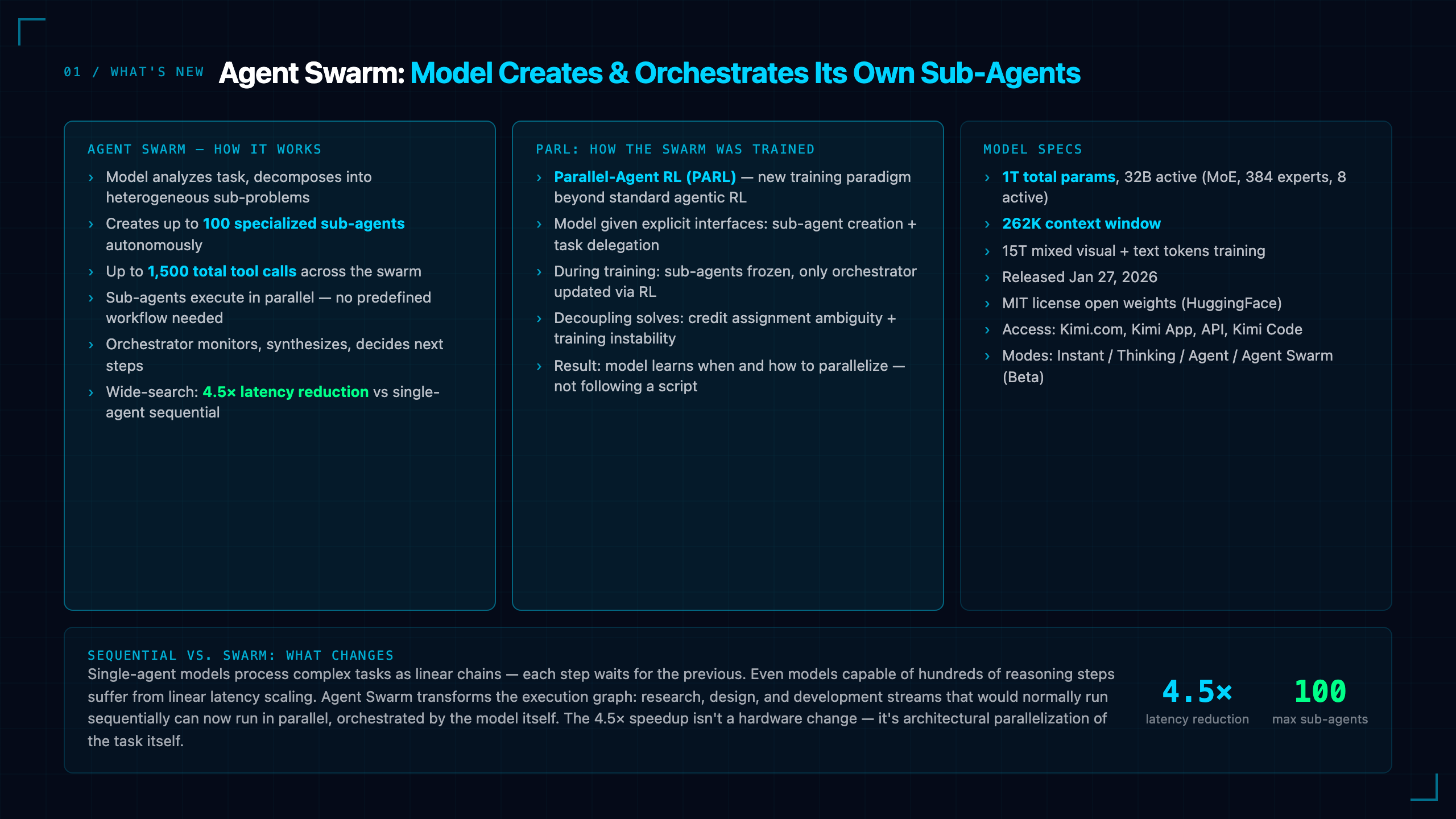
Most agent frameworks today require human-defined orchestration: you specify which agents run in which order, what tools they have access to, how results flow between them. Kimi K2.5's Agent Swarm inverts this. The model itself analyzes the incoming task, decomposes it into heterogeneous sub-problems, creates the appropriate sub-agents, assigns them tools and objectives, and monitors their execution.
The technical underpinning is a training approach called Parallel-Agent Reinforcement Learning (PARL). Unlike standard agentic RL where the model is trained on single-agent tool execution, PARL gives the model explicit interfaces for sub-agent creation and task delegation. During training, sub-agents are frozen — only the orchestrator is updated via RL. This decoupling solves two problems:
- Credit assignment ambiguity: in end-to-end multi-agent training, it's unclear which agent action caused the final reward. Freezing sub-agents makes the attribution clean.
- Training instability: co-optimizing orchestrator and sub-agents creates non-stationary training dynamics. Fixing sub-agents stabilizes learning.
At inference:
- K2.5 can spawn up to 100 sub-agents for a single task
- Total tool calls: up to 1,500
- Execution: parallel, with heterogeneous specialization per sub-agent
- Orchestration: fully autonomous — no predefined workflow required
In wide-search scenarios (extensive parallel search over large problem spaces), Agent Swarm reduces inference latency by up to 4.5× compared to sequential single-agent execution.
The Vision Architecture: Joint Training from Day One
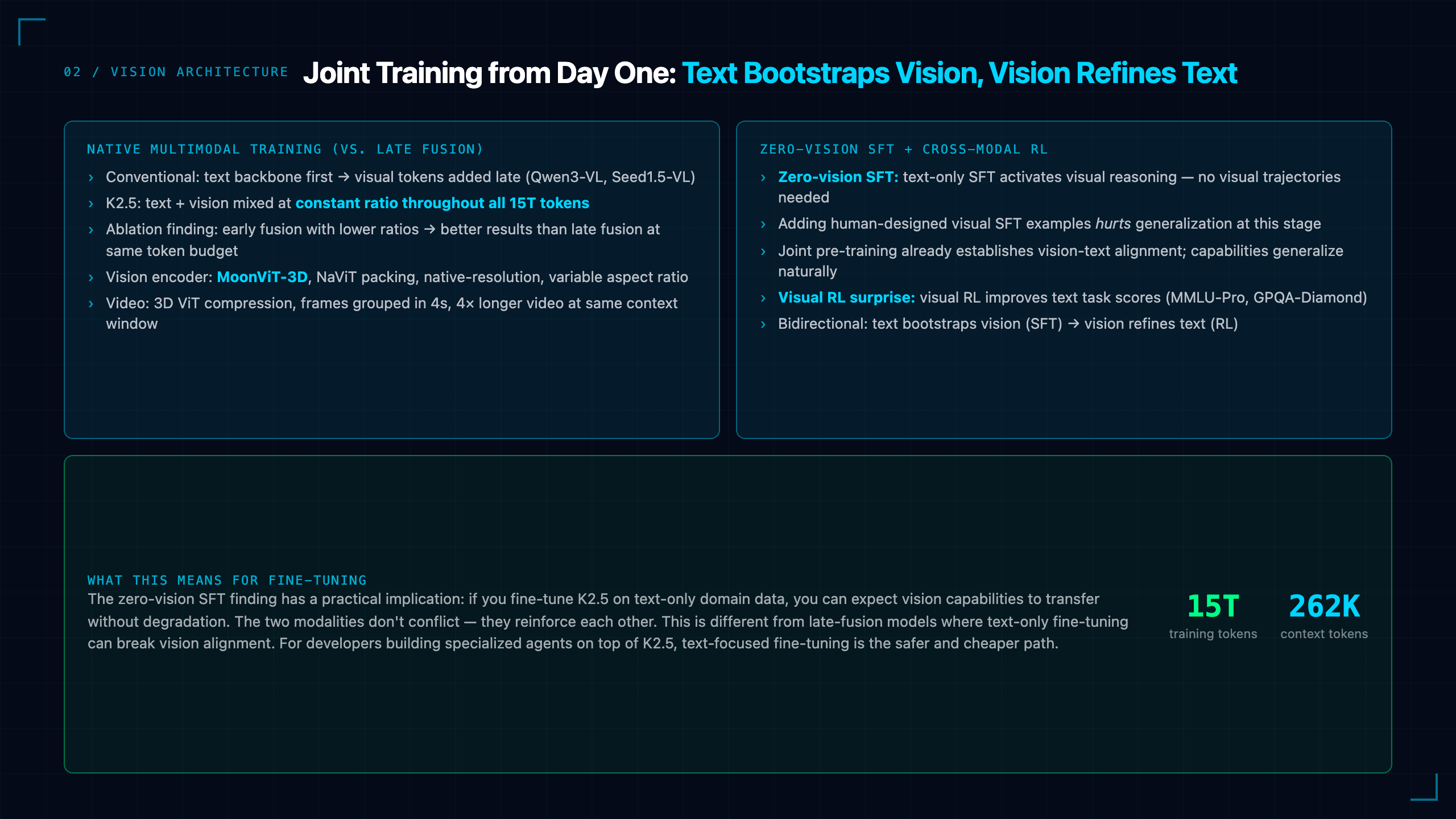
Kimi K2.5 is a native multimodal model — vision isn't bolted on after training. The approach differs from most current multimodal LLMs in a fundamental way.
Conventional practice: train a text backbone first, then add visual tokens in late-stage continued training. Qwen3-VL and Seed1.5-VL both follow this pattern.
K2.5's approach: mix text and vision tokens at a constant ratio throughout the entire training process — all 15T tokens. The finding from Moonshot's ablations is that early vision fusion with lower ratios produces better results than late-stage fusion, given the same total token budget.
The vision encoder is MoonViT-3D, a native-resolution encoder using the NaViT packing strategy for variable-resolution images. For video, a 3D ViT compression mechanism groups consecutive frames in fours, processes them through the shared MoonViT encoder, and temporally averages at the patch level — enabling 4× longer video processing within the same context window with no separate video weights.
Post-training insight (zero-vision SFT): Moonshot found that text-only SFT alone is sufficient to activate visual reasoning and tool use. Adding human-designed visual trajectories at this stage hurts generalization. The explanation: joint pre-training already establishes strong vision-text alignment, so visual capabilities generalize naturally without explicit visual SFT examples.
The cross-modal RL finding is the most surprising: visual RL doesn't just improve vision tasks — it improves text task performance on MMLU-Pro and GPQA-Diamond. Text bootstraps vision during SFT; vision then refines text during RL. The bidirectional enhancement is the key result.
Benchmarks
Math and Reasoning:
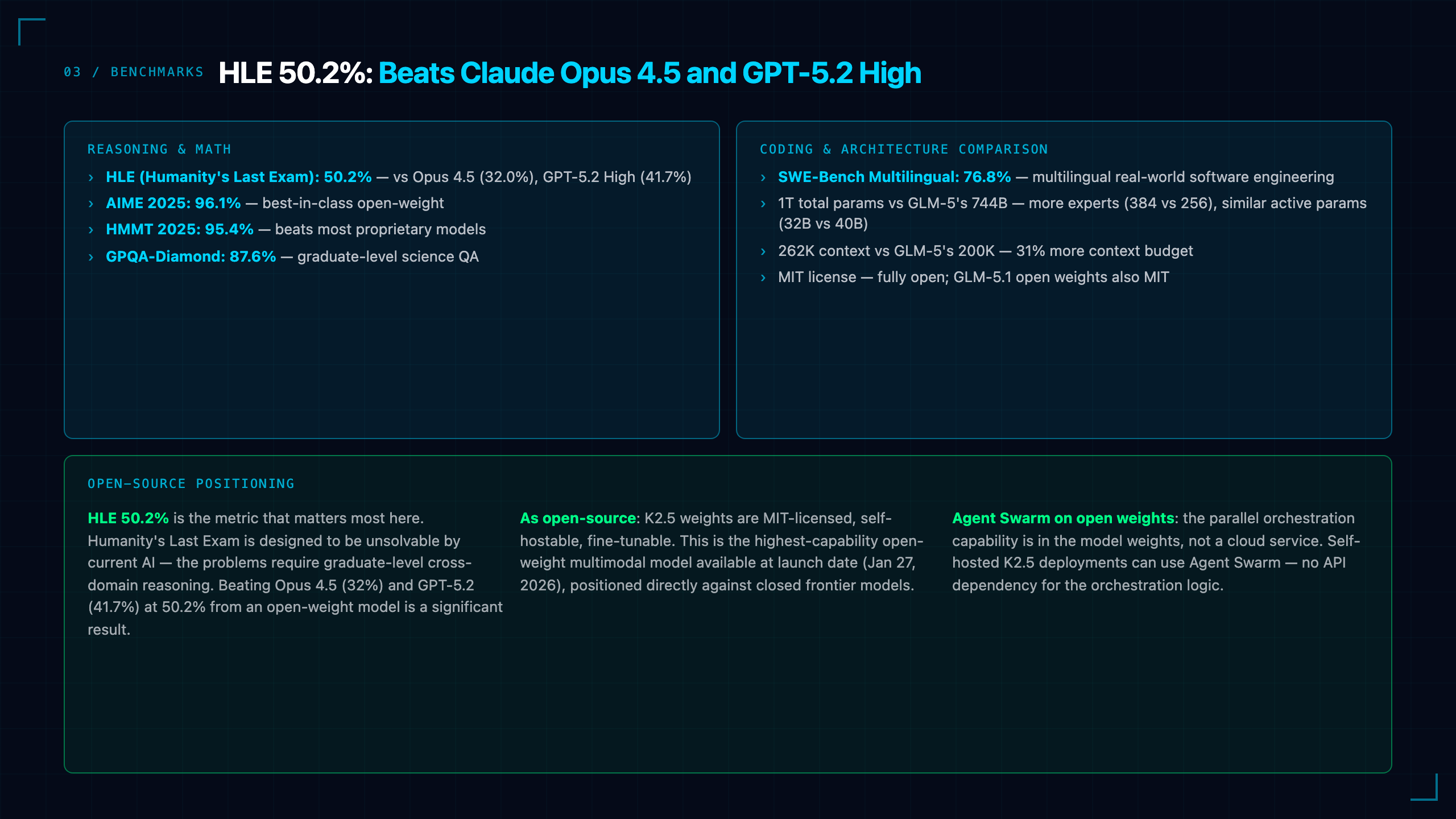
- HLE (Humanity's Last Exam): 50.2% — beating Claude Opus 4.5 (32.0%) and GPT-5.2 High (41.7%)
- AIME 2025: 96.1%
- HMMT 2025: 95.4%
- GPQA-Diamond: 87.6%
Coding and Engineering:
- SWE-Bench Multilingual: 76.8%
- Strong performance on multi-language real-world software engineering tasks
Architecture for comparison:
| Kimi K2.5 | GLM-5 | |
|---|---|---|
| Total params | 1T (1,000B) | 744B |
| Active params | 32B per token | 40B per token |
| Architecture | MoE, 384 experts, 8 active | MoE, 256 experts, 8 active |
| Context window | 262K tokens | 200K tokens |
| Release | Jan 27, 2026 | Feb 11, 2026 |
Access and Availability
K2.5 is available through four channels:
- Kimi.com and the Kimi App: four modes — K2.5 Instant, K2.5 Thinking, K2.5 Agent, K2.5 Agent Swarm (Beta; free credits for high-tier paid users)
- Kimi API: standard and thinking variants
- Kimi Code: coding agent interface
- HuggingFace: open weights (MIT license)
The MIT license is significant: unlike proprietary models that provide only API access, K2.5 weights are freely downloadable for self-hosted deployment, research, and fine-tuning.
What It Means for Developers
The Agent Swarm capability opens up a different class of applications than single-agent models support. The distinction isn't speed (though 4.5× latency reduction matters) — it's the structure of the task you can give the model.
With a single agent, you're limited to tasks that decompose naturally into sequential steps. With Agent Swarm, you can hand the model an entire project with multiple independent workstreams and let it figure out the parallelization. The orchestration logic — which sub-agents to create, what tools to give them, how to synthesize their outputs — is the model's responsibility, not yours.
For developers building products:
- Research pipelines: literature review, data collection, analysis, and synthesis can run in parallel streams
- Large codebase work: simultaneous analysis of different modules, parallel test generation, cross-file refactoring
- Multi-domain projects: design, development, and documentation workflows that can run concurrently
The zero-vision SFT finding also matters for anyone building vision-capable agents: you can likely fine-tune K2.5 on text-only data and expect vision capabilities to remain intact. The joint training means the two modalities don't conflict — text improvement generalizes to vision performance.
Bottom Line
Kimi K2.5 is the first open-source model with a trained, not prompted, parallel agent orchestration capability. Agent Swarm isn't a system prompt trick — it's a PARL-trained ability to create and manage sub-agent hierarchies. The 4.5× latency reduction is real, the HLE 50.2% is above most closed-source frontier models, and the MIT license means the weights are yours to run.
For developers building agentic systems where task parallelization could reduce end-to-end latency, K2.5 is the baseline to start from.
Resources
- Kimi K2.5 Official Blog — announcement and benchmarks
- Technical Report (arXiv 2602.02276) — full training methodology
- HuggingFace Weights — MIT license open weights
- Kimi API Platform — API access
- Kimi Code — coding agent interface
Kimi K2.5 weights available under MIT license at huggingface.co/moonshotai/Kimi-K2.5. API access at platform.kimi.ai.