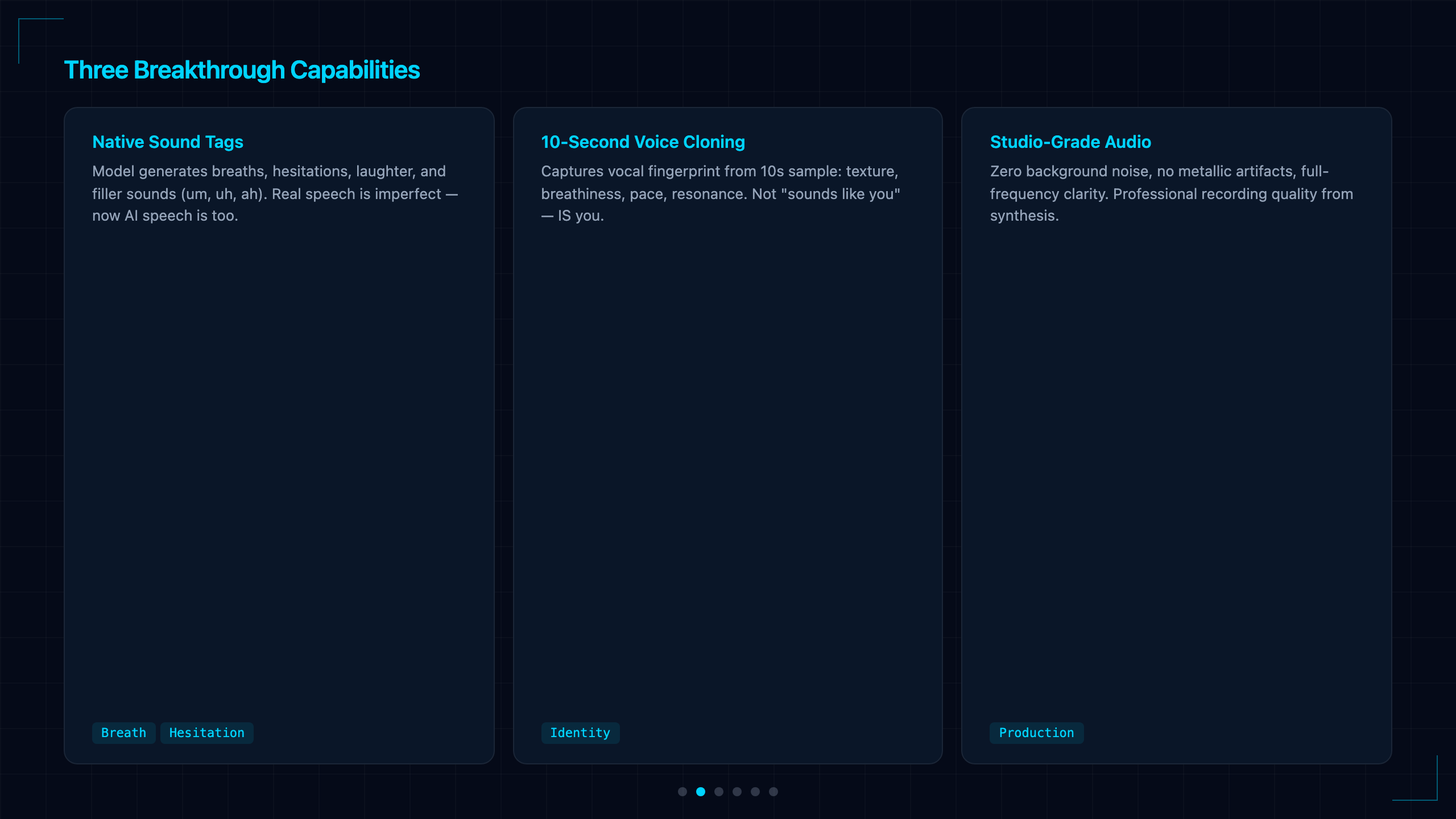
MiniMax just released Speech 2.8 with a framing that cuts to the core of what's been wrong with AI voice: previous models were "too perfect." Real human speech is messy — filled with breaths, hesitations, filler words, and micro-pauses that convey emotion. Speech 2.8's headline feature is Native Sound Tags: explicit modeling of colloquial fillers like "um," "uh," "ah," laughter, throat-clearing, and breathing. The result sounds human because it sounds imperfect.
This isn't a minor iteration. Voice cloning from a 10-second sample, native sound tag support, and studio-grade noise elimination represent three distinct engineering challenges solved simultaneously. The combination moves MiniMax's TTS from "good for demos" to "production-ready for content creators, game developers, and conversational AI."
Native Sound Tags: Modeling Imperfection
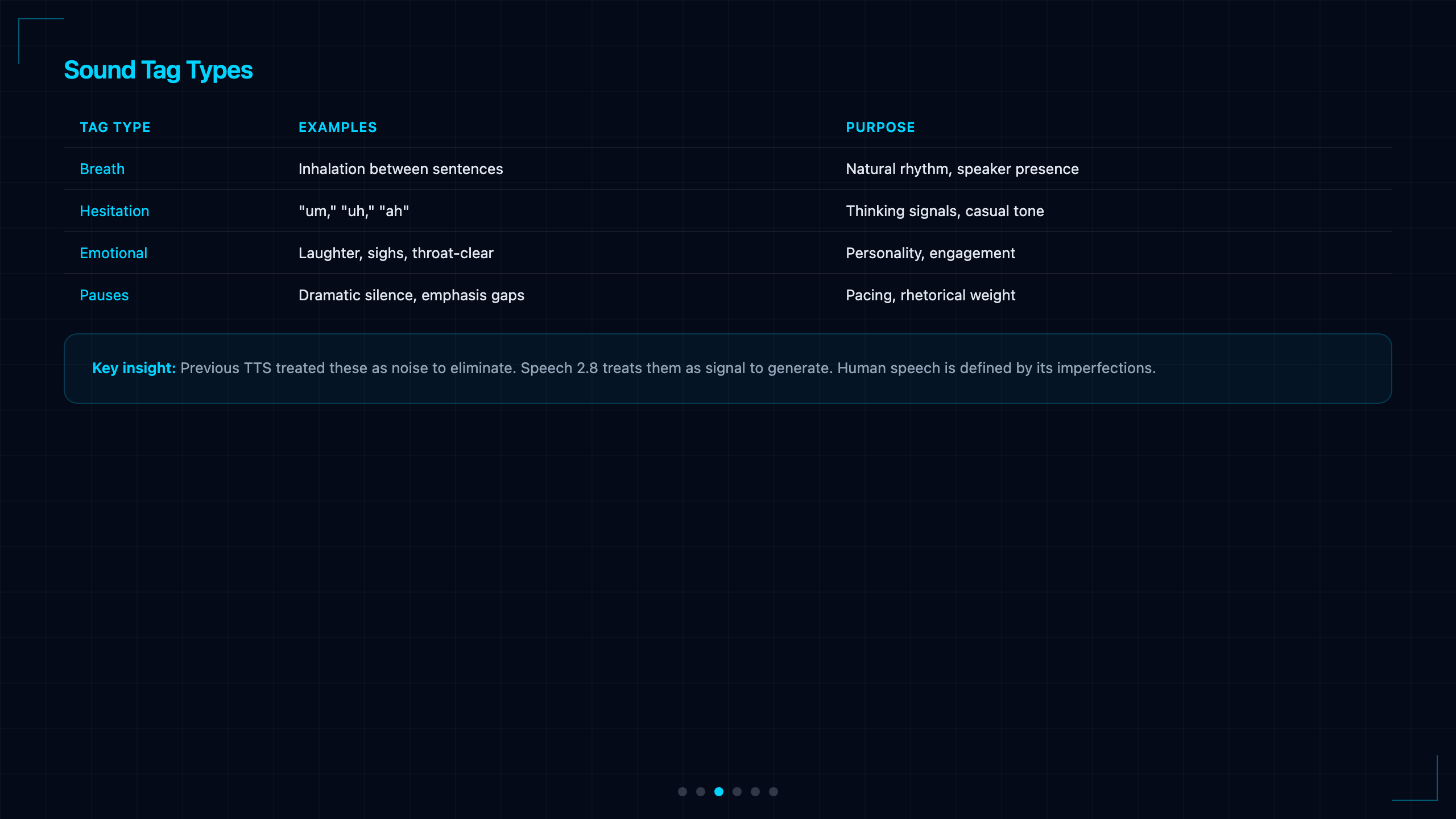
The core innovation is teaching the model to produce the sounds between words — the ones that make speech feel alive:
- Breath markers — natural inhalation between sentences
- Hesitation fillers — "um," "uh," "ah" with correct pitch and duration
- Emotional sounds — laughter, sighs, throat-clearing
- Rhythmic pauses — silence used for emphasis, not just gaps between sentences
Previous TTS models treated these as noise to eliminate. Speech 2.8 treats them as signal to preserve and generate. You can prompt for them explicitly or let the model inject them naturally based on context.
The demo sentence illustrates the approach: "Hey, it's me. How are ya? (chuckle) I hope you're having an awesome day! We actually had a bit of a crazy launch day yesterday, you know, but (breath) I'm just recovered and ready to roll." Every parenthetical becomes a generated sound, not synthesized silence.
10-Second Voice Cloning
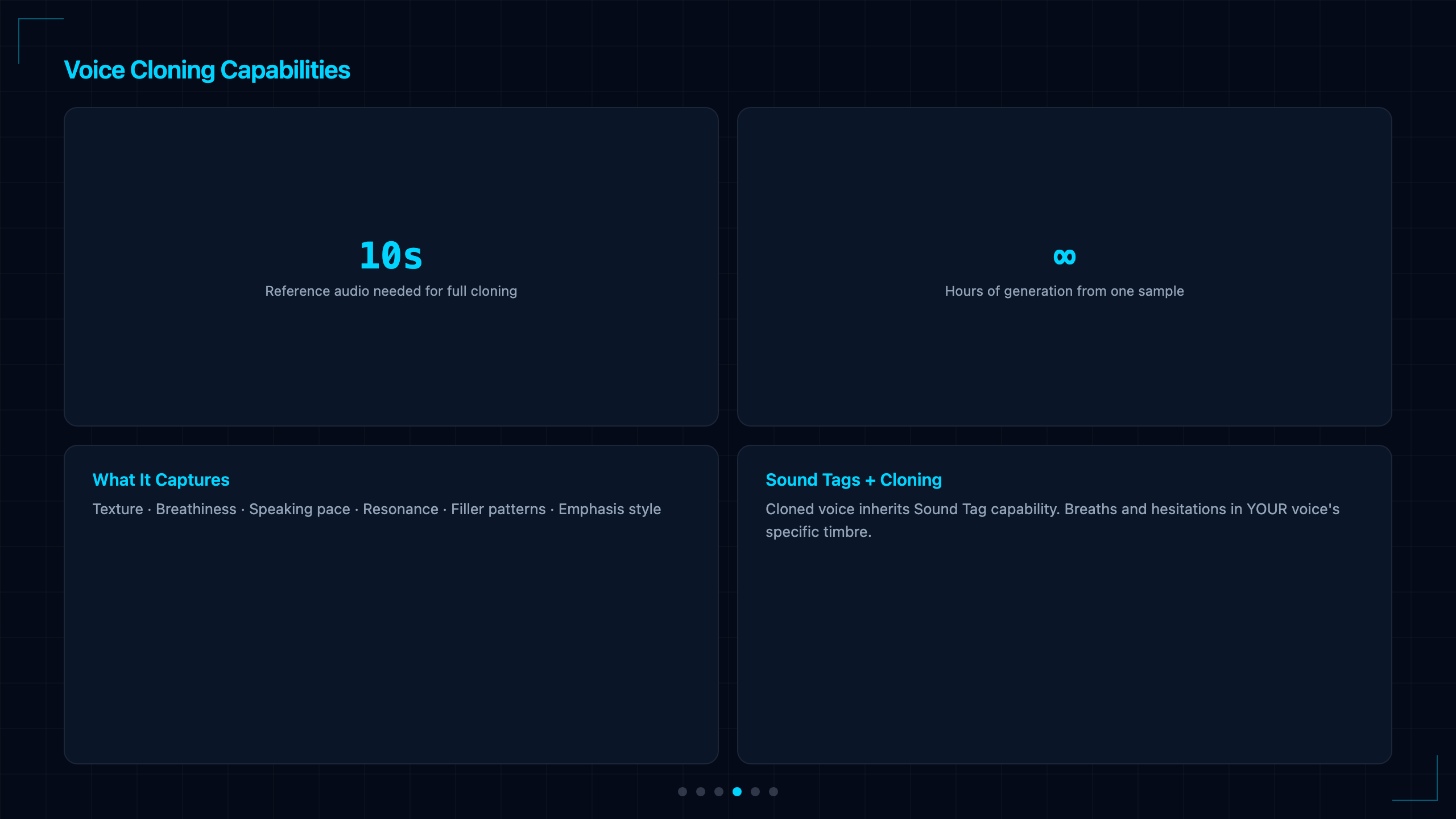
Speech 2.8's voice cloning captures what MiniMax calls your "vocal fingerprint" from just 10 seconds of audio. The feature extraction has been optimized to capture:
- Texture — the grain and breathiness unique to each voice
- Pace — individual speaking rhythm and cadence patterns
- Resonance — tonal quality and frequency characteristics
The claim isn't just "sounds like you" — it's "sounds like you having a casual conversation," including your specific patterns of emphasis, pause, and filler usage. The cloned voice inherits the Sound Tag capability, meaning it can produce breaths and hesitations in your voice's specific timbre.
For content creators, this means: record a 10-second sample, then generate hours of narration in your voice with natural-sounding delivery. No more choosing between "authentic but expensive" (hire yourself for every take) and "cheap but robotic" (standard TTS).
Studio-Grade Audio Quality
The third pillar is audio purity — eliminating background noise and digital artifacts from synthesized output. MiniMax re-engineered their processing pipeline to produce output that sounds like a professional studio recording:
- Zero background noise (no hiss, hum, or ambient artifacts)
- No synthetic distortion (the "metallic" quality that betrays AI voice)
- Transparent, full-frequency-range output
This matters for production use cases where AI voice sits alongside human-recorded audio. If the AI segments sound noticeably different in quality (even if the voice is convincing), the illusion breaks.
What It Means for Developers
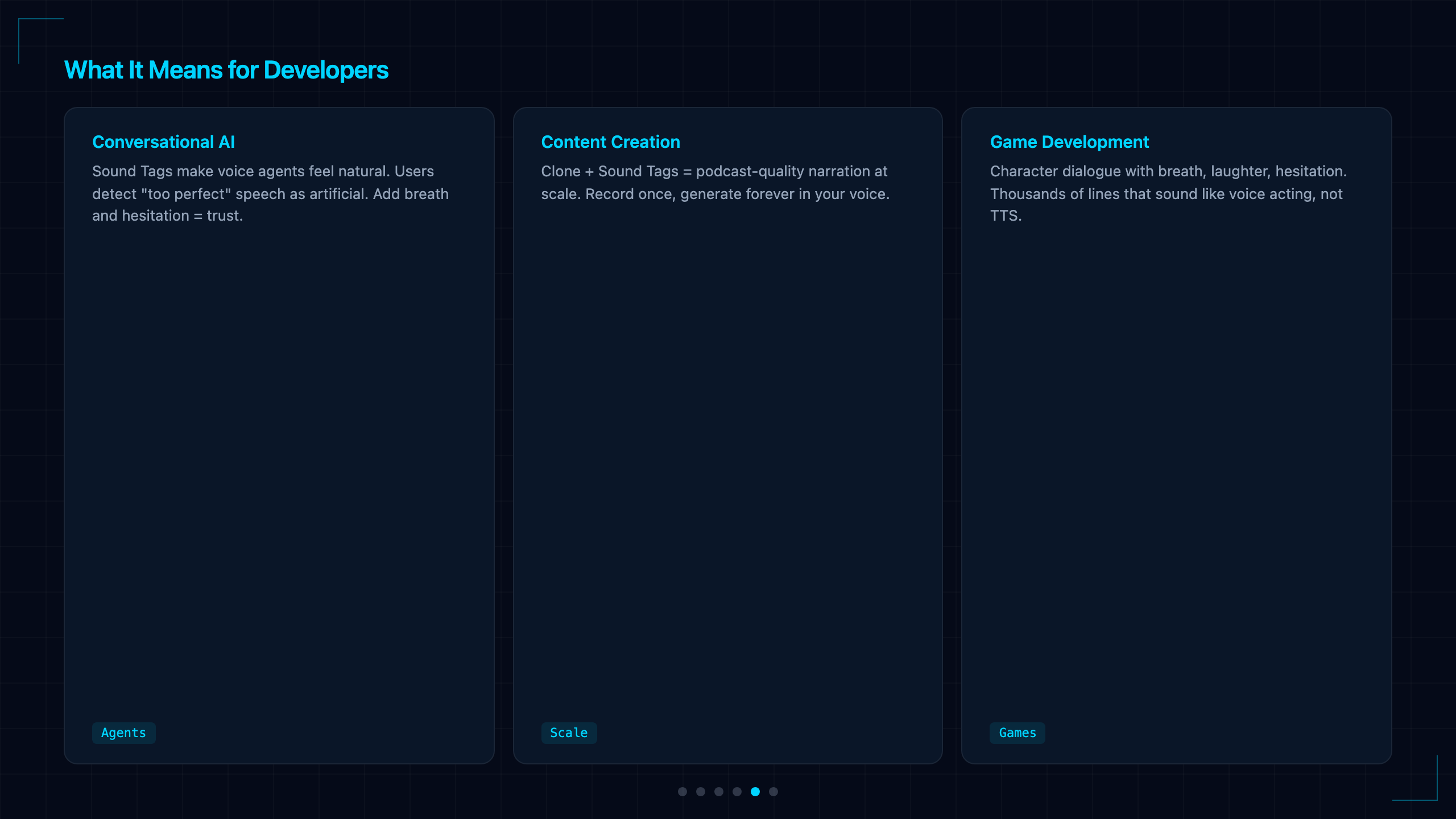
For conversational AI builders: Sound Tags are the missing piece for making voice agents feel natural. Users unconsciously detect "too perfect" speech as artificial. Adding breath, hesitation, and filler sounds at appropriate moments makes your agent sound like it's thinking, not just reading.
For content creators: 10-second voice cloning + Sound Tags means you can produce podcast-quality narration at scale without recording every word yourself. The combination of voice authenticity and natural delivery patterns is what makes this production-ready.
For game developers: Character dialogue that includes breath, laughter, and hesitation sounds dramatically different from standard TTS. Speech 2.8 can generate thousands of dialogue lines that sound like voice acting, not text-to-speech.
API access: Available through MiniMax's API platform. The Sound Tags are controllable via text markup — you can specify exactly where breaths, pauses, and fillers should appear, or let the model decide based on context.
Bottom Line
Speech 2.8's core insight is that human speech is defined by its imperfections. By explicitly modeling breaths, hesitations, and filler sounds as first-class audio features rather than artifacts to suppress, MiniMax closes the gap between "AI voice" and "voice that happens to be AI-generated." Combined with 10-second voice cloning and studio-grade output quality, this is the first TTS release that's genuinely production-ready for applications where the voice needs to feel human, not just sound human.
Resources
- MiniMax Speech 2.8 Announcement — full details and demos
- MiniMax API Platform — API access
- Audio Product — consumer-facing audio tools
MiniMax Speech 2.8 is available via API at minimax.io. Try the Audio product for a consumer experience.