Zhipu AI released GLM-5 on February 14, 2026 — the most significant architectural departure in the GLM series since GLM-4 introduced vision capabilities. GLM-5 moves from GLM-4's dense architecture to a large MoE design at 744B total / 40B active parameters, extends context to 200K tokens, and ships under MIT license — the same open licensing that made DeepSeek V3 attractive for self-hosted deployment.
The timing positions GLM-5 directly against Kimi K2 and DeepSeek V3.2 in the February 2026 crowded-frontier environment. SWE-bench Verified 77.8% places GLM-5 above DeepSeek V3.2 (49.8%) and competitive with Kimi K2 (70.4%) — establishing Zhipu as a serious contender in the agentic coding tier, not just general instruction following.
For developers, GLM-5 is notable as the only large Chinese MoE model with both MIT license and a 200K context window at this capability tier.
What's New
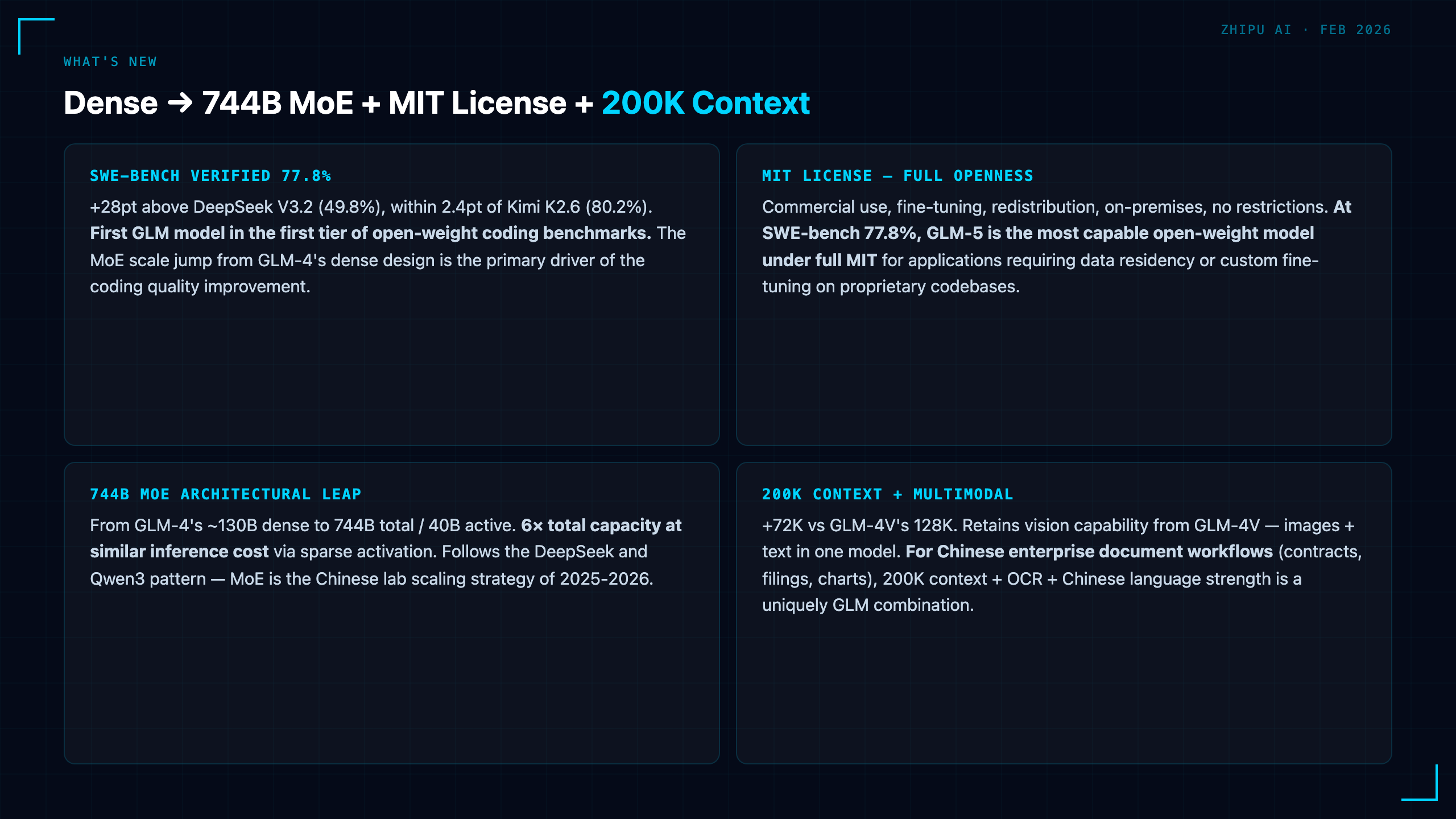
744B/40B MoE architecture: GLM-5 adopts mixture-of-experts scaling — 744B total parameters with 40B active per token. The MoE design follows the pattern established by DeepSeek V3 and Qwen3: large total capacity at manageable active parameter cost. For the GLM family, this is a significant scale increase from GLM-4's dense architecture.
SWE-bench Verified 77.8%: The headline number — +28pt above DeepSeek V3.2 (49.8%), within 5pt of Kimi K2.6 (80.2%), and competitive with the emerging coding-capable MoE tier. At 77.8%, GLM-5 can handle autonomous code change tasks at quality that was reserved for frontier closed-source models six months prior.
200K token context: GLM-5 extends from GLM-4's 128K to 200K tokens. For full-repository code analysis, legal document review, and multi-document research synthesis, 200K tokens covers most practical use cases without multi-pass chunking.
MIT license: GLM-5 ships under MIT — commercial use, fine-tuning, redistribution, on-premises deployment, no restrictions. This is the most permissive license available for a model at this capability tier, and it distinguishes GLM-5 from Qwen2.5-Max (API-only, proprietary) and Hunyuan-TurboS (proprietary).
Multimodal continuity: GLM-5 retains GLM-4V's vision capabilities — image understanding, chart analysis, and document OCR. The multimodal continuity makes GLM-5 a drop-in upgrade for applications built on GLM-4V, with the added coding and reasoning improvements.
Architecture
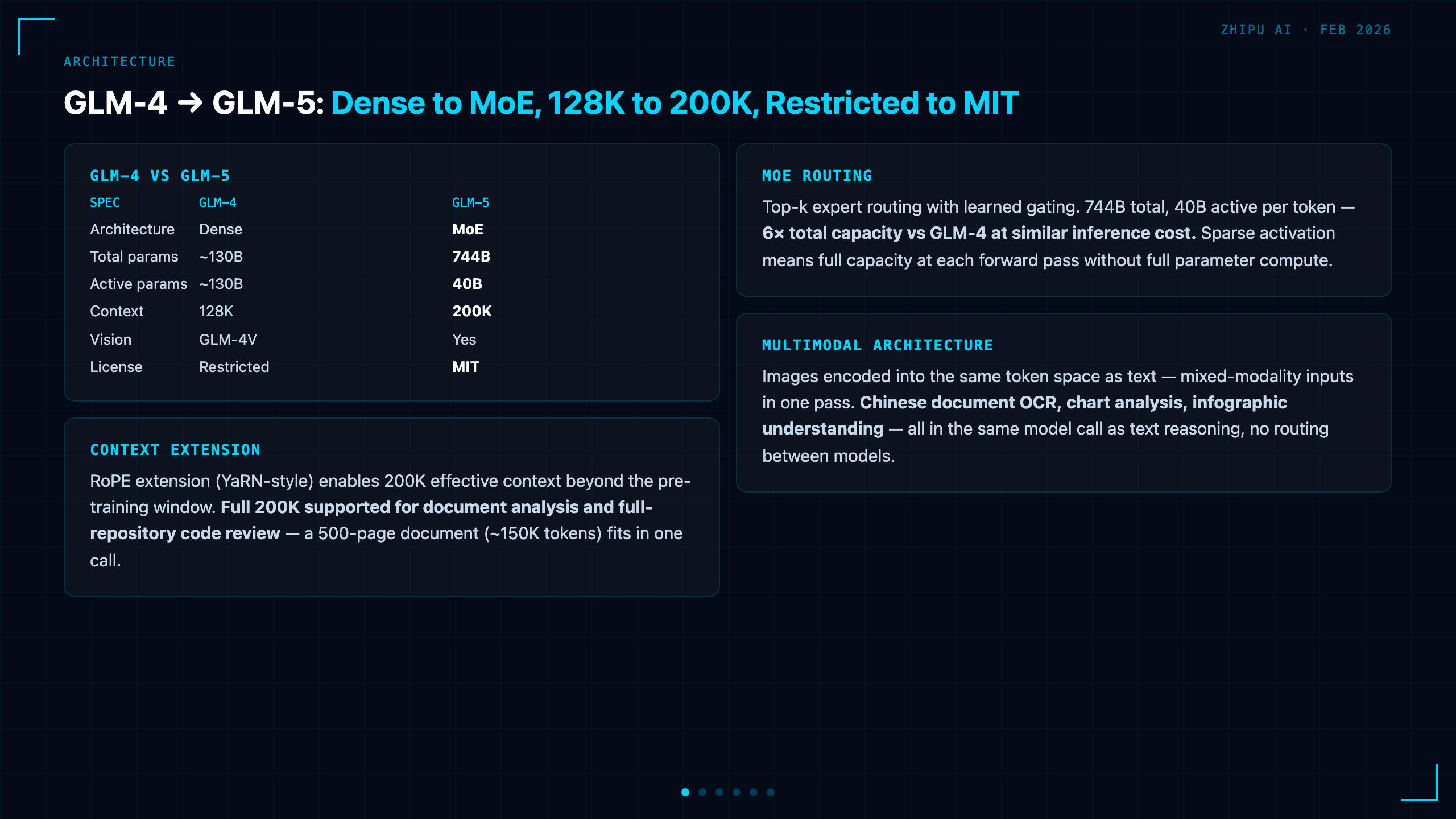
| Component | GLM-5 | GLM-4 (prev) |
|---|---|---|
| Total parameters | 744B | ~130B dense |
| Active parameters | 40B | ~130B |
| Architecture | MoE | Dense Transformer |
| Context window | 200K | 128K |
| Vision | Yes | Yes (4V) |
| License | MIT | Restricted |
| Input price | ~¥0.05/K tokens | — |
MoE routing in GLM-5: GLM-5 uses top-k expert routing with a learned gating mechanism. The MoE transition from GLM-4's dense design represents a fundamental architectural shift — at 744B total vs ~130B active, GLM-5 has roughly 6× the total parameter capacity while maintaining similar inference cost to GLM-4.
Context architecture: 200K context is supported via a combination of RoPE (Rotary Position Embedding) extension and attention optimization. GLM-5 applies techniques similar to YaRN (Yet another RoPE extension) to extend the effective context beyond the training window without full retraining at 200K.
Multimodal integration: GLM-5 maintains the visual grounding capability introduced in GLM-4V — images are encoded into the same token space as text, enabling mixed-modality inputs. Vision capability is particularly relevant for GLM-5's Chinese market focus: OCR of Chinese documents, analysis of Chinese-language charts and infographics.
MIT license implications: Full MIT means: (1) self-host on-premises without licensing fees, (2) fine-tune on proprietary data without restrictions, (3) distribute modified versions without disclosure requirements, (4) use commercially without per-seat or per-call licensing. The only comparable large open MoE is DeepSeek V3 (MIT) — GLM-5 adds vision and a slightly longer context.
Benchmarks
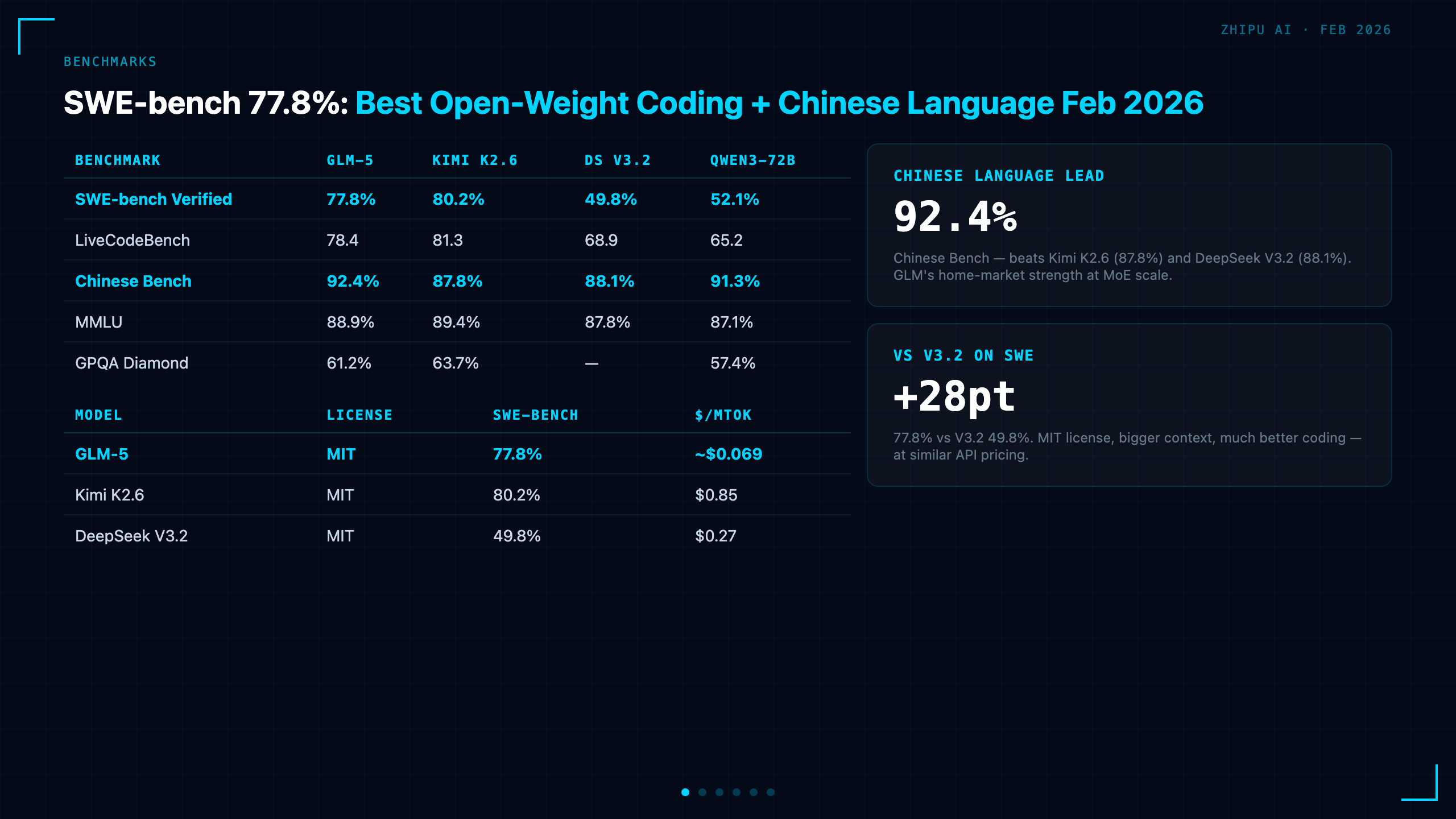
GLM-5 at February 2026 release:
| Benchmark | GLM-5 | Kimi K2.6 | DeepSeek V3.2 | Qwen3-72B | Notes |
|---|---|---|---|---|---|
| SWE-bench Verified | 77.8% | 80.2% | 49.8% | 52.1% | Real GitHub issues |
| LiveCodeBench | 78.4 | 81.3 | 68.9 | 65.2 | Competitive coding |
| MMLU | 88.9% | 89.4% | 87.8% | 87.1% | General knowledge |
| GPQA Diamond | 61.2% | 63.7% | — | 57.4% | Graduate science |
| GSM8K | 96.1% | — | 95.7% | 94.2% | Math word problems |
| Chinese Bench | 92.4% | 87.8% | 88.1% | 91.3% | Chinese language |
SWE-bench 77.8% is GLM-5's strongest story: +28pt above DeepSeek V3.2, within 2.4pt of Kimi K2.6 (80.2%). For a model launching at MIT license with 200K context, this places GLM-5 in the first tier of open-weight coding models.
Chinese Bench 92.4% is Zhipu's home-market advantage — GLM models have consistently led on Chinese language tasks, and GLM-5 extends this with its multimodal Chinese document processing.
Pricing in Context
| Model | License | Context | SWE-bench | Input Price |
|---|---|---|---|---|
| GLM-5 | MIT | 200K | 77.8% | ~$0.069/M |
| DeepSeek V3.2 | MIT | 256K | 49.8% | $0.27/M |
| Kimi K2.6 | MIT | 256K | 80.2% | $0.85/M |
| Qwen3-Coder | Proprietary | 128K | 70.6% | $0.048/M |
GLM-5 occupies a distinctive position: MIT license + 200K context + SWE-bench 77.8% at ~$0.069/M input. DeepSeek V3.2 (MIT, cheaper) has much lower SWE-bench (49.8%). Kimi K2.6 (MIT, 80.2%) costs more. GLM-5 is the best open-weight option for the specific combination of coding capability + MIT license.
What It Means for Developers
Best open MIT-licensed model for coding + Chinese: With SWE-bench 77.8% and MIT license, GLM-5 is the strongest open-weight option for coding-capable applications that require data residency, on-premises deployment, or fine-tuning. DeepSeek V3.2 (MIT) trails by 28pt on SWE-bench; Kimi K2.6 (MIT) beats by 2.4pt but costs more per API call.
200K context for full-document workflows: Legal contract analysis, full-codebase review, and multi-document research can run in a single context window without chunking. For Chinese-language enterprise customers — a primary GLM deployment context — processing contracts, regulations, and filings in 200K token windows is practical.
Multimodal + text in one model: GLM-5's retained vision capability means applications needing both text and image understanding (document OCR, chart analysis, mixed-content pipelines) use one model rather than routing between a text model and a vision model. For Chinese-language document processing, this is particularly valuable.
Zhipu enterprise relationships: Zhipu AI has deep relationships with Chinese state-owned enterprises and government institutions that require domestic AI vendors. GLM-5 with MIT license and Zhipu's enterprise support structure provides a path to frontier-quality AI for organizations with strict procurement constraints.
Drop-in upgrade from GLM-4V: Same API format, same tokenizer family, same multimodal capabilities — upgraded to 744B MoE, 200K context, and significantly better coding benchmarks. Existing GLM-4V applications upgrade by changing the model identifier.
Availability
- API: Zhipu BigModel Platform —
glm-5model ID - HuggingFace: THUDM/GLM-5 — MIT license
- License: MIT (commercial use, fine-tuning, redistribution)
- Pricing: ~¥0.05/K tokens input (~$0.069/M)
Bottom Line
GLM-5 is Zhipu's architectural reset: from dense to 744B MoE, from 128K to 200K context, from restricted to MIT, with SWE-bench 77.8% that places it in the first tier of open coding models. For developers who need MIT license + coding capability + Chinese language strength in a single model, GLM-5 is the clearest option at February 2026. The gap to Kimi K2.6 (2.4pt on SWE-bench, higher API price) leaves GLM-5 as the value option in open-weight frontier coding models — and the dominant choice where Chinese language quality is the primary requirement.
Resources
- Zhipu BigModel Platform — API access
- HuggingFace — THUDM/GLM-5 — model weights
- Zhipu AI — company website
- GLM Technical Report — prior GLM-4 architecture details
GLM-5 is available via the Zhipu BigModel Platform at open.bigmodel.cn and on HuggingFace under MIT license.