Alibaba's Qwen team released Qwen-Image, a 20B parameter MMDiT (Multi-Modal Diffusion Transformer) that cracks the hardest remaining problem in text-to-image generation: rendering text that's actually legible. Not just English text — Chinese text, with complex characters, multi-line layouts, and paragraph-level semantics. The model also does precise image editing through a unified architecture. Open-source. Available on HuggingFace and ModelScope.
This is significant because text rendering has been the persistent failure mode of diffusion models since DALL-E first shipped. Even the best models (Midjourney v6, DALL-E 3, SD3) produce garbled text more often than not. Qwen-Image doesn't just improve on this — it achieves state-of-the-art specifically on text rendering benchmarks while simultaneously leading on general image generation and editing.
Why Text Rendering is Hard
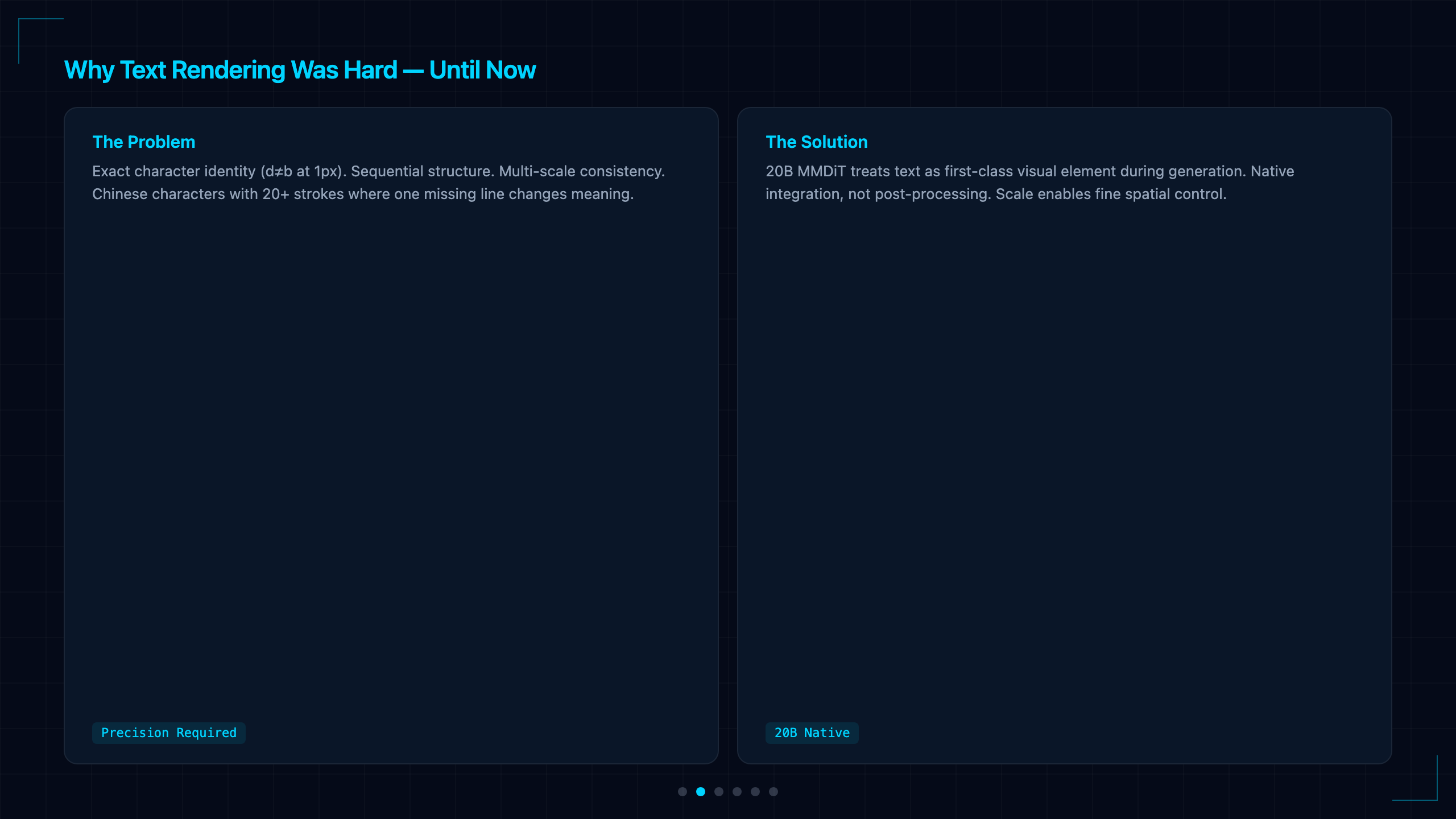
Text in images has fundamentally different requirements from visual content:
- Exact character identity: "d" and "b" differ by one pixel. Diffusion's stochastic sampling struggles with this precision.
- Sequential structure: Characters must appear in correct order, with consistent spacing and alignment.
- Multi-scale consistency: A word must be legible at the font size, while the surrounding image maintains aesthetic quality.
- Chinese complexity: Characters with 20+ strokes where a single missing line changes meaning entirely.
Previous approaches bolted text rendering on top of general image generation as a post-processing step. Qwen-Image integrates it natively into the 20B MMDiT architecture, treating text as a first-class visual element during generation.
Benchmark Results
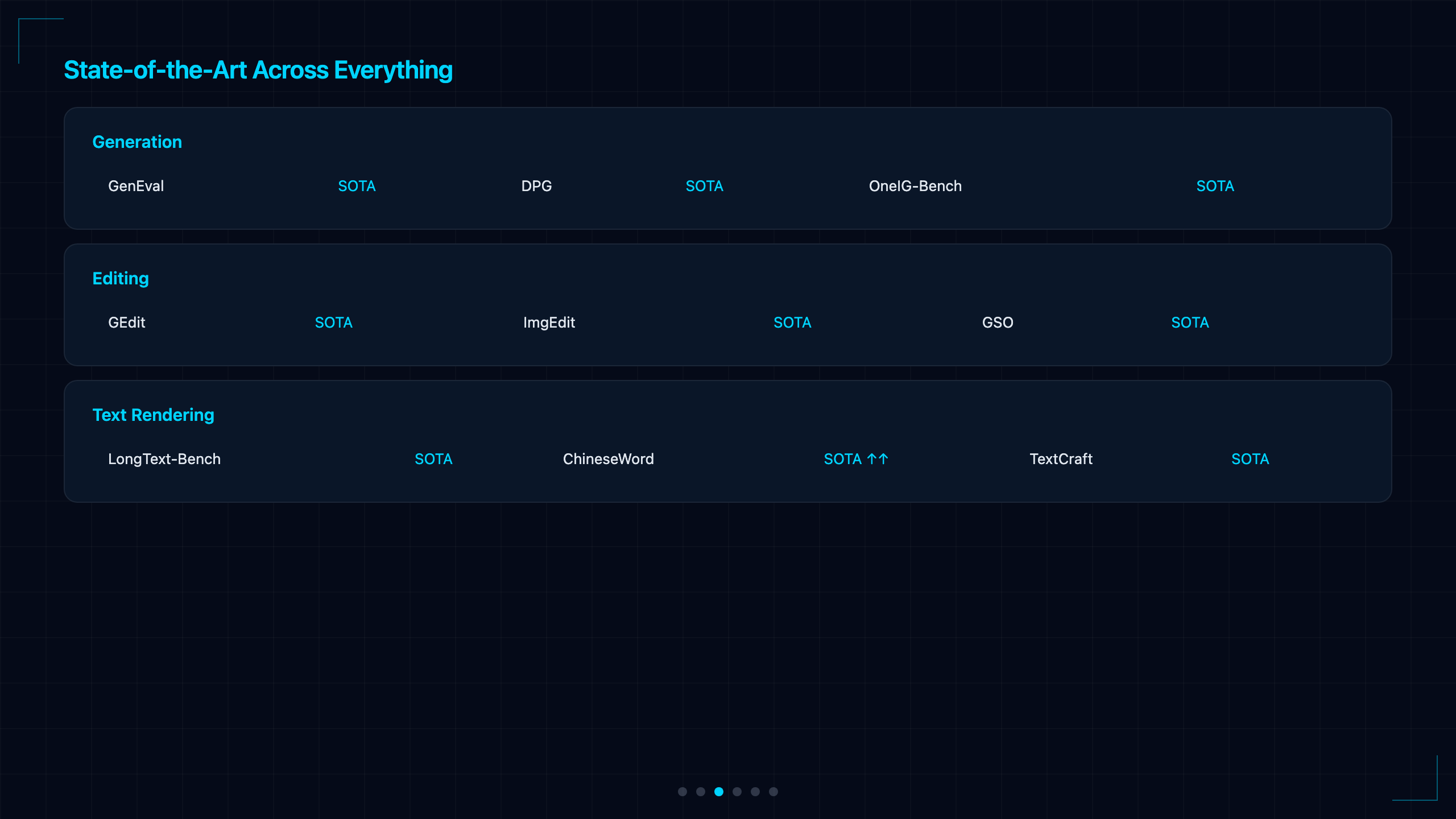
Qwen-Image achieves state-of-the-art across three categories:
General Image Generation
| Benchmark | Score | What it measures |
|---|---|---|
| GenEval | SOTA | Compositional generation fidelity |
| DPG | SOTA | Text-image alignment quality |
| OneIG-Bench | SOTA | Overall generation capability |
Image Editing
| Benchmark | Score | What it measures |
|---|---|---|
| GEdit | SOTA | General editing precision |
| ImgEdit | SOTA | Instruction-following in edits |
| GSO | SOTA | Geometric and structural operations |
Text Rendering
| Benchmark | Score | What it measures |
|---|---|---|
| LongText-Bench | SOTA | Multi-line, paragraph text generation |
| ChineseWord | SOTA (significant margin) | Chinese character rendering |
| TextCraft | SOTA | Creative text integration |
The ChineseWord result is particularly notable — Qwen-Image outperforms existing SOTA "by a significant margin," suggesting a qualitative improvement in Chinese text handling rather than incremental gains.
Key Capabilities
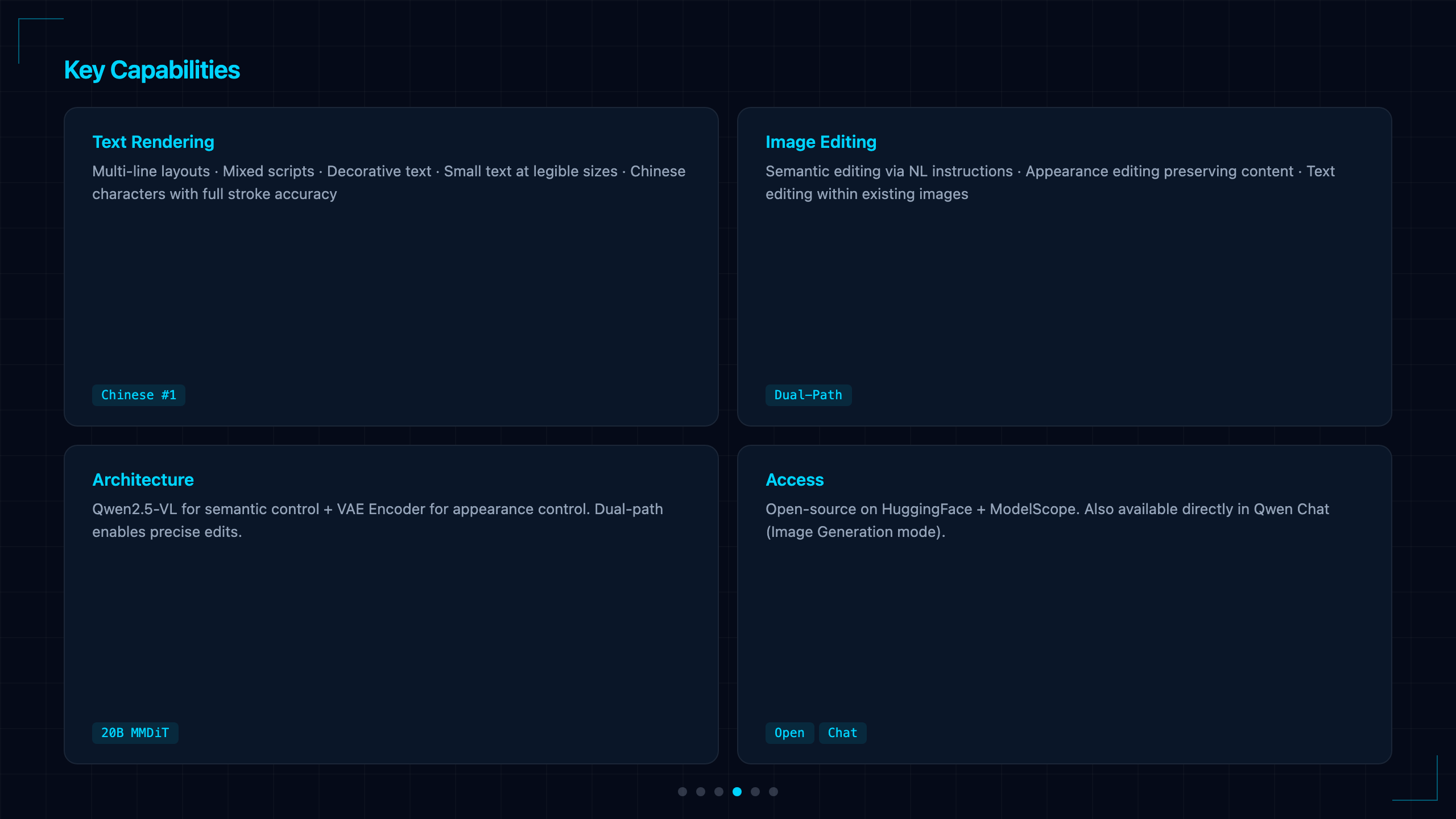
Complex Text Rendering
Qwen-Image handles scenarios that defeat other models:
- Multi-line layouts — paragraphs of text rendered legibly within images
- Mixed scripts — English and Chinese in the same composition
- Decorative text — text as design element (signage, logos, banners)
- Small text — legible at sizes where other models produce noise
Image Editing
Using the same 20B model, Qwen-Image supports precise editing through natural language instructions:
- Semantic editing — "change the cat to a dog" with surrounding context preserved
- Appearance editing — "make it sunset lighting" affecting only relevant pixels
- Text editing — change text within existing images while preserving layout
The architecture feeds the input image into Qwen2.5-VL (for semantic control) and a VAE Encoder (for appearance control) simultaneously. This dual-path approach means semantic edits preserve visual style, and appearance edits preserve semantic content.
Architecture: 20B MMDiT
Qwen-Image uses a Multi-Modal Diffusion Transformer at 20B parameters — substantially larger than most open image models (SD3 is ~8B, FLUX is 12B). The increased scale directly benefits:
- Text rendering precision — more parameters = finer spatial control
- Complex composition — better understanding of spatial relationships
- Style versatility — broader coverage of artistic styles and aesthetics
- Editing accuracy — more precise semantic understanding of what to change
The model integrates with Qwen Chat directly — you can access it through the chat interface by selecting "Image Generation," making it immediately usable without API integration work.
What It Means for Developers
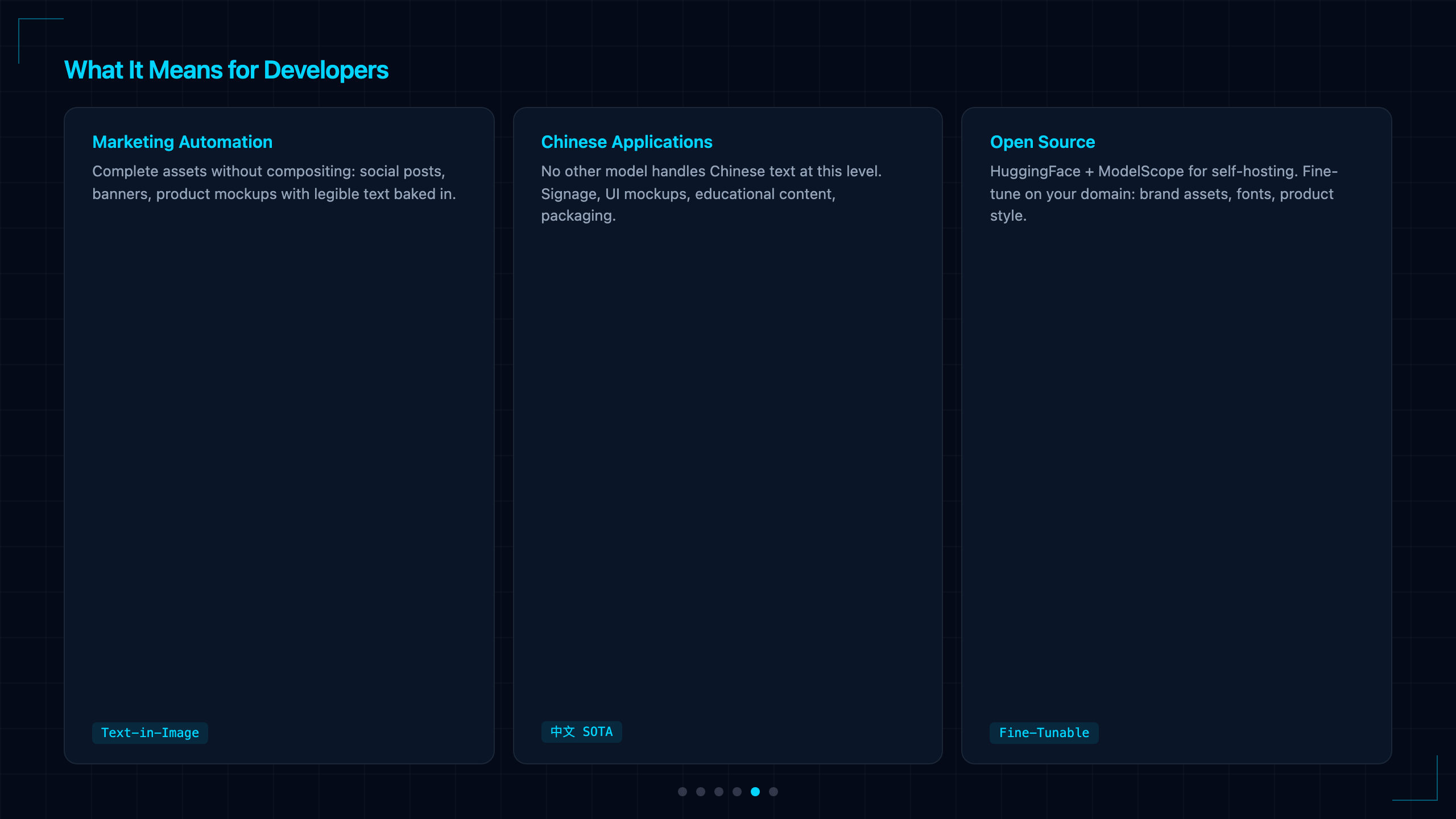
For marketing/content automation: Text rendering that actually works means you can generate complete marketing assets (social posts, banners, product mockups) without a compositing step. The Chinese text capability opens an entire market that was previously unserved by AI image generation.
For image editing pipelines: A single model that generates AND edits, controlled by natural language, with text-aware capabilities. This replaces multi-model pipelines (generate → edit → text overlay) with one API call.
For Chinese-language applications: No other model handles Chinese text rendering at this quality level. If your use case involves generating images with Chinese text (signage, UI mockups, educational content, product packaging), Qwen-Image is the only viable option.
Open-source advantage: Available on HuggingFace and ModelScope for self-hosting. This means you can fine-tune on your domain (product style, brand assets, specific font preferences) without API dependency.
Bottom Line
Qwen-Image solves text rendering — the problem that has plagued diffusion models since DALL-E 1. A 20B MMDiT with native text rendering, precise image editing, and SOTA on every major benchmark across generation, editing, and text rendering categories. The Chinese text capability is unmatched. Open-source on HuggingFace. Available through Qwen Chat for immediate use. If text legibility in generated images matters to your use case, this is the model.
Resources
- GitHub Repository — model code
- HuggingFace — model weights
- ModelScope — alternative download
- Qwen Chat — try directly (select "Image Generation")
- Blog Post — full technical details
Qwen-Image is available on HuggingFace and through Qwen Chat. Select "Image Generation" in Qwen Chat to try it directly.