Alibaba's Qwen team released Qwen3.7-Max on May 20, 2026 at the Alibaba Cloud Summit in Hangzhou. The headline number isn't a benchmark score — it's a duration: 35 hours of continuous autonomous execution, no human intervention, on a hardware platform the model had never been trained on.
That test is the clearest statement of what Qwen3.7-Max is designed for. It's not a chat model with better benchmarks. It's a model built from training through deployment for tasks that run longer than a human attention span — agent loops that execute hundreds of tool calls, discover and fix their own errors, and produce measurably better results the longer they run.
The 35-Hour Kernel Experiment
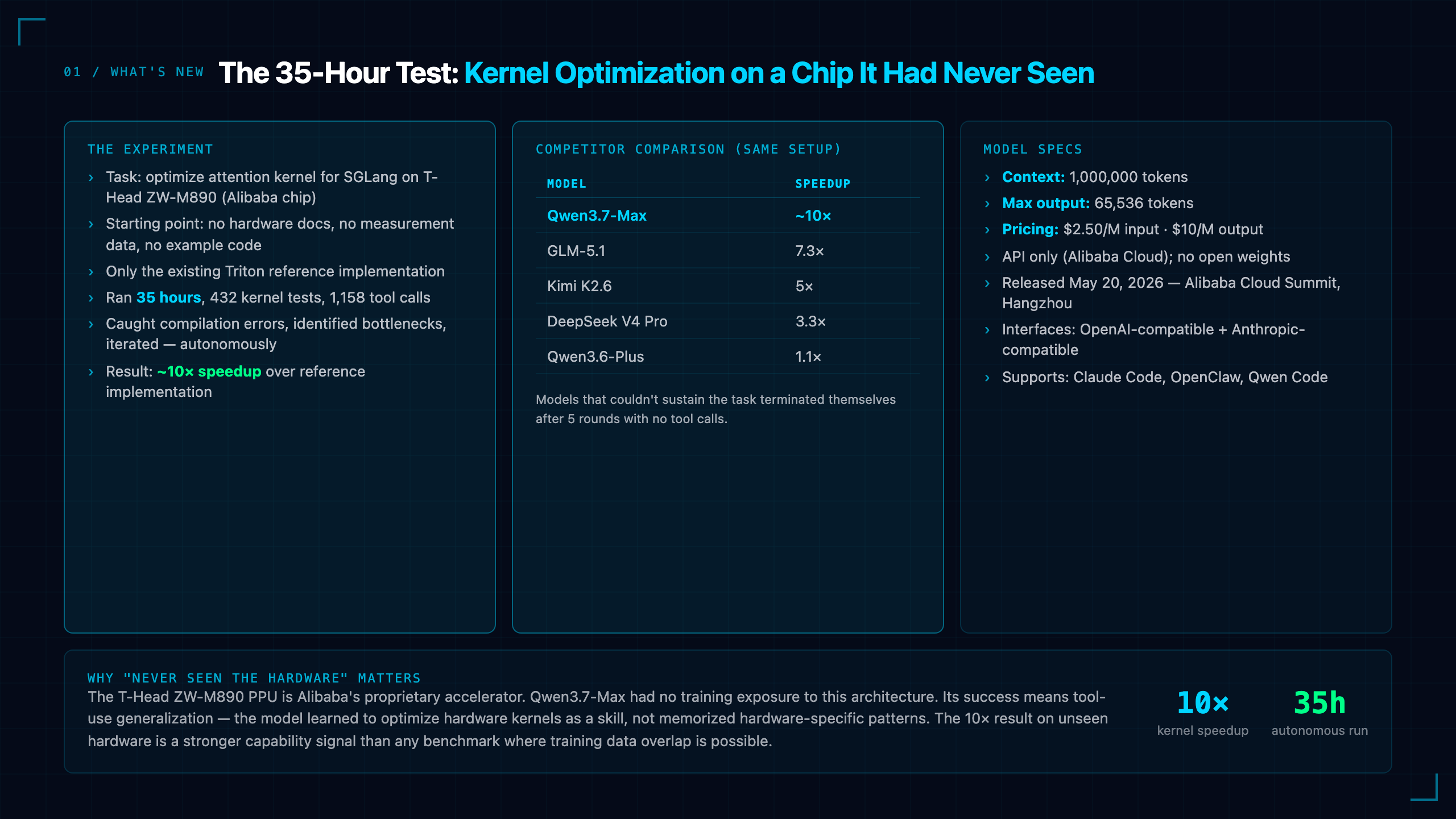
The Qwen team gave Qwen3.7-Max a concrete engineering task: optimize a hardware attention kernel for the open-source inference framework SGLang, targeting T-Head ZW-M890 accelerators — Alibaba's own AI chip platform, built by its semiconductor subsidiary T-Head.
The model started with nothing: no measurement data, no hardware documentation, no example code. Only the existing reference implementation written in Triton. The test environment was an isolated cloud instance.
What happened over 35 hours:
- 432 kernel tests executed
- 1,158 total tool calls made
- Compilation errors caught and resolved autonomously
- Performance bottlenecks identified and iterated on
- Final result: ~10× speedup over the reference implementation
The comparison against competing models in the same setup shows the gap clearly:
| Model | Kernel Speedup |
|---|---|
| Qwen3.7-Max | ~10× |
| GLM-5.1 | 7.3× |
| Kimi K2.6 | 5× |
| DeepSeek V4 Pro | 3.3× |
| Qwen3.6-Plus | 1.1× |
Models that couldn't sustain the task terminated themselves after five consecutive rounds with no tool calls. Qwen3.7-Max ran continuously.
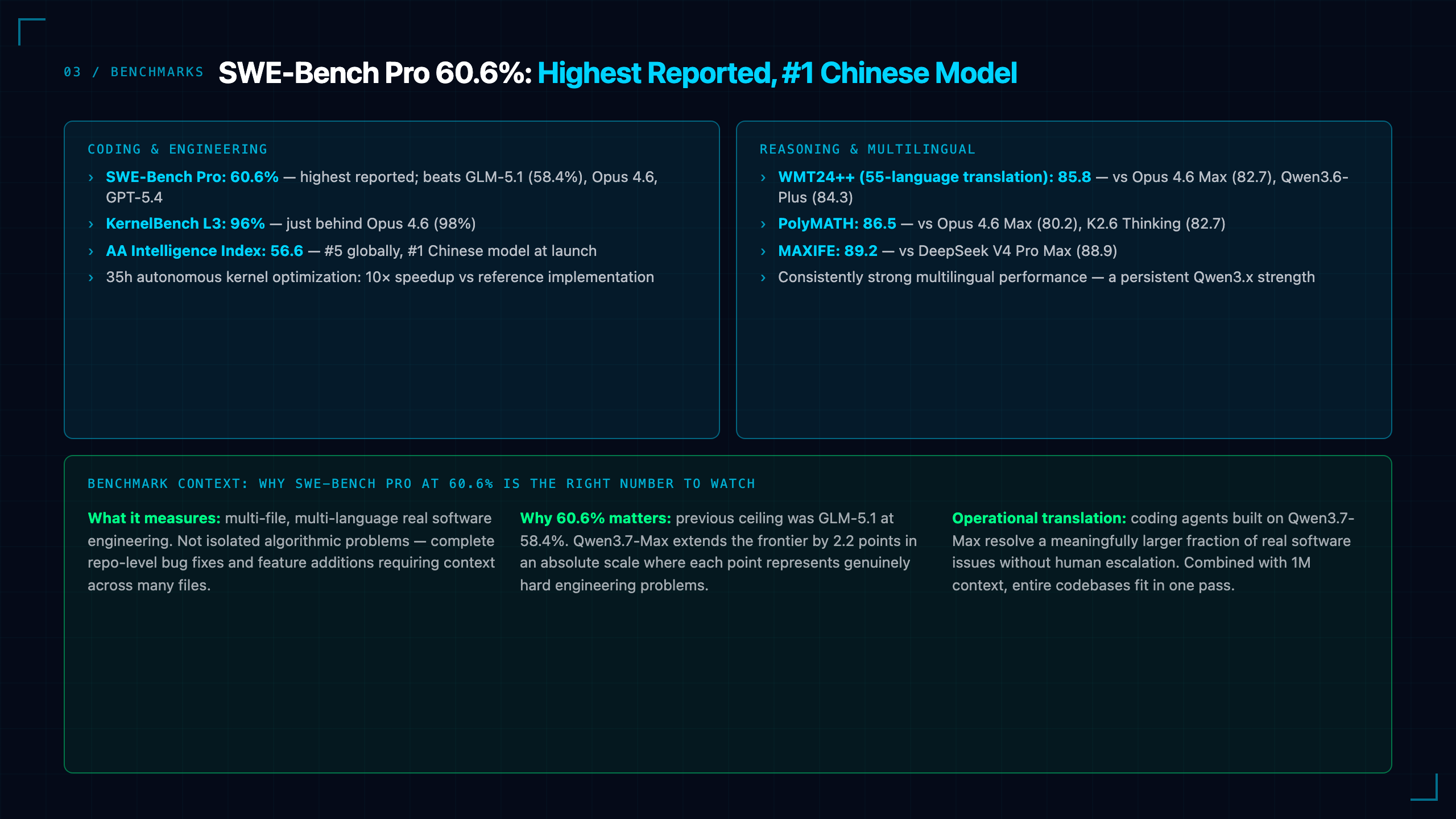
On KernelBench L3 (standardized kernel optimization benchmark), Qwen3.7-Max produces accelerated kernels 96% of the time — just behind Opus 4.6 at 98%.
Model Specs and Benchmarks
Qwen3.7-Max launched with a 1 million token context window — the longest in the Qwen line to date. Specs:
- Context: 1,000,000 tokens
- Max output: 65,536 tokens
- Access: API only (Alibaba Cloud Model Studio); no open weights
- Pricing: $2.50/M input tokens, $10/M output tokens
- Interfaces: OpenAI-compatible and Anthropic-compatible
- Harness support: Claude Code, OpenClaw, Qwen Code
The API endpoint supports both thinking (extended reasoning) and non-thinking modes. Compatible with standard tool-use frameworks without additional configuration.
Benchmark highlights:
- SWE-Bench Pro: 60.6% — highest reported across all models as of launch
- KernelBench L3: 96% (kernel acceleration success rate)
- Artificial Analysis Intelligence Index: 56.6 at launch (#5 globally, #1 Chinese model)
- WMT24++ (55-language translation): 85.8, ahead of Opus 4.6 Max (82.7)
- PolyMATH: 86.5 vs. Opus 4.6 Max (80.2)
- MAXIFE: 89.2, ahead of DeepSeek V4 Pro Max (88.9)
The SWE-Bench Pro number is operationally significant — it surpasses GLM-5.1's 58.4%, which was previously the highest reported score. At 60.6%, Qwen3.7-Max is the current top performer on the benchmark that measures real multi-file, multi-language software engineering.
Training Architecture: Decoupled Task Decomposition
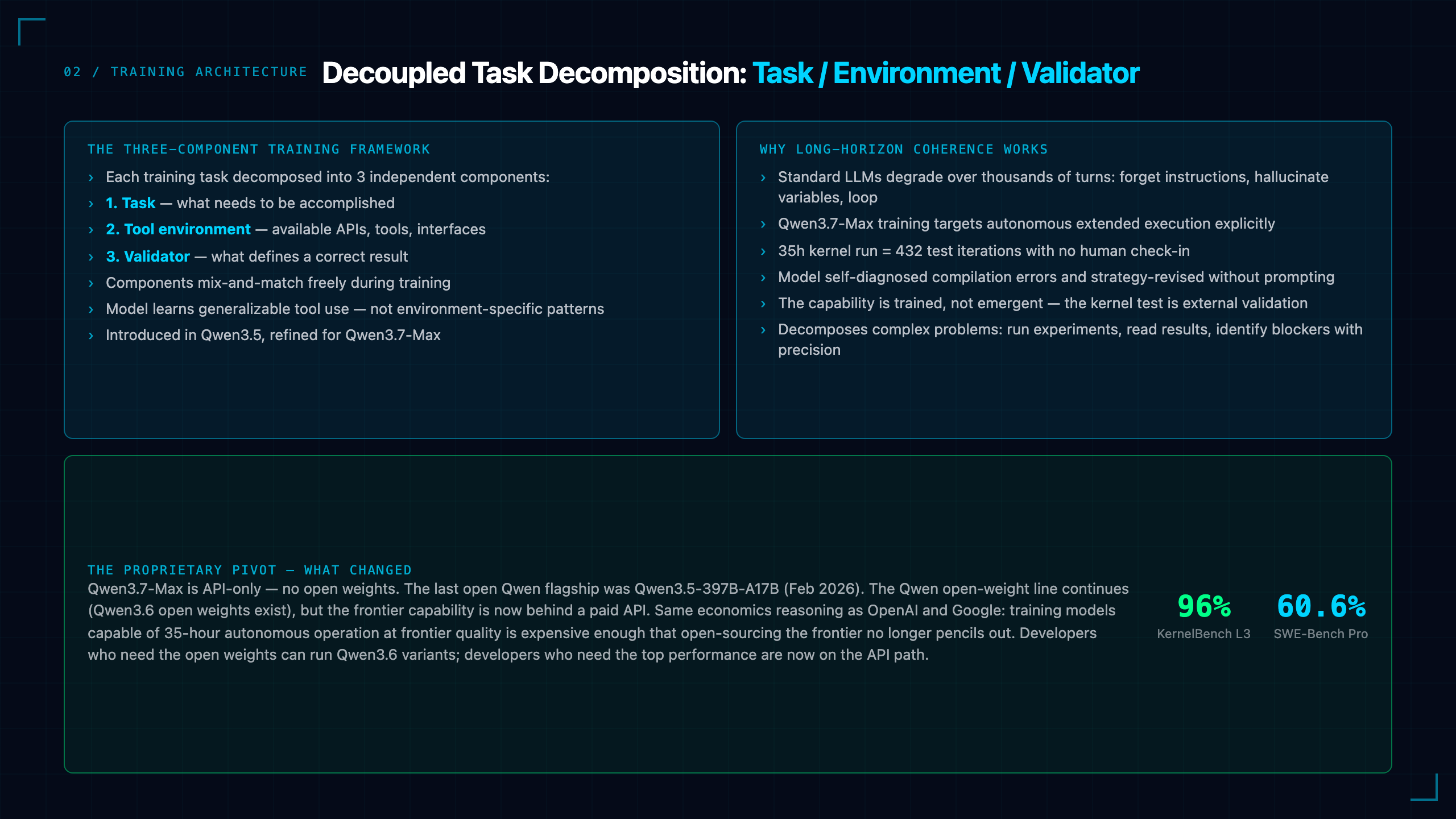
Qwen3.7-Max builds on a training methodology first introduced in Qwen3.5. Each training task is decomposed into three independent components:
- The task itself — what needs to be done
- The tool environment — what tools and APIs are available
- The validator — what defines a correct result
These three components can be mixed and matched freely during training. The decoupling means the model learns to use tools in diverse environments, not just the specific setups it was trained on. This is why it could navigate a chip architecture it had never seen: its training generalized tool use rather than memorizing specific hardware APIs.
The training approach also explains the long-horizon coherence. Standard language models degrade over thousands of conversational turns — they forget instructions, hallucinate variables, get stuck in loops. Qwen3.7-Max's training explicitly targets autonomous execution over extended sessions, with the kernel optimization test serving as external validation that the training produced genuine capability rather than benchmark overfitting.
The Proprietary Pivot
Qwen3.7-Max is proprietary-only — no open weights. This represents a strategic shift for the Qwen team. Their last open-weight flagship was Qwen3.5-397B-A17B (February 2026). Qwen3.6-Plus and now Qwen3.7-Max are API-only.
The practical read: training models capable of 35-hour autonomous operation at this performance level is expensive enough that Alibaba has decided the economics of open-sourcing don't work. The same reasoning OpenAI and Google applied years earlier. The Qwen open-weight line continues — Qwen3.6 open weights exist — but the frontier capability is now behind an API.
The API-only access does create a data sovereignty constraint for regulated industries. Endpoints are Alibaba Cloud endpoints; enterprises subject to government data residency requirements may find that limiting regardless of performance.
What It Means for Developers
The 1M token context and 65K output length are important for the agent use cases Qwen3.7-Max is designed for. Coding agents that need to read a full codebase before making changes, document analysis agents that process entire regulatory filings, research agents that maintain working memory across hundreds of search iterations — these aren't hypothetical use cases anymore. They're what Qwen3.7-Max is built to run.
The dual API compatibility (OpenAI + Anthropic interfaces) means integration into existing agent frameworks requires minimal changes. If you're running Claude Code or OpenClaw, the model plugs in as a drop-in replacement.
The relevant comparison isn't chat benchmark scores. It's the operational question: does the model sustain coherent, productive execution across a multi-hour autonomous task? The 35-hour kernel experiment is evidence for yes — and the comparison against GPT-5.4, Opus 4.6, and GLM-5.1 in the same environment gives it context.
For developers building systems where the model runs unattended — overnight data pipelines, continuous integration agents, research automation, hardware optimization loops — Qwen3.7-Max is the current benchmark to beat.
Bottom Line
Qwen3.7-Max is the model that ran for 35 hours, called tools 1,158 times, and produced a 10× speedup on hardware it had never trained on. The SWE-Bench Pro score of 60.6% confirms the capability isn't narrow. The 1M context, $2.50/M pricing, and dual API compatibility make deployment practical.
The proprietary-only structure is a constraint. But for developers building long-running autonomous systems, Qwen3.7-Max is currently the most capable option available — and the kernel optimization result is the most concrete evidence of that capability in the field.
Resources
- Qwen Official Blog (Qwen3.7) — official announcement
- Alibaba Cloud Model Studio — API access
- Qwen GitHub — open-weight models and tooling
- The Decoder coverage — 35-hour experiment deep dive
Qwen3.7-Max is available via Alibaba Cloud Model Studio API. Pricing: $2.50/M input, $10/M output. Compatible with OpenAI and Anthropic interfaces.