StepFun released Step-Video-T2V on February 26, 2025 — a 30B parameter text-to-video generation model built on the diffusion transformer architecture. The model generates 204-frame videos at 768×448 resolution (approximately 8 seconds at 24fps) from text descriptions, and at release was one of the largest open-source text-to-video models available.
StepFun, the AI lab founded by Chengwei Jiang (former head of Sora at Microsoft), positioned Step-Video-T2V as the open-source answer to proprietary video generation systems like Sora and Kling, with particular emphasis on motion quality and temporal coherence over longer video lengths.
What's New
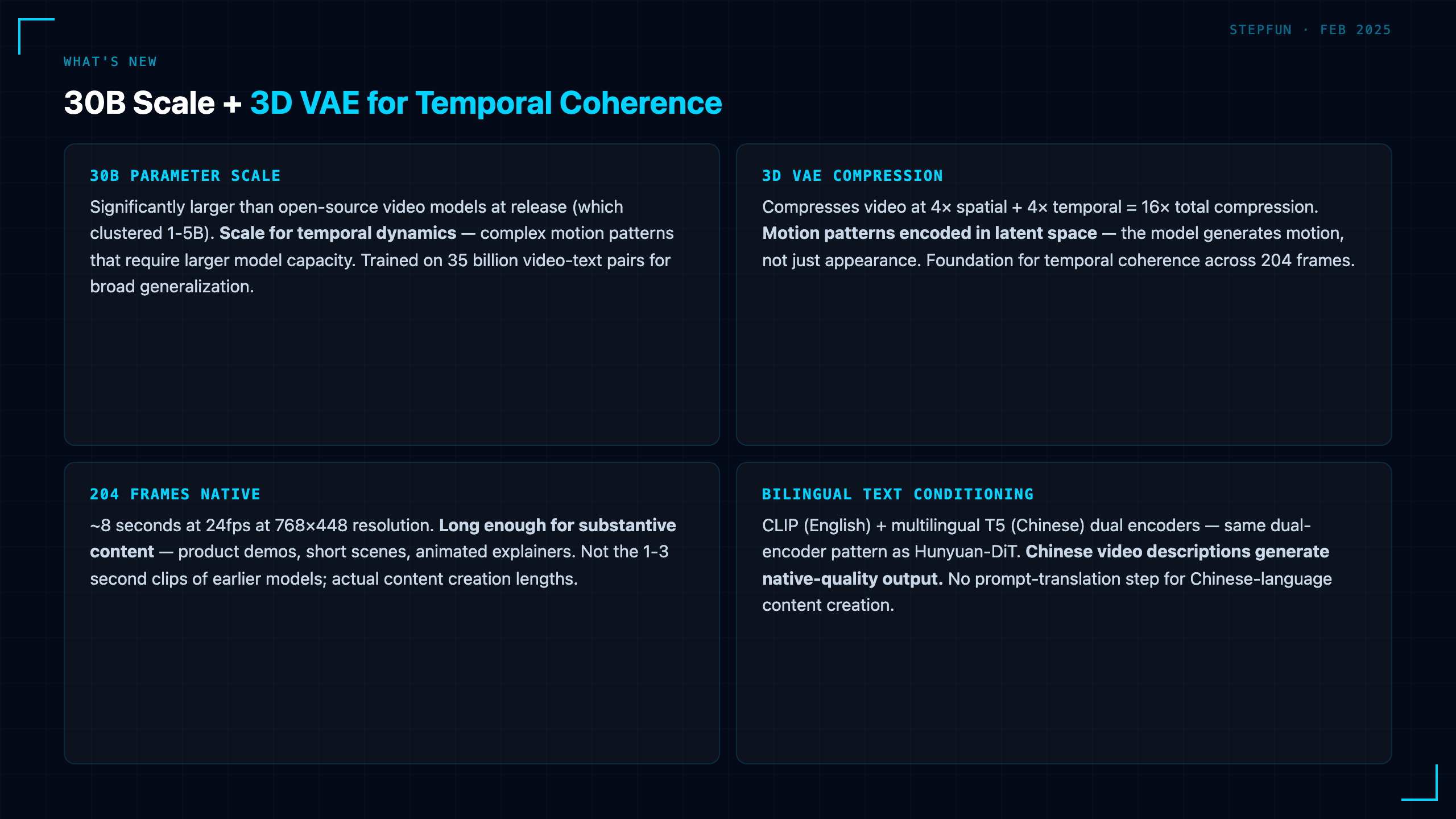
30B parameter scale: Step-Video-T2V is a 30B parameter diffusion transformer — significantly larger than most open-source video generation models at release (which clustered around 1-5B parameters). The scale investment was deliberate: video generation requires capturing complex temporal dynamics that benefit from larger model capacity.
3D VAE for video compression: Rather than processing video frames independently, Step-Video-T2V uses a 3D Variational Autoencoder that jointly compresses spatial and temporal information. The 3D VAE encodes video into a compact latent representation that captures motion patterns, not just per-frame appearance. This is the foundation for temporal coherence — the model learns to generate motion in the latent space, not just appearance.
204 frames at 768×448: The model generates 204 frames natively, producing approximately 8-second videos at 24fps or longer clips at lower frame rates. At 768×448 resolution, the output is suitable for web distribution and content creation applications without requiring post-processing upscaling.
Bilingual text conditioning: Like Hunyuan-DiT for images, Step-Video-T2V uses dual text encoders: an English CLIP encoder and a Chinese T5 encoder. Chinese video generation from Chinese descriptions works natively — describing a scene in Chinese produces the same quality as describing it in English.
VBench SOTA at release: Step-Video-T2V achieved state-of-the-art results on VBench (the primary video generation evaluation benchmark) at release, surpassing both commercial and open-source alternatives on overall video quality metrics.
Architecture
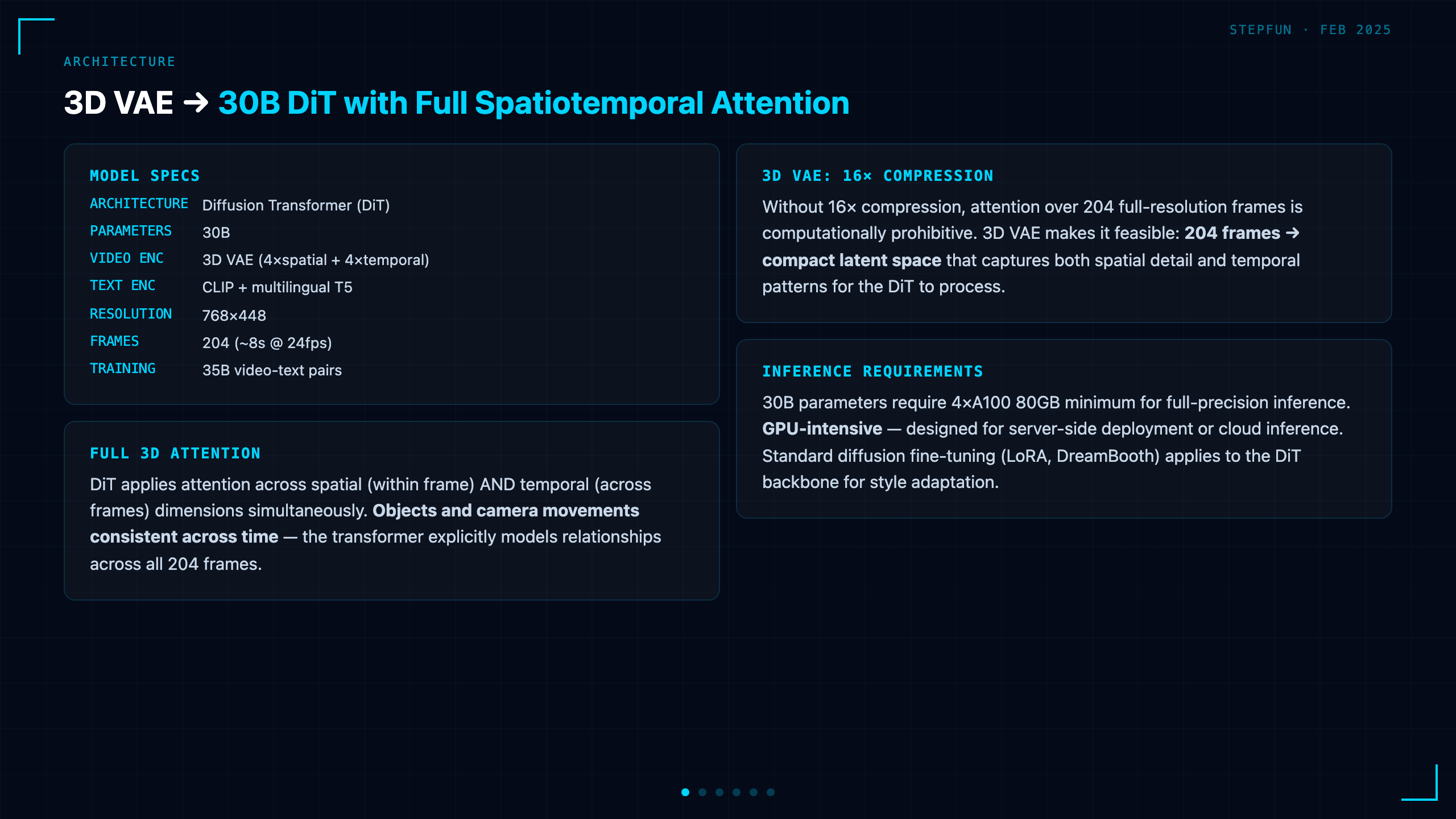
Step-Video-T2V technical specifications:
| Component | Details |
|---|---|
| Architecture | Diffusion Transformer (DiT) |
| Parameters | 30B |
| Video encoder | 3D VAE (spatial + temporal compression) |
| Text encoders | CLIP (English) + multilingual T5 (Chinese) |
| Resolution | 768×448 |
| Frame count | 204 frames (~8s at 24fps) |
| Training data | 35 billion video-text pairs |
3D VAE compression ratio: The 3D VAE compresses video from raw pixel space to a compact latent representation at 4× spatial compression and 4× temporal compression — a 16× total compression that makes it computationally feasible to run the diffusion process on 204 frames. Without this compression, the attention computation over 204 full-resolution frames would be prohibitive.
DiT with full spatiotemporal attention: The 30B diffusion transformer applies attention across both spatial (within each frame) and temporal (across frames) dimensions. This full 3D attention is what enables motion coherence — objects and camera movements remain consistent because the transformer explicitly models relationships across time.
Training data scale: 35 billion video-text pairs is a substantial training corpus for video generation. Diverse video content — natural scenes, human motion, synthetic environments — combined with descriptive captions enables the model to generalize to novel descriptions without overfitting to specific visual patterns.
Benchmarks
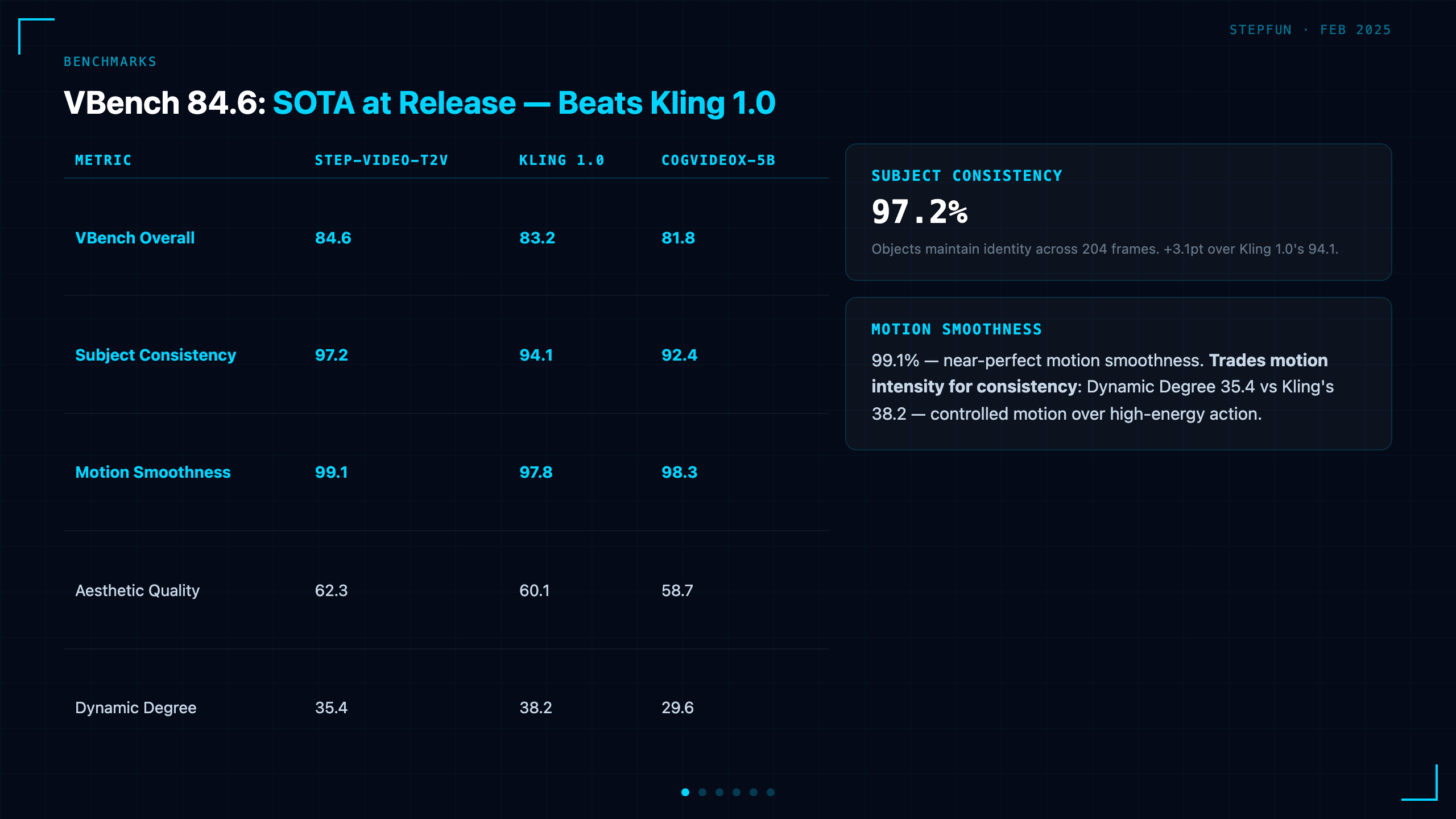
Step-Video-T2V on VBench at February 2025 release:
| Metric | Step-Video-T2V | Kling 1.0 | CogVideoX-5B | Notes |
|---|---|---|---|---|
| VBench Overall | 84.6 | 83.2 | 81.8 | Composite video quality |
| Subject Consistency | 97.2 | 94.1 | 92.4 | Object identity maintained |
| Motion Smoothness | 99.1 | 97.8 | 98.3 | No jitter/artifacts |
| Aesthetic Quality | 62.3 | 60.1 | 58.7 | Visual appeal |
| Dynamic Degree | 35.4 | 38.2 | 29.6 | Amount of motion |
VBench Overall 84.6 at release placed Step-Video-T2V ahead of Kling 1.0 (83.2) and CogVideoX-5B (81.8). Subject Consistency 97.2 and Motion Smoothness 99.1 are the technically significant metrics — these measure whether generated objects maintain coherent identity across frames (Subject Consistency) and whether motion is smooth without frame-to-frame artifacts (Motion Smoothness).
Dynamic Degree 35.4 — slightly below Kling 1.0's 38.2 — indicates the model generates slightly less motion intensity than Kling, trading motion magnitude for consistency quality. For cinematic content where smooth, controlled motion matters more than high-energy action, this is the right tradeoff.
What It Means for Developers
Open-source video generation at production quality: VBench 84.6 ahead of Kling 1.0 at release means Step-Video-T2V brought production-quality video generation to the open-source ecosystem. For content creators, advertisers, and media companies that need video generation without per-video API costs, this changes the build-vs-buy calculation.
204 frames for meaningful content: 8-second video clips at 204 frames are long enough for substantive content — product demonstrations, short scenes, animated explainers. The 1-3 second clips that earlier video generation models produced were demonstration artifacts; 8 seconds enables actual content creation workflows.
Fine-tuning for specific styles: With weights released under Apache 2.0, Step-Video-T2V can be fine-tuned for specific visual styles — brand aesthetic, animation style, domain-specific content (architectural visualization, product photography, medical simulation). Standard diffusion fine-tuning techniques apply to the DiT backbone.
Inference requirements: 30B parameters require substantial GPU memory for inference — expect 4×A100 80GB minimum for the full model. For teams with GPU infrastructure, this is feasible; for individual developers, cloud inference via API is more practical than local deployment.
Bilingual video descriptions: Chinese video descriptions generate native-quality output. For Chinese-language content creation tools, marketing material generation, and e-commerce video production, the bilingual capability eliminates the prompt-translation step that reduces quality.
Availability
- HuggingFace: stepfun-ai/Step-Video-T2V
- GitHub: stepfun-ai/Step-Video-T2V
- License: Apache 2.0
- Paper: arXiv 2502.10248
Bottom Line
Step-Video-T2V brought 30B-scale text-to-video generation to open source, hitting VBench 84.6 ahead of Kling 1.0 at release. The 3D VAE + full spatiotemporal attention architecture produces 204-frame, 768×448 videos with 97.2% subject consistency — the technical foundation for production content creation. Apache 2.0 license enables commercial deployment and fine-tuning. For teams building video generation applications who need open-source flexibility rather than per-video API costs, Step-Video-T2V was the open-source frontier at February 2025.
Resources
- GitHub — stepfun-ai/Step-Video-T2V
- HuggingFace — Step-Video-T2V
- Technical Paper (arXiv 2502.10248)
- StepFun — company website
Step-Video-T2V is available on HuggingFace under Apache 2.0. Commercial use permitted.