Tencent released Hunyuan-TurboS in February 2025, making it one of the first production AI labs to ship a hybrid Mamba-Transformer model at frontier scale. Where every major 2024 model used pure transformer architecture, TurboS introduced Mamba SSM (State Space Model) layers interleaved with standard attention layers — targeting the fundamental inefficiency of transformers on long sequences.
The rationale: attention computation scales quadratically with context length; Mamba processes each token in constant memory regardless of sequence length. A hybrid model can use attention for tasks requiring precise token-to-token reasoning and Mamba for efficient processing of long sequences, combining the strengths of both.
Hunyuan-TurboS reached LMSYS Chatbot Arena top-7 at release — competitive with GPT-4o, Claude 3.5 Sonnet, and Gemini 1.5 Pro on general capability while offering significantly faster inference on long contexts.
What's New
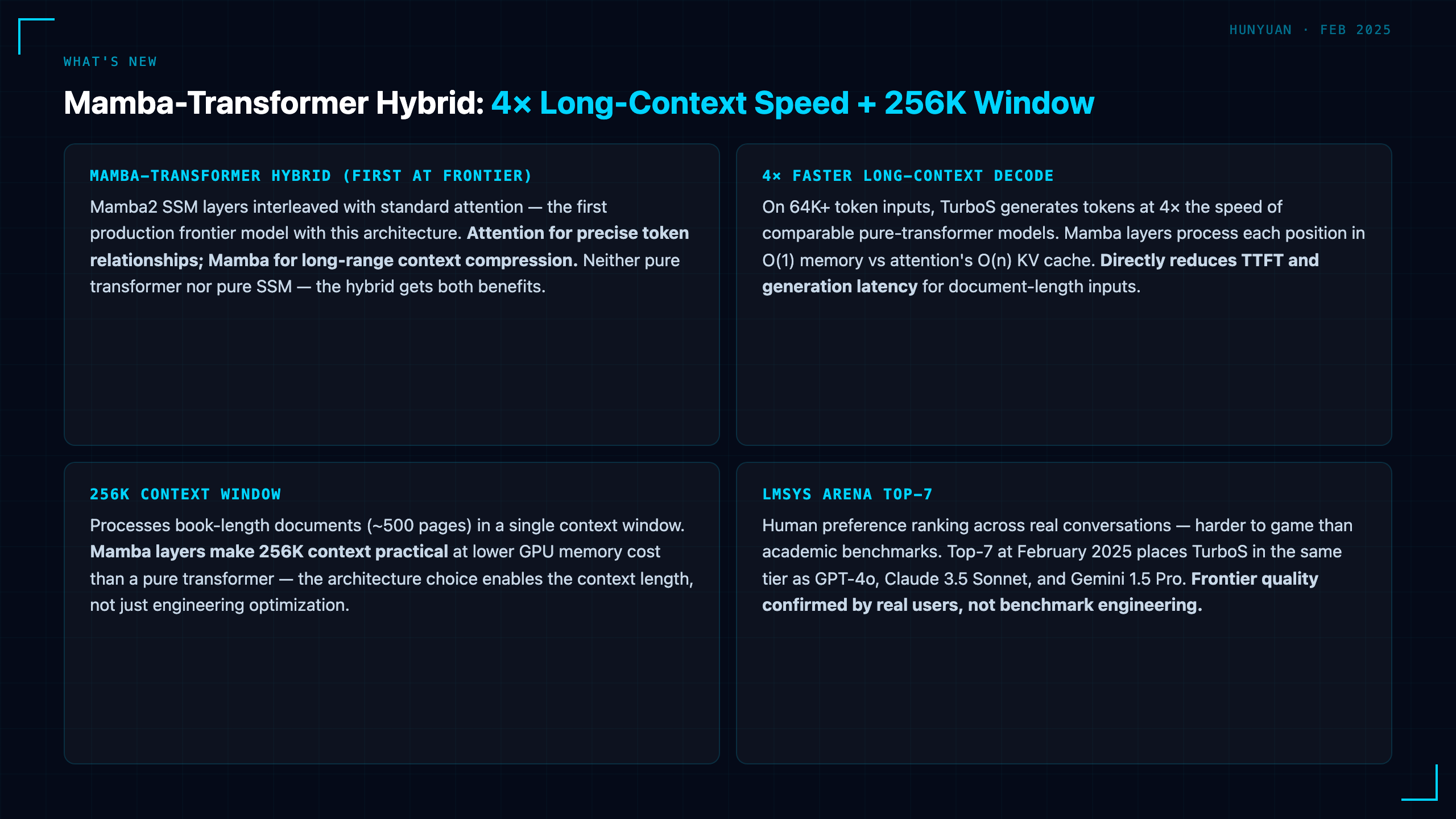
Mamba-Transformer hybrid architecture: TurboS interleaves Mamba2 SSM layers with standard multi-head attention layers across the model depth. The specific ratio and placement is tuned for quality-performance tradeoff: attention layers at lower depths (where precise token relationships matter most) and Mamba layers at higher depths (where long-range context compression is more valuable). This is the defining architectural departure from every other frontier model at February 2025.
4× faster long-context decode: On sequences over 32K tokens, TurboS generates output tokens at approximately 4× the speed of a comparable pure-transformer model. Mamba layers process context in O(n) rather than O(n²), which translates directly to faster first-token latency and token generation speed on long documents.
256K context window: TurboS supports 256K token context — competitive with Claude 3.5 Sonnet and Gemini 1.5 Pro. The Mamba layers make processing the full 256K context practical at lower GPU memory cost than a pure transformer would require.
LMSYS Arena top-7: At February 2025 release, Hunyuan-TurboS placed in the top 7 on LMSYS Chatbot Arena — the human preference ranking that is harder to game than academic benchmarks. This placed it in the same tier as GPT-4o and Claude 3.5 Sonnet on general conversational quality.
Hunyuan ecosystem integration: TurboS is available via Tencent Cloud's Hunyuan API and integrates with Tencent's enterprise AI tooling — Tencent Meeting, WeCom, and custom enterprise deployments. For developers building on Tencent Cloud infrastructure, TurboS is the natural frontier model choice.
Architecture
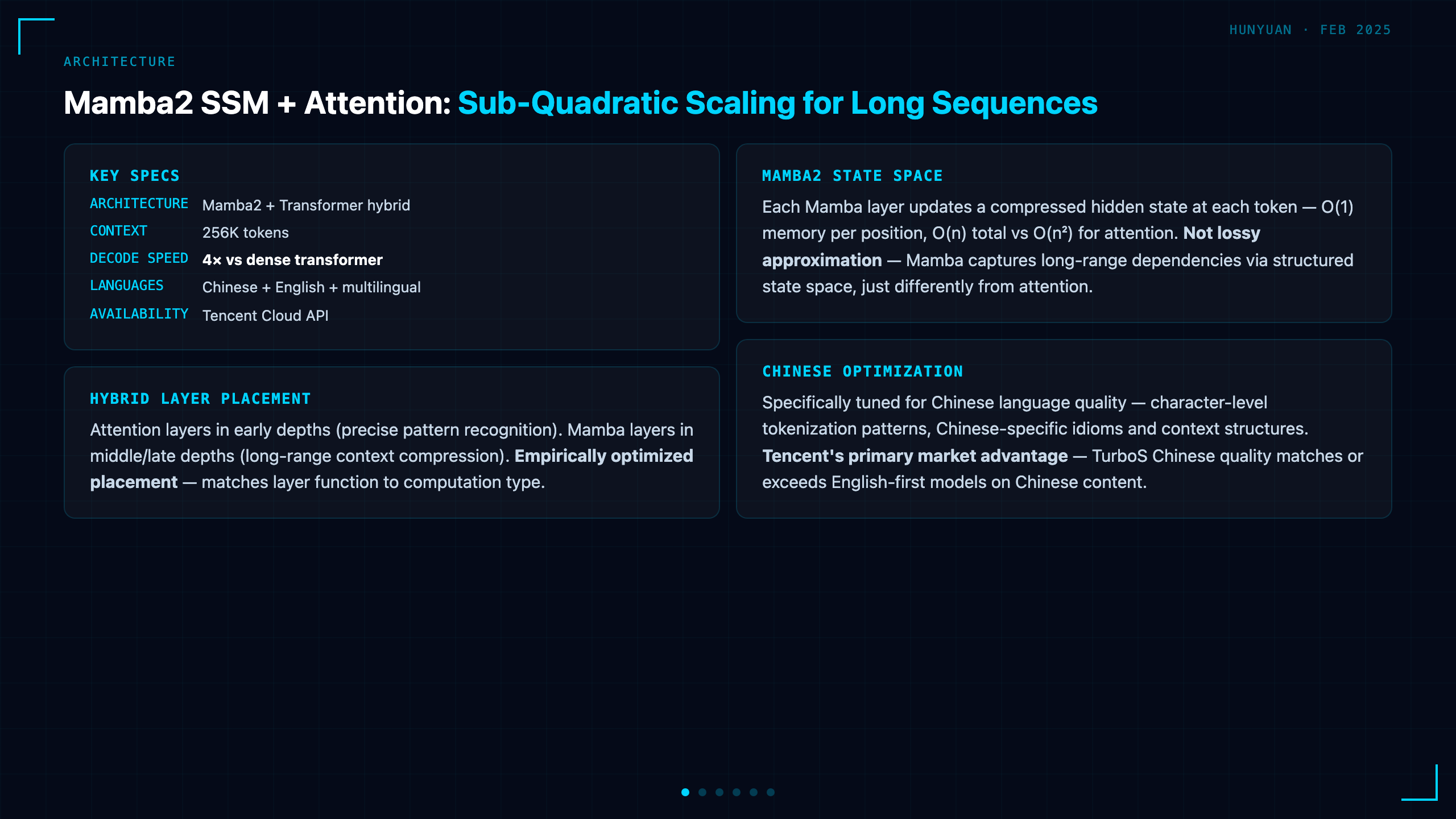
| Component | Hunyuan-TurboS |
|---|---|
| Architecture | Mamba2-Transformer hybrid |
| Context window | 256K tokens |
| Attention layers | Interleaved with Mamba2 layers |
| Token generation | 4× faster on long context vs dense transformer |
| Languages | Chinese + English (primary), multilingual |
| Availability | Tencent Cloud API |
| License | Proprietary |
Mamba2 SSM mechanism: Mamba2 processes sequences through a structured state space — a recurrent computation that updates a hidden state at each token position. Unlike attention, which attends to all previous tokens simultaneously, Mamba maintains a compressed state that captures long-range dependencies without quadratic memory growth. The tradeoff: Mamba is less precise for tasks requiring exact token-to-token retrieval, which is why TurboS combines it with attention rather than replacing attention entirely.
Hybrid layer placement strategy: The specific interleaving pattern — which depths get attention vs Mamba — is the core architectural decision in a hybrid model. Tencent's placement follows empirical results: attention dominates in early layers where fine-grained pattern recognition matters, Mamba in middle and late layers where sequence-level context compression is more useful.
Linear attention scaling: The Mamba layers are the key to TurboS's long-context efficiency. A pure transformer processing 256K tokens with multi-head attention has KV cache memory scaling at O(n·d) and attention computation at O(n²·d) per layer. Mamba layers replace this with O(d) memory per position regardless of sequence length. The hybrid model achieves sub-quadratic scaling in practice.
Chinese language optimization: Tencent specifically tuned TurboS for Chinese language quality — both because Tencent's primary market is domestic Chinese users and because Chinese tokenization characteristics (character-level vs byte-pair encoding) create different optimization requirements than English-first models.
Benchmarks
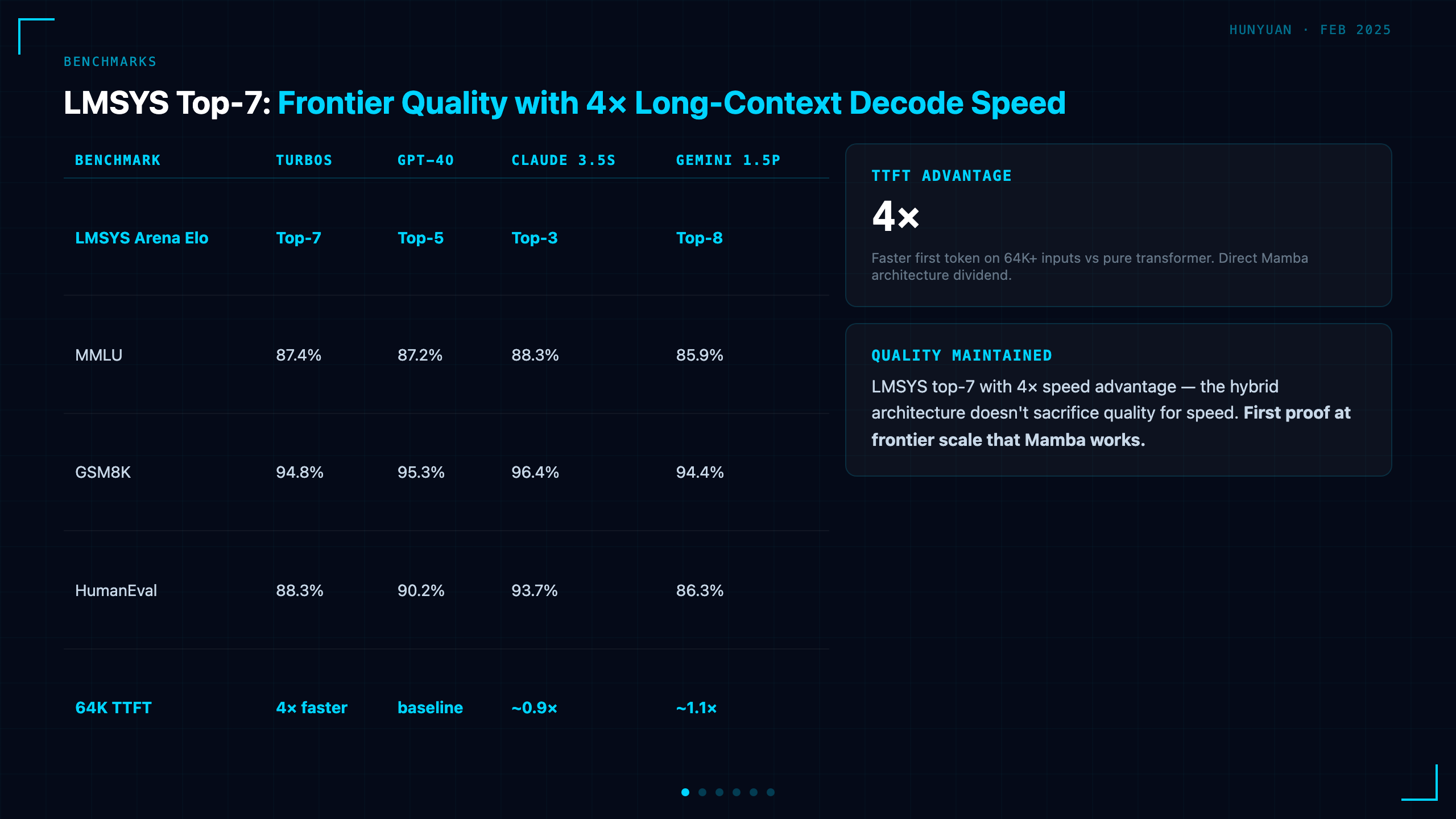
Hunyuan-TurboS at February 2025 release:
| Benchmark | TurboS | GPT-4o | Claude 3.5S | Gemini 1.5 Pro | Notes |
|---|---|---|---|---|---|
| LMSYS Arena Elo | Top-7 | Top-5 | Top-3 | Top-8 | Human preference |
| MMLU | 87.4% | 87.2% | 88.3% | 85.9% | General knowledge |
| GSM8K | 94.8% | 95.3% | 96.4% | 94.4% | Math word problems |
| HumanEval | 88.3% | 90.2% | 93.7% | 86.3% | Code generation |
| Long-context TTFT | 4× faster | baseline | ~0.9× | ~1.1× | Time-to-first-token, 64K ctx |
| Chinese-specific MOS | high | medium | medium | medium | Expert subjective rating |
LMSYS Arena top-7 is the most competitive benchmark: it reflects real users choosing between models in head-to-head conversations, across languages and task types. Top-7 at February 2025 placed TurboS in the same tier as the best models from OpenAI, Anthropic, and Google.
The long-context TTFT advantage is hardware-measured: on 64K token inputs, TurboS generates the first output token approximately 4× faster than a pure-transformer model of comparable size. This is the direct architectural dividend from Mamba layers.
Pricing in Context
| Model | Availability | Context | Architecture |
|---|---|---|---|
| Hunyuan-TurboS | Tencent Cloud | 256K | Mamba-Transformer |
| GPT-4o | OpenAI API | 128K | Transformer |
| Claude 3.5 Sonnet | Anthropic API | 200K | Transformer |
| Gemini 1.5 Pro | Google AI API | 2M | Transformer |
TurboS pricing via Tencent Cloud Hunyuan API is competitive with Chinese lab alternatives — roughly comparable to Qwen2.5-Max pricing. The key advantage is Tencent ecosystem integration: for enterprises using Tencent Cloud, WeCom, or other Tencent services, TurboS avoids cross-cloud data egress and integrates with existing IAM and billing.
What It Means for Developers
Long-context applications at lower latency: The 4× faster decode on long contexts is directly useful for document analysis, legal review, and research synthesis applications where 64K–256K token inputs are the norm. Faster first-token latency improves perceived responsiveness in user-facing applications.
256K context for large document workflows: At 256K tokens, TurboS can process book-length documents (a 500-page report is roughly 150K tokens) in a single context window. For Tencent Cloud customers, this is the first model enabling full-document processing without chunking strategies.
Mamba architecture as production proof: TurboS demonstrated that Mamba-Transformer hybrids work at frontier scale in production. This was the first major lab to ship this architecture commercially, establishing that the quadratic attention bottleneck is not inevitable — setting up the architectural experimentation that continued through 2025 and 2026.
Tencent ecosystem fit: TurboS integrates with Tencent Meeting transcription, WeCom document processing, and Tencent Cloud enterprise AI. For enterprise customers already in the Tencent ecosystem, TurboS provides frontier-quality AI with native integration rather than requiring cross-cloud API calls.
Availability
- API: Tencent Cloud Hunyuan — Hunyuan-TurboS endpoint
- Web: Yuanbao — Tencent's AI assistant powered by Hunyuan
- Ecosystem: WeCom, Tencent Meeting, Tencent Cloud enterprise AI
Bottom Line
Hunyuan-TurboS was the first production frontier model to prove that Mamba-Transformer hybrids work at scale. The 4× faster long-context decode is not a benchmark trick — it's the direct result of replacing quadratic attention with linear-complexity Mamba layers for most of the network. LMSYS Arena top-7 confirmed the quality tradeoff was acceptable. For developers on Tencent Cloud building long-context applications, TurboS offered both the capability tier they needed and architecture-native speed advantages that pure transformers can't match.
Resources
- Tencent Cloud Hunyuan — API access
- Yuanbao — web interface
- Hunyuan Technical Report — architecture details (prior version)
- Mamba2 Paper — structured SSM foundation
Hunyuan-TurboS is available via Tencent Cloud at cloud.tencent.com/product/hunyuan.