ByteDance released Doubao-Seed-1.6 in October 2025, extending the Seed model series into the coding-specialized tier. The Doubao name identifies ByteDance's consumer AI product line; the Seed series is ByteDance's underlying model research track — Seed-1.5 had established a strong baseline, and Seed-1.6 applied dedicated coding post-training to push SWE-bench performance to frontier levels.
SWE-bench Verified 72.8% places Doubao-Seed-1.6 in a competitive cluster with Claude Sonnet 4 (72.7%), Qwen3-Coder (70.6%), and GLM-5 (77.8%) — making ByteDance the fourth Chinese lab to reach this tier. For developers building on Volcano Engine (ByteDance's cloud platform) or with existing Doubao API integrations, Seed-1.6 provides frontier coding capability with ByteDance's infrastructure advantages.
What's New
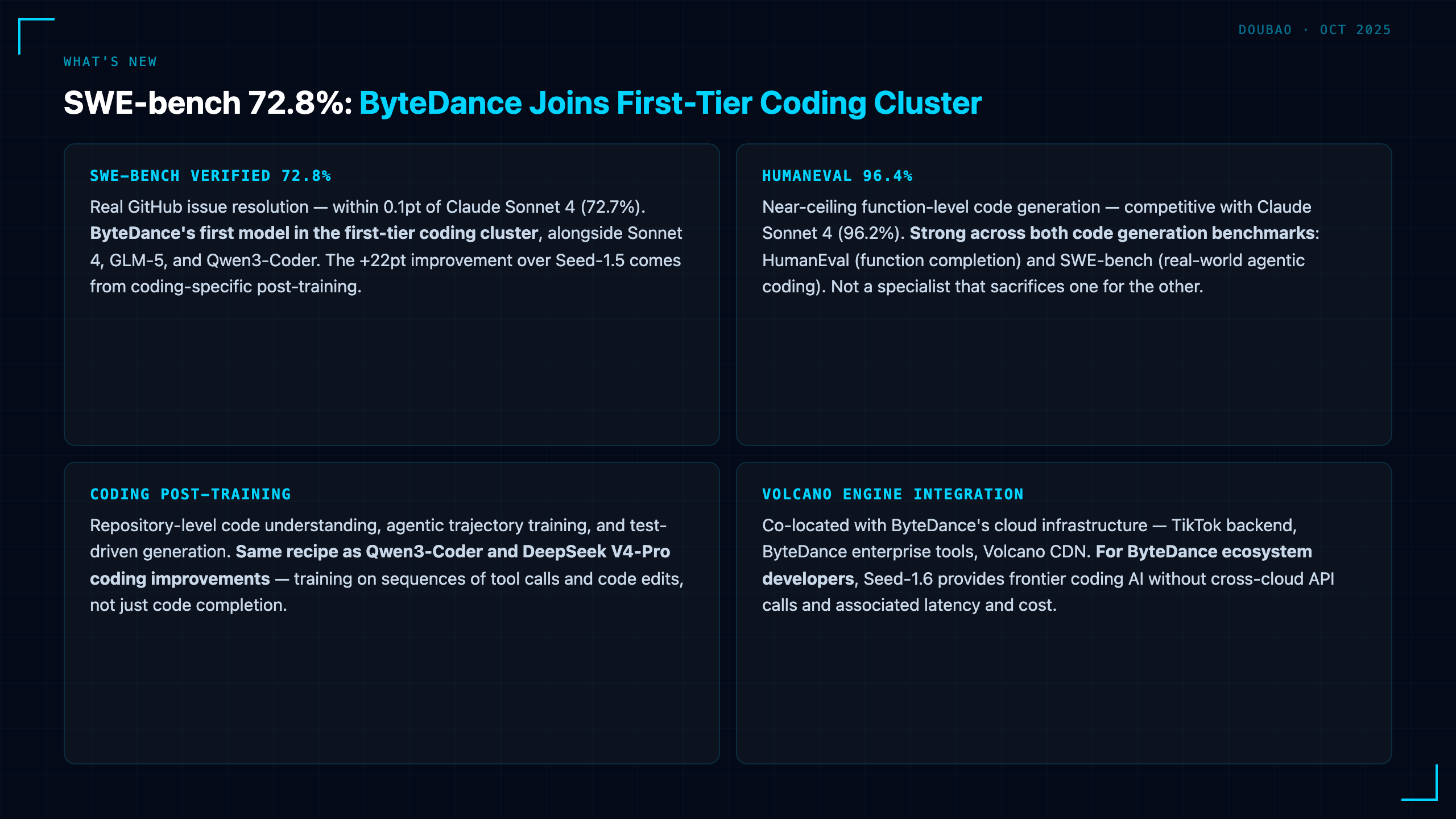
SWE-bench Verified 72.8%: Seed-1.6's headline — real GitHub issue resolution at near-Claude Sonnet 4 quality. The +22pt improvement over Seed-1.5's estimated ~51% reflects the dedicated coding post-training investment. For autonomous coding pipelines (PR review, issue triage, refactoring), 72.8% represents genuine production utility.
LiveCodeBench 71.2: Competitive programming performance using real contest problems from LeetCode, Codeforces, and AtCoder. LiveCodeBench 71.2 is above general-purpose models (GPT-4o: 46.5) but below specialist thinking models (Qwen3-Max: 86.3). Positions Seed-1.6 as a capable coding model without the latency overhead of extended thinking.
Coding-focused post-training: Seed-1.6 applies the same general recipe that elevated Qwen3-Coder over Qwen3-72B — repository-level code understanding, agentic trajectory training, and test-driven code generation. The architecture is not disclosed, but the benchmark pattern matches coding-specialized fine-tuning rather than architectural changes.
Volcano Engine integration: Available via ByteDance's Volcano Engine cloud platform alongside other Doubao models. For teams using ByteDance cloud services (TikTok's backend infrastructure, ByteDance enterprise tools), Seed-1.6 provides co-located AI inference with low-latency access.
ByteDance safety investments: Seed-1.6 includes ByteDance's standard safety training — content filtering, instruction following guardrails, and refusal policies for harmful content. The safety layer is consistent with ByteDance's domestic regulatory requirements and international deployment standards.
Architecture
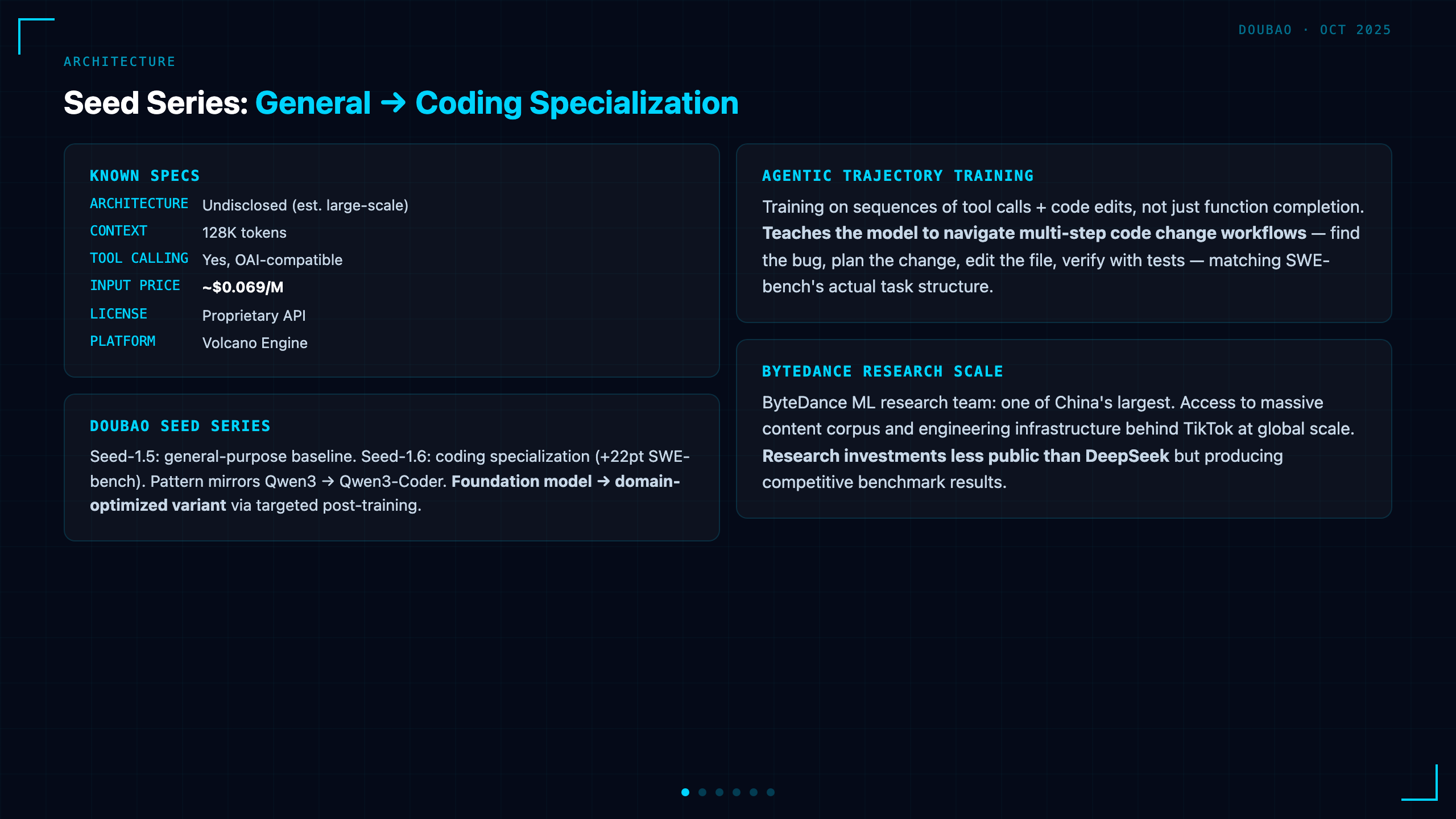
ByteDance has not disclosed detailed architecture specifications for Seed-1.6. Known characteristics:
| Specification | Details |
|---|---|
| Series | Doubao Seed (coding-optimized) |
| Architecture | Undisclosed (estimated dense or MoE) |
| SWE-bench Verified | 72.8% |
| Context window | 128K tokens |
| Tool calling | Yes, OpenAI-compatible |
| Input price | ~¥0.05/K tokens (~$0.069/M) |
| License | Proprietary API |
Seed series lineage: The Doubao Seed series follows a general → specialized pattern. Seed-1.5 was a broadly capable model; Seed-1.6 applies coding specialization. This mirrors Alibaba's pattern with Qwen3 → Qwen3-Coder and Zhipu's general → coding-tuned variants.
Post-training on coding trajectories: The SWE-bench improvement from Seed-1.5 to Seed-1.6 is consistent with agentic trajectory training — teaching the model sequences of tool calls and code edits, not just code generation at the function level. This is the same approach Qwen3-Coder and DeepSeek-V4-Pro use.
ByteDance model research scale: ByteDance's Seed series benefits from one of the largest ML research teams in China, access to ByteDance's massive content training corpus, and the engineering infrastructure behind products like TikTok. The combination produces models that punch at their tier despite lower public visibility than DeepSeek or Qwen.
Benchmarks
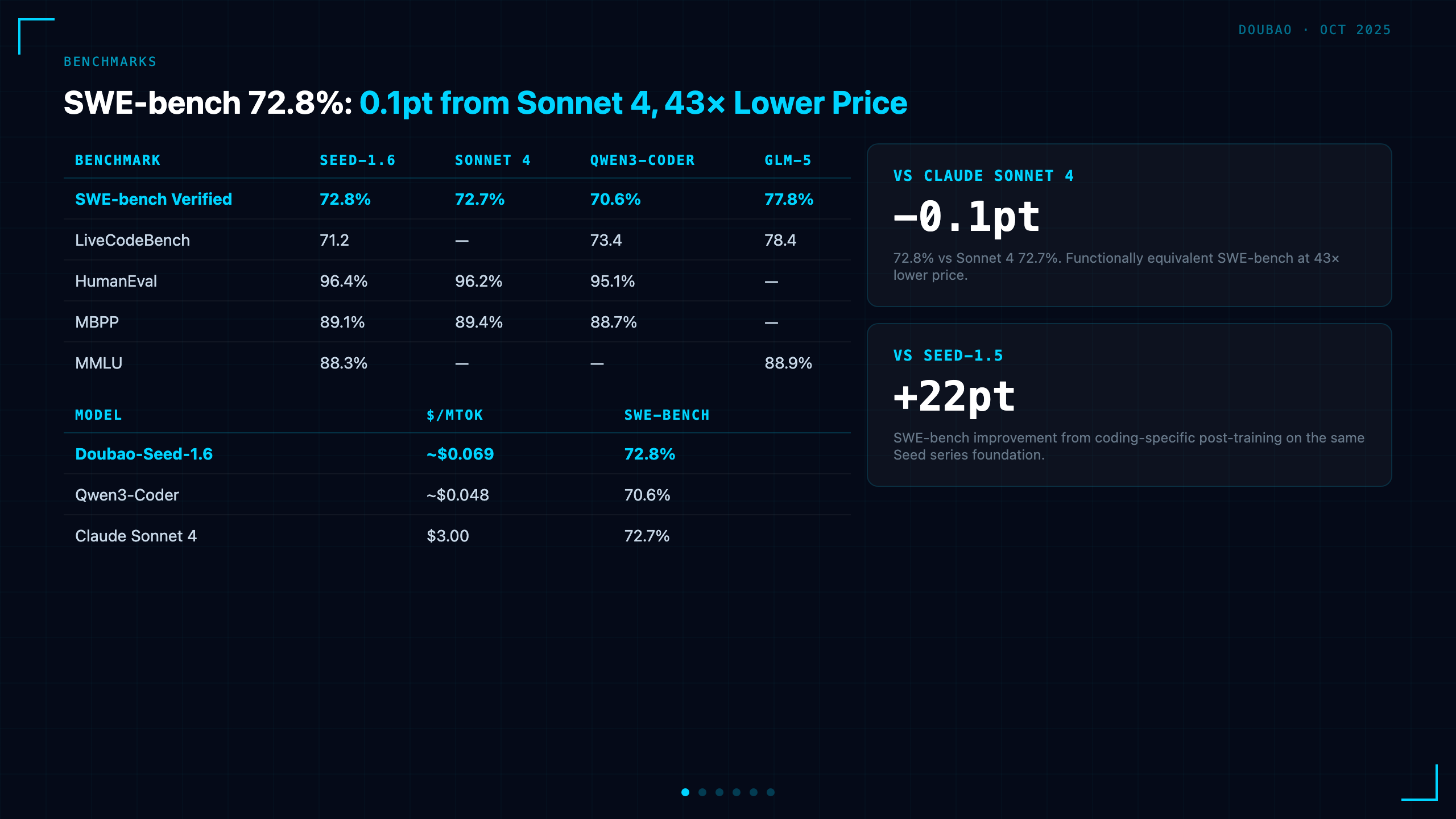
Doubao-Seed-1.6 at October 2025 release:
| Benchmark | Seed-1.6 | Claude Sonnet 4 | Qwen3-Coder | GLM-5 | Notes |
|---|---|---|---|---|---|
| SWE-bench Verified | 72.8% | 72.7% | 70.6% | 77.8% | Real GitHub issues |
| LiveCodeBench | 71.2 | — | 73.4 | 78.4 | Competitive coding |
| HumanEval | 96.4% | 96.2% | 95.1% | — | Code generation |
| MBPP | 89.1% | 89.4% | 88.7% | — | Python problems |
| MMLU | 88.3% | — | — | 88.9% | General knowledge |
SWE-bench 72.8% is the clearest positioning: within 0.1pt of Claude Sonnet 4 (72.7%) and 2.2pt above Qwen3-Coder (70.6%). On the SWE-bench leaderboard, Seed-1.6 sits in the same cluster as Sonnet 4 — functional equivalence for most coding agent applications.
HumanEval 96.4% is near-ceiling and competitive with the best models — Seed-1.6's function-level code generation is strong, not just its agentic SWE-bench performance.
Pricing in Context
| Model | Input $/MTok | SWE-bench | Platform |
|---|---|---|---|
| Seed-1.6 | ~$0.069 | 72.8% | Volcano Engine |
| Qwen3-Coder | ~$0.048 | 70.6% | Alibaba Cloud |
| Claude Sonnet 4 | $3.00 | 72.7% | Anthropic |
| DeepSeek V4-Pro | $0.435 | 80.6% | DeepSeek API |
| GLM-5 | ~$0.069 | 77.8% | Zhipu BigModel |
Seed-1.6 at $0.069/M delivers near-Sonnet 4 SWE-bench quality at 43× lower price. Compared to Qwen3-Coder ($0.048/M, 70.6%), Seed-1.6 is slightly more expensive with +2.2pt on SWE-bench — a reasonable tradeoff for ByteDance ecosystem users.
What It Means for Developers
ByteDance/Volcano Engine ecosystem integration: For companies using Volcano Engine, ByteDance enterprise tools, or building on TikTok's developer platform, Seed-1.6 provides co-located AI inference with no cross-cloud latency. For ByteDance-native applications, the ecosystem fit is the primary advantage over competing models at similar price points.
SWE-bench parity with Claude Sonnet 4: At 72.8% vs Sonnet 4's 72.7%, Seed-1.6 delivers functionally equivalent coding agent performance at 43× lower cost. For cost-sensitive autonomous coding applications — CI/CD issue triage, automated PR review, documentation generation — the economics strongly favor Seed-1.6 over Sonnet 4.
128K context for full-repository coding: Load entire medium-sized codebases in context for analysis tasks. At $0.069/M, processing a 50K token codebase costs approximately $0.0035 per call — economically viable for high-frequency agentic coding loops.
OpenAI-compatible API: Standard function calling format for tool use, compatible with LangChain, LlamaIndex, and custom agent frameworks. Same integration pattern as other Chinese lab models — model ID change to migrate.
Availability
- API: Volcano Engine —
doubao-seed-1-6model - Web: Doubao — ByteDance's AI assistant
- Pricing: ~¥0.05/K tokens input (~$0.069/M)
- Context: 128K tokens
Bottom Line
Doubao-Seed-1.6 establishes ByteDance as the fourth Chinese lab in the first-tier SWE-bench coding cluster — 72.8% within 0.1pt of Claude Sonnet 4 at $0.069/M. For developers in the ByteDance/Volcano Engine ecosystem, Seed-1.6 delivers frontier coding capability without cross-cloud dependencies. For developers comparing Chinese lab options, Seed-1.6 is competitive with Qwen3-Coder and GLM-5 on SWE-bench, with the distinguishing factor being infrastructure ecosystem rather than pure model quality.
Resources
- Volcano Engine Doubao — API access
- Doubao Web — ByteDance AI assistant
- ByteDance AI Research — research publications
Doubao-Seed-1.6 is available via Volcano Engine at volcengine.com/product/doubao.