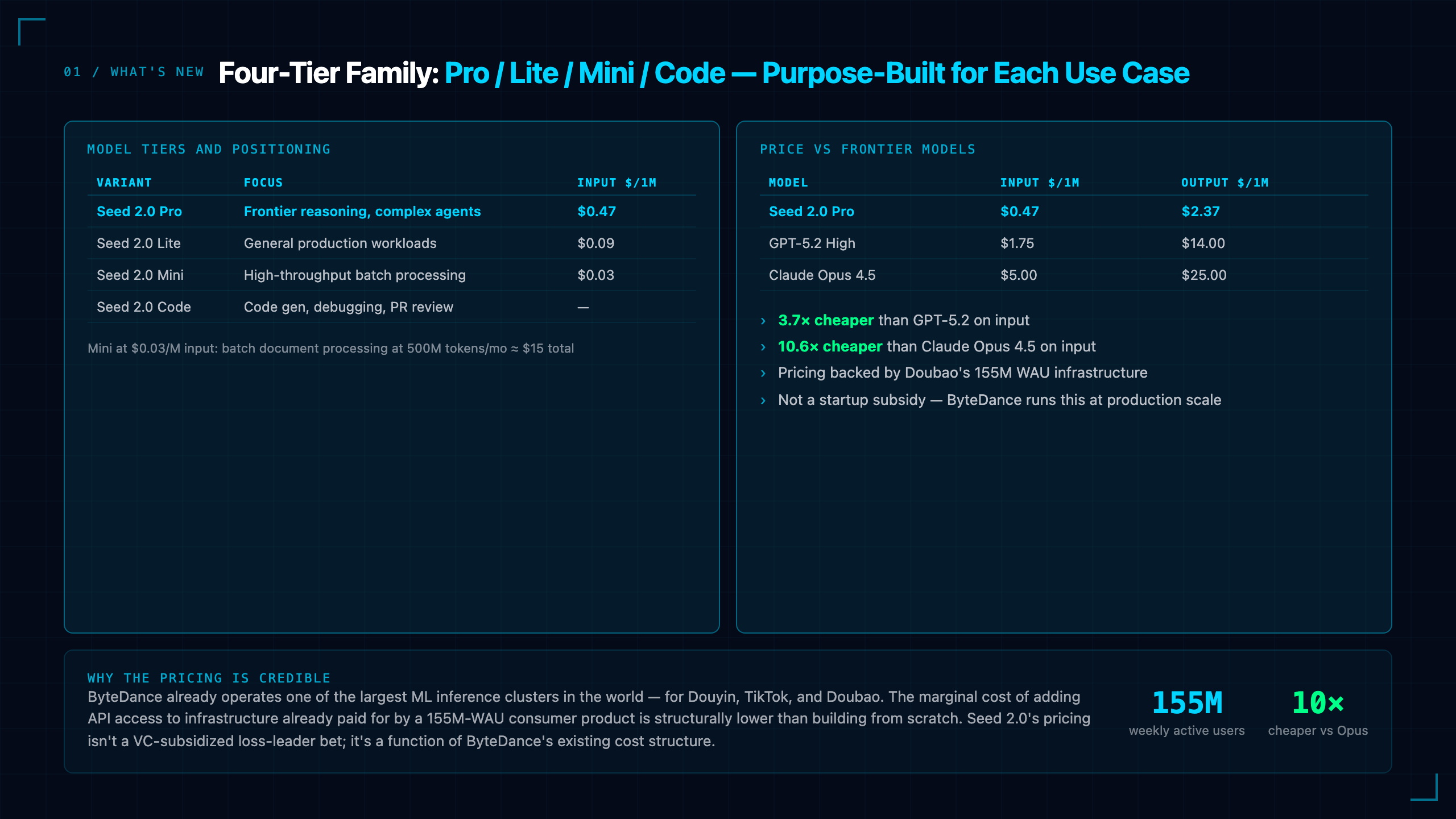
ByteDance's Seed team released Doubao Seed 3.0, the next major iteration of the foundation model powering Doubao — China's highest-traffic AI assistant with over 200 million monthly active users. Where Seed 2.0 established ByteDance as the price/performance leader in China's API market ($0.47/M input tokens vs. GPT-5.2's $1.75/M), Seed 3.0 focuses on closing the capability gap with frontier models while maintaining that cost advantage.
The release represents ByteDance's continued bet that serving the largest user base in China generates a data and deployment flywheel that's harder to replicate than any single architectural innovation. Seed 3.0 powers not just Doubao's chatbot, but the entire Volcengine AI cloud ecosystem — enterprise APIs, Douyin's recommendation intelligence, and ByteDance's internal coding assistants.
What's New in Seed 3.0
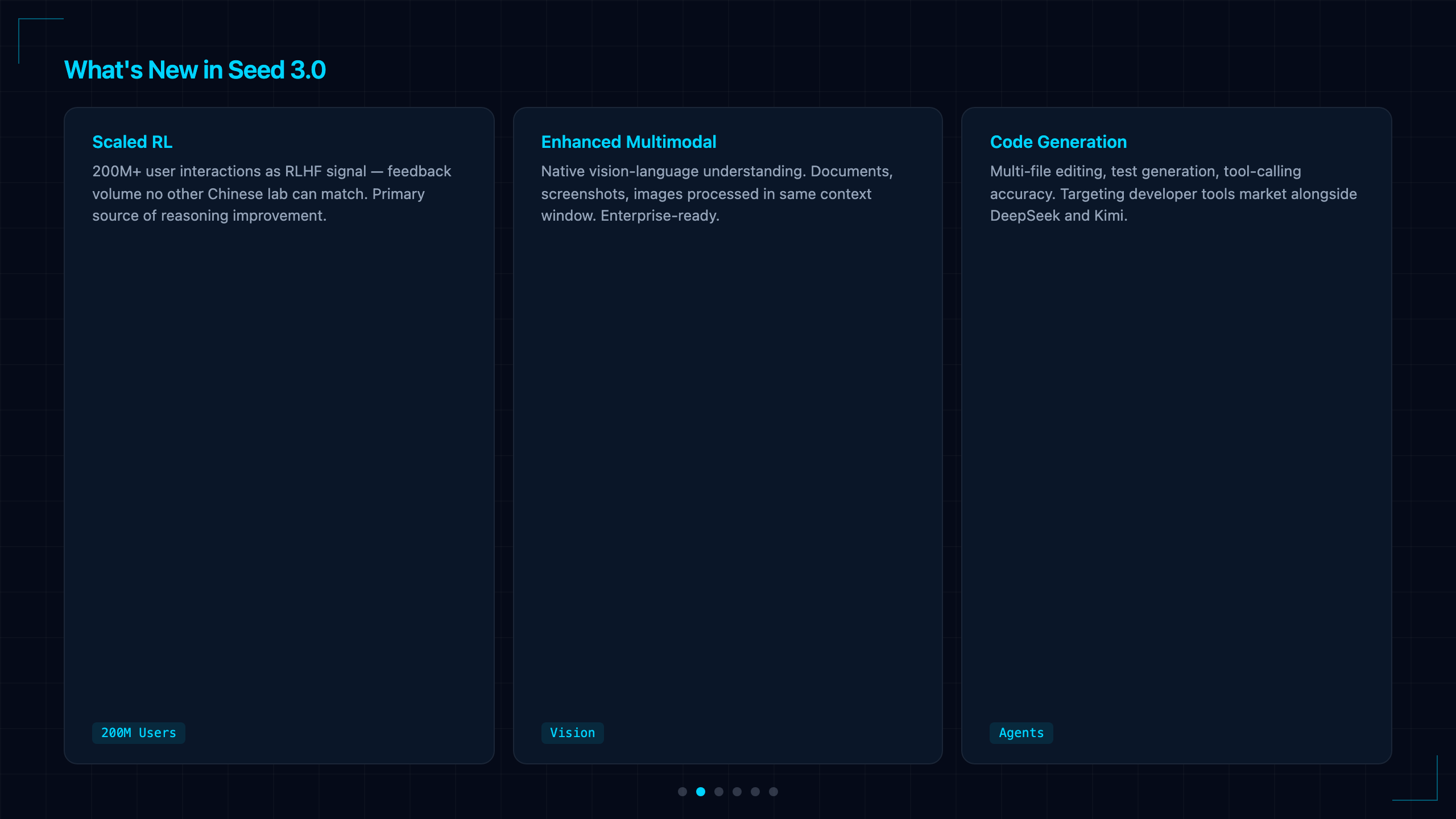
Seed 3.0 builds on the four-tier architecture established in Seed 2.0 (Pro, Lite, Mini, Code) with improvements across three axes:
Scaled Reinforcement Learning
ByteDance's internal RL infrastructure has evolved significantly since Seed 2.0. The team applies large-scale RLHF and RLAIF with signals from Doubao's 200M+ user interactions — a feedback volume that no other Chinese lab can match. Seed 3.0's reasoning improvements come primarily from scaling this RL pipeline rather than architectural changes.
Enhanced Multimodal Capabilities
Building on the Seedream (image) and Seedance (video) model families, Seed 3.0 integrates stronger vision-language understanding. The model processes images, documents, and screenshots natively rather than routing through a separate vision module. This matters for ByteDance's enterprise use cases: document understanding, receipt processing, and content moderation at Douyin scale.
Code Generation and Agentic Behavior
Seed 3.0's Code variant targets the developer tooling market where ByteDance is a latecomer relative to DeepSeek and Kimi. The improvements focus on multi-file editing, test generation, and tool-calling accuracy — capabilities needed for IDE integration and AI coding assistants.
The ByteDance Advantage: Scale + Cost
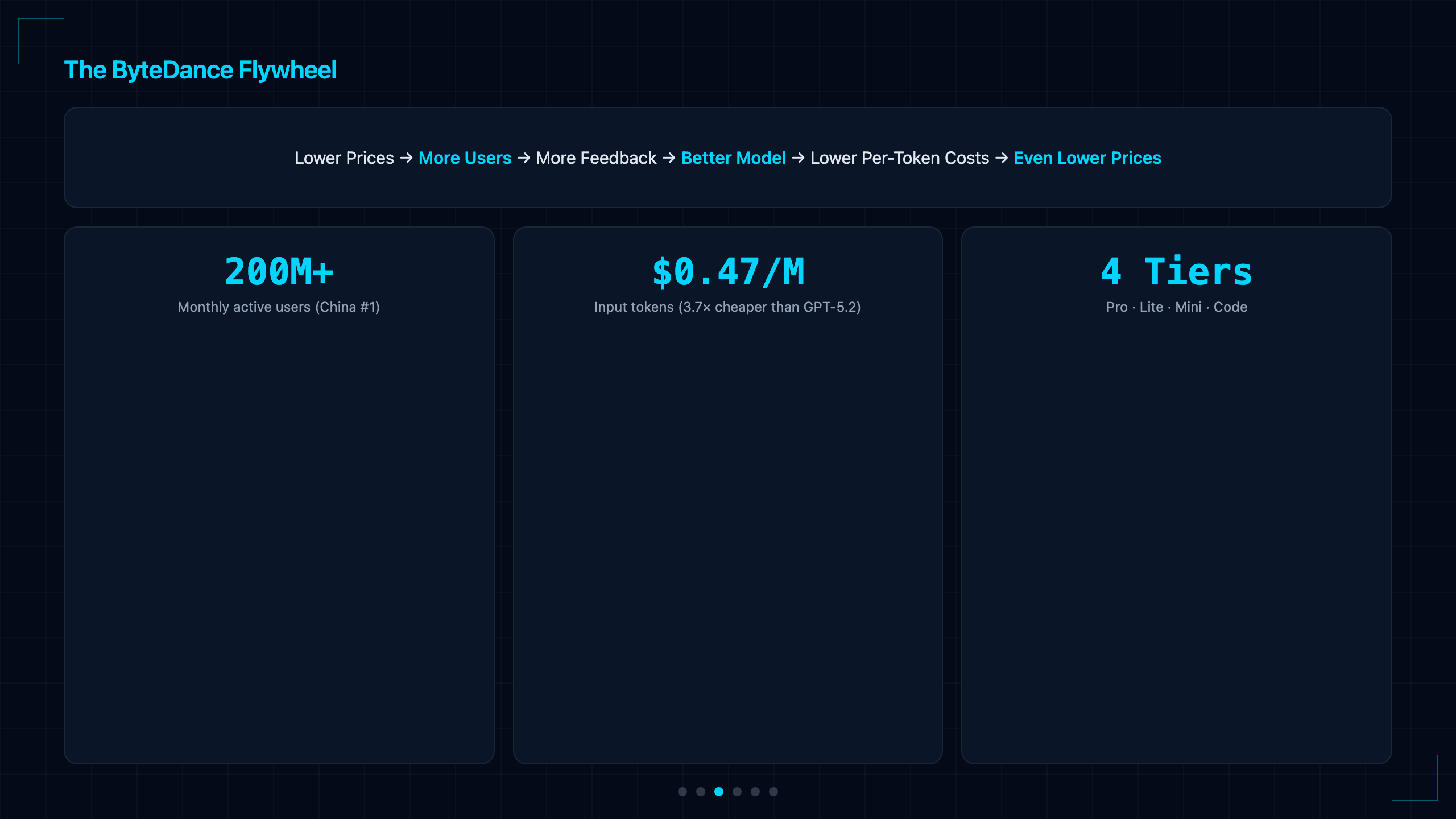
ByteDance's moat isn't model architecture — it's the combination of massive user scale and aggressive pricing. With 200M+ monthly active users generating real interaction data, ByteDance has:
- More RLHF signal than any Chinese competitor (Kimi ~30M, Doubao 200M+)
- More diverse use cases — Doubao users span casual chat, homework help, coding, translation, and creative writing
- Deployment efficiency forced by serving 200M users at $0.47/M token pricing
This creates a flywheel: lower prices → more users → more feedback → better model → lower per-token costs (inference optimization driven by volume) → even lower prices.
Seed 3.0 continues this strategy. API pricing remains among the lowest in China while capabilities move toward frontier parity. For most production applications, "95% of GPT-5 at 25% of the cost" is the correct tradeoff.
Positioning vs. Competition
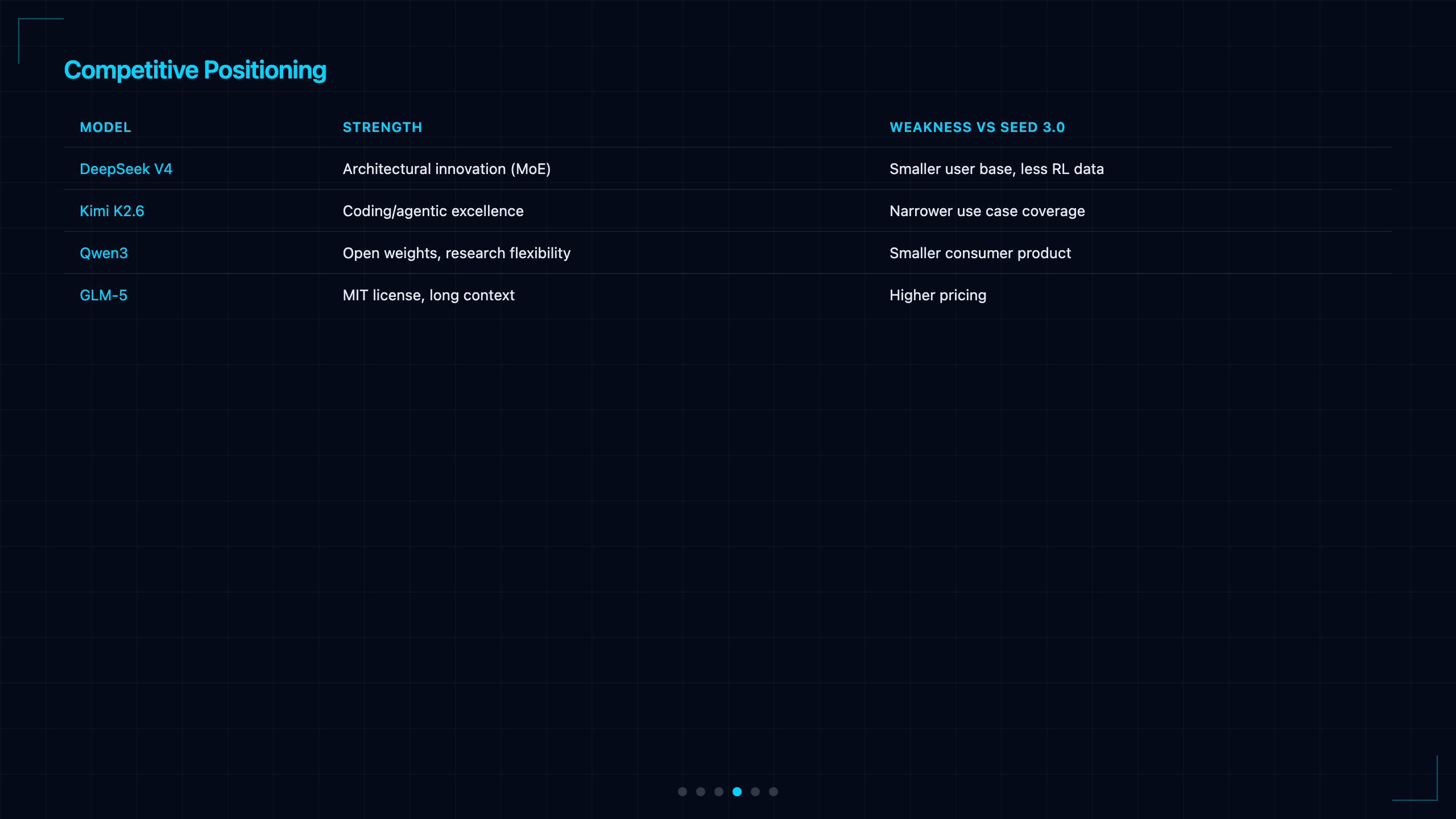
| Model | Strength | Weakness vs. Seed 3.0 |
|---|---|---|
| DeepSeek V4 | Architectural innovation (MoE) | Smaller user base, less RL data |
| Kimi K2.6 | Coding/agentic excellence | Narrower use case coverage |
| Qwen3 | Open weights, research flexibility | Alibaba's consumer product (Tongyi) smaller than Doubao |
| GLM-5 | MIT license, long context | Zhipu's pricing is higher |
Seed 3.0's competitive position: not the most innovative architecture, not the best open-source story, but the best price-to-performance ratio backed by the largest Chinese user base. This is the "Android of Chinese AI" strategy — win on distribution and cost, not on being first.
The Volcengine Ecosystem
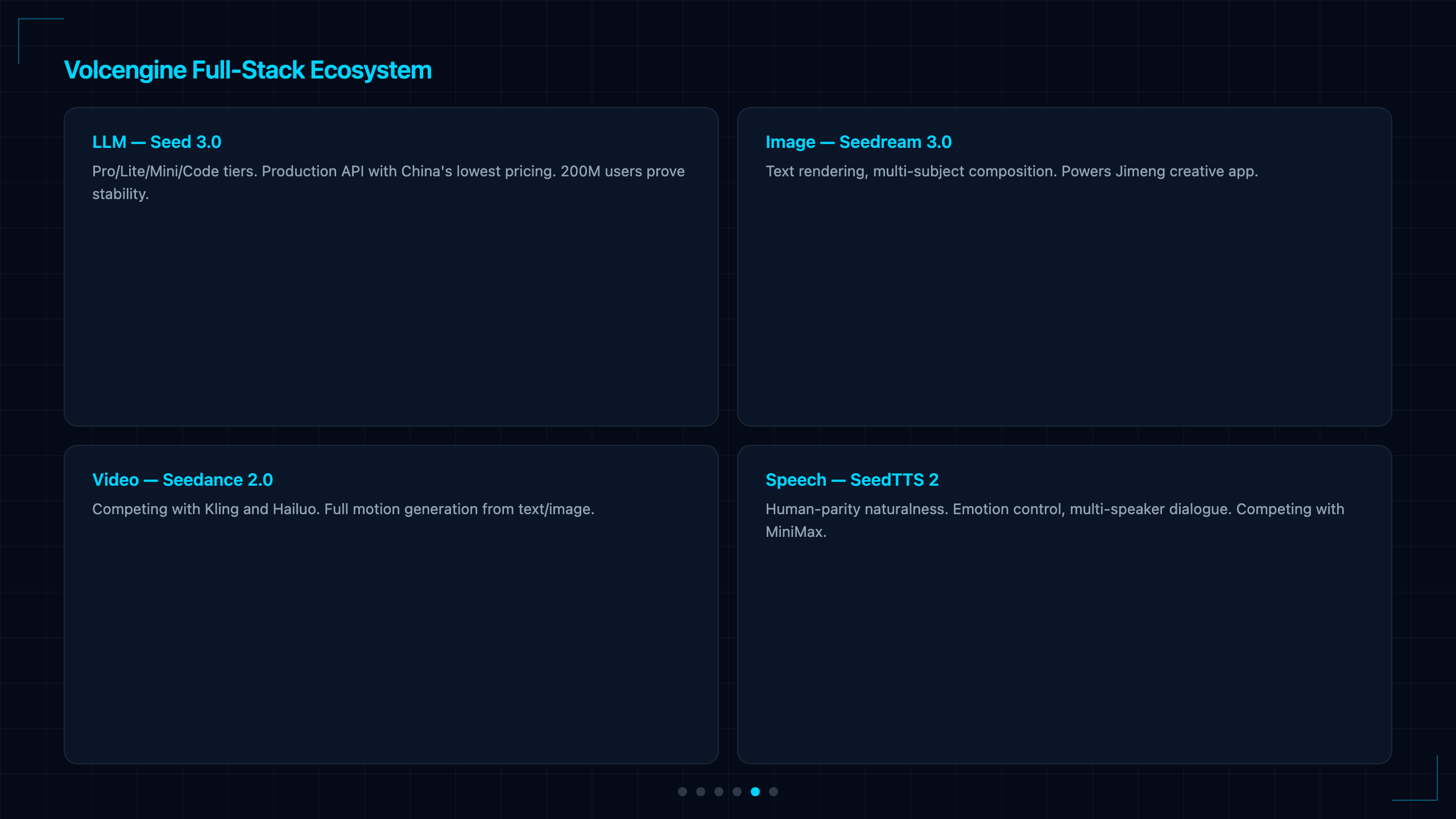
Seed 3.0 isn't just a model — it's the foundation of ByteDance's enterprise AI platform. Through Volcengine (火山引擎), ByteDance offers:
- Model API — Seed 3.0 Pro/Lite/Mini/Code via standard API
- Seedance — video generation (competitors: Kling, Hailuo)
- Seedream — image generation (competitors: Midjourney, DALL-E)
- SeedTTS — speech synthesis (competitors: MiniMax Speech)
- Enterprise RAG — document understanding and retrieval
- AI Infrastructure — GPU cloud optimized for inference
This full-stack approach means enterprise customers can consolidate on a single vendor for all AI capabilities — a significant procurement advantage over mixing DeepSeek (LLM) + MiniMax (speech/video) + Qwen (open-source customization).
What It Means for Developers
If you're building production applications in China: Seed 3.0's price/performance ratio makes it the default choice for high-volume use cases. 200M+ users prove the model works at scale across diverse domains.
If you need multimodal capabilities: The integrated vision-language approach is more seamless than bolting a VLM onto a separate LLM. Document understanding, image analysis, and text generation share the same context window.
If you're choosing between Volcengine and competitors: The full-stack value prop (LLM + image + video + speech + enterprise features) reduces vendor management complexity. The tradeoff is vendor lock-in to ByteDance's ecosystem.
Bottom Line
Doubao Seed 3.0 doesn't win on any single technical dimension — it wins on the combination of frontier-approaching capabilities, China's lowest API pricing, and the distribution advantage of 200M+ monthly active users generating continuous RL feedback. ByteDance's strategy is volume over innovation, ecosystem over point solutions. For most production use cases in China, that's the rational choice. Available through Volcengine with the same aggressive pricing structure as Seed 2.0.
Resources
- ByteDance Seed — research team homepage
- Volcengine AI Platform — enterprise API access
- Doubao App — consumer chatbot
- Seed 3.0 Blog — official announcement
Doubao Seed 3.0 is available via API at volcengine.com. Consumer access through the Doubao app.