ByteDance's Seed team released Seedream 3.0, their latest text-to-image foundation model. In a market where Midjourney, DALL-E 3, and Stable Diffusion dominate mindshare, Seedream 3.0 is ByteDance's bid to own the image generation layer of their full-stack AI platform. The model powers Doubao's built-in image generation, the Jimeng (即梦) creative app, and enterprise image APIs through Volcengine.
What's different about Seedream 3.0 isn't any single generation capability — it's the integration story. ByteDance now offers LLM (Seed 3.0), image (Seedream), video (Seedance), and speech (SeedTTS) through a unified platform. For developers building multimodal applications, this means one API key, one billing system, and consistent quality across modalities.
Key Improvements
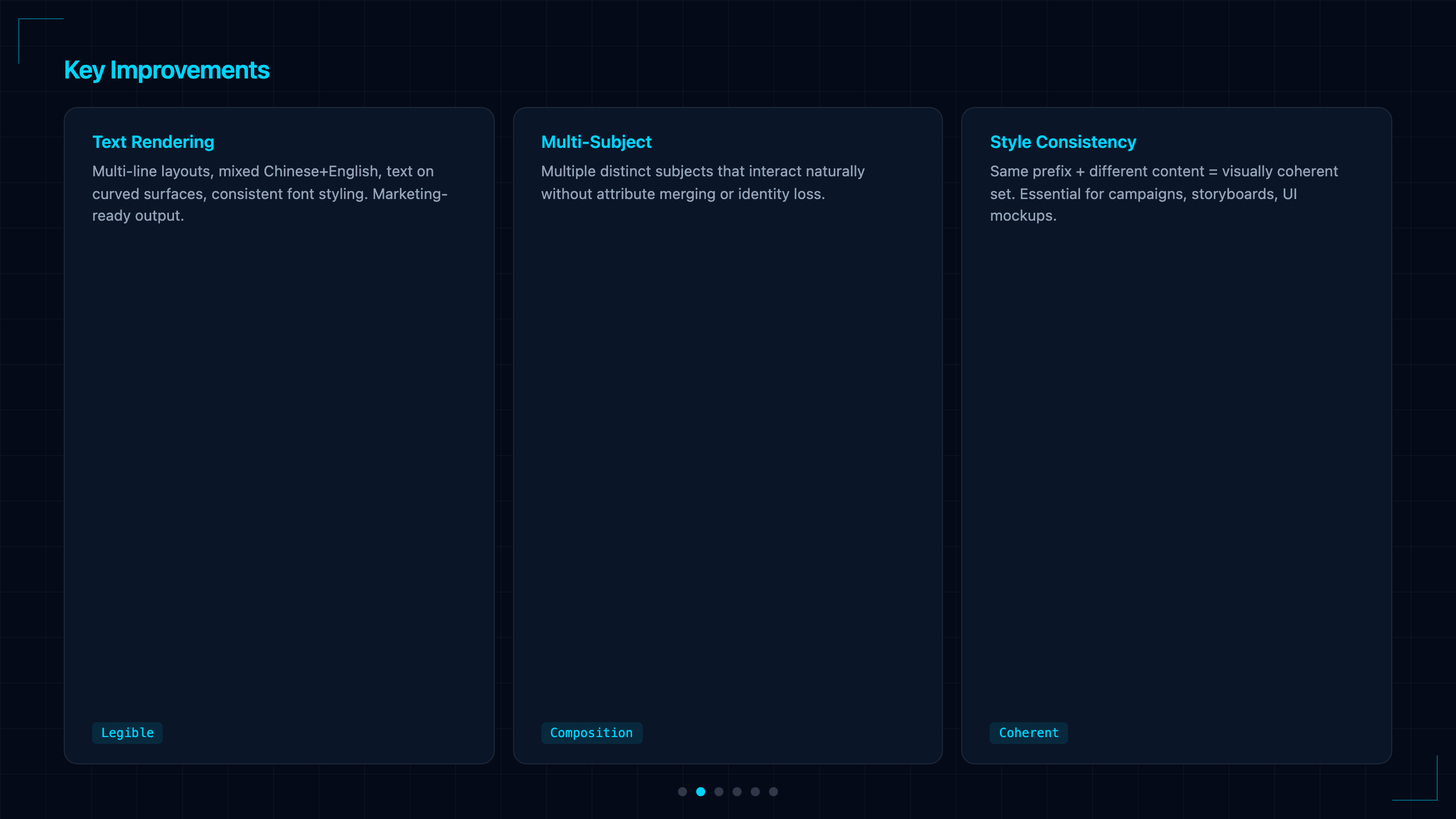
Text Rendering
The perennial weakness of diffusion models — rendering legible text within images — gets a significant upgrade in Seedream 3.0. The model handles:
- Multi-line text layouts with correct line breaks
- Mixed language rendering (English + Chinese in the same image)
- Text on curved surfaces and non-planar backgrounds
- Consistent font style throughout an image
This matters for marketing use cases (social media posts, banners, product mockups) where text is integral to the image, not an afterthought to be composited on top.
Multi-Subject Composition
Generating images with multiple distinct subjects that interact naturally — without merging attributes or losing identity — is a core challenge for diffusion models. Seedream 3.0 improves subject separation through better attention mechanisms and composition training.
Practical impact: generating product photos with multiple items, group scenes with distinct characters, or comparison images where each subject maintains its visual identity.
Style Consistency
For applications that need multiple images in a cohesive visual style (marketing campaigns, storyboards, UI mockups), Seedream 3.0 maintains better style consistency across generations. Same prompt prefix + different content = visually coherent set.
The Platform Play
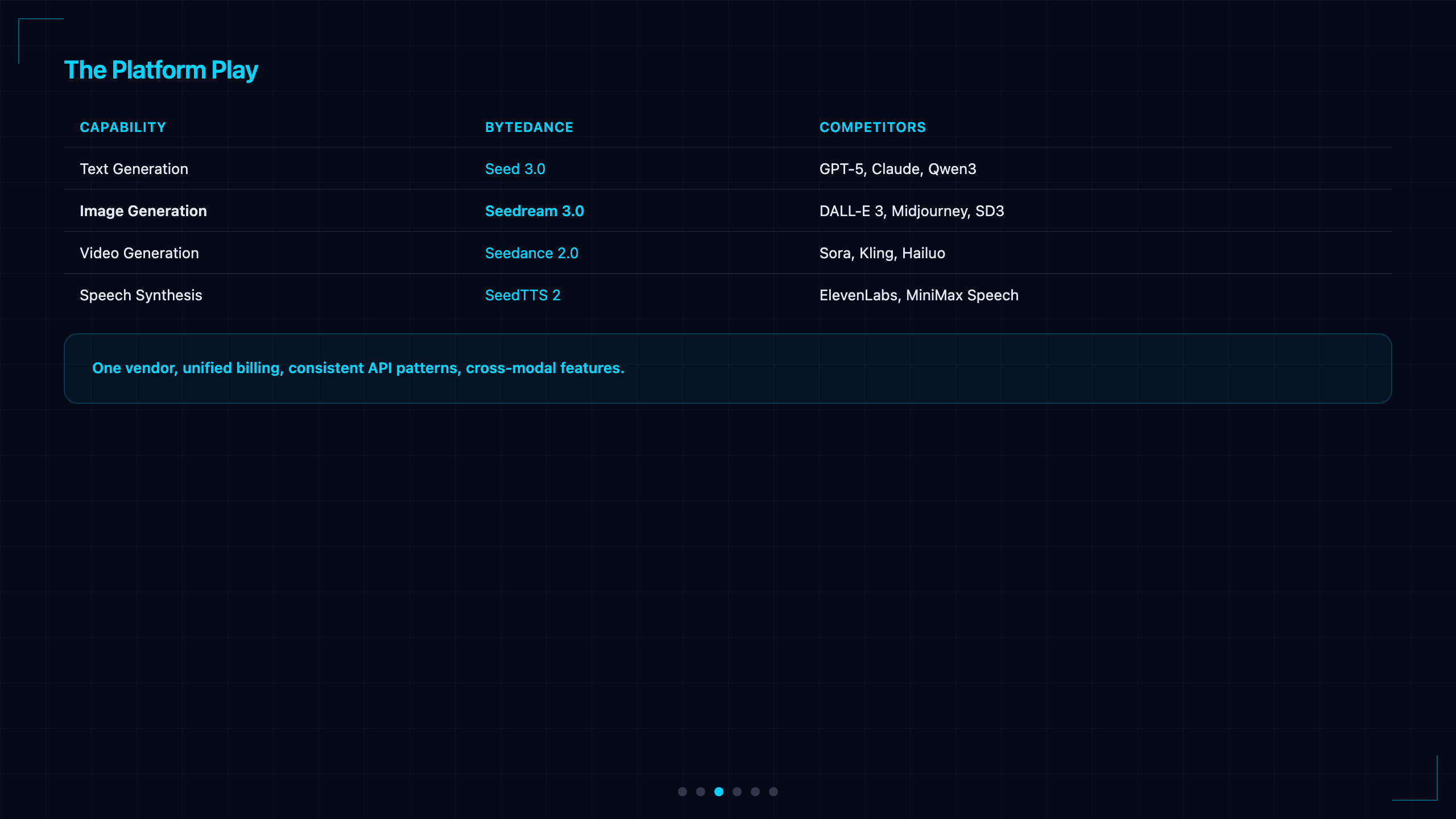
Seedream 3.0's competitive advantage isn't the model in isolation — it's the ecosystem:
| Capability | ByteDance Model | Competitors |
|---|---|---|
| Text generation | Seed 3.0 | GPT-5, Claude, Qwen3 |
| Image generation | Seedream 3.0 | DALL-E 3, Midjourney, SD3 |
| Video generation | Seedance 2.0 | Sora, Kling, Hailuo |
| Speech synthesis | SeedTTS 2.0 | ElevenLabs, MiniMax Speech |
| Music generation | — | Suno, MiniMax Music |
For enterprise customers, the value proposition is: "Build your entire multimodal AI pipeline on Volcengine." One vendor, unified billing, consistent API patterns, and cross-modal features (generate text → visualize with image → animate as video → narrate with speech).
The (now released) Seedream 5.0 Lite — a lighter variant optimized for production throughput — suggests ByteDance is already iterating rapidly beyond 3.0 for deployment-sensitive use cases.
Chinese Market Context
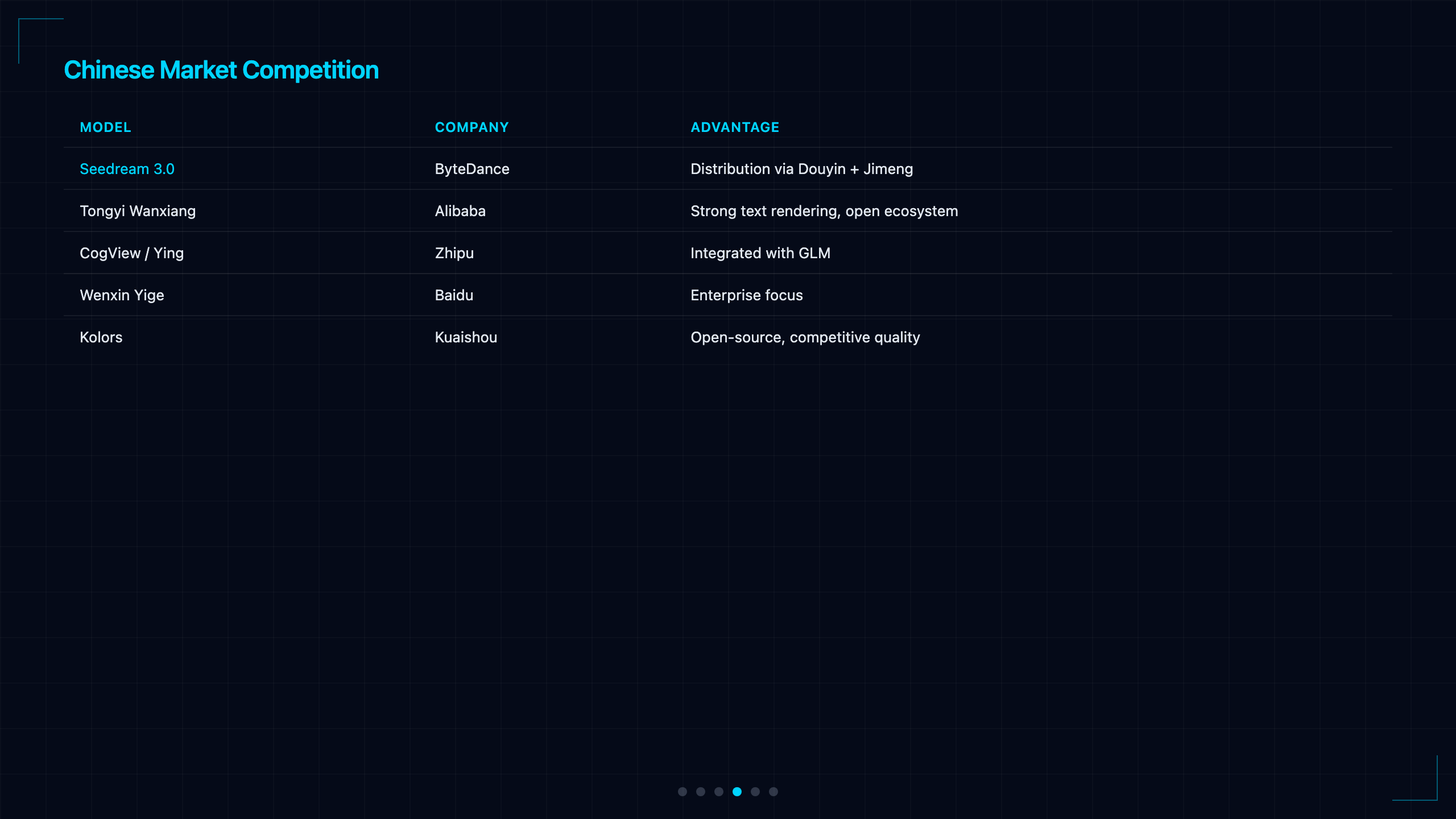
In China's image generation market, Seedream competes with:
- Tongyi Wanxiang (Alibaba/Qwen) — strong text rendering, open ecosystem
- Ying (Zhipu/GLM) — integrated with CogView architecture
- Wenxin Yige (Baidu) — paired with ERNIE, enterprise-focused
- Kolors (Kuaishou) — open-source, competitive quality
ByteDance's advantage is distribution: Jimeng already has significant user adoption through Douyin's creative tools ecosystem. Every short video creator on Douyin is a potential Seedream user for thumbnails, backgrounds, and creative assets.
What It Means for Developers
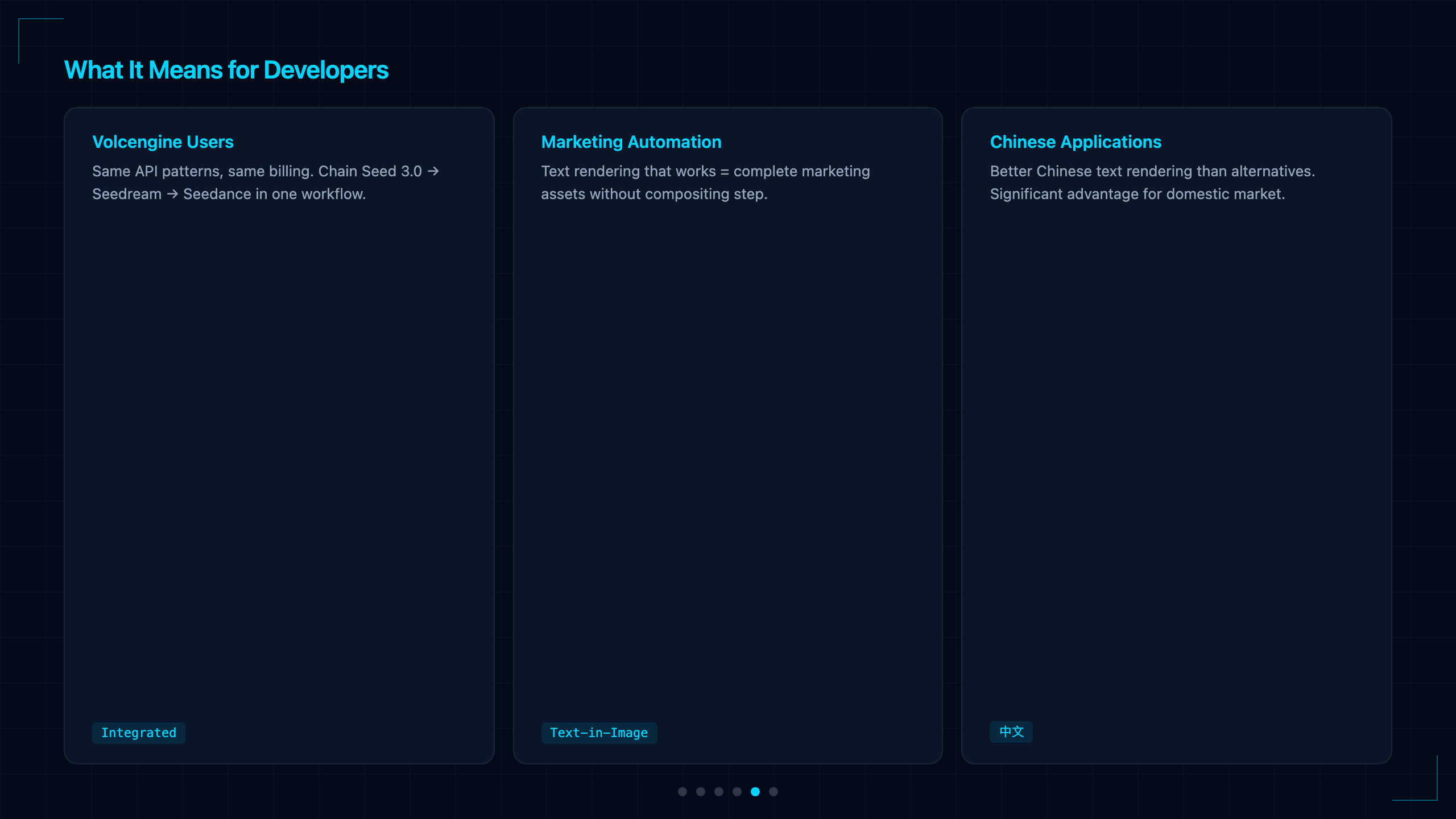
If you're on Volcengine already: Seedream 3.0 is a natural addition to your pipeline. Same API patterns, same billing, and you can chain Seed 3.0 (caption/prompt generation) → Seedream 3.0 (image) → Seedance (animate) in a single workflow.
If you need text-in-image generation: The improved text rendering makes Seedream viable for marketing automation, social media content generation, and banner creation without a compositing step.
If you're evaluating image APIs: Compare against DALL-E 3 and Midjourney on your specific use cases. Seedream 3.0 is competitive on general quality, often better on Chinese text rendering, and significantly cheaper at Volcengine's pricing.
Bottom Line
Seedream 3.0 is ByteDance's "good enough at everything, integrated into everything" image model. It won't dethrone Midjourney for artistic generation or DALL-E for creative versatility, but it doesn't need to. Its value is being the image layer in a full-stack multimodal platform that also does LLM, video, and speech — all through Volcengine at Chinese-market pricing. For developers already in ByteDance's ecosystem, it's the obvious choice. For those outside it, the platform integration story is the reason to look.
Resources
- Seedream 3.0 Blog — official announcement
- Volcengine AI — enterprise API
- Jimeng App — consumer image generation
- ByteDance Seed — research team
Seedream 3.0 is available via Volcengine API and through the Jimeng consumer app.