ByteDance's Seed team released Doubao Seed 2.0 on February 14, 2026 — timed two days before China's Spring Festival Gala, where ByteDance's Volcengine served as the exclusive AI cloud partner for the national broadcast. The timing wasn't accidental. Seed 2.0 is the foundation model powering Doubao, ByteDance's AI assistant app with 155 million weekly active users — China's most-used AI chatbot — and the release marks the platform's transition from a consumer product to a developer infrastructure play.
The headline number isn't a benchmark. It's the price. Seed 2.0 Pro costs $0.47 per million input tokens and $2.37 per million output tokens — about 3.7× cheaper than GPT-5.2 on input and 10× cheaper than Claude Opus 4.5. At benchmark parity with frontier models, that pricing difference changes the economic structure of AI applications built on top of it.
What's New: Four-Tier Model Family
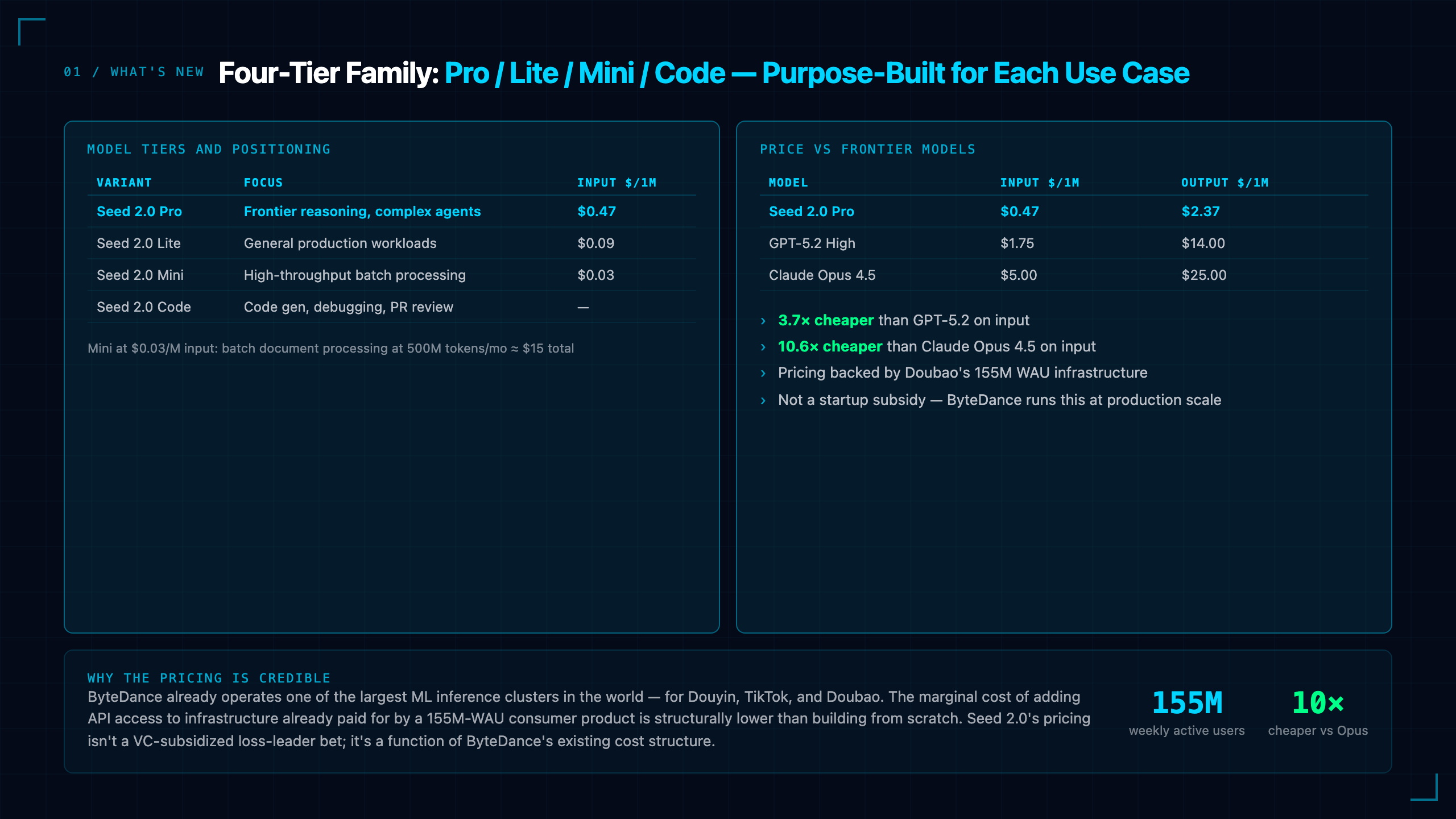
Seed 2.0 isn't a single model — it's four purpose-built variants designed for different positions in the cost-performance tradeoff:
Seed 2.0 Pro is the frontier reasoning variant. It targets the highest-accuracy benchmarks and is designed for complex agentic workflows, research tasks, and scenarios where output quality justifies higher token cost. AIME 2025: 98.3%, Codeforces ELO: 3020, VideoMME: 89.5%.
Seed 2.0 Lite is the general production tier. It balances benchmark performance with throughput and cost for standard developer workloads — chatbots, Q&A pipelines, classification, and similar applications. Competitive benchmark performance at a fraction of Pro pricing ($0.09/M input).
Seed 2.0 Mini is the high-throughput tier. Optimized for deployment density and concurrent request handling — batch document processing, high-volume API calls, cost-sensitive pipelines. At $0.03/M input, it's the cheapest token in the family.
Seed 2.0 Code is the coding-specialized variant. Fine-tuned specifically for software development tasks: code generation, debugging, PR review, and repository-level understanding. LiveCodeBench v6: 87.8%, SWE-Bench Verified: 76.5%.
Benchmarks: Competitive Frontier, Honest Gaps
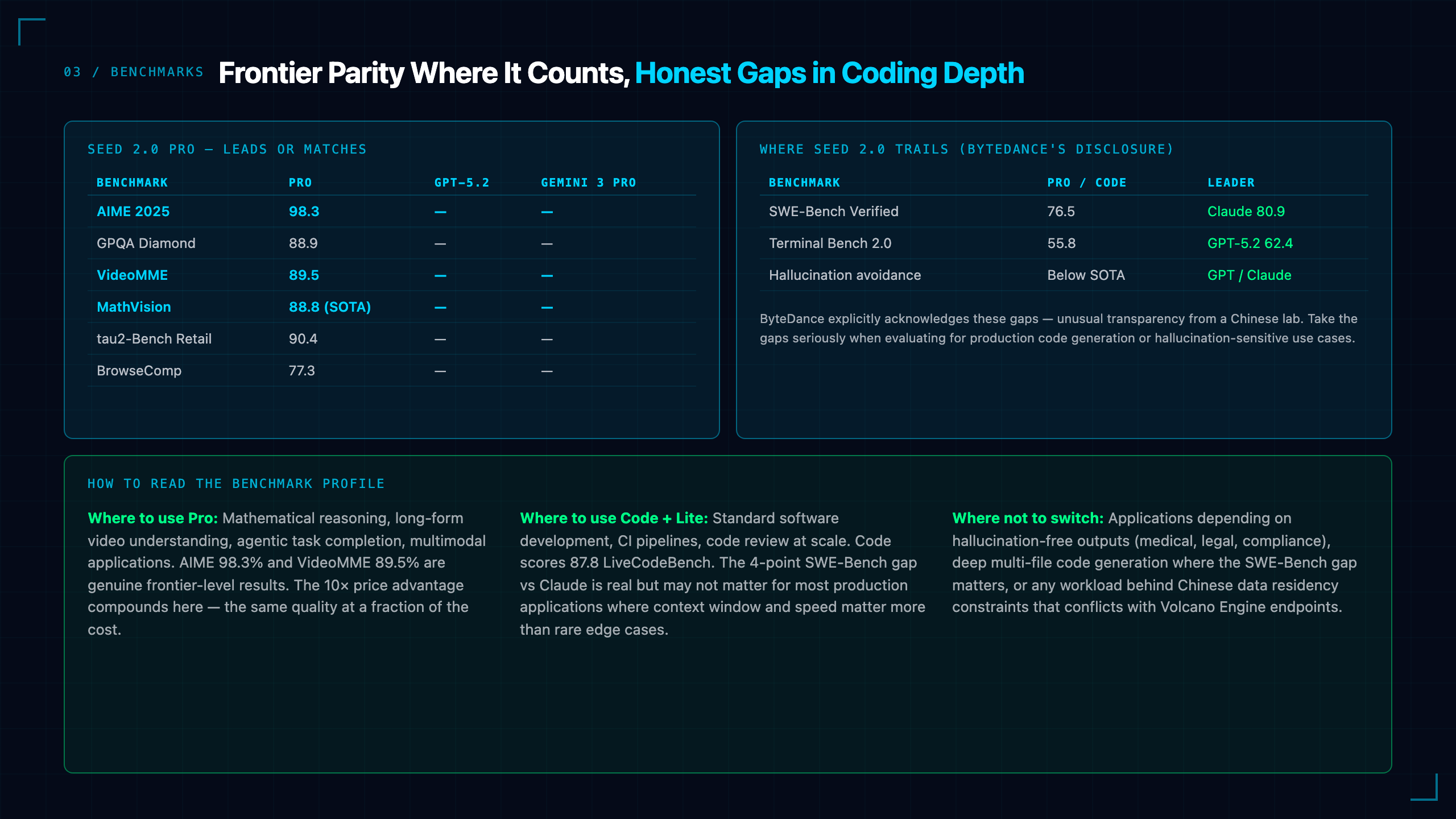
ByteDance publishes benchmark comparisons directly against GPT-5.2, Claude Opus 4.5, and Gemini 3 Pro — and is unusually explicit about where Seed 2.0 trails.
Math and Reasoning:
- AIME 2025: 98.3% (Pro) — competitive with frontier models
- AIME 2026: 94.2% (Pro)
- GPQA Diamond: 88.9% (Pro)
- MMLU-Pro: 87.0% (Pro)
- Competition math: IMO gold medals, CMO, all five ICPC programming competitions tested
Coding:
- Codeforces ELO: 3020 (Pro/Code) — 2233 (Lite), 1644 (Mini)
- LiveCodeBench v6: 87.8% (Pro/Code), 81.7% (Lite), 64.1% (Mini)
- SWE-Bench Verified: 76.5% — trails Claude Opus 4.5 (80.9%) and Opus 4.6 (80.8%)
- Terminal Bench 2.0: 55.8% — behind GPT-5.2 (62.4%)
Multimodal and Video (Seed 2.0's clearest strength):
- VideoMME: 89.5% — hour-long video understanding
- MathVision: 88.8% — visual mathematical reasoning (SOTA at release)
- MMMU: 85.4%
- MotionBench: 75.2%
- LMSYS Chatbot Arena: 6th for text, 3rd for vision at launch
Agentic:
- BrowseComp: 77.3%
- tau2-Bench Retail: 90.4%
- tau2-Bench Telecom: 94.2%
The honest summary ByteDance offers: Pro is competitive on math and reasoning benchmarks, genuinely strong on multimodal and video, and trails on coding depth (SWE-Bench Verified gap vs Claude) and hallucination avoidance relative to top Western models.
Architecture: Production-Scale Multimodal at 45T Tokens
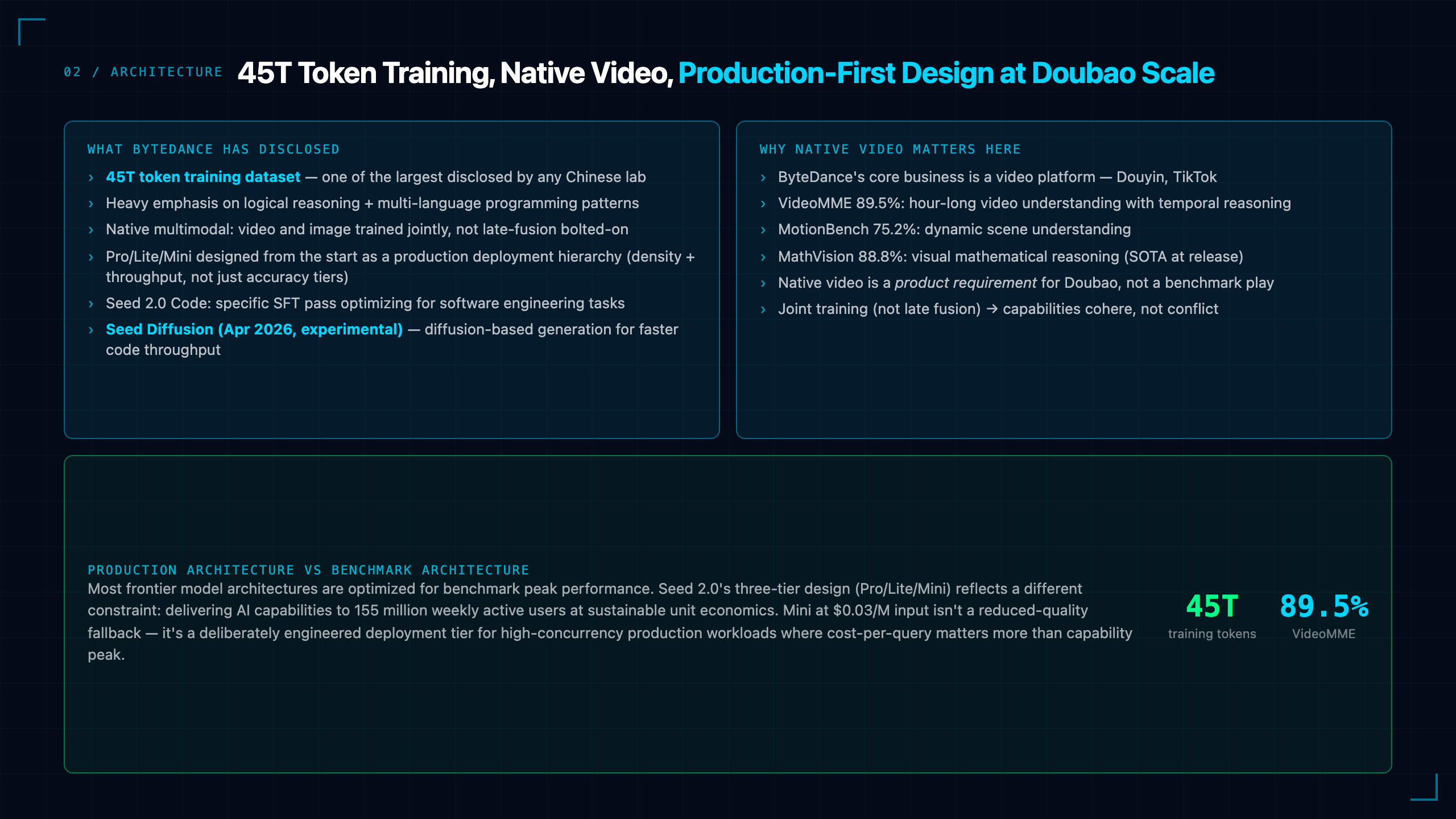
ByteDance has not released a full technical report for Seed 2.0 architecture details. What is publicly known:
Training scale: 45 trillion token training dataset, with heavy emphasis on logical reasoning and multi-language programming patterns for the Code variant. The scale situates it among the largest training runs disclosed by any Chinese lab.
Three-tier model design: The Pro/Lite/Mini hierarchy isn't just a capability gradient — it's an explicit production deployment strategy. Lite and Mini are designed from the start for deployment density and concurrent request handling, not just reduced-accuracy smaller models. The Mini variant at $0.03/M input is competitive with the cheapest batch processing tiers from any major model provider.
Native multimodality: Video and image understanding is built-in, not bolted on. The VideoMME score of 89.5% — handling hour-long video with temporal reasoning — reflects joint training across modalities rather than late-stage fusion. ByteDance's core product is a video platform; deep video understanding capability is a direct product requirement for Doubao.
Seed Diffusion (experimental, April 2026): ByteDance introduced an experimental diffusion-based generation approach for coding in April 2026, targeting faster code generation throughput. Details are limited, but it signals interest in non-autoregressive approaches specifically for the Code variant.
Production deployment at Doubao scale: The model architecture is optimized for the demands of 155 million weekly active users, which means sustained high-concurrency throughput as a primary constraint, not just benchmark-maximizing design.
Pricing: The Development Story
The pricing structure is the most consequential aspect of Seed 2.0 for developers outside China.
| Variant | Input ($/1M tokens) | Output ($/1M tokens) |
|---|---|---|
| Seed 2.0 Pro | $0.47 | $2.37 |
| Seed 2.0 Lite | $0.09 | $0.53 |
| Seed 2.0 Mini | $0.03 | $0.31 |
| GPT-5.2 High | $1.75 | $14.00 |
| Claude Opus 4.5 | $5.00 | $25.00 |
The practical impact:
- A team spending $14,000/month on GPT-5.2 for agentic workflows (1B output tokens) spends roughly $2,370 on Seed 2.0 Pro for comparable-quality outputs
- Batch document processing at 500M input tokens/month costs ~$235 on Seed 2.0 Pro vs ~$875 on GPT-5.2
- For Seed 2.0 Mini, the same batch workload costs ~$15
This pricing is enabled by ByteDance's infrastructure position — the company already operates one of the largest ML inference clusters in the world for Douyin/TikTok. Marginal cost of inference is genuinely lower when the hardware is already paid for by the consumer product.
Access
Seed 2.0 is available via Volcano Engine (ByteDance's cloud platform). International access has historically required a Chinese phone number and verification — but third-party providers including EvoLink have begun offering Seed 2.0 access without those requirements.
ByteDance's TRAE IDE integrates Seed 2.0 Code for development workflows. The Doubao app exposes Pro capabilities including deep research and autonomous search agents to end users.
There are no open weights. Seed 2.0 is API-only.
What It Means for Developers
Seed 2.0 makes a practical case that's harder to ignore than benchmark debates: if you're running AI-powered products at scale and paying frontier model pricing, switching to Seed 2.0 Pro for workloads where it achieves benchmark parity could reduce your API costs by 3-10× without changing output quality for most tasks.
The specific caveats matter. If your application depends on code generation quality where SWE-Bench depth matters (Seed 2.0 trails Claude by ~4 points on Verified), or on hallucination-free outputs in adversarial contexts, Seed 2.0 is not a drop-in replacement. ByteDance's own disclosure of these gaps is worth taking seriously.
Where Seed 2.0 is clearly competitive or leads:
- Long-form video understanding (VideoMME 89.5%)
- High-volume batch processing (Mini tier at $0.03/M)
- Agentic task completion (tau2-Bench 90-94%)
- Mathematical reasoning at production scale (AIME 98.3%)
Where the pricing case is weaker:
- Applications requiring frontier-quality code generation (SWE-Bench gap)
- Hallucination-sensitive contexts (ByteDance's acknowledged gap)
- Data residency requirements (Volcano Engine endpoints, Chinese infrastructure)
Bottom Line
Seed 2.0 Pro matches GPT-5.2 and Gemini 3 Pro on most benchmarks at 3.7× lower input cost and 10× lower output cost than Claude Opus 4.5. The pricing is credible because ByteDance runs Doubao at 155M weekly users on the same infrastructure — they're not speculating about unit economics. The gaps are real: SWE-Bench Verified trails Claude by ~4 points, and hallucination avoidance isn't at frontier level. But for the use cases where Seed 2.0 is competitive — video understanding, batch processing, mathematical reasoning, agentic tasks — the cost argument is straightforward.
Resources
- ByteDance Seed Official Site — Seed 2.0 model overview
- Volcano Engine API Platform — API access
- ByteDance TRAE IDE — coding agent with Seed 2.0 Code
- Doubao App — consumer product powered by Seed 2.0
Doubao Seed 2.0 is available via Volcano Engine API. Pricing: $0.47/M input, $2.37/M output (Pro); $0.09/M, $0.53/M (Lite); $0.03/M, $0.31/M (Mini). No open weights.