MiniMax released Speech-02 in March 2025, marking a significant upgrade to their text-to-speech API. Where Speech-01 focused on quality for Chinese language synthesis, Speech-02 expanded to 17 languages, added emotion and prosody controls, and introduced voice cloning from short audio samples — capabilities that address the full range of production voice application requirements.
MiniMax positioned Speech-02 directly against ElevenLabs, the dominant international TTS API, on key metrics: naturalness MOS scores, voice library size, and cloning quality. The pricing — at fractions of ElevenLabs' per-character cost — made it attractive for cost-sensitive Chinese developers and international developers looking for alternatives.
What's New
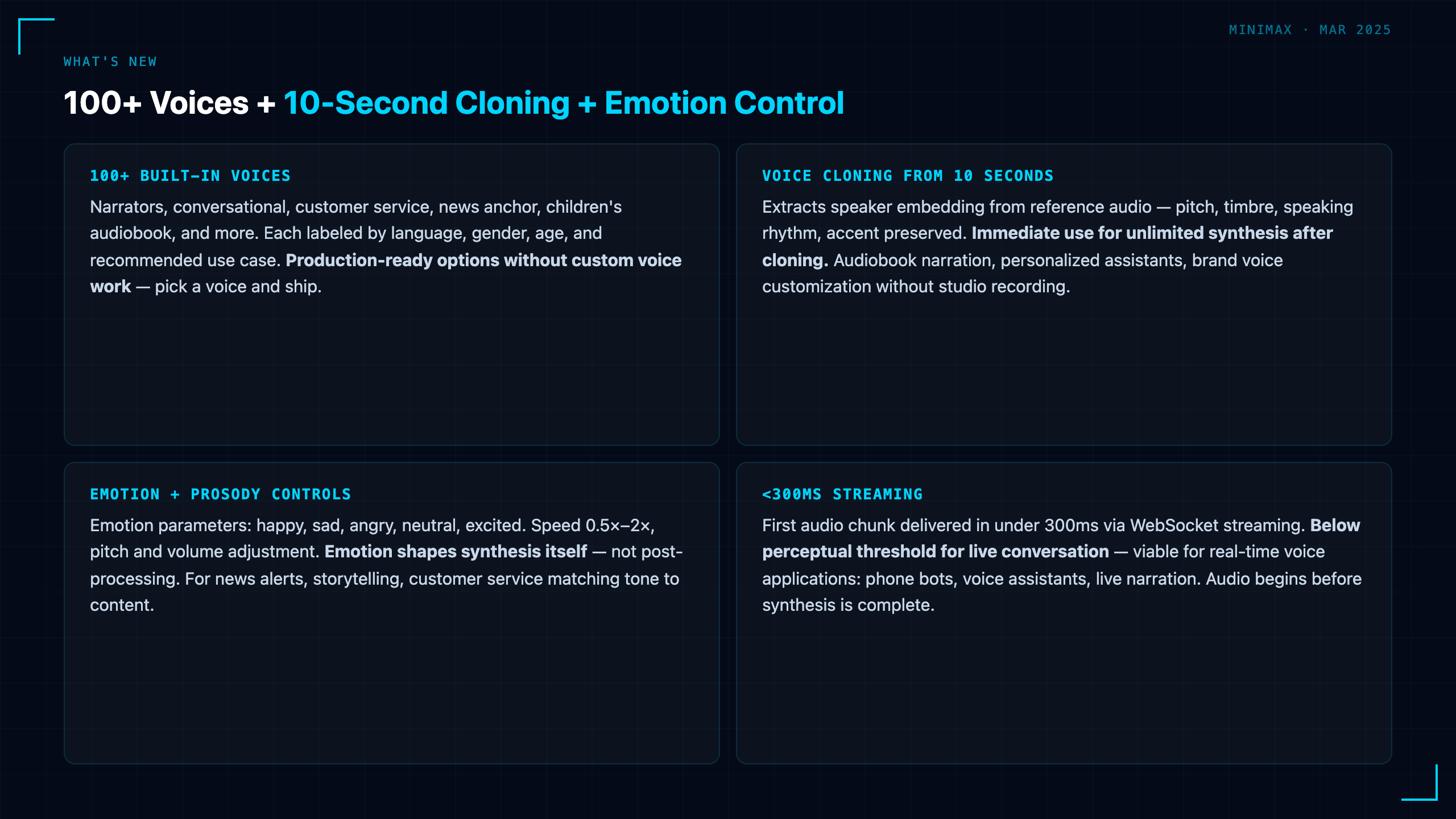
100+ built-in voices: Speech-02 ships with a library of over 100 distinct voices across different ages, genders, accents, and registers — narrators, conversational, customer service, news anchor, children's audiobook, and more. Each voice is labeled with language, gender, age, and recommended use case. For developers who need consistent brand voice across their application, the library provides production-ready options without custom voice work.
Voice cloning from 10-second samples: Users can clone a voice from as little as 10 seconds of reference audio. The cloned voice preserves speaker characteristics — pitch, timbre, speaking rhythm, accent — and can be used immediately for unlimited synthesis. For audiobook production, personalized voice assistants, and customer service applications using specific personas, voice cloning enables rapid customization.
Emotion and prosody control: Speech-02 supports emotion parameters (happy, sad, angry, neutral, excited) and prosody controls (speed 0.5×–2×, pitch adjustment, volume). For interactive applications where voice tone should match content — news alerts, customer service responses, storytelling — these controls enable expressive synthesis without post-processing.
17-language multilingual synthesis: English, Chinese, Japanese, Korean, French, German, Spanish, Portuguese, Italian, Russian, Arabic, Hindi, Thai, Vietnamese, Indonesian, Malay, and Turkish. Each language uses native-quality synthesis rather than cross-lingual transfer — the model was trained with native speakers per language rather than adapting an English base model.
Streaming under 300ms: First-audio-chunk latency under 300ms in streaming mode enables real-time voice applications — phone bots, voice assistants, live narration. At 300ms, the delay between text generation and audio playback is below the perceptual threshold for live conversation.
Architecture
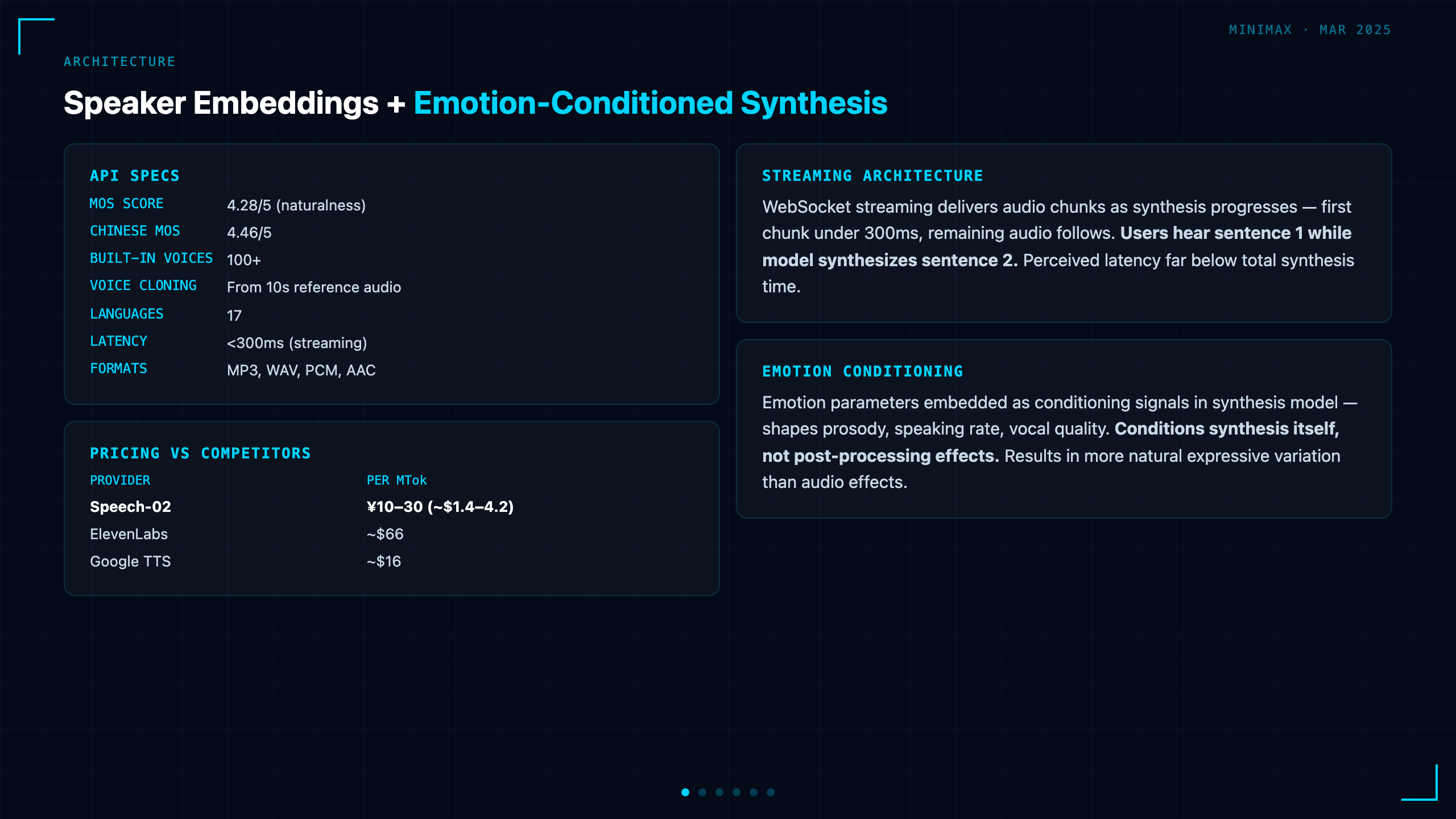
Speech-02 is an API product; detailed architecture is not publicly disclosed. What is published:
| Specification | Details |
|---|---|
| MOS score | 4.28/5 (naturalness) |
| Built-in voices | 100+ |
| Voice cloning | From 10-second sample |
| Languages | 17 |
| Streaming latency | <300ms first chunk |
| Audio formats | MP3, WAV, PCM, AAC |
| API format | REST, WebSocket streaming |
Voice cloning approach: MiniMax uses a speaker adaptation approach — the base TTS model is conditioned on a speaker embedding extracted from the reference audio. The 10-second minimum reflects the amount of audio needed to extract a reliable speaker embedding that generalizes to new text. Longer reference audio generally improves cloning fidelity.
Streaming architecture: Speech-02 supports chunked audio streaming via WebSocket, beginning audio delivery before the full synthesis is complete. For long texts, users hear the first sentence while the model is synthesizing the second — reducing perceived latency substantially below the total synthesis time.
Emotion conditioning: Emotion parameters are embedded as conditioning signals in the synthesis model, influencing prosody, speaking rate, and vocal quality. Unlike post-processing (which applies effects to finished audio), emotion conditioning shapes the synthesis itself — resulting in more natural expressive variation.
Benchmarks
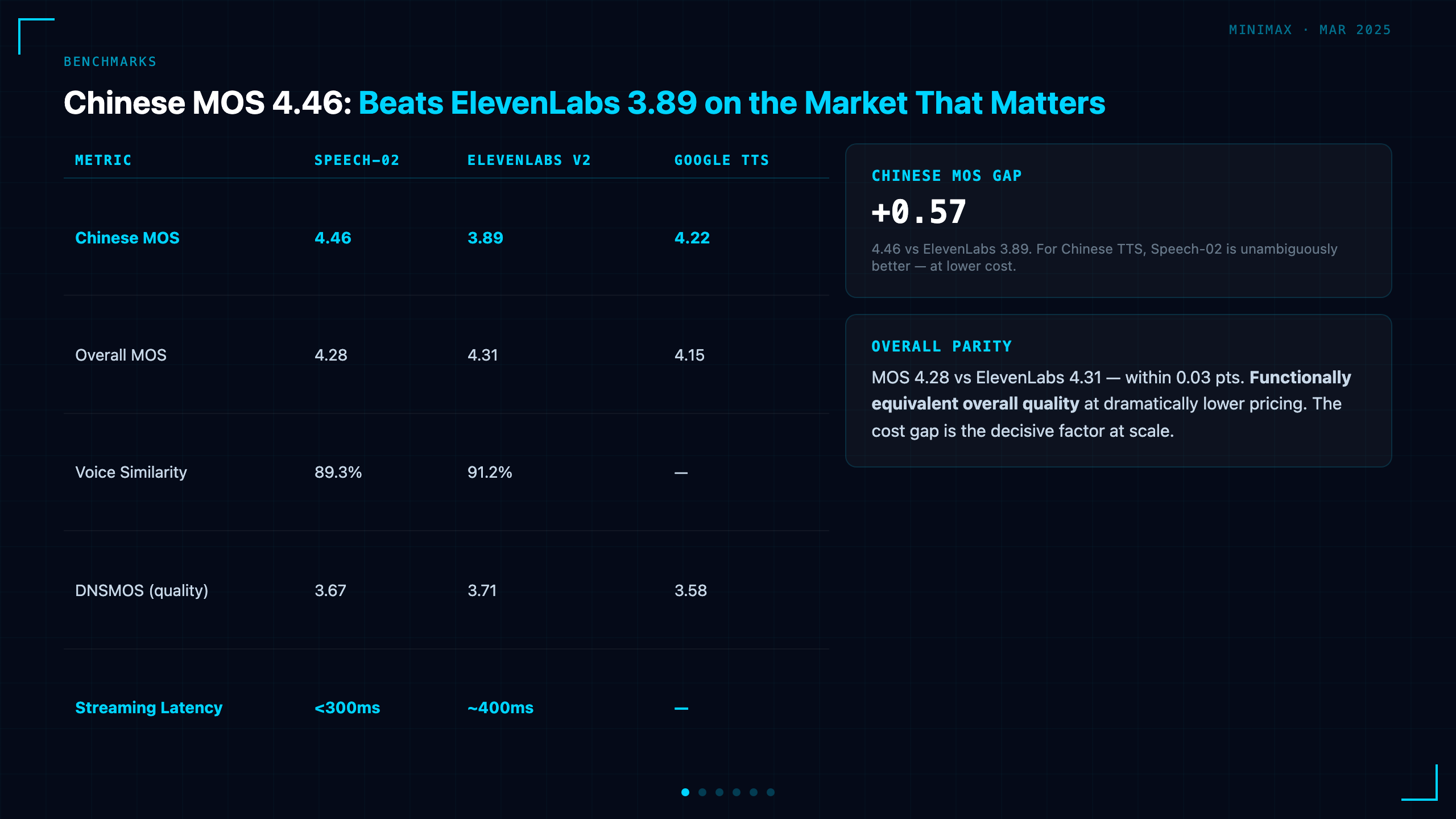
Speech-02 evaluation at March 2025 release:
| Metric | Speech-02 | ElevenLabs v2 | Google WaveNet | Notes |
|---|---|---|---|---|
| MOS (naturalness) | 4.28 | 4.31 | 4.15 | Mean Opinion Score (5=human) |
| Chinese MOS | 4.46 | 3.89 | 4.22 | Chinese language naturalness |
| Voice Similarity | 89.3% | 91.2% | — | Voice cloning similarity |
| DNSMOS (quality) | 3.67 | 3.71 | 3.58 | Deep Noise Suppression MOS |
| Streaming Latency | <300ms | ~400ms | — | First chunk delivery |
MOS 4.28 is near-human naturalness (5.0 = human baseline) and near ElevenLabs v2's 4.31. Chinese MOS at 4.46 substantially exceeds ElevenLabs' 3.89 — for Chinese-language synthesis, Speech-02 is clearly superior to the international leader.
Voice Similarity 89.3% versus ElevenLabs' 91.2% — the gap is small enough that for most production use cases, the cloning quality is functionally equivalent. At substantially lower pricing, the total cost of voice cloning at scale is dramatically different.
Pricing and Cost Comparison
| Provider | Price per 1M characters | Notes |
|---|---|---|
| Speech-02 | ¥10–30 (~$1.4–4.2) | Tiered by volume |
| ElevenLabs | ~$66 per 1M chars | Creator tier |
| Google Cloud TTS | ~$16 per 1M chars | Standard voices |
At high volume (>10M characters/month), Speech-02 pricing drops significantly. For applications serving Chinese-language markets — where Chinese MOS 4.46 (vs ElevenLabs 3.89) is the relevant quality metric — Speech-02 delivers better quality at lower cost.
What It Means for Developers
Chinese voice applications at production quality: Chinese MOS 4.46 makes Speech-02 the highest-quality Chinese TTS available via API at March 2025. For audiobooks, podcasts, video narration, customer service bots, and educational content in Chinese, Speech-02 exceeds what was previously achievable with any commercial TTS API.
Voice cloning for personalization at scale: 10-second cloning enables rapid voice customization per user or per brand. For personalized voice assistants, custom audiobook narration, or customer service applications where a specific voice persona is important, the cloning capability removes the barrier of extensive recording studio work.
Real-time voice in agentic applications: <300ms streaming latency makes Speech-02 viable in real-time agent pipelines — chain LLM output to Speech-02 synthesis to audio playback with a delay that feels live. For voice AI applications where speed matters, this latency threshold is the practical production requirement.
Cost-effective at scale: At ¥10–30 per million characters (volume dependent), Speech-02 enables voice features in cost-sensitive applications — content platforms that can't afford $66/MTok but need quality voice. The economics support voice-enabling features that would be prohibitive at ElevenLabs pricing.
Availability
- API: MiniMax API Platform — developer access
- Pricing: Starting at ¥10/MTok, volume discounts available
- Languages: 17 languages including Chinese, English, Japanese, Korean
- Docs: MiniMax Developer Docs
Bottom Line
Speech-02 arrived with Chinese MOS 4.46 (vs ElevenLabs 3.89), 100+ voices, 10-second voice cloning, and <300ms streaming at a fraction of ElevenLabs' pricing. For Chinese-language applications, Speech-02 is unambiguously the best available TTS API. For international applications cost-sensitive about voice, it's a compelling alternative. MiniMax's positioning in TTS mirrors DeepSeek's in LLMs: comparable quality to the international leader at dramatically lower cost, with particular excellence for Chinese language tasks.
Resources
- MiniMax API Platform — API access and management
- MiniMax Developer Documentation — Speech-02 API docs
- MiniMax — company website
Speech-02 is available via the MiniMax API platform. Pricing subject to change; verify current rates at minimaxi.com.