Alibaba released Qwen2.5-Coder-32B in November 2024 as the flagship of the Qwen2.5-Coder series — the first open-weight model to match GPT-4o on code generation benchmarks. This was not a marginal improvement over previous open models; Qwen2.5-Coder-32B's HumanEval 92.7% and EvalPlus 90.2% were directly competitive with GPT-4o's 90.2%, with the open model actually leading on EvalPlus.
The Qwen2.5-Coder release marked a turning point: for coding-specific tasks, open-weight models had reached parity with the dominant closed-source model — and at 32B, the model was deployable on consumer GPU setups (2–4 A100s, or a single A100 80GB with quantization). The Apache 2.0 license meant commercial deployment without restrictions.
What's New
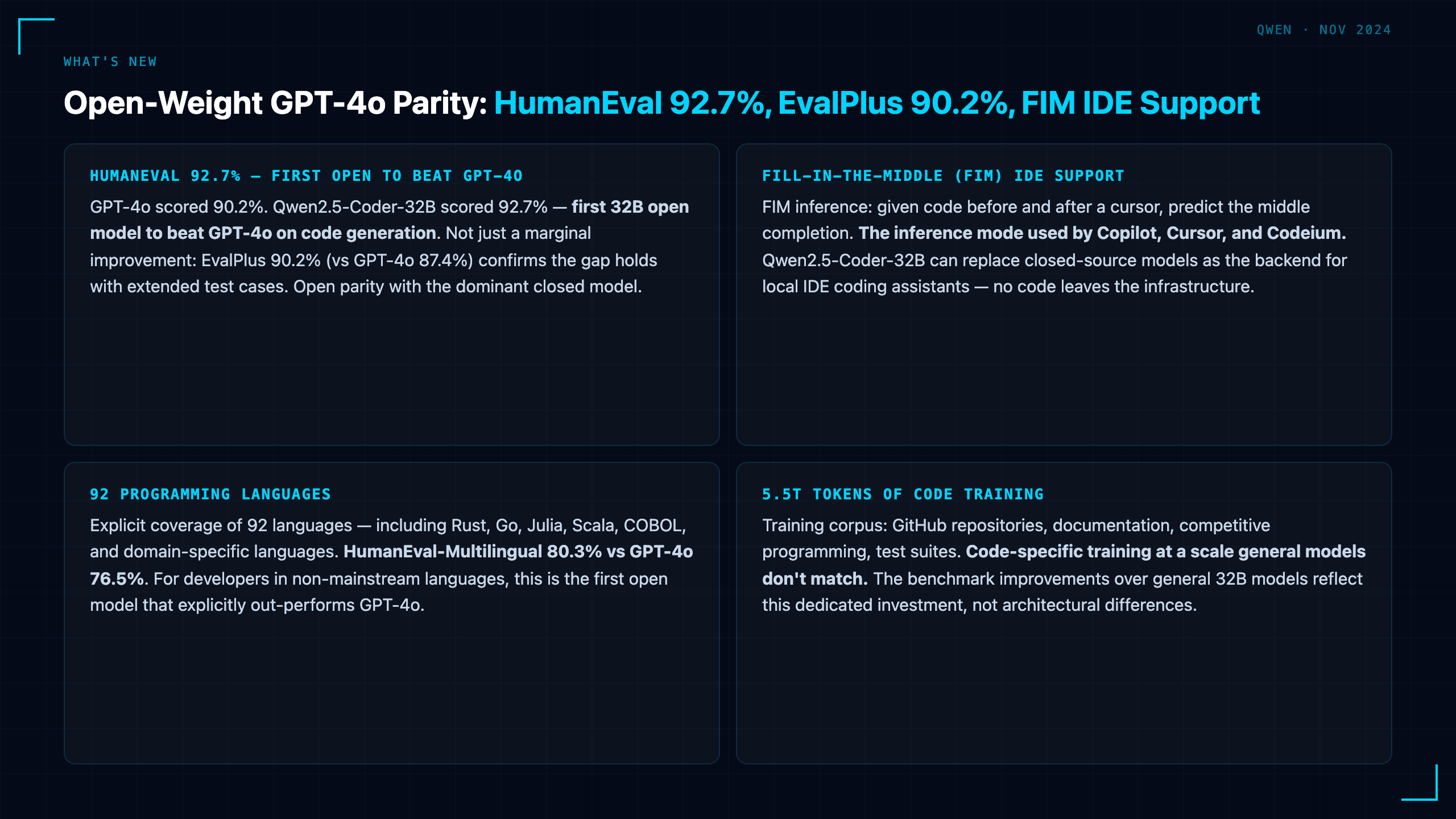
HumanEval 92.7% — matches GPT-4o: At November 2024, HumanEval 92.7% placed Qwen2.5-Coder-32B above GPT-4o (90.2%) on the standard code generation benchmark. This was the first time a 32B open model matched or exceeded GPT-4o on a major coding benchmark — establishing a new baseline for what open-weight models could achieve on code.
EvalPlus 90.2%: EvalPlus extends HumanEval with additional test cases per problem, reducing the impact of solutions that happen to pass only the provided test cases. Qwen2.5-Coder-32B's 90.2% on EvalPlus (vs GPT-4o's lower score on the same) indicates genuine code quality, not test overfitting.
CRUXEval 66.6%: Code Reasoning Understanding and eXecution — requires reasoning about what code does, not just generating it. CRUXEval tests code comprehension and debugging, not just synthesis. 66.6% was competitive with frontier closed models at November 2024.
Apache 2.0 license: Full commercial use, fine-tuning, redistribution without restrictions. The permissive license, combined with the GPT-4o-matching benchmark performance, made Qwen2.5-Coder-32B the default choice for any team requiring open-weight coding models with commercial deployment needs.
0.5B to 72B family: The Qwen2.5-Coder series spans seven sizes — 0.5B, 1.5B, 3B, 7B, 14B, 32B, 72B. Each size uses the same code-specific training; smaller sizes are designed for edge deployment, coding autocomplete in IDEs, and low-latency applications. The 32B is the flagship that matched GPT-4o; the 72B (released alongside) extends further.
Architecture
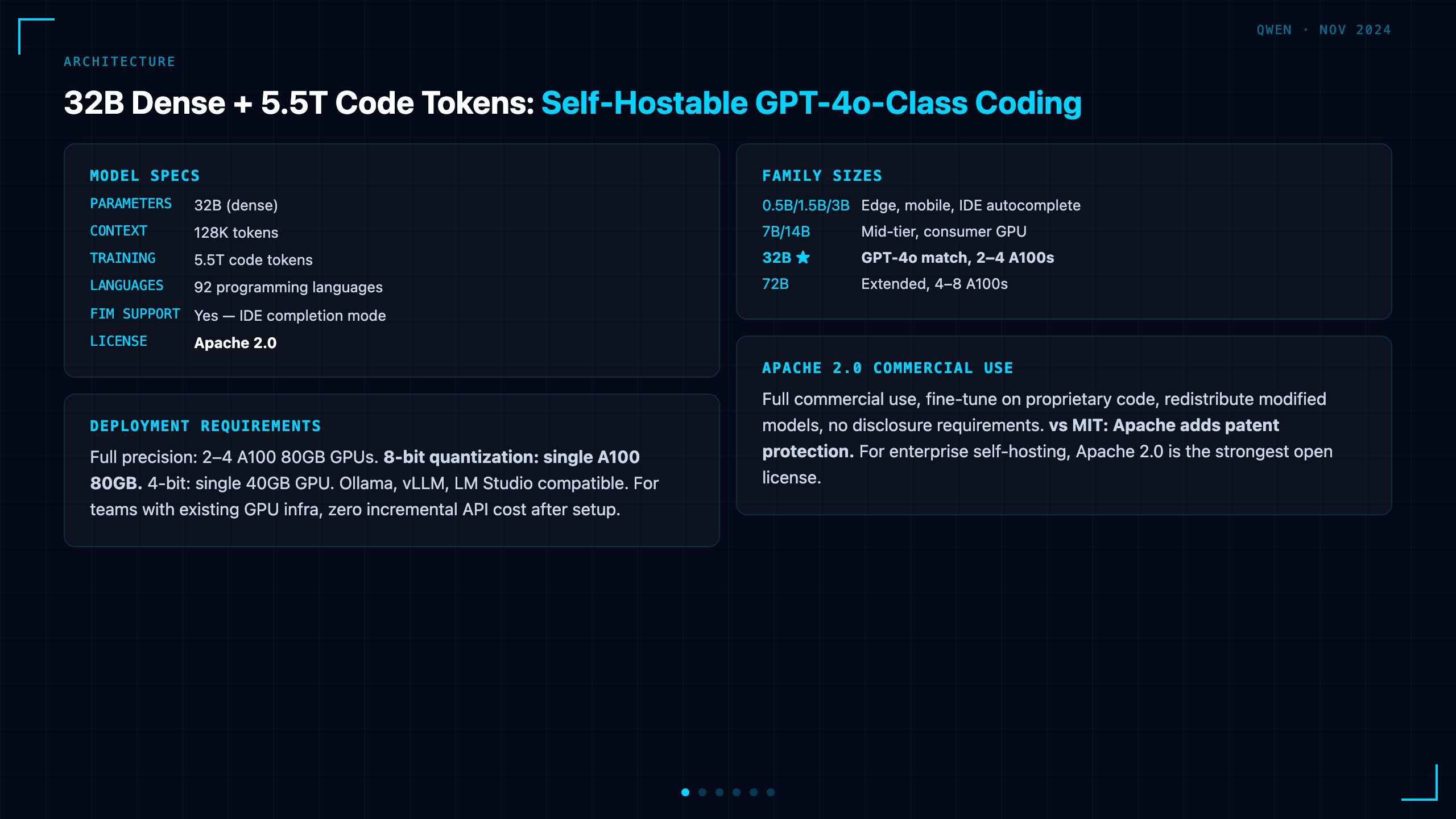
| Component | Qwen2.5-Coder-32B |
|---|---|
| Parameters | 32B (dense) |
| Architecture | Dense transformer |
| Context window | 128K tokens |
| Training data | 5.5T tokens of code |
| Languages | 92 programming languages |
| License | Apache 2.0 |
| Input price (API) | ~$0.035/M |
Code-specialized training: Qwen2.5-Coder was trained on 5.5 trillion tokens of code across 92 programming languages — substantially more code-focused training than general models. The training corpus includes GitHub repositories, documentation, competitive programming, and test suites — the same data sources that appear in the downstream coding benchmarks.
92 programming language support: Unlike general models that perform well on Python and JavaScript but degrade on less common languages, Qwen2.5-Coder was trained with explicit coverage of 92 languages — including Rust, Go, Julia, COBOL, and domain-specific languages. For developers working outside Python/JS/TypeScript, this explicit coverage matters.
128K context for repository-level code: 128K tokens enables loading most medium-sized codebases in context — useful for code review, refactoring, and documentation generation workflows. The context length is the same as GPT-4o-Turbo, removing the context constraint for most coding use cases.
Fill-in-the-Middle (FIM) support: Qwen2.5-Coder supports FIM inference — given code before and after a cursor position, predict the middle completion. This is the inference mode used by IDE coding assistants (Copilot, Cursor, Codeium). FIM support makes Qwen2.5-Coder-32B directly usable as a Copilot-style local coding assistant backend.
Benchmarks
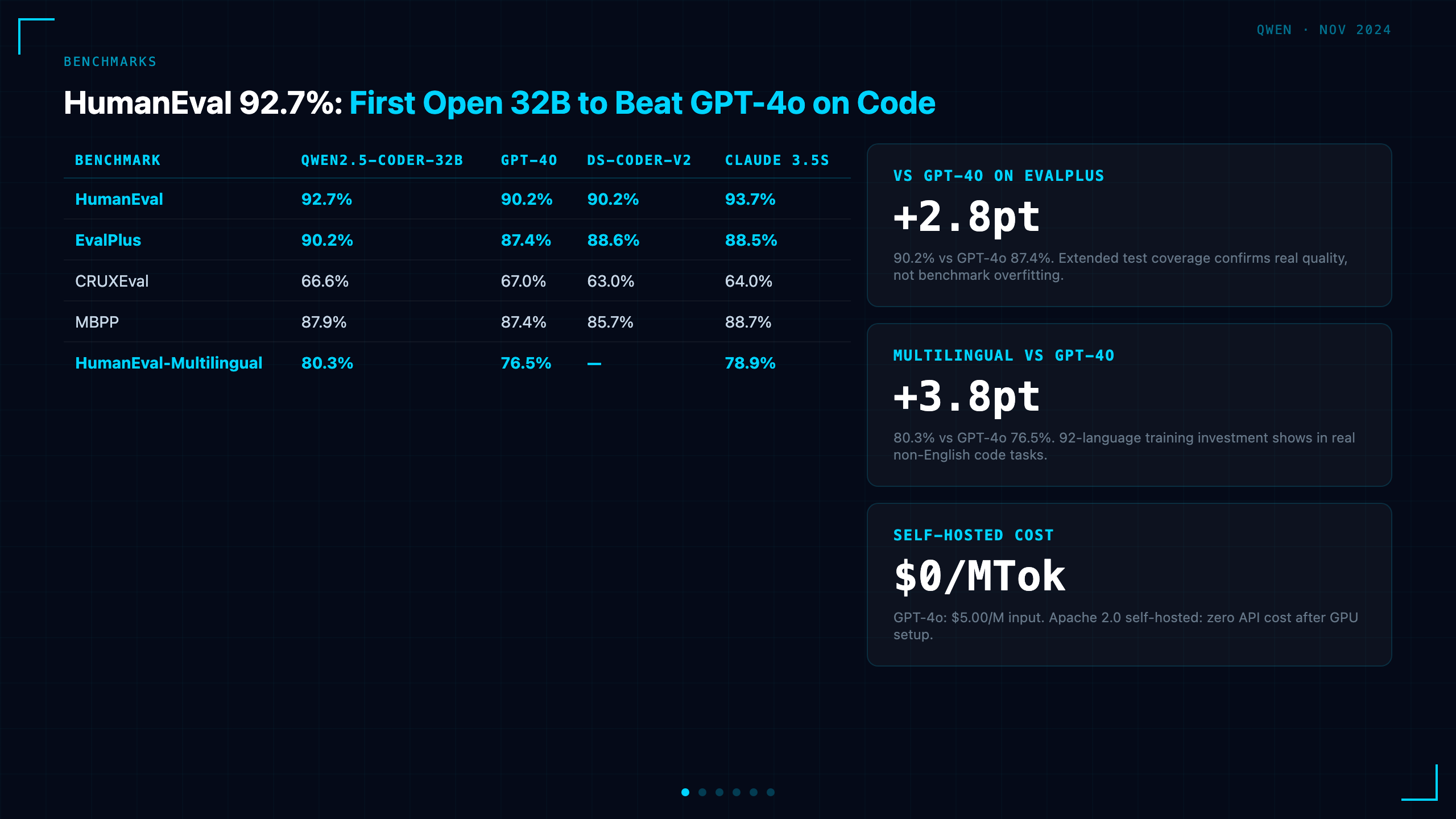
Qwen2.5-Coder-32B at November 2024 release:
| Benchmark | Qwen2.5-Coder-32B | GPT-4o | DeepSeek-Coder-V2 | Claude 3.5 Sonnet | Notes |
|---|---|---|---|---|---|
| HumanEval | 92.7% | 90.2% | 90.2% | 93.7% | Code generation |
| EvalPlus | 90.2% | 87.4% | 88.6% | 88.5% | Code gen + test coverage |
| CRUXEval | 66.6% | 67.0% | 63.0% | 64.0% | Code reasoning |
| MBPP | 87.9% | 87.4% | 85.7% | 88.7% | Python problems |
| HumanEval-Multilingual | 80.3% | 76.5% | — | 78.9% | Multi-language coding |
HumanEval 92.7% above GPT-4o's 90.2% is the defining result. EvalPlus 90.2% vs GPT-4o's 87.4% confirms the gap is not benchmark artifact — Qwen2.5-Coder-32B generates code that passes extended test coverage, not just the provided test cases.
HumanEval-Multilingual 80.3% above GPT-4o's 76.5% reflects the 92-language training investment — the model genuinely outperforms GPT-4o on non-English programming languages.
Pricing and Open-Weight Economics
| Model | Type | HumanEval | Access |
|---|---|---|---|
| Qwen2.5-Coder-32B | Open, Apache 2.0 | 92.7% | Self-host or API |
| GPT-4o | Closed | 90.2% | API only ($5/M) |
| DeepSeek-Coder-V2 | Open, MIT | 90.2% | Self-host or API |
| Claude 3.5 Sonnet | Closed | 93.7% | API only ($3/M) |
The open-weight value proposition: Qwen2.5-Coder-32B matches or exceeds GPT-4o on coding at $0 per token for self-hosted inference. The upfront cost is GPU provisioning; the marginal cost per query is electricity. For high-volume coding applications — IDE autocomplete, batch code analysis, automated refactoring pipelines — the self-hosted economics are compelling.
What It Means for Developers
Self-hosted GPT-4o-class code generation: On 2–4 A100 GPUs, or a single A100 80GB with 8-bit quantization, Qwen2.5-Coder-32B provides GPT-4o-class code generation at zero API cost. For teams with existing GPU infrastructure, this removes the per-token cost constraint for coding applications entirely.
IDE coding assistant backend: FIM (Fill-in-the-Middle) support makes Qwen2.5-Coder-32B the foundation for Copilot-style local code completion. Open-source IDE integrations (Continue.dev, Ollama, LM Studio) support Qwen2.5-Coder out of the box. For teams requiring on-premises IDE assistance without sending code to external APIs, this is the model of choice.
92 programming languages: For developers in Rust, Go, Julia, Scala, or other non-mainstream languages, Qwen2.5-Coder's explicit training coverage provides measurably better results than general models. HumanEval-Multilingual 80.3% (vs GPT-4o 76.5%) is the benchmark evidence.
Stepping stone to larger Qwen2.5-Coder-72B: The 72B variant extends further on coding benchmarks and serves teams with access to multi-GPU inference infrastructure. The 32B is the cost-efficiency optimum for most use cases; 72B provides headroom for the most demanding coding tasks.
Availability
- HuggingFace: Qwen/Qwen2.5-Coder-32B-Instruct — Apache 2.0
- API: Alibaba Cloud Model Studio —
qwen2.5-coder-32b-instruct - GGUF/quantized: Available via Ollama, LM Studio
- License: Apache 2.0
Bottom Line
Qwen2.5-Coder-32B was the milestone moment for open-weight coding models: first 32B model to match GPT-4o on HumanEval, Apache 2.0 licensed, self-hostable on consumer GPU infrastructure, with FIM support for IDE integration. For the six months between its November 2024 release and Qwen3-Coder's July 2025 launch, it was the rational default for any team self-hosting coding AI. Even after newer models surpassed it on SWE-bench, it remains the best option in the 32B size range — deployable on a single A100, zero API cost, GPT-4o-equivalent on code generation.
Resources
- HuggingFace — Qwen2.5-Coder-32B
- Qwen2.5-Coder GitHub
- Qwen Blog — release announcement
- Ollama — local deployment
Qwen2.5-Coder-32B is available on HuggingFace under Apache 2.0 and via Alibaba Cloud Model Studio API.