MiniMax just shipped Agent 2.0 with two features that answer a specific complaint about current agentic tools: you need to configure too much, and you can't reuse your domain expertise.
The Desktop App gives the agent direct access to your local filesystem and browser — local file read/write/delete without uploading to the cloud, plus autonomous browser control for web scraping and interaction. Expert Agents are reusable, prebuilt AI specialists with pre-configured toolchains and workflow logic baked in. You drop in your domain docs, it becomes a custom expert. You call it later without re-explaining anything.
Both features are free during the current beta period.
Desktop App: Local Files + Web Automation
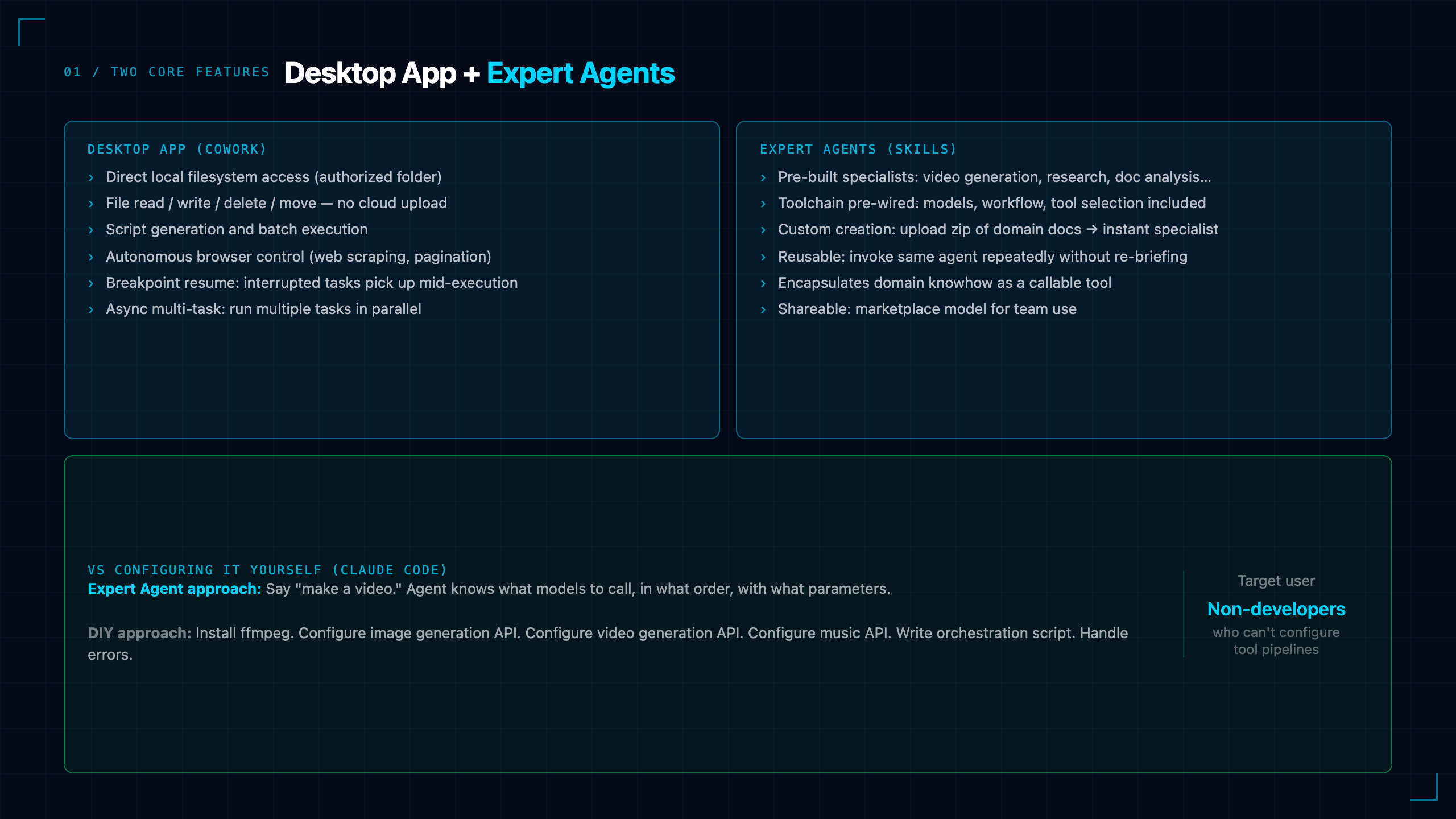
The Desktop App operates like Claude Code's computer use — direct filesystem access, script generation, autonomous execution — but without the requirement of setting up a development environment.
File organization test: Given a downloads folder with mixed file types (exe, mp4, pdf, zip, docx), the agent ran ls, created category subdirectories, and moved files one by one. When a docx was locked by another process and couldn't be moved, the agent skipped it and continued processing the remaining files, then reported the skipped file in the final summary. No crash, no hang — correct fault tolerance behavior for a batch file operation.
Resume parsing at scale: Given a folder of 52 resumes with inconsistent naming (some with job titles, some with salaries, some just a name), the task: rename all to name_Nyears.pdf format, separate 5+ year experience into a Senior_Level folder, and further split by student vs employed. The agent wrote a batch script and processed all 52 in under a minute. The output matched the specification: correct naming, correct category splits, content-parsed classification (not just filename parsing — it read inside the PDFs).
Web automation test: Given a URL and a task to find 5 AI-related financial news articles with links and summaries, the agent called a "Browser Expert" tool, opened the page, scrolled, filtered content, paginated when needed, and returned 5 items with URL, title, content summary, and timestamp. The task took minutes, required no user intervention during execution.
The key architecture note: the Desktop App operates on locally granted folder access, not cloud storage. Files never leave the machine. This matters for enterprise use cases where document contents are sensitive.
Expert Agents: Reusable Domain Expertise
Expert Agents are the MiniMax equivalent of Claude Code's skills system — pre-configured AI specialists with domain-specific instructions, model preferences, tool selections, and workflow logic baked in. The difference is the marketplace model: MiniMax ships a library of pre-built Expert Agents, and users can create custom ones by uploading domain documents.
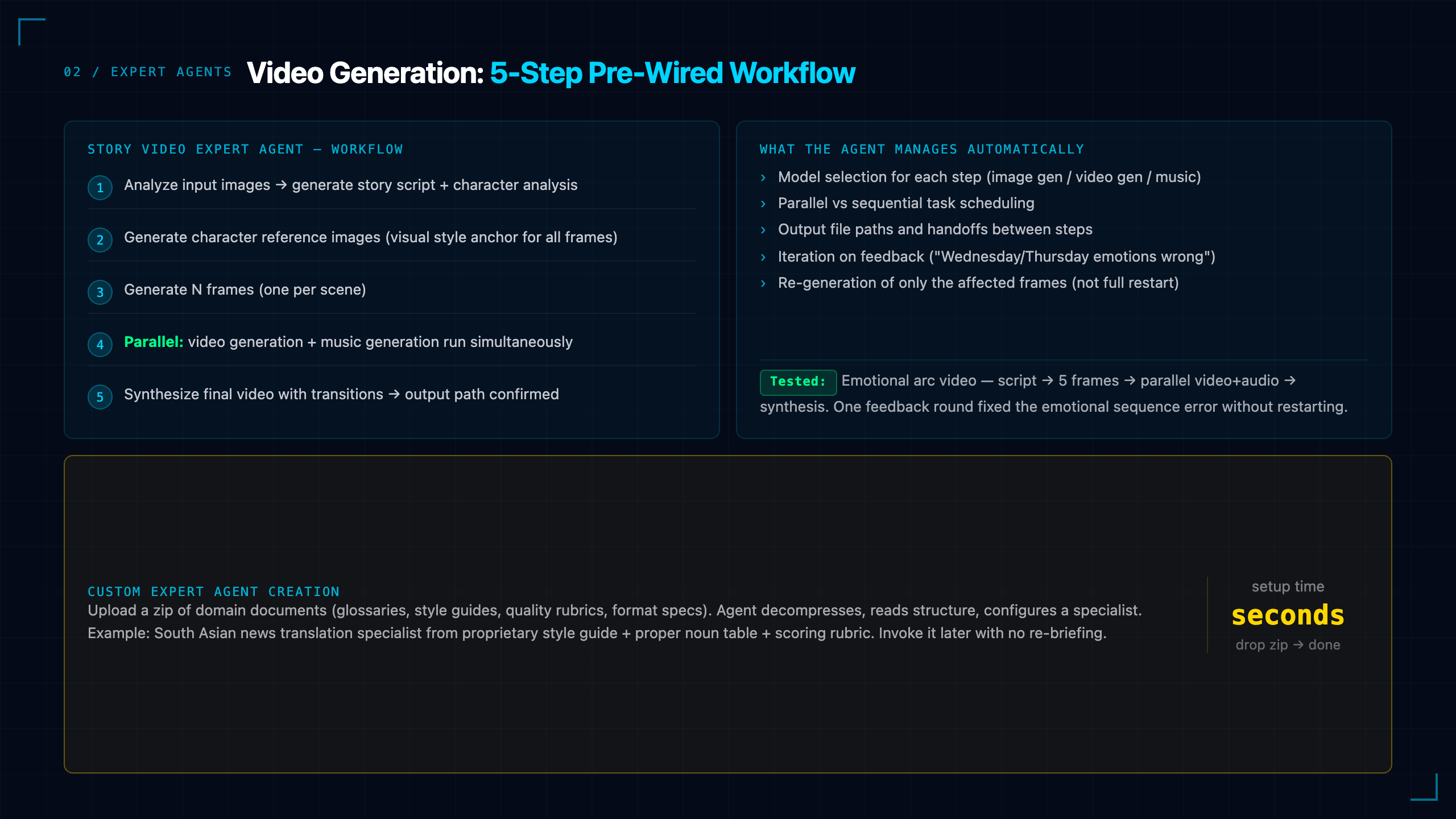
Pre-built Expert Agents in the library include: story video generation, document analysis, research synthesis, and others. Each comes with its toolchain already wired — the video generation expert knows to use image generation for frames, video generation for clips, and music generation for audio, running the last two in parallel once frames are ready.
The story video generation workflow demonstrates what a pre-configured Expert Agent actually does:
- Analyze input images → generate story script with character analysis
- Generate character reference images (visual consistency anchor for all frames)
- Generate 5 frames (one per weekday, for a "workweek emotional journey" video)
- Run video generation and music generation simultaneously (parallel, not sequential)
- Synthesize final video with transitions
The key comparison: asked to do the same task in Claude Code, the response is: "you'll need to install ffmpeg, configure API keys for image/video/music generation, handle the pipeline orchestration yourself." MiniMax's Expert Agent has all of that pre-wired. You don't know or care what models are running under each step.
Custom Expert Agent creation: Upload a zip of domain documents — terminology glossaries, style guides, quality scoring rubrics, format specifications. The agent decompresses, reads, and builds a specialist agent from the content. One example from testing: a South Asian news translation specialist configured from a proprietary style guide, proper noun lookup table, and quality rubric. Invoking it later requires no re-briefing — the domain context is preserved.
The expert creation interface effectively packages institutional knowledge into a reusable tool. The stated use case: three years of domain expertise, packaged into an Expert Agent that new team members can use immediately, and that you can batch-invoke without re-explaining your standards each time.
What This Competes With
The product is clearly positioned against Claude Code on one side (coding agent) and against general-purpose desktop automation tools on the other. The tradeoff is explicit:
What MiniMax Agent 2.0 does better than Claude Code for non-developers:
- No environment setup — video generation, audio, image pipelines just work
- Expert Agents with pre-wired multimodal toolchains for creative/content workflows
- Web automation with a managed browser (no Playwright/Puppeteer config)
- Local file access without needing to understand CLI commands
What Claude Code does better:
- Code generation quality and precision for software engineering tasks
- Full control over tooling choices and execution logic
- Integration with existing development workflows
The product makes most sense for knowledge workers with repetitive research, file organization, or content creation workflows who can't or won't configure API keys and tool environments. For developers already comfortable in Claude Code, the tradeoff is less obvious.
Additional Behaviors Worth Noting
Breakpoint resume: Tasks that stop mid-execution (network interruption, time limit) can be resumed without restarting. The agent picks up from where it left off.
Async multi-task execution: Multiple tasks can run in parallel in separate threads. The desktop app doesn't block on task completion, which is why the story video workflow was able to run video and music generation simultaneously.
Safety gating: The agent doesn't execute destructive file operations without explicit authorization for each folder. Consistent with the current pattern from Anthropic and others of requiring per-folder permission grants.
Availability and Pricing
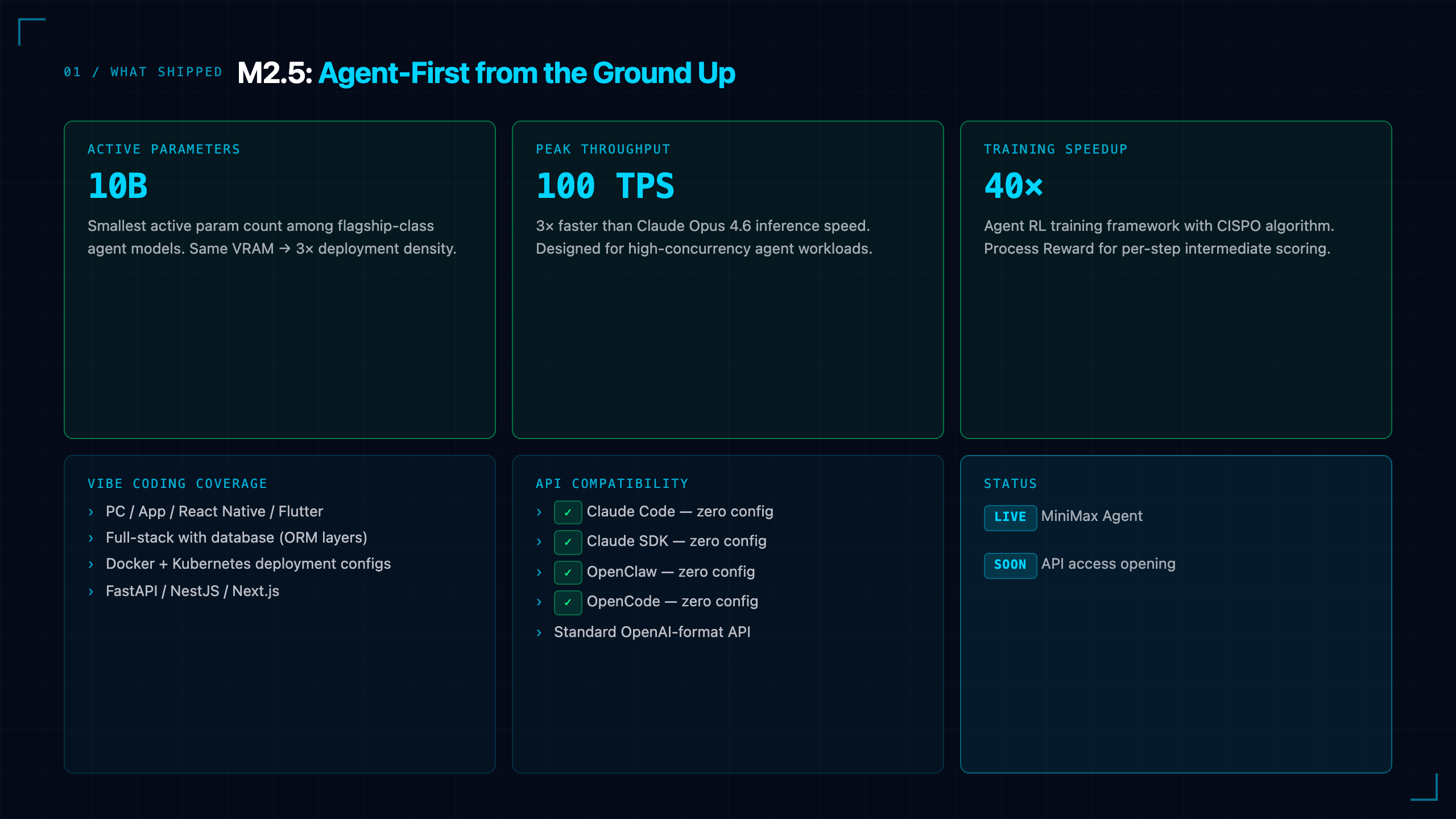
MiniMax Agent 2.0 with Desktop App and Expert Agents is in free beta. No pricing announced for the general availability release. The underlying model is M2.5 (10B active parameters, 3× Opus inference speed).
The Expert Agent marketplace approach — combining a library of pre-built agents with user-created custom ones — is the differentiator that makes this more than a desktop automation tool. Whether the ecosystem grows fast enough to match the quality of purpose-built tools in each domain remains to be seen.
Bottom Line
MiniMax Agent 2.0 is a bet that most people who need agentic automation aren't developers and don't want to configure their own toolchains. The Desktop App answers the "doesn't leave the machine" requirement for local file work. Expert Agents answer the "I don't want to re-explain my standards every time" requirement for domain-specific work. Both are now in free beta.
Resources
- MiniMax Agent — product page (free beta)
- MiniMax Official Site — company homepage
- MiniMax API — API access for M2.5
MiniMax Agent 2.0 is free during beta at agent.minimax.io. Pricing for general availability has not been announced.