Alibaba's Qwen team released Qwen-MT, and the framing is deliberate: this isn't "Qwen3 but for translation." It's a purpose-built translation model trained on trillions of multilingual and translation-specific tokens, then refined with reinforcement learning optimized for translation accuracy and linguistic fluency. 92 languages. 95%+ of global population coverage. Available through the Qwen API as qwen-mt-turbo.
The timing is interesting. General-purpose LLMs (GPT-4, Claude, Qwen3 itself) already do decent translation. But "decent" isn't good enough for professional translation workflows where accuracy, consistency, and domain adaptation matter. Qwen-MT targets the gap between "throw it at GPT-4" and "hire a professional translator" — the space currently owned by DeepL and Google Translate.
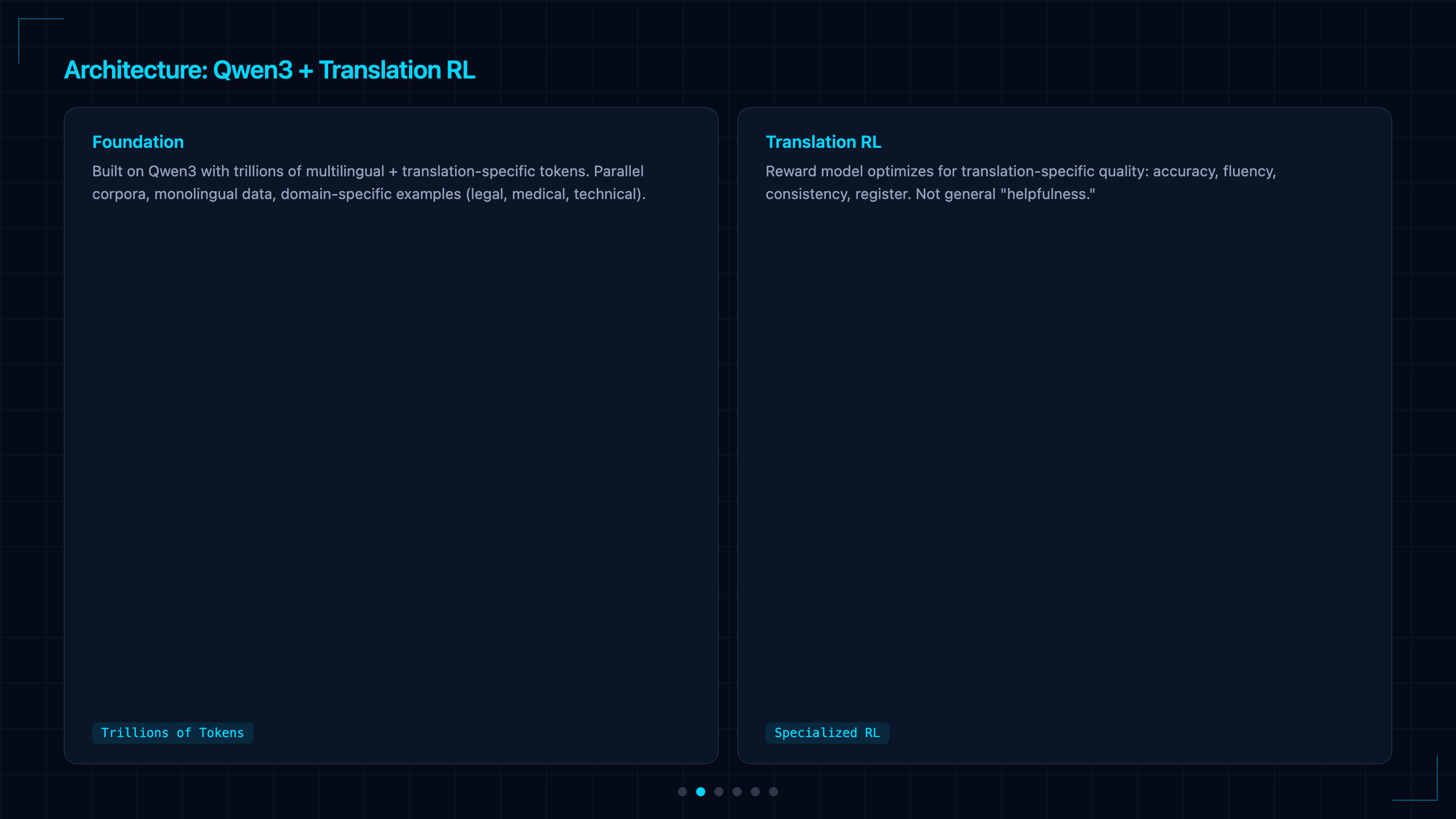
Architecture: Qwen3 + Translation RL
Qwen-MT is built on the Qwen3 foundation model but diverges significantly in post-training:
Pre-training data: Trillions of tokens specifically curated for multilingual understanding and translation. This includes parallel corpora (aligned text in multiple languages), monolingual corpora across all 92 languages, and domain-specific translation examples (legal, medical, technical, literary).
Reinforcement learning for translation: The key differentiator from just using Qwen3. Standard LLM fine-tuning optimizes for "does this response look good?" RL for translation optimizes for "is this translation accurate, fluent, and stylistically appropriate in the target language?" The reward model understands translation-specific quality dimensions that general-purpose RLHF misses.
Result: Qwen-MT produces translations that are not just semantically correct but linguistically natural — proper idioms, appropriate register, and culturally adapted expressions rather than word-for-word renderings.
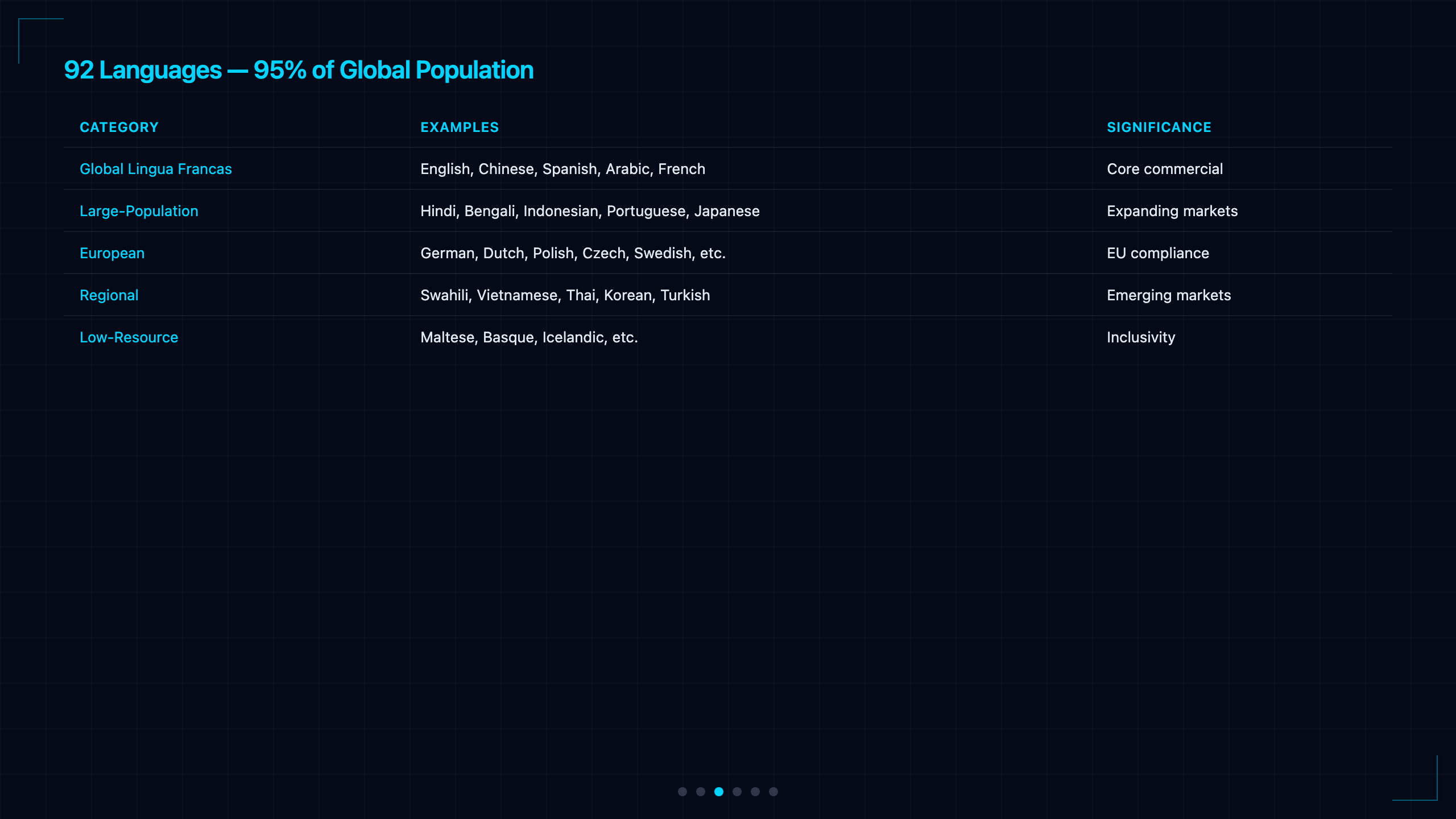
92 Languages: Coverage That Matters
Qwen-MT supports 92 major official languages and prominent dialects:
| Category | Examples | Significance |
|---|---|---|
| Global lingua francas | English, Chinese, Spanish, Arabic, French | Core commercial languages |
| Large-population languages | Hindi, Bengali, Indonesian, Portuguese, Japanese | Expanding market coverage |
| European languages | German, Dutch, Polish, Czech, Swedish, etc. | EU compliance, localization |
| Regional languages | Swahili, Vietnamese, Thai, Korean, Turkish | Emerging market access |
| Low-resource languages | Maltese, Basque, Icelandic, etc. | Inclusivity, government use |
The "95% of global population" claim matters for enterprise localization. A single API that handles English ↔ Japanese, Chinese ↔ Arabic, and Hindi ↔ French without switching providers or models simplifies international product development significantly.
RL for Translation: Why It Matters
General-purpose LLMs have a translation problem: they're optimized to produce helpful responses, not accurate translations. This manifests as:
- Over-explanation: Adding context or notes that weren't in the source
- Register drift: Translating formal text into casual English (or vice versa)
- Hallucination: Inventing content that "sounds right" but isn't in the source
- Inconsistency: Translating the same term differently across a document
Qwen-MT's RL training specifically penalizes these failure modes. The reward model evaluates:
- Accuracy — does the translation preserve meaning?
- Fluency — does it read naturally in the target language?
- Consistency — are terms translated uniformly?
- Register — is the formality level appropriate?
This is a fundamentally different optimization target from general-purpose chat models, and it shows in professional translation quality.
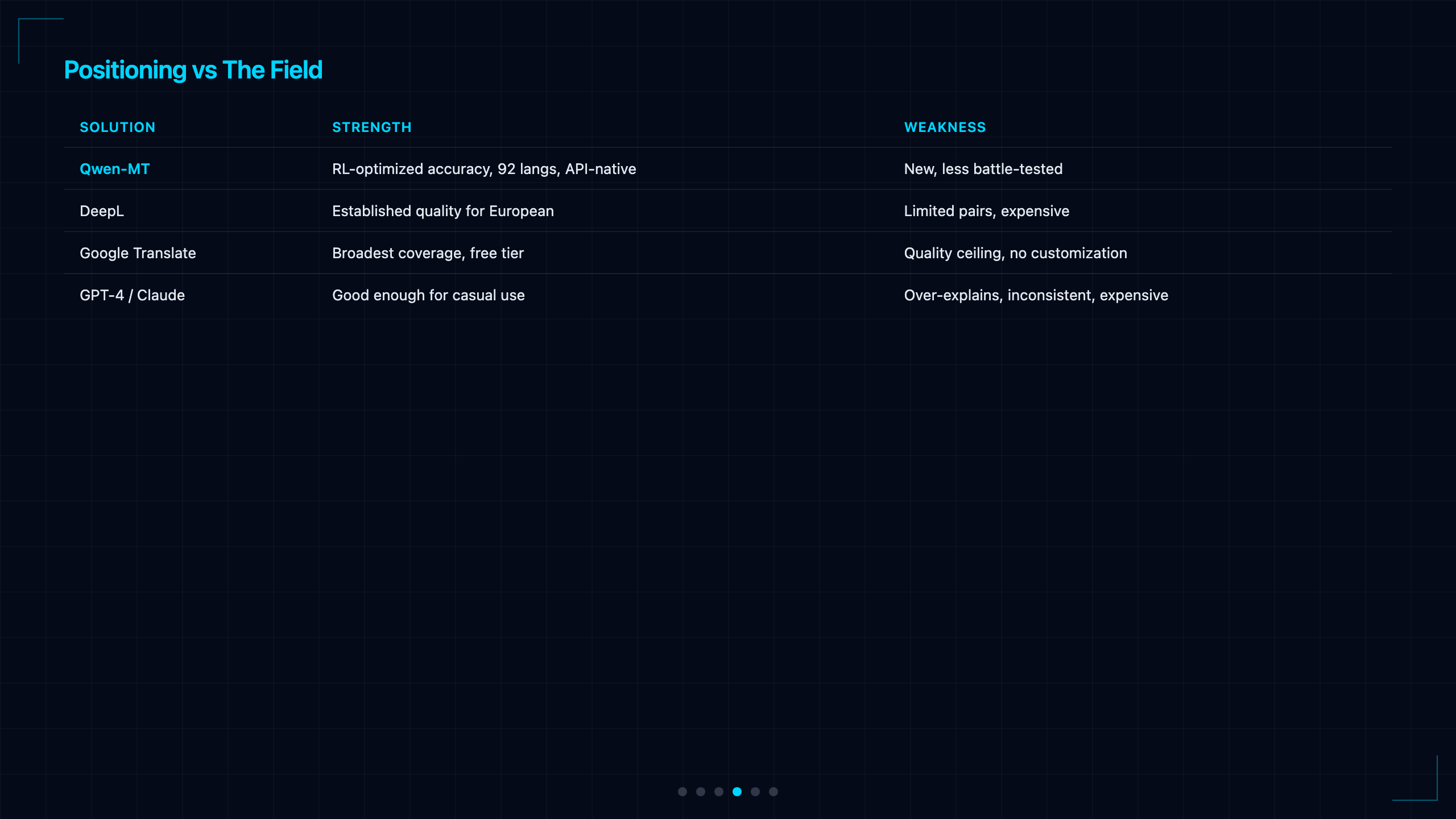
Positioning: Qwen-MT vs. The Field
| Solution | Strength | Weakness |
|---|---|---|
| Qwen-MT | RL-optimized accuracy, 92 languages, API-native | New, less battle-tested |
| DeepL | Established quality for European languages | Limited language pairs, expensive |
| Google Translate | Broadest coverage, free tier | Quality ceiling, no customization |
| GPT-4/Claude for translation | Good enough for casual use | Over-explains, inconsistent, expensive |
| Qwen3 (general) | Flexible, can be prompted | Not optimized for translation specifically |
Qwen-MT's pitch: DeepL-quality translation with broader language coverage, at API pricing that makes high-volume use cases viable. For developers who currently use GPT-4 for translation (common but expensive and sub-optimal), Qwen-MT offers better quality at lower cost through specialization.
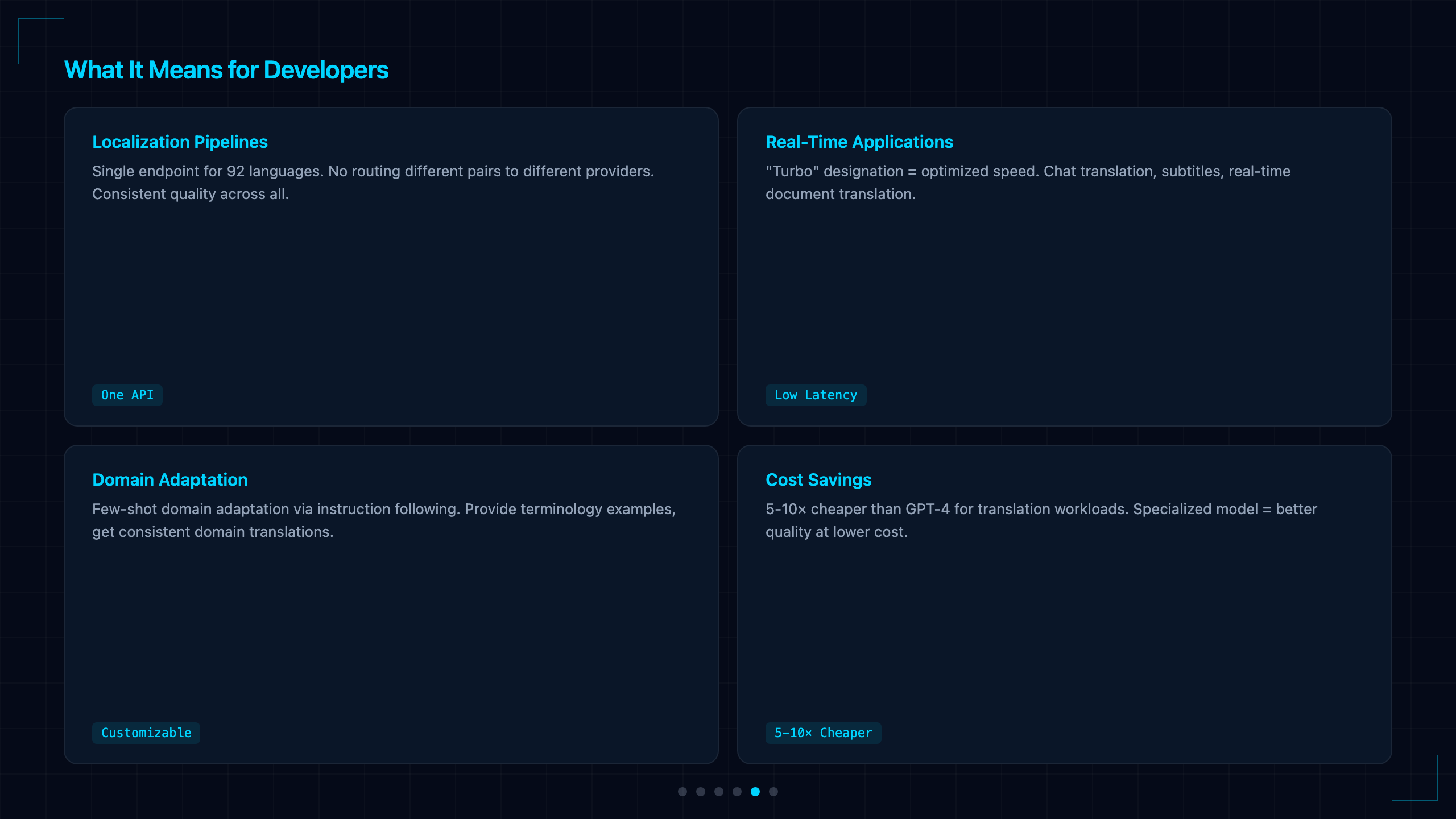
What It Means for Developers
For localization pipelines: A single API endpoint that handles 92 languages with RL-optimized quality. No more routing different language pairs to different providers or falling back to Google Translate for low-resource languages.
For real-time applications: The qwen-mt-turbo designation suggests optimized inference speed. For chat translation, subtitle generation, or real-time document translation, latency matters as much as quality.
For domain adaptation: Built on Qwen3's instruction-following capabilities, Qwen-MT likely supports few-shot domain adaptation — provide examples of your preferred terminology and style, get consistent translations in your domain.
Pricing: Through Qwen API, likely at standard Qwen pricing tiers. For high-volume translation workloads, this could represent 5-10x cost savings over using GPT-4 or Claude for the same task.
Bottom Line
Qwen-MT represents Alibaba's bet that translation deserves a specialized model, not just a prompt to a general-purpose LLM. The combination of Qwen3 foundation + trillions of multilingual tokens + translation-specific RL produces a model that's optimized for the specific failure modes of machine translation (over-explanation, register drift, inconsistency) rather than general helpfulness. 92 languages through a single API makes it viable for international product teams. Available now as qwen-mt-turbo through the Qwen API.
Resources
- Qwen-MT Blog — official announcement
- Qwen API — API access (model: qwen-mt-turbo)
- Demo — try Qwen-MT directly
Qwen-MT is available via the Qwen API as qwen-mt-turbo. Supports 92 languages covering 95%+ of the global population.