Alibaba DAMO Academy released Qwen2-Audio on September 18, 2024 — the second generation of their audio-language model family. Where Qwen-Audio handled basic speech recognition and audio understanding, Qwen2-Audio took a larger step: a unified model capable of analyzing any sound (speech, music, environmental audio), conducting multi-turn voice conversations, and following complex audio instructions, all within a single 8.4B parameter architecture.
The central design decision was dual-mode operation: one model switches between voice chat mode (low-latency conversational) and audio analysis mode (detailed understanding of non-speech audio). This eliminated the need to maintain separate speech and audio understanding systems.
What's New
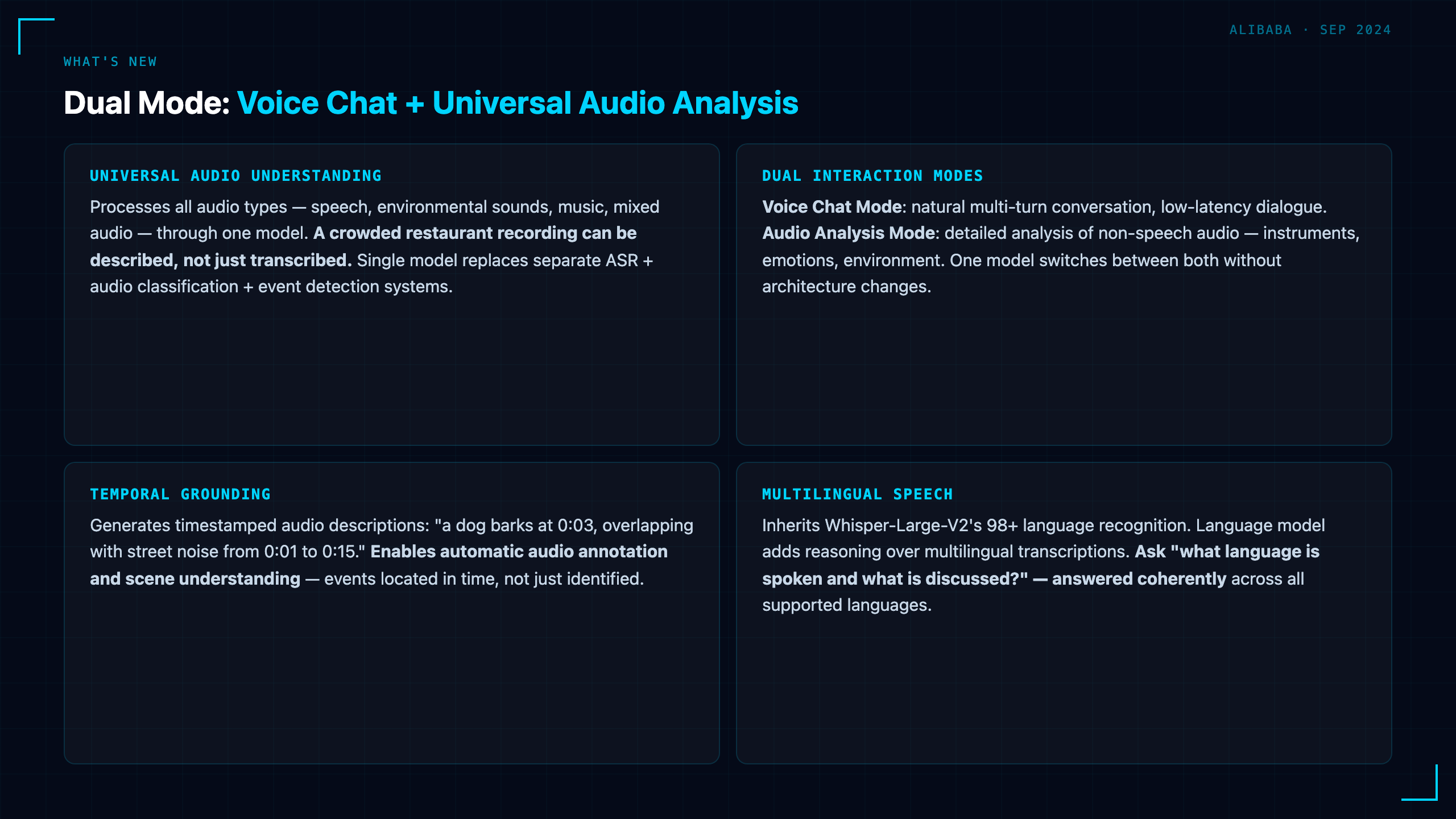
Universal audio understanding: Qwen2-Audio processes all audio types — speech in multiple languages, environmental sounds, music, and mixed audio — through a single model. The audio encoder (Whisper-Large-V2) handles the full spectrum, and the language model provides semantic reasoning over the audio content. A recording of a crowded restaurant can be described, not just transcribed.
Dual interaction modes: The model operates in two modes without architecture changes:
- Voice Chat Mode: Direct voice interaction with natural back-and-forth conversation, low latency optimized for dialogue
- Audio Analysis Mode: Detailed analysis of audio content — what instruments are playing, what emotions are conveyed, what environment is being recorded
Grounded audio understanding: Qwen2-Audio generates time-stamped audio descriptions — it can say "a dog barks at 0:03, overlapping with street noise from 0:01 to 0:15." This temporal grounding enables applications like automatic audio annotation and scene understanding.
Multilingual speech: Built on Whisper-Large-V2's multilingual foundation, Qwen2-Audio inherits recognition capability across 98+ languages. The language model adds reasoning over multilingual transcriptions — asking "what language is being spoken and what is the speaker discussing?" is answered coherently.
Architecture
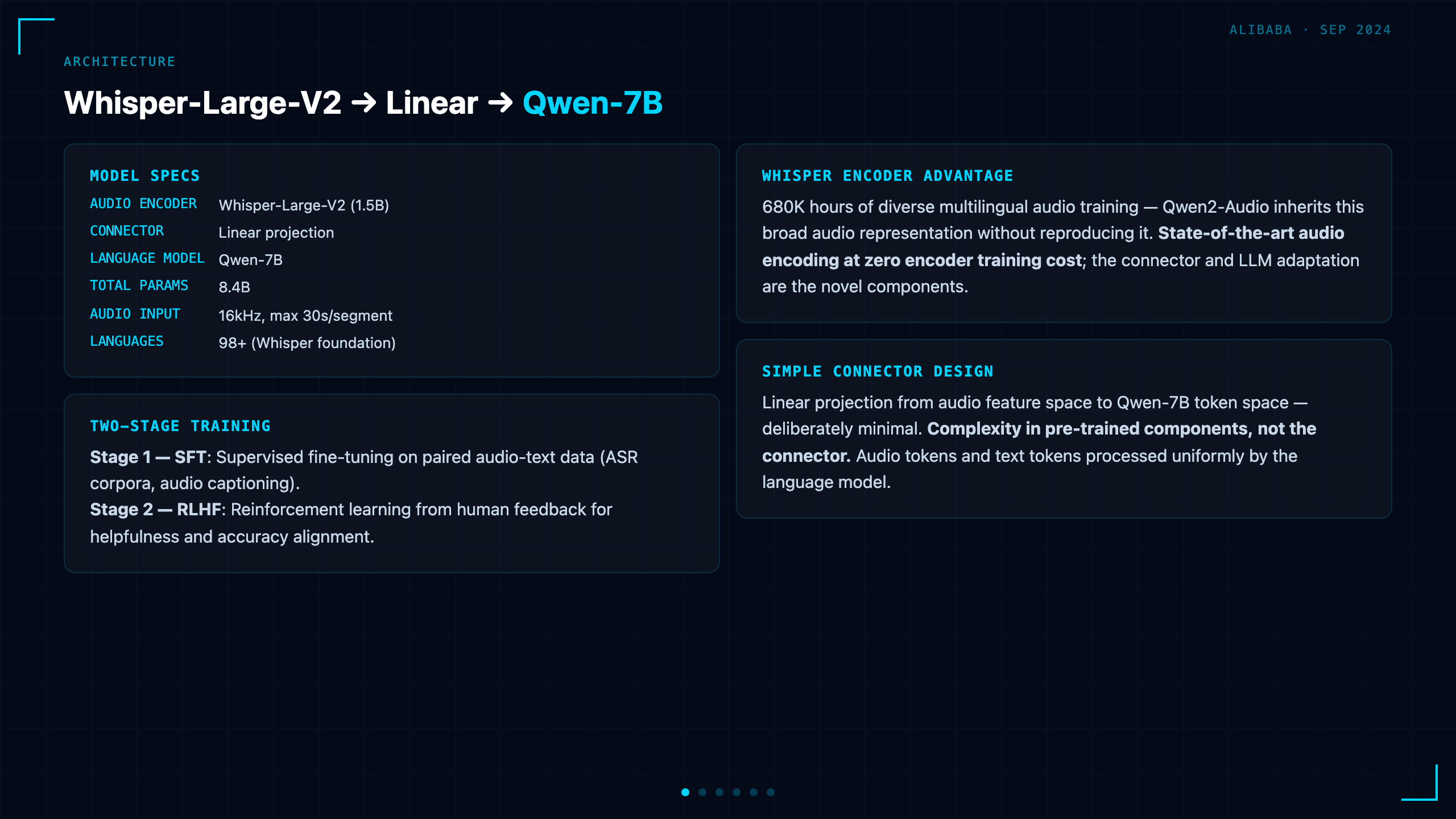
Qwen2-Audio uses a three-component pipeline:
| Component | Details |
|---|---|
| Audio encoder | Whisper-Large-V2 (1.5B params) |
| Connector | Linear projection layer |
| Language model | Qwen-7B |
| Total parameters | 8.4B |
| Audio sampling | 16kHz |
| Max audio length | 30 seconds per segment |
Whisper-Large-V2 encoder: Rather than training a custom audio encoder, Qwen2-Audio uses OpenAI's Whisper-Large-V2 — one of the strongest publicly available audio encoders. Whisper was trained on 680K hours of diverse audio data across 98 languages. Qwen2-Audio inherits this broad audio representation without the cost of reproducing it.
Linear connector: Audio features from Whisper are projected into the Qwen-7B token space via a learned linear layer. This is deliberately simple — the complexity lives in the pre-trained encoder and language model, not the connector.
Qwen-7B backbone: The 7B language model provides the reasoning layer. It processes both text tokens and projected audio tokens, enabling mixed-modality conversations: "Given this recording, write a summary" or "Translate the speech in this audio to English."
Training approach: Qwen2-Audio uses a two-stage training protocol:
- Supervised Fine-Tuning (SFT): Train on paired audio-text data (ASR corpora, audio captioning datasets)
- RLHF (Reinforcement Learning from Human Feedback): Align responses to human preferences for helpfulness and accuracy
Benchmarks
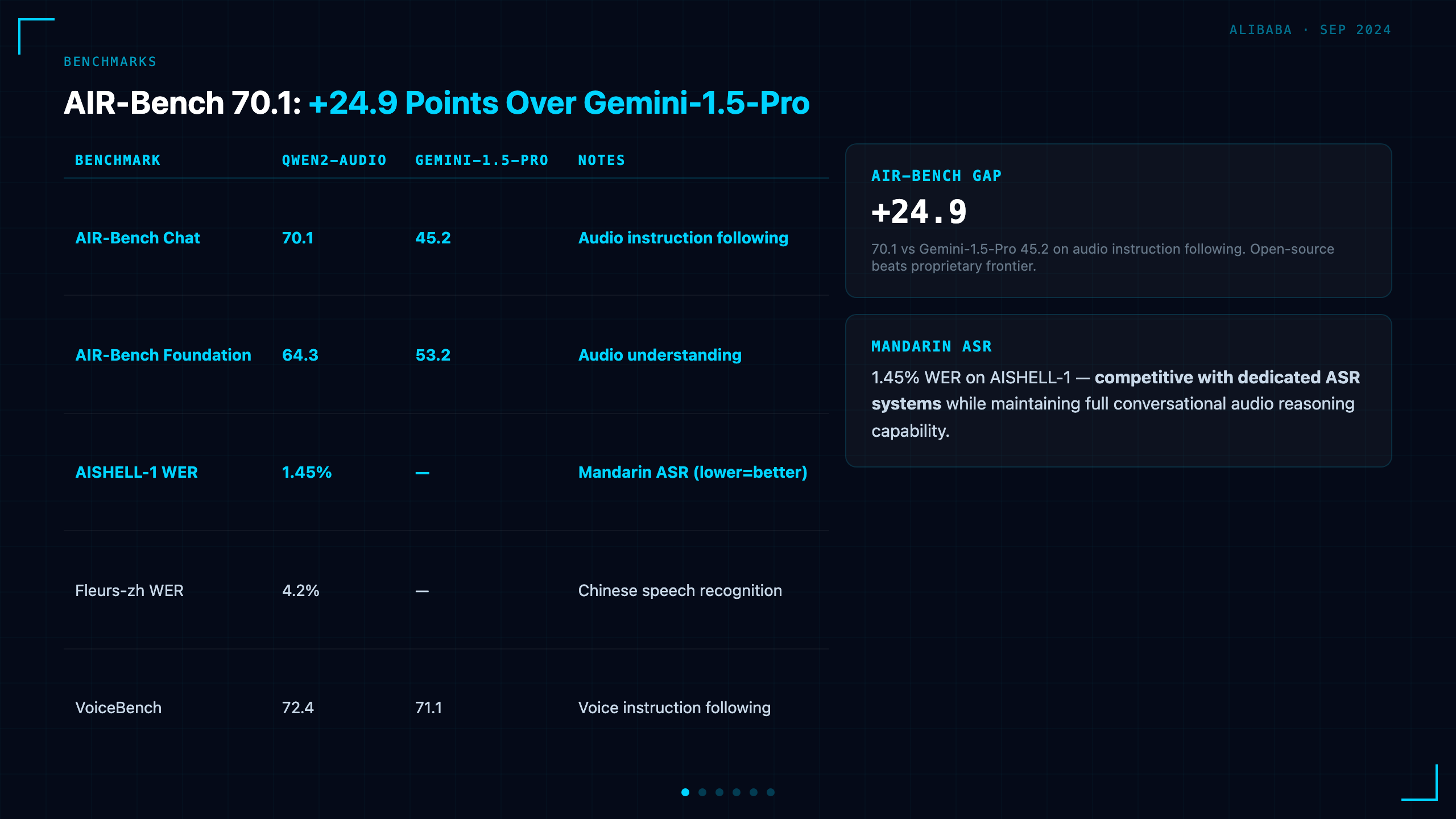
Qwen2-Audio at September 2024 release:
| Benchmark | Qwen2-Audio | Gemini-1.5-Pro | Qwen-Audio | Notes |
|---|---|---|---|---|
| AIR-Bench (Chat) | 70.1 | 45.2 | 42.7 | Audio instruction following |
| AIR-Bench (Foundation) | 64.3 | 53.2 | 52.1 | Audio understanding foundations |
| AISHELL-1 (WER) | 1.45% | — | 1.73% | Mandarin ASR |
| Fleurs-zh (WER) | 4.2% | — | 5.8% | Chinese speech recognition |
| VoiceBench | 72.4 | 71.1 | — | Voice instruction following |
AIR-Bench scores are the headline: 70.1 on the chat dimension vs Gemini-1.5-Pro's 45.2 — a substantial margin on audio instruction following. AIR-Bench tests a broad set of audio understanding tasks including speech QA, audio reasoning, sound event detection, and music understanding.
The ASR numbers show strong Mandarin speech recognition: 1.45% WER on AISHELL-1, competitive with dedicated ASR systems while maintaining full conversational capability.
What It Means for Developers
Single model for all audio tasks: Before Qwen2-Audio, building an audio application required separate systems — a Whisper instance for ASR, a classification model for sound events, a speaker diarization model for multi-speaker audio. Qwen2-Audio handles all of these in one API call. For startups building voice applications, this dramatically reduces infrastructure complexity.
Voice interfaces without custom pipelines: Voice Chat Mode provides a working multi-turn voice conversation capability out of the box. The model handles turn-taking, context maintenance, and response generation — the primitives for a voice assistant without assembling a pipeline from components.
Chinese-language audio strength: AISHELL-1 1.45% WER and strong Mandarin support makes Qwen2-Audio the practical choice for applications serving Chinese-speaking markets. Combined with the Qwen-7B backbone's bilingual capability, Chinese and English audio is handled with equal quality.
Audio annotation at scale: The temporal grounding capability enables automated audio labeling — timestamps for events, descriptions of audio segments, speaker identification labels. For media companies building audio archives or content moderation systems, this is directly applicable.
Apache 2.0 license: Commercial deployment, fine-tuning, and redistribution permitted without restrictions. The model weights and training code are on HuggingFace.
Availability
- HuggingFace: Qwen/Qwen2-Audio-7B-Instruct
- License: Apache 2.0
- GitHub: QwenLM/Qwen2-Audio
- Paper: arXiv 2407.10759
Bottom Line
Qwen2-Audio brought universal audio understanding to the open-source ecosystem — a single 8.4B model that handles speech, environmental audio, music, and voice conversation. AIR-Bench 70.1 (vs Gemini-1.5-Pro 45.2) is a significant result for audio instruction following, and the Apache 2.0 license makes it deployable in production. For developers building voice applications or audio analysis tools, Qwen2-Audio removed the need to assemble multi-component pipelines.
Resources
- GitHub — QwenLM/Qwen2-Audio
- HuggingFace — Qwen2-Audio-7B-Instruct
- HuggingFace — Qwen2-Audio-7B (base)
- Technical Paper (arXiv 2407.10759)
- Qwen Blog — model releases and updates
Qwen2-Audio is available on HuggingFace under Apache 2.0. Commercial use permitted.