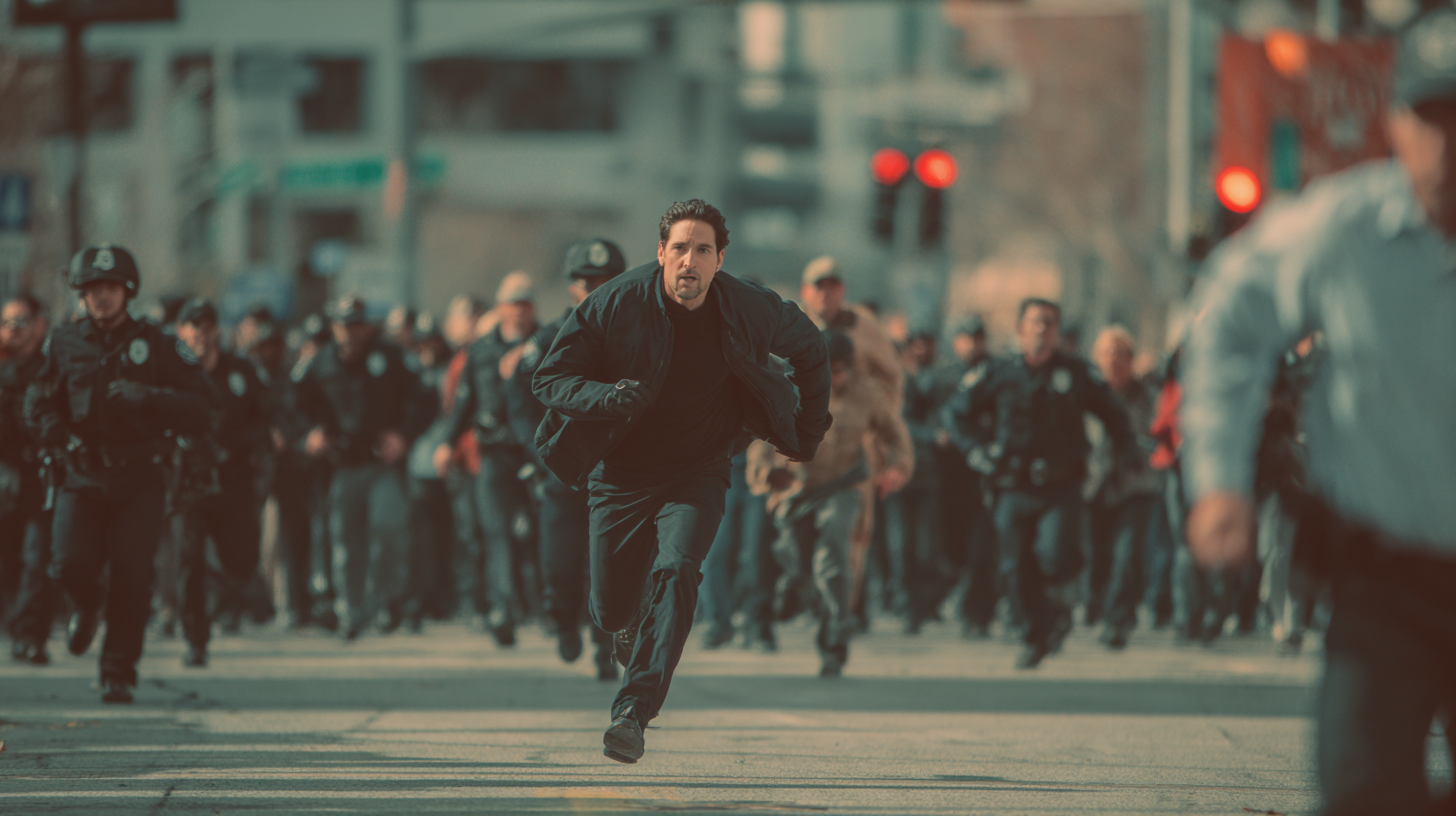
When someone cloned the most expensive shot in the 2025 Formula 1 film using Seedance 2.0 — for nine cents — the clip went viral before ByteDance's policy team could blink. That moment crystallized what Seedance 2.0 actually is: not just a better text-to-video model, but a capabilities step-change that makes professional-quality video generation economically viable for the first time.
Released on February 12, 2026 by ByteDance's SEED Lab, Seedance 2.0 builds on the original Seedance (June 2025) with a redesigned input architecture, native audio synthesis, and API access through both ByteDance's own infrastructure and third-party providers. For builders, the combination of quad-modal input and sub-$1 per clip pricing opens a category that simply didn't exist six months ago.
The Quad-Modal Input System
The most significant architectural change in Seedance 2.0 is its input layer. Standard text-to-video models accept one or two modalities — typically text plus an optional image reference. Seedance 2.0 accepts up to 12 reference files simultaneously across four types: text, reference image, video, and audio.
This unlocks what ByteDance calls "director-level control." In practice:
- Feed a face photo → the output locks in that identity consistently across frames
- Feed a dance video → the motion transfers to your target subject (no mocap equipment required)
- Feed a music track → the video generation syncs to beat and rhythm
- Combine all three → you get a coherent output that honors all constraints simultaneously
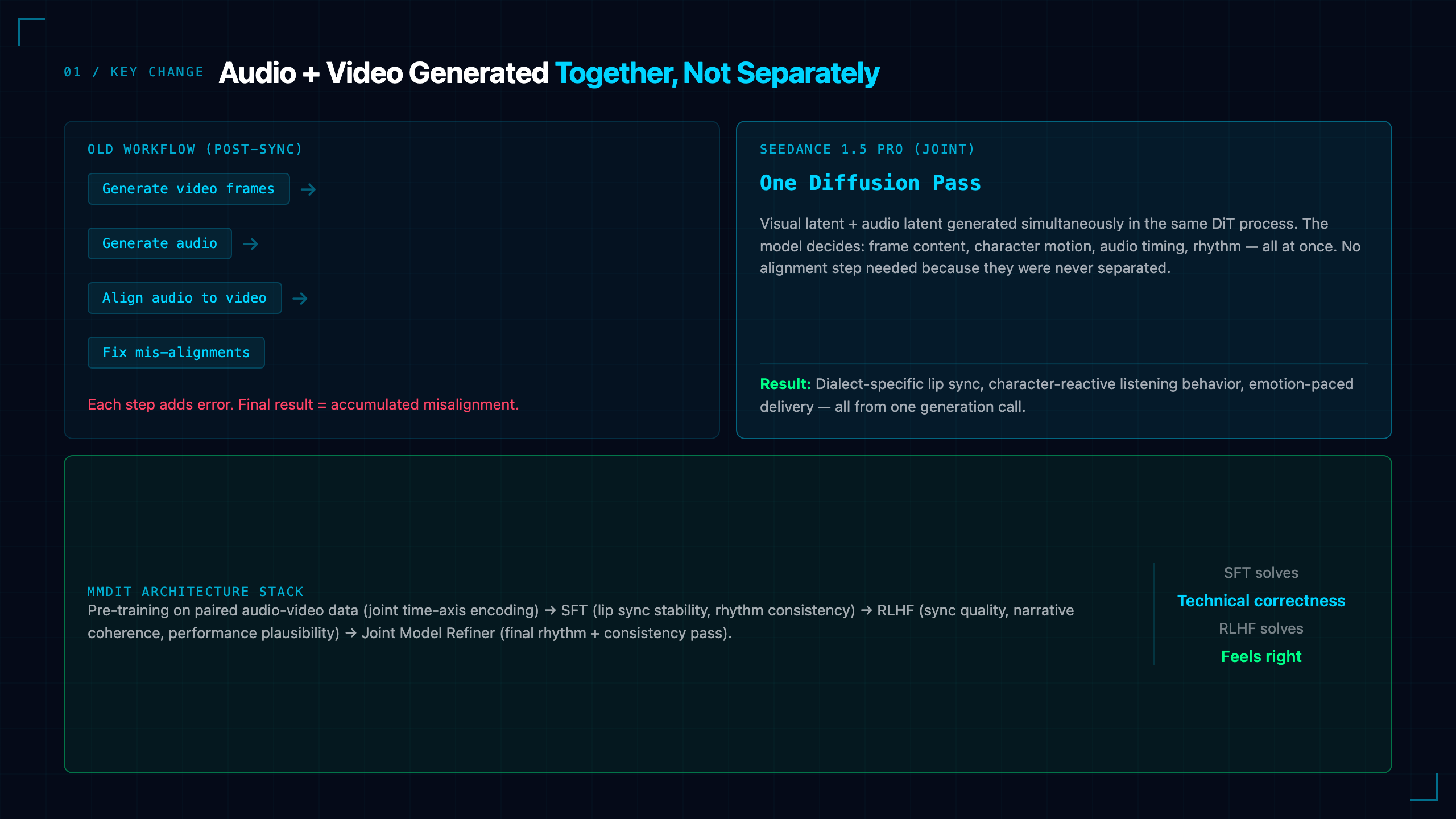
The system handles multi-subject interactions, camera movements, and emotional tone within a single generation pass. For dialogue scenes, putting speech in double quotes in the prompt triggers matching lip sync and voice synthesis.
Native audio is included at no extra cost on all pricing tiers — a deliberate competitive decision against Runway and Kling, both of which treat audio as a separate step.
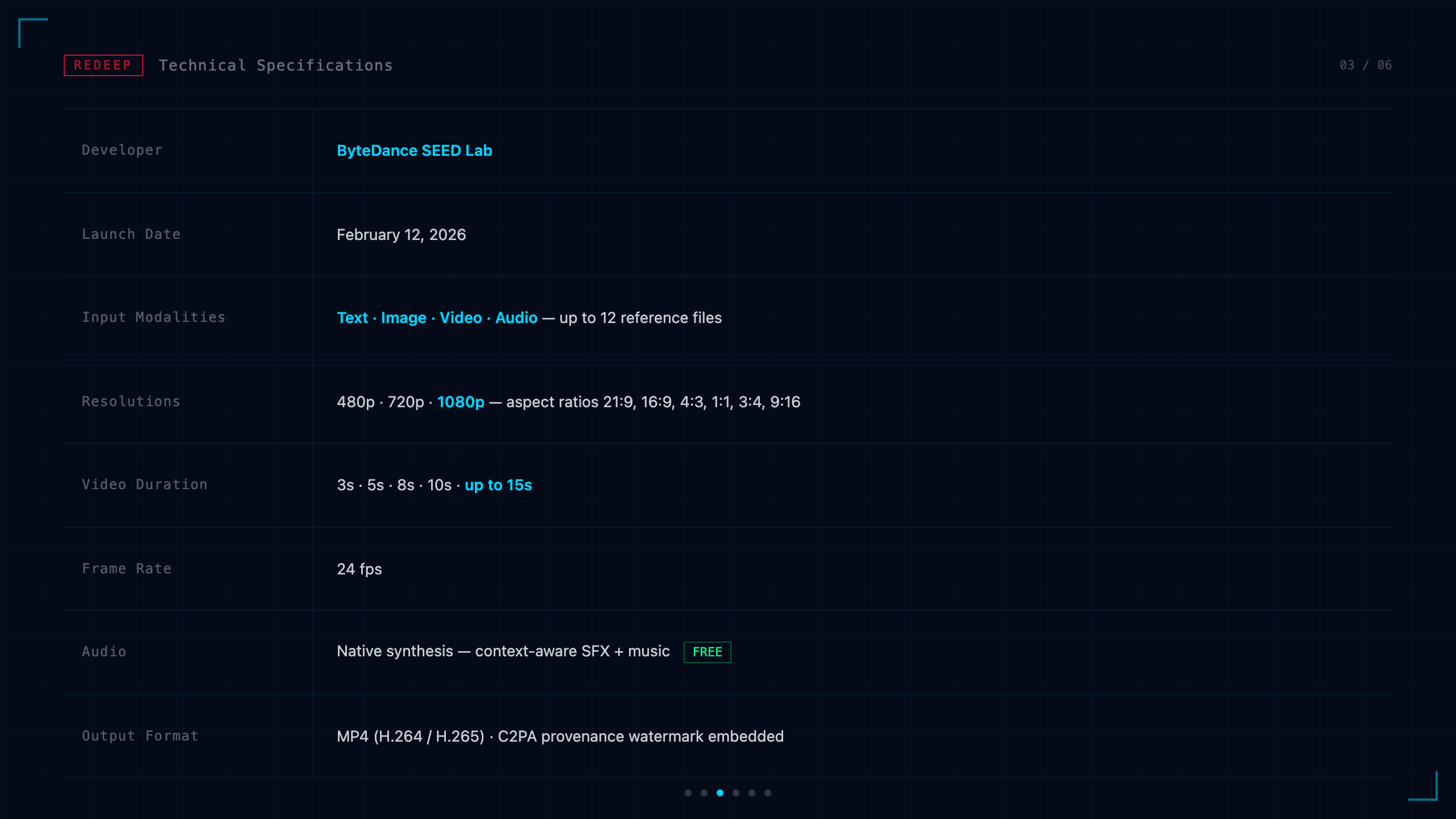
Technical Specifications
| Specification | Detail |
|---|---|
| Developer | ByteDance SEED Lab |
| Launch date | February 12, 2026 |
| Input modalities | Text, reference image, video, audio (up to 12 files) |
| Output formats | MP4 (H.264 / H.265) |
| Resolutions | 480p, 720p, 1080p; aspect ratios 21:9, 16:9, 4:3, 1:1, 3:4, 9:16 |
| Video duration | 3s, 5s, 8s, 10s, up to 15s |
| Frame rate | 24 fps |
| Audio | Native synthesis, context-aware sound effects + music |
| Safety | C2PA watermark embedded in every output |
The model supports multi-shot generation natively — sequences that flow between camera angles without requiring external editing tools. This matters for short drama and ad production workflows where cut continuity is expensive to achieve manually.
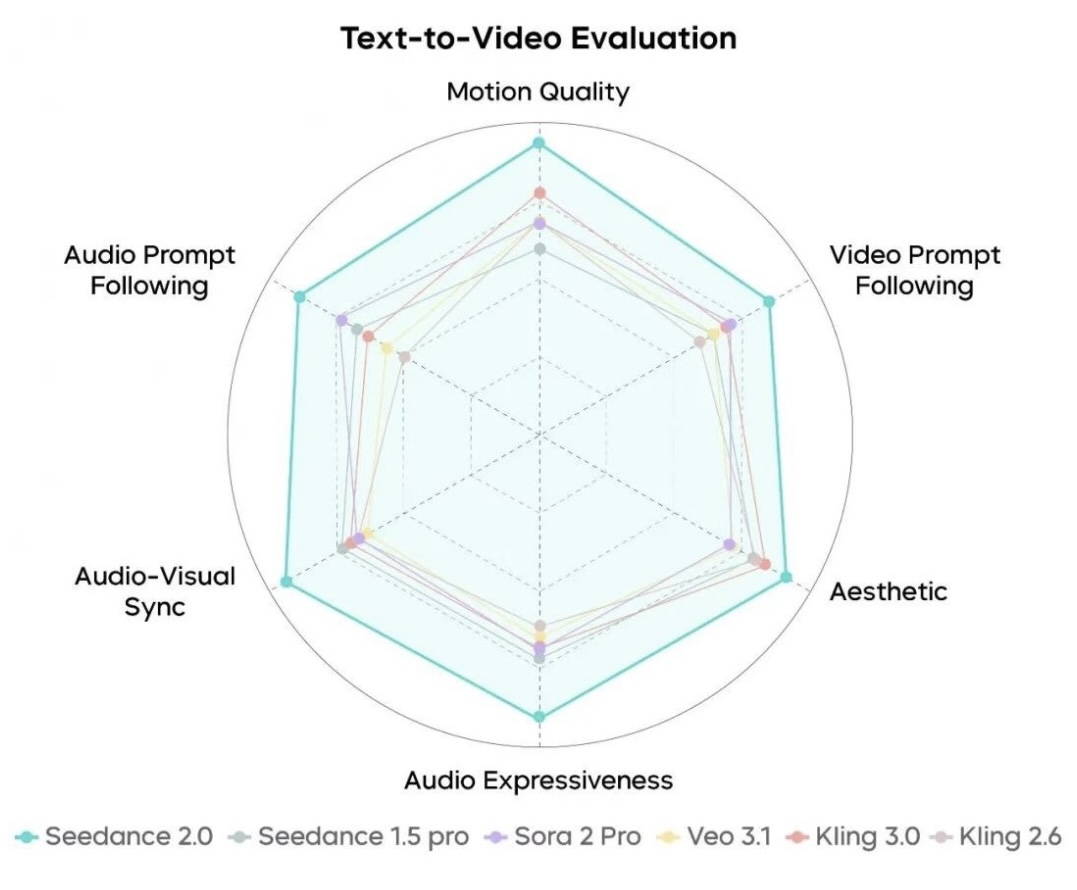
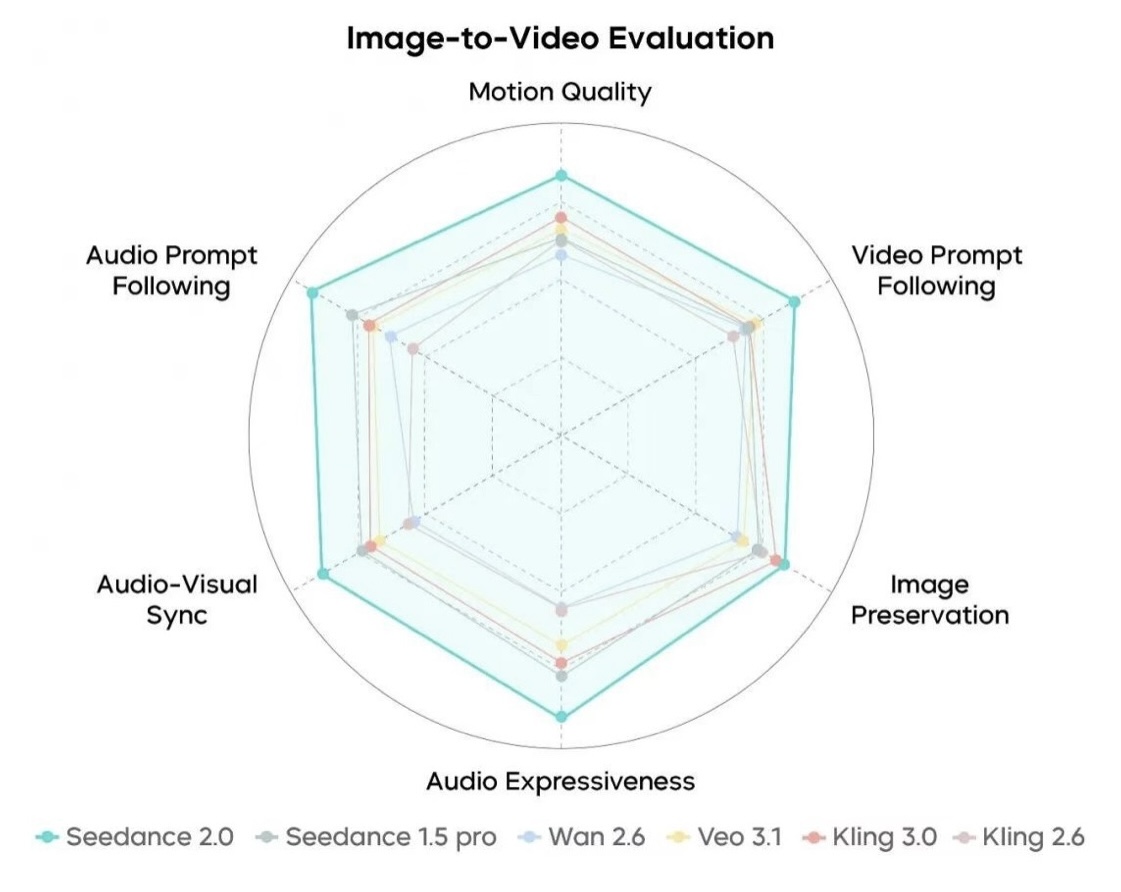
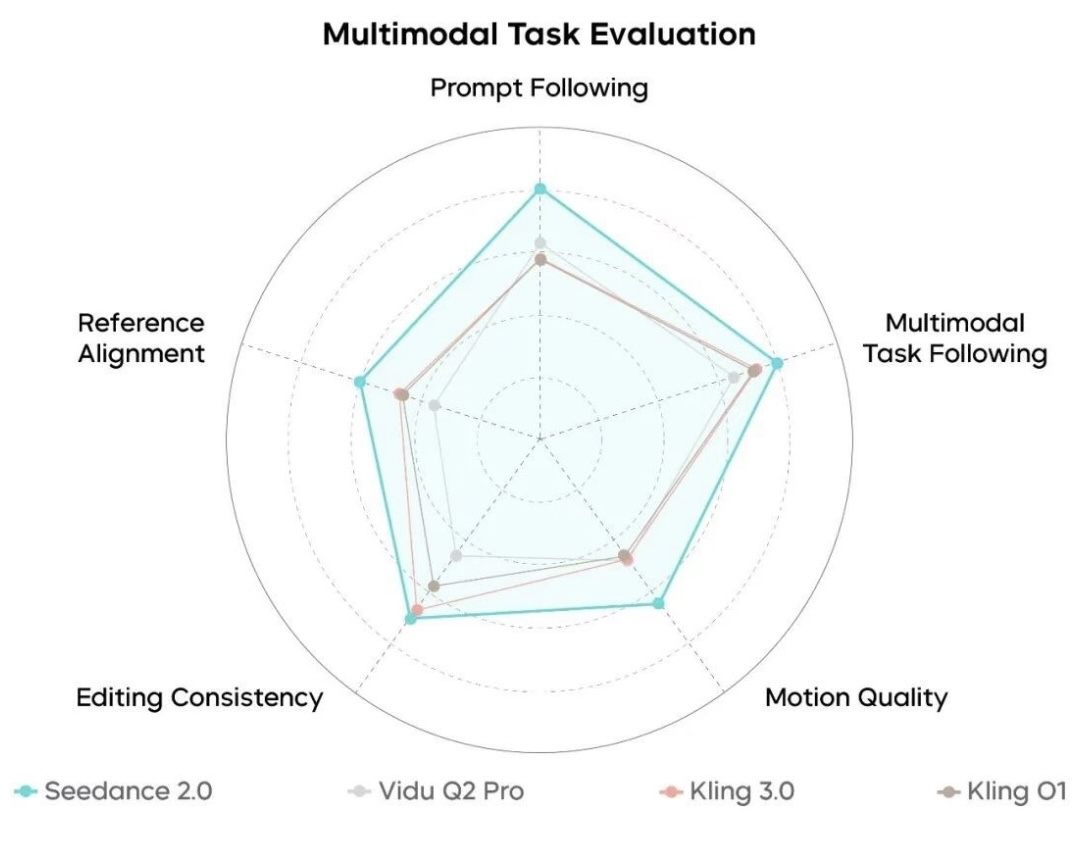
ByteDance published benchmark results from SeedVideoBench-2.0, comparing Seedance 2.0 against Sora 2 Pro, Veo 3.1, Kling 3.0, and Wan 2.6 across motion quality, audio-visual sync, and aesthetic dimensions:
Pricing and API Access
Seedance 2.0 is available through two official channels and several third-party API providers:
Official channels:
- BytePlus — international enterprise access
- Volcengine — China market
- Jimeng (即梦) — consumer product, ~$9.60/month
Third-party API (recommended for developers):
| Provider | Endpoint type | Price |
|---|---|---|
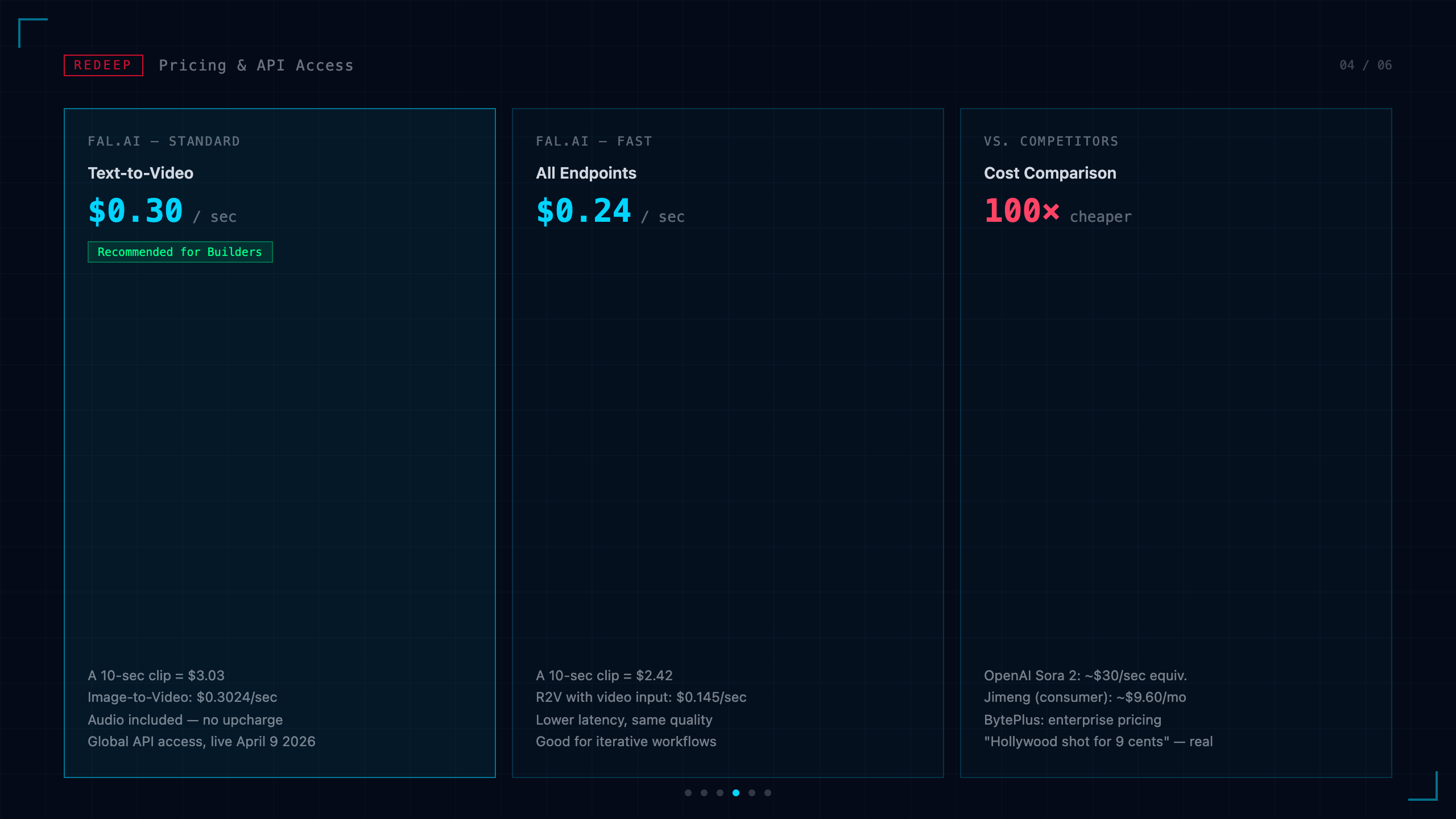
| fal.ai | Standard T2V | $0.3034/sec |
| fal.ai | Fast T2V | $0.2419/sec |
| fal.ai | Standard I2V or R2V | $0.3024/sec |
| fal.ai | R2V with video input | ~$0.1814/sec |
A 10-second clip costs $3.03 on the standard tier, $2.42 on fast. Audio generation is included in both. For comparison, OpenAI's Sora 2 runs approximately 100x more expensive at equivalent resolution — the $0.09 Hollywood-shot claim is real math, not hyperbole.
fal.ai went live with the API on April 9, 2026. PiAPI offers an alternative endpoint if you need different rate limits.
What It Means for Developers
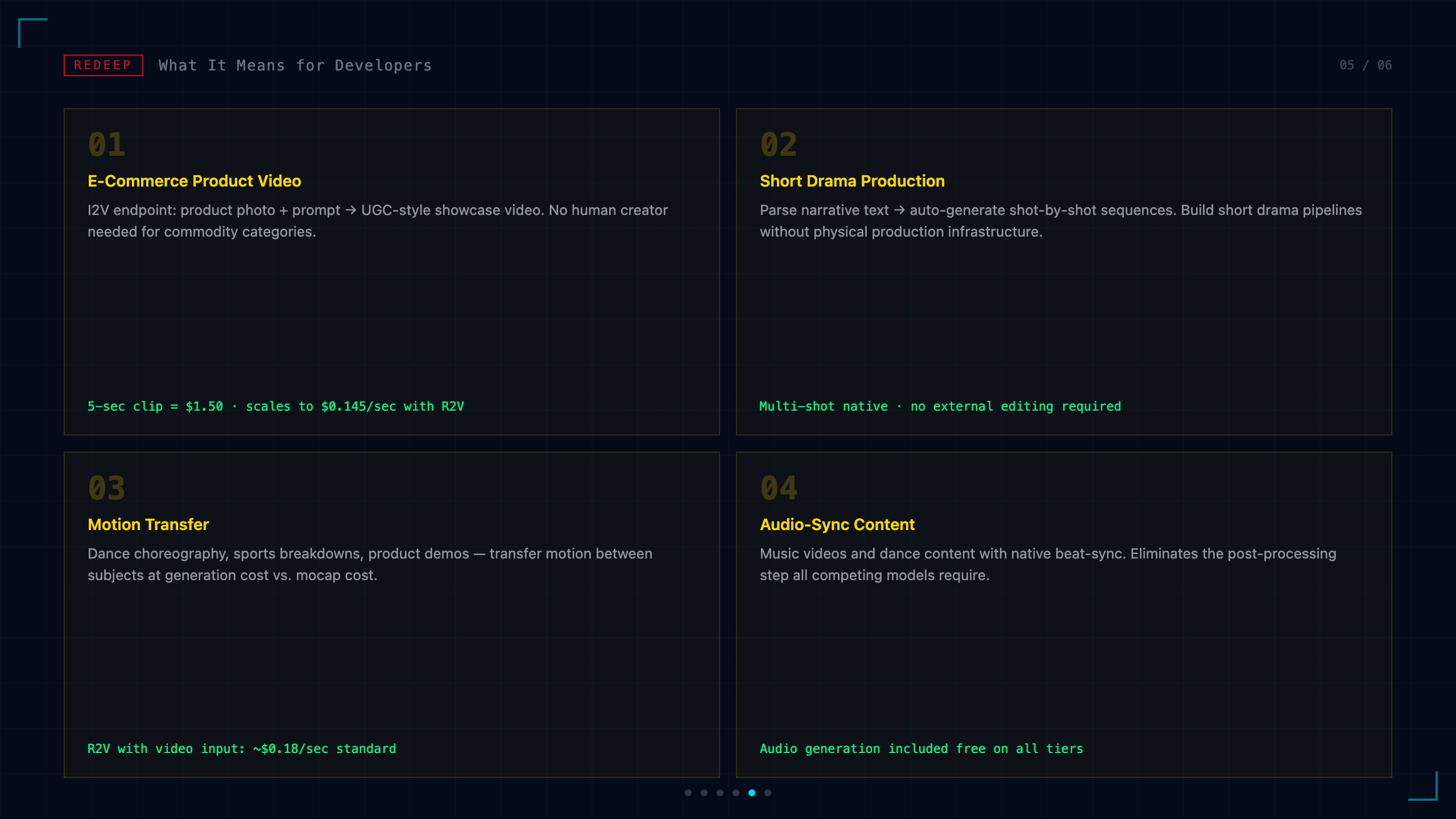
E-commerce and product video: The I2V endpoint (image-to-video) takes a product photo plus a text prompt and generates a UGC-style showcase video. At $0.30/sec, a 5-second product clip costs $1.50 — well below the cost of a human creator for commodity categories.
Short drama production: The auto-storyboarding capability (parse narrative text → generate shot-by-shot sequences) compresses a workflow that previously required a human director. Independent developers can now build short drama generation pipelines without physical production infrastructure.
Motion transfer: The reference video input for motion transfer means dance choreography, sports replay breakdowns, and product demonstrations can be transferred between subjects at generation cost rather than mocap cost.
Audio-sync content: Native beat-sync for music videos and dance content eliminates the post-processing step that most competing models require. This directly benefits the short-form social media content vertical.
One integration caveat: Because Seedance 2.0 is available through multiple API providers with different pricing, latency, and reliability profiles, you should abstract the provider behind your own adapter layer from day one. Pricing has shifted between fal.ai's launch and current rates and will continue to move.
The Copyright Problem
Seedance 2.0 went viral for the wrong reasons before it went viral for the right ones. Shortly after launch, users demonstrated the model could reproduce scenes from copyrighted films, anime franchises (One Piece, Dragon Ball), and gaming IP (Arcane) with high fidelity. Actor Scott Adkins publicly identified his likeness in generated content.
ByteDance responded by strengthening content filters and adding C2PA provenance watermarks to every output. Whether those safeguards are sufficient for a production system is a live legal question — but for developer use cases built on licensed or original content, the model itself doesn't create any novel risk beyond what already exists with other video generation tools.
If you're building a consumer-facing product with user-submitted inputs, budget for content moderation infrastructure. The model's fidelity is high enough that it becomes a vector for deepfake abuse at scale.
Bottom Line
Seedance 2.0 is the first video generation model where the economics work for production-scale content pipelines. The quad-modal input system, native audio, and fal.ai API access at $0.30/sec create a foundation that competes on capabilities with Runway and Kling while being meaningfully cheaper.
The copyright situation is messy and ByteDance is actively working through it, but that's a content policy problem, not a capability problem. For developers building licensed-content applications — product video, original short drama, brand advertising — the barriers are pricing and API stability, and both look favorable right now.
The most interesting builders are going to be the ones who treat the multi-shot, multi-modal input system as a programmable director rather than a prompt-response tool.
Resources
- Seedance 2.0 on fal.ai — API access, playground, pricing
- fal.ai GitHub SDK — Python/JS/cURL examples
- BytePlus — official international enterprise API
- Jimeng (即梦) — consumer product (Chinese)
- Seedance 2.0 vs Kling 3.0 comparison — fal.ai analysis
Seedance 2.0 API is available globally via fal.ai starting April 9, 2026. Standard T2V pricing is $0.3034/sec with audio included.