ByteDance's Seedance 1.5 Pro was announced at the Volcano Engine Winter FORCE 2025 conference — and quietly released two days before the announcement. The defining technical claim: native audio-video joint generation. Audio and video latents are generated in the same diffusion pass, not synthesized separately and then aligned.
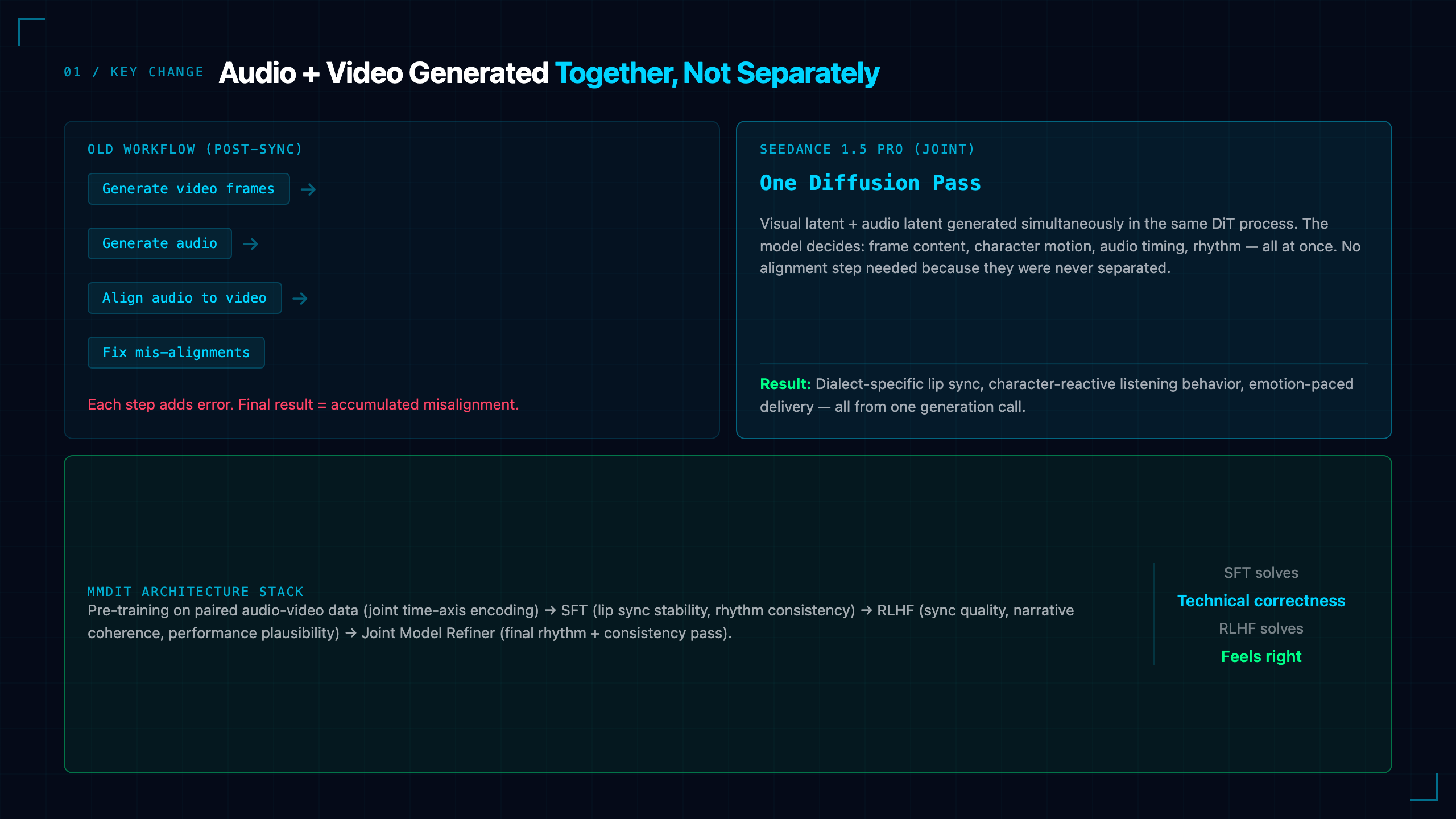
This matters because prior-generation video models treated audio as a post-processing step. You generate the video, then add audio, then attempt lip sync correction. Seedance 1.5 Pro's architecture removes that pipeline — audio, video, timing, and character expression are decided together.
What's New: MMDiT-Based Joint Architecture
The underlying architecture is MMDiT (Multimodal Diffusion Transformer) adapted for joint audio-video generation. The key design decisions:
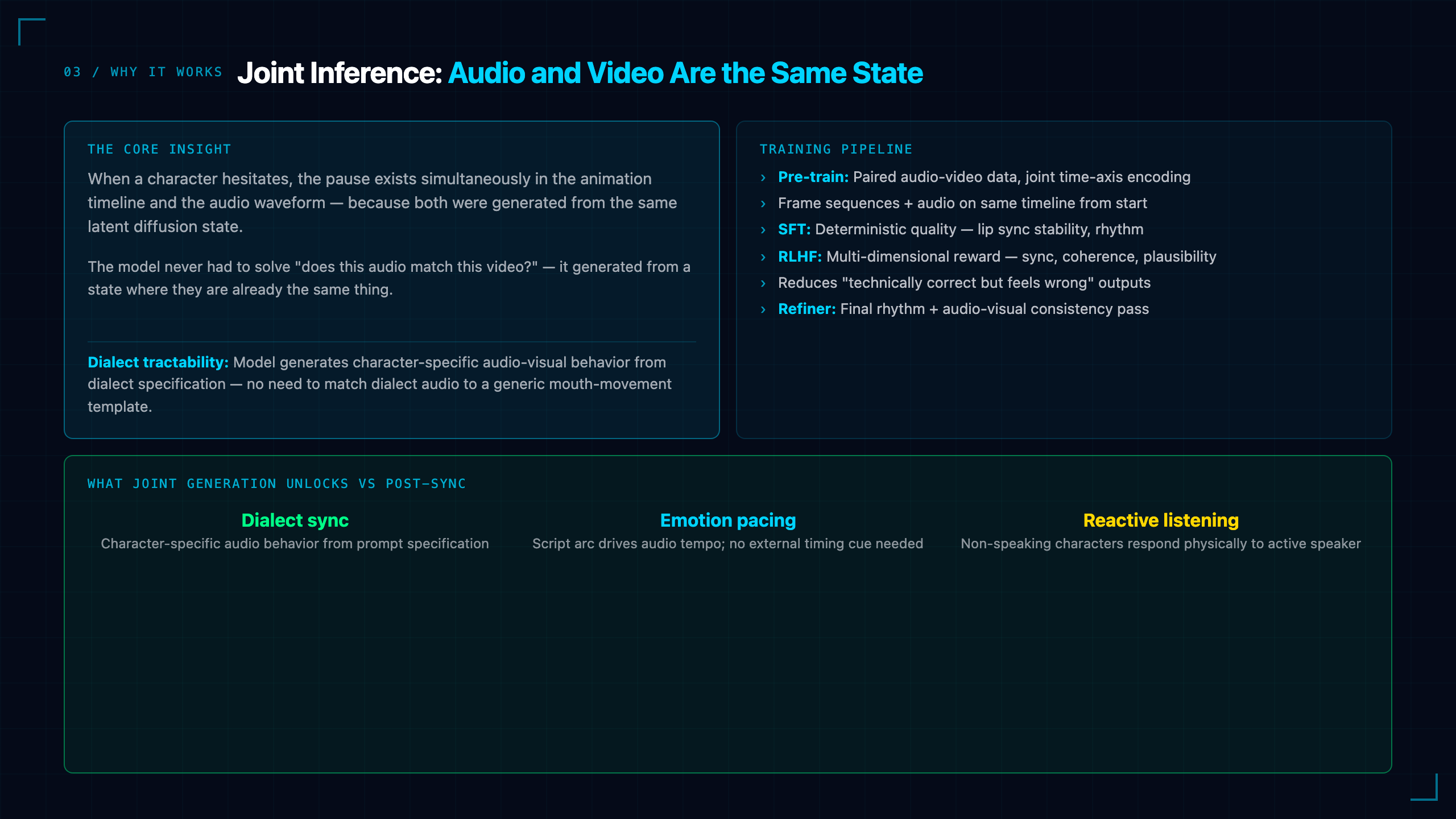
Pre-training on paired audio-video data — visual frame sequences and audio sequences are encoded on the same time axis from the start. This establishes statistical co-dependence: frame motion, action timing, and audio events are modeled as correlated, not as separate streams.
Joint inference — the Video-Audio Joint Model (DiT) generates visual latent and audio latent simultaneously in the same diffusion process. The model decides simultaneously: what the frame looks like, how the character moves, when audio occurs, at what rhythm. There is no post-sync step.
SFT + RLHF refinement — SFT addresses deterministic quality (stable lip sync, consistent rhythm). RLHF operates on subjective quality: audio-video synchronization, narrative coherence, performance plausibility. The distinction matters — SFT makes it technically correct; RLHF makes it feel right.
Joint Model Refiner — a final pass that tightens rhythm, detail, and audio-visual consistency across the full output.
Test Cases
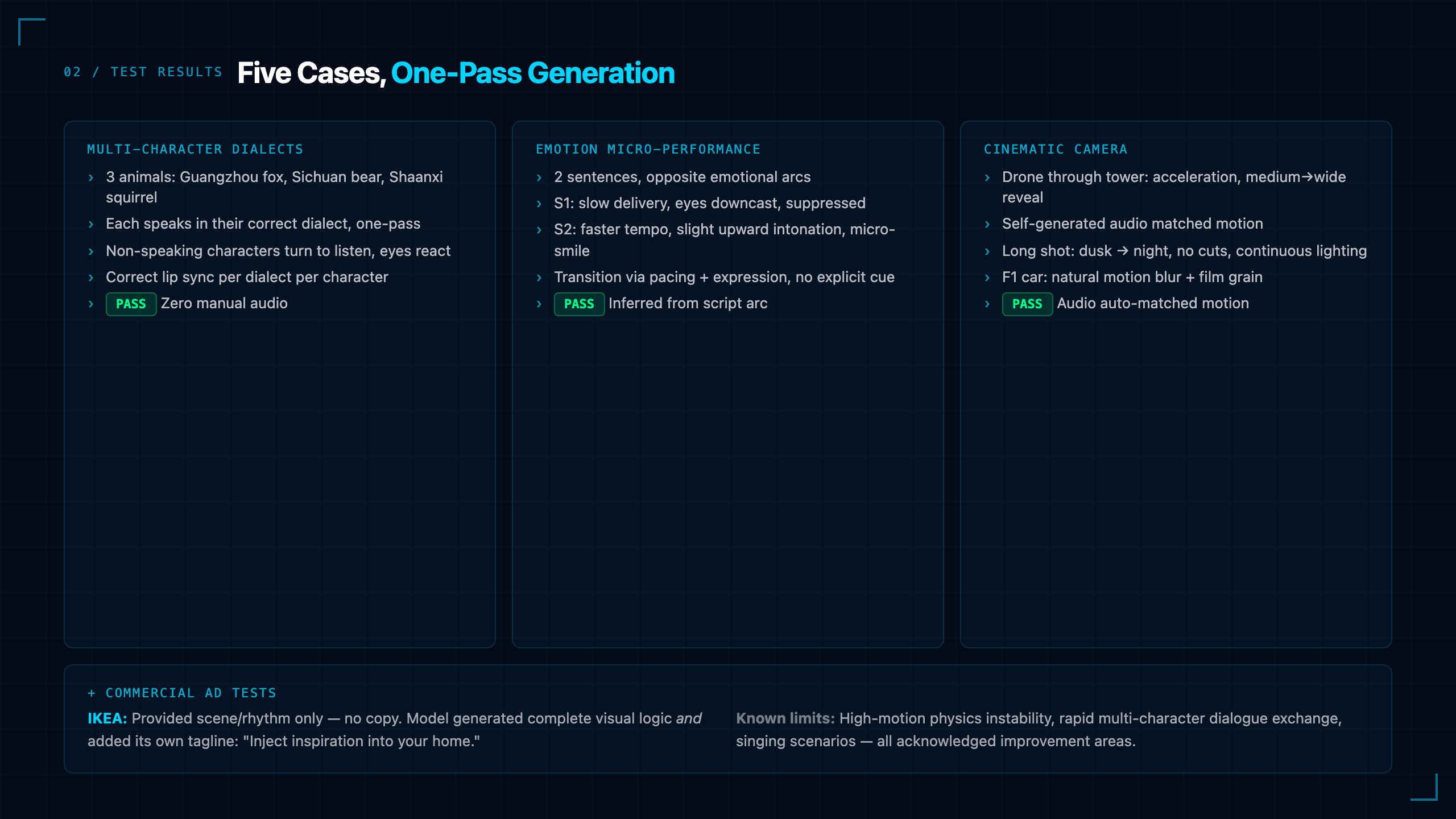
Multi-character multi-language dialogue — Three animals (fox, bear, squirrel) hold a meeting, each speaking in their regional dialect: Guangzhou fox, Sichuan bear, Shaanxi squirrel. Tested behaviors: lip sync per character, correct dialect audio output, other characters turning to listen when not speaking, natural eye-blink and posture response. All verified without manual audio override. Generated in a single pass.
Character micro-performance — Close-up single character, two-sentence dialogue with emotional arc. First sentence: delivered slowly, eyes downcast, emotional suppression. Second sentence: faster tempo, slight upward intonation, micro-smile. The model resolved the emotional transition in pacing, not just expression. No external audio cue was provided — the model inferred the emotional arc from the script and generated audio timing accordingly.
Cinematic camera motion — Drone shot through tower, with acceleration. Medium to wide pull revealing distant landscape. Self-generated audio effects matched the motion. Long shot of city transitioning from dusk to night — no cuts, lighting change handled continuously.
Commercial ad generation — IKEA scene: provided scene/rhythm/visual relationship description only; no copy instructions. Model generated complete visual logic and added its own tagline ("Inject inspiration into your home"). LEGO sequence: text-to-video first attempt produced clean output but garbled end-frame text; first-last-frame approach resolved it.
Limitations identified: Physics stability on high-motion sequences, rapid multi-character dialogue exchange at high tempo, singing scenarios — all noted as clear improvement areas.
Why Joint Architecture Changes the Output
The prior workflow for AI video with dialogue:
- Generate video frames
- Separately generate or record audio
- Align audio to video (lip sync)
- Fix mis-alignments in post
Each step introduces error that the next step partially compensates. The final result reflects accumulated misalignment, not original creative intent.
Seedance 1.5 Pro collapses steps 1–3 into one. The model has no concept of "audio layer" and "video layer" — there is one generation pass that outputs both. When a character hesitates, the pause exists simultaneously in the animation timeline and the audio waveform, because both were generated from the same latent diffusion state.
The practical result: the model doesn't need to solve "does this audio match this video?" — it generates from a state where they are already the same thing. This is why dialect support became tractable: the model doesn't have to match Chinese dialect audio to a generic mouth-movement template. It generates character-specific audio-visual behavior from the dialect specification.
What It Means for Developers
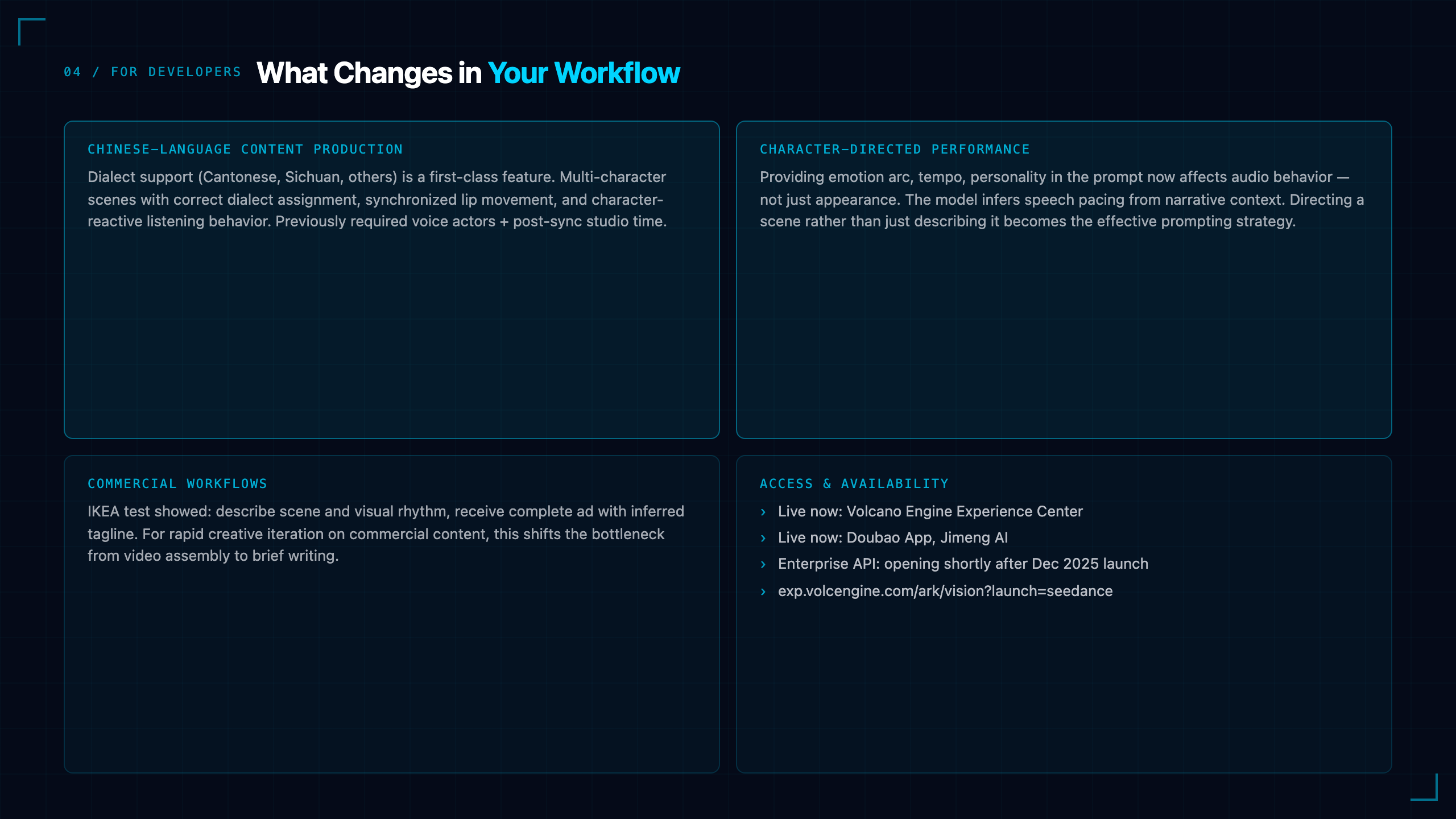
Content creators and directors: The significant capability gain is in character performance, not just image quality. Providing emotion arc, tempo, character personality in the prompt now directly affects audio behavior — not just what the character looks like, but how they speak and when they pause.
Chinese-language content production: Explicit dialect support (Cantonese, Sichuan, others) is a targeted feature. Multi-character dialogue scenes with correct dialect assignment per character, synchronized lip movement, and character-reactive listening behavior — this directly unlocks content that required voice actors and post-sync before.
Commercial video production: The IKEA and LEGO tests showed the model can infer advertising logic from scene descriptions and add appropriate copy. Prompting the scene and rhythm, not the specific tagline, and getting a complete ad is a meaningful workflow change for rapid creative iteration.
API integration: Volcano Engine API access is opening within a week of the announcement. Model available immediately on Volcano Engine Experience Center, Doubao App, and Jimeng AI.
Current access: exp.volcengine.com/ark/vision?launch=seedance
Bottom Line
Seedance 1.5 Pro's core differentiation from earlier Seedance versions and competitors is architectural: native joint generation means audio and video coherence is baked into the diffusion process, not solved in post. The test results — dialect-correct multi-character dialogue generated in one pass, micro-emotion performance synchronized with pacing, cinematic camera work with self-generated audio — are consistent with the MMDiT joint architecture claim.
The remaining limitations (high-motion physics, rapid multi-character exchange, singing) are tractable: they're hard cases within a solvable framework, not architectural blockers. The question for developers is whether the joint-generation advantage holds at API scale with consistent quality — that becomes verifiable when enterprise API access opens.
Resources
- Volcano Engine Experience Center — live access to Seedance 1.5 Pro
- Doubao App — consumer access
- Jimeng AI — creative tools access
- Volcano Engine Enterprise — API access (opening post-announcement)
Seedance 1.5 Pro is available via Volcano Engine. Enterprise API access is expected to open shortly after the December 2025 launch event.