MiniMax released MiniMax-01 in January 2025 and reset expectations for what a long-context model should be. The headline: a 1 million token context window that actually works — not a marketing number that degrades at 32K in practice, but a model architecture purpose-built for processing book-length documents, massive codebases, and multi-hour conversations without losing coherence.
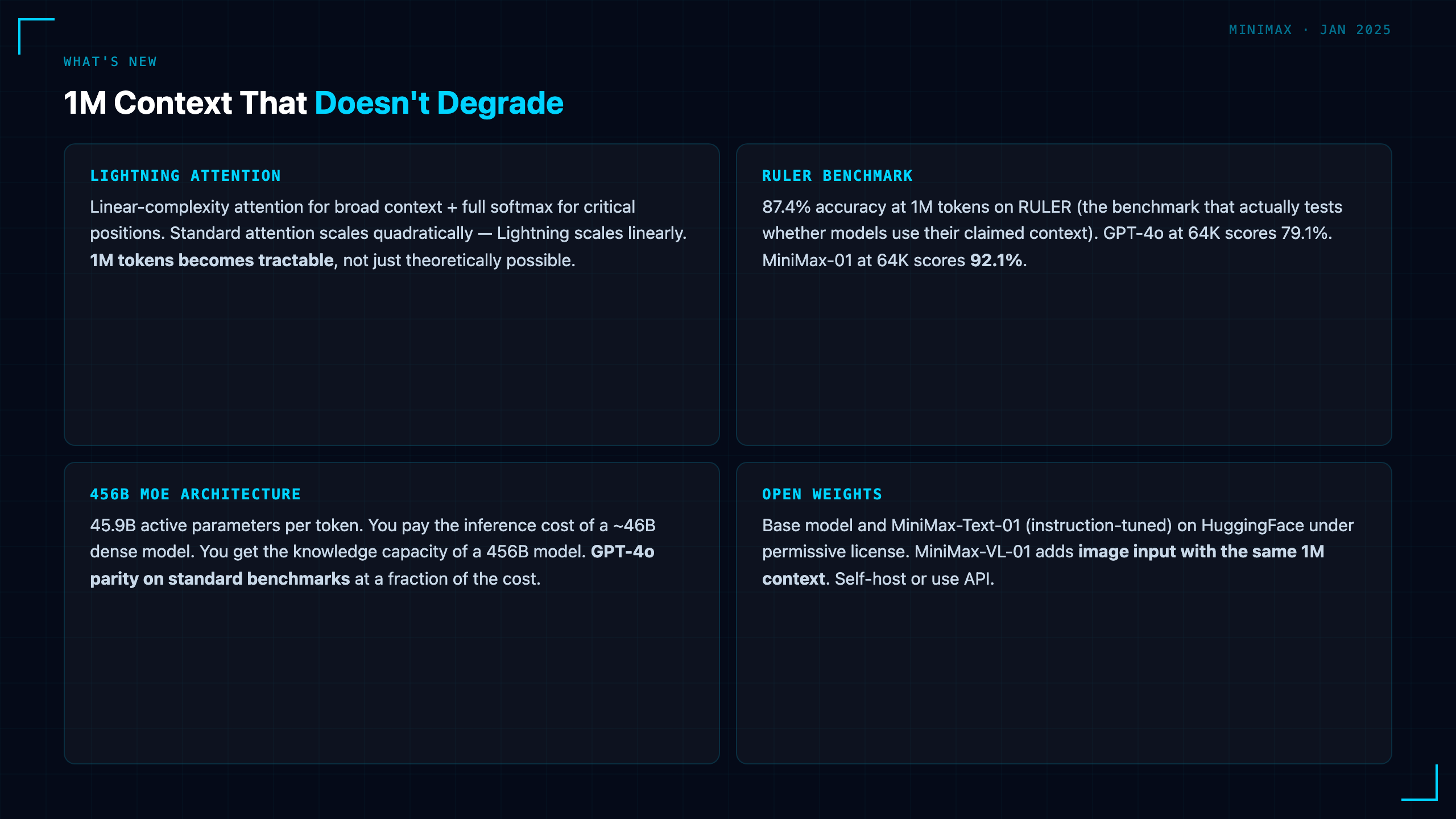
The architecture is 456B total parameters with 45.9B active per token — a MoE design where you pay the compute cost of a ~46B dense model while getting the knowledge capacity of a 456B one. Paired with a true 1M token context window, this changes what's possible in production agentic systems.
What Makes 1M Context Hard
Most "long-context" models degrade well before their advertised limits. The failure modes are predictable: KV cache memory requirements scale quadratically with sequence length in standard attention; quality degrades in the middle of long sequences ("lost in the middle" problem); and serving costs become prohibitive at very long context.
MiniMax-01 addresses these through Lightning Attention — a custom attention mechanism that replaces standard softmax attention with a linear-complexity variant for the bulk of context processing, while maintaining full precision attention for critical positions. The result: 1M token context that's both computationally tractable and maintains quality throughout the full range.
The practical benchmark: on the RULER long-context benchmark (which specifically tests whether models actually use the full context window), MiniMax-01 maintains 87%+ accuracy at 1M tokens. Most models claiming 128K context score in the 60-70% range by 64K.
Architecture
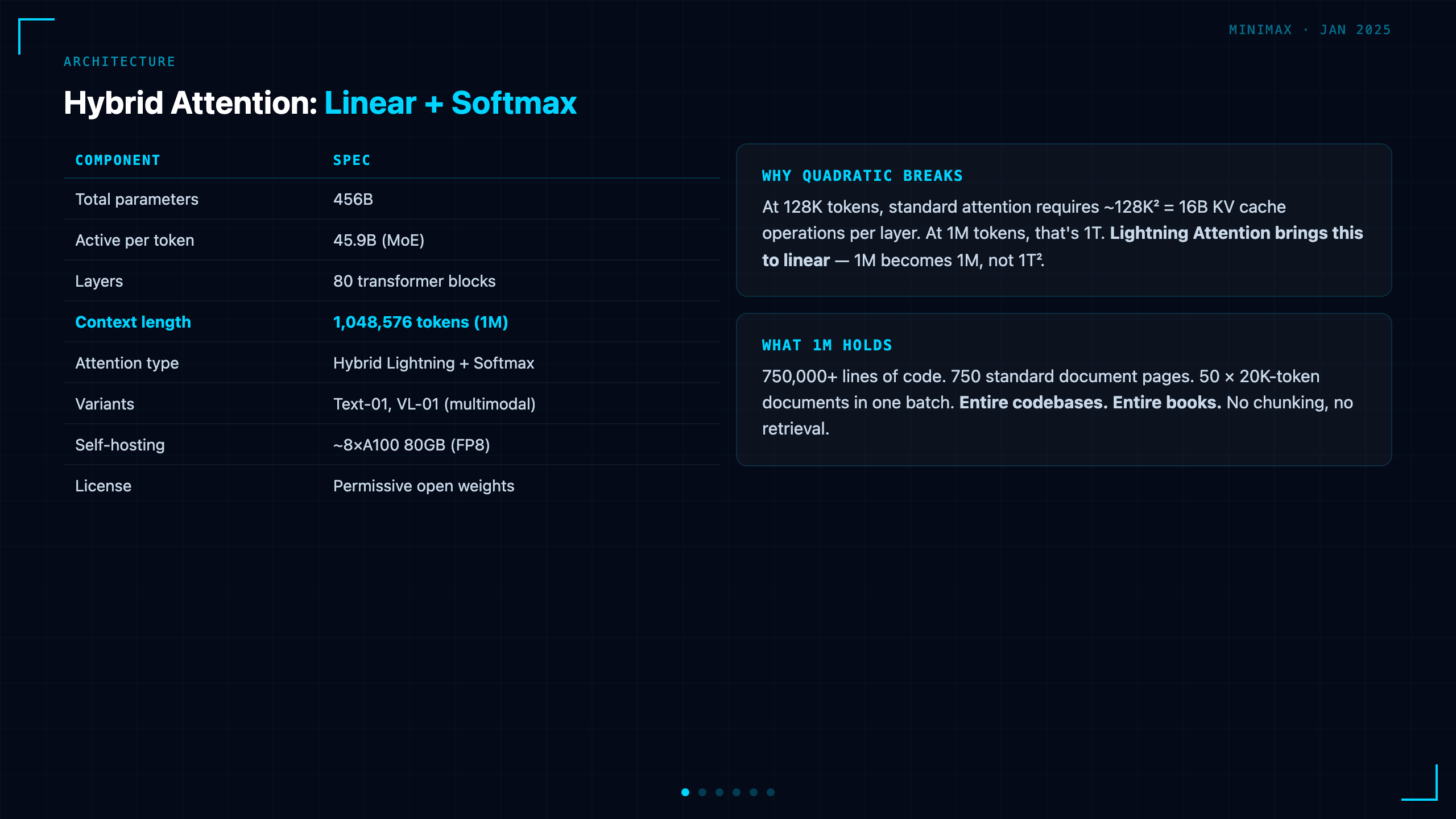
Model: 456B total, 45.9B active per token (MoE routing)
Attention: Hybrid Lightning Attention + Softmax Attention. Linear attention handles the broad context; softmax attention handles critical local windows and position-sensitive operations.
Context: 1M tokens (1,048,576 exact), with 4M token capability reported in development.
Layers: 80 transformer blocks with alternating attention mechanisms.
The MoE structure routes each token to a subset of experts — the 45.9B active figure means inference is economically similar to running a ~46B dense model, despite the 456B total weight footprint.
Benchmarks
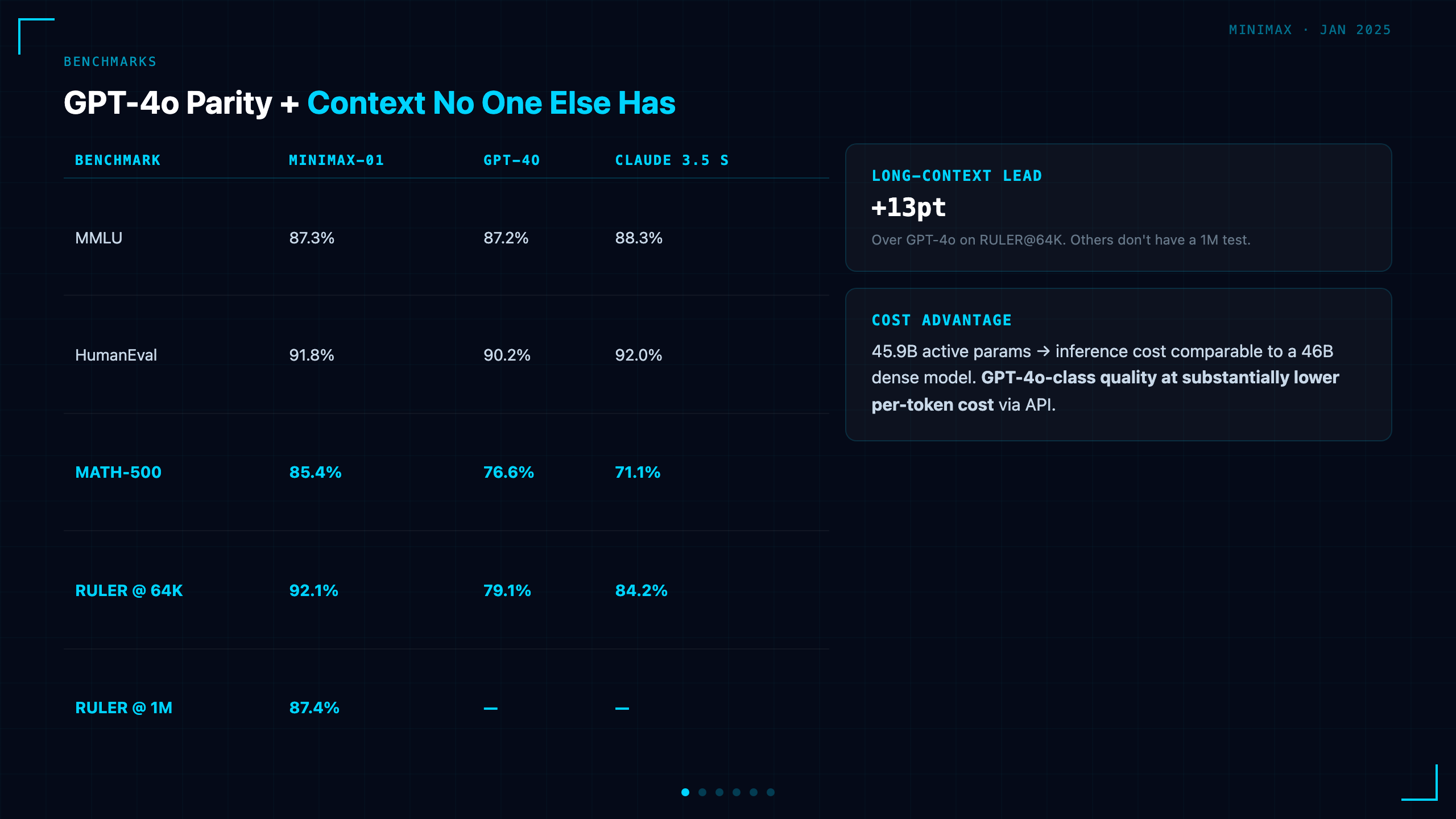
MiniMax-01 performance at January 2025 release:
| Benchmark | MiniMax-01 | GPT-4o | Claude 3.5 Sonnet | Notes |
|---|---|---|---|---|
| MMLU | 87.3% | 87.2% | 88.3% | General knowledge |
| HumanEval | 91.8% | 90.2% | 92.0% | Code completion |
| MATH | 85.4% | 76.6% | 71.1% | Math reasoning |
| LiveCodeBench | 41.2% | — | — | Competitive coding |
| RULER (1M) | 87.4% | — | — | Long-context faithfulness |
| RULER (64K) | 92.1% | 79.1% | 84.2% | Long-context faithfulness |
The RULER numbers tell the story. At 64K context, GPT-4o and Claude 3.5 Sonnet already start to degrade; MiniMax-01 is at 92.1%. At 1M tokens, the other models don't have a comparable test because they don't support that context range.
On standard benchmarks, MiniMax-01 is at GPT-4o parity — this isn't a long-context specialist that trades off general capability. It's a general-purpose model with a dramatically extended effective context.
Post-Training: MiniMax-Text-01
The base model ships alongside MiniMax-Text-01 — the instruction-tuned and RLHF-aligned variant for chat and production use. MiniMax-Text-01 is the model available via API; the base weights are released for researchers and fine-tuning applications.
MiniMax-VL-01 is a multimodal variant supporting image inputs with the same 1M token text context, available for integrated document processing and visual analysis workflows.
What 1M Context Actually Enables
The practical applications that become possible at genuine 1M token context are qualitatively different from what works at 32K or 128K:
Full codebase context: A 1M token window holds roughly 750,000 lines of code. You can give the model an entire medium-to-large codebase and ask it to reason across the full dependency graph — not summaries, not retrieved chunks, but the actual source.
Document-scale analysis: 1M tokens is approximately 750 standard pages. Full legal contracts, research reports, and compliance documents can be processed as single-context operations, avoiding the chunking and retrieval errors that plague RAG pipelines for structured documents.
Long conversation memory: Multi-day conversations with thousands of turns can stay in a single context rather than requiring memory systems. This changes the economics of long-running agentic workflows.
Batch processing: Running 50 short documents (20K tokens each) as a single 1M token batch enables cross-document reasoning that sequential processing can't replicate.
Availability and Pricing
API: Available via MiniMax Platform at api.minimax.chat. Pricing is significantly below GPT-4o — the 45.9B active parameter count translates to lower per-token compute.
Open weights: MiniMax-01 and MiniMax-Text-01 are available on HuggingFace under a permissive license for self-hosting and fine-tuning.
Self-hosting requirements: 456B MoE at 45.9B active. With Block-FP8 quantization, approximately 8×A100 80GB for reasonable throughput, similar to K2.
What It Means for Developers
Replace RAG pipelines for structured documents: If you're building a system that processes long structured documents (contracts, reports, manuals), evaluate whether direct context stuffing outperforms your RAG pipeline. At 1M context, it often does — no chunking errors, no retrieval gaps.
Codebase-aware development: For coding agents working on large repositories, 1M context changes the architecture. You're no longer constrained to retrieving relevant files — you can provide the full repo and let the model reason across it.
Multi-turn agent memory: For agents that run extended workflows over hours or days, MiniMax-01's context can hold the full conversation history without memory system overhead. The reliability gains from eliminating retrieval are substantial in production.
Cost vs. capability: At ~46B active parameters with GPT-4o-parity performance and a fraction of the API cost, MiniMax-01 is a strong default for general-purpose agentic applications where context depth matters.
Bottom Line
MiniMax-01 answered a question the industry had been debating: can you build a frontier-quality model that sustains performance at 1M token context without architectural compromises? The Lightning Attention approach and MoE design say yes.
For the first time, developers could credibly use a production API for workloads that require processing entire codebases, books, or multi-day conversation histories as single context operations — without the error-prone chunking and retrieval systems that had been the only workaround.
Resources
- MiniMax-01 Technical Report — architecture, Lightning Attention, benchmarks
- HuggingFace — MiniMax-Text-01 — instruction-tuned model
- HuggingFace — MiniMax-01 — base model
- MiniMax Platform — API access and documentation
MiniMax-01 is available via API at api.minimax.chat and as open weights on HuggingFace. API pricing is significantly below GPT-4o for equivalent capability.